Introduction
In the past few years, high-entropy alloys (HEAs) have attracted considerable research attention because of their excellent mechanical properties and simple solid solution structure. Many materials scientists have conducted a lot of research in the fields such as forging [Reference Sun, Tian, Lin, Dong, Wang, Zhang and Zhang1, Reference Sun, Tian, Lin, Yang, Dong, Wang and Zhang2], heat treatment [Reference Ma, Wang, Li, Santodonato, Feygenson, Dong and Liaw3, Reference Wu, Ni, Liu and Song4, Reference Zhang, Liu and Li5], alloying [Reference Liu, Zhang, Zhang, Wang, Chen, Zhang and Li6, Reference Liu, Chen, Li and Chen7, Reference Liu, Liu, Liu, Wu, Lu, Yao, Jiang, Fan and Zhang8], casting [Reference Lu, Dong, Guo, Jiang, Kang, Wang, Wen, Wang, Jie, Cao, Ruan and Li9, Reference Lu, Gao, Jiang, Chen, Wang, Jie, Kang, Zhang, Guo, Ruan, Zhao, Cao and Li10], and phase stability [Reference Yao, Liu, Gao, Jiang, Li, Liu, Zhang and Fan11]. Since 2004, when they were first proposed independently by Yeh and Cantor [Reference Yeh, Chen, Lin, Gan, Chin, Shun, Tsau and Chang12, Reference Cantor, Chang, Knight and Vincent13], HEAs have emerged as an important breakthrough in the traditional alloy design and have opened a new path for exploring new materials with excellent properties.
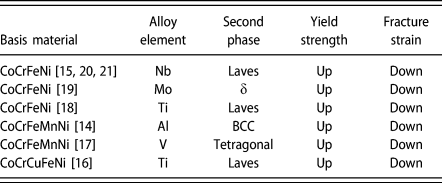
The traditional alloy design involves selecting the major component based on a specific property requirement and then conferring secondary properties by using alloying addition without sacrificing the primary property [Reference Cantor, Chang, Knight and Vincent13]. Several similar methods had been used in the field of HEAs. He et al. investigated the alloying effect of Al on the phase structure, strength, and ductility of the CoCrFeMnNi HEA system and found that the Al element had potential to directly change the phase structure and mechanical properties of CoCrFeMnNi HEA [Reference He, Liu, Wang, Wu, Liu, Nieh and Lu14]. The crystal structure, microstructure, microhardness, and compression properties of CoCrFeMnNiVx (x = 0, 0.25, 0.5, 0.75, 1) HEAs were studied by Stepanov et al., who reported that the sigma phase volume fraction increased with increase in the V content; in CoCrFeMnNiV, they found that the sigma phase became the matrix phase [Reference Stepanov, Shaysultanov, Salishchev, Tikhonovsky, Oleynik, Tortika and Senkov15]. In other studies, different elements (V/Nb/B/Mo/Si/Ti/Zr) were also added to AlCoCrFeNi HEA, and the alloying effect of these elements on the microstructure and mechanical properties was investigated [Reference He, Liu, Wang, Wu, Liu, Nieh and Lu14, Reference Stepanov, Shaysultanov, Salishchev, Tikhonovsky, Oleynik, Tortika and Senkov15, Reference Liu, He, Huang, Wang, Lu and Liu16, Reference Wang, Zhang, Qiao and Chen17, Reference Huo, Zhou, Fang, Xie and Jiang18, Reference Huo, Zhou, Fang, Zhou, Xie and Jiang19, Reference Shun, Chang and Shiu20, Reference Liu, Lu, He, Luan, Wang, Liu, Liu, Chen and Liu21]. Table I summarizes some available literatures about the alloying effect on phase composition and mechanical properties of HEAs; the data indicate that some elements promote the formation of hard phase (body-centered cubic/Laves/δ phase) and improve the strength of alloys. In 2017 and 2018 [Reference Huo, Zhou, Fang, Xie and Jiang18, Reference Huo, Zhou, Fang, Zhou, Xie and Jiang19], Fang and his team designed two eutectic HEAs (CoCrFeNiTax and CoCrFeNiZrx HEAs) strengthened by Laves phase; these two HEAs have excellent mechanical properties, which again proved that some elements could promote the formation of Laves phase and improve the strength of alloys. Low enthalpy of mixing (ΔH mix) is helpful to form intermetallic in HEAs. Nb and Ti elements were added to FCC CoCrFeMnNi HEAs, which can decrease the ΔH mix of (CoCrFeMnNi)100−xNbx and (CoCrFeMnNi)100−xTix HEAs. Thus, it is possible that the addition of Nb and Ti to (CoCrFeMnNi)100−xNbx and (CoCrFeMnNi)100−xTix HEAs induces hard phase formation in CoCrFeMnNi matrix alloy. However, based on the existing reports in the literatures [Reference He, Liu, Wang, Wu, Liu, Nieh and Lu14, Reference Stepanov, Shaysultanov, Salishchev, Tikhonovsky, Oleynik, Tortika and Senkov15, Reference Liu, He, Huang, Wang, Lu and Liu16, Reference Wang, Zhang, Qiao and Chen17, Reference Huo, Zhou, Fang, Xie and Jiang18, Reference Huo, Zhou, Fang, Zhou, Xie and Jiang19, Reference Shun, Chang and Shiu20, Reference Liu, Lu, He, Luan, Wang, Liu, Liu, Chen and Liu21, Reference Jiang, Jiang, Qiao, Lu, Wang, Cao and Li22, Reference He, Wang, Cheng, Wang, Li, Dang, Wang and Liu23, Reference Dong, Zhou, Lu, Gao, Wang and Li24, Reference Ma and Zhang25, Reference Chen, Lu, Dong, Wang and Li26, Reference Zhu, Zhang, Fu, Wang, Li and Hu27, Reference Zhu, Fu, Zhang, Wang, Li and Hu28], the effect of Nb and Ti addition on the structure evolution and mechanical properties of CoCrFeMnNi HEA has not been investigated thus far [Reference He, Liu, Wang, Wu, Liu, Nieh and Lu14, Reference Stepanov, Shaysultanov, Salishchev, Tikhonovsky, Oleynik, Tortika and Senkov15, Reference Liu, He, Huang, Wang, Lu and Liu16, Reference Wang, Zhang, Qiao and Chen17, Reference Huo, Zhou, Fang, Xie and Jiang18, Reference Huo, Zhou, Fang, Zhou, Xie and Jiang19, Reference Shun, Chang and Shiu20, Reference Liu, Lu, He, Luan, Wang, Liu, Liu, Chen and Liu21, Reference Jiang, Jiang, Qiao, Lu, Wang, Cao and Li22, Reference He, Wang, Cheng, Wang, Li, Dang, Wang and Liu23, Reference Dong, Zhou, Lu, Gao, Wang and Li24, Reference Ma and Zhang25, Reference Chen, Lu, Dong, Wang and Li26, Reference Zhu, Zhang, Fu, Wang, Li and Hu27, Reference Zhu, Fu, Zhang, Wang, Li and Hu28, Reference Yu, Wang, Li, Kou and Liu29, Reference Chen, Niu, Liu, Lu, Wang, Peng and Liu30]. The gap should be filled up.
Effect of some elements on the phase formation and mechanical properties of HEAs.

In the present study, an HEA containing CoCrFeMnNi (all elements in equal atomic proportions) with a single face-centered cubic (FCC) phase solid solution was selected as the baseline alloy system. A systematic study on the alloying effect of Nb and Ti on the microstructure, phase evolution, and mechanical properties of the (CoCrFeMnNi)100−xNbx and (CoCrFeMnNi)100−xTix HEAs was carried out. The correlations between the microstructure and the mechanical properties of these HEAs were determined. In addition, considering the combined effects of entropy of mixing (ΔS mix), enthalpy of mixing (ΔH mix), atomic radius difference (Δ), valence electron concentration (VEC), and the scald ratio of ΔS mix to ΔH mix (Ω), we tried to reveal the relevance between the phase translation and element properties.
Results and discussion
Phase composition
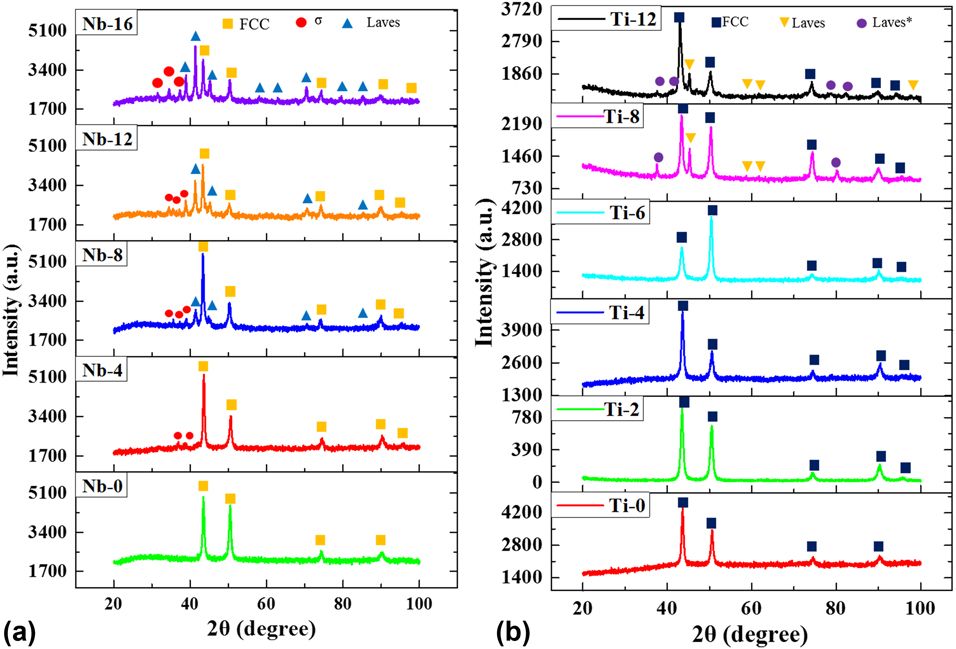
As shown in Fig. 1(a), the XRD patterns of (CoCrFeMnNi)100−xNbx (x = 0, 4, 8, 12, 16, hereafter in atomic ratio) HEAs indicate a phase selection from the FCC phase to the Laves phase and σ phase structure with increasing Nb content. The XRD patterns of (CoCrFeMnNi)100−xTix (x = 0, 2, 4, 6, 8, 12, hereafter in atomic ratio) HEAs also show a phase selection from the FCC phase to the Laves phase [see Fig. 1(b)]. This change enables the alloy system to attain a multiphase microstructure, in which both phases obtain the maximum benefit of the solid solution strengthening effect compared with only one phase [Reference Li, Pradeep and Deng31]. A single FCC structure was observed when the Nb content was 0. When the Nb content was 4%, only a weak reflection peak corresponding to σ phase and Laves phase structure was found. When the Nb content was 4–16%, the alloys show a multiphase (FCC, Laves phase, and σ phase) structure, which was obviously induced by the addition of Nb element. As shown in Fig. 1(b), the phase of the alloys was identified as a single FCC solid solution when the Ti content was lower (x = 0, 2, 4, 6), at which point the alloy mainly was strengthened by the solid solution strengthening mechanism. The weak reflection peak corresponding to the Laves phase and Laves* phase appeared when the Ti content reached 8 at.%. Thus, this alloy obtained a multiphase (FCC, Laves phase, and Laves* phase) structure when the Ti content was 8–12 at.%, at which point the alloy mainly was strengthened by the solid solution strengthening mechanism and the second-phase strengthening mechanism. The Ti element had a considerable influence on the phase translation from the FCC to the Laves phase structure in the alloys.
XRD patterns of HEAs. (a) (CoCrFeMnNi)100−xNbx and (b) (CoCrFeMnNi)100−xTix.

Microstructure and mechanical property
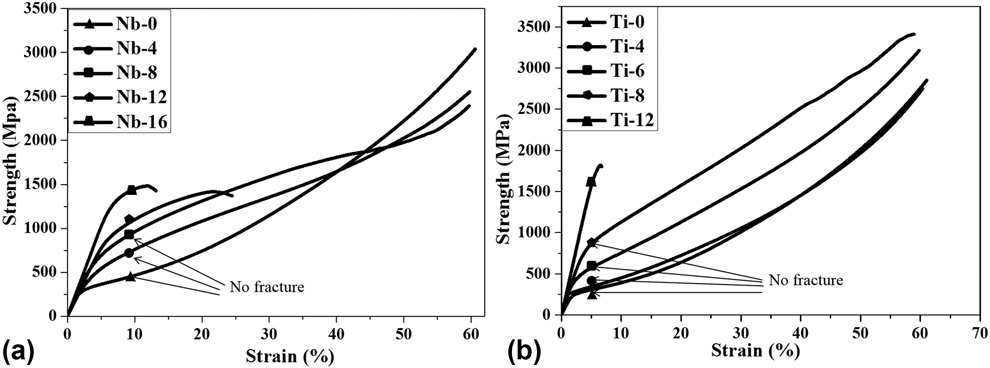
Figure 2 shows the compressive mechanical behavior of (CoCrFeMnNi)100−xNbx and (CoCrFeMnNi)100−xTix HEAs. The compressive yield strength of the (CoCrFeMnNi)100−xNbx HEAs increased from 202 to 1010 MPa; however, the fracture strain decreased from 60% (no fracture) to 12% with the addition of Nb from 0 to 16% [see Fig. 2(a)]. Figure 2(b) shows the stress–strain curve of the compression test for the (CoCrFeMnNi)100−xTix alloys. The yield strength of the alloys increased from 202 to 1322 MPa, whereas the fracture strain decreased from 60% (no fracture) to 7.5%, with the Ti content increased from 0 to 12 at.%. The results indicate that the addition of Nb and Ti has a positive effect on improving the strength of FCC HEAs.
Engineering stress–strain curves from compressive properties of HEAs. (a) (CoCrFeMnNi)100−xNbx (triangle, circular, quadrilateral, pentagon, and echelon represent the Nb-0, Nb-4, Nb-8, Nb-12, and Nb-16 HEAs, respectively). (b) (CoCrFeMnNi)100−xTix (triangle, circular, quadrilateral, pentagon, and echelon represent the Ti-0, Ti-4, Ti-6, Ti-8, and Ti-12 HEAs respectively).

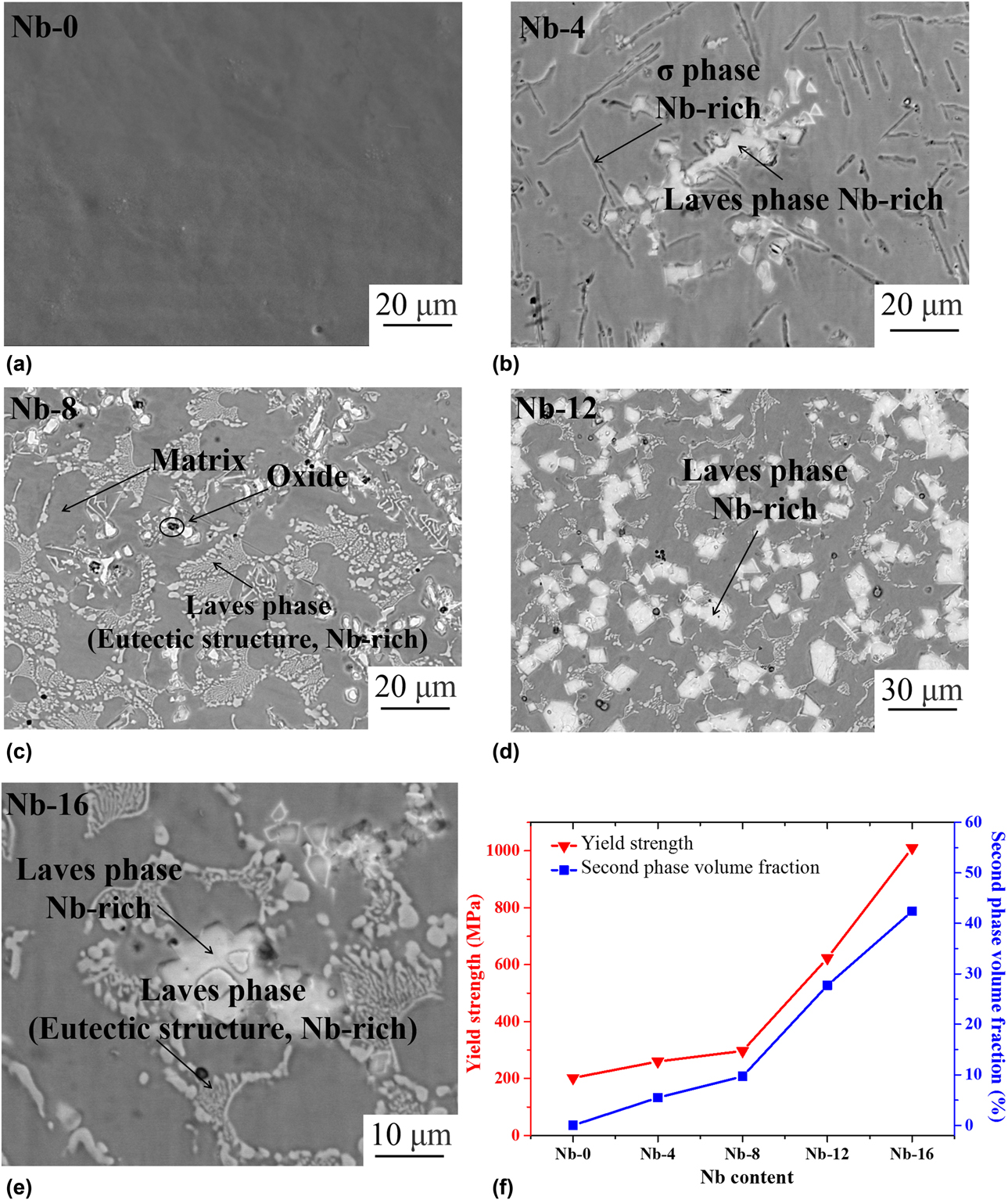
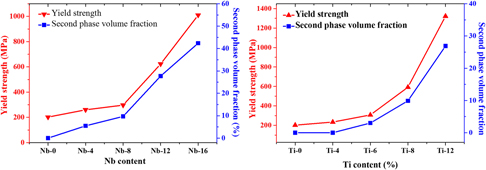
Figure 3 shows the microstructures of the as-cast (CoCrFeMnNi)100−xNbx HEAs with different Nb contents, and the relationship between the yield strength and the second-phase (Laves and σ phase) volume fraction with different Nb contents in (CoCrFeMnNi)100−xNbx HEAs. Nb-0 alloys were identified by XRD (see Fig. 1) with a single FCC phase microstructure, in agreement with the previous study [Reference He, Liu, Wang, Wu, Liu, Nieh and Lu14]. A small number of lath-shaped σ phase particles were generated when the Nb content was 4% [see Fig. 3(b)], at which point the alloy mainly consisted of the FCC phase. When the Nb content reached 8%, the Laves phase (eutectic structure, Nb-rich) appears and the volume increased gradually [see Figs 3(c) and 3(d)]. When the Nb content reached 16%, the alloy mainly consisted of the Laves phase [see Fig. 3(e)]. The number of Laves phases increases with increasing Nb content; this encourages growth in the phase boundary density, which creates additional obstacles for dislocation slipping, thus contributing to improving the strength of the alloy. In Fig. 3(c), the black areas indicate oxides; however, whether the oxygen was introduced through the raw material or during one of the subsequent processing steps is not known. However, because of their tiny volume fracture, they did not significantly influence mechanical properties, which is not surprising since they also have been previously found in these alloys [Reference Otto, Dlouhý, Pradeep, Kuběnová, Raabe, Eggeler and George32, Reference Gali and George33, Reference Otto, Hanold and George34, Reference Chen, Sui, Qi, He, Wei, Meng and Sun35]. Figure 3(f) shows the relationship between the yield strength and the second-phase (Laves and σ phase) volume fraction with different Nb contents in (CoCrFeMnNi)100−xNbx HEAs. The second-phase volume fraction increased with increase in Nb content. The yield strength also increased as the second-phase volume fraction increased from 0 to 42%. This indicates that the increase in the second phase induced by adding Nb is the key factor for the improvement of the yield strength in this HEA system. In addition, the previous studies [Reference Liu, He, Huang, Wang, Lu and Liu16, Reference Wang, Zhang, Qiao and Chen17, Reference Shun, Chang and Shiu20, Reference Liu, Lu, He, Luan, Wang, Liu, Liu, Chen and Liu21, Reference He, Wang, Cheng, Wang, Li, Dang, Wang and Liu23, Reference Ma and Zhang25, Reference Yu, Wang, Li, Kou and Liu29] also reported that Nb/Ti addition to CoCrFeNi/CoCrCuFeNi/AlCoCrFeNi HEAs, which also show the same result that Laves phase was generated in these HEAs. It proves that Nb and Ti elements have a positive effect on forming Laves phase, improving the strength of these HEAs.
Back scattered-electron (SEM-BSE) microstructure and yield strength of (CoCrFeMnNi)100−xNbx alloys. (a) x = 0, (b) x = 4, (c) x = 8, (d) x = 12, (e) x = 16, (f) relationship between the yield strength and the second-phase volume fraction.

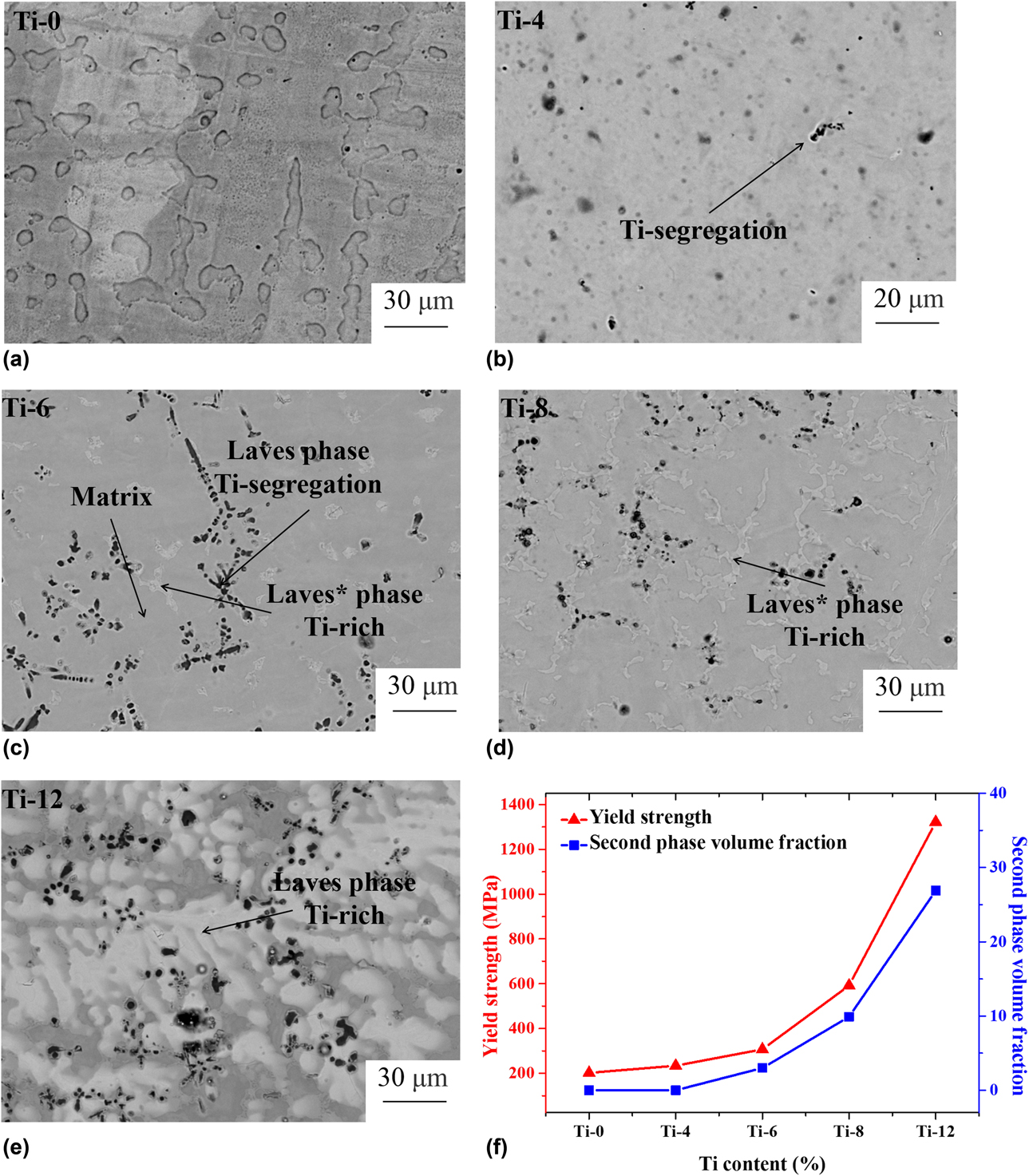
Figures 4(a)–4(e) show the microstructure morphology of the as-cast (CoCrFeMnNi)100−xTix (x = 0, 4, 6, 8, 12) HEAs. As shown in Fig. 4(a), combined with the XRD pattern in Fig. 1(b), the Ti-0 alloy (Ti content of 0 at.%) presented a single FCC phase structure. Some Laves phases (Ti segregation particles) were observed in the Ti-4 alloy, as shown in Fig. 4(b). When the Ti content was 6%, a small number of Laves* phases were observed in the Ti-6 alloy. The volume fraction of the new Laves* phase increased with increase in the Ti content [see Figs. 4(c)–4(e)]. Figure 4(f) shows the yield strength and the second-phase (Laves phase and Laves* phase) volume fraction with different Ti contents in the (CoCrFeMnNi)100−xTix HEAs. The second-phase volume fraction increased from 0 to 27% as the Ti content increased. The yield strength also increased with the increase in the second-phase volume fraction, which indicates the second phase induced by the addition of Ti is the key factor for increasing the yield strength.
Microstructure and yield strength of (CoCrFeMnNi)100−xTix alloys. (a) x = 0, (b) x = 4, (c) x = 6, (d) x = 8, (e) x = 12, (f) the yield strength and the second-phase volume fraction.

The FCC phase structure has better plasticity and low strength, whereas the Laves phase has higher strength and limited plasticity. The yield strength of the alloys can be estimated by the simple rule of mixtures [Eq. (1)] [Reference Zhou, Zhang, Wang and Chen36, Reference Tsai37, Reference Zhang, Zhou, Lin, Chen and Liaw38, Reference Egami and Waseda39].
 $$\delta = {\delta _{{\rm{fcc}}}}{V_{{\rm{fcc}}}} + {\delta _{{\rm{Laves}}}} \cdot {V_{{\rm{Laves}}}}\quad ,$$
where δfcc and δLaves denote the strength of the FCC and the Laves phase, respectively, and V fcc and V Laves refer to the volume fraction of the FCC and the Laves phase, respectively. This implies that the strength and plasticity can be regulated based on practical application by changing the alloy element (Nb and Ti) content.
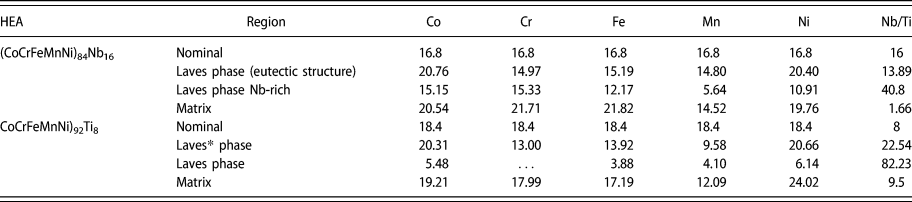
The elemental distribution is done by Energy Dispersive Spectrometer (EDS), and the compositions (at.%) of various phases in as-cast (CoCrFeMnNi)84Nb16 and (CoCrFeMnNi)92Ti8 HEAs are shown in Table II, which indicates the composition distribution in the (CoCrFeMnNi)84Nb16 HEA. In (CoCrFeMnNi)84Nb16 HEA, the Laves phase is shown to be an Nb-rich region, whereas the FCC phase is an Nb-poor region. The Laves phase and Laves* phase in the (CoCrFeMnNi)92Ti8 HEA are shown to be a Ti-rich region. The results prove that the Nb and Ti elements have a considerable influence on the phase selection from FCC to Laves phase structure in the alloys.
Compositions (at.%) of various phases in as-cast (CoCrFeMnNi)84Nb16 and (CoCrFeMnNi)92Ti8 HEAs.

The atomic radius, entropy of mixing, and enthalpy of mixing have been proposed to predict the structural stability and phase formation in HEAs [Reference Zhang, Zhou, Lin, Chen and Liaw38, Reference Egami and Waseda39, Reference Yang and Zhang40, Reference Guo and Liu41, Reference Guo, Ng, Lu and Liu42, Reference Tsai, Tsai, Tsai, Lee, Juan and Ye43, Reference Tsai, Chang, Li, Tsai and Cheng44, Reference Troparevsky, Morris, Kent, Lupini and Stocks45, Reference Yurchenko, Stepanov and Salishchev46, Reference Senkov and Miracle47, Reference Murty, Yeh and Ranganathan48, Reference Zhang, Zuo, Tang, Gao, Dahmen, Liaw and Lu49, Reference Guo, Hu, Ng and Liu50, Reference Zhang, Yang and Liaw51, Reference Chen, Qin, Zheng, Wang, Su, Chiu, Ding, Guo and Fu52, Reference Qin, Xue, Fan, Chen, Wang, Su, Ding and Guo53, Reference Qin, Wang, Chen, Gong, Wang, Su, Guo and Fu54, Reference Feng, Gao, Lee, Mathes, Zuo, Chen, Hawk, Zhang and Liaw55, Reference Zhang, Lu, Ma, Liaw, Tang, Cheng and Gao56, Reference Chanda and Das57]. Considering from the electronic level, VEC or the itinerant electrons per atom ratio (e/a) is an important parameter for the atom arrangement. Guo et al. proposed this parameter for predicting phase formation and summed up the correlation of VEC and FCC/BCC phase formation. FCC phases have been found to be stable at higher VEC (≥8), whereas BCC phases are stable at lower VEC (<6.87) in HEAs [Reference Guo and Liu41, Reference Guo, Ng, Lu and Liu42, Reference Tsai, Tsai, Tsai, Lee, Juan and Ye43]. Tsai et al. proposed that alloys having VEC values between 6.88 and 7.84 are prone to σ phase formation either in the as-cast state or during aging at suitable temperatures [Reference Tsai, Tsai, Tsai, Lee, Juan and Ye43, Reference Tsai, Chang, Li, Tsai and Cheng44]. They provided an important reference for the design of HEA. The value of VEC can be attained by Eq. (2) [Reference Guo and Liu41, Reference Guo, Ng, Lu and Liu42, Reference Tsai, Tsai, Tsai, Lee, Juan and Ye43, Reference Tsai, Chang, Li, Tsai and Cheng44].
 $${\rm{VEC}} = \sum\limits_{i = 1}^n {{C_i}{{\left( {{\rm{VEC}}} \right)}_i}} \quad ,$$
where C i is the atom percentage and (VEC)i is the VEC for the ith element.
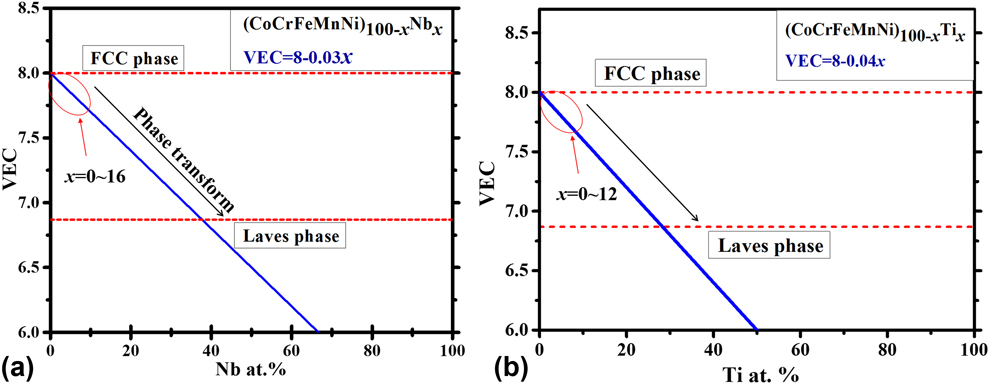
Based on the correlation between VEC and the FCC/BCC phase, a function about the VEC and the content of Nb and Ti element was established. As shown in Fig. 5, VEC decreased with increasing Nb and Ti content because of the VEC values of the Nb and Ti were lower than the average VEC of the CoCrFeMnNi HEA. Contrary to previous reports [Reference Guo and Liu41, Reference Guo, Ng, Lu and Liu42], no BCC phase formed in this alloy system; however, Laves phase and σ phase were generated in this alloy, which agrees with the criterion proposed by Tsai for σ phase formation [Reference Tsai, Tsai, Tsai, Lee, Juan and Ye43, Reference Tsai, Chang, Li, Tsai and Cheng44].
VEC of HEAs. (a) (CoCrFeMnNi)100−xNbx and (b) (CoCrFeMnNi)100−xTix.

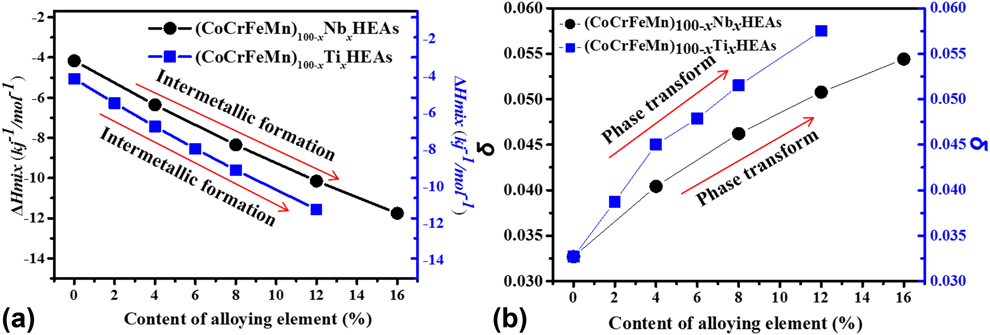
Enthalpy of mixing (ΔH mix), atomic radius difference (δ), entropy of mixing (ΔS mix), and the scald ratio of ΔS mix to ΔH mix (Ω) are important parameters for phase selection in HEAs based on the previous reports [Reference Guo and Liu41, Reference Guo, Ng, Lu and Liu42, Reference Tsai, Tsai, Tsai, Lee, Juan and Ye43, Reference Tsai, Chang, Li, Tsai and Cheng44, Reference Troparevsky, Morris, Kent, Lupini and Stocks45, Reference Yurchenko, Stepanov and Salishchev46, Reference Senkov and Miracle47, Reference Murty, Yeh and Ranganathan48, Reference Zhang, Zuo, Tang, Gao, Dahmen, Liaw and Lu49, Reference Guo, Hu, Ng and Liu50, Reference Zhang, Yang and Liaw51, Reference Chen, Qin, Zheng, Wang, Su, Chiu, Ding, Guo and Fu52, Reference Qin, Xue, Fan, Chen, Wang, Su, Ding and Guo53, Reference Qin, Wang, Chen, Gong, Wang, Su, Guo and Fu54, Reference Feng, Gao, Lee, Mathes, Zuo, Chen, Hawk, Zhang and Liaw55, Reference Zhang, Lu, Ma, Liaw, Tang, Cheng and Gao56, Reference Chanda and Das57]. Guo suggested that solid solution is expected if all the three parameters satisfy the conditions of −22 ≤ ΔH mix ≤ 7 kJ/mol, 0 ≤ δ ≤ 8.5, and 11 ≤ ΔS mix ≤ 19.5 J/K mol [Reference Guo and Liu41]. Figure 6(a) shows the enthalpy of mixing (ΔH mix) of (CoCrFeMnNi)100−xNbx HEAs and (CoCrFeMnNi)100−xTix HEAs. The ΔH mix can be estimated by Eq. (3) [Reference Qin, Wang, Chen, Gong, Wang, Su, Guo and Fu54].
 $$\Delta {H_{{\rm{mix}}}} = \sum\limits_{n = 1}^n {{\Omega _{ij}}{c_i}{c_{ji \ne j}}} \quad ,$$
where Ωij usually equals to 4 ΔHij mix and ΔHij mix is the enthalpy of mixing of the ith and jth component element [Reference Qin, Wang, Chen, Gong, Wang, Su, Guo and Fu54, Reference Feng, Gao, Lee, Mathes, Zuo, Chen, Hawk, Zhang and Liaw55, Reference Chanda and Das57].
Enthalpy of mixing (ΔH mix) and atomic radius difference (Δ). (a) ΔH mix and (b) δ.

It shows that the ΔH mix of both (CoCrFeMnNi)100−xNbx and (CoCrFeMnNi)100−xTix HEAs decreases with increasing Nb/Ti content. The value of ΔH mix is less than zero, which indicates that the reaction is an exothermic reaction. In the process of alloy solidification, the temperature decreases, which is helpful to promote the reaction and form intermetallic. The lower the mixing enthalpy is, the higher the probability of the chemical reaction.
Figure 6(b) shows the atomic radius difference (δ) of (CoCrFeMnNi)100−xNbx HEAs and (CoCrFeMnNi)100−xTix HEAs. The atomic radius difference (δ) was calculated by Eq. (4) [Reference He, Liu, Wang, Wu, Liu, Nieh and Lu14, Reference Chen, Qin, Zheng, Wang, Su, Chiu, Ding, Guo and Fu52, Reference Qin, Xue, Fan, Chen, Wang, Su, Ding and Guo53, Reference Qin, Wang, Chen, Gong, Wang, Su, Guo and Fu54, Reference Feng, Gao, Lee, Mathes, Zuo, Chen, Hawk, Zhang and Liaw55, Reference Zhang, Lu, Ma, Liaw, Tang, Cheng and Gao56, Reference Chanda and Das57].
 $$\delta = \sqrt {\sum\limits_{n = 1}^n {{c_i}} {{\left( {1 - {{{r_i}} / {\sum\limits_{n = 1}^n {\left( {{c_i}{r_i}} \right)} }}} \right)}^2}\quad .}$$
It shows that δ of both HEAs increases with increasing Nb/Ti content. The large lattice distortion energy, induced by Nb/Ti addition, can be released by the method of phase translation, so the increase of δ is helpful to promote phase translation in HEAs [Reference He, Liu, Wang, Wu, Liu, Nieh and Lu14, Reference Chen, Qin, Zheng, Wang, Su, Chiu, Ding, Guo and Fu52, Reference Qin, Xue, Fan, Chen, Wang, Su, Ding and Guo53, Reference Qin, Wang, Chen, Gong, Wang, Su, Guo and Fu54, Reference Feng, Gao, Lee, Mathes, Zuo, Chen, Hawk, Zhang and Liaw55, Reference Zhang, Lu, Ma, Liaw, Tang, Cheng and Gao56].
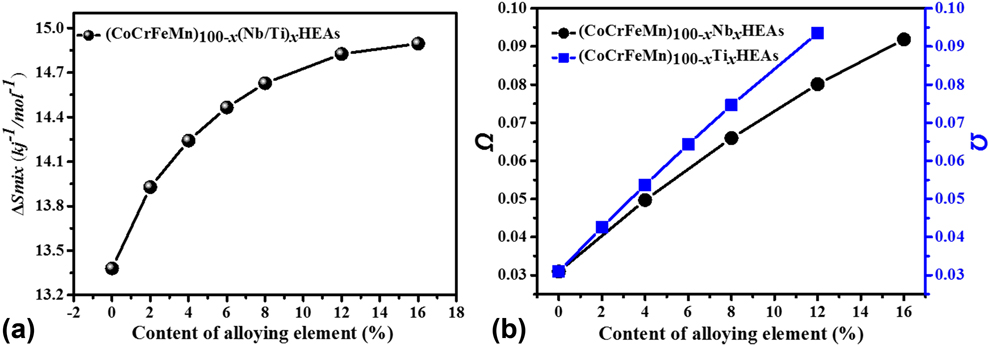
Figure 7(a) shows the entropy of mixing (ΔS mix) of (CoCrFeMnNi)100−x(Nb/Ti)x HEAs. The ΔS mix was attained by Eq. (5) [Reference Murty, Yeh and Ranganathan48, Reference Zhang, Zuo, Tang, Gao, Dahmen, Liaw and Lu49, Reference Guo, Hu, Ng and Liu50].
 $$\Delta {S_{{\rm{mix}}}} = - R\sum\limits_{n = 1}^n {\left( {{c_i}\ln {c_i}} \right)} \quad ,$$
where n represents the number of component elements, c i represents the at.% of the ith component element, and R is the universal gas constant [8.314 k/(J mol)] [Reference Murty, Yeh and Ranganathan48, Reference Zhang, Zuo, Tang, Gao, Dahmen, Liaw and Lu49, Reference Guo, Hu, Ng and Liu50]. It is shown that the value of ΔS mix decreases with increasing Nb/Ti content, which is helpful to promote solid solution formation based on the previous reports [Reference Murty, Yeh and Ranganathan48, Reference Zhang, Zuo, Tang, Gao, Dahmen, Liaw and Lu49, Reference Guo, Hu, Ng and Liu50].
Entropy of mixing (ΔS mix) and the scald ratio (Ω, the ratio of ΔS mix to ΔH mix). (a) ΔS mix and (b) Ω.

The scald ratio of ΔS mix to ΔH mix (Ω) was pointed out as an important parameter for prediction of solid solution formation by Yang et al. and Guo et al. [Reference Yang and Zhang40, Reference Guo and Liu41]. Figure 7(b) shows the scald ratio of ΔS mix to ΔH mix (Ω) of (CoCrFeMnNi)100−xNbx HEAs and (CoCrFeMnNi)100−xTix HEAs. The Ω was attained by Eq. (6) [Reference Yang and Zhang40, Reference Guo and Liu41].
 $$\Omega = {{\sum\limits_{n = 1}^n {\left( {{c_i}{{\left( {{T_{\rm{m}}}} \right)}_i}} \right)} \Delta {S_{{\rm{mix}}}}} \over {|\Delta {H_{{\rm{mix}}}}|}}\quad ,$$
where (T m)i is the melting point of the ith constituent element, and it can be attained by Eq. (7) [Reference Yang and Zhang40, Reference Guo and Liu41].
 $${T_{\rm{m}}} = \sum\limits_{n = 1}^n {\left( {{c_i}{{\left( {{T_{\rm{m}}}} \right)}_i}} \right)} \quad .$$
Figure 7(b) shows that Ω of both HEAs increases with increasing Nb/Ti content, which plays a positive role in promoting solid solution formation based on the previous reports [Reference Yang and Zhang40, Reference Guo and Liu41].
When Nb element is added to the CoCrFeMnNi HEA, part of the Nb atoms were incorporated into the CoCrFeMnNi matrix and form FCC phase, whereas remnant Nb atoms will solid solute with other elements each other and form Laves phase finally. With increase in Nb content, part of FCC phase changes to Laves phase, and the Laves phase volume fraction increases with further increase in Nb.
Conclusions
In this study, the alloying effects of Nb and Ti elements on the microstructure evolution and compressive properties of CoCrFeMnNi HEAs were investigated. Based on the experimental and analytical results, the following conclusions were obtained:
(1) Nb and Ti have the capacity to promote the phase selection from the FCC to the Laves phase.
(2) The second-phase (Laves and σ phase) volume fraction of (CoCrFeMnNi)100−xNbx HEAs increases from 0 to 42% when Nb content is increased from 0 to 16 at.%. The second-phase (Laves phase and Laves* phase) volume fraction of (CoCrFeMnNi)100−xTix HEAs increases from 0 to 27% with increasing Ti content from 0 to 12 at.%.
(3) The yield strength of (CoCrFeMnNi)100−xNbx HEA increases gradually from 202 to 1010 MPa with the addition of Nb at 0–16 at.%. The yield strength of (CoCrFeMnNi)100−xTix HEAs increases gradually from 202 to 1322 MPa with the addition of Ti at 0–12 at.%.
(4) As a reinforced phase, the Laves phase is beneficial for improving the yield strength of HEAs. The increased volume fraction of Laves phase plays a positive role in improving the strength of CoCrFeMnNi HEA.
Experimental
A series of (CoCrFeMnNi)100−xNbx and (CoCrFeMnNi)100−xTix HEAs were synthesized by arc melting a mixture of pure metals (purity >99%) in a high-purity argon atmosphere. The alloys were melted seven times for composition homogeneity. The phase structure was identified by X-ray diffraction (XRD; Empyrean) with a step size of 0.026°. Microstructure was characterized by scanning electron microscopy (SEM) with the use of a Zeiss Supra 55 instrument (Carl Zeiss AG, Oberkochen, Germany) operated at 15 kV. Element distribution was measured with an electronic probe. For microstructure observation, the SEM samples were cut from the center of the ingot. These samples were sequentially ground and polished, followed by electropolishing in a mixture of 90% acetic acid and 10% perchloric acid at room temperature and supplied with the voltage of 27 V for 15 s. Samples with dimensions of Ø4 mm × 6 mm were prepared for compressive testing; at least three specimens were tested for each same composition sample to obtain reliable results. Compression tests were carried out on an AG-X plus 250 kN electronic universal material testing machine (Shimadzu, Kyoto, Japan) at a strain rate of 0.5 × 10⁻³ mm/min at room temperature.
Acknowledgment
This work was supported by the Fund of State Key Laboratory of Advanced Welding and Joining and National Natural Science Foundation of China (No. 51741404).