Implication
In the present study, 18% of GSC was included in the milk replacer at the expense of lactose and the impact on protein and fat digestion was measured. Protein digestion in the small intestine was unaffected, whereas fat digestion tended to increase. Passage rates in gelatinized corn starch (GCS) milk-fed calves increased likely related to fermentation of a major portion of the starch. Hence, 18% of GSC could be included in milk replacer at the expense of lactose without negatively affecting digestion.
Introduction
Milk replacers (MR) are generally formulated from dairy products, together with animal fats or vegetable oils plus added vitamins and minerals (Heinrichs et al., Reference Heinrichs, Wells and Losinger1995). The ingredients that are required to formulate MR are increasingly expensive. The replacement of dairy proteins (in part) by proteins of vegetable origin has proved to be successful (Verdonk et al., Reference Verdonk, Gerrits, Beynen and Blok2002). Replacing dairy carbohydrates such as lactose with a cheaper alternative is desirable as well.
However, replacing key components of MR with vegetable substitutes has been shown to change the composition and therefore subsequent digestion of nutrients (Huber and Slade, Reference Huber and Slade1967). Replacing skimmed-milk protein by soya protein resulted in a lower protein and fat digestion in veal calves (Xu et al., Reference Xu, Wensing, Van der Meer and Beynen1997). Replacing dairy proteins with proteins such as soyabean and fish flour in MR has been shown to reduce fat digestibility (Huber and Slade, Reference Huber and Slade1967; Akinyele and Harshbarger, Reference Akinyele and Harshbarger1983). Flipse et al. (Reference Flipse, Huffman, Webster and Duncan1950) observed that MR containing glucose and corn syrup compared with MR containing lactose decreased growth performance of calves.
It has been documented that as little as 2% starch (food grade corn starch or partially hydrolysed starch based from corn) in MR is enough to depress growth by decreased digestion of nutrients (Natrajan et al., Reference Natrajan, Chandler, Huber, Polan and Jahn1972; Soliman et al., Reference Soliman, Orskov, Atkinson and Smart1979). Liang et al. (Reference Liang, Morrill and Noordsy1967) suggested that milk-fed calves are able to utilize starch as a source of energy by microbial degradation. Including starch into MR has been previously reported to reduce daily gains in Holstein calves (Huber et al., Reference Huber, Natrajan and Polan1968; Nitsan et al., Reference Nitsan, Ben-Asher, Nir and Zoref1990). The calves had reduced daily gains irrespective of the amount of amylopectin or corn starch in the MR: however, this was measured in calves of 3 weeks of age. Blaxter and Mitchell (Reference Blaxter and Mitchell1948) suggested that indigestible residues of nutrients other than protein have a marked effect on apparent digestibility of protein, due to increased passage of metabolic or endogenous secretion of nitrogen. Including a considerable portion of starch in the diet likely affects passage rates, with unknown effects on enzyme activities and thereby on digestion of the other nutrients. However, in Huber et al. (Reference Huber, Jacobson, McGilliard and Allen1961) and Le Huerou-Luron et al. (Reference Le Huerou-Luron, Guilloteau, Wicker-Planquart, Chayvialle, Burton, Mouats, Toullec and Puigserver1992a and Reference Le Huerou-Luron, Guilloteau, Wicker, Mouats, Chayvialle, Bernard, Burton, Toullec and Puigserver1992b) little starch was fed with the milk replacer while in Morrill et al. (Reference Morrill, Stewart, McCormick and Fryer1970) and Toofanian et al. (Reference Toofanian, Hill and Kidder1973) no starch was fed with the milk replacer and therefore, effects of starch on protein-degrading enzyme activities are not known. In exclusively milk-fed pre-ruminant calves from 2 to 119 days, the enzyme activities for chymotrypsin, elastase, carboxypeptidases A and B, ribonuclease and α-amylase increased with age. The enzyme activities for chymosin, lysozyme and colipase decreased, however, there was no change in the case of pepsin, trypsin, lipase and phospholipase A2 enzyme activities when compared with animals at birth (Le Huerou-Luron et al., Reference Le Huerou-Luron, Guilloteau, Wicker-Planquart, Chayvialle, Burton, Mouats, Toullec and Puigserver1992a and Reference Le Huerou-Luron, Guilloteau, Wicker, Mouats, Chayvialle, Bernard, Burton, Toullec and Puigserver1992b).
Lactose is readily digested with an apparent total tract disappearance of 98% to 100% (Van den Borne et al., Reference Van den Borne, Verstegen, Alferink, Giebels and Gerrits2006) and apparent ileal disappearance of 97% (Blaxter and Mitchell, Reference Blaxter and Mitchell1948; Coombe and Smith, Reference Coombe and Smith1974). Starch digestion (or disappearance) is much lower, with an apparent total tract disappearance of 79% for amylopectin and corn starch (Blaxter and Mitchell, Reference Blaxter and Mitchell1948) and an apparent ileal disappearance of 60% for partial acid-hydrolyzed starch (Coombe and Smith, Reference Coombe and Smith1974). It is not known how replacing lactose, which typically makes up 40% to 50% of the MR, with gelatinized corn starch (GCS) will affect protein and fat digestibility.
This study aims to determine the effect of replacing lactose with GCS on the digestibility of protein and fat in milk-fed calves from 13 to 30 weeks of age. We hypothesized that replacing lactose with a pre-GCS in the milk replacer would, due to limited capacity for starch digestion in calves, increase digesta passage rates and thereby reduce small intestinal digestion of protein and fat. The effects on starch digestion are presented elsewhere (Gilbert et al., Reference Gilbert, Pantophlet, Berends, Pluschke, Van den Borne, Hendriks, Schols and Gerrits2015a).
Material and methods
Experimental design, animals and housing
The experiment was reviewed and approved by the Animal Care and Use Committee of Wageningen University, Wageningen, The Netherlands. In total, 16 male Holstein-Friesian calves of 13 weeks of age (103.2±0.72 kg) received one of two MR treatments varying in carbohydrate source. The control treatment contained lactose (527 g/kg) as the only source of carbohydrate. The other MR contained 180 g GCS and 347 g lactose/kg MR. An industrial GCS product was selected (Tate & Lyle Europe, Boleraz, Slovakia). The GCS was analysed by high-performance size exclusion chromatography and by high-performance anion exchange chromatography as described by Gilbert et al. (Reference Gilbert, Van den Borne, Berends, Pantophlet, Schols and Gerrits2015b) and these analyses showed that GCS only contained polymers, and no low-molecular weight fractions. The experiment consisted of an adaptation and an experimental period. In the adaptation period, calves were exposed to the dietary treatments for 14 weeks. During these 14 weeks, the GCS calves were step-wise exposed to an increasing dose of GCS (3%/week) to allow maximal adaptation of all enzyme systems involved (Gilbert et al., Reference Gilbert, Van den Borne, Berends, Pantophlet, Schols and Gerrits2015b). The exchange ratio between GCS and lactose was determined based on the titration during the adaption phase, monitoring faecal dry matter (DM) and pH. The experimental period started at 27 weeks of age (212.1±4.26 kg) and lasted 3 weeks (until 30 weeks of age; 230.3±4.82 kg). During the experimental period, small intestinal, ileal and total tract digestibility, enzyme activities and rate of passage were measured to determine the effects of replacing lactose by GCS on protein and fat digestion. The calves were housed on wooden, slatted floors in pairs (except during faeces collection). During the collection of faeces, calves were housed individually for 8 consecutive days, they could change posture freely but could not turn around, facilitating the collection of faeces. Per calf, 2.7 m2 was available. Lights were on from 0600 to 1800 h. The stable was mechanically ventilated.
Diet and feeding
Calves were fed individually according to their metabolic weight at twice the metabolizable energy requirements for maintenance (ME m ). Feeding rates were adjusted weekly. ME m was assumed at 460 kJ/kg0.75 per day (Van Es et al., Reference Van Es, Nijkamp, Van Weerden and Van Hellemond1969). MR was provided in buckets. Solid feed was not provided as this would lead to difficulties in estimating starch flow and α-amylase activity in the intestinal tract. Lactose was exchanged for GCS on a weight basis. Ingredient and nutrient compositions have been described elsewhere (Gilbert et al., Reference Gilbert, Van den Borne, Berends, Pantophlet, Schols and Gerrits2015b). In brief, milk replacer was composed of 375.0 g/kg lactose, 285.4 g/kg delactosed whey powder, 123.2 g/kg whey protein concentrate, 46.2 g/kg palmstearin, 45.0 g/kg soya oil, 37.5 g/kg palm-kernel oil, 30.0 g/kg palm oil, 11.4 g/kg lecithin, 2.4 g/kg emulsifier, 14.8 g/kg calcium formiate, 8.0 g/kg premix, 7.2 g/kg L-lysine HCl, 6.2 g/kg mono ammonium phosphate, 5.7 g/kg methionine, 1.4 g/kg threonine and 0.6 g/kg citric acid. Milk replacer contained 171 g/kg CP, 176 g/kg crude fat, 63 g/kg crude ash, 21 g/kg moisture and 522 g/kg lactose for the control treatment. For the GCS treatment, 180 g lactose/kg was exchanged for GCS on a wt/wt basis. MR was mixed with water to obtain a concentration of 154 g/kg and was supplied to the calves at a temperature of ~42°C at 0600 and 1600 h in two equal portions. All diets included cobalt ethylenediaminetetraacetic acid (EDTA) as an indigestibly maker (1.3 g Co-EDTA/kg MR). A pulse dose of chromium chloride (7.69 g of CrCl3 hexahydrate) was provided with the last MR meal 4 h before slaughter. Water was available ad libitum.
Sample collection and measurements
Until 13 weeks of age, calves were fed a commercial MR and crushed barley from 3 to 8 weeks of age. When the calves reached 13 weeks of age, they were adapted to the control diet in 4 days, which all calves received thereafter for a week. Following this week, calves were assigned to the dietary treatments. Calves were weighed each week in order to adapt feeding level to their metabolic weight. Calves were first habituated to individual housing for 4 days before starting faeces collection. Faeces were collected from the buckets under the slatted floor twice a day for 4 consecutive days and were weighed, homogenized, sampled and stored at −20°C until analysis. As faeces were collected semi-quantitatively in trays underneath the slatted floor, no clean urine samples could be collected.
At 30 weeks of age, calves were anesthetized 4 h after feeding by pentobarbital injection. Calves were lifted by the forelegs to prevent reflux of MR from the abomasum into the rumen. Calves were subsequently exsanguinated. After opening the abdominal cavity, the digestive tract was ligated at five points to prevent digesta from flowing between gastrointestinal (GIT) sections. The small intestine was separated from the other parts of the GIT and divided into small intestine 1 and small intestine 2 (SI1 and SI2, respectively) and terminal ileum (defined as the last metre). The entire intestinal tract was removed from the calf, thereafter SI1 and SI2 were separated based on equal length of the small intestine excluding the ileum. Digesta samples were collected from each compartment (after collecting and weighing all digesta and homogenization) and were stored at −20°C (from SI1, SI2 and ileum for enzyme analyses and from all compartments; reticulorumen, abomasum, SI1, SI2, ileum and large intestine (colon+caecum) for Cr analysis to determine passage rates. This process was finished within 20 min/calf.
Analytical procedures
Samples of MR and GCS were collected weekly, pooled and analysed for DM, CP, crude fat and total glucose (Total starch kit from Megazyme International Ireland Ltd, Co., Wicklow, Ireland; Association of Analytical Communities 996.11). Diets, GIT digesta and faeces were analysed in duplicate for content of DM (ISO 1999a and 1999b), CP (Kjeldahl method (ISO 2005)) for SI1 and SI2 samples and Dumas combustion method for ileal samples due to a small amount of digesta. (AOAC 990.03, using a Thermo Quest NA 2100 Nitrogen and Protein analyzer of Interscience, Troy, NY, USA) and crude fat with acid hydrolysis for faeces and without hydrolysis for SI1 and SI2 (ISO 1999a and 1999b). Cobalt (faeces and ileal digesta) and chromium (GIT samples) were measured by atomic absorption spectrophotometry using a SpectrAA300 (Varian, B.V., Middelburg, the Netherlands).
Digestibility (%) was calculated using the following equation:
 $$\eqalignno{{ & {\rm Digestion }\ ( % \,{\equals}\,100\,{\minus}\,( {100{\rm }\,{\times}\,{\rm }( {{\rm Co}_{{{\rm feed}}} /{\rm Co}_{{{\rm digesta}}} } ){\rm } }}\cr{\times}{\rm }( {{\rm Nutrient}_{{{\rm digesta}}} /{\rm Nutrient}_{{{\rm feed}}} } ) )}$$
where Cofeed is the cobalt concentration in the milk replacer (mg/kg DM), Codigesta the cobalt concentration in the faeces or digesta (mg/kg DM), Nutrientdigesta the nutrient concentration in the faeces or digesta (g/kg DM) and Nutrientfeed the nutrient concentration in the milk replacer (g/kg DM).
Quantifying enzyme activity
Intestinal digesta from SI1 and SI2 were thawed and analysed using an α-amylase activity assay kit (BioVision K711-100, Milpitas, CA, USA), a lipase activity assay kit (BioVision 723-100) and a trypsin activity assay kit (BioVision K771-100) using an colorimeter TECAN Infinite F500 spectrophotometer (Grödig, Austria). Activity was corrected for the dilution factor between sample and buffer. One unit (U) of enzyme activity was defined as the amount of enzyme that hydrolysed 1 µmol substrate/minute at pH 7.20 and 25°C for trypsin and α-amylase and 37°C for lipase. Activity was expressed against the Co concentration present in the small intestine section, thereby correcting for changes in enzyme activity related to the disappearance of nutrients along the digestive tract. Each assay was performed in duplicate.
Statistical methods
All statistical analyses were performed using SAS 9.3 (SAS Institute Inc., Cary, NC, USA). Apparent total tract digestibility was analysed for treatment effects by ANOVA using the GLM procedure. Apparent SI digestibility, enzyme activities and recovery of Cr were analysed on treatment, GIT and treatment×GIT effects using the MIXED procedure, using GIT as a repeated measure, with calf as subject. One calf with a Cr recovery in the rumen >50% was excluded from the analysis, as this high recovery is evidence of ruminal drinking (Labussière et al., Reference Labussière, Berends, Gilbert, Van den Borne and Gerrits2014). After an interaction effect was found, treatment effects per segment were analysed using the slice statement in the MIXED procedure. Total tract crude fat digestibility, apparent ileal N digestibility and α-amylase activity were log transformed to obtain homogeneity of variance. Differences were considered significant when P<0.05 and tendencies were noted when 0.10>P>0.05. Results are expressed as non-transformed means±SEM.
Results
One calf from the control treatment was identified as a ruminal drinker; this calf was excluded from the analyses.
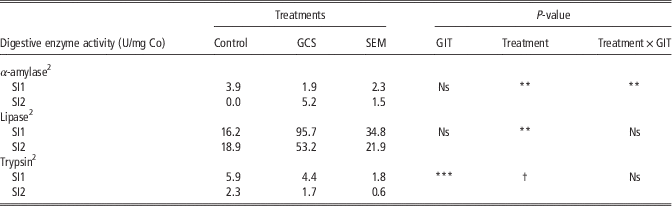
Control calves had higher α-amylase activity in SI1 than GCS calves (Table 1). Whereas α-amylase activity was higher in SI2 for GCS calves (treatment×GIT, P=0.025). Lipase activity was higher for GCS calves (P=0.023). The large SEM for lipase activity is due to large variation observed from the GCS calves. Trypsin activity was higher in SI1 compared with SI2 (P=0.017) and tended to be greater for control calves (P=0.087).
Luminal α-amylase, lipase and trypsin activity in small intestinal segments of calves fed a milk replacer containing lactose as only carbohydrate source (control) or 18% of gelatinized corn starch (GCS) at the expense of lactoseFootnote 1

GIT=gastrointestinal; SI=small intestine; Ns=not significant.
1 Values represent means±SEM and (n=15, control=7, GCS=8).
2 All enzyme activities are expressed per gram of indigestible marker cobalt (Co). †P<0.10, **P<0.05, ***P<0.001.
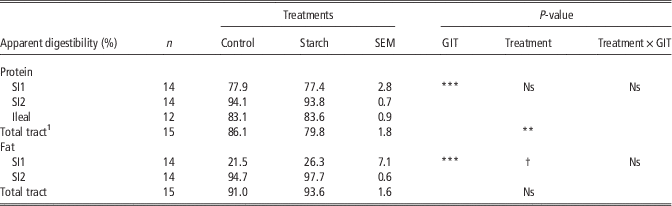
Apparent small intestinal protein digestibility did not differ between treatments (P=0.386) (Table 2). Apparent total tract protein digestibility was decreased in GSC calves (P=0.035). Apparent crude fat digestibility tended to be increased by 4.8% in SI1 and 3.0% in SI2 for GCS calves compared with control calves. However, total tract fat digestibility did not differ between treatments (P=0.24).
Apparent total tract, ileal and small intestinal (SI) protein and fat digestibility of calves fed a milk replacer containing lactose as only carbohydrate source (control) or 18% of gelatinized corn starch at the expense of lactose

GIT=gastrointestinal; Ns=not significant.
Values represent means±SEM.
1 Total tract digestibility was analysed separately as the faeces was not collected at the same time as small intestinal digesta. †P<0.10, ***P<0.001, **P<0.05.
Apparent disappearance of GCS was 64.0±9.94% of intake at the ileum and 99.0±0.51% of intake at total tract, indicating that 35% of the GCS intake was fermented in the large intestine. In addition, total tract fermentation of GCS was quantified, which averaged 447±27 g/day, corresponding to 89% of intake. By difference, this indicated that 54% of the GCS intake was fermented before the terminal ileum (Gilbert et al., Reference Gilbert, Pantophlet, Berends, Pluschke, Van den Borne, Hendriks, Schols and Gerrits2015a).
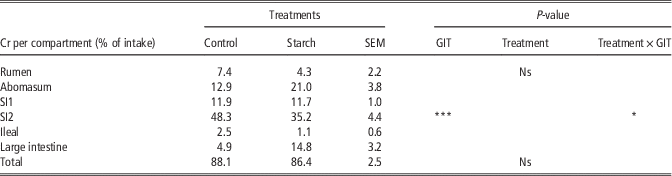
Total recovery of Cr averaged 87±1% and did not differ between treatments (P=0.924). Chromium recoveries per compartment of milk-fed calves (13 to 30 weeks) are presented in Table 3. There was an interaction between treatment and GIT (P=0.037). Less Cr was recovered in SI2 (P=0.042) and more in the large intestine (P=0.047) for GCS calves compared with control calves.
Recovery of chromium (Cr) per gastrointestinal (GIT) compartment in calves fed a pulse dose of chromium chloride hexahydrate with the milk replacer containing lactose as only carbohydrate source (control) or 18% of gelatinized corn starch at the expense of lactoseFootnote 1

Ns=not significant.
1 Values represent means±SEM and n=14. *P<0.05, ***P<0.001.
The average lengths of small intestine excluding the ileum for the control and starch treatments were 26.8±1.1 m and 28.0±1.5 m, respectively, and did not differ between treatments.
Discussion
This experiment was conducted to determine the effects of replacing one-third of the lactose with GCS on the digestibility of protein and fat in milk-fed calves (13 to 30 weeks).
Milk-fed calves were fed a pulse dose of chromium before they were euthanized providing an indication of passage rates. Calves fed MR with GCS had increased passage rates as indicated by a higher recovery of chromium in the large intestine and a lower recovery in the small intestine, which have been previously associated with increased fermentation of starch occurring along the GIT. DM content and pH has been found to decrease when feeding starch to calves (13 to 27 weeks old) (Gilbert et al., Reference Gilbert, Van den Borne, Berends, Pantophlet, Schols and Gerrits2015b) and sheep (lambs from 4 to 17 weeks and mature sheep from 2 to 3 years) (Mayes and Ørskov, Reference Mayes and Ørskov1974), and diarrhoea was observed after feeding increasing concentration of starch to cattle of various ages (Huber et al., Reference Huber, Jacobson, Allen and Hartman1961). A decrease in ileal pH after abomasal infusion of increasing amounts of starch has been found in steers (Kreikemeier et al., Reference Kreikemeier, Harmon, Brandt, Avery and Johnson1991).
Apparent protein digestibility in the small intestinal tract did not differ between treatments, whereas trypsin activity tended to be higher in control calves. A decrease in trypsin activity was found after abomasal infusion of starch hydrolysate in steers (Swanson et al., Reference Swanson, Matthews, Woods and Harmon2002). Trypsin activity was highest in SI1. This is in agreement with a loss of protease activity along the small intestinal tract (Layer et al., Reference Layer, Liang, Go and Dimagno1986). GCS calves had decreased apparent total tract protein digestibility. This is probably due to increased endogenous secretions of nitrogen or an influx of urea occurring in the later parts of the GIT, because apparent ileal digestibility did not differ between treatments.
Passage rate was increased in GSC calves, which was probably the result of starch being (partly) undigested in these calves, resulting in water being drawn into the lumen. As a result of less starch digestion, it is likely that the starch becomes substrate for microbial fermentation in the large intestine causing an influx of urea nitrogen into the large intestine (Gerrits et al., Reference Gerrits, Bosch and Van den Borne2012). Substantial starch fermentation was observed in milk-fed calves (13 to 30 weeks), with 37% of the ingested starch fermented in the colon and an additional 41% of the ingested starch fermented in the small intestine (Gilbert et al., Reference Gilbert, Pantophlet, Berends, Pluschke, Van den Borne, Hendriks, Schols and Gerrits2015a). Although the inclusion level of GCS was not fixed, GCS-fed calves had a reduction in growth as a result of fermentation of GCS instead of digestion. Increasing the number of calves would improve the reliability of the growth rates. The estimated daily gain of control calves was 1169±26 g and was 1130±31 g for GCS calves. Apparently, the increase in passage rate did not affect protein digestion in the small intestine, which could be because it is already very high in SI1, corresponding with the enzyme activities.
GCS calves had higher lipase activity throughout the small intestine when compared with control calves, which correlates well with the higher small intestinal fat digestibility. Lipase activity determined in small intestinal luminal contents has been positively correlated with the concentration of lipase secreted from the pancreas (Sternby et al., Reference Sternby, Nilsson, Melin and Borgström1991). Pancreatic lipase secretions are readily influenced by the amount of fat in the diet (Mu and Hoy, Reference Mu and Hoy2004). However, neither the fat content nor the fat source differed between treatments. Adding GCS into the MR might improve the ability of the secreted bile salts to emulsify the luminal contents sufficiently as reviewed by Radostits and Bell (Reference Radostits and Bell1970) or reduce the binding affinity of lipase to the lipids (Lairon et al., Reference Lairon, Nalbone, Lafont, Leonardi, Domingo, Hauton and Verger1978). A reduced affinity of lipase to its substrate may result in an increase in the hydrolysis of added substrate and therefore be recorded as increased activity. The decreased apparent total tract protein digestibility and increased passage rate when feeding GSC suggest that starch was fermented, and starch fermentation in both the large and small intestine was indeed confirmed by Gilbert et al. (Reference Gilbert, Pantophlet, Berends, Pluschke, Van den Borne, Hendriks, Schols and Gerrits2015a). From the current study, replacing lactose with GCS in the MR increased α-amylase activity, potentially by adaptation to the starch as reviewed by Brannon (Reference Brannon1990) and Mosenthin and Sauer (Reference Mosenthin and Sauer1993) or by inducing microbial amylase activity (Cummings and Macfarlane, Reference Cummings and Macfarlane1991). This is in contrast to the findings of Walker and Harmon (Reference Walker and Harmon1995) who determined that abomasal infusion of partially hydrolysed starch in steers decreased pancreatic α-amylase activity in both pancreatic tissue and secreta. In our study, increased amylase activity was measured in the second part of the small intestine in GCS-fed calves. We speculate this increase to be either of microbial origin. The increased passage rate could also have resulted in active pancreatic α-amylase being transported with digesta to distal sections of the small intestine. Although the capacity for starch digestion in milk-fed calves is limited, additional negative effects on digestion of other nutrients were not demonstrated. Thus, the economic incentive of replacing lactose in calf milk replacers by starch is a trade-off between the digestive yield of these energy sources and ingredient prices.
Conclusions
Including 18% of GCS in milk replacer at the expense of lactose increased passage rate and decreased apparent total tract protein digestibility, most likely as a result of starch fermentation. However, in the small intestine, protein digestion did not decrease when feeding GCS and fat digestion tended to increase, which was also reflected in increased lipase activity in the small intestine of calves fed GCS. Overall, effects on digestion might be levelled when partially replacing lactose with GCS, because starch digestion is lower than that of lactose but fat digestion may be slightly increased when feeding GCS.
Acknowledgements
A. P. was supported by the Wageningen Institute of Animal Sciences and by the ARC Centre of Excellence for Plant Cell Walls. Technical assistance was provided by Saskia van Laar and Erika Beukers-van Laar (Animal Nutrition Group, Wageningen University) and Edwin Bakx (Laboratory of Food Chemistry, Wageningen University). This project is jointly financed by the European Union, European Regional Development Fund and the Ministry of Economic Affairs, Agriculture and Innovation, Peaks in the Delta, the Municipality of Groningen, the Province of Groningen as well as the Dutch Carbohydrate Competence Center (CCC2 WP21), and by Tereos Syral, VanDrie Group and Wageningen University.