INTRODUCTION
The whale shark (Rhincodon typus Smith, 1828) and rays of the family Mobulidae are large elasmobranchs found in tropical and temperate seas worldwide (Couturier et al., Reference Couturier, Marshall, Jaine, Kashiwagi, Pierce, Townsend, Weeks, Bennett and Richardson2012; Rowat & Brooks, Reference Rowat and Brooks2012). Despite their wide range, very little is known of their pelagic distribution. R. typus are most frequently observed in areas of fish spawning events (Heyman et al., Reference Heyman, Graham, Kjerfve and Johannes2001; Hoffmayer et al., Reference Hoffmayer, Franks, Driggers, Oswald and Quattro2007; de la Parra Venegas et al., Reference de la Parra Venegas, Hueter, Cano, Tyminski, Gregorio Remolina, Maslanka, Ormos, Weigt, Carlson and Alistair2011; Robinson et al., Reference Robinson, Jaidah, Jabado, Lee-Brooks, Nour El-Din, Malki, Elmeer, McCormick, Henderson, Pierce and Ormond2013) and areas of major zooplankton blooms (Motta et al., Reference Motta, Maslanka, Hueter, Davis, Parra, Mulvany, Habegger, Strothere, Mara, Gardiner, Tyminski and Zeigler2010; Ramírez-Macías et al., Reference Ramírez-Macías, Meekan, De La Parra-Venegas, Remolina-Suarez, Trigo-Mendoza and Vázquex-Juárez2012), although surface zooplankton may only be a component of their diet (Rohner et al., Reference Rohner, Couturier, Richardson, Pierce, Prebble, Gibbons and Nichols2013). The Mobulidae, comprising manta rays (Manta spp.) and devil rays (Mobula spp.), are largely planktivorous elasmobranchs. The genus Manta has at least two distinct species: the reef manta ray (Manta alfredi Krefft, 1868) and the giant manta ray (Manta birostris Walbaum, 1792). This genus was recently re-described with a third putative species, Manta sp. cf. birostris (Marshall et al., Reference Marshall, Compagno and Bennett2009). Manta spp. are the largest rays and reach between 5 and 7 m disc width (W D) (Compagno & Last, Reference Compagno, Last, Carpenter and Niem1999; Marshall et al., Reference Marshall, Compagno and Bennett2009). The genus Mobula comprises nine recognized species attaining 1–5 m W D and includes the pygmy devil ray (Mobula eregoodootenkee Bleeker, 1959), the Atlantic devil ray (Mobula hypostoma Bancroft, 1831), the spinetail devil ray (Mobula japanica Müller & Henle, 1841), the shortfin devil ray (Mobula kuhlii Müller & Henle, 1841), the giant devil ray (Mobula mobular Bonnaterre, 1788), the Munk's devil ray (Mobula munkiana Notarbartolo-di-Sciara, Reference Notarbartolo-di-Sciara1987), the lesser Guinean devil ray (Mobula rochebrunei Vaillant, 1979), the Chilean devil ray (Mobula tarapacana Philippi, 1893) and the bentfin devil ray (Mobula thurstoni Lloyd, 1908) (Notarbartolo-di-Sciara, Reference Notarbartolo-di-Sciara1987). The identification of individual species of Mobula is often problematic because of the similarities between species within this taxon; these similarities have led to taxonomic ambiguities (Couturier et al., Reference Couturier, Marshall, Jaine, Kashiwagi, Pierce, Townsend, Weeks, Bennett and Richardson2012).
Assessment of the current conservation status of Mobula is further hampered by a paucity of information, resulting in a ‘Data Deficient’ status for Mobula hypostoma, Mobula kuhlii and Mobula tarapacana within the IUCN Red List for Threatened Species (Clark et al., Reference Clark, Smith and Bizzarro2006a; Bizzarro et al., Reference Bizzarro, Smith and Clark2006, Reference Bizzarro, Smith, Baum, Domingo and Menni2009). Four species of Mobula are listed as ‘Near Threatened’ (Mobula eregoodootenkee, Mobula japanica, Mobula munkiana and Mobula thurstoni), one as ‘Vulnerable’ (Mobula rochebrunei) and one as ‘Endangered’ (Mobula mobular) (Pierce & Bennett, Reference Pierce and Bennett2003; Bizzarro et al., Reference Bizzarro, Smith and Clark2006; Clark et al., Reference Clark, Smith and Bizzarro2006b; Notarbartolo-di-Sciara et al., Reference Notarbartolo-di-Sciara, Serena and Mancusi2006; White et al., Reference White, Clark, Smith and Bizzarro2006; Valenti & Kyne, Reference Valenti and Kyne2007). R. typus and Manta spp. are listed as ‘Vulnerable’ (Norman, Reference Norman2005; Marshall et al., Reference Marshall, Kashiwagi, Bennett, Deakos, Stevens, McGregor, Clark, Ishihara and Sato2011a, Reference Marshall, Bennett, Kodja, Hinojosa-Alvarez, Galvan-Magana, Harding, Stevens and Kashiwagib) with worldwide distributions.
R. typus are known to seasonally aggregate in near-shore waters off Western Australia (Colman, Reference Colman1997), Belize (Heyman et al., Reference Heyman, Graham, Kjerfve and Johannes2001), northern Mexico (Eckert & Stewart, Reference Eckert and Stewart2001), the Philippines (Alava et al., Reference Alava, Dolumbalo, Yaptinchay, Trono, Fowler, Reed and Dipper2002), Djibouti (Rowat et al., Reference Rowat, Meekan, Engelhardt, Pardigon and Vely2006), Mozambique (Pierce et al., Reference Pierce, Mendez-Jimenez, Collins, Rosero-Caicedo and Monadjem2010), the Maldives (Anderson & Ahmed, Reference Anderson and Ahmed1993; Riley et al., Reference Riley, Hale, Harman and Rees2010) and the Seychelles (Rowat, Reference Rowat1997; Rowat & Gore, Reference Rowat and Gore2007). Recent records originating from purse-seine fisheries in offshore waters revealed that R. typus habitat suitability in the Atlantic, Indian and Pacific Oceans is driven by spatial variation in the bathymetry and sea surface temperatures (Sequeira et al., Reference Sequeira, Mellin, Rowat, Meekan and Bradshaw2012, Reference Sequeira, Mellin, Fordham, Meekan and Bradshaw2014). Mobula spp. are regarded as pelagic or epipelagic species of coastal waters, and may be encountered in both shallow inshore environments and deeper offshore waters (Bizzarro et al., Reference Bizzarro, Smith, White and Valenti2007; Cortés & Blum, Reference Cortés and Blum2008; Scacco et al., Reference Scacco, Consalvo and Mostarda2009; Canese et al., Reference Canese, Cardinali, Romeo, Giusti, Salvati, Angiolillo and Greco2011). Manta alfredi, Manta birostris, Mobula japanica, Mobula tarapacana and Mobula thurstoni have been reported from the Pacific, Atlantic and Indian Oceans (Clark et al., Reference Clark, Smith and Bizzarro2006a, Reference Clark, Smith and Bizzarrob; White et al., Reference White, Clark, Smith and Bizzarro2006; Marshall et al., Reference Marshall, Compagno and Bennett2009, Reference Marshall, Kashiwagi, Bennett, Deakos, Stevens, McGregor, Clark, Ishihara and Sato2011a, b; Kashiwagi et al., Reference Kashiwagi, Marshall, Bennett and Ovenden2011). Mobula hypostoma is a widely distributed species endemic to coastal and shelf waters of the western Atlantic Ocean. It can be found from North Carolina in the United States in the north, through much of the Gulf of Mexico and the Greater and Lesser Antilles, to northern Argentina in the south (McEachran et al., Reference McEachran, de Carvalho, Carpenter and Carpenter2002; Bizzarro et al., Reference Bizzarro, Smith, Baum, Domingo and Menni2009). Mobula rochebrunei has a limited distribution along the coastal areas of Western Africa, from Senegal to Angola (Notarbartolo-di-Sciara and Seret, in press).
Without the aid of underwater cameras the identification of aquatic animals to species level from ocean-going vessels is often problematic. However, as both R. typus and Manta spp. can be observed swimming just below the surface during feeding sessions and as both have unique colouration patterns (R. typus has white characteristic spots and stripes on an overall dark blue body and manta rays have a unique skin pigmentation pattern on the ventral surface, e.g. Marshall et al., Reference Marshall, Compagno and Bennett2009; Rowat & Brooks, Reference Rowat and Brooks2012), then, given good viewing conditions, the positive identification of these species at sea is feasible.
Based on observations made during surveys of free-ranging marine fauna in Suriname offshore waters, we report on the presence and, where possible, the behaviour of R. typus and two mobulid rays: Manta birostris and Mobula tarapacana. Notable gaps exist in the knowledge of these species, particularly with respect to their migration routes and their range (Couturier et al., Reference Couturier, Marshall, Jaine, Kashiwagi, Pierce, Townsend, Weeks, Bennett and Richardson2012; Rowat & Brooks, Reference Rowat and Brooks2012). Our observations therefore add to the documented information on these species within the Wider Caribbean Region (WCR) and contribute to the knowledge of the pelagic distribution of these species.
MATERIALS AND METHODS
Study area
Suriname is located on the north-east coast of South America, bordering the Atlantic Ocean, with French Guiana to the east and Guyana to the west (Figure 1), an area also known as ‘the Guianas’. These largely unexplored coastal areas, together with the eastern Venezuelan coastline, are heavily influenced by the Amazon River and ecosystems typically include estuaries, mudflats, sandy beaches and mangrove forests (Miloslavich et al., Reference Miloslavich, Klein, Dıaz, Hernandez, Bigatti, Campos, Artigas, Castillo, Penchaszadeh, Neill, Carranza, Rretana, Diaz de Astarloa, Lewis, Yorio, Piriz, Rodriguez, Yoneshigue-Valentin, Gamboa and Martin2011).
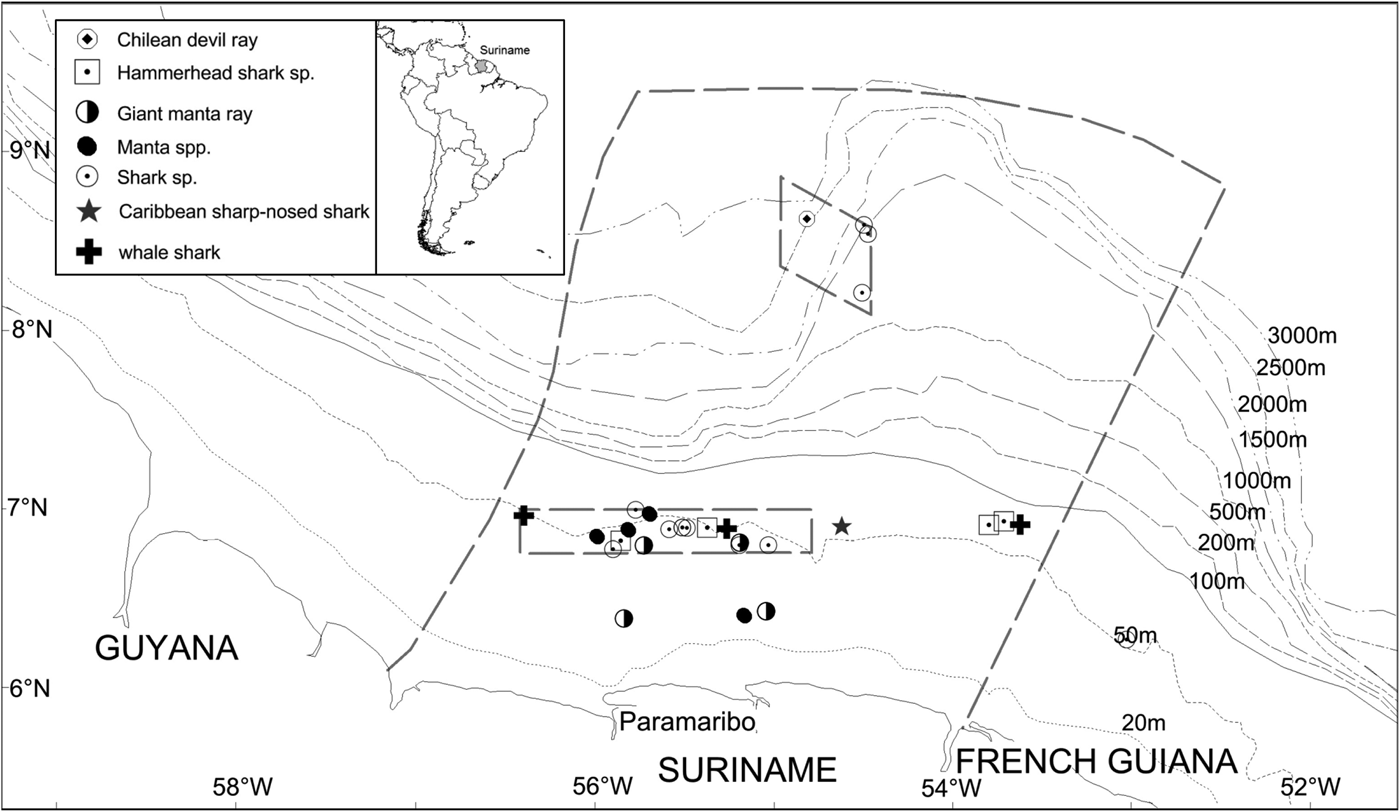
Map of large elasmobranch sightings recorded during both the marine fauna surveys and during transits outside the study areas. The Exclusive Economic Zone of Suriname (large dashes) and the two main study areas (small dashed boxes) are also shown together with isobaths up to 3000 m.

The North Brazil Current dominates the area and is characterized by large anti-cyclonic eddies. Upon reaching French Guiana this current splits; one branch diverges from the coast and joins the North Equatorial Counter Current, while the other branch continues flowing north-westwards to form the Guiana Current (Condie, Reference Condie1991). The coastal waters off Suriname are loaded with sediment from the Amazon River carried by this Guiana Current. Between the 30 and 60 m isobath the water is coloured green due to the high abundance of algae, whilst beyond the 60 m isobath the water is clear (Lowe-McConnell, Reference Lowe-McConnell1962; Teunissen, Reference Teunissen2000).
Survey design
Effort-related (dedicated) marine fauna observations were carried out within Suriname waters during three surveys from several geophysical survey vessels (surveys 1–3; Table 1). Incidental observations were also contributed from two additional geophysical surveys (surveys 4 and 5; Table 1); the authors were not present during these additional surveys and the methodology for these surveys was not specified.
Summary of surveys.
Multiple observers were involved with the data collection with MDB and JTS participating in surveys 1–3 and TPL in survey 1. None of the authors were present during surveys 4 and 5. Surveys 1–3 were effort-related (dedicated) marine fauna surveys, whereas observations made during surveys 4 and 5 are regarded as incidental sightings as survey methodology was not specified and no photographs were available.
Survey coverage was determined by the design of the geophysical surveys, which resulted in a series of parallel survey transects. During all surveys the coastal waters were occasionally surveyed opportunistically from supply vessels (MV Opal, MV Maria G and MV Elizabeth C) during transits to and from Paramaribo.
All research vessels operated with a survey speed of ca. 7.4 km h−1. During surveys 1–3, observational efforts were conducted from the bridge wings and foredeck (14 m above sea level) with two observers (survey 1) or one observer (survey 2–3) monitoring ahead and to the side of the vessel (for further information on cetacean survey methodology; De Boer, in press). Observations were carried out during all daylight hours (0900–2200 h UTC). Sightings data included the time (UTC), position (from GPS), water depth, species, group-size and initial range and bearing to the sighting. Environmental observations were collected during the survey, these included wind speed and direction (from the ship's wind instruments), swell height, visibility and Beaufort Sea State (estimated by eye). In surveys 1 and 2, the water depth was measured using an acoustic Doppler current profiler, while in the remaining surveys the vessels' echo sounders were used. When conditions allowed, marine fauna were photographed to confirm the species identification using Sony, Nikon and Canon DSLR cameras with 70–200 mm, 70–300 mm and 100–400 mm zoom lenses respectively.
RESULTS
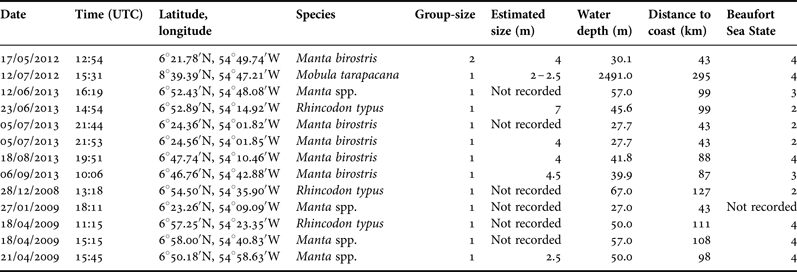
Most of the dedicated survey efforts in the coastal zones were carried out in waters between 40 and 50 m deep (69.2% of all efforts). A total of three Rhincodon typus, nine Manta spp. and one Mobula tarapacana were recorded (Table 2). Other species of elasmobranchs were also recorded, including four hammerhead sharks (Sphyrna sp.), one unconfirmed Caribbean sharpnose shark (Rhizoprionodon porosus) and 12 unidentified sharks.
Summary of whale shark and mobulid ray sighting records.
Manta spp. were most likely M. birostris but no photographs were available to substantiate species' identification.
Whale shark (Rhincodon typus)
On 23 June 2013, Rhincodon typus was observed and photographed approximately 99 km off the north coast of Paramaribo (Figure 1). During the sighting, R. typus swam just below the surface and slowly passed ahead of the bow of the vessel (Figure 2). The shark had an overall darkish colouration with distinct white dots and stripes and a large, broad and rounded head. The dorsal fin and tip of the caudal fin were exposed. The shark was believed to be ram-feeding (Rowat & Brooks, Reference Rowat and Brooks2012) although it was not possible to see if the mouth was open during the encounter. Two other incidental sighting records were made during surveys 4 and 5, but these were not substantiated by photographs. On both occasions, R. typus surfaced approximately 20–30 m away from the vessel but without breaking the surface. Both sharks were described as having an overall dark blue body with distinct white spotting; characteristics were consistent with the observers' identification of these sharks as R. typus. No further details were observed regarding any of the R. typus sightings due to the irregular sea surface distorting the view.
Whale shark Rhincodon typus photographed on 23 June 2013 (photograph © M.N. de Boer).
Giant manta ray (Manta birostris)
Of all the Manta sightings, Manta birostris was sighted on five occasions and verified by photographs (Figure 3). The following identification features were noted: (1) a large body size of 4–5 m W D; (2) a black dorsal surface; (3) very distinct shoulder patches present in the supra-branchial region; (4) these shoulder patches occurred on either side of a dark midline and were approximately triangular in shape; and (5) long curved pectoral fins. Occasionally the following features were also noted: (6) a distinct pale chevron-shaped patch in the region of the dorsal fin; (7) a white ventral surface visible during breaching events; and (8) white pectoral fins on ventral and dorsal surfaces exposed during surface feeding events. On 17 May 2012, a pair of M. birostris was recorded; these rays were following each other, swimming just below the surface and exposing the tips of their dorsal fins. On 5 July 2013, M. birostris was seen repeatedly leaping clear of the water. During surveys 4–5, four incidental sightings were made of Manta spp. (though they remained unidentified as they were unsubstantiated by photographs). All M. birostris sightings were made between 43 and 88 km from the coast and in shallow waters, ranging in depths of between 28 and 42 m. The records of unidentified Manta spp. were made in waters depths between 27 and 57 m.
Giant manta ray Manta birostris photographed on 18 August 2013: (A) pale chevron-shaped patch in the region of the dorsal fin; (B) distinct shoulder patches present in the supra-branchial region and exposed pale pectoral fin tips (photographs © J.T. Saulino).
Chilean devil ray (Mobula tarapacana)
On 12 July 2012, a single devil ray was observed and photographed approximately 295 km off the north coast of Paramaribo (Figure 1). The water depth was 2491 m and the Beaufort Sea State was 4. During the sighting the devil ray swam slowly just below the surface and was photographed as it passed down the vessel's portside (Figure 4). The following identification features were noted: (1) the devil ray had a sandy-brown/buff and slightly greenish dorsal colouration; (2) was estimated to be 2–2.5 m W D; (3) had an elongated ‘neck’; (4) an elongated posterior end to the disc; and (5) the cephalic fins were clearly visible and were pale in colour. No further details were observed due to the distortion of the view by the irregular sea surface.
Chilean devil ray Mobula tarapacana photographed on 12 July 2012: (A) sandy-brown/buff and slightly greenish dorsal colouration and elongated ‘neck’; (B) elongated posterior end to the disc (photographs © J.T. Saulino).
DISCUSSION
Understanding the distribution and migration patterns of Rhincodon typus, Mobula tarapacana and Manta birostris is essential in identifying important mating, breeding and feeding grounds and migration routes and in understanding the potential effects of fisheries on these iconic species. Our records of free-ranging elasmobranchs contribute to the poorly documented pelagic distribution of R. typus, Mobula tarapacana and Manta birostris within the WCR.
Within the WCR, R. typus are known to aggregate annually at feeding locations off Gladden Spit in Belize (Heyman et al., Reference Heyman, Graham, Kjerfve and Johannes2001; Graham & Roberts, Reference Graham and Roberts2007) and off the Yucatan Peninsula in Mexico (Motta et al., Reference Motta, Maslanka, Hueter, Davis, Parra, Mulvany, Habegger, Strothere, Mara, Gardiner, Tyminski and Zeigler2010; Ramírez-Macías et al., Reference Ramírez-Macías, Meekan, De La Parra-Venegas, Remolina-Suarez, Trigo-Mendoza and Vázquex-Juárez2012). More recently, dense aggregations of R. typus were recorded offshore, to the east of Contoy Island off the Yucatan Peninsula (de la Parra Venegas et al., Reference de la Parra Venegas, Hueter, Cano, Tyminski, Gregorio Remolina, Maslanka, Ormos, Weigt, Carlson and Alistair2011) and individuals are regularly sighted off Utila (Bay Islands) in Honduras (Fox et al., Reference Fox, Foisy, De La Parra Venegas, Galvan Pastoriza, Graham, Hoffmayer, Holmberg and Pierce2013). R. typus are known to feed on lutjanid snappers, spawning off the coast of Belize between March and May (Graham & Roberts, Reference Graham and Roberts2007; Heyman et al., Reference Heyman, Graham, Kjerfve and Johannes2001). Off the Yucatan Peninsula in Mexico, R. typus feed inshore on zooplankton blooms (Motta et al., Reference Motta, Maslanka, Hueter, Davis, Parra, Mulvany, Habegger, Strothere, Mara, Gardiner, Tyminski and Zeigler2010; Ramírez-Macías et al., Reference Ramírez-Macías, Meekan, De La Parra-Venegas, Remolina-Suarez, Trigo-Mendoza and Vázquex-Juárez2012) and further offshore they feed on tuna eggs (de la Parra Venegas et al., Reference de la Parra Venegas, Hueter, Cano, Tyminski, Gregorio Remolina, Maslanka, Ormos, Weigt, Carlson and Alistair2011). Off Venezuela, the highest concentration of R. typus records were from the Gulf of Cariaco, made during August–October, while a lesser peak in R. typus records was found in January–February (Romero et al., Reference Romero, Agudo and Salazar2000). The principal peak in occurrence in that study coincided with the period of greatest marine productivity in the area, as governed by wind-driven seasonal upwelling and inflow of freshwater from the Orinoco River. In the southern part of the Dutch Caribbean, R. typus have been reported in association with seasonal upwelling-driven productivity (Debrot et al., Reference Debrot, De Leon, Esteban and Meesters2013). R. typus has not been documented in Suriname previously. Local fishermen that were interviewed did not appear to be familiar with the species. Since records of shark catches are pooled and not specified by species, no useful information on the three species was forthcoming from fisheries bycatch data (Babb-Echteld et al., Reference Babb-Echteld, Chin-A-Lin and Charlier2000; Seijo, Reference Seijo2013). Within the region, R. typus are a known bycatch off Venezuela (Romero et al., Reference Romero, Agudo and Salazar2000). One of our R. typus sightings coincided with the full moon (23 June 2013), which is when R. typus have been reported to aggregate off Belize to forage on snapper spawn (Heyman et al., Reference Heyman, Graham, Kjerfve and Johannes2001; Graham & Roberts, Reference Graham and Roberts2007). One of the important commercial species in Suriname is the Caribbean red snapper (Lutjanus purpureus Poey, 1866), which spawns from May to August (though this can extend to October; Riley et al., Reference Riley, Holladay, Chesney and Tierscha2004). R. typus populating waters off Suriname may be attracted to a local area of high productivity in this coastal region whilst they are migrating through Suriname coastal waters to one of their main aggregation sites within the WCR (e.g. off Belize and off the Yucatan Peninsula). Little is known about the migration of R. typus between aggregations. Hueter et al. (Reference Hueter, Tyminski and de la Parra2013) attached both conventional and satellite tags to R. typus off the north-eastern corner of the Yucatan Peninsula in Mexico. These authors found tracks that predominately lead to areas within the Gulf of Mexico and the Caribbean Sea, however they also found one long track that left Mexico in August, continued through offshore waters and ended at the south of the Saint Peter and Saint Paul Archipelago, off the coast of north-eastern Brazil, in January.
Manta birostris is most commonly found in coastal waters with high productivity. Within the WCR, its presence is well documented off Venezuela (Notarbartolo-di-Sciara & Hillyer, Reference Notarbartolo-di-Sciara and Hillyer1989) and off the Yucatan Peninsula in Mexico (Graham et al., Reference Graham, Witt, Castellanos, Remolina, Maxwell, Godley and Hawkes2012). During aerial surveys off French Guiana it was the most commonly sighted megavertebrate species (Mannocci et al., Reference Mannocci, Monestriez, Bolanos, Doremus, Jérémie, Laran, Rinaldi, van Ganneyt and Ridoux2013). Our Manta birostris records were made in shallow waters (<42 m), while sightings of Manta spp. were made in waters with a depth of 27–57 m. Manta rays were observed mainly in the months of January and April to September. These records coincided with the two rainy seasons that occur in Suriname (short rainy season: early December to early February; and the long rainy season: late April to the middle of August; Amatali, Reference Amatali and Ouboter1993). The outflow of the Amazon and several Suriname rivers contribute nutrient-rich water and lower the salinity in the neritic zone (Eisma & Bennekom, Reference Eisma and van Bennekom1969). The species was recorded off Venezuela between March and December with sightings peaking towards the end of the rainy season (Notarbartolo-di-Sciara & Hillyer, Reference Notarbartolo-di-Sciara and Hillyer1989). Similar seasonal patterns were recently described for south-eastern Brazil where the occurrence of Manta birostris coincided with a low-salinity front generated by outflow from the La Plata River (Luiz et al., Reference Luiz, Balboni, Kodja, Andrade and Marum2009). The authors are unaware of any documented records of Manta birostris for Suriname, however, some local Suriname fishermen, interviewed during the present survey, were familiar with Manta birostris (using the common name ‘batfish’), suggesting that the species occurs regularly in the area. During most of our Manta birostris observations the rays were seen swimming just below the surface with their pectoral fins often curled up and protruding from the surface; characteristics we believed to be indicative of feeding. Our sample size is low, which is probably because the majority of the surveys took place in deep waters where this species is less common (Mannocci et al., Reference Mannocci, Monestriez, Bolanos, Doremus, Jérémie, Laran, Rinaldi, van Ganneyt and Ridoux2013). Nevertheless, our records suggest that the coastal waters off Suriname may be a feeding ground for this species, particularly during the rainy seasons.
Both Mobula tarapacana and Mobula hypostoma are known to occur in the tropical and sub-tropical Atlantic and the WCR (Clark et al., Reference Clark, Smith and Bizzarro2006a, Reference Clark, Smith and Bizzarrob; Bizzarro et al., Reference Bizzarro, Smith, Baum, Domingo and Menni2009). However, Mobula hypostoma reaches a maximum size of only 1.2 m W D and occurs primarily in coastal waters, although they may occasionally enter oceanic waters (Bizarro et al., Reference Bizzarro, Smith, Baum, Domingo and Menni2009), while Mobula tarapacana is larger (2–3 m W D) and has been reported in deep waters (>200 m) off Venezuela (Notarbartolo-di-Sciara & Hillyer, Reference Notarbartolo-di-Sciara and Hillyer1989). We are confident that our sighting can be identified as Mobula tarapacana and we base this identification on the following characteristics: (1) colour and size of the ray (all other Mobula rays with a light brown colouration are smaller in size); (2) the overall shape including specifically the elongated ‘neck’ and the elongated posterior end to the disc; and (3) the deep water habitat. Mobula tarapacana are predominantly oceanic (Thorrold et al., Reference Thorrold, Afonso, Fontes, Braun, Santos, Skomal and Berumen2014), but are occasionally recorded in coastal waters. Limited information is available for this broadly distributed ray (Clark et al., Reference Clark, Smith and Bizzarro2006a). Records known for this species in the western Atlantic are from Venezuela, Brazil, Mexico and the United States (Texas; Clark et al., Reference Clark, Smith and Bizzarro2006a). Sightings off Venezuela (21 records involving 32 animals) were made during aerial surveys between April and November (Notarbartolo-di-Sciara & Hillyer, Reference Notarbartolo-di-Sciara and Hillyer1989). Our record was made in July, the same month during which sightings peaked off Venezuela (Notarbartolo-di-Sciara & Hillyer, Reference Notarbartolo-di-Sciara and Hillyer1989). This is the first record for Suriname and its presence in the deep oceanic waters contributes to the documented distribution range of the species.
Manta birostris and R. typus are internationally classified as ‘Vulnerable’ species and the health of the populations of these species is now being examined accordingly. Shrimp trawling, snapper trawling and snapper long-lining take place in Suriname waters at depths of up to 80 m. In the Guianas there are clear signs of overexploitation of some species in fisheries, including L. purpureus, with declining catch rates and a decrease in the size of this species (Plouvier et al., Reference Plouvier, Gomes, Verweij and Verlinden2012). The pressure from fisheries on sharks and rays in Suriname is largely unknown as details of their catches in fisheries are often pooled and species are not specified (Babb-Echteld et al., Reference Babb-Echteld, Chin-A-Lin and Charlier2000; CARICOM, 2000; Seijo, Reference Seijo2013). However, it is known that sharks and rays are caught in trawl-gear and there are also large pelagic long-liners operating within the region that target elasmobranchs (Gillett, Reference Gillett2011; Seijo, Reference Seijo2013). Concerns have been raised over the bycatch of cartilaginous fish, including rays and sharks, in the Atlantic seabob shrimp (Xiphopenaeus kroyeri Heller, 1862) fishery off Suriname (Willems et al., Reference Willems, Depestele, De Backer and Hostens2013). This fishery consists of about 20 vessels that typically operate 15–35 km offshore in Suriname waters. Willems et al. (Reference Willems, Depestele, De Backer and Hostens2013) assessed the effectiveness of the recently installed net-adaptations including the Turtle Excluder Devices (TEDs) and Bycatch Reduction Devices (BRDs; square-mesh-window type) in the Suriname seabob shrimp trawling fishery. Fishermen do very occasionally catch Manta spp. in these fisheries (Willems, personal communication) but no Manta birostris were bycaught in that particular study, either during trawls fitted with TEDs and BRDs or during trawls without these (Willems et al., Reference Willems, Depestele, De Backer and Hostens2013). It was found that TEDs and BRDs seem effective in reducing the bycatch of large pelagic rays, but less effective in protecting smaller demersal rays, such as Gymnura micrura Bloch & Schneider, 1801, Dasyatis guttata Bloch & Schneider, 1801 and Urotrygon microphthalmum Delsman, 1941.
The seasonal appearance of large elasmobranchs such as mobulids and R. typus is often related to temporal variability in the abundance of their prey (Notarbartolo-di-Sciara, Reference Notarbartolo-di-Sciara1988; Taylor, Reference Taylor1996; Wilson et al., Reference Wilson, Taylor and Pearce2001). Zooplankton often congregates in areas where seasonal upwellings and fronts enhance the plankton productivity (Sims & Quayle, Reference Sims and Quayle1998; Wilson, Reference Wilson2004; Etnoyer et al., Reference Etnoyer, Canny, Mate, Morgan, Ortega-Ortiz and Nichols2006). The waters off Suriname are highly dynamic with eddies affecting local-scale currents further offshore. Furthermore, the region is influenced by the Amazon and several Suriname rivers (Gyory et al., Reference Gyory, Mariano and Ryan2005); this probably creates localized areas of enhanced productivity and perhaps temporal feeding grounds for these large elasmobranchs.
ACKNOWLEDGEMENTS
We thank all the observers and special thanks go to S. Milne (RPS Group), Y. Babb-Echteld (Fisheries Department of Suriname) and T. Willems (Instituut voor Landbouw en Visserijonderzoek) for their support and for providing contributing information. Of equal importance has been the support and goodwill of the crews of the Western Regent, Geo Celtic, Polarcus Naila, Maria G, Opal and Elizabeth C. Many thanks to D. Bolger and N. McMahon from Tullow Oil, N. Newton from INPEX/Teikoku Oil Suriname and M. Daal-Vogelland from Staatsolie. Opportunistic records, which were gratefully received, were contributed by Murphy Oil, RPS Group, Kosmos Energy and M.J. Barkaszi (CSA Ocean Sciences). Many thanks to S.J.P. Pierce and A.D. Marshall for reviewing an earlier draft of this manuscript.