Introduction
Older adults are susceptible to falls, with one in three older adults over the age of 65 years falling at least once each year (Morrison et al., Reference Morrison, Fan, Sen and Weisenfluh2013). The detrimental effects of falls are well known, ranging from increased morbidity and disability, a higher risk for hospitalization and institutionalization (Gill et al., Reference Gill, Murphy, Gahbauer and Allore2013) and even an increased risk for death due to fall-related injuries (Stevens et al., Reference Stevens, Corso, Finkelstein and Miller2006).
Past research has identified several risk factors for falls (Rubenstein, Reference Rubenstein2006; Ambrose et al., Reference Ambrose, Paul and Hausdorff2013; Chang and Do, Reference Chang and Do2015). These include certain medication, vision impairment, impairments in activities of daily living, gait and balance impairments, and cognitive impairments. Having a history of past falls is also a strong risk for future falls.
With the exception of fear of falling (Zijlstra et al., Reference Zijlstra, van Haastregt, van Rossum, van Eijk, Yardley and Kempen2007), the majority of research, to date, has focused on environmental, physiological, or biological risks for falling, with very limited attention given to psychosocial factors associated with falling (Chang et al., Reference Chang2004). This is unfortunate given the relative amenability to change of psychosocial factors compared with physiological or biological risk factors (Bryant et al., Reference Bryant, Bei, Gilson, Komiti, Jackson and Judd2014).
The present study evaluated the role of satisfaction with one's aging process (i.e. satisfaction with aging/attitudes towards aging) (Levy and Myers, Reference Levy and Myers2004; Ailshire and Crimmins, Reference Ailshire and Crimmins2011) in predicting risk for falling. Past research has shown that satisfaction with aging is a strong predictor of functional impairment (Sargent-Cox et al., Reference Sargent-Cox, Anstey and Luszcz2012), morbidity (Levy et al., Reference Levy, Slade and Kasl2002a; Moser et al., Reference Moser, Spagnoli and Santos-Eggimann2011), health behaviors (Levy and Myers, Reference Levy and Myers2004), and even mortality (Levy et al., Reference Levy, Slade, Kunkel and Kasl2002b).
Consistent with these epidemiological findings, there have been several intervention studies demonstrating the positive effects of improving attitudes towards aging on a variety of health outcomes including, physical activity (Wolff et al., Reference Wolff, Warner, Ziegelmann and Wurm2014), walking (Sarkisian et al., Reference Sarkisian, Prohaska, Davis and Weiner2007), and memory performance (Hess et al., Reference Hess, Hinson and Statham2004). However, despite the inherent promise in these interventions, a recent meta-analysis has shown that impacting negative age stereotypes has a greater effect on health behaviors than impacting positive age stereotypes (Meisner, Reference Meisner2012).
A contemporary theory suggested three potential pathways through which satisfaction with aging could impact one's health (Levy, Reference Levy2009). The firth pathway is a cognitive-psychological pathway which argues for the power of self-fulfilling prophecy. According to this argument, the belief that aging means decline and deterioration, negatively impacts one's health and well-being, whereas positive beliefs about aging are likely to result in positive health outcomes. A related, behavioral pathway suggests that having positive perceptions about old age makes one more susceptible to engaging in positive health behaviors and vice versa. Finally, the third pathway concerns the autonomic nervous system, which is thought to be differentially affected by one's images of old age.
To date, only one study restricted to individuals between the ages of 65 years and 70 years has assessed the predictive value of satisfaction with aging with regard to falls. That study resulted in inconclusive findings, possibly due to its limited age range (Moser et al., Reference Moser, Spagnoli and Santos-Eggimann2011). The present study adds to existing knowledge by examining the role of satisfaction with aging in predicting falls in a large US nationally represented sample of individuals over the age of 50 years. To identify explanatory mechanisms, the mediating roles of physical activity and activities of daily living/instrumental activities of daily living (ADL/IADL) were evaluated. It was hypothesized that the effect of satisfaction with aging is partially accounted for by its effect on these variables (Levy and Myers, Reference Levy and Myers2004; Sargent-Cox et al., Reference Sargent-Cox, Anstey and Luszcz2012; Stephan et al., Reference Stephan, Sutin, Caudroit and Terracciano2015), which have shown to predict falls in past research (Grenier et al., Reference Grenier, Payette, Langlois, Vu and Bherer2014; Kaminska et al., Reference Kaminska, Brodowski and Karakiewicz2015).
Methods
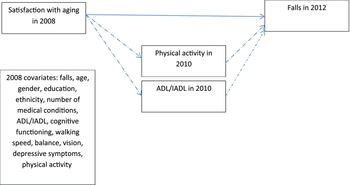
The HRS is a biannual longitudinal panel of US nationally representative individuals over the age of 50 years and their spouses of any age. The HRS is supported by the National Institute on Aging (NIA U01AG009740) and the Social Security Administration. The satisfaction with aging questionnaire was first administered in 2008 as part of the psychosocial questionnaire, which is administered every four years to approximately half the sample. Follow-up data from 2012 were used to assess risk for falling. To assess mediation, physical activity, and ADL/IADL evaluated in 2008 and 2010 were used. See Figure 1 for details.
Activities of daily living/instrumental activities of daily living (ADL/IADL) and physical activity as mediators of the relationship between satisfaction with aging and the risk for fallingFootnote 1 .

Measures
Outcome
Participants were asked if they had fallen down in the past two years (1 = yes, 0 = no).
Independent variable
An eight-item measure of attitudes towards aging was used as an indicator of satisfaction with aging. The first five questions (e.g. “things keep getting worse as I get older;” “I have as much pep as I had last year;” “as I get older things are better than I thought they would be;” “I am as happy now as I was when I was younger;” “the older I get the more useless I feel”) were taken from the “Attitude Toward Own Aging” subscale of the Philadelphia Geriatric Center Morale Scale (Lawton, Reference Lawton1975), and the remaining questions (e.g. “so far, I am satisfied with the way I am aging;” “the older I get the more I have to stop doing things that I liked;” “getting older has brought with it many things that I do not like”) were used in other studies e.g. (Ailshire and Crimmins, Reference Ailshire and Crimmins2011). A composite mean score was calculated after reverse-scoring relevant items, so that a higher score indicated greater satisfaction with aging. This measure has a range between 1 and 6, with a higher score indicating better attitudes (Cronbach's α = 0.82). It has adequate criterion validity by its associations with health status, loneliness (Ailshire and Crimmins, Reference Ailshire and Crimmins2011), and preventive health service use (Kim et al., Reference Kim, Moored, Giasson and Smith2014).
Mediators
Six difficulties in performing activities of daily living (e.g. walking, bathing, getting in/out of bed) and five difficulties in performing instrumental activities of daily living (e.g. making phone calls, taking medication) were assessed (Juster and Suzman, Reference Juster and Suzman1995). Range was between 0 and 11, with a higher score indicating greater impairment (Cronbach's α = 0.88).
An average score of vigorous, moderate, and mild physical activity was calculated on a five-point scale, with higher scores representing more frequent activity (Jenkins et al., Reference Jenkins, Ofstedal and Weir2008).
Covariates
Depressive symptoms were measured using eight Center for Epidemiologic Studies Depression Scale (CES-D) items (Radloff, Reference Radloff1977; Steffick, Reference Steffick2000). A composite score was calculated after reverse coding relevant items so that a higher score represents more depressive symptoms (Cronbach's α = 0.80).
A composite score of the overall number of medical conditions (e.g. high blood pressure, diabetes, cancer) was constructed (Fisher et al., Reference Fisher, Faul, Weir and Wallace2005). Range was between 0 (having no medical conditions) and 6 (having all six conditions).
A composite cognitive functioning score was based on four cognitive tasks (Ofstedal et al., Reference Ofstedal, Fisher and Herzog2005). Immediate recall was evaluated by reading a list of ten nouns to participants and then asking participants to immediately recall the words. Five minutes afterwards, participants were asked to recall the list (i.e. delayed recall). The overall number of words recalled correctly was counted for the two recall tasks. Participants were also asked to count backward from a certain number and to subtract 7 from a number five times. Range was between 0 (severe impairment) and 26 (perfect performance) (Cronbach's α = 0.64).
Visual impairment was gathered based on self-report. Respondents were asked to rate their eyesight, including distal and near vision on a five-point scale, with a higher score representing better eyesight. An average composite score was calculated (Cronbach's α = 0.85).
Balance was assessed by instructing participants to stand up with the side of the heel of one foot touching the big toe of the other foot for 10 seconds (Crimmins et al., Reference Crimmins, Guyer, Langa, Ofstedal, Wallace and Weir2008). Range was between 0 and 10, with higher score indicating better balance.
Walking speed was measured as participants walked a 98.5 inch course twice (Crimmins et al., Reference Crimmins, Guyer, Langa, Ofstedal, Wallace and Weir2008). The two measures were averaged, with a higher score indicating faster walking speed.
Demographic characteristics
Age in years, gender, years of education, and ethnic origin (White, Latino, Black, or other) were gathered based on self-report.
Analysis
Logistic regression analyses were conducted. The 2008 satisfaction with aging score was entered as a predictor. In the adjusted models, all covariates assessed in 2008 were entered (e.g. age, gender, education, ethnicity, medical conditions, physical activity, depressive symptoms, ADL/IADL impairments, cognitive functioning, walking speed, balance, and vision). The same analyses were repeated with having fallen assessed in 2008 and 2012 as outcomes. To predict falls in 2012, baseline falls evaluated in 2008 was included as a potential covariate in the fully adjusted model. Potential interactions between satisfaction with aging, age, sex, and falls in 2008 were examined, but were non-significant.
Mediation was examined using bootstrapping, with n = 5,000 bootstrap resamples to test whether physical activity and ADL/IADL evaluated in 2010 mediated the relationship between satisfaction with aging assessed in 2008 and the risk for falls assessed in 2012, controlling for all potential covariates. Bootstrapping resamples the data 5,000 times and estimates the indirect effect in each sample to obtain an estimation of the indirect effect and its 95% confidence intervals (CI) (Kenny, Reference Kenny2013). When the 95% CI does not contain zero, the effect is considered significant.
In an additional sensitivity analysis, falls in 2008 were examined as potential predictors of satisfaction with aging assessed in 2012. All analyses were weighted and stratified to account for the complex survey design. Analyses were conducted in Stata 13 (StataCorp, 2013).
Results
Compared with those over the age of 50 years who were eligible to complete the psychosocial questionnaire in 2008, but did not complete the satisfaction with aging questionnaire (n = 1,279), those who completed it (n = 6,816) were significantly younger (mean[SE] = 67.3[0.19] vs. mean[SE] = 72.3[1.48], F[1,56] = 11.63, p < 0.001), more educated (mean[SE] = 12.8[0.53] vs. mean[SE] = 11.5[0.10], F[1,56] = 6.44, p < 0.05), had fewer ADL/IADL impairments (mean[SE] = 0.78[0.03] vs. mean[SE] = 1.73[0.31], F[1,56] = 9.37, p < 0.05) and better cognitive functioning (mean[SE] = 13.48[0.10]vs. mean[SE] = 10.11[0.66], F[1,52] = 26.01, p < 0.001). Relative to ethnic minorities, Whites were more likely to complete the satisfaction with aging questionnaire (80.1% White among completers vs. 72.6% among non-completers, χ 2[df] = 11.0[3], p < 0.05).
Of those eligible to the 2008 psychosocial questionnaire over the age of 50 years, 4,121 had fall data in 2008 and 2012 and 1,407 had fall data available only in 2008. Those who had fall data available on both waves were significantly younger (mean[SE] = 73.9[0.16] vs. mean[SE] = 79.0[0.36], F[1,52] = 165.8, p < 0.001), more educated (mean[SE] = 12.5[0.16] vs. mean[SE] = 11.7[0.13], F[1,52] = 30.86, p < 0.001), suffered from fewer medical conditions (mean[SE] = 1.5[0.02] vs. mean[SE] = 2.0[0.04], F[1,52] = 109.72, p < 0.001), had fewer ADL/IADL impairments (mean[SE] = 0.75[0.04] vs. mean[SE] = 2.2[0.13], F[1,52] = 130.65, p < 0.001), and better cognitive functioning (mean[SE] = 13.2[0.11] vs. mean[SE] = 10.9[0.18], F[1,52] = 137.27, p < 0.001) than those with fall data available only in 2008. Those with fall data on both waves were more likely to be White (83.3% vs. 81.8% respectively, χ 2 [df] = 17.3[3], p < 0.01).
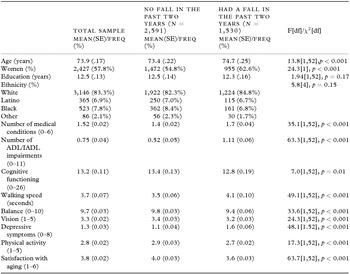
All analyses were restricted to 4,121 respondents over the age of 50 years, who had fall data on both waves and were eligible to complete the 2008 psychosocial questionnaire. Overall, 38.1% of the sample reported having fallen at least once between 2006 and 2008 and 40.7% reported having fallen at least once between 2010 and 2012. With the exception of education and ethnicity those who said “yes” to having fallen down over the past two years in 2008, were significantly different from those who had no falls (see Table 1). In general, those who had a fall were older, more likely to be women and scored less favorably on all health indicators.
Baseline characteristics of the sample (n = 4,121)

ADL/IADL-activities of daily living/instrumental activities of daily living.
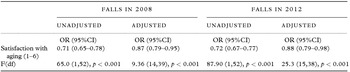
Lower levels of satisfaction with aging predicted falls in the cross-sectional and in the longitudinal design even after adjustment (see Table 2). Of note is that in the fully adjusted model, only having a history of past falls (OR [95%CI] = 3.00[2.52–3.57]), being Black rather than White (OR[95%CI] = 0.65[0.45–0.94]) and ADL/IADL impairments (OR[95%CI] = 1.23[1.10–1.38]) exceeded the predictive ability of satisfaction with aging. In contrast, the positive effect of satisfaction with aging was greater than the actual effects of age (OR[95%CI] = 1.03[1.02–1.05]). No other risk factors remained significant in the fully adjusted model.
2008 Satisfaction with aging as a predictor of falls in 2008 and 2012

Logistic regression analyses were conducted.
OR(95%CI) = Odds Ratio(95%Confidence Interval).
Logistic regression analyses were adjusted for age, gender, education, ethnicity, number of medical conditions, ADL/IADL impairments, cognitive functioning, walking speed, balance, depressive symptoms, physical activity, and vision. To predict falls in 2012, analysis was also adjusted for falls in 2008.
ADL/IADL-activities of daily living/instrumental activities of daily living.
To assess for mediation, a significant effect of satisfaction with aging assessed in 2008 on ADL/IADL assessed in 2010 (Beta[SE] = −0.05[0.02], p = 0.04) and on physical activity assessed in 2010 (Beta[SE] = 0.09[0.02], p < 0.001) was established, after controlling for all covariates assessed in 2008 (e.g. age, gender, education, ethnicity, medical conditions, physical activity, depressive symptoms, ADL/IADL impairments, cognitive functioning, walking speed, balance, and vision). A significant effect of ADL/IADL assessed in 2010 on falls assessed in 2012 was established even after controlling for all covariates (OR[95% CI] = 1.14[1.02–1.21]), but not for physical activity assessed in 2010 (OR[95%CI] = 0.98[0.84–1.15]). Hence, the indirect effect of ADL/IADL assessed in 2010 on falls in 2012 was significant (unstandardized coefficient [95% bias-corrected CI] = −0.005[−0.01–0.007]), but not the indirect effect of physical activity (unstandardized coefficient [95% bias-corrected CI] = −0.001[−0.003–0.007]). The overall direct effect of satisfaction with aging remained significant (unstandardized coefficient [95% bias-corrected CI] = −0.08[−0.12–0.03]) and so did the total effect (unstandardized coefficient[95% bias-corrected CI] = −0.08[−0.13–0.03]).
In an additional sensitivity analysis, falls assessed in 2008 were examined as potential predictors of satisfaction with aging in 2012, but had no significant effect (Beta[SE] = −0.07[0.04], p = 0.08) in the fully adjusted model.
Discussion
Because falls are associated with increased morbidity and mortality, substantial efforts are in place to reduce the risks for falling in older adults (Gillespie et al., Reference Gillespie2009). To date, most of these efforts have been geared towards improving balance and physical activity and reducing environmental barriers. The present study points to a new direction for potential interventions. The findings suggest that the subjective experience of satisfaction with one's aging process is protective against falls, not only in a cross-sectional design, but also over time. Further support for the direction of the effect from satisfaction with aging to falls and not vice versa was established as falls assessed in 2008 were a non-significant predictor of satisfaction with aging assessed in 2012 in the fully adjusted model.
In an attempt to explain the mechanisms behind the association between satisfaction with aging and falls, the present study shows that greater satisfaction with aging results in less physical impairment which in return, also reduces the risk for falling. Although physical activity was associated with satisfaction with aging, it did not predict falls in the fully adjusted model and did not mediate the effects of satisfaction with aging. Hence, the study's hypotheses regarding the mediating roles of physical functioning and physical activity were only partially supported.
Even though the HRS is a nationally representative sample, the generalizability of the present study is somewhat impaired by the fact that most covariates examined in the present study were associated with whether or not fall and satisfaction with aging data were available on both waves. In addition, the reliance on subjective information concerning falls could potentially result in under-report due to shame or stigma. Moreover, the reliance on one's recall of falls that occurred over a period of two years has likely resulted in substantial omissions due to memory slips. Another potential limitation concerns the fact that the sensitivity analysis spans over a longer period of time than the main analysis. This is because fall data between 2006 and 2008 are used to predict satisfaction with aging in 2012, whereas in the main analysis, satisfaction with aging assessed in 2008 is used to predict falls between 2010 and 2012. Finally, although the potential role of several covariates was addressed in the present analysis, medication use, which has shown to be associated with falls in past research (Kelly et al., Reference Kelly2003), was not accounted for in this analysis. Nonetheless, the findings point to the important role of satisfaction with aging as a potential protective mechanism against falls. This association is partially mediated through its effects on physical functioning.
The results call for further development of psychosocial interventions geared towards reducing falls in older adults. One potential direction for intervention could be through improving one's attitudes towards aging (Wolff et al., Reference Wolff, Warner, Ziegelmann and Wurm2014). A recent intervention study has shown that physical activity can be increased by improving one's views on aging through the provision of positive information about old age or by challenging automatic thinking (Wolff et al., Reference Wolff, Warner, Ziegelmann and Wurm2014). Consistently, other interventions geared towards improving attitudes towards aging have resulted in improved walking activity (Sarkisian et al., Reference Sarkisian, Prohaska, Davis and Weiner2007), walking speed, and swing time (Hausdorff et al., Reference Hausdorff, Levy and Wei1999). These results combined with the present study point to attitudes towards aging as a potentially important venue for intervention among older adults.
Conflict of interest
None.