Introduction
Endoscopic surgical procedures have revolutionised the field of otorhinolaryngology by providing the surgeon with wide visualisation, better accessibility to difficult sites and precise movements. In transnasal endoscopic surgical procedures, the surgeon relies heavily on the unobstructed view through the endoscope, given the absence of decent tactile feedback.
Often, the lens of the endoscope becomes fogged or smeared with mucus or blood, and the surgeon has to clean the lens and reintroduce the endoscope multiple times during the surgery, which makes it a cumbersome and tiring process. In routine endoscopic surgery, it was found that 37 per cent of the operative time was spent under impaired endoscopic views, and 7 per cent was used for cleaning the lens.Reference Yong, Grange and Eldred-Evans1
Such an obstacle may significantly impair the performance and judgement of the surgeon, thereby impairing patient care. Numerous methods have been devised to clean the endoscope lens during surgery, from wiping with gauze and coating with repellent solutions to advanced lens irrigation systems.
This article introduces a novel lens irrigation system, which can be easily assembled within minutes from consumables readily available in a standard operating theatre, even in a low-resource setting. Such a system, we believe, will provide an uninterrupted view of the surgical field by flushing blood and mucus smudges away from the lens tip, and, in turn, contribute to improved surgical outcomes.
Materials and methods
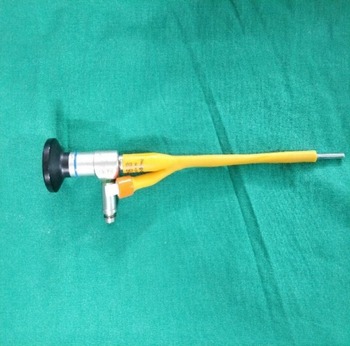
Our novel lens irrigation system comprises a modified 16 Fr Foley catheter, a 20 cc or 50 cc syringe filled with warm normal saline (0.9 per cent), and a commercially available intravenous infusion set. We chose a 16 Fr Foley catheter as it has an outer diameter of 5.3 mm, which in our experience, is apt to snugly fit a standard rigid nasal endoscope of 4 mm diameter (Figure 1).
A 16 Fr Foley catheter, with an outer diameter of 5.3 mm, mounted on a standard rigid nasal endoscope of 4 mm diameter.

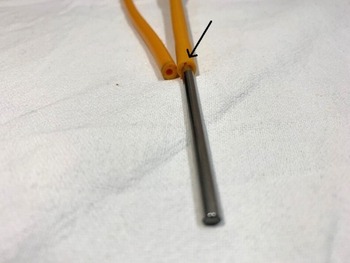
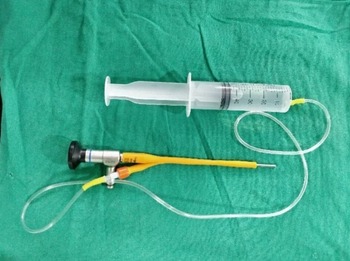
Just before commencing the insertion of the endoscope into the Foley catheter, the tip of the catheter is cut proximal to the inflating balloon. A small incision is made at the partition between the two ports of the catheter, at the tip, to ensure that the irrigating fluid slides along the surface of the endoscope (Figure 2). Next, the rigid endoscope is introduced into the catheter through the urine draining port until the tip of the endoscope is about 8–10 cm distal to the cut end. The catheter is aligned in such a way that the irrigating port lies above the endoscope. Finally, the irrigating syringe filled with warm normal saline solution is connected to the balloon inflating port via the infusion set. This completes the lens irrigation system (Figure 3).
A small incision is made at the partition between the two ports of the catheter (arrow), at the tip. A reference Foley catheter is placed alongside for comparison.

The complete lens irrigation system.

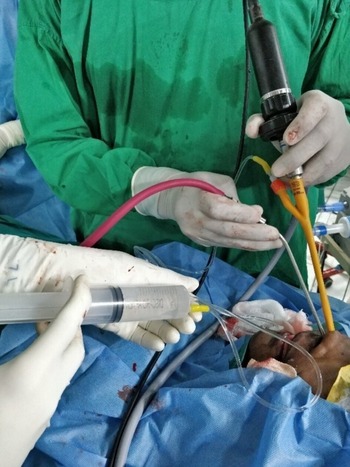
In the instance where the lens of the endoscope gets smudged with blood or mucus, the assistant holds the irrigating syringe and pushes the plunger; this forces the irrigating saline through the inflating port and out through the cut end (Figure 4). The saline then traverses the surface of the endoscope by surface tension, thereby flushing out the residues at the lens tip.
The assistant is shown holding the irrigating syringe and pushing the plunger, which forces the irrigating saline through the inflating port and out through the cut end.

Results
Optimal clear vision was restored immediately on flushing the syringe. The force of irrigation could easily be controlled by the syringe plunger. This property enables the system to act as a point irrigator as well. The system was found to be ergonomically sound. It does not add any significant weight to the endoscope, thanks to the lightness of the Foley catheter, nor does it increase the working diameter of the scope, as the cut end of the Foley catheter is kept outside the nasal vestibule.
Discussion
Various methods have been devised to tackle the troublesome issue of lens fouling and smudging during endoscopic nasal surgical procedures. The most common method is manual wiping of the lens tip with gauze soaked in saline or anti-fogging solution such as a soap solution. However, this requires frequent withdrawal and reinsertion of the endoscope, leading to prolonged operating time and excessive physical stress to the surgeon. Moreover, frequent rubbing with the gauze can scratch the lens, thereby permanently damaging the endoscope and impairing the vision.
Modifications of this wiping method have been reported in several articles. For instance, the EndoClear® lens cleaning system, invented by Cassera et al.,Reference Cassera, Goers, Spaun and Swanström2 is secured inside the body cavity of concern, and the endoscope lens is cleaned with it whenever the lens tip gets fogged or smudged. This method has very limited application in endonasal surgical procedures given the small working space within the nasal cavity.
Lens irrigation systems are a promising alternative to manual wiping. Irrigation systems and the hydrophobic or hydrophilic coating of lens tips are the most effective methods for achieving surface cleanliness in endoscope lenses.Reference Kreeft, Arkenbout, Henselmans, van Furth and Breedveld3 Two such systems available are the K-Endosheath® and Endosplash®. The former is a straw sheath system with separate ports for simultaneous irrigation and suction, primarily used for endoscopic transnasal pituitary surgical procedures.Reference Kubo, Kikawada, Hasegawa, Tominaga and Yoshimine4 Though it is a sophisticated lens irrigation system, it has the disadvantage of increasing the overall thickness of the endoscope, thereby compromising the operating space. Endosplash, on the other hand, is a three-dimensional printed polymeric cylindrical fitting, with three ports – one for fluid inlet, one for the endoscope and one for fluid outlet.Reference Kuroda, Nakajima, Yamaguchi and Watanabe5 It provides adequate lens cleaning and does not compromise the operating space. The issue with this system is that the fluid has to traverse the entire length of the scope, where it may be hindered before it reaches the tip. The major drawbacks of both these systems are the complexities in production, cost and availability, especially in a low-resource setting.
Our lens irrigation system tackles all the above-mentioned drawbacks while combining the advantages. Its parts are readily available, cost-effective, easy to assemble and effortless to use. Tapering the Foley catheter and inserting the endoscope through it requires only minimal skills, and can be performed easily by nursing or paramedical staff. Moreover, the system is intended for one-time use, and a new assembly can be set up instantly for subsequent cases. Hence, there is no concern about losing sterility.
The idea of incorporating a suction port to the system to clear out the irrigating fluid from the operative field, as in the K-Endosheath, was earnestly considered in the initial stage of development. However, this was found to have a detrimental rather than beneficial effect. The negative pressure from the suction port will suck all the fluid and debris towards the lens tip, resulting in further lens fouling, thereby negating the system's very objective.
Conclusion
Better visualisation and an unhindered view are imperative to any endoscopic surgery. This innovative lens irrigation system saves the time spent cleaning the lens by manual wiping. It improves operational efficiency by reducing the number of endoscope removals and reinsertions. This device, we hope, will enhance the quality and shorten the learning curve in transnasal endoscopic surgical procedures, especially in low-income settings.
Competing interests
None declared