Introduction
Falls and fall-related injury continue to be a major challenge for healthcare systems internationally. Approximately 30% of adults aged 65 years and over fall at least once each year and the prevalence increases to nearly 50% in those aged over 85 years (Campbell et al., Reference Campbell, Reinken, Allan and Martinez1981). Falls may result in fractures, excessive fear of further falls, social isolation, reduced quality of life, need for institutional care, and death. The economic cost of falls is considerable and the approaching impact of fall-related injury due to worldwide population aging has been characterized as a potential “epidemic” creating resource demands that will be difficult to meet (Moller, Reference Moller2002).
Cognitive impairment and dementia in older people are also highly significant healthcare problems. Dementia affects approximately 5%–7% of people aged over 60 years (Wimo and Prince, Reference Wimo and Prince2010) and has major impacts on sufferers, their carers, and healthcare systems. The estimated cost of dementia worldwide for 2010 was $604 billion (Wimo and Prince, Reference Wimo and Prince2010). With changing demography and higher rates of diagnosis, prevalence of dementia is expected to almost double every 20 years from 2010, resulting in a projected 115.4 million people worldwide living with dementia by 2050 (Wimo and Prince, Reference Wimo and Prince2010).
Cognitive impairment and dementia are known risk factors for falls (Tinetti et al., Reference Tinetti, Speechley and Ginter1988). The incidence of falls in cognitively impaired older adults is more than twice that of their cognitively intact counterparts (Tinetti et al., Reference Tinetti, Speechley and Ginter1988; Allan et al., Reference Allan, Ballard, Rowan and Kenny2009). Cognitively impaired individuals are also more likely to have injurious falls with an up to three-fold increased incidence of hip fracture (Baker et al., Reference Baker, Cook, Arrighi and Bullock2011). Higher rates of mortality and institutionalization after falls have also been reported in this group (Lord, Reference Lord, Ward, Williams and Anstey1994; Baker et al., Reference Baker, Cook, Arrighi and Bullock2011).
The reasons for increased fall risk in older people with cognitive impairment and dementia are still unclear. A number of studies have examined components of motor function in cognitively impaired older adults and have reported a high prevalence of gait and balance impairments (Waite et al., Reference Waite, Broe, Grayson and Creasey2000; Pettersson et al., Reference Pettersson, Olsson and Wahlund2005; Boyle et al., Reference Boyle2007). A recent study examined physical differences between 25 participants with Alzheimer's disease and age-sex matched controls using a range of balance, functional and fall risk assessment tools including the Physiological Profile Assessment (PPA) (Suttanon et al., Reference Suttanon, Hill, Said, Logiudice, Lautenschlager and Dodd2012). They reported significant differences in reaction time, strength, balance, gait, and functional measures as well as overall fall risk scores. The PPA is a validated measure of fall risk with the ability to identify future multiple fallers in community settings with an accuracy of up to 75% (Lord et al., Reference Lord, Menz and Tiedemann2003). While used predominantly with cognitively intact populations, preliminary studies have shown that this assessment is feasible for use in people with Alzheimer's disease (Lorbach et al., Reference Lorbach, Webster, Menz, Wittwer and Merory2007) and other forms of cognitive impairment (Whitney et al., Reference Whitney, Lord and Close2005).
The aim of this case control study was to compare physiological and functional performance measures in cognitively impaired and age and sex matched cognitively intact older adults. We hypothesized that older people with cognitive impairment would have multiple physiological and functional impairments and significantly increased composite physiological fall risk scores. If this is found to be the case, then targeted intervention addressing known physical fall risk factors may be of benefit in reducing falls in this high-risk population.
Methods
Participants
Cognitively Impaired Group (CIG)
One hundred and thirty-eight cognitively impaired older people were recruited from a number of sources, i.e. health service settings, community services, and responders to newspaper advertisements and media coverage. Inclusion criteria were: (1) aged 60 years and above, (2) living in the community, (3) absence of recent stroke (within 18 months), Parkinson's disease or other neuro-degenerative disorders (excluding dementia), (4) sufficient knowledge of the English language to complete the assessments, and (5) no known end stage illness. Participants had to be medically stable at home for at least six weeks prior to assessment.
Cognitive impairment was defined as a Mini-Mental State Examination (MMSE) score of <24, or an Addenbrooke's Cognitive Examination – Revised (ACE-R) (Mioshi et al., Reference Mioshi, Dawson, Mitchell, Arnold and Hodges2006) score <83 or a diagnosis of cognitive impairment or dementia by a specialist clinician. All cognitively impaired participants had an identified and willing “person responsible” with at least 3.5 hours of face-to-face contact per week. Participants and their person responsible consented to participate prior to assessment.
Cognitively Intact Group (NCIG)
Data for 276 age and gender matched cognitively intact participants were randomly selected from the databases of three previous cohort studies conducted at Neuroscience Research Australia (Lord et al., Reference Lord, Clark and Webster1993; Reference Lord2005; Delbaere et al., Reference Delbaere, Close, Brodaty, Sachdev and Lord2010). Participants for these studies were recruited from the electoral roll, local advertisements, and community groups. Inclusion criteria were: (1) aged 60 years and above, (2) living in the community, (3) having an MMSE score ≥ 24, and meeting the co-morbidity and language inclusion criteria required for the CIG. Power analysis was performed using the mean and standard deviation (SD) values for coordinated stability from a previous study (Lorbach et al., Reference Lorbach, Webster, Menz, Wittwer and Merory2007) (two-tailed test, 1% significance level, 90% power). This indicated that a sample size of 200 was required to detect a difference of 6.2 in coordinated stability error score. The study had Ethics Committee approval and consent was obtained from all participants and their person responsible prior to assessment.
Assessments
The questionnaires and physical assessments were administered typically over two sessions (one assessment conducted in the participant's home and one within the gait laboratory at Neuroscience Research Australia) with two research assistants trained in the correct and standardized method for all tests. The socio-demographic and medical information was obtained from participants and/or their person responsible in a structured interview (Table 1).
Participant characteristics

SD – Standard deviation, MMSE – Mini-Mental State Examination. CNS – Central Nervous System.
astroke >18 months prior to study commencement.
Sensorimotor and Reaction Time Tests
Participants underwent assessments of vision, sensation, muscle strength, and reaction time. Visual contrast sensitivity was assessed using the Melbourne Edge Test (Lord et al., Reference Lord, Menz and Tiedemann2003). Proprioception was measured using a composite lower limb task, involving primarily the knee and ankle joints (Lord et al., Reference Lord, Menz and Tiedemann2003). In this test, seated participants, with their eyes closed, are asked to align their lower limbs simultaneously on either side of a vertical clear acrylic sheet (60 × 60 × 1 cm) inscribed with a protractor and placed between their legs. Errors in degrees in matching the position of the great toes were recorded. Maximal knee extension strength in kilogram force was measured in the dominant leg with participants’ seated using a spring gauge (Lord et al., Reference Lord, Menz and Tiedemann2003). The angle of the hip to the knee was 90° and the best of three trials was recorded. The maximum grip strength was recorded with a hand-held dynamometer (North Coast™ Hydraulic Hand Dynamometer, North Coast Medical Inc., CA, USA) as the best of three trials in kilograms. Simple reaction time was measured using a visual stimulus and a finger-press as the response; the average of ten trials was recorded in milliseconds (Lord et al., Reference Lord, Menz and Tiedemann2003).
Balance Tests
Balance was evaluated barefoot using tests of postural sway, coordinated stability, and near tandem standing. Postural sway was measured using a swaymeter that measured displacements of the body at the level of the waist for 30-second period. Testing was performed with participants standing on the floor and a foam rubber mat (65 cm × 65 cm × 15 cm thick) with eyes open (Lord et al., Reference Lord, Menz and Tiedemann2003). The coordinated stability test measured the participant's ability to adjust body position in a steady and coordinated way while placing them at or near the limits of their base of support (Lord et al., Reference Lord, Ward and Williams1996). In this test, the swaymeter was attached to the participant at waist level with the rod extending arteriorly, so that a pen at the end of the rod rested on a piece of paper attached to an adjustable-height table. Participants were then asked to adjust the position of their body without moving their feet so that the pen followed and remained within a convoluted track marked on the piece of paper. To complete the test without errors, participants had to remain within the 1.3-cm wide track and, therefore, be capable of adjusting the position of the pen 29 cm laterally and 18 cm anteroposteriorly. A total error score was calculated by summing the number of occasions that the pen on the swaymeter failed to stay within the path. Where participants failed to negotiate an outside corner, five additional points were accrued. This score was corrected for body height (score × (participant height/average height of sample)). Participants attempted the test twice, with the better trial taken as the test result. The near tandem standing test assessed participants’ ability to stand with their feet separated laterally by 2.5 cm and the heel of the front foot 2.5 cm anterior to the great toe of the back foot (eyes open, barefoot) for up to a maximum period of 10 seconds.
Fall Risk Profile
In addition to the individual physiological tests, a fall risk score was computed for each participant using a discriminant function that comprises weighted scores from the postural sway on foam, reaction time, knee extension strength, proprioception, and visual contrast sensitivity tests (Lord et al., Reference Lord, Menz and Tiedemann2003). This measure has been shown to have up to 75% accuracy in predicting multiple falls in older people (Lord et al., Reference Lord, Menz and Tiedemann2003). Fall risk scores below zero indicate a low risk of falling, scores between 0 and 1 indicate a mild risk of falling, scores between 1 and 2 indicate a moderate risk of falling, and scores above 2 indicate a high risk of falling.
In addition to a direct comparison of sensorimotor and balance performance between the CIG and the NCIG, we also looked at performance in the CIG against population normative data for the PPA. For the CIG, each of the continuously scored physiological test results were converted to standardized (Z) scores, using reference data from previous population studies (Lord et al., Reference Lord1991; Reference Lord1994a; Reference Lord, Ward, Williams and Anstey1994b). According to this reference data, a score of zero in each test indicates average performance for people aged 65 years and over, positive scores indicate above average performances, and negative scores indicate below average performances. Each unit represents one standard deviation, and as the scores have been standardized, results from different tests can be compared with each other.
Functional mobility
Functional mobility was assessed with the timed up and go (TUG) (Podsiadlo and Richardson, Reference Podsiadlo and Richardson1991) and five repetition sit-to-stand (STS) (Lord et al., Reference Lord, Murray, Chapman, Munro and Tiedemann2002) tests. Occasional prompts were needed to encourage the cognitively impaired participants to continue with the task. TUG was assessed by asking participants to rise from a 45-cm-high chair with armrests, walk forward three meters at their usual pace, turn 180°, walk back to the chair, and sit down. Steps to turn 180° during the TUG were recorded, the research assistant timing the task also counted the number of steps to turn. In the STS test, participants were asked to rise from a standard height chair (45 cm) with their arms folded, five times, as fast as possible. Arm use was permitted if participants were unable to complete the task with their arms folded. Upper limb use was recorded.
Full descriptions of the sensorimotor performance, balance, and functional mobility tests including test-retest reliability data are published elsewhere (Podsiadlo and Richardson, Reference Podsiadlo and Richardson1991; Lord et al., Reference Lord, Ward and Williams1996; Reference Lord, Murray, Chapman, Munro and Tiedemann2002; Reference Lord, Menz and Tiedemann2003; Lorbach et al., Reference Lorbach, Webster, Menz, Wittwer and Merory2007).
Falls
A fall was defined as an event that resulted in a person coming to rest unintentionally on the ground or other lower level and not as the result of a major intrinsic event or an overwhelming hazard (Gibson et al., Reference Gibson, Andres, Isaacs, Radebaugh and Worm-Petersen1987). Monthly falls calendars and reply paid envelopes were given to the participants/carers to ensure accurate data collection with regard to falls. If a participant/carer failed to return a calendar, a telephone call was made to the participant/carer/person responsible to obtain the participant's falls data. A multiple faller was defined as someone who fell at least twice during the 12 month follow-up period.
Statistical analysis
Statistical analyses were performed using SPSS (version 17.0). If participants were physically unable to perform a component of the PPA and/or the coordinated stability test, they were given the physically unable score provided by the PPA guidelines (proprioception: 6° [CIG n = 3; NCIG n = 2], lower limb strength: 5 kg [CIG n = 6; NCIG n = 0], sway on floor: 1,680 mm2 [CIG n = 6; NCIG n = 0], sway on foam: 2,500 mm2 [CIG n = 33; NCIG n = 14], coordinated stability: 35 [CIG n = 22; NCIG n = 8]. If participants in the cognitively impaired group were physically unable to complete a functional task, they were given a score of 3SD above the mean for the cognitively impaired cohort (TUG: n = 2, STS: n = 8). Variables with skewed distributions were normalized using square root transformations (MET, proprioception and coordinated stability), logarithmic transformations (MMSE, grip strength, sway on floor, sway on foam, five-repetition STS, and steps to turn 180°), or inverse transformations (simple reaction time and TUG). All parametric analyses were performed with transformed data. Logistic regression was performed to investigate the association between demographic variables, medical history, medication use, physical variables and faller status, and cognitive group.
Results
Socio-demographic and medical history characteristics of the CIG and NCIG
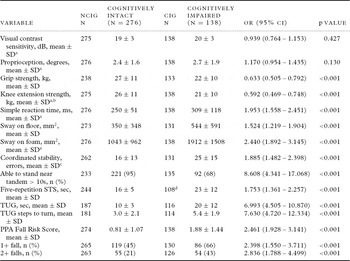
The mean age of the total sample was 82 years and 204 (49%) were female. Demographic characteristics, medical history, and medication use are outlined in Table 1 and the physiological measures are outlined in Table 2.
Physical measures and number of fallers in the follow-up period: univariate analysis comparing cognitively intact with cognitively impaired cohorts

SD – Standard deviation, STS – sit to stand, TUG – timed up and go, PPA – Physiological Profile Assessment.
aMeasures incorporated into PPA Falls Risk Score.
bDifference remained significant when scores were contrasted for males and females separately.
cOne additional CIG participant was cognitively unable to complete the task.
d27 of the CIG (27%) used their upper limbs for assistance.
Missing data for NCIG due to test not administered in sample subsets.
Missing data for CIG due to participants not able to attend a second test session at NeuRA.
Normal values: TUG: >15 seconds indicates increased falls risk. Falls risk score: >1 indicates increased falls risk.
A higher score represents better performance in the MET, knee extension and grip strength tests.
A lower score represents better performance in the proprioception, reaction time, sway, coordinated stability, TUG and STS tests.
The CIG reported taking significantly more psychoactive and total medications, suffered from more medical conditions (i.e. stroke, arthritis, depression) and reported greater walking aid use (indoors or outdoors) compared to the NCIG. Eighty-nine (33%) NCIG participants reported a fall in the past year compared to 90 (65%) participants in the CIG.
Sensorimotor, balance, and functional mobility performance of the CIG and NCIG
The CIG performed significantly worse in all of the physiological and functional tests, with the exception of the tests of visual contrast sensitivity and proprioception (Table 2). The CIG also had significantly higher PPA fall-risk scores than the NCIG. In logistic regression analyses, these results remained significant after controlling for stroke, arthritis, light headedness on standing, depression, and psychoactive and total mediation use.
Fall risk and falls
One hundred and nineteen (45%) NCIG participants reported a fall in the 12-month follow-up period compared with 86 (66%) CIG participants. Of those who reported falls in the NCIG, 64 (24%) reported a single fall, 32 (12%) two falls, and 23 (9%) three or more falls. In the CIG, 32 (25%) reported a single fall, 19 (15%) two falls, and 35 (27%) three or more falls. Thirteen participants in the NCIG and 12 in the CIG had insufficient follow-up data to classify as multiple or non-multiple fallers and 11 participants in the NCIG and eight in the CIG had insufficient follow-up data to classify as fallers or non-fallers.
The CIG were significantly more likely to suffer 1+ fall (OR = 2.40, 95% CI 1.55–3.71) and 2+ (multiple) falls (OR = 2.84, 95% CI 1.79–4.50) in the 12-month follow-up period. In logistic regression analyses, these results remained significant after controlling for stroke, arthritis, light headedness on standing, depression, and psychoactive and total medication use.
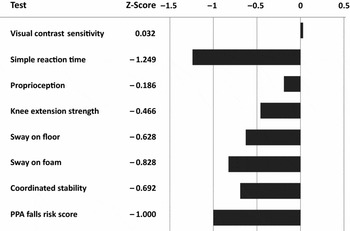
The PPA fall risk profile for the CIG is presented in Figure 1. This profile indicates that the CIG performed poorly in the tests of reaction time, knee extension strength, postural sway and coordinated stability while being comparable in vision and proprioception compared to normative values for community-dwelling people.
Combined physiological falls profile of participants in the CIG. Each bar represents a mean Z-score for the CIG based on normative values in community-dwelling people ≥ 65 (Lord et al., Reference Lord, Menz and Tiedemann2003). Larger positive or negative Z-scores represent deviation from the general older population, with negative scores representing poorer performance.

Discussion
In line with previous studies undertaken in older people with cognitive impairment, the proportion of fallers in our CIG was elevated at 66% per annum. However, the main difference in the proportion of fallers between the CIG and NCIG was due to a higher proportion of the CIG suffering multiple falls in the follow-up year, i.e. 43% as compared with 21% in the NCIG. This suggests the CIG have multiple chronic conditions and an increased physiological predisposition to falls (Lord et al., Reference Lord, Menz and Tiedemann2003). Indeed, in addition to reduced mobility, we found that cognitively impaired older people had significant impairments in the physiological domains of strength, reaction time, and balance. These findings, therefore, build on previous studies that have reported that older people with cognitive impairment perform poorly in composite mobility measures (e.g. gait and TUG assessments) and activities of daily living, as well as displaying deficits in multiple physiological domains (Asada et al., Reference Asada1996; Waite et al., Reference Waite, Broe, Grayson and Creasey2000; Pettersson et al., Reference Pettersson, Olsson and Wahlund2005; Boyle et al., Reference Boyle2007; Allan et al., Reference Allan, Ballard, Rowan and Kenny2009; Salva et al., Reference Salva2012; Suttanon et al., Reference Suttanon, Hill, Said, Logiudice, Lautenschlager and Dodd2012).
The CIG performed poorly in a range of functional mobility tests. These composite measures test multiple domains, e.g. TUG performance is underpinned by knee strength, postural sway (balance), reaction time, visual contrast sensitivity, body pain, and cognitive and general health (Kwan et al., Reference Kwan, Lin, Chen, Close and Lord2011). There is also a cognitive load associated with some of the functional tests as they involve three and four stage commands requiring cognitive processes such as verbal comprehension, working memory, motor planning, and visuo-spatial processing. These tests could be used as screening tests to identify those most at risk of falls and also assist in identifying particular exercises, such as sit to stand training that could be incorporated into exercise programs.
The PPA has previously been shown to be feasible in a small study of older people with Alzheimer's disease (Lorbach et al., Reference Lorbach, Webster, Menz, Wittwer and Merory2007). The current study, together with a recent study by Suttanon and colleagues, confirmed that the PPA could be performed in cognitively impaired populations with a wide range of cognitive and physical abilities (Suttanon et al., Reference Suttanon, Hill, Said, Logiudice, Lautenschlager and Dodd2012). It also demonstrates that older people with cognitive impairment have significantly elevated overall fall-risk scores and perform poorly on many individual PPA items when compared to their cognitively intact peers. These findings are consistent with the previously reported deficits of a study comparing 25 participants with Alzheimer's disease to their age-sex matched controls (Suttanon et al., Reference Suttanon, Hill, Said, Logiudice, Lautenschlager and Dodd2012).
In this study, the PPA and functional measures administered by skilled staff, experienced in the test procedures and working with older people with cognitive impairment, proved feasible for most participants. Occasional prompting was provided when necessary to encourage task completion. For some participants with impaired balance and function, a “physically unable score” provided by the PPA program was allocated (derived from cognitively intact cohorts; 2SD below or above the mean) or upper limb use was permitted for the five-repetition STS. These modifications, effected to minimize data loss, would have only lessened the differences in test performances between the groups.
Several effective approaches to fall prevention have been identified for community-dwelling cognitively intact populations (Gillespie et al., Reference Gillespie2009). However, as shown by Shaw and colleagues, these cannot be assumed to be effective in community-dwelling cognitively impaired older adults (Shaw et al., Reference Shaw2003). In fact, there are currently no published trials that have been shown to prevent falls in community-dwelling people with dementia. The current findings revealed impairments across sensorimotor and balance domains, which may be helpful for guiding interventions to prevent falls.
Other recognized fall-risk factors were prevalent in the CIG and might also provide avenues for future targeted intervention. The CIG were more likely to be taking multiple medications as well as medications acting on the central nervous system (Luukinen et al., Reference Luukinen, Koski, Laippala and Kivela1995), and were also more likely to report a history of depression (Panza et al., Reference Panza2010). Thus, the PPA could be used to direct interventions aimed at enhancing sensorimotor functioning and balance and complement medical and interdisciplinary assessments addressing autonomic symptoms, depression, medication use, continence, behavioral issues, and cognition management. Further research is required to explore the potential benefits of intervention in these areas.
A strength of our study was the thorough follow-up procedure. We used a combination of monthly calendars, telephone calls, and use of a proxy who had a minimum of 3.5 contact hours with the participant each week to maximize the accuracy of the falls surveillance for the CIG. Using this method, 66% of the CIG group were recorded as fallers in the 12-month follow-up period. This proportion is consistent with other studies of populations with dementia that have used rigorous fall reporting methods (Tinetti et al., Reference Tinetti, Speechley and Ginter1988; Allan et al., Reference Allan, Ballard, Rowan and Kenny2009). Though, unlike the cohort in the present study, Allan and colleagues included participants with Parkinson's disease related dementia, these participants had a higher prevalence of falls than other dementia types contributing to the reported prevalence (Allan et al., Reference Allan, Ballard, Rowan and Kenny2009).
The main study limitation relates to the different recruitment methods for the CIG and NCIG. The NCIG were recruited from a mix of electoral role sampling and local community advertising, whereas a number of people in the CIG were identified from the healthcare setting – mainly cognitive disorders and memory clinics as well as dementia day care centers, etc. However, given that the CIG needed to be in stable health before assessment and that the number and rate of falls in the two groups are consistent with previous literature, we are confident that both samples comprised relatively representative samples and the differences identified between the groups are clinically important. We acknowledge that our CIG sample was a heterogeneous one that is likely to have included people with Alzheimer's disease, vascular dementia, and dementia with Lewy bodies. However, we feel our sample reflects the heterogeneous nature of the cognitively impaired population accessing our healthcare system. Further, although the underlying pathologies may be different, the PPA measures common physiological endpoints (poor balance, muscle weakness, etc.) that would provide direction for impairment/functional based interventions.
Conclusions
In conclusion, the study findings indicate that cognitively impaired older people have an elevated risk of falls due to impaired physiological and functional performance. The physiological deficits identified are potentially modifiable and could form the basis for a targeted intervention to prevent falls in dementia. More research is required to identify effective strategies to prevent falls and fall-related injury that are appropriate for this high-risk population.
Conflict of interest
The PPA (NeuRA FallScreen) is commercially available through Neuroscience Research Australia.
Description of authors’ roles
Stephen Lord, Jacqueline Close, and Morag Taylor conceived the study objectives and participated in its design. Morag Taylor and Stefanie Mikolaizak were responsible for recruitment, data acquisition, and data entry. Morag Taylor, Kim Delbaere, Jacqueline Close, and Stephen Lord drafted the manuscript. Morag Taylor had full access to all of the data in the study and took responsibility for the integrity of the data and the accuracy of the data analysis. All authors were involved with interpretation of the data and preparation of the manuscript.
Acknowledgment
The authors thank Jodie Martin (research assistant) for her contribution to participant recruitment and assessment.