


Agreement is a pervasive phenomenon of human language. The most frequent instance of agreement is that between a subject and a verb, where certain properties of the subject determine the form of the verb. Regarding the information transmitted, agreement is redundant, because the verb copies information that is already present in the subject. Subject–verb agreement (subject agreement) is illustrated in Example 1 from BasqueFootnote 1:
- 1.
a. Zu-k emakume-a ikusi d-u-zu
You-S woman-the seen 3SGhaveS.2SG
“You saw the woman.”
b. Ni-k emakume-a ikusi d-u-t
I-S woman-the seen 3SGhaveS.1SG
“I saw the woman.”
This linguistic dependency requires speakers to check that the subject and the verb of the sentence have the correct morphological features. In the examples above, when the subject is the addressee “you” (1a), the verb must carry the corresponding agreement marker –zu, and when the subject is the speaker “I” (1b), the verb must carry the corresponding agreement marker –t. Agreement is an asymmetric dependency, consisting of a trigger (also known as a controller) and a target. It involves repeating bits of grammatical information copied from the trigger to the target (Corbett, Reference Corbett2006). In Example (1), the subject is the trigger, carrying information about number and person, and the verb is the target, displaying person and number morphology that covaries systematically depending on the properties of the subject (Steele, Reference Steele and Greenberg1978).
As discussed by Baker (Reference Baker2008), verbs are the prototypical and most prolific targets of agreement. Although there are many languages where adjectives and nouns can also enter into systematic covariance with controllers, only verbs agree in person (Stassen, Reference Stassen1997). Because of this and other systematic differences between verbs and adjectives/nouns/pronouns, it is customary to refer to covariance in the nominal domain as concord, restricting the term agreement for the covariance shown by verbs. Another difference between concord and agreement is that agreement is not restricted to a single controller; that is, verb agreement is not limited to subjects cross-linguistically: for instance, in Basque, the verb must agree not only with the subject but also with the object and dative arguments of the sentence, and may agree with the person addressed in the conversation even if it is not an argument of the sentence (de Rijk, Reference de Rijk2008). Psycholinguistic studies on agreement errors also reveal that agreement and concord show qualitatively different profiles: while agreement is reliably susceptible to intrusion from structurally illicit distractors, reflexive dependencies resist intrusion in identical environments, suggesting that agreement is not a uniform phenomenon (Dillon, Mishler, Sloggett, & Phillips, Reference Dillon, Mishler, Sloggett and Phillips2013).
Despite the broad range of variation in agreement patterns across different languages, it is a well-established typological generalization that subject agreement is the most frequent and basic agreement relation, and languages where agreement can be controlled by constituents other than subjects always show subject agreement as well. The features of the controller that enter into agreement are known as phi-features, and they are viewed as primitives of grammar (Rezac, Reference Rezac2011). Person is the most salient and prototypical phi-feature controlling agreement, followed by number and gender (Greenberg, Reference Greenberg1966; Harley & Ritter, Reference Harley and Ritter2002). The repertoire of phi-features varies across languages, but this variation is not random; Greenberg (Reference Greenberg1966) observed that other types of features are dependent on person and number: for instance, if the verb agrees with a nominal subject or nominal object in gender, it also agrees in number (Universal 32), and number-related features such as trial and dual are dependent on having a singular/plural distinction (Universal 34). There is agreement in linguistics regarding the saliency of person, followed by number, among the repertoire of phi-features, but there are competing views on the nature of these features and their combinations. Thus, for instance, Chomsky (Reference Chomsky1995, Reference Chomsky and Kenstowicz2001) argues that phi-features are computed together as a cluster in syntactic derivation, whereas other authors (Boeckx, Reference Boeckx, Ramchand and Reiss2007; Nevins, Reference Nevins2011; Sigurdsson, Reference Sigurdsson and Grohman2009) argue that person and number features undergo different derivational processes.
Although verb agreement is one of the most studied processes in psycholinguistics, there is scarce experimental evidence on how phi-features are processed. While many experiments have been carried out manipulating number feature in subject agreement (e.g., Hagoort, Brown, & Groothusen, Reference Hagoort, Brown and Groothusen1993, in Dutch; Osterhout & Mobley, Reference Osterhout and Mobley1995, in English; Münte, Matzke, & Johannes, Reference Münte, Matzke and Johannes1997, in German; Hinojosa, Martín-Loeches, Casado, Muñoz, & Rubia, Reference Hinojosa, Martín-Loeches, Casado, Muñoz and Rubia2003, in Spanish; Paololahti, Leino, Jokela, Kopra, & Paavilainen, Reference Paololahti, Leino, Jokela, Kopra and Paavilainen2005, in Finnish), few studies have focused on how person versus number features are processed and whether similar or different processes underlie their computation; we will discuss them below.
One of the experimental techniques that has provided the most relevant evidence on the way agreement is processed is event-related potentials (ERPs). This issue has been mainly investigated by comparing grammatical and ungrammatical instances of verb agreement (“John sings a song” vs. “John *sing a song”). Three main ERP components have been reported in relation to agreement processing: left anterior negativity (LAN), N400, and P600. Both LAN and N400 are negative wave deflections occurring between 300 and 500 ms after the stimulus onset, while the P600 component, also labeled syntactic positive shift, is a centroparietally distributed positive-going wave starting approximately 500 ms after the stimulus onset.
The LAN component is distributed over the left and anterior sites and has been interpreted as an electrophysiological response to morphosyntactic processes that occurs when processing ungrammatical information (Münte, Heinze, & Mangun, Reference Munte, Heinze and Mangun1993) or syntactically complex structures (Fiebach, Schlesewsky, & Friederici, Reference Fiebach, Schlesewsky and Friederici2002; Rösler, Pechmann, Streb, Röder, & Hennighausen, Reference Rösler, Pechmann, Streb, Röder and Hennighausen1998). However, there has been a long debate about the nature of the LAN component, as it has not been consistently reported in many studies that manipulated morphosyntactic processing and the source of the variability between the presence/absence of LAN is still not clear (for a thorough review of the LAN, see Molinaro, Barber, & Carreiras, Reference Mancini, Molinaro, Rizzi and Carreiras2011; Tanner, Reference Tanner2014; Tanner & Van Hell, Reference Tanner and Van Hell2014). For instance, the LAN component also has been claimed to reflect working-memory load (Martín-Loeches, Muñoz, Casado, Melcón, & Fernández-Frías, Reference Martín-Loeches, Muñoz, Casado, Melcón and Fernández-Frías2005) and has been reported for semantically reversible sentences (Meltzer & Braun, Reference Meltzer and Braun2013) or syntactic structures involving long-distance dependencies (e.g., wh-questions; Phillips, Kazanina, & Abada, Reference Phillips, Kazanina and Abada2005).
Unlike the LAN, the N400 component is a centroparietal and slightly right-lateralized component that has been considered to respond to semantic, pragmatic, or thematic violations (Hagoort, Hald, Bastiaansen, & Petersson, Reference Hagoort, Hald, Bastiaansen and Pertersson2004; Kutas & Hillyard, Reference Kutas and Hillyard1980) and to atypical thematic hierarchy (Bornkessel-Schlesewsky & Schlesewsky, 2009; Frisch & Schlesewsky, Reference Frisch and Schlesewsky2001). The N400 also has been found in nonlinguistic contexts, such as meaningful environmental sounds in unexpected or incongruent contexts (e.g., animal sounds or telephone ringing; Wu, Athanassiou, Dorjee, Roberts, & Thierry, Reference Wu, Athanassiou, Dorjee, Roberts and Thierry2012), pictures, faces, movie clips, or gestures (e.g., Grosvald, Gutierrez, Hafer, & Corina, Reference Grosvald, Gutierrez, Hafer and Corina2012).
Finally, the P600 has been generally interpreted in terms of reanalysis or integration effects taking place when syntactically ungrammatical, ambiguous (Osterhout & Holcomb, Reference Osterhout and Holcomb1992), or structurally complex information (Kaan, Harris, Gibson, & Holcomb, Reference Kaan, Harris, Gibson and Holcomb2000) is being parsed. Experimental evidence suggests that besides morphosyntactic processes, the P600 is also sensitive to nonsyntactic factors such as semantic information (e.g., semantic reversal anomalies), processing strategies, and experimental tasks (Bornkessel-Schlesewsky et al., Reference Bornkessel-Schlesewsky, Kretzschmar, Tune, Wang, Genç and Philipp2011). In addition, the P600 has been reported as a response to nonlinguistic tasks, such as rule violation in an arithmetic task (Núñez-Peña & Honrubia-Serrano, Reference Núñez-Peña and Honrubia-Serrano2004) or incongruent chords in music (Sammler, Novembre, Koelsch, & Keller, Reference Sammler, Novembre, Koelsch and Keller2013).
PREVIOUS STUDIES ON PERSON AND NUMBER FEATURE PROCESSING
To our knowledge, only three studies so far have addressed the question and provided direct electrophysiological evidence on whether person and number features are processed similarly or differently. Nevins, Dillon, Malhotra, and Phillips (Reference Nevins, Dillon, Malhotra and Phillips2007) investigated how agreement violations of different combinations of phi-features are processed in Hindi. More precisely, in a grammaticality judgment task, they examined the electrophysiological responses elicited by agreement violations of gender and number, as well as agreement violations of one (gender or number) versus two phi-features (e.g., gender+number or gender+person). ERP responses to all types of subject agreement violations elicited a P600 component (with no LAN/N400 components found). It is interesting that the P600 component elicited by the gender+person violations was larger than the ones elicited by all the other types of violations, while the gender+number violations did not differ from the responses to the individual gender or number violations. The authors conclude that the feature distance does not impact ERP responses because no amplitude differences were found among the gender, number, and combined gender/number violations. In contrast, larger P600 responses to the violations involving the person feature are attributed to the greater saliency of this feature at multiple levels of representation.
Silva-Pereyra and Carreiras (Reference Silva-Pereyra and Carreiras2007) also used ERPs to explore how person and number agreement features are processed in Spanish. They visually presented native speakers with person, number, and person+number violations, such as tú juego “You2SG play1SG (. . .),” nosotros juego “We play1SG (. . .),” and Ustedes juego “You2PL play1SG (. . .).” All violations elicited a P600 component, while only person+number violations yielded anterior negativity. Although all three ungrammatical conditions showed larger P600 amplitudes than the grammatical condition, no differences between person and number were reported, failing to provide evidence that phi-features are distinctly processed during agreement computation. The authors investigated two phases of the P600 component: the early one (500–700 ms), related with syntactic integration difficulty or diagnosis, and the late one (700–900 ms), reflecting reanalysis or repair processes (Friederici et al., 2001). The combination of two ungrammatical features triggered larger P600 amplitudes during its early phase only (500–700 ms), indicating additive processing effects of both person and number agreement. A similar P600 effect was found in all three violations in the later stage of processing (700–900 ms). The authors concluded that the mechanisms of diagnosis, reanalysis, or repair processes appear to be similar for both features.
More recently, Mancini, Molinaro, Rizzi, and Carreiras (Reference Mancini, Molinaro, Rizzi and Carreiras2011) investigated subject agreement computation by specifically targeting person and number features. Native speakers of Spanish read grammatical control sentences (i.e., Los cocineros cocinaron (. . .) “The cooks3PL cooked3PL”) as well as sentences containing number (i.e., El cocinero *cocinaron (. . .) “The cookSG cooked3PL”) and person violations (i.e., El cocinero *cocinaste (. . .) “The cook3SG cooked2SG”). Participants judged all three conditions with similar accuracy, but they were significantly faster when judging number violations than when judging person violations and grammatical control sentences. ERP data for number agreement violations revealed a LAN component between 300 and 500 ms after the stimulus onset, and person agreement violations elicited an N400. The analysis of the 500–800 ms time window showed a P600 effect for both person and number violations; however, whereas number agreement violation effects were posteriorly distributed, person agreement violation effects were also significant over frontocentral sites. Finally, in the 800–1000 ms time window, the analyses revealed larger positivity for person than for number violations, with the effects also spreading to frontocentral regions for person violations only. The authors interpreted the presence of LAN or N400 components as indicators of processing disruptions at different processing levels: the N400 component found in person violations would be a signature of a disruption at the semantic-discourse level, where interpretive relations among constituents are not preserved (i.e., when the subject is a speaker, first person; an addressee, second person; or neither of the two, third person); in contrast, the LAN components found in number violations would be a signature of a disruption at the morphosyntactic level. According to Mancini et al., the increase of the P600 effect for person violations at the frontal regions suggests discourse-related integration difficulties, that is, the impossibility of integrating in the same discourse representations the incompatible speech participants (e.g., third person vs. second person addressee), as indicated by the anomalous subject–verb dependency. In addition, the larger P600 amplitude for person than for number violations indicates higher repair cost for the former violation in comparison to the latter. Following this study, Molinaro et al. (Reference Molinaro, Barber and Carreiras2011) claim that agreement is sensitive both to the type of phi-features involved in the agreement relation and to the constituents that express the agreement dependency. According to the authors, this sensitivity is reflected by different ERP components: the LAN would reflect violation of expectancy elicited by the trigger, while the N400 would mirror additional, nonsyntactic (discourse-level) processes occurring during agreement computation.
Regarding Basque, the object of the present study, there is already some indirect evidence on how person versus number features are processed. Zawiszewski and Friederici (Reference Zawiszewski and Friederici2009) investigated subject and object–verb agreement (object agreement) processing. In a grammaticality judgment task, participants were visually presented with grammatical sentences and ungrammatical sentences containing either person or person+number agreement violations generated for both subject (zu-k ni (. . .) na-u-zu / *na-u-te “YouS.2SG meO O.1SGhaveS.2SG/*S.3PL”/ “You haveS.2SG/*S.3PL (. . .) me”) and object (zu-k ni (. . .) na-u-zu / *d-u-zu “YouS.2SG meO O.1SG/*O.3SGhaveS.2SG”/“You haveO.1SG/*O.3SG (. . .) me”) agreement types. However, because the authors’ main aim was to explore the differences in the processing of subject versus object agreement, they did not make separate analyses for single versus double feature violations. They observed similar ERP components toward both subject and object agreement violations, namely, a N400 followed by a P600. The N400 was a novel finding not reported in the previous ERP literature for verb agreement violations (as mentioned above, also found later by Mancini et al., Reference Mancini, Molinaro, Rizzi and Carreiras2011), while the P600 was highly expected as a response to ungrammatical agreement. The authors interpreted the N400 component as indicating a failure to link previously presented arguments to the corresponding agreement morphology or to the difficulties engendered by having to keep track of more than one argument (subject and object) during agreement computation. The P600 was explained in terms of reanalysis and repair effects taking place during the late stage of processing.
Díaz, Sebastián-Gallés, Erdocia, Mueller, and Laka (Reference Díaz, Sebastián-Gallés, Erdocia, Mueller and Laka2011) subsequently further examined subject and object agreement in Basque, but only number agreement violations were tested in this study. In a grammaticality judgment task, participants were auditorily presented with grammatical and ungrammatical sentences containing subject (arreb-ek egunkaria ekarri d-u-te / *d-u “The sistersS a newspaperO brought OhaveS.3PL/*S.3SG”/“The sisters brought a newspaper”) and object number agreement violations (arreb-ek egunkariak ekarri d-it-u-z-te / *d-u-te “sistersS newspapersO brought O.3PL/*O.3SGhaveS”/“The sisters brought newspapers”). In this occasion, different ERP patterns were reported for both types of number agreement violations: for subject violations only, a P600 component was found, while for object violations, the P600 was preceded by a posterior negativity between 200 and 300 ms after verb onset. Díaz et al. (Reference Díaz, Sebastián-Gallés, Erdocia, Mueller and Laka2011) interpreted this negativity as an instance of a N200 component, related with the violation of participants’ phonological expectancy about the upcoming morpheme (while in subject agreement violations hearing *du matches the first syllable of the predicted dute, in object agreement violations listening the first syllable of *dute does not match the first syllable of the predicted dituzte auxiliary verb). They argued that the different ERP patterns reported for subject and object agreement violations in their study and that of Zawiszewski and Friederici (Reference Zawiszewski and Friederici2009) could be attributed to the different phi-features manipulated (number vs. person) as well as to other potential factors (i.e., visual vs. auditory stimuli presentation; presence of single and double agreement violations).
To summarize, the experimental evidence shows that person, number, and person+number violations elicit a P600 component (present in all the studies cited above). However, with regard to early ERP components, a different picture emerges: no negativities are found for any of the feature violations (Nevins et al., Reference Nevins, Dillon, Malhotra and Phillips2007), similar anterior negativities are found for person, number, and person+number violations (Silva-Pereyra & Carreiras, Reference Silva-Pereyra and Carreiras2007), or LAN is found for number (Mancini et al., Reference Mancini, Molinaro, Rizzi and Carreiras2011) and N400 for person violations (Mancini et al., Reference Mancini, Molinaro, Rizzi and Carreiras2011; Zawiszewski & Friederici, Reference Zawiszewski and Friederici2009). Finally, when comparing single-feature versus double-feature violations, larger amplitudes of the P600 have been found for double violations as compared to single ones in those cases where the person feature is involved (i.e., person+gender or person+number vs. single person and number violations; Nevins et al., Reference Nevins, Dillon, Malhotra and Phillips2007; Silva-Pereyra & Carreiras, Reference Silva-Pereyra and Carreiras2007).
CAVEATS REGARDING PREVIOUS STUDIES
In light of the studies discussed above, it remains unclear whether person and number phi-features are processed similarly or whether different processes operate during their computation. Nevins et al. (Reference Nevins, Dillon, Malhotra and Phillips2007) found no electrophysiological differences between number and gender agreement processing. However, limitations of the experimental design did not allow the authors to compare the electrophysiological responses toward person versus number feature violations in isolation. Hence, no clear conclusions can be drawn on whether these features are processed differently. However, offline behavioral evidence (acceptability ratings, accuracy, and response times) provided in their Experiment 2 showed that the conditions involving person feature violations were judged differently from the other violation conditions (lower acceptability ratings and faster and more accurate judgments). These behavioral differences suggest that person features might bear a different status in comparison to number or gender features, as suggested by some authors (Boeckx, Reference Boeckx, Ramchand and Reiss2007; Nevins, Reference Nevins2011; Sigurdsson, Reference Sigurdsson and Grohman2009).
The results of the ERP experiment carried out in Spanish by Silva-Pereyra and Carreiras (Reference Silva-Pereyra and Carreiras2007) did not clarify this issue; the fact that the authors found no differences between person and number feature processing might be due to the experimental manipulations used in the study: the authors used the contrast between yo “I” and nosotros “we” as testing ground for number violations (nosotros *juego “We play1SG”). However, it has been widely argued in linguistics that the contrast between I and we involves more than a change in plurality. Specifically, whereas I necessarily involves the speaker, we is not a plurality of speakers, but a set containing more than one element where one is necessarily the speaker (Benveniste, Reference Benveniste1966; Goddard, Reference Goddard1995; Ingram, Reference Ingram and Greenberg1978; Sørensen, Reference Sørensen1958; Wierzbicka, Reference Wierzbicka1972). In other words, while I is considered to be inherently singular, we is not a plurality of I-s (Jespersen, Reference Jespersen1933; Lyons, Reference Lyons1968), and consequently the contrast between I and we would involve more than a mere number distinction form.
Subsequently, Mancini et al. (Reference Mancini, Molinaro, Rizzi and Carreiras2011) found significant differences between person and number features. These authors used third-person plural verb forms (cocinaron “cooked3PL”) as a grammatical baseline to which the respective person and number violations were compared. However, in number violations, the same plural verb forms as in the baseline (cocinaron “cooked3PL”) were preceded by singular subjects (el cocinero “the cook3SG”) while person violations were generated using the ungrammatical agreement between the singular verb (cocinaste “cooked2SG”) and the singular subject (el cocinero “the cook3SG”). In other words, the comparison between the grammatical baseline and the number mismatch condition involved one manipulation (plural vs. singular subjects; same verb forms “cooked3PL”), while the comparison between the grammatical baseline and the person mismatch condition involved two manipulations (plural vs. singular subjects; different verb forms: “cooked3PL” vs. “cooked2SG”). For person violations, the critical verbs were preceded by a different context (singular vs. plural nouns) and having used third person as a testing ground might have influenced the final outcome. It has been widely argued in linguistics that third person is not specified for person at all; that is, it contains no person feature (since Benveniste, Reference Benveniste1966). Mancini et al. agree with this view that “third person is specified for number, but not for person” (p. 67). Under this assumption, no true person violations can be generated using third-person agreement as a baseline, and consequently the possibility that the results are due to the specific manipulations used in this study cannot be ruled out.
Finally, regarding the ERP studies in Basque, Díaz et al. (Reference Díaz, Sebastián-Gallés, Erdocia, Mueller and Laka2011) reported ERP evidence concerning only number feature processing. However, the comparison between these results and those obtained by Zawiszewski and Friederici (Reference Zawiszewski and Friederici2009), who only tested person and person+number violations, does not provide direct evidence that person and number phi-features are processed differently because neither study manipulated person and number features independently. Hence, these two studies do not allow direct comparisons between the reported results, and no firm conclusions can be drawn on the processes underlying person and number processing.
THE PRESENT STUDY
We acknowledge the difficulty of providing an experimental design that avoids all the main caveats mentioned above, because most languages tested so far did not allow controlling for all those factors. Previous research has provided very valuable information about the way different phi-features are processed during agreement computation. However, further pieces of evidence are needed in order to have a full picture of the puzzle. The present study aims at providing new evidence on how person and number agreement features are processed. We do it by investigating subject agreement in Basque, a head-final ergative language with very rich verbal morphology. These characteristics make it an appropriate testing ground to explore person and number feature processing in detail.
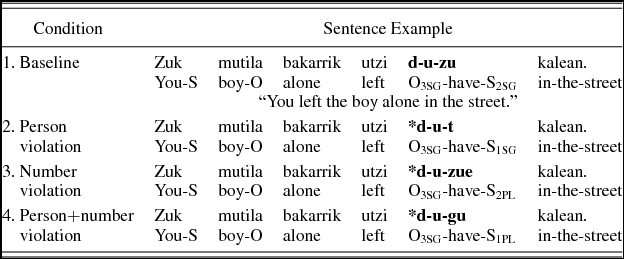
In order to avoid confounds of the sort reported for previous studies, we used a baseline condition that allowed us to generate subject–verb person violations where no third-person verb agreement forms were used (object agreement was not manipulated: third-person singular or plural objects were always used and they were kept constant across conditions; see Table 1). Hence, to test “pure” person violations, second-person verb forms (d-u-zu “O.3SGhaveS.2SG” / d-u-zue “O.3SGhaveS.2PL”) were used as baseline and compared to first-person forms (d-u-t “O.3SGhaveS.1SG” / d-u-gu “O.3SGhaveS.1PL”).
Sample of the materials used in the experiment.

For testing number feature violations, we also refrained from using first-person verb forms as baseline, because, as mentioned above, the contrast between I and we has been argued to involve more than a change from singular to plural, given that I is necessarily the speaker but we is not a plurality of speakers (Jespersen, Reference Jespersen1933; Lyons, Reference Lyons1968), and consequently no proper number violations can be generated. Hence, in our materials, the manipulation of subject–verb number feature involved strictly the contrast between the second-person singular and plural (-zu vs. -zue), referring to one or more addressees.
In sum, unlike previous studies (Díaz et al., Reference Díaz, Sebastián-Gallés, Erdocia, Mueller and Laka2011; Mancini et al., Reference Mancini, Molinaro, Rizzi and Carreiras2011; Nevins et al., Reference Nevins, Dillon, Malhotra and Phillips2007; Silva-Pereyra & Carreiras, Reference Silva-Pereyra and Carreiras2007; Zawiszewski & Friederici, Reference Zawiszewski and Friederici2009), only second-person agreement verb forms were used here as a baseline to test how person and number violations are processed. Such a design allows us to directly test whether distinct mechanisms underlie person and number processing, and to further explore how the parser deals with single-feature versus double-feature violations (similarly to Nevins et al., Reference Nevins, Dillon, Malhotra and Phillips2007; Silva-Pereyra & Carreiras, Reference Silva-Pereyra and Carreiras2007).
Hypotheses and predictions
Using the manipulations discussed above, three alternative hypotheses were considered. First, if different cognitive processes underlie person and number phi-feature computations, qualitatively different ERP responses to person and number violations could be expected: the LAN for number violations and the N400 for person violations (Mancini et al., Reference Mancini, Molinaro, Rizzi and Carreiras2011, Molinaro et al., Reference Molinaro, Barber and Carreiras2011). However, when comparing single-versus double-feature violations, no clear prediction can be made with respect to the expected electrophysiological pattern because the effects could overlap (e.g., LAN + N400 yielding a broad negativity) or even cancel one another out (broad negativity canceling a P600). Second, if similar processes govern person and number feature computation but the cost related to the processing is different due to greater saliency of one feature over the other (Carminati, Reference Carminati2005; Greenberg, Reference Greenberg1966; Harley & Ritter, Reference Harley and Ritter2002), then qualitatively similar but quantitatively different ERP signatures would be expected as responses to person and number violations (e.g., larger ERP components for person than for number). According to these predictions, when comparing single versus double violations, we would expect violations involving the person feature (either person or person+number violations) to elicit larger effects in comparison to those elicited by the number feature only. Third, if person and number are processed similarly and one is not cognitively more salient than the other (Silva-Pereyra & Carreiras, Reference Silva-Pereyra and Carreiras2007), we expect the ERP responses toward both feature violations to be the same (but note that this interpretation is based on a null effect, and should be taken with caution). If this pattern emerges when comparing single versus double violations, we might expect either no differences or larger amplitudes for person+number violations as compared to only person and only number violations. The latter would indicate additive effects during feature processing, that is, that processing two ungrammatical phi-features is costlier than processing one ungrammatical phi-feature or that the saliency related to two ungrammatical features is greater than that present in one ungrammatical feature. In addition, one might interpret this result as indicating that person and number features are processed independently during syntactic derivation (Boeckx, Reference Boeckx, Ramchand and Reiss2007; Nevins, Reference Nevins2011; Nevins et al., Reference Nevins, Dillon, Malhotra and Phillips2007; Sigurdsson, Reference Sigurdsson and Grohman2009) rather than as an undifferentiated cluster (Chomsky, Reference Chomsky1995, Reference Chomsky and Kenstowicz2001).
Experiment
Participants
Twenty-four neurologically healthy native speakers of Basque (undergraduates and graduates at the University of the Basque Country) participated in the experiment: 3 men with a mean age of 18.37 years (SD = 1.03). According to the Edinburgh Inventory for Assessment of Handedness (Oldfield, Reference Oldfield1971), they were all right-handed. Data from 2 participants were excluded from the analyses because of excessive eye movements and other artifacts. Consequently, the results of 22 speakers were submitted to the statistical analyses. All participants were paid for their participation.
Materials
The experiment was carried out in standard Basque. One hundred and sixty experimental sentences were created, and each of them was presented in the following subject agreement experimental conditions (see Examples 1–4 in Table 1): Condition 1, grammatical subject agreement; Condition 2, person violation; Condition 3, number violation; and Condition 4, person+number violation. Half of the direct object nouns in the experimental conditions were singular and the other half were plural. An additional 240 grammatical filler sentences including first-person and third-person subject agreement structures were added in order to make the material as diverse as possible. In sum, each participant read 400 sentences: 160 experimental sentences (40 per condition) and 240 fillers. All the lists were counterbalanced so that each participant read only one version of each sentence.
In Condition 1 the verb “have” agrees with the subject “you” in person (second) and number (SG) features; in Condition 2 the verb agrees with the subject in number (SG), but disagrees in person (first); in Condition 3 the verb agrees with the subject in person (second), but disagrees in number (PL); and finally in Condition 4 the verb disagrees with the subject in both person (first) and number (PL) features.
Procedure
Personal computers (Windows XP operating system) and Presentation® software (Version 16.0; www.neurobs.com) were used to present the stimuli. Before the real experiment started, participants were instructed about the EEG procedure and seated comfortably in a quiet room in front of a 17-in. monitor. All sentences were displayed in the middle of the screen word-by-word for 350 ms (interstimulus interval = 250 ms). A fixation cross (+) indicated the beginning of each trial. After each sentence participants saw the words zuzen? “correct?” or oker? “incorrect?” in the screen, and participants were asked to judge the grammaticality of the previously displayed sentence by pressing one of two keyboard buttons (left Ctrl = correct; right Intro = incorrect). Half of participants used the left hand for correct responses and the other half the right hand. All 400 sentences were distributed randomly over four blocks that lasted approximately 9 min each. Participants were given a short break between each block. Before the actual experiment, participants ran a short training session of five trials. They were instructed to avoid blinking or moving when the sentences were being displayed and to make the grammaticality judgment as fast and accurately as possible. The whole experiment, including electrode-cap application and removal, lasted no longer than 1.5 hr.
EEG recording
The EEG was recorded from 32 active electrodes secured in an elastic cap (Acticap System, Brain Products, Gilching, Germany). Electrodes were placed on standard positions according to the extended Internationals 10–20 system in the following sites: Fp1/Fp2, Fz, F3/F4, F7/F8, FC5/FC6, FC1/FC2, T7/T8, C3/C4, Cz, CP5/CP6, CP1/CP2, P7/P8, P3/P4, Pz, PO9/PO10, O1/02, and Oz. All recordings were referenced to FCz position and rereferenced off-line to the global average reference. Vertical and horizontal eye movements and blinks were monitored by means of two electrodes positioned beneath and to the right of the right eye. Electrode impedance was kept below 10 kOhm at all scalp and eye electrodes. The electrical signals were digitized online at a rate of 500 Hz by a BrainVision amplifier system and filtered offline within a bandpass of 0.01–35 Hz. After the EEG data were recorded, the ocular correction procedure (Gratton, Coles, & Donchin, Reference Gratton, Coles and Donchin1983) as well as the artifact rejection procedure were applied (offline). Trials with other artifacts were removed indicated by any voltage exceeding 150 μV and voltage steps between two sampling points exceeding 35 μV.
Data analysis
For the data analysis the following types of subject agreement violations were compared: person agreement violations (duzu “have2SG” vs. *dut “have1SG”; conditions 1 vs. 2 in Table 1, respectively); number agreement violations (duzu “have2SG” vs. *duzue “have2PL”; conditions 1 vs. 3); and person+number violations (duzu “have2SG” vs. *dugu “have1PL”; conditions 1 vs. 4). For the ERP measures, segments were constructed from 200 ms before and 1000 ms after the onset of the critical words (the verb) in the sentences. The trials associated with each sentence type were averaged for each participant. The EEG 200 ms prior to the onset was also used as a baseline for all sentence type comparisons. After the baseline correction, epochs with artifacts were rejected, which resulted in the exclusion of 10.85% (SDE = 2.3) of the trials across conditions. Based on the literature and visual inspection of the data, 300–500 ms and 500–800 ms temporal windows were considered during statistical analysis for all conditions. After the stimuli were recorded and averaged, analyses of variance (ANOVA) were carried out in nine regions of interest that were computed out of 21 electrodes: lateral electrodes: left frontal (F7, F3), left central (FC5, C3), left parietal (CP5, P3), right frontal (F4, F8), right central (C4, FC6), and right parietal (P4, CP6); midline electrodes: frontal (Fp1, Fz, Fp2), central (FC1, Cz, FC2), and parietal (CP1, Pz, CP2). Repeated-measures ANOVAs were performed over all experimental manipulations and trials (correctly and incorrectly judged trials) for each window of time using three within-subjects factors: grammaticality (4 levels: grammatical, person violation, number violation, and person+number violation), hemisphere (2 levels: left and right), and region (3 levels: frontal, central, and parietal). Midline (frontal, central, and parietal) electrodes were analyzed independently. Whenever the sphericity of variance was violated, Greenhouse–Geisser (Reference Greenhouse and Geisser1959) correction was applied to all the data with greater than one degree of freedom in the numerator. Finally, further statistical comparisons were conducted (split by the grammaticality condition) whenever an interaction turned out to be statistically significant. Effects for the hemisphere or region factors are only reported when they interact with the experimental manipulation.
For the behavioral results, error rates and response latencies of all the trials were submitted to by subject (F1) and by item (F2) repeated measures ANOVAs with grammaticality condition (four levels: grammatical, person violation, number violation, and person+number violation) as a within-subjects factor. Subsequent by-subject (t1) and by-item (t2) paired t tests were carried out whenever the effect was significant. In order to avoid Type I errors, Bonferroni correction was used and only the contrasts with the p values below .0083 (.05/six tests) were considered significant.
BEHAVIORAL RESULTS
Grammaticality judgment errors
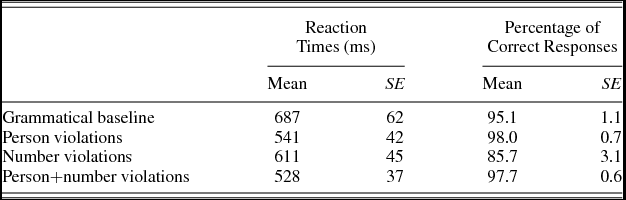
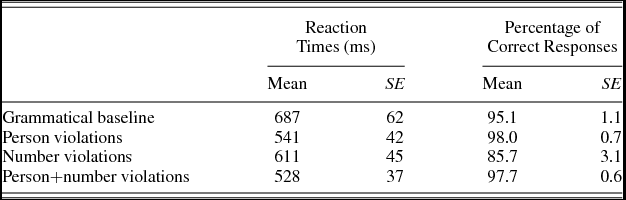
Participants overall showed a high grammaticality judgment accuracy (mean accuracy of 94.1%, SDE = 1.97; see Table 2). The analysis of accuracy data revealed that there was a significant difference between the grammaticality conditions, F1 (3, 63) = 15.42, p < .001, εGG = 0.444; F2 (3, 477) = 59.95, p < .001, εGG = .760. Statistical pairwise tests showed that in comparison to the grammatical baseline, the participants committed more errors in the number condition, t1 (21) = –3.56, p = .006, t2 (159) = –7.11, p < .001, and fewer errors in the person condition, although these differences were only significant in the analysis by items, t1 (21) = 2.29, p = .032, t2 (159) = 3.02, p = .003. No differences were found between baseline and person+number conditions, t1 (21) = 2.26, p = .034; t2 (159) = 2.59, p = .010. In addition, error rates were significantly lower in person and person+number conditions compared to the number condition: person versus number, t1 (21) = 5.09, p < .001; t2 (159) = –10.32, p < .001; person+number versus number, t1 (21) = 4.47, p < .001; t2 (159) = –10.65, p < .001.
Mean reaction times and percentage of correct responses with their corresponding standard errors per experimental condition
Grammaticality judgment response latencies
Similarly to the accuracy data, the results of the response time data showed differences between the four grammaticality conditions, F1 (3, 63) = 11.26, p < .001, εGG = 0.549; F2 (3, 477) = 30.90, p < .001, εGG = 0.851. Further paired comparisons revealed that, compared to the grammatical sentences, the participants needed significantly less time to make grammaticality judgments in the ungrammatical person, t1 (21) = 4.31, p < .001; t2 (159) = 7.8, p < .001, and person+number conditions, t1 (21) = 4.11, p < .001; t2 (159) = 7.42, p < .001, while no differences were found when comparing the grammatical baseline to the ungrammatical number condition in the analysis by subjects, t1 (21) = 1.77, p = .09; t2 (159) = 3.81, p < .001. In addition, the participants needed more time to judge the grammaticality of sentences containing number violations than to judge the grammaticality of sentences containing person violations, t1 (21) = –2.86, p = .009; t2 (159) = –3.63, p < .001, or person+number violations, t1 (21) = 3.17, p = .001; t2 (159) = –5.33; p < .001.
ERP RESULTS
The analyses carried out over the lateral electrodes within the 300–500 ms time window revealed a significant Grammaticality × Hemisphere × Region interaction, F (6, 126) = 3.30, p = .015, εGG = 0.653. The comparison between the four grammaticality conditions carried out over the midline electrodes yielded no statistically significant results. The analyses carried out over the lateral electrodes within the 500–800 ms time window showed significant Grammaticality × Hemisphere, F (3, 63) = 9.04, p = .001, εGG = 0.655, and Grammaticality × Region interactions, F (6, 126) = 6.66, p = .001, εGG = 0.414, while the analyses carried out over the midline electrodes revealed a significant Grammaticality × Region interaction, F (6, 126) = 11.49, p < .001, εGG = 0.468.
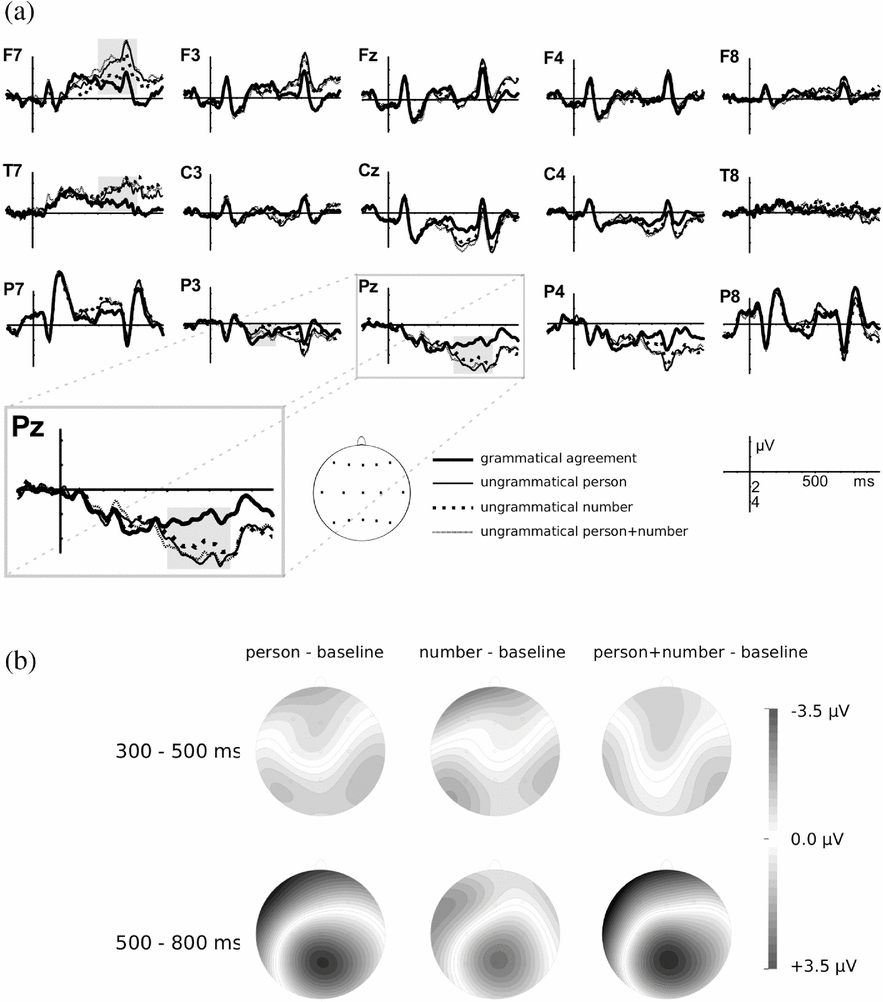
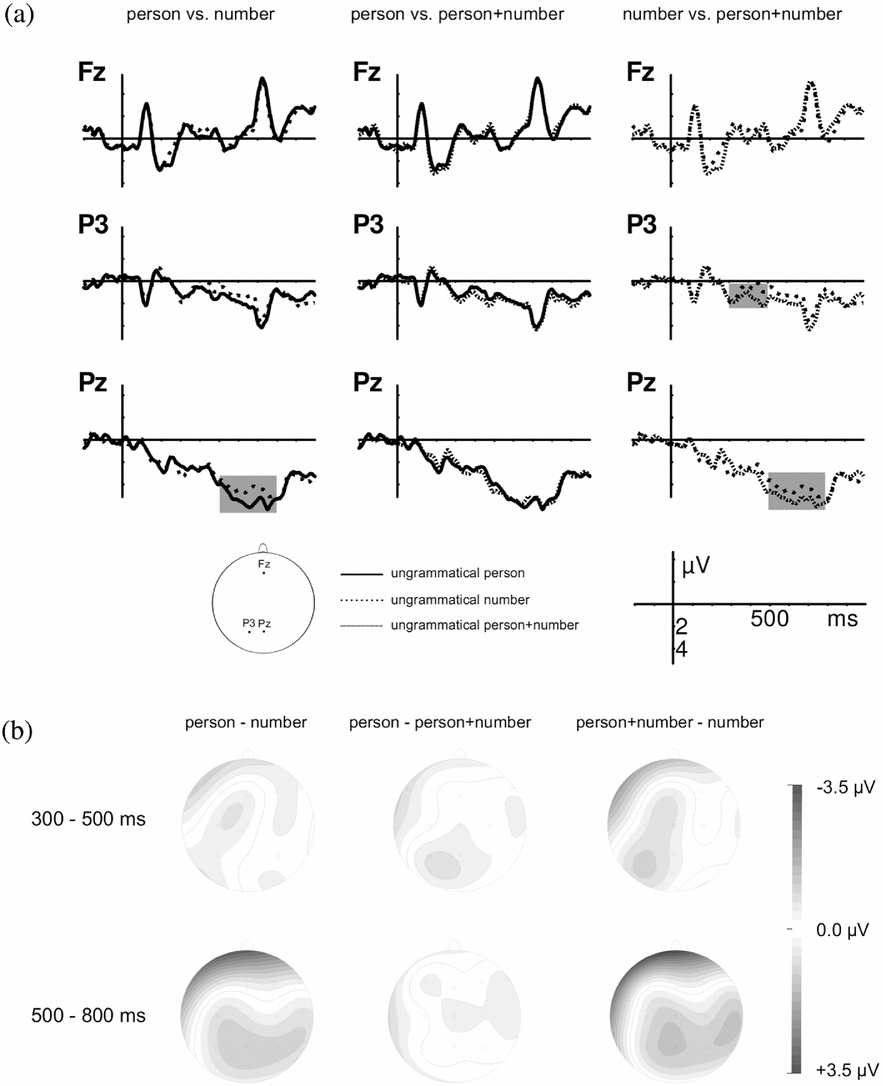
In order to better understand these interactions, we conducted follow-up analyses comparing each of the three main agreement violations separately against the control grammatical sentence (Fig. 1) and then each violation type against the other two ungrammatical conditions (Fig. 2).
(a) Event-related potentials elicited at the critical word position in all conditions. The thick solid line represents the grammatical baseline, the thin solid line stands for the ungrammatical person feature violations, the thick dashed line represents number feature violations, and the thin dashed line represents person+number feature violations. Major significant differences between the grammaticality conditions are highlighted by the gray areas. (b) Topographical amplitude difference maps for the grammaticality effect in all conditions, calculated as the average difference amplitude between each ungrammatical condition and the grammatical baseline.
(a) Comparison of the effects elicited by the ungrammatical conditions at the critical word position at Fz, P3, and Pz electrodes. The solid line stands for the ungrammatical person feature violations, the thick dashed line represents number feature violations, and the thin dashed line represents person+number feature violations. Major significant differences between the grammaticality conditions are highlighted by the gray areas. (b) Topographical amplitude difference maps calculated as the average difference amplitude between the ungrammatical conditions (person minus number, person minus person+number, and person+number minus number).
Main grammaticality effects per condition
300–500 ms time window
PERSON VIOLATIONS
Further analyses of the Grammaticality × Hemisphere × Region interaction showed that person violations elicited a larger negativity than the grammatical baseline over the left posterior sites of the scalp, F (1, 21) = 4.82; p = .040, as well as marginally larger negativity over the right posterior region, F (1, 21) = 3.34, p = .082.
NUMBER VIOLATIONS
The analysis of the Grammaticality × Hemisphere × Region interaction revealed that, in comparison to the grammatical agreement condition, number violations elicited a larger negativity over the left posterior, F (1, 21) = 27.84, p < .001, and the right posterior regions, F (1, 21) = 4.49, p = .046, which was accompanied by a larger positivity over the left anterior site, F (1, 21) = 7.42, p = .013.
PERSON+NUMBER VIOLATIONS
The follow-up analyses of the Grammaticality × Hemisphere × Region interaction showed that the person+number violations elicited a marginally larger negativity than the grammatical baseline over the right posterior region, F (1, 21) = 3.42, p = .079.
500–800 ms time window
PERSON VIOLATIONS
Subsequent analyses of the Grammaticality × Hemisphere interaction revealed that the person violations elicited a larger negativity than the grammatical baseline condition over the left hemisphere, F (1, 21) = 14.38, p = .001, and a marginally larger negativity over the right hemisphere, F (1, 21) = 3.57, p = .073. The analyses of the Grammaticality × Region interaction revealed that person violations elicited a larger negativity than grammatical stimuli over the frontal region accompanied by a larger positivity over posterior electrodes: frontal region, F (1, 21) = 9.98, p = .005; central region, F (1, 21) < .001, p = .952; posterior region, F (1, 21) = 7.31, p = .013.
Further analyses of the Grammaticality × Region interaction carried out over the midline electrodes showed that person violations elicited a larger negativity over frontal and a larger positivity over central and posterior regions of the scalp as compared to the grammatical condition: frontal region, F (1, 21) = 5.69, p = .027; central region, F (1, 21) = 5.33, p = .031; posterior region, F (1, 21) = 57.39, p < .001.
NUMBER VIOLATIONS
The follow-up analyses of the Grammaticality × Hemisphere interaction revealed that, in comparison to the grammatical condition, number violations elicited a larger negativity over the left hemisphere, F (1, 21) = 10.28, p = .004, and a marginally larger positivity over the right hemisphere, F (1, 21) = 3.40, p = .079. The analyses of the Grammaticality × Region interaction revealed that number violations elicited a larger negativity than grammatical stimuli over the frontal region accompanied by a larger positivity over posterior electrodes: frontal region, F (1, 21) = 8.81, p = .008; central region, F (1, 21) = 0.24, p = .628; posterior region, F (1, 21) = 4.74, p = .041. The analyses of the Grammaticality × Region interaction carried out over the midline electrodes revealed that number violations elicited a larger positivity than grammatical stimuli over central and posterior regions: frontal region, F (1, 21) = 0.68, p = .419; central region, F (1, 21) = 5.27, p = .032; posterior region, F (1, 21) = 26.00, p < .001.
PERSON+NUMBER VIOLATIONS
Further analyses of the Grammaticality × Hemisphere interaction revealed that person+number violations elicited a larger negativity than grammatical stimuli over the left hemisphere, F (1, 21) = 15.37, p = .001, accompanied by a larger positivity over the right hemisphere, F (1, 21) = 9.16, p = .006. The analyses of the Grammaticality × Region interaction conducted over the lateral electrodes revealed that, compared to the grammatical baseline, person+number violations elicited a larger positivity at the posterior region accompanied by a frontal negativity: frontal region, F (1, 21) = 15.43, p = .001; central region, F (1, 21) = 0.21, p = .654, posterior region, F (1, 21) = 22.03, p < .001. The analyses of the Grammaticality × Region interaction carried out over the midline electrodes revealed that person+number violations elicited a larger negativity than grammatical stimuli over frontal sites and a larger positivity over the central and posterior regions of the scalp: frontal region, F (1, 21) = 12.90, p = .002; central region, F (1, 21) = 10.98, p = .003; posterior region, F (1, 21) = 52.07, p < .001.
Comparing person and number phi-feature violations
300–500 ms time window
The analysis of the Grammaticality × Hemisphere × Region interaction revealed no statistically significant effect.
500–800 ms time window
The analyses of the Grammaticality × Hemisphere and Grammaticality × Region interactions conducted over the lateral electrodes yielded no statistically significant results. The analyses of the Grammaticality × Region interaction carried out over the midline electrodes revealed that, compared to number violations, person violations elicited a larger negativity over the frontal regions, as well as a larger positivity over posterior sites of the scalp: frontal region, F (1, 21) = 6.80, p = .016; central region, F (1, 21) = 0.80, p = .382, posterior region: F (1, 21) = 5.92, p = .024.
Comparing person and number single-features versus person+number double-feature violations
300–500 ms time window
The follow-up analysis of the Grammaticality × Hemisphere × Region interaction revealed no differences between person violations and person+number violations. In contrast, number violations showed a larger negativity than person+number violations over the left posterior site, F (1, 21) = 5.79, p = .025.
500–800 ms time window
The analysis of the Grammaticality × Hemisphere interaction showed no differences between person and person+number violations or between number and person+number violations. The subsequent analyses of the Grammaticality × Region interaction carried out over the lateral and midline electrodes yielded no significant effects between person violations and person+number violations. In contrast, the comparison between number violations and person+number violations conducted over the lateral electrodes showed a larger positivity for person+number violations than for number violations over the posterior regions of the scalp: frontal region, F (1, 21) = 1.88, p = .185; central region, F (1, 21) = 2.18, p = .155; posterior region, F (1, 21) = 6.31, p = .02. At the midline electrodes, the same comparison revealed a larger negativity for person+number violations than for number violations over frontal sites as well as a marginally larger positivity for person+number violations than for number violations over the central region and a larger positivity over posterior sites: frontal region, F (1, 21) = 11.32, p = .003; central region, F (1, 21) = 3.95, p = .06; posterior region, F (1, 21) = 5.04, p = .036.
SUMMARY OF THE RESULTS
The behavioral results showed that person violations and person+number violations were judged with higher accuracy than were number violations. The response times revealed a very similar pattern: participants were slower detecting the ungrammaticality of sentences containing number violations than those containing both person violations and person+number violations. These results suggest that person and person+number agreement violations are more salient and therefore easier and faster to detect than number agreement violations.
ERP data showed that in comparison to grammatical stimuli, overall all violation conditions elicited similar ERP components: a posterior negativity between 300 and 500 ms after the stimulus onset (although only marginally significant for person+number violations). Although its distribution is not “classic” (centroparietal; Kutas & Hillyard, Reference Kutas and Hillyard1980), given its latency (300 ms) and posterior (rather than frontal) distribution we labeled it as a N400. The posterior negativity was followed by a positivity, which we interpreted as a classic P600 component. This posterior positivity was accompanied by a late negative component present over the lateral and frontal regions of the scalp. The comparisons of the magnitude of these two main ERP components between the three different types of violations revealed the following patterns: (a) in the 300–500 ms time window, no differences were found between person and number violations or between person and person+number violations, while number violations elicited a larger negativity over left-posterior sites than person+number violations; and (b) in the 500–800 ms time window, no differences were found between person and person+number violations, whereas both person and person+number violations elicited a larger P600 than number violations over posterior sites accompanied by a larger negativity over frontocentral sites.
GENERAL DISCUSSION
The current study investigated whether person and number phi-features are distinctly processed during verb-agreement computation. To this purpose, we tested how native speakers of Basque dealt with ungrammatical sentences where subject agreement relations were violated in person, number, or both features. Previous experiments carried out in Hindi, Basque, and Spanish yielded contrasting results: some studies found no differences in processing person and number feature violations (Nevins et al., Reference Nevins, Dillon, Malhotra and Phillips2007; Silva-Pereyra & Carreiras, Reference Silva-Pereyra and Carreiras2007), while others reported distinct ERP signatures for each phi-feature violation, suggesting they are processed differently (Díaz et al., Reference Díaz, Sebastián-Gallés, Erdocia, Mueller and Laka2011; Mancini et al., Reference Mancini, Molinaro, Rizzi and Carreiras2011; Zawiszewski & Friederici, Reference Zawiszewski and Friederici2009).
Our results revealed qualitatively similar but quantitatively larger ERP signatures for person than for number violations. The behavioral results concurrently revealed that participants made more errors and were slower when processing number violations as compared to person violations. All together, these findings lend support to the hypothesis that similar processes govern person and number agreement computation, but that the person phi-feature is cognitively more salient than the number phi-feature, as argued by Carminati (Reference Carminati2005), Greenberg (Reference Greenberg1966), Harley and Ritter (Reference Harley and Ritter2002), and Nevins et al. (Reference Nevins, Dillon, Malhotra and Phillips2007), among others.
In the case of the ERP results, both person and number violations elicited a N400, followed by a P600. A similar pattern was also observed during ungrammaticality detection of sentences containing person+number feature violations. The two conditions including person feature violations (person and person+number conditions) did not show any difference in their ERP patterns. However, the amplitude of the P600 was significantly larger in the conditions including person feature violations compared to the condition including number feature violations. Together with the results from the behavioral task where higher accuracy and shorter response times were found in person and person+number violation than in number violation conditions, the larger P600 for the former than for the latter conditions suggests that these violations are more salient and that person has a special status among agreement features (see Nevins et al., Reference Nevins, Dillon, Malhotra and Phillips2007, Experiment 2, for similar results and conclusions). In order to investigate whether there is a relationship between the amplitude of the P600 component and the behavioral performance of the participants, we computed a correlation analysis in which we included accuracy scores and the amplitude of the P600 component corresponding to each condition. The two-tailed correlation analyses showed no dependency between both factors; that is, the number of errors did not correlate with the changes of the P600 in any condition: grammatical subject agreement: r (22) = –.247, p = .268; person violations, r (22) = .088, p = .697; number violations, r (22) = –.047, p = .835; person+number violations, r (22) = –.247, p = .267. In addition, in comparison to person+number violations, number violations elicited a larger negativity over the left-posterior region of the scalp. A deeper look at this effect revealed that although all violations elicited a larger negativity at this region as compared to the grammatical baseline, the magnitude of the effect in the 300–500 ms time window was largest in number violations (–0.97 μV) followed by person (–0.61 μV) and person+number violations (–0.32 μV). These gradual changes in the amplitude of the N400 (statistically reliable only for the comparison between number and person+number violations) might reflect difficulties during error identification (greater for number as compared to person and person+number violations). As suggested by an anonymous reviewer, the effect described as negativity could be also interpreted as an instance of the P300 component. The P300 effect can be modulated by many factors: expectancy, probability of the upcoming target, task difficulty, and so forth (Osterhout, McKinnon, Bersick, & Corey, Reference Osterhout, McKinnon, Bersick and Corey1996; Picton, Reference Picton1992). Picton (Reference Picton1992) showed that the amplitude of the P300 varies depending on how difficult the discrimination task is, so that if the task of discriminating the target stimulus from the standard stimulus is difficult, the amplitude of the P300 tends to become smaller and its latency longer. If we interpret the grammatical condition as “standard” and the ungrammatical conditions as “targets,” then our data are consistent with this view. In any case, both interpretations (N400 or P300) suggest that the changes in the amplitude of the N400/P300 might reflect difficulties during error identification (greater for number as compared to person and person+number violations).
In contrast, the larger P600 amplitudes found in person and person+number violations as compared to the number violations reveals greater difficulties during the repair/revision phase for the former conditions as compared to the latter one.
Put together, our results reveal greater prominence of the person phi-feature as compared to number during the computation of person+number agreement violations, because the effects yielded by number violations were overridden by those elicited by person violations, at least at late stages of agreement processing.
Comparison of the current experiment with previous studies
Regarding the results from Spanish reported by Silva-Pereyra and Carreiras (Reference Silva-Pereyra and Carreiras2007), two major differences can be observed. In our study in Basque, all violations led to a biphasic N400–P600 pattern. In contrast, in Spanish, person and number violations only yielded a P600, while the biphasic anterior negativity followed by a P600 was only reported for person+number violations. These apparently contrasting findings may be due to differences between the experimental manipulations in these studies: while Silva-Pereyra and Carreiras (Reference Silva-Pereyra and Carreiras2007) used first person to test number violations, we used second person. The N400–P600 ERP patterns related to subject agreement violations in our study are the same as those previously obtained by Zawiszewski and Friederici (Reference Zawiszewski and Friederici2009) related to subject and object agreement violations in the same language, Basque. Both studies used single-person or double person+number violations when testing subject agreement. However, the ERP responses in the present experiment differ from those reported by Díaz et al. (Reference Díaz, Sebastián-Gallés, Erdocia, Mueller and Laka2011). They found a P600 elicited by both subject and object agreement violations preceded by posterior negativity between 200 and 300 ms in object agreement violations, while the manipulations used in the current study led to a N400–P600 pattern. As suggested in the introductory section, besides the possible influence of the way the stimuli were presented (auditorily vs. visually), the differences at early stages of processing (between 300 and 500 ms) are likely because Díaz et al. (Reference Díaz, Sebastián-Gallés, Erdocia, Mueller and Laka2011) tested number feature violations only (third-person verb forms) while in our study we also tested the person feature (second-person verb forms).
Our results are consistent with those reported by Mancini et al. (Reference Mancini, Molinaro, Rizzi and Carreiras2011) in finding differences between person and number phi-feature processing. However, the way in which these features differ diverges significantly in both studies. Unlike the present study, Mancini et al. (Reference Mancini, Molinaro, Rizzi and Carreiras2011) found that participants were faster judging the grammaticality of sentences with number than person violations, but they did not find behavioral accuracy differences between the conditions. In addition, in contrast to the N400–P600 pattern reported here for Basque, in Mancini et al. (Reference Mancini, Molinaro, Rizzi and Carreiras2011), number violations in Spanish elicited a LAN followed by a P600 component and only person violations yielded N400–P600 effects. The amplitude of the P600 was similar in both number and person violations over the parietal sites, but larger for person than for number violations over the frontal sites, which, according to the authors, was due to discourse-related integration difficulties. In sum, the pattern reported by Mancini et al. (Reference Mancini, Molinaro, Rizzi and Carreiras2011) suggests that person and number features processing are different operations, as indicated by the qualitatively different ERP components (LAN vs. N400).
The results of the current study do not support this claim, because person and number violations displayed a similar N400–P600 pattern. The different findings in both studies may be attributed to the differences between experimental materials used: third-person agreement as a testing ground for person and number violations and critical words preceded by different contexts in Mancini et al. (Reference Mancini, Molinaro, Rizzi and Carreiras2011) versus second-person agreement as a comparison point for all types of violations and critical words preceded by the same context in our study. In contrast, it might reflect differences in processing strategies when dealing with Basque and Spanish verb agreement. More precisely, in Spanish, the finite verb only agrees with the subject of the sentence, while in Basque, it agrees with both the subject and the object of the sentence, and consequently both arguments need to be taken into account when processing verb agreement structures. Even if we kept object agreement constant across the experiment (third-person singular or plural), it cannot be ruled out that when more than one constituent is involved in agreement processes, the thematic dependencies of the arguments also play a role in agreement computation. This might be the reason why a N400 emerges in Basque independently of the type of feature involved. In this regard, partial evidence supporting this argument comes from the diverging patterns of results showed by studies investigating subject agreement that used animate versus inanimate objects: note that both Zawiszewski and Friederici (Reference Zawiszewski and Friederici2009) and the present study used animate objects, while Díaz et al. (Reference Díaz, Sebastián-Gallés, Erdocia, Mueller and Laka2011) used inanimate objects. In those cases in which both the subject and the object are animate, the likelihood of the object argument to be misinterpreted as a candidate for subjecthood due to its animacy feature may make agreement computation more demanding in comparison to the cases where the subject is animate and the object is inanimate. Consequently, because in order to identify and repair the error the parser must deal with the thematic dependencies of the arguments, a N400 is elicited.
Finally, in addition to the parietal positivity observed between 500 and 800 ms, we also found a negative component, mostly distributed over the left and frontal areas of the scalp. Late frontal negativities have been previously described as related to working memory and task demands (Sabourin & Stowe, Reference Sabourin and Stowe2004; Sabourin, Stowe, & de Haan, Reference Sabourin, Stowe and de Haan2006). Sabourin and Stowe (Reference Sabourin and Stowe2004) suggested that this type of negativity could be related to the effect of maintaining the ungrammaticality in memory until a delayed grammaticality decision is made at the end of the sentence. Our findings are compatible with this view: the negativity was larger for person and person+number violations in comparison to number violations, suggesting that memory-related processes involved during later stages of agreement computation are more demanding in the former conditions as compared to number violations.Footnote 2
However, it could be argued that the differences observed between the number feature and other violations might be due to the visual saliency or length differences between the auxiliary forms of the various violation conditions.Footnote 3 For instance, the visual saliency and length differences between the grammatical baseline (duzu “have2SG”) and the number feature violations (*duzue “have2PL”) seem smaller in comparison to those between the grammatical baseline and person (duzu vs. *dut “have1SG”) or person+number feature violations (duzu vs. *dugu “have1PL”). Hence, it might be that part of the differences between the number versus person and person+number violation conditions is due to their visual saliency differences, and not to the greater prominence of the person phi-feature as compared to number phi-feature. This is a caveat that cannot be easily avoided, and it also affects other ERP studies that investigated subject–verb agreement relations.
For instance, Nevins et al. (Reference Nevins, Dillon, Malhotra and Phillips2007, their Experiment 1) found that, compared to the grammatical baseline, a larger P600 was found for the person+gender violation, while no modulation of the P600 was found when contrasting the grammatical baseline with the gender violation, the number violation, and the gender+number violation. In this case, although they interpret this finding as evidence of the special status of the person among the other features, they do not discard the possibility that the larger P600 may have been modulated by the greater orthographic/visual saliency of the Devanagari script (in which the stimuli were presented; see Nevins et al., Reference Nevins, Dillon, Malhotra and Phillips2007) in the case of person+gender violations than in the other type of violations. However, in the study of Silva-Pereyra and Carreiras (Reference Silva-Pereyra and Carreiras2007), the comparisons in Spanish involved the contrasts yo abro “I open1SG” (grammatical) versus yo *abrimos “I open1PL” (number violation) versus yo *abres “I open2SG” (person violation) versus yo *abren “I open2PL” (person+number violation). Although the differences between abro vs. *abrimos may be considered more visually salient than those between abro and *abres (e.g., the latter shares the same length and syllabic structure), the two comparisons yielded similar P600 components. This suggests that the role of visual saliency in this type of task might be rather limited. Finally, in a study that aimed to explore the impact of the phonological realization of visually presented morphosyntactic agreement in French, Frenck-Mestre, Osterhout, McLaughlin, and Foucart (Reference Frenck-Mestre, Osterhout, McLaughlin and Foucart2008) compared the following subject agreement conditions: (je mange “I eat1SG” (/ʒə mãʒə/; grammatical) versus je *mangez “I eat2PL” (/ʒə mãʒe/; phonologically realized) versus je *manges “I eat2SG” (/ʒə mãʒə/; phonologically silent). Despite the similar difference in visual saliency between the baseline condition and the two violation conditions, a larger P600 was reported for the phonologically realized than for the phonologically silent conditions. In sum, there are studies in which visually different agreement violations show no different magnitudes of P600 components, while different P600 amplitudes also have been reported in studies in which visually similar agreement violations are compared.
Coming back to our study, if the reported differences were only due to visual saliency, then we would also expect the contrast between the grammatical baseline duzu and the person feature violation *dut to be larger than that observed between duzu and the person+number feature violation *dugu, because of the larger visual difference between duzu and *dut than between duzu and *dugu (e.g., the latter shares the same length and syllabic structure). However, our data reveal a similar pattern in person and person+number violations suggesting that visual saliency effects are rather small in our experimental design, and thus unlikely to be the main factor responsible for the larger grammaticality effects found for number than for person or number+person feature violation conditions. Hence, although we acknowledge that visual saliency differences between conditions might play a small role in our results, we believe that the main differences between number versus person and person+number feature violations observed in our results are best interpreted as reflecting a greater prominence of the person phi-feature as compared to the number phi-feature, following the wake of previous ERP studies on verb agreement where visual saliency did not seem to play a significant role either.
In sum, the present data and other cross-linguistic evidence suggest that qualitatively similar but quantitatively distinct ERP effects obtain for person and number phi-features only when the person feature is involved, that is, when either I (speaker) and you (addressee) are manipulated. Thus, our results are consistent with the claim in linguistics that only I, you, and we forms involving the speaker and the addressee are valued for the person feature (Anagnostopoulou, Reference Anagnostopoulou2003; Benveniste, Reference Benveniste1966; Harley & Ritter, Reference Harley and Ritter2002) while third person is the absence of the person feature, a view long held in linguistics (Benveniste, Reference Benveniste1966; Jakobson, Reference Jakobson1971). This view is convergent with the ERP findings reported across the studies mentioned above: whenever the person feature is involved in agreement computation, a N400–P600 pattern emerges (Mancini et al., Reference Mancini, Molinaro, Rizzi and Carreiras2011; Zawiszewski & Friederici, Reference Zawiszewski and Friederici2009), while when it is not, the LAN–P600 components (Mancini et al., Reference Mancini, Molinaro, Rizzi and Carreiras2011) or the P600 (Díaz et al., Reference Díaz, Sebastián-Gallés, Erdocia, Mueller and Laka2011; Nevins et al., Reference Nevins, Dillon, Malhotra and Phillips2007; Silva-Pereyra & Carreiras, Reference Silva-Pereyra and Carreiras2007) have been reported. The fact that in the present study person and person+number violations elicited similar responses might suggest that person features do not necessarily combine with number, as argued by Cysouw (Reference Cysouw2003) and Wechsler (Reference Wechsler2004).
Conclusions
Here, we focused on the core components of verb agreement. We considered the case of subject agreement, and more specifically, we investigated whether person and number, the core phi-features, are processed differently. Our results reveal a distinct cost related to person and number feature computation, and clearly signal the saliency of person among the repertoire of phi-features. However, it is well known that agreement patterns can be intricately variable cross-linguistically (Baker, Reference Baker2008; Corbett, Reference Corbett1983, Reference Corbett2006, Reference Corbett, Birzer, Finkelstein and Mendoza2009; Nevins, Reference Nevins2011), and therefore further research is necessary, across different types of grammars and agreement types, to confirm the validity of these initial findings and to determine how they relate to other aspects of agreement that have yet to be experimentally explored.
ACKNOWLEDGMENTS
This research was supported by the Spanish Ministerio de Economía y Competitividad and the Spanish Ministerio de Ciencia e Innovación (FFI2010-20472; FFI2012-31360), the Basque government (IT665-13), a postdoctoral position (EC FP7/SSH-2013-1 AThEME 613465, to A.Z.), and a Ramón y Cajal research position (RyC-2013-14722, to M.S.).