Implications
In Europe, growing rabbits are housed in bicellular (two animals) or small-group cages (four to six animals), which do not permit a full expression of animal behaviour, particularly movement and social contacts. Rabbit farmers are afraid to adopt large-group cages because of the possible impairment of growth performance and carcass and meat quality, especially when rabbits are sold at high market weight (2.5 to 2.8 kg). The present study compared individual, bicellular and collective cages with nine rabbits, and it demonstrates that the adoption of collective cages does not impair growth performance and carcass quality in comparison with bicellular cages.
Introduction
According to the European Food and Safety Authority (EFSA, 2005a and 2005b), the rearing system currently used in intensive commercial farms does not fulfil the welfare requirements of rabbits. In Italy and other European countries, rabbits are housed in individual or bicellular cages or in small cages with four to six rabbits, and males and females are kept together because of the low sexual dimorphism. This housing system does not permit rabbits to fully express their normal behaviour (Trocino and Xiccato, Reference Trocino and Xiccato2006; Verga et al., Reference Verga, Luzi and Carenzi2007). Growing rabbits should be kept in groups to promote normal social interactions and in cages or pens with a suitable dimension to allow all other activities. However, group rearing is often associated with worsening growth performance and the impairment of carcass and meat quality (Xiccato et al., Reference Xiccato, Verga, Trocino, Ferrante, Queaque and Sartori1999; Combes and Lebas, Reference Combes and Lebas2003; Szendrő et al., Reference Szendrő, Princz, Romvári, Locsmándi, Szabó, Bázár, Radnai, Biró-Németh, Matics and Nagy2009). When rabbits are slaughtered after 9 to 10 weeks of age with a live weight higher than 2.2 to 2.4 kg (e.g. in Italy and Hungary where the market slaughter weight is 2.5 to 2.7 kg), these negative results are even accentuated by an increase in aggressiveness among animals reared in collective systems with large groups (>10 rabbits; Szendrő et al., Reference Szendrő, Princz, Romvári, Locsmándi, Szabó, Bázár, Radnai, Biró-Németh, Matics and Nagy2009). Little information is available for groups of intermediate size, that is, 6 to 10 rabbits corresponding to the typical size of weaned litters.
The present study aimed to compare the growth performance, slaughter results and carcass and meat quality of rabbits reared in individual, bicellular or collective cages with groups of nine animals.
Material and methods
Animals and housing
The study was approved by the Italian Ministry of Education, University and Research, and all animals were handled according to the principles stated by the EC Directive 86/609/EEC regarding the protection of animals used for experimental and other scientific purposes.
A total of 384 rabbits of both genders (not controlled) from a cross-bred line (Hyplus, Grimaud Frères, France) were reared from weaning (27 days of age) to the day before slaughtering (75 days of age). The rabbits were kept in a brick shed equipped with a forced heating and cooling system to maintain the temperature within the range of 14°C to 25°C and were submitted to a natural photoperiod during the months of March to May.
The rabbits were divided into three experimental groups that were homogeneous in average live weight and variability: 72 rabbits were put into individual cages (25 cm wide × 40 cm long × 30 cm high; available surface per rabbit: 1000 cm2; stocking density: 10 rabbits/m2); 96 rabbits were put into 48 bicellular cages (2 rabbits/cage; 28 × 40 × 30 cm; available surface per rabbit: 560 cm2; stocking density: 18 rabbits/m2); 216 rabbits were put into 24 open-top collective cages (9 rabbits/cage; 50 × 100 cm; available surface per rabbit: 555 cm2; stocking density: 18 rabbits/m2). Both the floors and walls of all cages were made of wire net. All cages were equipped with nipple drinkers (one in the individual and bicellular cages; two in the collective cages) and feeders for the manual distribution of diets (one in the individual and bicellular cages; two in the collective cages).
The rabbits were given ad libitum access to water and a diet suitable for growing rabbits (as-fed basis, CP: 16.1%, NDF: 36.6%, starch: 11.6%, digestible energy: 10.1 MJ/kg), according to the recommendation of De Blas and Mateos (Reference De Blas and Mateos2010), containing coccidiostat (Robenidine, 66 mg/kg diet) and without any antibiotic drug.
Growth performance and health status
Individual live weight and feed intake were recorded once a week from 27 to 75 days of age. The health status of the rabbits was controlled daily. The rabbits were considered ill when evidencing diarrhoea or a strong reduction of feed intake (at least −0.30 compared with the previous recording). During the whole trial, the sanitary status was good, and only 10 animals died: two rabbits from the individual cages; seven from the bicellular cages; and one from the collective cages.
Commercial slaughter and carcass recordings
The day after the end of the growth trial, at 76 days of age, 120 rabbits were selected (40 per housing system) and individually processed in a commercial slaughterhouse. The slaughtered animals were representative of the corresponding experimental group in terms of average live weight and variability. After 24 h of cooling, the commercial carcasses were dissected. The reference carcass was obtained by removing the head, the thoracic organs and the kidneys according to the procedures described by Blasco et al. (Reference Blasco, Ouhayoun and Masoero1993). The pH was measured in duplicate on the longissimus lumborum and biceps femoris muscles. The L*a*b* colour indexes (Commission International de l'Eclairage (CIE) 1976) were measured in duplicate on the same muscles using a Minolta CM-508 C spectrophotometer (Minolta Corp., Ramsey, NJ, USA).
Statistical analysis
Individual data of growth, slaughter results and carcass and meat traits were analysed by ANOVA with the housing system as the main effect and the cage as the random effect and using the PROC MIXED of SAS (Statistical Analysis System Institute, 1991). The cage data of feed intake and feed conversion were analysed by ANOVA with the housing system as the main effect and using the PROC GLM of SAS. The Bonferroni t-test was used to compare the means by groups of housing systems. Differences among the means with P < 0.05 were accepted as representing statistically significant differences.
Results
Growth performance
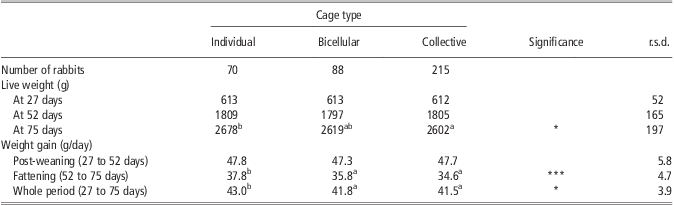
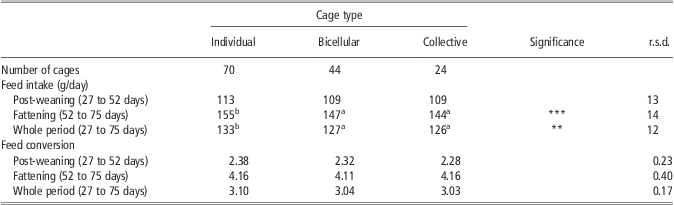
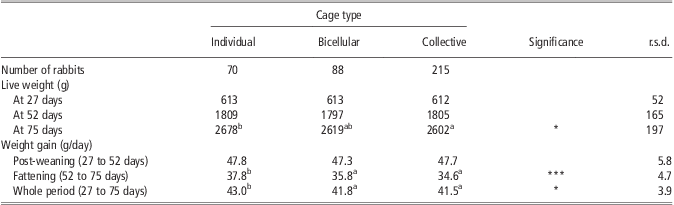
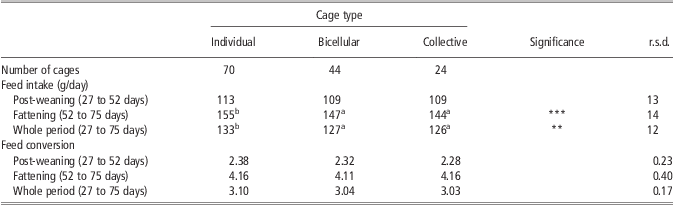
The rabbits reared in individual cages showed a higher final live weight (75 days of age) compared with the rabbits in the bicellular and collective cages (2678 v. 2619 and 2602 g, respectively; P < 0.05; Table 1). The daily weight gain was significantly higher in the individually reared rabbits, both during the fattening period (from 52 to 75 days of age) and in the whole period of growth (43.0 v. 41.8 and 41.5 g/day, respectively; P < 0.05) compared with the rabbits in the bicellular and collective cages. The rabbits kept in individual cages also ingested a higher amount of feed in the second period of growth (Figure 1) and in the whole period (0.01 < P < 0.001; Table 2). The feed conversion did not differ significantly among the rabbits housed in the different types of cages.
Rabbit performance from weaning (27 days of age) until slaughter (75 days): individual dataFootnote 1
1 Data analysed by ANOVA with the housing system as the main effect and the cage as the random effect and using the PROC MIXED of SAS (Statistical Analysis System Institute, 1991).
* P < 0.05, ***P < 0.001.
a,b Within a row, the means without a common superscript letter differ, P < 0.05.
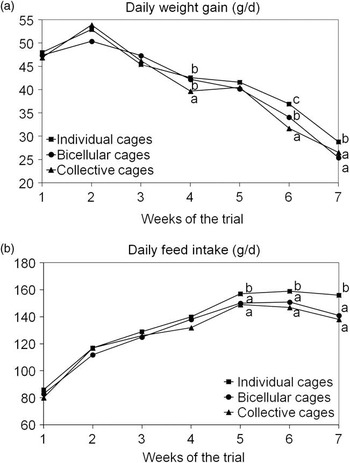
Daily weight gain (a) and feed intake (b) of rabbits during the weeks of the trial. Different letters on indicators within the same week indicate the means are significantly different (P < 0.05).

Feed intake and feed conversion from weaning (27 days of age) until slaughter (75 days): cage dataFootnote 1
1 Data analysed by ANOVA with the housing system as the main effect and using the PROC GLM of SAS (Statistical Analysis System Institute, 1991).
** P < 0.01, ***P < 0.001.
a,b Within a row, the means without a common superscript letter differ, P < 0.05.
Figure 1 shows that differences in daily weight gain were significant on the 4th week and after the 6th week of the trial. Similarly, differences in feed intake were evident from the 5th week of the trial onward in favour of rabbits kept in individual cages.
Slaughter traits and carcass and meat quality
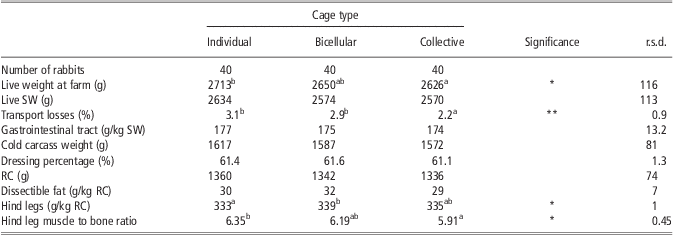
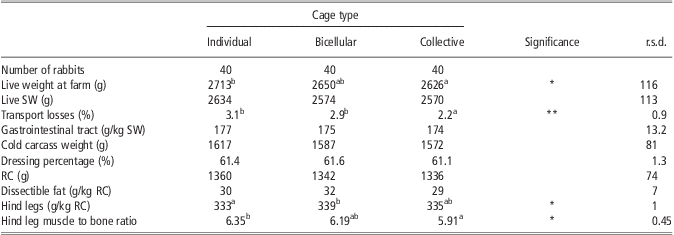
The slaughter and carcass traits (Table 3) and the meat quality (Table 4) were weakly affected by the housing system. The transport losses were higher in the rabbits kept in individual and bicellular cages compared with those in collective cages (3.1% and 2.9% v. 2.2%, respectively; P < 0.01). The muscle to bone ratio measured on the hind leg was higher in the individually housed rabbits (6.35 v. 6.19 and 5.91; P < 0.05) compared with the rabbits in the bicellular and collective cages, respectively.
Results at slaughter of rabbits at 76 days of age and main characteristics of 24-h chilled carcassesFootnote 1
SW = slaughter weight; RC = reference carcass.
1 Data analysed by ANOVA with the housing system as the main effect and the cage as the random effect and using the PROC MIXED of SAS (Statistical Analysis System Institute, 1991).
* P < 0.05, **P < 0.01.
a,b Within a row, the means without a common superscript letter differ, P < 0.05.
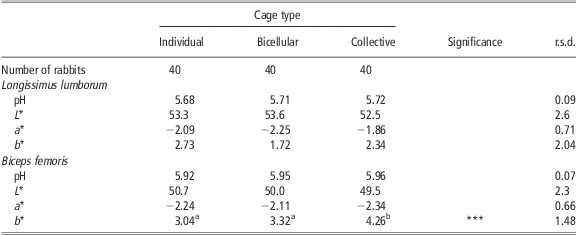
Meat pH and colour indexes of 24-h chilled carcassesFootnote 1
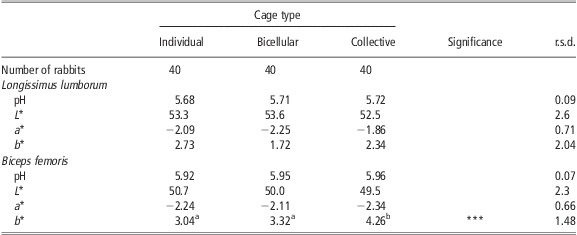
1 Data analysed by ANOVA with the housing system as the main effect and the cage as the random effect and using the PROC MIXED of SAS (Statistical Analysis System Institute, 1991).
*** P < 0.001.
a,b Within a row, the means without a common superscript letter differ, P < 0.05.
The pH and colour of the l. lumborum did not change with the housing system. For the b. femoris, the b* index was lower (3.04 and 3.32 v. 4.26, respectively; P < 0.001) in the rabbits kept in individual and bicellular cages than in those kept in collective cages.
Discussion
Effects of the housing system on growth performance
Consistent with earlier results, the housing of growing rabbits in small individual cages always allows the best growth performance (Maertens and De Groote, Reference Maertens and De Groote1984; Xiccato et al., Reference Xiccato, Verga, Trocino, Ferrante, Queaque and Sartori1999) as a consequence of the high ingestion of feed. With increasing age and weight of rabbits, the reduction in available space for movement in bicellular cages and the higher social interaction among animals in collective cages were likely to reduce the access of animals to feeders.
When keeping more than one rabbit per cage, growth performance depends on group size and cage characteristics. In the present trial, the growth performance of rabbits kept in bicellular and collective cages with nine animals were similar but worse than those recorded in individually housed rabbits. Other authors found that rabbits kept in conventional wire-net cages in small groups (two to six rabbits) showed similar growth rates (Verga et al., Reference Verga, Zingarelli, Heinzl, Ferrante, Martino and Luzi2004) or even better performance when group size increased (Mirabito et al., Reference Mirabito, Galliot and Souchet1999). In contrast, the growth performance of rabbits housed in large-group cages (Princz et al., Reference Princz, Dalle Zotte, Metzger, Radnai, Biró-Németh, Orova and Szendrő2009; Szendrő et al., Reference Szendrő, Princz, Romvári, Locsmándi, Szabó, Bázár, Radnai, Biró-Németh, Matics and Nagy2009) or in pens (Lambertini et al., Reference Lambertini, Vignola and Zagnini2001; Martrenchar et al., Reference Martrenchar, Boilletot, Cotte and Morisse2001; Dal Bosco et al., Reference Dal Bosco, Castellini and Mugnai2002; Postollec et al., Reference Postollec, Boilletot, Maurice and Michel2008) was worse compared with the rabbits kept in bicellular cages or in small-group cages, especially during the last weeks of growth.
In the collective systems (cages or pens), the increase of group size above 10 rabbits did not affect the daily growth rate or feed intake (Rommers and Meijerhof, Reference Rommers and Meijerhof1998; Lambertini et al., Reference Lambertini, Vignola and Zagnini2001; Szendrő et al., Reference Szendrő, Princz, Romvári, Locsmándi, Szabó, Bázár, Radnai, Biró-Németh, Matics and Nagy2009).
Generally speaking, the better performance of rabbits kept in small individual cages compared with rabbits kept in bicellular or collective cages may be explained by the fact that animals in individual cages cannot perform activities other than feeding and resting. The similar performance or weak differences between the rabbits in the bicellular and small- or medium-group cages (<10 rabbits) may be explained by the rather limited possibility of movement inside both types of cages, as well as the absence of or weak competition among the animals. Conversely, the better performance of the rabbits in the bicellular and small-group cages compared with rabbits in large-group cages (>10 animals) depends on the possibility of the latter rabbits to express behaviours other than feeding. Higher competition is also likely to occur within large groups of animals both to establish hierarchies and to gain access to feeders, which may reduce feed intake and therefore the growth of the animals. Lastly, the worse performance of rabbits in pens compared with those in cages may depend on the type of floor (concrete), which often increases the movement of the rabbits inside the pen looking for a more comfortable and clean place, especially when a bed of straw is used (Dal Bosco et al., Reference Dal Bosco, Castellini and Mugnai2002).
Rearing rabbits in small groups is usually recommended to limit aggressiveness in establishing hierarchies. Some authors have found a correlation between group size and signs of aggressiveness (Bigler and Oester, Reference Bigler and Oester1996; Szendrő et al., Reference Szendrő, Princz, Romvári, Locsmándi, Szabó, Bázár, Radnai, Biró-Németh, Matics and Nagy2009), whereas others have not (Postollec et al., Reference Postollec, Boilletot, Maurice and Michel2006 and Reference Postollec, Boilletot, Maurice and Michel2008). Rommers and Meijerhof (Reference Rommers and Meijerhof1998) reported that wound frequency increased with age regardless of group size. Under the conditions of our study, the rabbits did not show any apparent sign of wounds at the end of the trial.
Effects of the housing system on slaughter traits and carcass and meat quality
The slaughter traits of rabbits kept in individual, bicellular and collective cages were statistically similar. The higher transport losses of rabbits kept in individual and bicellular cages compared with those in collective cages likely depended on the higher repletion state of the former rabbits, which also ingested more feed than the latter. Moreover, the rabbits in individual and bicellular cages may have been more stressed during transport than those kept in collective cages because of the presence of several animals inside the transport cage (8 to 10 animals per cage). This stress could have stimulated defecation and urination in these animals compared with the rabbits coming from collective cages, which were already used to contact with several conspecifics.
Other authors have found that physical exercise in rabbits in larger cages reduced carcass fatness and increased the proportion of the body hind part on the whole carcass (Dal Bosco et al., Reference Dal Bosco, Castellini and Mugnai2002; Gondret et al., Reference Gondret, Hernández, Rémignon and Combes2009; Combes et al., Reference Combes, Postollec, Cauquil and Gidenne2010).
With regard to meat traits, different degrees of activity or stress during rearing could affect the final pH and colour of the meat. In contrast with the results of this trial, muscle pH may decrease when allowing rabbits the possibility to move in different housing systems (Dal Bosco et al., Reference Dal Bosco, Castellini and Mugnai2002; Combes et al., Reference Combes, Postollec, Cauquil and Gidenne2010), whereas changes in colour are not always consistent among the studies. Some authors (Lambertini et al., Reference Lambertini, Vignola and Zagnini2001; Szendrő et al., Reference Szendrő, Princz, Romvári, Locsmándi, Szabó, Bázár, Radnai, Biró-Németh, Matics and Nagy2009) found no effect of the housing system (cage v. pens with different group sizes) on meat colour. Dal Bosco et al. (Reference Dal Bosco, Castellini and Mugnai2002) observed higher colour indexes in the carcasses of rabbits having more freedom of movement. Differently, Dalle Zotte et al. (Reference Dalle Zotte, Princz, Metzger, Szabó, Radnai, Biró-Németh, Orova and Szendrő2009) found lower a* and b* indexes in the meat of rabbits kept in collective pens compared with those in bicellular cages. Combes et al. (Reference Combes, Postollec, Cauquil and Gidenne2010) observed that red and yellow indexes of both l. lumborum and b. femoris were higher in rabbits kept in large pens (60 rabbits per pen) and in the presence of platforms compared with rabbits in standard collective cages (6 rabbits per cage) and in small pens (10 rabbits per pen). According to Gondret et al. (Reference Gondret, Hernández, Rémignon and Combes2009), physical exercise did not affect the colour of l. lumborum, whereas it increased yellowness and redness of the b. femoris as a consequence of the modified oxidative metabolism and myofibre types of this muscle. In our study, the increased yellowness of the b. femoris may be due to the higher movement of the rabbits kept in collective cages than in individual and bicellular cages as discussed by Trocino et al. (Reference Trocino, Majolini, Tazzoli, Filiou and Xiccato2012). However, these differences were limited in absolute value, ranging within a narrow interval of values.
The inconsistencies of results among the different studies may depend on the fact that rabbit meat quality is hardly affected by the rearing conditions, whereas larger effects of the pre-slaughter factors (transport, lairage) have been reported (Cavani et al., Reference Cavani, Petracci, Trocino and Xiccato2009).
Conclusions
The rabbits kept in individual cages showed higher daily growth than the rabbits housed in bicellular or in collective cages, but they had similar feed conversion and carcass quality. Differently, neither in vivo performance nor slaughter results differed between the rabbits kept in groups of nine in collective cages and the rabbits kept in bicellular cages, which is the most widely used system in Italy. The meat traits may be affected in terms of colour, but within a range that is hardly perceivable by the final consumer.
Acknowledgements
This study was funded by the Italian Ministry of Education, University and Research MIUR (Project PRIN 2008 – Prot. 2008P4XY93_002).