



1. Introduction
1.1 Statement of results
The main result of this paper concerns the following two classes of symplectic manifolds.
Definition 1.1. A closed connected symplectic manifold
 $(X,\Omega )$
is enumeratively uniruled if there exist a spherical second homology class
 $A \in H_2(X;\mathbb{Z})$
and non-torsion homology classes
 $A_1,\dots ,A_k \in H_\bullet (X;\mathbb{Z})$
such that
 \begin{equation*} \textrm{GW}_{0,1+k}^A(X,\Omega ;[\textrm{pt}],A_1,\dots ,A_k) \neq 0. \end{equation*}
A closed connected symplectic manifold
 $(X,\Omega )$
is enumeratively rationally connected if there exist a spherical second homology class
 $A \in H_2(X;\mathbb{Z})$
and non-torsion homology classes
 $A_1,\dots ,A_k \in H_\bullet (X;\mathbb{Z})$
such that
 \begin{equation*} \textrm {GW}_{0,k+2}^A(X,\Omega ;[\textrm{pt}],[\textrm {pt}],A_1,\dots ,A_k) \neq 0. \end{equation*}
The goal of this paper is to establish the following result.
Theorem 1.2.
If
 $(X,\Omega )$
is enumeratively uniruled with
 \begin{equation*} \textrm{GW}_{0,2+k}^A(X,\Omega ;[\textrm{pt}],[Z],A_1,\dots ,A_k) \neq 0, \end{equation*}
and
 $h: Z \to X$
is an embedded submanifold of
 $X$
, then the image of
 \begin{equation*} h_*: \pi _1(Z) \to \pi _1(X) \end{equation*}
is a finite index subgroup of
 $\pi _1(X)$
. Moreover, if
 $A \in H_2(X;\mathbb{Z})$
is
 $\Omega$
-indecomposable, then
 $H_2(X;\mathbb{Q})$
is generated by
 $h_*\left (H_2(Z;\mathbb{Q})\right )$
and
 $A$
.
We have the following immediate corollary.
Theorem 1.3.
If
 $(X,\Omega )$
is enumeratively rationally connected, then
 $\pi _1(X)$
is finite. Moreover, if
 $(X,\Omega )$
is enumeratively rationally connected with
 \begin{equation*} \textrm {GW}_{0,2+k}^A(X,\Omega ;[\textrm {pt}],[\textrm {pt}],A_1,\dots ,A_k) \neq 0\end{equation*}
for some
 $\Omega$
-indecomposable homology class
 $A \in H_2(X;\mathbb{Z})$
, then
 $H_2(X;\mathbb{Q})$
is generated by the class
 $A$
.
The motivation for our main result comes from algebraic geometry. A smooth complex projective variety is rationally connected if there exists a (possibly nodal) genus zero curve passing through any two generic points in the variety. A classical result [Reference CampanaCam91] (cf. [Reference DebarreDeb01, Corollary 4.18]) says that every rationally connected variety has trivial fundamental group. An argument using Hilbert schemes is used to show that such varieties have finite fundamental groups, and Hodge theory is used to show that rationally connected varieties with finite fundamental groups have, in fact, trivial fundamental groups. This leads to an obvious question in the symplectic case.
Question 1.4. Does there exist an enumeratively rationally connected symplectic manifold with non-trivial fundamental group?
Remark 1.5. In the specific cases where rational connectedness is known to be equivalent to enumerative rational connectedness, Theorem 1.3 provides another proof of the fact that rationally connected varieties have finite fundamental groups. In full generality, it is an open question whether or not every rationally connected variety is enumeratively rationally connected. The only known cases are in complex dimensions one, two, and three. See [Reference TianTia12] for further discussion and proofs of the known cases.
Remark 1.6. Kollár, Miyaoka and Mori [Reference Kollár, Miyaoka and MoriKMM92, Theorem 0.1] show that a smooth complex projective Fano variety is rationally connected and, thus, is simply connected. Given Theorem 1.3, one could ask whether every symplectic Fano manifoldFootnote 1 has finite fundamental group or is enumeratively rationally connected. However, this fails to be the case. Indeed, Panov and Fine [Reference Fine and PanovFP10] construct non-Kähler symplectic Fano manifolds that have infinite fundamental groups.
Remark 1.7. The literature contains several approaches to defining Gromov–Witten invariants (see [Reference Fukaya and OnoFO99, Reference Li and TianLT98, Reference RuanRua99, Reference SiebertSie96, Reference Hofer, Wysocki and ZehnderHWZ17, Reference PardonPar16, Reference Abouzaid, McLean and SmithAMS21, Reference Bai and XuBX22]), which may or may not all agree. In this paper, we have elected to use Cieliebak and Mohnke’s approach that defines Gromov–Witten invariants via rational pseudocycles (see [Reference Cieliebak and MohnkeCM07]). This is done to minimize the amount of necessary technical machinery. However, we believe that the results of this paper will continue to hold for all of the different constructions of Gromov–Witten invariants above. Elements of our argument will simply need to be appropriately modified to suit the flavour of the Gromov–Witten invariants and virtual fundamental cycles used.
1.2 Idea of proof
To illustrate the idea behind Theorem1.2, consider the case where
 \begin{equation*} \textrm {GW}_{0,2}^A(X,\Omega ;[\textrm {pt}],[\textrm {pt}]) = q \not = 0. \end{equation*}
Let us also assume that we are in a nice situation where the moduli space of stable genus zero
 $J$
-holomorphic maps with
 $2$
-marked points of class
 $A \in H_2(X;\mathbb{Z})$
, denoted
 $\overline {\mathcal{M}}_{0,2}^A(X,J)$
, is a smooth closed oriented manifold of the expected dimension (which in this case is
 $4n$
), where
 $J$
is some regular
 $\Omega$
-tamed almost complex structure.
We have an evaluation map
 \begin{equation*} \textrm {ev} = (\textrm {ev}_0,\textrm {ev}_1): \overline {\mathcal{M}}_{0,2}^A(X,J) \to X \times X. \end{equation*}
For generic
 $p_1 \in X$
,
 $M := \textrm {ev}^{-1}(X \times \{p_1\})$
is a smooth closed oriented manifold of dimension
 $2n$
such that the following hold.
-
(i) First,
 $\textrm {ev}_0|_{M}$
is a degree
$q$
map to
$X$
. This follows from the non-vanishing Gromov–Witten invariant assumption and Poincaré duality.
-
(ii) Second,
$\textrm {ev}_1|_{M} \equiv p_1$
. This follows by definition of
$M$
.


By covering space theory, see Lemma 3.2, the image of
 \begin{equation*} (\textrm {ev}_0|_{M})_* : \pi _1(M) \to \pi _1(X) \end{equation*}
is a finite index subgroup of
 $\pi _1(X)$
(this fact continues to hold even when
 $\textrm {ev}_0|_M$
is a non-zero pseudocycle of dimension
 $2n$
). The maps
 $\textrm {ev}_0|_{M}$
and
 $\textrm {ev}_1|_{M}$
are not homotopic; however, they are homotopic over any generic
 $1$
-skeleton of
 $M$
. To see this, recall that the moduli space
 $\overline {\mathcal{M}}_{0,2}^A(X,J)$
carries a universal curve
 \begin{equation*} \pi : \mathcal{C}_{0,2}^A(X,J) \to \overline {\mathcal{M}}_{0,2}^A(X,J), \end{equation*}
where
 $\pi ^{-1}([u])$
is given by the domain of the stable map
 $u$
. This universal curve restricts to a universal curve over
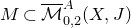 $M \subset \overline {\mathcal{M}}_{0,2}^A(X,J)$
. So
 $\pi$
has (tautological) sections
 $s_0$
and
 $s_1$
and an evaluation map
 \begin{equation*} e: \mathcal{C}_{0,2}^A(X,J) \to X \end{equation*}
that satisfy
 $\textrm {ev}_i = e \circ s_i$
. Generically, the locus of maps in
 $\overline {\mathcal{M}}_{0,2}^A(X,J)$
with nodal domains has codimension two. So for a generic choice of
 $1$
-skeleton in
 $M$
, say
 $M_{(1)}$
, the restriction
 $\pi |_{\pi ^{-1}\left (M_{(1)}\right )}$
defines an oriented
 $S^2$
-bundle. The obstruction to the two sections
 $s_i|_{M_{(1)}}$
being homotopic lies in the fundamental group of the fibre of
 $\pi |_{M_{(1)}}$
, which is trivial. Since
 $\textrm {ev}_i = e \circ s_i$
, the
 $\textrm {ev}_i|_{M}$
induce isomorphic maps on
 $\pi _1(M)$
. But
 $(\textrm {ev}_0|_{M})_*$
has finite index and it agrees with the trivial map (it’s isomorphic to
 $(\textrm {ev}_1|_M)_*$
), so it follows that
 $\pi _1(X)$
is finite.
The restriction on
 $H_2(X;\mathbb{Q})$
is obtained as follows. When
 $M$
(as defined above) is a closed manifold (which in general cannot be arranged because
 $\overline {\mathcal{M}}_{0,2}^A(X,J)$
is hardly ever a closed manifold; however, it can be arranged in the case where
 $A$
is
 $\Omega$
-indecomposable), Poincaré duality, see Lemma 3.1, gives a surjection
 \begin{equation*} (\textrm {ev}_0|_{M})_*: H_2(M;\mathbb{Q}) \to H_2(X;\mathbb{Q}). \end{equation*}
In the case where
 $A$
is
 $\Omega$
-indecomposable, one can also arrange for the restriction of the universal curve to
 $M$
,
 $\pi |_{\pi ^{-1}(M)}$
, (or an appropriate replacement, see § 4.2) to be an oriented
 $S^2$
-bundle over all of
 $M$
. So the Gysin sequence, see Lemma 3.5, implies that for each
 $\Sigma \in H_2(M;\mathbb{Q})$
, there exists
 $c \in \mathbb{Q}$
such that
 \begin{equation*} c \cdot e_*([\mbox{Fibre}]) = (\textrm {ev}_0)_*(\Sigma ). \end{equation*}
Here we use that
 $\textrm {ev}_i = e \circ s_i$
and that
 $\textrm {ev}_1|_M$
is trivial on second homology. In essence, the difference of the push-forward of any second homology class in
 $H_2(M;\mathbb{Q})$
under two different sections of
 $\pi |_M$
is a multiple of the fibre. The class of
 $e_*([\mbox{Fibre}])$
is given by the class of a map in
 $\overline {\mathcal{M}}_{0,2}^A(X,J)$
, that is,
 $A$
. Since
 $(\textrm {ev}_0)_*$
is surjective on homology, it follows that every class in
 $H_2(X;\mathbb{Q})$
can be written as a multiple of
 $A$
.
The issue with the above sketch of a proof is that
 $\overline {\mathcal{M}}_{0,2}^A(X,J)$
is hardly ever a smooth closed oriented manifold. In general, one has to represent it by a Kuranishi structure, or represent its virtual homology class by a pseudocycle. We have opted to use Cieliebak and Mohnke’s [Reference Cieliebak and MohnkeCM07] approach to define Gromov–Witten invariants so that we can effectively replace
 $\overline {\mathcal{M}}_{0,2}^A(X,J)$
by a pseudocycle in the above sketch. The technical aspects of this paper revolve around altering the above arguments to the cases where the moduli spaces in question are pseudocycles.
1.3 Outline of paper
In § 2, we derive an intersection product for pseudocycle homology, show that it is well defined, and establish some of its additional properties that we need to prove our main result. In § 3, we discuss some algebraic topology lemmas that we need to prove our main result. In § 4, we review and study Cieliebak and Mohnke’s [Reference Cieliebak and MohnkeCM07] construction of Gromov–Witten moduli spaces and Gromov–Witten invariants. We also construct a naive, smooth compactification of the open stratum of the moduli space of stable maps that represent an indecomposable spherical class. In § 5, we give the proof of our main result, using definitions and material built up in the previous sections.
2. Pseudocycles and the intersection product
The goal of this section is to define an intersection product for pseudocycle homology and to establish some of its basic properties that we will need to prove our main result. Throughout this entire section, we fix the following notation.
Notation 2.1. Let
 $X$
be a smooth manifold.
2.1 Definitions and the singular homology isomorphism
We review the definition of a pseudocycle and the isomorphism relating pseudocycle homology with singular homology.
Definition 2.2. A smooth map
 $f: M \to X$
is a
 $k$
-pseudocycle if:
-
(i)
$M$
is a smooth oriented
$k$
-dimensional manifold; -
(ii)
$\overline {f(M)}$
is compact; and -
(iii) the dimension of
is at most
\begin{equation*} \textrm {Bd}(f) := \bigcap _{ \substack{\scriptsize K \subset M \\ \scriptsize\mbox{compact} }} \overline {f(M \smallsetminus K)} \end{equation*}
$k-2$
, that is,
$\textrm {Bd}(f)$
is covered by the image of a smooth map
$g: W \to X$
, where
$W$
is a smooth manifold of dimension
$k-2$
.


Two
 $k$
-pseudocycles
 $f_0: M_0 \to X$
and
 $f_1: M_1 \to X$
are equivalent if there exists a smooth map
 $F: B \to X$
that satisfies:
-
(i)
$B$
is a smooth oriented
$(k+1)$
-dimensional manifold with boundary; -
(ii)
$\overline {F(B)}$
is compact; -
(iii) the dimension of
$\textrm {Bd}(F)$
is at most
$k-1$
; -
(iv)
$\partial B = M_1 - M_0$
; and -
(v)
$F|_{M_i} = f_i$
for
$i=0,1$
.





We write
 $f_0 \sim f_1$
to denote an equivalence and write
 $[f]$
to denote an equivalence class.
The equivalence classes of
 $k$
-pseudocycles define a
 $\mathbb{Z}$
-module under disjoint unions, denoted
 $\mathcal{H}_k(X)$
. Inverses are given by reversing orientations of pseudocycles.
Theorem 2.3 [Reference ZingerZin08, Theorem 1.1]. There is a natural isomorphism
 \begin{equation*} \Phi _\bullet : \mathcal{H}_\bullet (X) \to H_\bullet (X;\mathbb{Z}).\end{equation*}
To define the map
 $\Phi$
in Theorem2.3, one uses the following observation made by Zinger.
Proposition 2.4 [Reference ZingerZin08, Proposition 2.2]. Let
 $W$
be a smooth
 $k$
-dimensional manifold and let
 $g: W \to X$
be a smooth map. There is an open subset
 $U \subset X$
such that
 $g(W) \subset U$
and
 \begin{equation*} H_\bullet (U;\mathbb{Z}) = 0 \quad \mbox{for} \ \bullet \gt \dim (W). \end{equation*}
Proposition 2.4 follows from Lemma 2.5 and an inductive argument using the Mayer–Vietoris sequence.
Lemma 2.5 [Reference ZingerZin08, Proof of Lemma 2.4]. Let
 $W$
be a smooth
 $k$
-dimensional manifold and let
 $g: W \to X$
be a smooth map. For
 $0 \leq i \leq k$
, there exist open subsets
 $U_i \subset X$
such that each intersection
 \begin{equation*} U_{i_1} \cap \cdots \cap U_{i_\ell } \quad \mbox{for} \ 0 \leq i_j \leq k \end{equation*}
is a disjoint union of contractible open subsets and
 $g(W) \subset \bigcup _i U_i$
.
Construction 2.6 [Reference ZingerZin08, Lemma 3.5]. Given a
 $k$
-pseudocycle
 $f: M \to X$
, the element
 $\Phi _k(f) \in H_k(X;\mathbb{Z})$
is defined as follows. Suppose that
 $g: W \to X$
covers
 $\textrm {Bd}(f)$
. Then
 $\dim (W) \leq k-2$
since it covers the boundary of the
 $k$
-pseudocycle
 $f$
. By Proposition 2.4, there exists an open neighbourhood
 $U$
of
 $\textrm {Bd}(f) \subset g(W) \subset X$
such that
 $H_\bullet (U;\mathbb{Z}) = 0$
for
 $\bullet \gt k-2$
. Define
 $V = f^{-1}(U)$
. Fix a compact codimension zero submanifold with boundary
 $M_0 \subset M$
such that
 $\partial M_0 \subset V$
and
 $M \smallsetminus V \subset M_0$
. Orient
 $M_0$
with respect to the orientation on
 $M$
. The map
 $f$
induces a map of pairs
 $f: (M_0,\partial M_0) \to (X,U)$
. The homology class associated with the pseudocycle
 $f$
is the image of the (relative) fundamental class of
 $(M_0,\partial M_0)$
under the composition

where the right isomorphism follows from the vanishing of
 $H_\bullet (U;\mathbb{Z})$
for
 $\bullet \gt k-2$
and the homology long exact sequence associated with the pair
 $(X,U)$
.
The following fact will be used implicitly throughout the next subsection.
Lemma 2.7 [Reference McDuff and SalamonMS12, Lemma 6.5.9]. If
 $f: M \to X$
is a pseudocycle and
 $\psi : X \to Y$
is a smooth map of manifolds, then
 $\psi \circ f$
is a pseudocycle. Moreover, if
 $f_0$
is equivalent to
 $f_1$
, then
 $\psi \circ f_0$
is equivalent to
 $\psi \circ f_1$
.
Finally, we remark that removing a codimension two submanifold from a pseudocycle does not change the equivalence class.
Lemma 2.8.
If
 $f: M \to X$
is a
 $k$
-pseudocycle and
 $N \subset M$
is a submanifold of codimension at least two, then
 $f|_{M \smallsetminus N}: M \smallsetminus N \to X$
is a pseudocycle that is equivalent to
 $f$
.
Proof.
To see that
 $f|_{M \smallsetminus N}$
is a pseudocycle, notice that
 $\textrm {Bd}(f|_{M \smallsetminus N}) \subset \textrm {Bd}(f) \bigcup f(N)$
and
 $\overline {f|_{M \smallsetminus N}(M \smallsetminus N)} \subset \overline {f(M)}$
, so
 $f|_{M \smallsetminus N}$
is precompact and its boundary has dimension at most
 $k-2$
. It is therefore a pseudocycle. To obtain the equivalence, define
 $B = I \times M \smallsetminus \{0\} \times N$
and
 \begin{equation*} F: B \to X, \quad F(t,p) = f(p). \end{equation*}
Notice that
 $\textrm {Bd}(F) \subset \textrm {Bd}(f) \bigcup f(N)$
, so the dimension of
 $\textrm {Bd}(F)$
is at most
 $k-2$
and, vacuously, the dimension of
 $\textrm {Bd}(F)$
is at most
 $k-1$
. The remaining conditions for
 $F$
to define an equivalence from
 $f$
to
 $f|_{M \smallsetminus N}$
are clear.
2.2 Intersections of pseudocycles
The goal of this subsection is to define an intersection product for pseudocycles and show that it is well defined. We begin by fixing an appropriate notion of transversality for pseudocycles.
Definition 2.9. Two pseudocycles
 $f_0: M_0 \to X$
and
 $f_1: M_1 \to X$
are strongly transverse if there exist coverings
 $g_i: W_i \to X$
of the
 $\textrm {Bd}(f_i)$
such that:
-
(i)
$f_0$
is transverse to
$f_1$
;Footnote
2
-
(ii)
$g_0$
is transverse to
$g_1$
; -
(iii)
$f_0$
is transverse to
$g_1$
; and -
(iv)
$g_0$
is transverse to
$f_1$
.


We can take the intersection of strongly transverse pseudocycles.
Lemma 2.10.
If
 $f_i: M_i \to X$
are strongly transverse
 $k_i$
-pseudocycles, then
 \begin{equation*} (f_0 \cdot f_1) := f: M \to X, \quad M := \left \{ (p_0,p_1) \in M_0 \times M_1 \mid f_0(p_0) = f_1(p_1) \right \} \end{equation*}
given by
 $f := f_i \circ pr_i$
is a
 $(k_0+k_1-\dim (X))$
-pseudocycle.
Proof.
We verify the conditions of Definition 2.2. First, by transversality,
 $M$
is a smooth oriented manifold of dimension
 $k_0+k_1-\dim (X)$
and the map
 $f$
is smooth. Second,
 \begin{equation*} \overline {f(M)} \subset \overline {f_0(M_0)} \cap \overline {f_1(M_1)}.\end{equation*}
So
 $\overline {f(M)}$
is compact. Third, we claim that
 \begin{equation*} \textrm {Bd}(f) \subset \left ( \textrm {Bd}(f_0) \cap f_1(M_1) \right ) \cup \left (f_0(M_0) \cap \textrm {Bd}(f_1) \right ) \cup \left ( \textrm {Bd}(f_0) \cap \textrm {Bd}(f_1) \right ). \end{equation*}
To see this, let
 $K_{i,j}$
for
 $j \in \mathbb{N}$
be a sequence of compact subsets that exhaust
 $M_i$
. Then
 \begin{equation*} K_j = M \cap (K_{0,j} \times K_{1,j}) \end{equation*}
is a sequence of compact subsets of
 $M$
that exhaust
 $M$
. Since
 \begin{equation*} M \smallsetminus K_j = M \cap (( (M_0 \smallsetminus K_{0,j}) \times M_1) \cup ( M_0 \times ( M_1 \smallsetminus K_{1,j}))), \end{equation*}
the above claim follows. By transversality, the following subsets are smooth manifolds of dimensions less than or equal to
 $k_0+k_1-\dim (X)-2$
:
 \begin{align*} Z_{01} & = \{ (w_0,w_1) \in W_0 \times W_1 \mid g_0(w_0) = g_1(w_1) \}, \\ Z_{1} & = \{ (p_0,w_1) \in M_0 \times W_1 \mid f_0(p_0) = g_1(w_1) \},\\ Z_{0} & = \{ (w_0,p_1) \in W_0 \times M_1 \mid g_0(p_0) = f_1(w_1) \}. \end{align*}
Moreover, their images under
 $g_0 \circ pr_0$
,
 $f_0 \circ pr_0$
, and
 $g_0 \circ pr_0$
respectively cover
 $\textrm {Bd}(f)$
, so the dimension of
 $\textrm {Bd}(f)$
is at most
 $k_0+k_1-\dim (X)-2$
. This completes the verification of the conditions of Definition 2.2.
Intersecting strongly transverse pseudocycles induces an intersection product on
 $\mathcal{H}_\bullet (X)$
.
Proposition 2.11.
There exists a well-defined intersection product on
 $\mathcal{H}_\bullet (X)$
given by the
 $\mathbb{Z}$
-bilinear map
 \begin{equation*} (-) \cdot (-): \mathcal{H}_k(X) \times \mathcal{H}_\ell (X) \to \mathcal{H}_{k+\ell - \dim (X)}(X), \quad [f_0] \cdot [f_1] \mapsto [\widetilde {f_0} \cdot \widetilde {f_1}], \end{equation*}
where
 $\widetilde {f_i} \in [f_i]$
and
 $\widetilde {f_0}$
is strongly transverse to
 $\widetilde {f_1}$
.
To prove Proposition 2.11, we need to show that the perturbations
 $\widetilde {f_i}$
exist and that the equivalence class of the intersection in Proposition 2.11 is independent of all choices. This amounts to fairly standard transversality arguments. For completeness, we give them here. We begin by reviewing generic transversality for smooth maps.
Notation 2.12. Recall that
 $X$
is not necessarily compact. With this in mind, we fix a nested sequence of compact subsets
 $A_n \subset X$
such that
 $X = \bigcup _n A_n$
.
-
(i) Let
$\textrm {Diff}^k(X)$
denote the set of
$k$
-differentiable homeomorphisms of
$X$
for
$1 \leq k \leq \infty$
. Letfor
\begin{equation*} \textrm {Diff}^k_{A_n}(X) = \{ \phi \in \textrm {Diff}^k(X) \mid \textrm {supp}(\phi ) \subset A_n \} \end{equation*}
$1 \leq k \leq \infty$
. We endow
$\textrm {Diff}^k_{A_n}(X)$
with the weak topology (which agrees with the strong topology since we have restricted supports of diffeomorphisms to the compact subset
$A_n$
, effectively reducing to the setting of
$X$
compact); see [Reference HirschHir94, Chapter 2, Section 1] for a discussion of these topologies. With this topology,
$\textrm {Diff}^k_{A_n}(X)$
is separable smooth Banach manifold (cf. [Reference WittmannWit19, Theorem 4.4]) for
$1 \leq k \lt \infty$
and
$\textrm {Diff}^\infty _{A_n}(X)$
is a complete metric space (cf. [Reference HirschHir94, Theorem 4.4]). In particular,
$\textrm {Diff}^\infty _{A_n}(X)$
is Baire and is a dense subset of
$\textrm {Diff}^k_{A_n}(X)$
for all
$1 \leq k \leq \infty$
.
-
(ii) Suppose that
$\phi \in \textrm {Diff}^k_{A_n}(X)$
is contained in the connected component that contains the identity. In a similar way to what we did above, we let
$\mathcal{P}_{\phi ,A_n}^k \subset C^k(I,\textrm {Diff}_{A_n}^k(X))$
denote the space of
$k$
-differentiable diffeotopies of
$X$
from the identity to
$\phi \in \textrm {Diff}_{A_n}^k(X)$
.


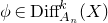



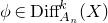
Remark 2.13. To obtain generic transversality of smooth maps, we follow [Reference McDuff and SalamonMS12, Lemma 6.5.5]. Fix smooth maps
 $h_i: Z_i \to X$
for
 $i=0,1$
such that
 $h_i(Z_i)$
is relatively compact and
 $\overline {h_i(Z_i)} \subset A_n$
for some
 $n$
. Consider the evaluation map
 \begin{equation*} \textrm {ev}: X \times \textrm {Diff}_{A_n}^k(X) \to X, \quad \textrm {ev}(x,\phi ) = \phi (x). \end{equation*}
This is a
 $C^k$
-map of separable smooth Banach manifolds. The composition
 $\textrm {ev} \circ (h_1 \times \unicode {x1D7D9})$
is transverse to
 $h_0$
. Therefore, by the implicit function theorem, we have that
 \begin{equation*} \mathcal{M} := \{ (z_0,z_1,\phi ) \in Z_0 \times Z_1 \times \textrm {Diff}^k_{A_n}(X) \mid \phi \circ h_0(z_0) = h_1(z_1)\} \end{equation*}
is a separable
 $C^k$
-Banach manifold. The projection
 \begin{equation*} \mathcal{M} \to \textrm {Diff}^k_{A_n}(X), \quad (z_0,z_1,\phi ) \mapsto \phi \end{equation*}
at a point
 $(z_0,z_1,\phi )$
has kernel isomorphic to
 \begin{equation*} d\phi \circ dh_0(T_{z_0}Z_0) \cap dh_1(T_{z_1}Z_1) \subset T_{h_1(z_1)}X \end{equation*}
and has cokernel isomorphic to
 \begin{equation*} T_{h_1(z_1)}X/(d\phi \circ dh_0(T_{z_0}Z_0) + dh_1(T_{z_1}Z_1)).\end{equation*}
It follows that the projection is a Fredholm map of separable
 $C^k$
-Banach manifolds. So, for
 $k$
larger than the index of the projection, the Sard–Smale theorem gives that the set of regular values of the projection is residual. Notice that
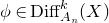 $\phi \in \textrm {Diff}_{A_n}^k(X)$
is a regular value of the projection if and only if
 $\phi \circ h_0$
is transverse to
 $h_1$
. There is thus a residual subset
 $\mathcal{F}^k_{A_n}(X;h_0,h_1) \subset \textrm {Diff}_{A_n}^k(X)$
such that for
 $\phi \in \mathcal{F}^k_{A_n}(X;h_0,h_1)$
,
 $h_0$
and
 $\phi \circ h_1$
are transverse.
Since
 $\textrm {Diff}^\infty _{A_n}(X)$
is dense in
 $\textrm {Diff}^k_{A_n}(X)$
, we have that
 $\mathcal{F}^k_{A_n}(X;h_0,h_1) \cap \textrm {Diff}^\infty _{A_n}(X)$
is residual in
 $\textrm {Diff}^\infty _{A_n}(X)$
. Indeed, since
 $\mathcal{F}^k_{A_n}(X;h_0,h_1)$
is residual in
 $\textrm {Diff}^k_{A_n}(X)$
, we have that
 $\mathcal{F}^k_{A_n}(X;h_0,h_1) = \cap _j U_j$
for some dense open subsets
 $U_j \subset \textrm {Diff}^k_{A_n}(X)$
. For each
 $\phi \in \textrm {Diff}^\infty _{A_n}(X)$
, we have a sequence of elements
 $\phi _\ell \in U_j$
such that
 $\phi _\ell \to \phi$
. Since
 $\textrm {Diff}^\infty _{A_n}(X)$
is dense in
 $\textrm {Diff}^k_{A_n}(X)$
and since
 $U_j$
is open, we have elements
 $\psi _{\ell ,\nu } \in \textrm {Diff}^k_{A_n}(X) \cap U_j$
such that
 $\psi _{\ell ,\nu } \to \phi _\ell$
. Diagonalizing, we have that
 $\psi _{\ell ,\ell } \to \phi$
. It follows that
 $U_j \cap \textrm {Diff}^\infty _{A_n}(X)$
is a dense open subset. Consequently,
 $\mathcal{F}^k_{A_n}(X;h_0,h_1) \cap \textrm {Diff}^\infty _{A_n}(X)$
is residual in
 $\textrm {Diff}^\infty _{A_n}(X)$
. Setting
 \begin{equation*} \mathcal{F}^\infty _{A_n}(X;h_0,h_1) = \bigcap\nolimits _k \mathcal{F}^k_{A_n}(X;h_0,h_1) \subset \textrm {Diff}^\infty _{A_n}(X)\end{equation*}
gives a residual subset
 $\mathcal{F}^\infty _{A_n}(X;h_0,h_1) \subset \textrm {Diff}^\infty _{A_n}(X)$
such that for
 $\phi \in \mathcal{F}^\infty _{A_n}(X;h_0,h_1)$
,
 $h_0$
and
 $\phi \circ h_1$
are transverse.
Similarly, consider the evaluation map
 \begin{equation*} \textrm {ev}: I \times X \times \mathcal{P}^k_{\phi ,A_n} \to X, \quad \textrm {ev}(t,x,\Phi ) = \Phi (t,x).\end{equation*}
If
 $h_0$
is transverse to both
 $h_1$
and
 $\phi \circ h_1$
, then the composition
 $\textrm {ev} \circ (\unicode {x1D7D9} \times h_0 \times \unicode {x1D7D9})$
is transverse to
 $h_0$
. So, as above, there is a residual subset
 $\mathcal{F}_{\phi ,A_n}^\infty (X;h_0,h_1) \subset \mathcal{P}_{\phi ,A_n}^\infty$
such that for
 $\Phi \in \mathcal{F}_{\phi ,A_n}^\infty (X;h_0,h_1)$
,
 $h_0$
and
 $\Phi \circ h_1$
are transverse.
Notation 2.14. Let
 $\textrm {Diff}^+_{0,A_n}(X)$
denote the path component of orientation-preserving diffeomorphisms of
 $X$
that contain the identity.Footnote
3
Given the data of
 $h_0$
and
 $h_1$
from Remark 2.13, we obtain a residual subset
 $\mathcal{F}_{A_n}(X;h_0,h_1) \subset \textrm {Diff}^+_{0,A_n}(X)$
such that, for
 $\phi \in \mathcal{F}_{A_n}(X;h_0,h_1)$
,
 $h_0$
and
 $\phi \circ h_1$
are transverse. From now on, we omit mention of
 $A_n$
from our notation, simply writing
 $\textrm {Diff}^+_{0}(X)$
and
 $\mathcal{F}(X;h_0,h_1)$
and implicitly assuming that an appropriate
 $A_n$
for
 $h_0$
and
 $h_1$
has been selected.
Similarly, we will write
 $\mathcal{P}_{\phi ,A_n} \subset C^\infty (I,\textrm {Diff}_{0,A_n}^+(X))$
as
 $\mathcal{P}_{\phi } \subset C^\infty (I,\textrm {Diff}_{0}^+(X))$
and denote the corresponding residual subset from Remark 2.13 by
 $\mathcal{F}_{\phi }(X;h_0,h_1)$
.
Proposition 2.11 will follow from Lemma 2.15.
Lemma 2.15.
Consider pseudocycles
 $f_i: M_i \to X$
for
 $i=0,1,2$
.
-
(i) There exists a residual subset
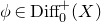
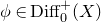
$\mathcal{F}^{\mathrm{reg}}(X;f_0,f_1) \subset \textrm {Diff}_0^+(X)$
such that for each
$\phi \in \mathcal{F}^{\mathrm{reg}}(X;f_0,f_1)$
, the pseudocycles
$f_0$
and
$\phi \circ f_1$
are strongly transverse.
-
(ii) Given
$\phi \in \textrm {Diff}_0^+(X)$
, the pseudocycle
$\phi \circ f_i$
is equivalent to
$f_i$
. -
(iii) Suppose that
$\phi \in \textrm {Diff}_0^+(X)$
such that
$f_0$
and
$\phi \circ f_0$
are both strongly transverse to
$f_1$
. Then
$f_0 \cdot f_1$
is equivalent to
$(\phi \circ f_0) \cdot f_1$
. -
(iv) If
$f_0$
is equivalent to
$f_2$
, then there exists
$\phi \in \textrm {Diff}_0^+(X)$
such that
$f_0$
and
$f_2$
are both strongly transverse to
$\phi \circ f_1$
and
$f_0 \cdot (\phi \circ f_1)$
is equivalent to
$f_2 \cdot (\phi \circ f_1)$
.








Assuming Lemma 2.15, we prove Proposition 2.11.
Proof of Proposition 2.11.
Given classes
 $[f_i] \in \mathcal{H}_{k_i}(X)$
, by Lemma 2.15(i), there exists
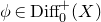 $\phi \in \textrm {Diff}_0^+(X)$
such that
 $f_0$
and
 $\phi \circ f_1$
are strongly transverse. Set
 $\widetilde {f_0} = f_0$
and
 $\widetilde {f_1} = \phi \circ f_1$
. By Lemma 2.15(ii),
 $\widetilde {f_1} = \phi \circ f_1$
is equivalent to
 $f_1$
. So we find that there exist
 $\widetilde {f_0} \in [f_0]$
and
 $\widetilde {f_1} \in [f_1]$
such that
 $\widetilde {f_0}$
is strongly transverse to
 $\widetilde {f_1}$
. Define
 \begin{equation*} [f_0] \cdot [f_1] = [\widetilde {f_0} \cdot \widetilde {f_1}].\end{equation*}
Suppose that
 $h_0 \in [f_0]$
and
 $h_1 \in [f_1]$
such that
 $h_0$
is strongly transverse to
 $h_1$
. We need to show that
 $\widetilde {f_0} \cdot \widetilde {f_1}$
is equivalent to
 $h_0 \cdot h_1$
.
By Lemma 2.15(iv), since
 $\widetilde {f_0}$
and
 $h_0$
are equivalent, there exists
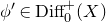 $\phi ' \in \textrm {Diff}_0^+(X)$
such that
 $\widetilde {f_0}$
and
 $h_0$
are both strongly transverse to
 $\phi ' \circ \widetilde {f_1}$
and
 $\widetilde {f_0} \cdot (\phi ' \circ \widetilde {f_1})$
is equivalent to
 $h_0 \cdot (\phi ' \circ \widetilde {f_1})$
, where notationally
 $\widetilde {f_0}$
,
 $h_0$
,
 $\widetilde {f_1}$
, and
 $\phi '$
correspond to
 $f_0$
,
 $f_2$
,
 $f_1$
, and
 $\phi$
, respectively, in the statement of Lemma 2.15(iv). By Lemma 2.15(ii),
 $\widetilde {f_1}$
is equivalent to
 $\phi ' \circ \widetilde {f_1}$
. Since
 $\widetilde {f_1}$
is equivalent to
 $h_1$
, it follows that
 $\phi ' \circ \widetilde {f_1}$
is equivalent to
 $h_1$
. By Lemma 2.15(iv), since
 $\phi ' \circ \widetilde {f_1}$
is equivalent to
 $h_1$
, there exists
 $\psi \in \textrm {Diff}_0^+(X)$
such that
 $\phi ' \circ \widetilde {f_1}$
and
 $h_1$
are both strongly transverse to
 $\psi \circ h_0$
and
 $(\psi \circ h_0) \cdot (\phi ' \circ \widetilde {f_1})$
is equivalent to
 $(\psi \circ h_0) \cdot h_1$
, where notationally
 $\phi ' \circ \widetilde {f_1}$
,
 $h_1$
,
 $h_0$
, and
 $\psi$
correspond to
 $f_0$
,
 $f_2$
,
 $f_1$
, and
 $\phi$
in the statement of Lemma 2.15(iv). By construction,
 $\widetilde {f_0}$
and
 $\widetilde {f_1}$
are strongly transverse. By assumption,
 $h_0$
and
 $h_1$
are strongly transverse. By our work above,
 $\widetilde {f_0}$
and
 $(\phi ' \circ \widetilde {f_1})$
,
 $h_0$
and
 $(\phi ' \circ \widetilde {f_1})$
,
 $(\psi \circ h_0)$
and
 $(\phi ' \circ \widetilde {f_1})$
, and
 $(\psi \circ h_0)$
and
 $h_1$
are all strongly transverse pairs of pseudocycles. So, by Lemma 2.10, we have that
 $\widetilde {f_0} \cdot \widetilde {f_1}$
,
 $\widetilde {f_0} \cdot (\phi ' \circ \widetilde {f_1})$
,
 $h_0 \cdot (\phi ' \circ \widetilde {f_1})$
,
 $(\psi \circ h_0) \cdot (\phi ' \circ \widetilde {f_1})$
,
 $(\psi \circ h_0) \cdot h_1$
, and
 $h_0 \cdot h_1$
are well-defined pseudocycles.
We have the following chain of equalities:
 \begin{equation*} [\widetilde {f_0} \cdot \widetilde {f_1}] = [\widetilde {f_0} \cdot (\phi ' \circ \widetilde {f_1})] = [h_0 \cdot (\phi ' \circ \widetilde {f_1})] = [(\psi \circ h_0) \cdot (\phi ' \circ \widetilde {f_1})] = [(\psi \circ h_0) \cdot h_1] = [h_0 \cdot h_1], \end{equation*}
where the first equality follows from Lemma 2.15(iii) since, by our construction above,
 $\widetilde {f_1}$
and
 $\phi ' \circ \widetilde {f_1}$
are both strongly transverse to
 $\widetilde {f_0}$
, the second equality follows from our construction and was shown above, the third equality follows from Lemma 2.15(iii) since, by our construction above,
 $h_0$
and
 $\psi \circ h_0$
are both strongly transverse to
 $\phi ' \circ \widetilde {f_1}$
, the fourth equality follows from our construction and was shown above, and the fifth equality follows from Lemma 2.15(iii) since, by our construction above,
 $\psi \circ h_0$
and
 $h_0$
are both strongly transverse to
 $h_1$
. This completes the proof.
We now prove each item in Lemma 2.15 in turn.
Proof of item (i). If
 $g_i: W_i \to X$
covers
 $\textrm {Bd}(f_i)$
, then, using Remark 2.13, set
 \begin{equation*} \mathcal{F}^{\mathrm{reg}}(X;f_0,f_1) := \mathcal{F}(X;f_0,f_1) \cap \mathcal{F}(X;f_0,g_1) \cap \mathcal{F}(X;g_0,f_1) \cap \mathcal{F}(X;g_0,g_1).\\[-7pt] \end{equation*}
Proof of item (ii). Suppose
 $g: W \to X$
covers
 $\textrm {Bd}(f)$
. By definition, there exists a diffeotopy
 $\phi _t: I \times X \to X$
such that
 $\phi _0 = \unicode {x1D7D9}$
and
 $\phi _1 = \phi$
. Consider
 \begin{equation*} F: I \times M \to X, \quad F(t,p) = \phi _t(f(p)) \end{equation*}
and
 \begin{equation*} G: I \times W \to X, \quad G(t,w) = \phi _t(g(w)).\end{equation*}
One can check that
 $G$
covers
 $\textrm {Bd}(F)$
and that
 $F$
gives an equivalence between
 $f$
and
 $\phi \circ f$
.
Proof of item (iii). If
 $g_i: W_i \to X$
covers
 $\textrm {Bd}(f_i)$
, then, using Remark 2.13, fix
 \begin{equation*} \Phi \in \mathcal{F}_\phi (X;f_1,f_0) \cap \mathcal{F}_\phi (X;f_1,g_0) \cap \mathcal{F}_\phi (X;g_1,f_0) \cap \mathcal{F}_\phi (X;g_1,g_0). \end{equation*}
Define
 \begin{equation*} \widetilde {F}: I \times M_0 \to X, \quad \widetilde {F}(t,p) = \Phi (t,f_0(p))\end{equation*}
and
 \begin{equation*} \widetilde {G}: I \times W_0 \to X, \quad \widetilde {G}(t,w) = \Phi (t,g_0(w)).\end{equation*}
By construction,
 $\widetilde {F}$
and
 $\widetilde {G}$
are both transverse to both
 $f_1$
and
 $g_1$
. By transversality,
 \begin{equation*} B' := \{ (t,p_0,p_1) \in I \times M_0 \times M_1 \mid \widetilde {F}(t,p_0) = f_1(p_1) \} \end{equation*}
is a smooth oriented
 $(k_0 + k_1 +1 - \dim (X))$
-dimensional manifold with boundary such that
 $\partial B' = \widetilde {M} - M$
, where
 $M$
and
 $\widetilde {M}$
are the domains of the intersections
 $f_0 \cdot f_1$
and
 $(\phi \circ f_0) \cdot f_1$
, respectively. Moreover,
 $F' := f_1 \circ pr_1: B' \to X$
is smooth and satisfies
 \begin{equation*} F'|_{\widetilde {M}} = \phi \circ f_0 \quad \mbox{and} \quad F'|_{M} = f_0. \end{equation*}
Since
 $\textrm {Im}(F') \subset \textrm {Im}(f_1)$
,
 $\overline {F'(B')} \subset \overline {f_1(M_1)}$
is compact. To conclude that
 $F': B' \to X$
is an equivalence from
 $f_0 \cdot f_1$
to
 $(\phi \circ f_0) \cdot f_1$
, we need that
 $\textrm {Bd}(F')$
has dimension at most
 $k_0 + k_1 -1- \dim (X)$
. As in the proof of Lemma 2.10,
 \begin{equation*} \textrm {Bd}(F') \subset ( \textrm {Bd}(\widetilde {F}) \cap f_1(M_1) ) \cup (\widetilde {F}(I \times M_0) \cap \textrm {Bd}(f_1) ) \cup ( \textrm {Bd}(\widetilde {F}) \cap \textrm {Bd}(f_1) ). \end{equation*}
Now, by transversality, the following are smooth manifolds with boundaries of dimension less than or equal to
 $k_0+k_1-1-\dim (X)$
:
 \begin{align*} Z_{01} & = \{ (t,w_0,w_1) \in I \times W_0 \times W_1 \mid \widetilde {G}(t,w_0) = g_1(w_1) \}, \\ Z_{1} & = \{ (t,p_0,w_1) \in I \times M_0 \times W_1 \mid \widetilde {F}(t,p_0) = g_1(w_1) \}, \\ Z_{0} & = \{ (t,w_0,p_1) \in I \times W_0 \times M_1 \mid \widetilde {G}(t,w_0) = f_1(w_1) \}. \end{align*}
Their images under the smooth mappings
 $\widetilde {G} \circ pr_0$
,
 $\widetilde {F} \circ pr_0$
, and
 $\widetilde {G} \circ pr_0$
, respectively, cover
 $\textrm {Bd}(F')$
. So the dimension of
 $\textrm {Bd}(F')$
is at most
 $k_0+k_1-1-\dim (X)$
, as desired.
Proof of item (iv). Let
 $F: B \to X$
be a smooth map that realizes the equivalence between
 $f_0$
and
 $f_2$
. Suppose that
 $G: V \to X$
covers
 $\textrm {Bd}(F)$
. Suppose that
 $g_0: W_0 \to X$
and
 $g_2: W_2 \to X$
cover
 $\textrm {Bd}(f_0)$
and
 $\textrm {Bd}(f_2)$
, respectively. Using Remark 2.13, define
 \begin{align*} \mathcal{F} := \mathcal{F}(X;F,f_1) & \cap \mathcal{F}(X;F,g_1) \cap \mathcal{F}(X;G,f_1) \cap \mathcal{F}(X;G,g_1) \\ & \cap \mathcal{F}(X;f_0,f_1) \cap \mathcal{F}(X;f_0,g_1) \cap \mathcal{F}(X;g_0,f_1) \cap \mathcal{F}(X;g_0,g_1) \\ & \cap \mathcal{F}(X;f_2,f_1) \cap \mathcal{F}(X;f_2,g_1) \cap \mathcal{F}(X;g_2,f_1) \cap \mathcal{F}(X;g_2,g_1). \end{align*}
Fix
 $\phi \in \mathcal{F}$
. We have that
 $f_0$
is strongly transverse to
 $\phi \circ f_1$
and
 $f_2$
is strongly transverse to
 $\phi \circ f_1$
. To complete the proof, we need to show that
 $f_0 \cdot (\phi \circ f_1)$
is equivalent to
 $f_2 \cdot (\phi \circ f_1)$
.
Fix domains
 $M_{01}$
and
 $M_{21}$
for
 $f_0 \cdot (\phi \circ f_1)$
and
 $f_2 \cdot (\phi \circ f_1)$
respectively. Define
 \begin{equation*} \widetilde {F} := \phi \circ f_1 \circ pr_1: \widetilde {B} \to X, \quad \widetilde {B} := \{ (b,p_1) \in B \times M_1 \mid F(b) = \phi \circ f_1(p_1) \}. \end{equation*}
By transversality,
 $\widetilde {B}$
is a smooth oriented
 $(k_0+k_1+1 - \dim (X))$
-dimensional manifold with boundary such that
 $\partial \widetilde {B} = M_{01} - M_{21}$
. Moreover,
 \begin{equation*} \widetilde {F}|_{M_{01}} = f_0 \quad \mbox{and} \quad \widetilde {F}|_{M_{21}} = f_2.\end{equation*}
Since
 $\textrm {Im}(\widetilde {F}) \subset \textrm {Im}(\phi \circ f_1)$
,
 $\overline {\widetilde {F}(\widetilde {B})}$
is compact. To conclude that
 $\widetilde {F}$
gives an equivalence from
 $f_0 \cdot (\phi \circ f_1)$
to
 $f_2 \cdot (\phi \circ f_1)$
, we need that
 $\textrm {Bd}(\widetilde {F})$
has dimension at most
 $(k_0 + k_1 -1 -\dim (X))$
. To see this, one argues in an identical way to the argument at the end of Lemma 2.15(iii).
2.3 Properties of intersections on product manifolds
Let
 $X_i$
be smooth closed oriented manifolds. Each identity map,
 $\unicode {x1D7D9} \colon X_i \to X_i$
, therefore defines a pseudocycle. Suppose that
 $f_i: M_i \to X_i$
are
 $k_i$
-pseudocycles. The product
 $f_0 \times f_1: M_0 \times M_1 \to X_0 \times X_1$
is a
 $(k_0+k_1)$
-pseudocycle. The main property of the intersection product that we will need is the following.
Proposition 2.16.
Given pseudocycles
 $h_i: N_i \to X_i$
for
 $i = 0,1$
and a pseudocycle
 $f: M \to X_0 \times X_1$
, the intersection product satisfies:
 \begin{equation*} pr_0 \circ ([f] \cdot [h_0 \times h_1]) = [pr_0 \circ ([f] \cdot [\unicode {x1D7D9} \times h_1])] \cdot [h_0]. \end{equation*}
Proposition 2.16 will follow from Lemma 2.17 and Lemma 2.18 below.
Lemma 2.17.
Suppose that
 $f: M \to X_0 \times X_1$
and
 $h: N \to X_1$
are pseudocycles. If
 $pr_1 \circ f$
is strongly transverse to
 $h$
, then
 $f$
is strongly transverse to
 $\unicode {x1D7D9} \times h$
.
Proof.
Suppose that
 $\textrm {Bd}(f)$
is covered by
 $g: W \to X_0 \times X_1$
and
 $\textrm {Bd}(h)$
is covered by
 $r: V \to X_1$
. It follows that
 $\textrm {Bd}(\unicode {x1D7D9} \times h)$
is covered by
 $\unicode {x1D7D9} \times r: X_0 \times V \to X_0 \times X_1$
. We need to show that
 $f \pitchfork \unicode {x1D7D9} \times h$
,
 $f \pitchfork \unicode {x1D7D9} \times r$
,
 $g \pitchfork \unicode {x1D7D9} \times h$
, and
 $g \pitchfork \unicode {x1D7D9} \times r$
. We will show that
 $f \pitchfork \unicode {x1D7D9} \times h$
(the others being entirely analogous).
Write
 $f$
as
 $f = (f_0,f_1)$
, where
 $f_i = pr_i \circ f$
. We need to show that, for each
 \begin{equation*} (p,x_0,q) \in M \times X_0 \times N \quad \mbox{such that} \quad f(p) = (x_0,x_1) = (x_0,h(q)), \end{equation*}
the operator
 \begin{equation*} (d(f_0)_p + \unicode {x1D7D9}, d(f_1)_p + dh_q): T_p M \oplus T_{x_0} X_0 \oplus T_q N \to T_{x_0}X_0 \oplus T_{x_1}X_1 \end{equation*}
is surjective. Consider a vector
 $(v_0,v_1) \in T_{x_0}X_0 \oplus T_{x_1}X_1$
. Since
 $f_1$
is transverse to
 $h$
, there exist
 $\xi \in T_pM$
and
 $\zeta _1 \in T_q N$
such that
 \begin{equation*} v_1 = d(f_1)_p(\xi ) + dh_q(\zeta _1).\end{equation*}
So
 \begin{equation*} (v_0,v_1) = (d(f_0)_p + \unicode {x1D7D9}, d(f_1)_p + dh_q)(\xi ,v_0 - d(f_0)_p(\xi ),\zeta _1).\\[-6pt]\end{equation*}
Lemma 2.18.
Given pseudocycles
 $h_i: N_i \to X_i$
and a pseudocycle
 $f: M \to X_0 \times X_1$
, there exist
 $\phi _i \in \textrm {Diff}_0^+(X_i)$
such that:
-
(i)
$pr_1 \circ f$
is strongly transverse to
$\phi _1 \circ h_1$
; -
(ii)
$pr_0 \circ ( f \cdot (\unicode {x1D7D9} \times (\phi _1 \circ h_1)))$
is strongly transverse to
$\phi _0 \circ h_0$
; and
-
(iii)
$f$
is strongly transverse to
$(\phi _0 \circ h_0) \times (\phi _1 \circ h_1)$
.






Proof.
Recall by Lemma 2.7 that
 $pr_1 \circ f: M \to X_1$
is a pseudocycle. By Lemma 2.15(i), there exists
 $\phi _1 \in \textrm {Diff}_0^+(X_1)$
such that
 $pr_1 \circ f$
is strongly transverse to
 $\phi _1 \circ h_1$
, where notationally
 $pr_1 \circ f$
,
 $h_1$
, and
 $\phi _1$
correspond to
 $f_0$
,
 $f_1$
, and
 $\phi$
in the statement of Lemma 2.15(i). This proves item (i).
By Lemma 2.17, since
 $pr_1 \circ f$
is strongly transverse to
 $\phi _1 \circ h_1$
,
 $f$
is strongly transverse to
 $\unicode {x1D7D9} \times (\phi _1 \circ h_1)$
, where notationally
 $f$
and
 $\phi _1 \circ h_1$
correspond to
 $f$
and
 $h$
in the statement of Lemma 2.17. Let
 $e: P \to X_0 \times X_1$
denote the pseudocycle given by
 $f \cdot (\unicode {x1D7D9} \times (\phi _1 \circ h_1))$
. By Lemma 2.15(i), there exists
 $\phi _0 \in \textrm {Diff}_0^+(X_0)$
such that
 $pr_0 \circ e$
is strongly transverse to
 $\phi _0 \circ h_0$
, where notationally
 $pr_0 \circ e$
,
 $h_0$
, and
 $\phi _0$
correspond to
 $f_0$
,
 $f_1$
, and
 $\phi$
in the statement of Lemma 2.15. This proves item (ii).
We now show that
 $f$
is strongly transverse to
 $(\phi _0 \circ h_0) \times (\phi _1 \circ h_1)$
. Suppose that
 $\textrm {Bd}(f)$
was covered by
 $g: W \to X_0 \times X_1$
. Suppose that
 $\textrm {Bd}(h_i)$
was covered by
 $r_i: V_i \to X_i$
. To show strong transversality, we need to show that
 $f \pitchfork (\phi _0 \circ h_0) \times (\phi _1 \circ h_1)$
,
 $f \pitchfork (\phi _0 \circ h_0) \times (\phi _1 \circ r_1)$
,
 $f \pitchfork (\phi _0 \circ r_0) \times (\phi _1 \circ h_1)$
,
 $f \pitchfork (\phi _0 \circ r_0) \times (\phi _1 \circ r_1)$
,
 $g \pitchfork (\phi _0 \circ h_0) \times (\phi _1 \circ h_1)$
,
 $g \pitchfork (\phi _0 \circ h_0) \times (\phi _1 \circ r_1)$
,
 $g \pitchfork (\phi _0 \circ r_0) \times (\phi _1 \circ h_1)$
, and
 $g \pitchfork (\phi _0 \circ r_0) \times (\phi _1 \circ r_1)$
. We will prove the first (the others being entirely analogous). Write
 $f$
as
 $f = (f_0,f_1)$
, where
 $f_i = pr_i \circ f$
. We need to show, for each
 \begin{equation*} (p,q_0,q_1) \in M \times N_0 \times N_1 \quad \mbox{such that} \quad f(p) = (\phi _0 \circ h_0(q_0),\phi _1 \circ h_1(q_1)) \end{equation*}
that
 \begin{equation*} (d(f_0)_p + d(\phi _0 \circ h_0)_{q_0}, d(f_1)_p + d(\phi _1 \circ h_1)_{q_1}) : T_p M \oplus T_{q_0} N_0 \oplus T_{q_1} N_1 \to T_{x_0} X_0 \oplus T_{x_1} X_1 \end{equation*}
is surjective. Fix
 $(v_0,v_1) \in T_{x_0}X_0 \oplus T_{x_1}X_1$
. First, consider
 $(v_0,0)$
. By the transversality of
 $f$
and
 $(\unicode {x1D7D9} \times (\phi _1 \circ h_1))$
and the definition of
 $P$
above,
 $T_{(p,x_0,q_1)} P$
is
 \begin{equation*} \{ (\xi ,w_0,\zeta _1) \in T_p M \oplus T_{x_0} X_0 \oplus T_{q_1} N_1 \mid (d(f_0)_p(\xi )+w_0, d(f_1)_p(\xi )+d(\phi _1 \circ h_1)_{q_1}(\zeta _1) ) = (0,0)\}.\end{equation*}
Since
 $pr_0 \circ e$
is transverse to
 $\phi _0 \circ h_0$
, there exist
 $(\xi ,w_0,\zeta _1) \in T_{(p,q_0,q_1)} P$
and
 $\zeta _0 \in T_{q_0}N_0$
such that
 \begin{equation*} d(pr_0 \circ e)(\xi ,w_0,\zeta _1) + d(\phi _0 \circ h_0)_{q_0}(\zeta _0) = v_0.\end{equation*}
Since
 $pr_0 \circ e = f_0 \circ pr_M|_{P}$
, we have that
 \begin{equation*} d(f_0)_p(\xi )+d(\phi _0 \circ h_0)(\zeta _0) = v_0. \end{equation*}
But
 \begin{equation*} d(f_1)_p(\xi )+d(\phi _1 \circ h_1)_{q_1}(\zeta _1) = 0. \end{equation*}
So
 \begin{equation*} (d(f_0)_p(\xi )+d(\phi _0 \circ h_0)(\zeta _0),d(f_1)_p(\xi )+d(\phi _1 \circ h_1)_{q_1}(\zeta _1)) = (v_0,0). \end{equation*}
Now consider
 $(0,v_1)$
. By the above work, it suffices to show that there exist
 $\xi \in T_pM$
and
 $\zeta _i \in T_{q_i}N_i$
such that
 \begin{equation*} (d(f_0)_p(\xi ) + d(\phi _0 \circ h_0)_{q_0}(\zeta _0), d(f_1)_p(\xi ) + d(\phi _1 \circ h_1)_{q_1}(\zeta _1)) = (*,v_1), \end{equation*}
where
 $*$
can be any vector. Since
 $pr_1 \circ f$
is transverse to
 $\phi _1 \circ h_1$
, we have that there exist
 $\xi \in T_pM$
and
 $\zeta _1 \in T_{q_1}N_1$
such that
 \begin{equation*} d(f_1)_p(\xi ) + d(\phi _1 \circ h_1)_{q_1}(\zeta _1) = v_1. \end{equation*}
So
 \begin{equation*} (d(f_0)_p(\xi ) + d(\phi _0 \circ h_0)_{q_0}(0), d(f_1)_p(\xi ) + d(\phi _1 \circ h_1)_{q_1}(\zeta _1)) = (*,v_1), \end{equation*}
as desired. This proves Lemma 2.18(iii).
We can now prove Proposition 2.16.
Proof of Proposition 2.16.
Consider the
 $\phi _i \in \textrm {Diff}_0^+(X_i)$
given by Lemma 2.18. By the strong transversality obtained in Lemma 2.18, tautologically, we have an equality of pseudocycles:
 \begin{equation*} pr_0 \circ (f \cdot ((\phi _0 \circ h_0) \times (\phi _1 \circ h_1))) = pr_0 \circ (f \cdot (\unicode {x1D7D9} \times (\phi _1 \circ h_1))) \cdot (\phi _0 \circ h_0). \end{equation*}
We have that
 \begin{align*} pr_0 \circ ([f] \cdot [h_0 \times h_1]) & = pr_0 \circ ([f \cdot ((\phi _0 \circ h_0) \times (\phi _1 \circ h_1))]) \\& = [pr_0 \circ (f \cdot (\unicode {x1D7D9} \times (\phi _1 \circ h_1))) \cdot (\phi _0 \circ h_0)] \\ & = [ pr_0 \circ (f \cdot (\unicode {x1D7D9} \times (\phi _1 \circ h_1)))] \cdot [h_0] \\ & = [ pr_0 \circ ( [f] \cdot [\unicode {x1D7D9} \times h_1])] \cdot [h_0], \end{align*}
where the first equality follows from Proposition 2.11 (using that
 $f$
and
 $(\phi _0 \circ h_0) \times (\phi _1 \times h_1)$
are strongly transverse, from Lemma 2.18(iii), and that
 $(\phi _0 \circ h_0) \times (\phi _1 \times h_1) = (\phi _0 \times \phi _1) \circ (h_0 \times h_1)$
is equivalent to
 $h_0 \times h_1$
by Lemma 2.15(ii)), the second equality follows from the tautological equality mentioned above, the third equality follows from Proposition 2.11 (using that
 $pr_0 \circ (f \cdot (\unicode {x1D7D9} \times (\phi _1 \circ h_1)))$
and
 $\phi _0 \circ h_0$
are strongly transverse from Lemma 2.18(ii), and that
 $h_0$
and
 $\phi _0 \circ h_0$
are equivalent by Lemma 2.15(ii)), and the fourth equality follows from Proposition 2.11 (using that
 $f$
and
 $\unicode {x1D7D9} \times (\phi _1 \circ h_1)$
are strongly transverse and that
 $\unicode {x1D7D9} \times h_1$
and
 $\unicode {x1D7D9} \times (\phi _1 \circ h_1)$
are equivalent by Lemma 2.15(ii)). This completes the proof.
Finally, for convenience, we record a corollary of Lemmas 2.17 and 2.18.
Corollary 2.19.
Suppose that
 $f \colon M \to X_0 \times X_1$
is a
 $k$
-pseudocycle and
 $h_1 \colon N_1 \to X_1$
is a
 $(\dim (X_0)+\dim (X_1)-k)$
-pseudocycle. There exists a diffeomorphism
 $\phi \in \textrm {Diff}^+_0(X_1)$
such that:
-
(i)
$f$
is strongly transverse to
$\unicode {x1D7D9} \times (\phi \circ h_1)$
and
-
(ii) we have that
is a
\begin{equation*}g \colon M_0 \to X_0, \hspace {10pt} g = pr_0 \circ (f \cdot (\unicode {x1D7D9} \times (\phi \circ h_1)))\end{equation*}
$\dim (X_0)$
-pseudocycle, where
$g$
and
$M_0$
are specified in Lemma 2.10
.


Proof.
By Lemma 2.18(i), there exists
 $\phi \in \textrm {Diff}^+_0(X_1)$
such that
 $pr_1 \circ f$
is strongly transverse to
 $\phi \circ h_1$
. By Lemma 2.17, since
 $pr_1 \circ f$
is strongly transverse to
 $\phi \circ h_1$
,
 $f$
is strongly transverse to
 $\unicode {x1D7D9} \times (\phi \circ h_1)$
, where we are taking
 $\phi \circ h_1$
to be the
 $h$
in the statement of Lemma 2.17. This proves Corollary2.19(i). Continuing the proof onto Corollary2.19(ii), by Lemma 2.10, the intersection
 $f \cdot (\unicode {x1D7D9} \times \phi \circ h_1))$
is a pseudocycle of dimension
 \begin{equation*} k+2\dim (X_0) + \dim (X_1) - k - (\dim (X_0) + \dim (X_1)) = \dim (X_0), \end{equation*}
since
 $\unicode {x1D7D9} \times \phi \circ h_1$
is a
 $(2\dim (X_0) + \dim (X_1)-k)$
-pseudocycle. So we may define
 $g := pr_0 \circ (f \cdot (\unicode {x1D7D9} \times \phi \circ h_1))$
and obtain a
 $(\dim (X_0))$
-pseudocycle in
 $X_0$
.
3. Some algebraic topology lemmas
In this section, we collect some lemmas that are used to establish our main result.
Lemma 3.1.
Let
 $X$
be a topological space. Let
 $Y$
be a closed oriented connected
 $n$
-dimensional manifold. Suppose that
 $f: X \to Y$
is a continuous map such that
 \begin{equation*} f_*: H_{n}(X;\mathbb{Z}) \to H_{n}(Y;\mathbb{Z})\end{equation*}
is non-zero. The map
 \begin{equation*} f_*: H_\bullet (X;\mathbb{Q}) \to H_\bullet (Y;\mathbb{Q})\end{equation*}
is surjective.
Proof.
Let
 $A \in H_\bullet (Y;\mathbb{Q})$
. By Poincaré duality, there exists
 $\alpha \in H^{n -\bullet }(Y;\mathbb{Q})$
such that
 $A = [Y] \cap \alpha$
. Since
 $f_*$
is non-zero on
 $H_n(-;\mathbb{Z})$
, there is a
 $C \in H_{n}(X;\mathbb{Q})$
such that
 $f_*(C) = [Y]$
. By naturality,
 $f_*(C \cap f^*(\alpha )) = A$
. So
 $f_*$
is surjective on rational homology.
Lemma 3.2.
Let
 $Y$
be a closed oriented connected
 $n$
-dimensional manifold. Suppose that
 $f: X \to Y$
is an
 $n$
-pseudocycle whose class in
 $\mathcal{H}_n(Y)$
is non-zero. The image of
 \begin{equation*} f_*: \pi _1(X) \to \pi _1(Y)\end{equation*}
is a finite index subgroup of
 $\pi _1(Y)$
.
Proof.
Let
 $\pi : \widetilde {Y} \to Y$
denote the covering space associated with the subgroup
 $\textrm {Im}(f_*) \subset \pi _1(Y)$
[Reference HatcherHat02, Proposition 1.36]. The covering degree of
 $\pi$
is given by the index of the subgroup
 $\textrm {Im}(f_*) \subset \pi _1(Y)$
[Reference HatcherHat02, Proposition 1.32]. Note that the covering degree of
 $\pi$
is finite if and only if
 $\widetilde {Y}$
is compact; however,
 $\widetilde {Y}$
is orientable, so
 $\widetilde {Y}$
is compact if and only if
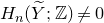 $H_{n}(\widetilde {Y};\mathbb{Z}) \neq 0$
. So, to prove the lemma, it suffices to show that
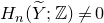 $H_{n}(\widetilde {Y};\mathbb{Z}) \neq 0$
. To see this, by homotopy lifting [Reference HatcherHat02, Proposition 1.33], we have the following commutative diagram.

Since
 $f$
is an
 $n$
-pseudocycle, there exists
 $g \colon W \to Y$
with
 $\dim (W) \leq n-2$
such that
 $\textrm {Bd}(f) \subset g(W)$
. By Lemma 2.5, there exist open subsets
 $U_i\subset Y$
for
 $0 \leq i \leq n-2$
, such that each intersection
 \begin{equation*} U_{i_1} \cap \cdots \cap U_{i_\ell } \quad \mbox{for} \ 0 \leq i_j \leq n-2 \end{equation*}
is a disjoint union of contractible open subsets and
 \begin{equation*} \mbox{Bd}(f) \subset g(W) \subset \bigcup _i U_i =: U.\end{equation*}
Define
 $\widetilde {U_i} = \pi ^{-1}(U_i)$
and
 $\widetilde {U} := \bigcup _i \widetilde {U_i}$
. Since
 $\pi$
is a covering map, for
 $0 \leq i \leq n-2$
, each intersection
 \begin{equation*} \widetilde {U}_{i_1} \cap \cdots \cap \widetilde {U}_{i_\ell } \quad \mbox{for} \ 0 \leq i_j \leq n-2 \end{equation*}
is a disjoint union of contractible open subsets. So, by an inductive argument with the Mayer–Vietoris sequence,
 \begin{equation*} H_\bullet (\widetilde {U};\mathbb{Z}) = 0 = H_\bullet (U;\mathbb{Z})\quad \mbox{for} \ \bullet \gt n-2.\end{equation*}
Let
 $X_0$
be an oriented codimension zero submanifold of
 $X$
with boundary as in Construction 2.6. We have the following commutative diagram.

The two left horizontal arrows are isomorphisms by the long exact sequence for the homology of the pairs
 $(\widetilde {Y},\widetilde {U})$
and
 $(Y,U)$
and the homological conditions for
 $\widetilde {U}$
and
 $U$
. By assumption, the composition along the bottom row of the diagram is non-zero. Consequently,
 $H_n(\widetilde {Y};\mathbb{Z}) \neq 0$
. This completes the proof of the lemma.
We conclude this section with a discussion on oriented sphere bundles.
Definition 3.3. An oriented
 $S^2$
-bundle over a manifold
 $X$
is a fibre bundle
 $\pi : \mathcal{E} \to X$
with fibre
 $S^2$
such that there exists a collection of contractible open subsets
 $\{U_i\}_i$
of
 $X$
, trivializations
 \begin{equation*} \phi _i: \pi ^{-1}(U_i) \cong U_i \times S^2, \end{equation*}
and generators
 \begin{equation*} \mathfrak{o}_i \in H^{2}(\mathcal{E}|_{U_i};\mathbb{Z}) \cong H^2(S^2;\mathbb{Z}) \end{equation*}
so that over the intersections
 $U_{ij} = U_i \cap U_j$
,
 \begin{equation*} \mathfrak{o}_i|_{\mathcal{E}|_{U_{ij}}} = \mathfrak{o}_j|_{\mathcal{E}|_{U_{ij}}}. \end{equation*}
Our oriented
 $S^2$
-bundles will arise from the following situation.
Lemma 3.4.
Let
 $G$
be a Lie group. Suppose that
 $X$
and
 $S^2$
admit smooth
 $G$
-actions, where
 $G$
acts freely and properly on
 $X$
and
 $G$
acts via orientation-preserving diffeomorphisms on
 $S^2$
. The projection
 \begin{equation*} \pi : X \times _G S^2 \to X/G\end{equation*}
is an oriented
 $S^2$
-bundle.
Footnote
4
Proof. By the Slice Theorem [Reference PalaisPal61, Proposition 2.2.2, Remark 2.2.3 and Section 4.1], the projection
 \begin{equation*} \pi _X: X \to X/G\end{equation*}
is a smooth principal
 $G$
-bundle. We have local trivializations over
 $U_i \subset X/G$
,
 \begin{equation*} \Phi _i: \pi _X^{-1}(U_i) \to U_i \times G, \quad \Phi _i(x) = (\pi _X(x),\phi _i(\pi _X(x))), \end{equation*}
where
 $\phi _i: U_i \to G$
. The
 $\Phi _i$
are equivariant with respect to the
 $G$
-action on
 $\pi _X^{-1}(U_i)$
and the
 $G$
-action on
 $U_i \times G$
given by
 \begin{equation*} h \cdot (p,g) = (p,h \cdot g) \quad \mbox{for} \ h \in G.\end{equation*}
There are transition functions relating the
 $\Phi _i$
,
 \begin{equation*} \Phi _{ij}: U_{ij} \times G \to U_{ij} \times G, \quad (p,g) \mapsto (p,g \cdot \phi _{ij}(p)), \end{equation*}
where
 $\phi _{ij}: U_{ij} \to G$
. So
 $\Phi _i = \Phi _{ij} \circ \Phi _j$
. Notice that
 $\Phi _{ij}$
is
 $G$
-equivariant.
These determine trivializations of
 $\pi$
over
 $U_i \subset X/G$
,
 \begin{equation*} \Psi _i: \pi ^{-1}(U_i) = (\pi _X^{-1}(U_i) \times _G S^2) \to U_i \times S^2, \quad \Psi _i = \sigma _i \circ (\Phi _i \times _G \unicode {x1D7D9}), \end{equation*}
where
 \begin{equation*} \sigma _i: (U_i \times G) \times _G S^2 \to U_i \times S^2, \quad \sigma _i([(p,g),z]) = (p,g^{-1} \cdot z), \end{equation*}
with transition functions relating the
 $\Psi _i$
,
 \begin{equation*} \Psi _{ij}: U_{ij} \times S^2 \to U_{ij} \times S^2, \quad \Psi _{ij}(p,z) = (p, \phi _{ij}(p)^{-1} \cdot z).\end{equation*}
In particular,
 $\Psi _i = \Psi _{ij} \circ \Psi _{j}$
. We have thus shown that the projection is an
 $S^2$
-bundle.
For orientability, fix an orientation
 $\mathfrak{o} \in H^2(S^2;\mathbb{Z})$
. Define
 $\mathfrak{o}_i \in H^2(\pi ^{-1}(U_i);\mathbb{Z})$
via
 $\mathfrak{o}_i = \Psi _i^*(1 \otimes \mathfrak{o})$
. Note that
 $\mathfrak{o}_i|_{\mathcal{E}|_{U_{ij}}} = \mathfrak{o}_j|_{\mathcal{E}|_{U_{ij}}}$
if and only if
 $\Psi _{ij}^* \mathfrak{o} = \mathfrak{o}$
. But the
 $G$
-action on
 $S^2$
preserves
 $\mathfrak{o}$
. So, by the above description of
 $\Psi _{ij}$
, the desired equality follows.
Finally, we give a flavour of the Gysin sequence.

Lemma 3.5.
Let
 $\pi : \mathcal{E} \to X$
be an oriented
 $S^2$
-bundle. There exists an exact sequence

Proof. Recall the (homological) Gysin sequence for an oriented sphere bundle:

where
 $e$
denotes the Euler class of the oriented sphere bundle and the map
 $\tau$
is given by where
 $\mathcal{D}$
is the disk bundle associated with
 $\mathcal{E}$
with fibrewise boundary given by
 $\mathcal{E}$
,
 $u_{\mathcal{E}}$
is the Thom class associated with the pair
 $(\mathcal{D},\mathcal{E})$
, and
 $\partial$
is the connecting homomorphism in the long exact sequence of the pair
 $(\mathcal{D},\mathcal{E})$
. The map
 $H_3(\mathcal{D},\mathcal{E}) \to H_0(X)$
above is the homological Thom isomorphism. The cohomological version of this sequence is given in [Reference HatcherHat02, Section 4.D]. The construction of the homological version given above is entirely analogous. From the above description, it follows that the image of the point class in
 $H_0(X)$
under
 $\tau$
is identified with the image of the fundamental class of the fibre under the inclusion
 \begin{equation*} (i_x)_*: H_2(S^2;\mathbb{Z}) \to H_2(\mathcal{E};\mathbb{Z}).\end{equation*}
This gives the claimed exact sequence.
4. Gromov–Witten invariants
4.1 Gromov–Witten invariants à la Cieliebak and Mohnke
We recall Cieliebak and Mohnke’s [Reference Cieliebak and MohnkeCM07] construction of Gromov–Witten pseudocycles for rational symplectic manifolds, and Krestiachine’s [Reference KrestiachineKre15] extension of their construction to non-rational symplectic manifolds.
Notation 4.1.
-
(i) Let
$(X,\Omega )$
be a closed symplectic manifold. -
(ii) Let
$\omega$
be a perturbation of
$\Omega$
to a rational symplectic form. So
$[\omega ] \in H^2(X;\mathbb{Q})$
. After rescaling, we can, and do, assume that
$[\omega ] \in H^2(X;\mathbb{Z})$
. -
(iii) Let
$J$
be an
$\omega$
-compatible almost complex structure. -
(iv) Let
$Y$
denote a Donaldson hypersurface for
$\omega$
, so that, in particular,
$PD([Y]) = N \cdot [\omega ]$
for some
$N\gg 0$
. Further suppose that
$(Y,J)$
is a Donaldson pair, see [Reference Cieliebak and MohnkeCM07, Definition 9.2]. Such pairs always exist for any fixed compatible pair
$(\omega ,J)$
.






Definition 4.2. A family of
 $\omega$
-tamed almost complex structures
 \begin{equation*} \mathbf{J} \in C^\infty (\overline {\mathcal{M}}_{0,\ell +1}, \mathrm{End}(TM))\end{equation*}
is admissible if
 $\mathbf{J}$
is coherent (see [Reference Cieliebak and MohnkeCM07, Definition 3.1]) and for each
 $p \in \overline {\mathcal{M}}_{0,\ell +1}$
,
 $\mathbf{J}(p)$
leaves
 $TY$
invariant and
 $\mathbf{J}(p)$
is
 $C^0$
-close to
 $J$
. Here
 $\overline {\mathcal{M}}_{0,\ell +1}$
is the moduli space of stable genus zero curves with
 $\ell +1\geq 4$
ordered marked points.
Notation 4.3. By forgetting the last of the
 $(\ell +1)$
-marked points and restricting to the open stratum
 $\mathcal{M}_{0,\ell +1} \subset \overline {\mathcal{M}}_{0,\ell +1}$
, an admissible
 $\mathbf{J}$
encodes a
 ${\mathcal{M}}_{0,\ell }$
-family of
 $\mathbb{P}^1$
domain dependent almost complex structures on
 $X$
, where the
 $\mathbb{P}^1$
dependence is parameterized by the
 $(\ell +1)$
-marked point. A tuple
 $\mathbf{z} = (z_1,\dots ,z_\ell ,\dots ,z_{\ell +k}) \in (\mathbb{P}^1)^{\ell +k} \smallsetminus \Delta _{\textrm {fat}}$
, where
 \begin{equation*} \Delta _{\textrm {fat}} = \{(z_1,\dots ,z_\ell ,\dots ,z_{\ell +k}) \in (\mathbb{P}^1)^{\ell +k}\mid z_i = z_j \mbox{ for some }i \neq j\},\end{equation*}
determines an element
 $[\mathbf{z}] \in \mathcal{M}_{0,\ell }$
by forgetting the last
 $k$
-marked points. Let
 $\mathbf{J}_{\mathbf{z}}$
denote the associated
 $\mathbb{P}^1$
-dependent almost complex structure on
 $X$
.
Notation 4.4. Let
 $\widetilde {\mathcal{M}}_{0,\ell +k}^A(X,\Omega ;\omega ,\mathbf{J},Y)$
denote the subspace of
 \begin{equation*} C^\infty (\mathbb{P}^1,X) \times ( (\mathbb{P}^1)^{\ell +k} \smallsetminus \Delta _{\textrm {fat}} ) \end{equation*}
of pairs
 $(u,\mathbf{z})$
that satisfy:
-
(i)
$du(z) + \mathbf{J}_{\mathbf{z}}(z,u(z)) \circ du(z) \circ j(z)$
; -
(ii)
$[u] = A \in H_2(X;\mathbb{Z})$
; and -
(iii)
$u(z_i) \in Y$
for
$1 \leq i \leq \ell$
.




Define an evaluation map
 \begin{equation*} \widetilde {\textrm {ev}}_{\ell +k}(X,\Omega ;\omega ,\mathbf{J},Y): \widetilde {\mathcal{M}}_{0,\ell +k}^A(X,\Omega ;\omega ,\mathbf{J},Y) \to X^k \end{equation*}
by
 \begin{equation*} \widetilde {\textrm {ev}}_{\ell +k}(X,\Omega ;\omega ,\mathbf{J},Y)(u,z_1,\dots ,z_{\ell +k}) = (u(z_{\ell +1}),\dots ,u(z_{\ell +k})). \end{equation*}
By [Reference Cieliebak and MohnkeCM07, Discussion following the proof of Lemma 5.1] (see the proof of Proposition 4.14 for an analogous argument), there is a proper free
 $\textrm {PGL}_2(\mathbb{C})$
-action on
 $\widetilde {\mathcal{M}}_{0,\ell +k}^A(X,\Omega ;\omega ,\mathbf{J},Y)$
,
 \begin{equation*} \psi \cdot (u,z_1,\dots ,z_{\ell +k}) \mapsto (u \circ \psi ^{-1}, \psi (z_1),\dots ,\psi (z_{\ell +k})). \end{equation*}
Let
 $\mathcal{M}_{0,\ell +k}^A(X,\Omega ;\omega ,\mathbf{J},Y)$
denote the quotient of
 $\widetilde {\mathcal{M}}_{0,\ell +k}^A(X,\Omega ;\omega ,\mathbf{J},Y)$
by the
 $\textrm {PGL}_2(\mathbb{C})$
-action and let
 ${\textrm {ev}}_{\ell +k}(X,\Omega ;\omega ,\mathbf{J},Y)$
denote the induced evaluation map.
The main result of [Reference Cieliebak and MohnkeCM07] is the following.
Theorem 4.5 [Reference Cieliebak and MohnkeCM07, Theorem 1.1 and Theorem 1.2]. For a generic
Footnote
5
choice of admissible
 $\mathbf{J}$
and
 $\ell \gg 0$
, the evaluation map
 \begin{equation*} \textrm {ev}_{\ell +k}(X,\Omega ;\omega ,\mathbf{J},Y): \mathcal{M}_{0,\ell +k}^A(X,\Omega ;\omega ,\mathbf{J},Y) \to X^k \end{equation*}
defines a pseudocycle of dimension
 $2n+2c_1(A) +2k-6$
.
Theorem4.5 allows us to give the following definition of Gromov–Witten invariants.
Definition 4.6. Let
 $A \in H_2(X;\mathbb{Z})$
be a spherical homology class. Let
 $A_1,\dots ,A_k \in H_\bullet (X;\mathbb{Z})$
be non-torsion homology classes that satisfy
 \begin{equation*} \sum _{i=1}^k 2n-\deg (A_i) = 2n+ 2c_1(A)+2k-6. \end{equation*}
Suppose that
 $A_i$
is represented by a pseudocycle
 $h_i: Z_i \to X$
. Define
 \begin{equation*} \textrm {GW}_{0,k}^A(X,\Omega ;A_1,\dots ,A_k) := \frac {1}{\ell !} \cdot \Phi ([\textrm {ev}_{\ell +k}(X,\Omega ;\omega ,\mathbf{J},Y)] \cdot [h_1 \times \cdots \times h_k]), \end{equation*}
where
 $\textrm {ev}_{\ell +k}(X,\Omega ;\omega ,\mathbf{J},Y)$
is a pseudocycle from Theorem 4.5 and
 $\Phi$
is given in Theorem 2.3.
By [Reference Cieliebak and MohnkeCM07, Theorem 1.2] and [Reference KrestiachineKre15, Theorem B], Definition 4.6 is well defined. Finally, we give a type of universal curve over these pseudocycles.
Lemma 4.7.
There exists an oriented
 $S^2$
-bundle
 \begin{equation*} \pi : \mathcal{C}_{0,\ell +k}^A(X,\Omega ;\omega ,\mathbf{J},Y) \to \mathcal{M}_{0,\ell +k}^A(X,\Omega ;\omega ,\mathbf{J},Y) \end{equation*}
with sections
 \begin{equation*} s_i: \mathcal{M}_{0,\ell +k}^A(X,\Omega ;\omega ,\mathbf{J},Y) \to \mathcal{C}_{0,\ell +k}^A(X,\Omega ;\omega ,\mathbf{J},Y) \end{equation*}
and an evaluation map
 \begin{equation*} e: \mathcal{C}_{0,\ell +k}^A(X,\Omega ;\omega ,\mathbf{J},Y) \to X\end{equation*}
that satisfy
 \begin{equation*} e \circ s_i = pr_i \circ \textrm {ev}_{\ell +k}(X,\Omega ;\omega ,\mathbf{J},Y).\end{equation*}
Proof.
Consider the projection
 $\widetilde {\pi }$
with sections
 $\widetilde {s}_i$
:
 \begin{gather*} \widetilde {\pi }: \widetilde {\mathcal{M}}_{\ell +k}^A(X,\Omega ;\omega ,\mathbf{J},Y) \times \mathbb{P}^1 \to \widetilde {\mathcal{M}}_{\ell +k}^A(X,\Omega ;\omega ,\mathbf{J},Y), \\ \widetilde {s}_i: \widetilde {\mathcal{M}}_{\ell +k}^A(X,\Omega ;\omega ,\mathbf{J},Y) \to \widetilde {\mathcal{M}}_{\ell +k}^A(X,\Omega ;\omega ,\mathbf{J},Y) \times \mathbb{P}^1, \\ \widetilde {s}_i(u,z_1,\dots ,z_{\ell +k}) = (u,z_1,\dots ,z_{\ell +k},z_{\ell +i}). \end{gather*}
There is an evaluation map
 \begin{equation*} \widetilde {e}: \widetilde {\mathcal{M}}_{\ell +k}^A(X,\Omega ;\omega ,\mathbf{J},Y) \times \mathbb{P}^1 \to X, \quad \widetilde {e} (u,z_1,\dots ,z_{\ell +k},z) = u(z). \end{equation*}
By [Reference Cieliebak and MohnkeCM07, Section 5], the action of
 $\textrm {PGL}_2(\mathbb{C})$
on
 $\widetilde {\mathcal{M}}_{\ell +k}^A(X,\Omega ;\omega ,\mathbf{J},Y)$
is proper and free. Since
 $\textrm {PGL}_2(\mathbb{C})$
is connected, its action on both
 $\widetilde {\mathcal{M}}_{\ell +k}^A(X,\Omega ;\omega ,\mathbf{J},Y)$
and
 $\mathbb{P}^1$
is orientation-preserving. So, by Lemma 3.4, the quotient
 \begin{equation*}\mathcal{C}_{0,\ell +k}^A(X,\Omega ;\omega ,\mathbf{J},Y) := ( \widetilde {\mathcal{M}}_{\ell +k}^A(X,\Omega ;\omega ,\mathbf{J},Y) \times \mathbb{P}^1)/\textrm {PGL}_2(\mathbb{C}) \end{equation*}
by the diagonal action is an oriented
 $S^2$
-bundle over
 $\mathcal{M}_{0,\ell +k}^A(X,\Omega ;\omega ,\mathbf{J},Y)$
, where notationally
 $\widetilde {\mathcal{M}}_{\ell +k}^A(X,\Omega ;\omega ,J,Y)$
and
 $\textrm {PGL}_2(\mathbb{C})$
correspond to
 $X$
and
 $G$
, respectively, in the statement of Lemma 3.4. Finally, the maps
 $\widetilde {s_i}$
and
 $\widetilde {e}$
are equivariant with respect to the
 $\textrm {PGL}_2(\mathbb{C})$
-action, so they descend to the desired maps
 $s_i$
and
 $e$
.
4.2 Gromov–Witten invariants for indecomposable classes
When the spherical homology class associated with a Gromov–Witten invariant is indecomposable, there is an alternative representation of the Gromov–Witten pseudocycle which is a closed manifold. First, we recall the notion of an indecomposable homology class, and then we give the construction.
Notation 4.8. Let
 $(X,\Omega )$
be a closed symplectic manifold.
Definition 4.9. Let
 $J$
be an
 $\Omega$
-tamed almost complex structure. A class
 $A \in H_2(X;\mathbb{Z})$
is
 $J$
-indecomposable if
 $A$
cannot be written as a sum
 $A_1 + A_2$
, where
 $A_i \in H_2(X;\mathbb{Z})$
is represented by a possibly disconnected, non-constant, nodal, genus zero
 $J$
-holomorphic curve.
Lemma 4.10 (Cf. [Reference McDuff and SalamonMS12, Exercise 7.1.10]). Given
 $A \in H_2(X;\mathbb{Z})$
, the subspace (with respect to the
 $C^\infty$
-topology) of all
 $\Omega$
-tamed almost complex structures
 $J$
for which
 $A$
is
 $J$
-indecomposable is open.
Proof.
We show that the complement of the said subspace is closed. Suppose that
 $J_\nu$
is a sequence of
 $\Omega$
-tamed almost complex structures for which
 $A$
is not
 $J_\nu$
-indecomposable that converge in the
 $C^\infty$
-topology to an
 $\Omega$
-tamed almost complex structure
 $J$
. Since
 $A$
is not
 $J_\nu$
-indecomposable, we have that
 \begin{equation*} A = A_0^\nu + A_1^\nu , \end{equation*}
where each
 $A_i^\nu \in H_2(X;\mathbb{Z})$
is represented by a possibly disconnected, non-constant, nodal, genus zero
 $J_\nu$
-holomorphic curve, say
 $u_i^\nu : \Sigma _i^\nu \to X$
. By Gromov compactness, after passing to a sub-sequence, the
 $u_i^\nu$
Gromov converge to non-constant nodal genus zero
 $J$
-holomorphic curves,
 $u_i: \Sigma _i \to X$
, such that
 \begin{equation*} A = [u_0] + [u_1].\end{equation*}
This shows that
 $A$
is not
 $J$
-indecomposable, as desired.
Definition 4.11. A class
 $A \in H_2(X;\mathbb{Z})$
is
 $\Omega$
-indecomposable if
 $A$
is
 $J$
-indecomposable for some
 $\Omega$
-tamed almost complex structure
 $J$
.
We now construct the alternative representation of the Gromov–Witten pseudocycle.
Notation 4.12. Fix an
 $\Omega$
-indecomposable homology class
 $A \in H_2(X;\mathbb{Z})$
and an
 $\Omega$
-tamed almost complex structure
 $J$
on
 $X$
for which
 $A$
is
 $J$
-indecomposable. Define the spaces
 \begin{equation*} \mathcal{M}_{0,0}^A(X,J) := \{ u: \mathbb{P}^1 \to X \mid du(z) + J(u(z)) \circ du(z) \circ j(z) = 0,\ [u] = A \} \end{equation*}
and
 \begin{equation*} \mathcal{M}_{0,k}^A(X,J) := ( \mathcal{M}_{0,0}^A(X,J) \times (\mathbb{P}^1)^k \smallsetminus \Delta _{\textrm {fat}} ) / \textrm {PGL}_2(\mathbb{C}), \end{equation*}
where
 $\textrm {PGL}_2(\mathbb{C})$
acts by
 \begin{equation*} \psi \cdot (u,z_1,\dots ,z_k) \mapsto (u \circ \psi ^{-1},\psi (z_1),\dots ,\psi (z_k)). \end{equation*}
Define
 \begin{equation*} \widehat {\mathcal{M}}_{0,k}^A(X,J) = ( \mathcal{M}_{0,0}^A(X,J) \times (\mathbb{P}^1)^k ) / \textrm {PGL}_2(\mathbb{C}). \end{equation*}
There is an evaluation map
 \begin{equation*} \widehat {\textrm {ev}}: \widehat {\mathcal{M}}_{0,k}^A(X,J) \to X^k, \quad \widehat {\textrm {ev}}([u,z_1,\dots ,z_k]) = (u(z_1),\dots ,u(z_k)). \end{equation*}
There is a forgetful map
 \begin{equation*} \pi : \widehat {\mathcal{M}}_{0,k+1}^A(X,J) \to \widehat {\mathcal{M}}_{0,k}^A(X,J), \quad \pi ([u,z_1,\dots ,z_k,z_{k+1}]) = [u,z_1,\dots ,z_k]. \end{equation*}
There are sections of
 $\pi$
,
 \begin{equation*} s_i : \widehat {\mathcal{M}}_{0,k}^A(X,J) \to \widehat {\mathcal{M}}_{0,k+1}^A(X,J), \quad s_i([u,z_1,\dots ,z_k]) = [u,z_1,\dots ,z_k,z_i]. \end{equation*}
Notice that
 $pr_{k+1} \circ \widehat {\textrm {ev}} \circ s_i = pr_{i} \circ \widehat {\textrm {ev}}$
, where the
 $\widehat {\textrm {ev}}$
on the left side of the equation has domain
 $\widehat {\mathcal{M}}_{0,k+1}^A(X,J)$
and the
 $\widehat {\textrm {ev}}$
on the right side of the equation has domain
 $\widehat {\mathcal{M}}_{0,k}^A(X,J)$
.
Remark 4.13. One can take the stable maps compactification of
 $\mathcal{M}_{0,k}^A(X,J)$
, denoted
 $\overline {\mathcal{M}}_{0,k}^A(X,J)$
, and show that it is a smooth closed oriented manifold for some regular
 $J$
; however, for our purposes, it is convenient to use the compactification
 $\widehat {\mathcal{M}}_{0,k}^A(X,J)$
.
Proposition 4.14.
For a generic choice of
 $\Omega$
-tamed almost complex structure
 $J$
as in Notation 4.12 the following hold.
-
(i) The space
$\widehat {\mathcal{M}}_{0,k}^A(X,J)$
is a smooth closed oriented manifold of dimension
\begin{equation*} 2n+2k+2c_1(A)-6. \end{equation*}
-
(ii) The maps
$\pi$
,
$s_{i}$
, and
$\widehat {\textrm {ev}}$
are smooth.
-
(iii) The map
$\pi$
defines an oriented
$S^2$
-bundle over
$\widehat {\mathcal{M}}_{0,k}^A(X,J)$
.


Finally, the class of
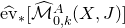 $\widehat {\textrm {ev}}_*[\widehat {\mathcal{M}}_{0,k}^A(X,J)]$
is independent of the choice of generic
 $J$
and agrees with the class of the pseudocycle
Footnote
6
 \begin{equation*} \text{ev}: \mathcal{M}_{0,k}^{A}(X,J) \rightarrow X^{k}, \quad \rm{ev} ([u,z_{1},\ldots,z_{k}]) = (u(z_{1}),\ldots, u(z_{k})). \end{equation*}
Proof.
Every holomorphic curve that represents an indecomposable class is simple. So [Reference McDuff and SalamonMS12, Theorem 3.1.6] implies that, for a generic choice of
 $J$
as in Notation 4.12, the space
 $\mathcal{M}_{0,0}^A(X,J) \times (\mathbb{P}^1)^k$
is a smooth oriented (non-compact) manifold of dimension
 $2n+2c_1(A)+2k$
. We claim that the action of
 $\textrm {PGL}_2(\mathbb{C})$
on
 $\mathcal{M}_{0,0}^A(X,J)$
is free and proper (cf. [Reference McDuff and SalamonMS12, Exercise 6.1.4]).
To prove freeness, we proceed as follows. Since
 $u$
is simple, its set of injective points is dense (see [Reference McDuff and SalamonMS12, Lemma 2.4.1]). It follows that if
 $u = \psi \cdot u = u \circ \psi ^{-1}$
, then
 $\psi ^{-1}$
is given by the identity on a dense subset. Consequently,
 $\psi ^{-1}$
is given by the identity. This proves freeness. To prove properness, it suffices to show that, given sequences
 $u_\nu \in \mathcal{M}_{0,0}^A(X,J)$
and
 $g_\nu \in \textrm {PGL}_2(\mathbb{C})$
such that both
 $u_\nu$
and
 $u_\nu \circ g_\nu$
converge, then
 $g_\nu$
converges, where convergence means uniform convergence with respect to all derivatives. If the sequence
 $g_\nu$
does not converge, then there exist points
 $x,y \in \mathbb{P}^1$
and a sub-sequence
 $g_{\nu _i}$
which converges to the constant map at
 $y$
on all compact subsets of
 $\mathbb{P}^1 \smallsetminus \{x\}$
(see [Reference McDuff and SalamonMS12, Lemma D.1.2]). Up to replacing
 $g_\nu$
by
 $g_\nu \circ \phi$
, where
 $\phi \in \textrm {PGL}_2(\mathbb{C})$
satisfies
 $\phi (y) = 0$
and
 $\phi (x) = \infty$
, we may assume that the
 $g_{\nu _i}$
converge to the constant map at
 $0$
on all compact subsets of
 $\mathbb{C} \subset \mathbb{P}^1$
. It follows that
 $|d g_{\nu _i}| \to 0$
on
 $\mathbb{D}^2 \subset \mathbb{C}$
. Since
 $u_\nu \to u$
, the
 $|du_\nu |$
are uniformly bounded above in
 $\nu$
. Since
 $u_\nu \circ g_\nu$
converges, we find that
 $|du_\nu \circ d g_\nu | \to 0$
on
 $\mathbb{D}^2 \subset S^2$
. Consequently,
 $u_\nu \circ g_\nu$
converges to the constant map on
 $\mathbb{D}^2 \subset \mathbb{C}$
. In particular,
 $u_\nu \circ g_\nu$
must converge to the constant map. However, the energy of the limit of
 $u_\nu \circ g_\nu$
must be positive, which contradicts the fact that the limit is constant. This proves properness and completes the proof of the claim.
Since
 $\textrm {PGL}_2(\mathbb{C})$
is connected, its action on
 $\mathcal{M}_{0,0}^A(X,J)$
is also orientation-preserving. Also, the action of
 $\textrm {PGL}_2(\mathbb{C})$
on
 $(\mathbb{P}^1)^k$
is orientation-preserving. So the action of
 $\textrm {PGL}_2(\mathbb{C})$
on the product
 $\mathcal{M}_{0,0}^A(X,J) \times (\mathbb{P}^1)^k$
is proper and free and orientation-preserving on each factor. By the Slice Theorem [Reference PalaisPal61, Proposition 2.2.2, Remark 2.2.3 and Section 4.1], the quotient
 $\widehat {\mathcal{M}}_{0,k}^A(X,J)$
is a smooth oriented manifold of dimension
 $2n+2k+2c_1(A)-6$
. The quotient is closed by Gromov compactness and the indecomposability of
 $A$
(cf. [Reference McDuff and SalamonMS12, Proof of Lemma 7.1.8]). This proves item (i).
The maps
 $\pi$
,
 $s_i$
and
 $\widehat {\textrm {ev}}$
are induced from smooth
 $\textrm {PGL}_2(\mathbb{C})$
-equivariant maps on the product
 $\mathcal{M}_{0,0}^A(X,J) \times (\mathbb{P}^1)^k$
. By the Slice Theorem [Reference PalaisPal61, Proposition 2.2.2, Remark 2.2.3, and Section 4.1], the quotient projection by the action of
 $\textrm {PGL}_2(\mathbb{C})$
 \begin{equation*} \mathcal{M}_{0,0}^A(X,J) \times (\mathbb{P}^1)^k \to \widehat {\mathcal{M}}_{0,k}^A(X,J) \end{equation*}
is a submersion. So, by [Reference LeeLee13, Theorem 4.2.9], the above maps descend to smooth maps on
 $\widehat {\mathcal{M}}_{0,k}^A(X,J)$
. This proves item (ii). By Lemma 3.4 and our observations,
 $\pi$
defines an oriented
 $S^2$
-bundle. We have taken
 $\mathcal{M}_{0,0}^A(X,J) \times (\mathbb{P}^1)^k$
to be equal to
 $X$
and
 $\textrm {PGL}_2(\mathbb{C})$
to be equal to
 $G$
in the statement of Lemma 3.4. So
 $X \times _G \mathbb{P}^1 = \widehat {\mathcal{M}}_{0,k+1}^A(X,J)$
and
 $X/G = \widehat {\mathcal{M}}_{0,k}^A(X,J)$
. This proves item (iii).
To prove the final conclusion, note that
 $\mathcal{M}_{0,k}^A(X,J)$
is an open subset of
 $\widehat {\mathcal{M}}_{0,k}^A(X,J)$
and its complement is covered by smooth, closed manifolds of dimensions less than or equal to
 $2n+2k+2c_1(A)-8$
. By Lemma 2.8,
 $\widehat {\textrm {ev}}$
and
 $\textrm {ev}$
define the same pseudocycles. By [Reference McDuff and SalamonMS12, Lemma 7.1.8], the pseudocycle
 $\textrm {ev}$
is independent of the choice of
 $J$
. So
 $\widehat {\textrm {ev}}$
is also independent of the choice of
 $J$
. This completes the proof of the proposition.
Remark 4.15. By [Reference Cieliebak and MohnkeCM07, Remark 1.6], the pseudocycle
 $\widehat {\textrm {ev}}$
from Proposition 4.14 can be used instead of a pseudocycle
 $\textrm {ev}_{\ell +k}(X,\Omega ;\omega ,\mathbf{J},Y)$
from Definition 4.6 to compute the Gromov–Witten invariants of
 $X$
for an
 $\Omega$
-indecomposable class
 $A$
.
5. Proof of main result
In this section, we prove Theorem1.2. First, we prove a general geometric result, Proposition 5.2, that encapsulates the hypotheses of Theorem1.2. Then we show that Theorem1.2 follows from Proposition 5.2.
Notation 5.1. Let
 $X$
be a smooth closed oriented manifold of dimension
 $n$
. Let
 $f = (f_0,f_1): \mathcal{M} \to X \times X$
be a
 $k$
-pseudocycle. Let
 $\pi : \mathcal{C} \to \mathcal{M}$
be an oriented
 $S^2$
-bundle. Suppose there is a map
 $e: \mathcal{C} \to X$
and sections
 $s_i: \mathcal{M} \to \mathcal{C}$
of
 $\pi$
that satisfy
 $f_i = e \circ s_i$
.
Proposition 5.2.
If
 $h: Z \to X$
is a
 $(2n-k)$
-dimensional embedded submanifold such that
Footnote
7
 \begin{equation*} [ f ] \cdot [ \textrm {pt} \times h ] \neq 0, \end{equation*}
then the image of
 \begin{equation*} h_*: \pi _1(Z) \to \pi _1(X) \end{equation*}
is a finite index subgroup of
 $\pi _1(X)$
. If
 $\mathcal{M}$
is, further, a closed manifold, then
 $H_2(X;\mathbb{Q})$
is generated by
 $h_*(H_2(Z;\mathbb{Q}))$
and
 $e_*([\pi ^{-1}(x)])$
.
Proof.
We begin by proving the first claim about fundamental groups. By Corollary 2.19(i), there exists a diffeomorphism
 $\phi \in \textrm {Diff}_0^+(X)$
such that
 \begin{equation*} g: M \to X, \quad g = pr_0 \circ (f \cdot (\unicode {x1D7D9} \times (\phi \circ h)))\end{equation*}
is an
 $n$
-pseudocycle, where notationally
 $\mathcal{M}$
,
 $X$
,
 $X$
,
 $f$
,
 $h$
,
 $M$
, and
 $g$
correspond to
 $M$
,
 $X_0$
,
 $X_1$
,
 $f$
,
 $h_1$
,
 $M_0$
, and
 $g$
, respectively, in the statement of Corollary 2.19. In particular,
 $M$
is given by the transverse intersection of
 $f_1$
and
 $\phi \circ h$
and
 $g$
is the composition of
 $pr_0$
and the map associated with the transverse intersection of
 $f$
and
 $\unicode {x1D7D9} \times (\phi \circ h)$
. We claim that the image of
 \begin{equation*} g_*: \pi _1(M) \to \pi _1(X) \end{equation*}
is a finite index subgroup of
 $\pi _1(X)$
. Indeed, by Proposition 2.16,
 \begin{equation*} [g] \cdot [pt] = pr_0 \circ ([f] \cdot [ pt \times h ]) \neq 0, \end{equation*}
where notationally
 $X$
,
 $X$
,
 $f$
,
 $pt$
, and
 $h$
correspond to
 $X_0$
,
 $X_1$
,
 $f$
,
 $h_0$
, and
 $h_1$
, respectively, in the statement of Proposition 2.16. Since the intersection of
 $[g]$
with the point class is non-zero, Proposition 2.11 implies that
 $[g] \in \mathcal{H}_n(X)$
is non-zero. The claim about fundamental groups then follows from Lemma 3.2., where notationally
 $g$
,
 $M$
, and
 $X$
correspond to
 $f$
,
 $X$
, and
 $Y$
, respectively, in the statement of Lemma 3.2.
Since
 $\unicode {x1D7D9} \times (\phi \circ h)$
is injective, by Lemma 2.10,
 $M$
naturally sits inside
 $\mathcal{M}$
. So we may restrict the
 $S^2$
-bundle over
 $\mathcal{M}$
to
 $M$
,
 $\pi |_M: \mathcal{C}|_M \to M$
. The homotopy long exact sequence for a fibre bundle implies the following.
-
(i) The map
$\pi _*: \pi _1(\mathcal{C}|_M) \to \pi _1(M)$
is an isomorphism. -
(ii) The
$(s_i|_M)_*: \pi _1(M) \to \pi _1(\mathcal{C}|_M)$
are isomorphic for
$i = 0,1$
, that is, up to applying a change-of-basepoint isomorphism to
$\pi _1(\mathcal{C}|_M)$
,
$(s_0|_M)_*$
and
$(s_1|_M)_*$
induce the same isomorphism. Indeed, let
$p \in M$
be a basepoint and let
$\gamma$
be a path from
$s_0(p)$
to
$s_1(p)$
that is completely contained in a fibre of
$\pi$
. Let
$\Phi _\gamma \colon \pi _1(\mathcal{C}|_M,s_0(p)) \to \pi _1(\mathcal{C}|_M,s_1(p))$
denote the change-of-basepoint isomorphism. We claim that
$\Phi _\gamma \circ (s_0)_*(\alpha ) = (s_1)_*(\alpha )$
for any class
$\alpha \in \pi _1(M,p)$
. Indeed, by the definition of the change-of-basepoint isomorphism, we have that
$\pi _* \circ \Phi _\gamma \circ (s_0)_*(\alpha ) = \pi _* \circ (s_1)_*(\alpha )$
. But since
$\pi _*$
is an isomorphism, we have the desired relation. It follows that
$\Phi _\gamma \circ (s_0)_* = (s_1)_*$
, that is, the maps are isomorphic.


Consider
 \begin{equation*} \widetilde {g}: M \to X, \quad \widetilde {g} = pr_1 \circ (f \cdot (\unicode {x1D7D9} \times (\phi \circ h))).\end{equation*}
Since
 $e \circ s_i = f_i$
, the above discussion implies that
 \begin{equation*} g_*: \pi _1(M) \to \pi _1(X) \quad \mbox{and} \quad \widetilde {g}_*: \pi _1(M) \to \pi _1(X) \end{equation*}
are isomorphic. Explicitly,
 $g_* = (f_0|_{M})_* = e_* \circ (s_0)_*$
and
 $\widetilde {g}_* = (f_1|_{M})_* = e_* \circ (s_1)_* = e_* \circ \Phi _\gamma \circ (s_0)_*$
. Since
 $\Phi _\gamma$
is a change-of-basepoint isomorphism, it commutes over
 $e$
with a change-of-basepoint isomorphism on
 $\pi _1(X)$
. So, in other words,
 $g_*$
and
 $\widetilde {g}_*$
agree up to applying a change-of-basepoint isomorphism. In particular, the index of
 $g_*$
agrees with the index of
 $\widetilde {g}_*$
. So
 $\textrm {Im}(\widetilde {g}_*) \subset \pi _1(X)$
is a finite index subgroup. But
 \begin{equation*} \textrm {Im}(\widetilde {g}_*) \subset \textrm {Im}((\phi \circ h)_*) = \textrm {Im}(h_*) \subset \pi _1(X) \end{equation*}
since
 $\widetilde {g}$
is given by the map associated with the transverse intersection of
 $f_1$
and
 $\phi \circ h$
(in particular,
 $\widetilde {g}$
factors through
 $\phi \circ h$
) and since
 $\phi$
is diffeotopic to the identity. So
 $\textrm {Im}(h_*)$
is a finite index subgroup of
 $\pi _1(X)$
, as desired.
Now we prove the second conclusion. Assume that
 $\mathcal{M}$
is closed. In this case,
 $M$
is a closed manifold, and, as above, the class of
 $g$
in
 $H_n(X;\mathbb{Z})$
is non-zero. So, by Lemma 3.1,
 \begin{equation*} g_*: H_2(M;\mathbb{Q}) \to H_2(X;\mathbb{Q}) \end{equation*}
is surjective, where notationally
 $g$
,
 $M$
, and
 $X$
correspond to
 $f$
,
 $X$
, and
 $Y$
, respectively, in the statement of Lemma 3.1. As above,
 $\pi |_{M}$
is an oriented
 $S^2$
-bundle. Lemma 3.5 gives an exact sequence

where notationally
 $\mathcal{C}|_{M}$
and
 $M$
correspond to
 $\mathcal{E}$
and
 $X$
, respectively, in the statement of Lemma 3.5. Fix some homology class
 $B \in H_2(X;\mathbb{Q})$
. There exists
 $\widetilde {B} \in H_2(M;\mathbb{Q})$
so that
 $g_*(\widetilde {B}) = B$
. By the exact sequence,
 \begin{equation*} (i_x)_*(q \cdot [S^2]) = -(s_1)_*(\widetilde {B}) + (s_0)_*(\widetilde {B}) \end{equation*}
for some
 $q \in \mathbb{Q}$
. Since
 $e \circ s_i = f_i$
, it follows that
 \begin{equation*} g_*(\widetilde {B}) = e_* \circ (s_0)_*(\widetilde {B}) = e_*(q \cdot (i_x)_*([S^2])) + e_* \circ (s_1)_*(\widetilde {B}).\end{equation*}
But
 $e_* \circ (s_1)_*(\widetilde {B})$
lies in the image of
 $h_*$
. So the desired result follows.
We now give the proof of Theorem1.2.
Proof of Theorem 1.2 . We begin with the claim about fundamental groups. Consider a choice of Gromov–Witten pseudocycle from Theorem4.5,
 \begin{equation*} \textrm {ev}_{\ell +(2+k)}(X,\Omega ;\omega ,\mathbf{J},Y): \mathcal{M}_{\ell +(2+k)}^A(X,\Omega ;\omega ,\mathbf{J},Y) \to X^{2+k}.\end{equation*}
Since the Gromov–Witten invariant stated in the theorem is non-zero, Definition 4.6 implies that there are pseudocycles
 $h_i: Z_i \to X$
for
 $3 \leq i \leq 2+k$
such that
 \begin{equation*} [ \textrm {ev}_{\ell +(2+k)}(X,\Omega ;\omega ,\mathbf{J},Y)] \cdot [ \textrm {pt} \times h \times h_3 \times \cdots \times h_{2+k} ] \neq 0. \end{equation*}
(We remark that, by appealing to Thom’s result [Reference ThomTho54] that every rational homology class can be represented as some multiple of an embedded submanifold, one could take the
 $h_i \colon Z_i \to X$
to be submanifolds; however, simply using pseudocycles suffices for this part of the proof.) By Corollary 2.19(i), there exists
 $\phi \in \textrm {Diff}_0^+(X^{k})$
such that the pseudocycle
 $\textrm {ev}_{\ell +(2+k)}(X,\Omega ;\omega ,\mathbf{J},Y)$
is strongly transverse (recall Definition 2.9) to
 \begin{equation*} \unicode {x1D7D9} \times \unicode {x1D7D9} \times (\phi \circ ( h_3 \times \cdots \times h_{2+k})), \end{equation*}
where notationally
 $\textrm {ev}_{\ell +(2+k)}$
,
 $h_3 \times \cdot \times h_{2+k}$
,
 $X \times X$
, and
 $X^k$
correspond to
 $f$
,
 $h_1$
,
 $X_0$
, and
 $X_1$
, respectively, in the statement of Corollary 2.19. By Corollary 2.19(ii), we obtain a
 $2 \cdot \dim (X)$
-pseudocycle,
 $f: \mathcal{M} \to X \times X$
by
 \begin{equation*} f = (pr_1 \times pr_2) \circ ( \textrm {ev}_{\ell +(k+2)}(X,\Omega ;\omega ,\mathbf{J},Y) \cdot (\unicode {x1D7D9} \times \unicode {x1D7D9} \times (\phi \circ ( h_3 \times \cdots \times h_{2+k})))). \end{equation*}
In particular,
 $\mathcal{M}$
is given by the transverse intersection of
 $\textrm {ev}_{\ell +(k+2)}(X,\Omega ;\omega ,\mathbf{J},Y)$
and
 $\unicode {x1D7D9} \times \unicode {x1D7D9} \times (\phi \circ ( h_3 \times \cdots \times h_{2+k}))$
, that is, the elements of
 $\mathcal{M}_{\ell +(2+k)}^A(X,\Omega ;\omega ,\mathbf{J},Y)$
whose evaluation under the last
 $k$
-marked points lie in the image of
 $\phi \circ ( h_3 \times \cdots \times h_{2+k})$
. By Proposition 2.16,
 \begin{equation*} [f] \cdot [ pt \times h ] \neq 0, \end{equation*}
where notationally
 $\textrm {ev}_{\ell +(2+k)}(X,\Omega ;\omega ,\mathbf{J},Y)$
,
 $f$
,
 $pt \times h$
,
 $h_3 \times \cdots \times h_{2+k}$
,
 $X^2$
, and
 $X^k$
correspond to
 $f$
,
 $pr_0 \circ ([f] \cdot [\unicode {x1D7D9} \times h_1])$
,
 $h_0$
,
 $h_1$
,
 $X_0$
, and
 $X_1$
, respectively, in the statement of Proposition 2.16.
Consider the oriented
 $S^2$
-bundle from Lemma 4.7,
 \begin{equation*} \pi : \mathcal{C}_{0,\ell +(2+k)}^A(X,\Omega ;\omega ,\mathbf{J},Y) \to \mathcal{M}_{0,\ell +(2+k)}^A(X,\Omega ;\omega ,\mathbf{J},Y)\end{equation*}
with its sections
 $s_i$
and evaluation map
 $e$
. Consider the oriented
 $S^2$
-bundle
 \begin{align*} \pi \times \unicode {x1D7D9}: & \ \mathcal{C}_{0,\ell +(2+k)}^A(X,\Omega ;\omega ,\mathbf{J},Y) \times (X \times X \times Z_3\times \cdots \times Z_{k+2}) \\ & \ \ \ \ \ \to \mathcal{M}_{0,\ell +(2+k)}^A(X,\Omega ;\omega ,\mathbf{J},Y) \times (X \times X \times Z_3\times \cdots \times Z_{k+2}). \end{align*}
It has sections
 $s_i \times \unicode {x1D7D9}$
and an evaluation map
 \begin{equation*} e \circ pr: \mathcal{C}_{0,\ell +(2+k)}^A(X,\Omega ;\omega ,\mathbf{J},Y) \times (X \times X \times Z_1\times \cdots \times Z_{k+2}) \to X,\end{equation*}
where
 $pr$
denotes the projection onto
 $\mathcal{C}_{0,\ell +(2+k)}^A(X,\Omega ;\omega ,\mathbf{J},Y)$
. Since
 $\mathcal{M}$
naturally sits inside the target of
 $\pi \times \unicode {x1D7D9}$
above, we may restrict this bundle, its sections, and its evaluation to
 $\mathcal{M}$
to obtain the data described in Notation 5.1. The first hypothesis of Proposition 5.2 is now satisfied, so the first part of Theorem1.2 follows from the first part of Proposition 5.2.
Now we prove the second conclusion of Theorem1.2. Consider a choice of Gromov–Witten pseudocycle from Proposition 4.14 and Notation 4.12,
 \begin{equation*} \widehat {\textrm {ev}}: \widehat {\mathcal{M}}_{0,2+k}^A(X,J) \to X^{2+k}.\end{equation*}
Recall that by Remark 4.15, we may use the class determined by
 $\widehat {ev}$
to compute the Gromov–Witten invariant stated in the theorem. Since this Gromov–Witten invariant is non-zero, and since every rational homology class can be represented as some multiple of an embedded submanifold, a classical result due to Thom [Reference ThomTho54], we have, by Definition 4.6, that there exist submanifolds
 $h_i: Z_i \to X$
for
 $3 \leq i \leq 2+k$
such that
 \begin{equation*} [ \widehat {\textrm {ev}}] \cdot [ \textrm {pt} \times h \times h_3 \times \cdots \times h_{2+k} ] \neq 0. \end{equation*}
Arguing exactly as we did for the first conclusion, by Corollary 2.19, there exists
 $\phi \in \textrm {Diff}_0^+(X^{k})$
such that
 $\widehat {\textrm {ev}}$
is strongly transverse to
 \begin{equation*} \unicode {x1D7D9} \times \unicode {x1D7D9} \times (\phi \circ ( h_3 \times \cdots \times h_{2+k})) \end{equation*}
and a pseudocycle
 \begin{equation*} f: \mathcal{M} \to X \times X, \quad f = (pr_1 \times pr_2) \circ \widehat {\textrm {ev}} \cdot (\unicode {x1D7D9} \times \unicode {x1D7D9} \times (\phi \circ ( h_3 \times \cdots \times h_{2+k}))). \end{equation*}
Since the
 $h_i$
are submanifolds (and, in particular, are closed), in this case,
 $\mathcal{M}$
is a closed manifold and, just as we argued above, by Proposition 2.16,
 \begin{equation*} [f] \cdot [pt \times h] \neq 0. \end{equation*}
Consider the oriented
 $S^2$
-bundle from Proposition 4.14:
 \begin{equation*} \pi : \widehat {\mathcal{M}}_{0,k+1}^A(X,J) \to \widehat {\mathcal{M}}_{0,k}^A(X,J). \end{equation*}
Using Proposition 4.14 and defining
 $\mathcal{C} := \pi ^{-1}(\mathcal{M})$
,
 $s_i = s_i|_{\mathcal{M}}$
for
 $i=0,1$
, and
 $e = pr_{k+3} \circ \widehat {\textrm {ev}}$
gives the desired data from Notation 5.1. The second hypothesis of Proposition 5.2 is satisfied, so the rest of Theorem1.2 follows from the second part of Proposition 5.2.
Acknowledgements
I thank Dusa McDuff for posing the first conclusion of Theorem1.3 as a question to me. I also thank Mohammed Abouzaid and Paul Seidel for discussions related to this paper.
Conflicts of interest
None.
Financial support
The author was supported by a National Science Foundation Postdoctoral Research Fellowship through NSF grant DMS-2202941 as well as the Simons Foundation through its ‘Homological Mirror Symmetry’ Collaboration grant.
Journal information
Compositio Mathematica is owned by the Foundation Compositio Mathematica and published by the London Mathematical Society in partnership with Cambridge University Press. All surplus income from the publication of Compositio Mathematica is returned to mathematics and higher education through the charitable activities of the Foundation, the London Mathematical Society and Cambridge University Press.








