Introduction
General population surveys have indicated that psychotic experiences such as hallucinations and delusions are often observed in 5–8% of respondents (van Os et al. Reference van Os, Linscott, Myin-Germeys, Delespaul and Krabbendam2009) and also in individuals who are at high risk for a transition to psychosis (Yung et al. Reference Yung, Phillips, Pan Yuen, Francey, McFarlane, Hallgreen and McGorry2003, Reference Yung, Stanford, Cosgrave, Killackey, Phillips, Nelson and McGorry2006), leading to suggestions that psychotic disorders exist along a spectrum and that psychotic experiences might be considered as the behavioural expression of an underlying distributed liability for psychosis (Johns & van Os, Reference Johns and van Os2001; van Os et al. Reference van Os, Linscott, Myin-Germeys, Delespaul and Krabbendam2009). The notion of continuity between clinical and subclinical phenotypes is supported by evidence that demographic characteristics such as male gender, younger age, single marital status, ethnic minority status and low socio-economic status (SES) are associated with schizophrenia and also with psychotic experiences demonstrated by individuals in the general population (see review by Kelleher & Cannon, Reference Kelleher and Cannon2011). Further evidence points to non-genetic risk factors such as urbanicity, cannabis use, and stressful or traumatic experiences associated with both schizophrenia and psychotic experiences (Henquet et al. Reference Henquet, Krabbendam, Spauwen, Kaplan, Lieb, Wittchen and van Os2005; Krabbendam & van Os, Reference Henquet, Krabbendam, Spauwen, Kaplan, Lieb, Wittchen and van Os2005; Kelleher et al. Reference Kelleher, Harley, Lynch, Arseneault, Fitzpatrick and Cannon2008; Schreier et al. Reference Schreier, Wolke, Thomas, Horwood, Hollis, Gunnell, Lewis, Thompson, Zammit, Duffy, Salvi and Harrison2009; Arseneault et al. Reference Arseneault, Cannon, Fisher, Polancyk, Moffitt and Caspi2011).
Questions remain, however, with regard to whether the existence of psychotic experiences in the general population persist or disappear over time. Hanssen et al. (Reference Hanssen, Bak, Bijl, Vollebergh and van Os2005) examined the 2-year stability of psychotic experiences in 79 adults who demonstrated new onset at baseline; 8% of the sample showed evidence of continuity of expression at follow-up. More recently, Dominquez et al. (Reference Dominguez, Wichers, Lieb, Wittchen and van Os2011) investigated persistent psychotic experiences from late adolescence to early adulthood. Of the 83 participants who showed evidence of psychotic experiences at age 15 years, 32 (38.6%) were recurrent at age 16 or 18, and 14 participants showed persistent psychotic experiences at all three time points. Individuals with persistent psychotic experiences were 16 times more likely to transition to a clinical diagnosis of psychotic impairment compared to individuals with no evidence of psychosis, thus demonstrating the importance of considering their longitudinal development.
Importantly, the majority of individuals in both studies reported only transitory psychotic experiences, leading investigators to suggest that environmental risk factors are important for transitory developmental expression to become persistent over time (Cougnard et al. Reference Cougnard, Marcelis, Myin-Germeys, de Graaf, Vollebergh, Krabbendam, Lieb, Wittchen, Henquet, Spauwen and van Os2007; Collip et al. Reference Collip, Myin-Germeys and van Os2008). Cannabis use is consistently associated with a risk for psychotic disorder (see Barkus & Murray, Reference Barkus and Murray2010 for a review). A dose–response association has been demonstrated in which a greater frequency of cannabis use is associated with an increased risk for subsequent psychotic experiences (van Os et al. Reference van Os, Bak, Hanssen, Bijl, de Graaf and Verdoux2002; Zammit et al. Reference Zammit, Allebeck, Andreasson, Lundberg and Lewis2002). Research has also focused on whether cannabis use in adolescence is a unique risk factor for later psychotic experiences Arseneault et al. (Reference Arseneault, Cannon, Poulton, Murray, Caspi and Moffitt2002) showed that children and adolescents who used cannabis prior to age 15 were 4.5 times more likely to have been diagnosed with schizophreniform psychosis at age 26. This finding was supported in adolescents in Greece (Stefanis et al. Reference Stefanis, Delespaul, Henquet, Bakoula, Stefanis and van Os2004) and Trinidad (Konings et al. Reference Konings, Henquet, Maharajh, Hutchinson and van Os2008), indicating that early adolescence may be a sensitive developmental period of exposure or that greater cumulative exposure of cannabis increases the risk for psychotic experiences.
However, it remains a matter of debate whether the association is causal or whether early psychotic experiences might prompt cannabis use as a means of self-medication (Ferdinand et al. Reference Ferdinand, Sondeijker, van der Ende, Selten, Huizink and Verhulst2005; Henquet et al. Reference Henquet, Krabbendam, Spauwen, Kaplan, Lieb, Wittchen and van Os2005; McGrath et al. Reference McGrath, Welham, Scott, Varghese, Degenhardt, Hayatbakhsh, Alati, Williams, Bor and Najman2010; Kuepper et al. Reference Kuepper, van Os, Lieb, Wittchen, Hofler and Henquet2011). Henquet et al. (Reference Henquet, Krabbendam, Spauwen, Kaplan, Lieb, Wittchen and van Os2005) examined the association between cannabis use and subsequent development of psychotic experiences at a 4-year follow-up. After controlling for pre-existing experiences, cannabis use remained a significant predictor of subsequent experiences; no evidence was demonstrated for the reverse association. In a general population sample, Ferdinand et al. (Reference Ferdinand, Sondeijker, van der Ende, Selten, Huizink and Verhulst2005) demonstrated a bidirectional association. Cannabis use was found to predict later psychotic experiences in individuals with no evidence of psychosis prior to cannabis use and vice versa. These studies demonstrate that evidence for the temporal association between cannabis use and psychosis remains conflicting.
Current evidence points increasingly towards an association between childhood bullying and psychosis (Lataster et al. Reference Lataster, van Os, Drukker, Henquet, Feron, Gunther and Myin-Germeys2006; Campbell & Morrison, Reference Campbell and Morrison2007; Schreier et al. Reference Schreier, Wolke, Thomas, Horwood, Hollis, Gunnell, Lewis, Thompson, Zammit, Duffy, Salvi and Harrison2009; Arseneault et al. Reference Arseneault, Cannon, Fisher, Polancyk, Moffitt and Caspi2011). A dose–response relationship has been observed between the frequency, severity and stability of bullying and an increased likelihood of later psychotic experiences. Schreier et al. (Reference Schreier, Wolke, Thomas, Horwood, Hollis, Gunnell, Lewis, Thompson, Zammit, Duffy, Salvi and Harrison2009) showed that overt/direct and relational bullying at ages 8 and 10 was associated with psychotic experiences in a dose–response fashion. Children who were exposed to both types of bullying showed an increased risk of psychotic experiences at age 12 compared with children who were exposed to either overt or relational bullying.
Research has suggested that childhood trauma might moderate the association between cannabis use and psychotic experiences (Cougnard et al. Reference Cougnard, Marcelis, Myin-Germeys, de Graaf, Vollebergh, Krabbendam, Lieb, Wittchen, Henquet, Spauwen and van Os2007; Houston et al. Reference Houston, Murphy, Adamson, Stringer and Shevlin2008, Reference Houston, Murphy, Shevlin and Adamson2011; Harley et al. Reference Harley, Kelleher, Clarke, Lynch, Arseneault, Connor, Fitzpatrick and Cannon2010). Houston et al. (Reference Houston, Murphy, Adamson, Stringer and Shevlin2008) demonstrated a significant increased risk of psychosis in respondents who reported childhood sexual trauma, but this was only evident in those who used cannabis before 16 years of age. Similarly, both Cougnard et al. (Reference Cougnard, Marcelis, Myin-Germeys, de Graaf, Vollebergh, Krabbendam, Lieb, Wittchen, Henquet, Spauwen and van Os2007) and Harley et al. (Reference Harley, Kelleher, Clarke, Lynch, Arseneault, Connor, Fitzpatrick and Cannon2010) reported an increase in psychotic experiences when respondents reported both childhood trauma and early-onset cannabis use. Houston et al. (Reference Houston, Murphy, Shevlin and Adamson2011) demonstrated that individuals who experienced non-consensual sex before age 16 were six times more likely to have received a diagnosis of psychotic disorder compared to individuals without those experiences. When accounting for lifetime cannabis use, this figure increased to seven times more likely, suggesting that childhood trauma may be one of the more prevalent environment variables in psychosis onset.
Even though existing studies yield important information about the association between environmental risk factors and psychotic experiences, assessments have been conducted at two time points, which limits the conclusions regarding stability and change. Recent research using state-of-the-art techniques in the analysis of longitudinal data has supported the existence of subgroups who demonstrate different developmental trajectories of psychotic experiences (Mackie et al. Reference Mackie, Castellanos-Ryan and Conrod2011; Wigman et al. Reference Wigman, van Winkel, Raaijmakers, Ormel, Verhulst, Reijneveld, van Os and Vollebergh2011). One group of adolescents showed evidence of a persistent/elevated profile of psychotic experiences and a second group a pattern of emerging or increasing psychotic experiences over time. Both groups demonstrated evidence of social, emotional and attentional difficulties, but the increasing group was differentially characterized by a pattern of emerging illicit substance use, including cannabis use. However, neither study was able to address the causal association between environmental risk and a subsequent change in psychotic experiences over time.
In this study we focused on five research strategies to further our understanding of the association between two environmental risk factors, bullying by peers and cannabis use, and the longitudinal developmental trajectories of psychotic experiences in adolescence. First, we examined its development during adolescence. It is well known that psychotic experiences often emerge and peak during childhood and continue at an elevated rate during adolescence (Dhossche et al. Reference Dhossche, Ferdinand, van der Ende, Hofstra and Verhulst2002; Yoshizumi et al. Reference Yoshizumi, Murase, Honjo, Kaneko and Murakami2004). Longitudinal research has consistently identified adolescence-onset psychotic experiences, rather than adult-onset psychotic experiences, as one of the most robust predictors of later transition to clinical psychotic disorders (Cannon et al. Reference Cannon, Cadenhead, Cornblatt, Woods, Addington, Walker, Seidman, Perkins, Tsuang, McGlashan and Heinssen2008), and thus represent a way of examining aetiological factors associated with early emerging psychotic experiences.
Second, we examined the effects of both frequent and early-onset cannabis use on the increased the risk of psychotic experiences. Third, prospective measures of psychotic experiences, cannabis use and bullying were reported by the adolescents themselves. Reliable prospective reports of cannabis use that are not confounded by current symptoms are important for unbiased associations. Fourth, we tested the increased risk of psychotic experiences associated with cannabis use over and above other drug use. Psychotic experiences in adolescence could be explained by drug use other than cannabis, such as cocaine or amphetamines (Lichlyter et al. Reference Lichlyter, Purdon and Tibbo2011). Fifth, we examined whether cannabis use and bullying by peers predicted subsequent increasing or persistent developmental trajectories over time. Cannabis use and bullying might impact on emerging psychotic experiences that under normal circumstances would have remained a transitory phenomenon. Similarly, cannabis use and bullying might maintain persistence of psychotic experiences in individuals vulnerable to their development that would have decreased without exposure to environmental risk factors.
Method
Participants
The participants comprised 1098 adolescents (mean age 13.6 years; 60.9% boys) attending eight secondary schools in Greater London. Each school was initially recruited to take part in a wider study investigating the effects of a school-based intervention programme to reduce substance misuse (see O'Leary-Barrett et al. Reference O'Leary-Barrett, Mackie, Castellanos-Ryan, Al-Khudhairy and Conrod2010 for further information). The participants involved in the current study all attended control schools who were not taking part in the intervention programme. Thus, the current sample comprises a general UK adolescent population sample. The participants completed surveys at four further time points (Times 2, 3, 4 and 5) equally separated by 6 months. Students were surveyed in classroom or assembly formats during the first academic term of their ninth year of school. Self-report paper-and-pencil questionnaires were used. Recommended methods to maximize the accuracy of participants self-reports were followed, such as a reliability check (sham drug item), with research staff conducting survey sessions to maintain confidentiality of reporting. Participant confidentiality was assured by emphasizing that parents and teachers would not have access to survey results, and by substituting personal information with an anonymous code. Passive consent was obtained from parents and informed consent from the adolescents themselves. Ethical approval for this study was given by the Research Ethics Committee of King's College London. Because of a positive response to a sham drug item or inconsistency across items, 25 (2.2%) participants were excluded at Time 2, 34 (3.1%) at Time 3, 44 (4%) at Time 4 and 58 (5.3%) at Time 5.
A total of 851 (77.5%) participants were followed up at Time 2, 988 (90%) at Time 3, 897 (81.7%) at Time 4 and 843 (76.8%) at Time 5. Participants with missing data at Time 2 did not differ significantly from participants without missing data on psychotic experiences at Time 2 (t 935 = 0.30, p = 0.76); similar results were shown between participants with missing data at Time 3 (t 935 = 0.91, p = 0.37), Time 4 (t 935 = 1.36, p = 0.18) and Time 5 (t 935 = 1.79, p = 0.09).
Measures
Demographics
SES was assessed with the Family Affluence Scale for Adolescents (Currie et al. Reference Currie, Elton, Todd and Platt1997). The items asked respondents to state whether they had their own bedroom (yes or no), the number of cars in their household (ranging from 0 to 4 or more) and whether they had their own computer (yes or no). Each subscale was summed. Respondents provided information on gender and ethnicity (White British, White European, Black African, Black Caribbean and Asian).
Psychotic experiences
Nine questions assessed hallucinatory experiences and delusional beliefs in the previous 6 months on a three-point scale (0 = not true, 2 = certainly true). Five questions were adapted from the Diagnostic Interview Schedule (Costello et al. Reference Costello, Edelbrock, Kalas, Kessler and Klaric1982): (1) ‘Some people believe that their thoughts can be read: have other people ever read your thoughts?’, (2) ‘Have you ever believed that you were being sent special messages through the TV?’, (3) ‘Have you ever thought that you were being spied upon?’, (4) ‘Have you ever heard voices that no-one else could hear?’ and (5) Have you ever felt that your body had changed in some unusual way?' Four additional questions devised and validated in a community sample of children and adolescents by Laurens et al. (Reference Laurens, Hodgins, Maughan, Murray, Rutter and Taylor2007) were also included: (6) ‘Have you ever felt that you were under the control of some special power?’, (7) ‘Have you ever known what someone else was thinking even though they were not speaking?’, (8) ‘Do you have some special powers that other people do not have?’ and (9) ‘Have you ever seen something or someone that other people could not see?’ Individual item scores were summed to obtain a global score. Cronbach's α ranged from 0.81 to 0.85 between Time 1 and Time 5.
Illicit drug use
Two items from the Reckless Behavior Questionnaire (Shaw et al. Reference Shaw, Wagner, Arnett and Aber1992) assessed the frequency of cannabis and other illicit drug use. Participants were asked ‘How many times in the last six months have you used cannabis and other illicit drugs on a five-point scale (0 = never, 4 = more than 10 times)?’ Cannabis use and other illicit drug use were dichotomized into a ‘yes/no’ variable to provide a prevalence rate. In addition, cannabis use was dichotomized into three separate categories (0 = ‘no use, 1 = once in the previous 6 months and 2 = twice or more’). Cannabis use was dichotomized into a ‘use prior to age 14/after age 14’ variable to stress the impact of early- versus late-adolescent cannabis use on subsequent psychotic experiences. Participants were also asked if they smoked cigarettes and drank alcohol in the previous 6 months.
Bullying
Two separate questions derived from the revised Olweus Bully/Victim Questionnaire (Olweus, Reference Olweus1996) assessed bullying by peers. Respondents were asked to rate item frequency in the previous 6 months of relational bullying (others left me out of things on purpose, excluded me from the group) and overt/direct bullying (I was hit, kicked, pushed, shoved around) on a five-point scale (0 = none, 5 = several times a week). Both relational and overt/direct bullying questions were chosen to provide an overall measure of bullying encompassing the two most commonly reported areas of bullying. Bullying by peers was dichotomized into three separate categories (0 = no bullying, 1 = once or twice a month, 2 = three times or more a month).
Depression
The seven-item depression subscale from the self-report Brief Symptom Inventory (BSI; Derogatis, Reference Derogatis1993) assessed severity of depression symptoms in the previous 6 months on a five-point scale (0 = not at all, 5 = often). The BSI depression scale is comparable to the Beck Depression Inventory (BDI) with respect to its accuracy in detecting depression symptoms in adolescents (Sahin et al. Reference Sahin, Batiguen and Ugurtas2002). Cronbach's α ranged from 0.87 to 0.91 across each time point.
Statistical analysis
First, models for the psychotic experience trajectories were estimated. Growth mixture models were applied to estimate the trajectories using Mplus version 5.2 (Muthén & Muthén, Reference Muthén and Muthén2007). Models were fitted beginning with a one-group trajectory model and moving to a four-group trajectory model, all with random starting values. The best-fitting model was established using the number-adjusted Bayesian Information Criterion (BIC; Schwartz, Reference Schwartz1978), the Akaike Information Criterion (AIC; Akaike, Reference Akaike1979), the Lo–Mendell–Rubin Likelihood Ratio Test (LMR-LRT; Lo et al. 1979) and entropy (Muthén, Reference Muthén and Kaplan2004). A lower value in the BIC and the AIC indicates a more parsimonious model. The LMR-LRT provides a k − 1 likelihood ratio method to determine the ideal number of classes (p < 0.05 indicates a better fit). Entropy is a measure of classification accuracy, with values close to 1 indicating a good separation of classes.
Second, using Stata version 10.1 (StataCorp, 2005), multinominal logistic regressions examined individual differences across trajectory classes in bullying by peers, onset and frequency of cannabis use, demographic variables and confounding variables such as other illicit drug use. Third, we investigated the causal association between cannabis use, bullying by peers and any subsequent change in psychotic experiences. We examined whether cannabis use or bullying by peers at Time 1 predicted growth in psychotic experiences between Time 2 and Time 5 within each trajectory class with a random effects regression analysis using the XTREG procedure. All analyses were adjusted for the effects of demographics, depression, cigarette, alcohol, other illicit drug use and previous psychotic experiences at Time 1.
Results
Psychotic experience trajectories
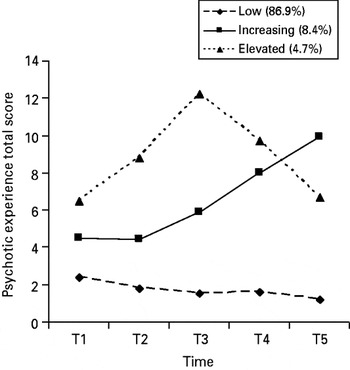
A three-class model was selected as the best model on the basis of the empirical fit indices (BIC = 17089.2, AIC = 17069.8, entropy = 0.92 and LMR-LRT, p = 0.01) and correspondence with a priori expectations derived from previous trajectory class analyses. A decrease in the BIC (17329.6 to 17089.2) and the AIC (17307.9 to 17069.8) between a two- and three-class model was shown. Moving from a three- to a four-class model was not well supported, and the decrease in the BIC (17098.2 to 16955.4) and AIC (17069.8 to 16920.43) was small. The LMR-LRT test favoured rejecting the four-class model (p = 0.30) and the classification accuracy was lower (entropy = 0.88). Fig. 1 presents the three-class trajectory model. The trajectories included a low class (n = 814, 86.9% of the sample) who showed low levels of psychotic experiences reporting across each time point, an increasing class (n = 79, 8.4%) who showed initial low levels of psychotic experiences but increased over time, and an elevated class (n = 44, 4.7%) characterized by initial elevated psychotic experiences but a decrease between Time 3 and Time 5.
Developmental trajectories of psychotic experiences.

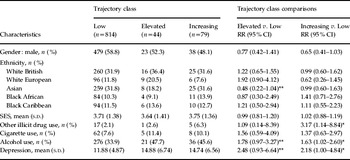
Table 1 presents demographic characteristics, depression, cigarette, alcohol and other illicit drug use by trajectory class membership. Adolescents belonging to the elevated class were significantly less likely to report Asian ethnicity than adolescents in the low class. Other illicit drug use was associated with increasing psychotic experience trajectories; that is, the increasing class differed significantly from the low class on the prevalence of self-reported illicit drug use at Time 1. Adolescents from both the increasing and elevated classes reported high scores in depression and alcohol use rates compared to the low class.
Associations between demographics and trajectory class at Time 1

SES, Socio-economic status; RR, relative risk; CI, confidence interval; s.d., standard deviation.
* p < 0.05, ** p < 0.06.
Associations between bullying by peers, cannabis use and psychotic experiences
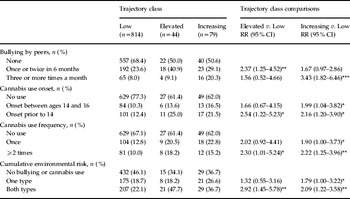
Table 2 presents the associations between bullying by peers and cannabis use by trajectory class. There are four main findings. First, compared with adolescents who did not report any psychotic experiences, those who experienced bullying once or twice a month were 2.37 times [95% confidence interval (CI) 1.25–4.52] as likely to report elevated psychotic experiences and 1.67 times (95% CI 0.97–2.86) as likely to report increasing psychotic experiences. Adolescents who experienced bullying three or more times a month were 3.43 times (95% CI 1.82–6.46) as likely to report increasing psychotic experiences. Second, an earlier age of cannabis use was associated with both elevated and increasing psychotic experiences. Adolescents who reported cannabis use onset prior to age 14 were 2.54 (95% CI 1.22–5.23) and 2.16 (95% CI 1.20–3.90) times as likely to report elevated and increasing psychotic experiences respectively. Third, occasional cannabis use was associated with increasing psychotic experiences. Adolescents who reported cannabis use on only one occasion were 1.90 times (95% CI 1.00–3.73) as likely to report increasing psychotic experiences whereas adolescents reporting cannabis use on two or more occasions were 2.33 times (95% CI 1.25–3.96) more likely to report elevated psychotic experiences. Fourth, we found evidence for a dose–response relationship between a cumulative index of environmental risk and psychotic experiences. Compared with adolescents who did not experience any bullying or cannabis use, those who experienced only one risk factor were 1.79 times (95% CI 1.00–3.22) as likely to report increasing psychotic experiences and those who experienced both risk factors were 2.92 times (95% CI 1.45–5.78) and 2.09 (95% CI 1.20–3.58) times as likely to report elevated or increasing psychotic experiences respectively.
Associations between bullying and cannabis use at Time 1 and trajectory class

RR, Relative risk; CI, confidence interval.
* p < 0.05, ** p < 0.01, *** p < 0.001.
The effects of bullying by peers and cannabis use at Time 1 on subsequent change in psychotic experiences
Bullying by peers and cannabis use at Time 1 on subsequent changes in psychotic experiences between Times 2 and 5 was investigated in each trajectory group. Between Times 2 and 5, the low group showed no significant change (β = −0.01, 95% CI −0.03 to 0.01, p = 0.18), the elevated group showed a significant decrease (β = −0.55, 95% CI −0.77 to −0.32, p = 0.001) and the increasing group a significant increase (β = 0.56, 95% CI 0.41–0.71, p = 0.001), confirming the results outlined in Fig. 1.
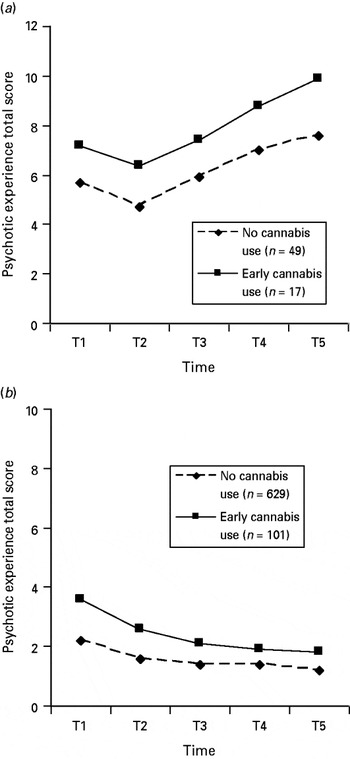
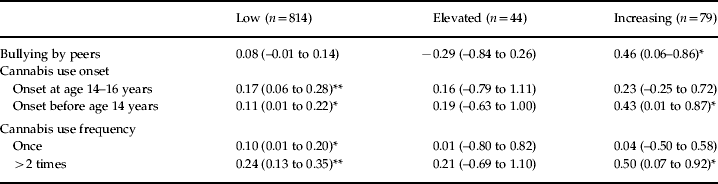
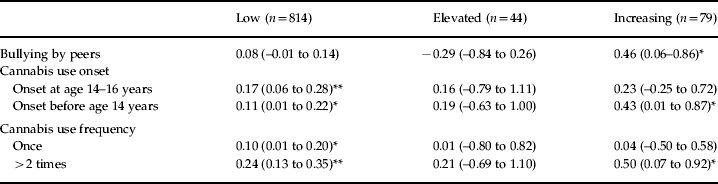
Controlling for cannabis use, bullying by peers significantly predicted change in psychotic experiences between Times 2 and 5 in adolescents belonging to the increasing group (Table 3). No effect was found for the elevated or low groups. Controlling for bullying, an earlier age of cannabis use and cannabis use more than twice significantly predicted change in psychotic experiences in adolescents belonging to the increasing group. Cannabis use at any age was significantly associated with subsequent change in psychotic experiences in the low group. Similarly, cannabis use either once or more than twice was also significantly associated with subsequent change in psychotic experiences in the low trajectory group. Fig. 2a shows the mean change in psychotic experiences for early cannabis users and non-users for the increasing group over time. This plot demonstrates that cannabis users report a higher level of psychotic experiences than non-users but the rate of change is similar across both users and non-users. Similarly, in the low group (Fig. 2b), both cannabis users and non-users showed a decline in psychotic experiences but cannabis users reported an overall higher level of reporting than non-users. Reverse causal associations were examined and there was no evidence for psychotic experiences at Time 1 predicting a subsequent change in cannabis use between Time 2 and Time 5 in any trajectory group (increasing: β = 0.07, 95% CI −0.12 to 0.26; elevated: β = 0.17, 95% CI −0.10 to 0.44; low: β = 0.07, 95% CI −0.03 to 0.17).
Plot of change in mean psychotic experiences total score for adolescents reporting early cannabis use and no cannabis use in (a) the increasing trajectory group and (b) the low trajectory group.

Effect of bullying by peers and cannabis use on subsequent changes in psychotic experiences in each trajectory class
Values given as β (95% confidence interval).
Regression coefficients indicate the change in psychotic experiences associated with bullying by peers or cannabis use. All associations were adjusted for the effects of other illicit drug use, alcohol use, cigarette use, depression, demographic variables and Time 1 psychotic experiences.
* p < 0.05, ** p < 0.01.
Discussion
The effects of bullying and cannabis use on the developmental trajectories for psychotic experiences were examined in 1048 adolescents. Previous research focused on the association between environmental risk factors and future psychotic experiences at a single time point whereas our findings extend the range of outcomes to include change over time. Our results indicate that there are clusters or groupings of individuals within the population whose development of psychotic experiences follows age-related patterns in their developmental course. Evidence has shown that psychotic experiences peak during adolescence and decline in early adulthood (Verdoux et al. Reference Verdoux, van Os, Maurice-Tison, Gay, Salamon and Bourgeois1998). The final growth mixture model confirmed this pattern by showing that the majority of adolescents (low class: 86.9%) decreased in their reporting of psychotic experiences A small number of adolescents showed elevated and increasing patterns of psychotic experiences (4.7% and 8.4% respectively). Adolescents in the elevated class showed high initial levels of psychotic experiences with a subsequent decrease. By contrast, the increasing group showed a low level of reporting at Time 1 with a steady increase over time. Consistent with previous literature (Mackie et al. Reference Mackie, Castellanos-Ryan and Conrod2011; Wigman et al. Reference Wigman, van Winkel, Raaijmakers, Ormel, Verhulst, Reijneveld, van Os and Vollebergh2011), higher scores in depression, cannabis use and bullying differentiated the elevated group from the low group. The increasing group was characterized by higher reported depressed feelings, higher rates of illicit drug use, including cannabis, and more frequent reports of bullying.
Bullying by peers three or more times a month, cannabis use early in adolescence and cannabis use more than twice predicted a subsequent change in psychotic experiences in the increasing group. To our knowledge, this is the first study to demonstrate a prospective link between bullying and cannabis use in early adolescence and subsequent emerging and increasing psychotic experiences in adolescents between age 14 and 16. This is consistent with previous work (Cougnard et al. Reference Cougnard, Marcelis, Myin-Germeys, de Graaf, Vollebergh, Krabbendam, Lieb, Wittchen, Henquet, Spauwen and van Os2007; Kuepper et al. Reference Kuepper, van Os, Lieb, Wittchen, Hofler and Henquet2011) suggesting that the presence of environmental risk factors might allow for transitory experiences to become abnormally persistent. Our study extends these findings by associating two environmental risk factors with a particular developmental pattern in time.
Only a small proportion of the individuals who use cannabis and experience bullying behaviour go on to develop psychosis. Currently, there is no evidence to suggest that moderate cannabis use (twice or more in the previous 6 months) in early adolescence is associated with significant biological effects. However, it has been proposed that certain individuals may be genetically vulnerable to the development of psychotic experiences. Evidence that psychotic experiences may have a genetic origin comes from studies showing that first-degree relatives of patients with schizophrenia display higher levels of psychotic experiences than controls (Appels et al. Reference Appels, Sitskoorn, Vollema and Kahn2004). Experimental and observational work has suggested that environmental risk factors, and cannabis use in particular, may provoke a psychotic response in individuals with a susceptibility to the development of a psychotic disorder (Henquet et al. Reference Henquet, Rosa, Krabbendam, Papiol, Fananas, Drukker, Ramaekers and van Os2006; Kahn et al. Reference Kahn, Linszen, van Os, Wiersma, Bruggeman, Cahn, de Haan, Krabbendam and Myin-Germeys2010). A study by Caspi et al. (Reference Caspi, Moffitt, Cannon, McClay, Murray, Harrington, Taylor, Arsenault, Williams, Braithwaite, Poulton and Craig2005) was the first to demonstrate a gene–environmental interaction between early-onset cannabis and psychosis. For individuals homozygous for the catechol-O-methyltransferase (COMT) Vall58Met Val allele, the relative risk of developing psychotic illness after early adolescent cannabis exposure was 10.9, whereas in individuals homozygous for the Met allele, the risk was only 1.1.
Genetic and environmental influences on the development of psychotic experiences in adolescence may be especially dynamic. Genetic influences are often associated with stability but may be important early in development and then wane or exert their influence as individuals mature (Plomin et al. Reference Plomin, Emde, Braungart, Campos, Corley, Fulker, Kagan, Reznick, Robinson, Zahn-Wexler and Defries1993; Kendler et al. Reference Kendler, Gardner and Lichtenstein2008). As with genetic effects, environmental influences may contribute to change over time. For example, girls who mature earlier than their peers are increasingly found to be involved in early-onset cannabis use (Lanza & Collins, Reference Lanza and Collins2002; Ge et al. Reference Ge, Jin, Natsuaki, Gibbons, Brody and Cutrona2006), arguably due to an increase in risk taking (Hayatbakhsh et al. Reference Hayatbakhsh, Najman, McGee, Bor and O'Callaghan2009). The combination of early expressed genes and environmental influences may well predict an increase in psychotic experiences in individuals most at risk (Cannon, Reference Cannon2005). In addition, neurobiological models have postulated that adolescent exposure to delta-9-tetrahydrocannabinol, the active ingredient in cannabis, adversely affects adolescent time-dependent maturation of neural circuits within the prefrontal cortex, ultimately giving rise to psychotic experiences (see Bossong & Niesink, Reference Bossong and Niesink2010 for a review), suggesting that adolescence is a sensitive developmental period for exposure to cannabis use and development of psychotic experiences.
Studies have examined the association between a susceptibility to psychosis and childhood trauma. The findings to date suggest that the cumulative effect of bullying, rather than developmental timing, is particularly important (Arseneault et al. Reference Arseneault, Cannon, Fisher, Polancyk, Moffitt and Caspi2011), resulting in a sensitized state. Sensitization refers to the phenomenon that repeated exposure to an environmental stressor leads to progressively greater responses over time (Myin-Germeys et al. Reference Myin-Germeys, Delespaul and van Os2005; Collip et al. Reference Collip, Myin-Germeys and van Os2008; Varese et al. Reference Varese, Udachina, Myin-Germeys, Oorschot and Bentall2011). Research has identified mechanisms that might explain associations between childhood trauma and psychotic experiences. A neurodevelopmental model (Read et al. Reference Read, van Os, Morrison and Ross2005) has been posited suggesting that stressful life events produce activation of the hypothalamic–pituitary–adrenal (HPA) axis. The HPA axis is associated with the release of glucocorticoids, which can further impair the HPA axis when prolonged exposure to trauma is experienced. Cognitive distortion might also explain the presence of psychotic experiences among individuals experiencing bullying behaviour (Bentall & Fernyhough, Reference Bentall and Fernyhough2008). Repeated episodes of trauma can exacerbate negative self-esteem, provoking an externalizing explanatory style. Negative life events are attributed externally to the self, rather than to situational events. Both negative self-esteem and an external style of attribution can lead to a tendency to anticipate social threats and thus an increase in paranoid beliefs (Bentall et al. Reference Bentall, Rowse, Shryane, Kinderman, Howard, Blackwood, Moore and Corcoran2009). Furthermore, adolescent self-report may lead to inflated scores in bullying as perception of threat is often part of the symptom profile of psychotic experiences.
In agreement with two longitudinal studies on this topic (Henquet et al. Reference Henquet, Krabbendam, Spauwen, Kaplan, Lieb, Wittchen and van Os2005; Kuepper et al. Reference Kuepper, van Os, Lieb, Wittchen, Hofler and Henquet2011), the present data did not support the mechanism of self-medication because cannabis use was not predicted by earlier psychotic experiences. In the low trajectory group, cannabis use and psychotic experiences were significantly associated, albeit with small effect sizes. Cannabis use resulted in stemming the expected developmental decline in psychotic experiences, suggesting that the association was short term, whereby any change in subsequent psychotic experiences might be transitory.
Limitations
The reports on psychotic experiences were based on self-report and were not independently confirmed, and the current findings need to be interpreted, first, in light of the limitations of self-report. A recent review by Linscott & van Os (Reference Linscott and van Os2010) showed that the use of self-report compared to professional assessment accounted for 26% of the variance in psychosis experience prevalence rates. Prevalence rates were considerably higher in studies that used self-report measures. The number of items and response criterion also accounted for 7% and 16% of the variance in psychosis experience prevalence rates respectively (Linscott & van Os, Reference Linscott and van Os2010). However, previous work has shown good sensitivity and specificity in identifying adolescents in the general population with a similar questionnaire who were also identified as expressing psychotic experiences in a clinical interview (Kelleher et al. Reference Kelleher, Harley, Murtagh and Cannon2011). Second, the type and potency of cannabis was not controlled for in the current study; however, it is unlikely that this would explain the stronger association between cannabis and psychotic symptoms in the increasing class, as the participants were attending the same schools and lived in the same area, and thus were likely to be consuming similar types of cannabis. Third, the CIs were wide and likely to reflect the low levels of prevalence of illicit drug use and the small sample size within the elevated and increasing classes. Fourth, only bullying by peers was assessed, and it is possible that other types of trauma such as childhood sexual and physical abuse might demonstrate stronger associations with elevated and increasing psychotic experiences. Fifth, even though the prevalence rates of bullying and cannabis use were as high for the elevated as the increasing class, no measure predicted subsequent change in psychotic experiences in the elevated class. However, the low number of participants and the decline in psychotic experiences between Time 2 and Time 5 would need to be considered before excluding environmental factors as risk factors for change in psychotic experiences in this particular group. Sixth, we remain uncertain about the timing of onset of bullying behaviours and transition to a clinical psychotic disorder given the limited time frame of the study. Furthermore, the psychotic experience trajectory classes were estimated between 13 and 16 years. This adolescent time frame will inevitability influence the estimation of the trajectory classes. For instance, adolescents who demonstrated elevated psychotic experiences in childhood but declined prior to age 13 may not be captured by the three trajectory classes.
Our study has implications for clinicians working with children and adolescents who demonstrate psychotic experiences. Assessments of bullying by peers and cannabis use can be used in clinical interviews. For a truly preventative intervention, the onset of cannabis use needs to be targeted early in adolescence, prior to the onset of psychotic experiences.
Acknowledgements
This investigation was supported by a research grant (2007–2010) from Action on Addiction (registered charity number, 1007308). Dr Mackie was supported by a Medical Research Council (MRC)/Economic and Social Research Council (ESRC) Interdisciplinary Post-doctoral Research Fellowship (G0800060) and the European Research Advisory Board. Dr Conrod's salary was supported by a grant from the National Institute for Health Research (NIHR) Biomedical Research for Mental Health at the South London and Maudsley National Health Service (NHS) Foundation Trust and the Institute of Psychiatry, King's College London from 2008 to 2009 and a Scientist Career (2010–2013) Award from the Fondation de Recherche en Santé du Québec (FRSQ).
Declaration of Interest
None.