I. Introduction
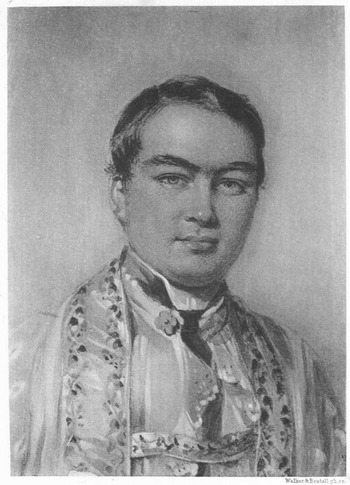
Recent scholarship on the Oxford Movement (1833–1845) and its leading dramatis personae—John Henry Newman (1801–1890), John Keble (1792–1866), Richard Hurrell Froude (1803–1836), and Edward Bouverie Pusey (1800–1882)—continues to revise and elucidate the history, influence, and reception of this Anglican phenomenon, otherwise known as Tractarianism (a name designating the movement's publications, the Tracts for the Times).Footnote 1 One such revision has been to highlight neglected contexts and personalities who, in their day, were of greater influence than is commonly accepted. For example, in Newman's Early Roman Catholic Legacy 1845–1854 (2017), C. Michael Shea has outlined how Nicholas Wiseman (1802–1865), eventually the first Cardinal Archbishop of Westminster (1850–1865), led Roman Catholicism's early reception of the Oxford Movement and of Newman's theological ideas (Fig. 1).Footnote 2 Shea notes that Wiseman's influence preceded Newman's conversion, speculating on the possibility that Wiseman even inspired the ideas within Newman's Essay on the Development of Christian Doctrine (1845).Footnote 3 This influence, on the one hand, affected Newman and other Romeward-leaning Tractarians during the late-1830s and early-1840s as they skirted the edges of Roman Catholicism. However, Shea also shows how Wiseman was a “key figure” in making Rome aware of the Oxford Movement's potential for gifting converts to Rome.Footnote 4 As Colin Barr has noted in an important recent study of Cardinal Paul Cullen's power over Irish Catholicism in the nineteenth century (in Ireland and the British diaspora), both Cullen and Wiseman were active in Rome during a period when few members of the Italian curia read English.Footnote 5 Though Shea published his book prior to Barr, Shea has nonetheless shown how Wiseman used the Roman theological press for publishing, in Italian, his views regarding the importance of the Oxford Movement. Of note is the Annali delle Scienze Religiose, which Shea describes as “the premier theological journal in Rome at the time, as well as the semi-official mouthpiece of the Vatican.”Footnote 6 Shea draws particular attention to one published piece, originally a lecture by Wiseman to the Pontificia Accademia di Religione Cattolica in Rome on June 16, 1837. In the lecture, Wiseman highlighted the Oxford Movement's revival of High Church principles, noting the potential for conversion, while at the same time criticizing Tractarianism's claim to catholicity.Footnote 7 Wiseman's “optimism and eagerness” was, therefore, balanced with his belief in Tractarianism's “necessary collapse.”Footnote 8 Published that year in the Annali delle Scienze Religiose and in an edition by itself under the title Dissertazione sullo stato attuale del Protestantesimo in Inghilterra (A Dissertation on the Present State of Protestantism in England),Footnote 9 Wiseman's enthusiasm for the Oxford Movement, communicated to a Roman audience, was evident and, as Shea argues, influential in making the Oxford Movement a subject of missionary interest in Rome.
A young Nicholas Wiseman (c.1835–36). Engraving after a miniature by François Theodore Rochard.
Source: Wilfrid Ward, The Life and Times of Cardinal Wiseman vol. 1 (London, 1897) [frontispiece].

Though a handful of scholars have realized Wiseman's importance to Oxford Movement,Footnote 10 the dominance of Newman studies within the last fifty years has inevitably sidelined alternative avenues of research into Tractarianism and its contexts. In light of this, this article argues that there is a broader context and much more extensive literature regarding Wiseman's interest in, and commentary upon, the Oxford Movement's events and publications. The principal source for this contention is the Dublin Review, founded in 1836. Established in part by Wiseman, the Dublin Review was a major journalistic contribution by Roman Catholics to British intellectual culture—a sign of a new religious climate in which British Catholics, following Catholic Emancipation in 1829, were increasingly making their views known and felt. A major impetus for the Dublin Review's founding and subsequent modus operandi, for Wiseman especially, was to contribute to the religious controversy that had accompanied the rise of the Oxford Movement. This new journalistic effort, coupled with a focus on Tractarianism, began for Wiseman during a stay in England from September 1835 to September 1836.Footnote 11 This visit, which included a series of influential public lectures,Footnote 12 proved to be defining for Wiseman.Footnote 13 By the time Wiseman returned to Rome, his focus on the Oxford Movement intensified. It is at this point that Wiseman began to also publicize, in Italian, his conviction that the theological views being advanced by the Tractarians were worthy of Rome's attention. In Rome, Wiseman composed a series of articles on the Oxford Movement and its related controversies for the Dublin Review. In 1840, Wiseman moved permanently to England, settling at Oscott College. A major motivation for this change in Wiseman's life was an intensification of his interest in the Oxford Movement—an interest linked to a belief that providence was leading the Tractarians to Roman Catholicism. Via the Dublin Review, Wiseman would communicate his criticisms of Tractarianism in the hope of bringing its leaders out of the Church of England and into the Roman Catholic Church and of contributing to the return of England to Roman communion. Consequently, in England, Wiseman composed a further series of articles. In discussing Wiseman's contributions to the Dublin Review, this article will also pay attention to the response of John Henry Newman to Wiseman's scholarly, irenic, not to mention, polemical, refutations of Tractarian ideas. Aware of the tendency of histories of the Oxford Movement to focus disproportionately on Newman, Newman's responses to Wiseman's Dublin Review articles are nonetheless an appropriate secondary focal point in highlighting the Dublin Review's reception history. This is particularly the case when considering that it was Wiseman's August 1839 article in the Dublin Review that first seriously dented Newman's confidence in Anglicanism. Consequently, though in 1836 Newman could assert with confidence that, “Dr. Wiseman will do us no harm at all,”Footnote 14 by 1842 Newman was beginning to tell his friends that Rome might in fact be right after all. Three years later, Newman would come to Oscott College to be confirmed by Wiseman as a Roman Catholic. Wiseman's conviction that providence had directed his use of the Dublin Review had reached what seemed like an almost dream-like outcome.
II. The Origins of the Dublin Review
The Irish Church Temporalities Bill of 1833, which had given rise to John Keble's warning of “national apostasy,”Footnote 15 was part of a series of legislative acts that, while being opposed by the Tractarians, were welcomed by British Catholics. Daniel O'Connell (1775–1847), one of the co-founders of the Dublin Review, had referred to Catholic Emancipation (1829) as a “bloodless revolution . . . one of the greatest triumphs recorded in history,”Footnote 16 sentiments that found few adherents among the conservative High Churchmen of Oxford, for whom the very concept of political reform was regarded as little more than a Trojan Horse for radicalism.Footnote 17 Also an Irishman, Wiseman shared O'Connell's enthusiasm for Catholic Emancipation, though his support for the 1801 union between England and Ireland, not to mention his desire to write—at least in part—to a Tractarian readership, meant that O'Connell's liberalism, not to mention Irish nationalism, would need to be minimized for the new journal.Footnote 18 To quote Wilfrid Ward, Wiseman was all too aware that “the very cause that made O'Connell and his friends Liberals, made Newman and Pusey anti-Liberals.”Footnote 19
Brought to fruition by three men: Wiseman, O'Connell, and Michael Joseph Quin (1796–1843), the Dublin Review was an important part of the early stages of British Catholicism's revival in the nineteenth century.Footnote 20 A journal that would be a dominant part of the Catholic element of the British religious press well into the next century, the Dublin Review's first editors were signs of a new age for Roman Catholicism in Britain—for both the English and Irish churches. Each man had been raised in contexts that diverged from the main forces that had shaped and sustained British Catholicism in the eighteenth century. They were, first and foremost, all Irish and of middle-class backgrounds. Their influence in England signaled the presence of Irish Catholicism as a growing part of English Catholic life during the nineteenth century, in addition to the aspirations and religious interests of the growing Irish Catholic middle class.Footnote 21 Of course, though the English and Irish churches were not a united body, the connected nature of Catholicism for England and Ireland was, to an extent, unavoidable following the union of both kingdoms in 1801. Not surprisingly, the Dublin Review focused heavily on Irish political and religious themes as they related to English policy. Its title—which positioned it in contrast to the Whig Edinburgh Review and Tory Quarterly Review—appeared above a version of the Irish coat of arms, which carried the words “Eire go Brách” (Ireland forever). However, though the Dublin Review's “connection with Ireland was,” to quote the diamond jubilee issue of April 1896, “from its earliest days very close,”Footnote 22 according to Paul Alexander Richardson, “outside the gates of Maynooth College . . . the Dublin Review did not have widespread Irish support.”Footnote 23 Maynooth was, of course, Royal St. Patrick's College, Maynooth, an institution which not only received an annual parliamentary grant from Westminster, but which provided the Dublin Review with a number of key writers. These men, of whom the historian-priest Charles William Russell (1812–1880) stands out, were of course all Irish and all Catholic but were also content as a matter of editorial policy to follow Wiseman's conservative anti-repeal stance.Footnote 24 As a publication that attempted to appeal to both English and Irish readerships, politics was always going to be delicate in terms of adopting an editorial line that satisfied the majority Catholic opinions of both England and Ireland. However, given that the Dublin Review's early posturing as a kind of British Catholic version of the Whig Edinburgh and Tory Quarterly reviews—that is, on a common British Catholic identity that spanned the Irish Sea—Wiseman's position regarding the Dublin Review's political stance was non-negotiable, despite the issue almost leading to an early falling out with the pro-repeal O'Connell and, therefore, to the Dublin Review's possible discontinuance in the early-1840s.Footnote 25 However, O'Connell remained a supporter and the Dublin Review was to survive into the nineteenth century with its English and Irish connections intact, though with a significantly more pervasive English readership.Footnote 26
As a milestone in modern British Catholic journalism, the founding and early history of the Dublin Review stands out. Its British ambit and intended audience would venture beyond a sectarian readership. There had, of course, been a number of important publishing ventures in Catholic journalism prior to the Dublin Review's arrival.Footnote 27 Moreover, from 1840, the Dublin Review would be joined by the Tablet: a journal that has outlived the Dublin Review, and which—along with other Catholic journals of the period—took a negative position in regard to Wiseman's approach towards the Oxford Movement.Footnote 28 Thus, though it is incorrect to grant too much originality to the Dublin Review's appearance in 1836, the new journal nonetheless sought to address what it saw as neglected forums, especially the need to engage non-Catholic readers. Not only was anti-Roman Catholic print culture—with its fantastic and mythical conspiracy theories—always in need of public refutation,Footnote 29 as the advent of Tractarianism within post-emancipation and post-reform contexts demonstrated, disputes about ecclesial identity within the British state, of which Roman Catholics were participants, had become pressing by the mid-1830s. As has been noted, Wiseman's conservative political stance in regard to Irish politics was inseparably related to his desire to interrelate with non-Catholics, especially those associated with the Oxford Movement. Given that Tractarianism's foundations were anti-reform and Tory, Wiseman was not interested in alienating the Oxford reformers by promoting the Whig Irish Catholic activism of O'Connell, to whom the Tractarians were vehemently opposed. Wiseman wanted to speak to the leaders of the Oxford Movement directly, and he wanted them to listen.
Michael Joseph Quin, lawyer, travel writer, and former editor of the Monthly Review from 1825 to 1832, has since faded into obscurity, though he is the one to whom the original idea for the Dublin Review most likely originated.Footnote 30 As it turns out, his tenure with the Dublin Review—as the primary editor dealing with the publication on a day-by-day basis—was brief, and he ceased his editorial role with the Dublin Review after only the first two issues due to a disagreement over remuneration, which Quin regarded as insufficient.Footnote 31 His role, therefore, quickly passed to another lawyer, Henry Ridgard Bagshawe (1799–1870). Despite resentment from the already-established Catholic Magazine, in addition to criticism by a handful of English Catholic figures that a lay editorship would sink the Dublin Review, the new journal managed to survive.Footnote 32 Assisted especially by Wiseman and Russell of Maynooth, Bagshawe would successfully manage the editing of the Dublin Review until 1863.Footnote 33
It was, ultimately, the young rector of the English College who provided the Dublin Review with not only its most influential articles but the ecclesial authority and theological censorship it required for its ambitious aims.Footnote 34 Wiseman's influence, of course, extends well beyond his contributions to Roman Catholic print culture in nineteenth-century Britain. Much to the chagrin of many English Catholics, who saw him as an outsider unacquainted with the realities of English Catholic life, Wiseman was to position himself at the forefront of English Catholicism's nineteenth-century revival. His upbringing and origins—not to mention his approach to Catholic journalism—said a lot about the changes that English Catholicism would undergo during the nineteenth century. Born in Spain to Irish parents, his subsequent presence at the English College in Rome from 1818 to 1840 gave him a continental perspective that mitigated against the parochialism that had been part of some elements of pre-emancipation English Catholicism.
The need for missions to British Protestants was one such perspective inherited from Wiseman's time in Rome. “We are much gratified,” wrote the Dublin Review's first issue in its “Miscellaneous Intelligence” section, “at the aspect which Catholicity presents to us at this moment in Great Britain. The numbers who continue to join our communion, attest the beneficial tendency of the spirit of enquiry, which marks the religious character of our age.”Footnote 35 This confidence, devoid of timidity, was central to the Dublin Review's establishment and of Wiseman's interest in the Oxford Movement.Footnote 36 Post-emancipation Britain was, for Wiseman, at the very least to be Catholic as well as Protestant. Indeed, though such a view was to become part of the Second Spring's overoptimism, post-emancipation Britain may even become Catholic once again. Such a perspective, fueled by a handful of influential Romantic converts and by paradigm-shifting political and ecclesiastical contexts, found an ally in Wiseman—at the very least, a man to whom they could confide their dreams of pre-Reformation revival and restoration.Footnote 37 However, though many English Catholics found Wiseman's approach to public life too extroverted and his desire to court High Church Anglicans delusional, for Wiseman such a mode of action was based on a belief that post-emancipation Britain provided a context in which Roman Catholicism could finally do battle against its various ecclesiastical opponents. According to law, English Catholics were now largely equal to their Anglican coreligionists, even if as a body they were socially inferior to the richer and larger Church of England. Nonetheless, “the ignobler labours of apology and defence” were to be disbanded.Footnote 38 Wiseman's engagement with Tractarianism, composed in a respectful tone, was nonetheless a battle, though now, for him, a fair one. Those to whom Wiseman was targeting would come to recognize this, react accordingly, some even to capitulate. At the very least, they noticed the Dublin Review's emergence in 1836 and its potential significance as a journal of Roman Catholic opinion. “Dr. Wiseman has just begun what he calls the ‘Dublin Review,’ under the auspices of himself and O'Connell,” wrote John Henry Newman to Thomas Acland on April 27, 1836. “Really, if one wished a plain practical direction as to one's behaviour towards Romanism, this surely would seem a sufficient one.”Footnote 39
III. Strategy and Early Posturing
Wiseman's typical approach towards the Oxford Movement in the Dublin Review was to combine limited doses of cautious praise for Tractarianism with simultaneous, forthright criticism. Most of Wiseman's articles presented variants of this tactic. Such a method was strategic, based on conviction, in addition to being tempered by a genuine respect for the sincerity and scholarship that underlay the Oxford Movement. Thus Wiseman regarded the Oxford Movement's main personalities as potential converts while also holding the conviction that Tractarianism was ultimately futile if its main personalities remained within the Church of England, no matter how “Catholic” their Anglicanism had become in doctrine or liturgical praxis. Wiseman's approach can be seen in his first article in the Dublin Review, which dealt with the Tractarian opposition to the appointment of Renn Dickson Hampden (1793–1868) as Regius Professor of Divinity at Oxford University in 1836.
Hampden, for the Tractarians, was a “liberal bogeyman.”Footnote 40 Their zealous and unbending opposition to his appointment gave rise to university meetings, letters of protest, petitions to Canterbury, publications, even discussions at Westminster and Buckingham Palace.Footnote 41 The Tractarian position was seen in John Henry Newman's Elucidations of Dr. Hampden's Theological Statements (1836)Footnote 42 and Edward Bouverie Pusey's Dr. Hampden's Theological Statements and the Thirty-Nine Articles Compared (1836)—both of which were published anonymously.Footnote 43 The controversy prompted a defiant Hampden to respond with his own strident, though also anonymous, defense against this opposition.Footnote 44
Symbolic of a broader liberal-conservative struggle within the Church of England during the post-reform era,Footnote 45 the Hampden controversy was noticed by the British periodical press. The Whig Edinburgh Review thus devoted a fifteen-page article to the controversy (which took Hampden's side), while the High Church British Critic was predictably negative.Footnote 46 Wiseman's perspective, reflective of the Dublin Review's modus operandi, was deliberately nuanced. As a conservative Roman Catholic, Wiseman had little in common with Hampden's liberal theology. Yet, at the same time, the Tractarians were, for Wiseman, attempting to counter Hampden with an ecclesiology that could never claim victory within the Church of England. They were instead rolling a stone up an endless hill. Sympathetic to their zeal for “a better Church and a better cause,” Wiseman nonetheless conveyed his mixed feelings:
On the one hand we see learned and zealous, and we have reason to believe, in some instances, amiable men, contending, in the spirit which belongs to a better Church and a better cause, in favour of a rigid adherence to principles and doctrines which we must approve; yet, thereby departing from the consistency of their professed faith, and betraying how powerless they are in wielding the weapons which it has long since blunted, and then thrown aside. On the other side, we see the professor elect accused, not unjustly, of rash and dangerous opinions in his earlier works, but yet most unjustly cited to answer for them, upon principles which his accusers themselves had no right to adopt.Footnote 47
For Wiseman, Hampden was a rationalist of dubious orthodoxy, even if his appointment had forced him to moderate his previous views in favor of a public orthodoxy.Footnote 48 But, asked Wiseman, did not Hampden's theological views have precedence in the Latitudinarian tradition of the eighteenth century? Had not churchmen like him long been the recipients of patronage and preferment? Had not Hampden himself been previously promoted to other positions in Oxford without protest? Even if Wiseman did not approve of a liberal rationalism he would “gladly see avowed in the face of heaven,” neither was he able to adopt the perspectives of those who invoked against Hampden “those rules and principles of interpretation, which have guided the judgements of Christ's Holy Catholic Church in all ages of its history, and under every variety of its warfare.”Footnote 49 Hampden, the “rationalist,” was not therefore to be let off, but neither were those who invoked from within the Church of England the catholicity of the primitive Church against him. “Do we mean then to join in the clamour which has been raised against them [the Tractarians]?,” Wiseman rhetorically asked, replying with a sincerity qualified by a clear polemical intent:
Assuredly not. We gladly close our eyes to all consideration of personal motives or feelings which have been thought to prevail in this controversy, and we are willing to look upon it solely as a struggle of contending principles. For we believe that sincere regret has been felt by this party, at what they consider the exaltation of opinions hostile to their views of the Church and of its doctrines. But if they would look steadily at their own position, now rendered more manifest by the issue of the contest, they would feel that they are vainly trying to raise their Church to the standard of influence and power which their affections have devised. They would feel that they are only one small section of it, tending to dissent from its essential principles. We can sympathise with their feelings, we can well conceive the painful disappointment which an ardent spirit must feel, when having fixed its eagerest [sic] ambition upon the establishment of a favourite theory, it finds a clog upon its efforts in the very cause it has espoused.Footnote 50
Another example of Wiseman's careful blend of conviction and irenicism can be seen in his July 1837 review of Keble's published sermon, Primitive Tradition Recognised in Holy Scripture (1837) and Newman's review of Wiseman's Lectures on the Principal Doctrines and Practices of the Catholic Church (1836), published in the British Critic in October 1836.Footnote 51 Wiseman thus described the Oxford Movement within the context of a battlefield, positioning himself as a spectator and critic, as if above and detached from the fray:
The fearless and uncompromising revival of High Church principles by a small body of youthful, learned, and as far as we have opportunity of knowing, amiable clergymen, in the face of much unpopular feeling, of great alienation from their brethren, and of little encouragement from their superiors, does credit to their sincerity and to their zeal. They have placed themselves in a prominent position, and in the post of honourable danger. They have endeavoured to throw outworks beyond the acknowledged precincts of their Church's walls, to protest against the encroaching lines of dissent; and they have manned them, we think, in forlorn hope, determined to keep the pressure of the attack at a greater distance. We, indeed, on our side, complain, and their more immediate adversaries—their rebels as they consider them—agree, that they have seized, for this purpose, a territory, not their own, but of our legitimate possession. They disclaim the charge, and affirm that they stand in a middle position—between “Romanism,” as they choose to call it, and dissent. But, when they speak thus, it is not as a school, or a party; they boldly profess to declare the real sentiments of their church, “the Anglican,” as they style it, considering it a part of the Catholic or universal Church of Christ dispersed over the world. Of this Church, “the Roman” is acknowledged to be a part, though they think it has not preserved purity of doctrine.Footnote 52
Wiseman's use of such an analogy, on the one hand to commend Tractarianism's fight against liberalism, whilst simultaneously claiming that the Tractarian position was external to “the acknowledged precincts of their Church's walls” is typical of how Wiseman sought to exploit and encourage the Oxford Movement's exploration of an ecclesiology that brought them closer to Roman Catholicism. Tractarianism's exposed position, which placed its rear to its own Church, was Wiseman's way of making the point that the Oxford Movement had ventured out to a position that was both unsafe and contradictory—unsafe in that the Tractarians were moving away from Anglicanism's Protestant boundaries and contradictory because, though the Tractarians were closer to Roman Catholicism, which Wiseman acknowledged was a good thing, they were, in the process, still in error. Having “seized, for this purpose, a territory, not their own, but of our legitimate possession,”Footnote 53 the Tractarians were in enemy territory, a fact Wiseman was careful to exploit by noting that Keble's sermon was being criticized by other Anglicans as being akin to Roman Catholicism.Footnote 54 While critical of the Tractarian attempt to promote their Church as a Via Media (“a middle position—between ‘Romanism,’ as they choose to call it, and dissent”),Footnote 55 Wiseman's critique was also an appeal to them that, considering the enemies within their own camp, they should look to the Roman Catholic Church as a welcoming home.
While not hugely influential, Wiseman's early Tractarian commentary in the Dublin Review was nonetheless noticed by the leaders of the Oxford Movement. Indeed, Wiseman could not easily be dismissed—especially by Newman, whom Wiseman had met (along with Hurrell Froude) in April 1833 in Rome just prior to the beginning of the Oxford Movement. Thus, Wiseman's promotion of Roman Catholicism in England during his much-publicized visit from September 1835 to September 1836,Footnote 56 in addition to a failed attempt to meet Newman, along with other overtures, had arguably contributed toward Newman's need to show his hand in regard to Tractarianism vis-à-vis Roman Catholicism.Footnote 57 With its insinuation that a resurgent Roman Catholicism was present in England, Tract 71 (“On the Controversy with the Romanists”) had thus appeared in January 1836.Footnote 58 Newman's comment that the “Roman Catholics . . . are said to be spreading and strengthening on all sides of us, vaunting of their success, real or apparent, and taunting us with our inability to argue with them,” was a likely reference to Wiseman lectures of 1835–36.Footnote 59 Tract 71 was followed by Newman's review Wiseman's Lectures on the Principal Doctrines and Practices of the Catholic Church (1836) in the British Critic in October 1836,Footnote 60 then by his Lectures on the Prophetical Office of the Church (1837).Footnote 61 Prior to its publication, Newman had told Henry Edward Manning that his Lectures on the Prophetical Office were an indirect reply to Wiseman.Footnote 62 In the same letter, Newman had consoled Manning with the remark that “Dr Wiseman will do us no harm at all; I think not.”Footnote 63 Similar confidence is found in Newman's review of Wiseman's Lectures, where Newman wrote that, “we hear with great equanimity the rumours of the impression which Dr. Wiseman's lectures have made upon the mixed multitude of London.”Footnote 64 Yet as Wiseman's articles on Tractarianism increased in number, so did Newman's mention of them to his correspondents.Footnote 65 “Equanimity,” moreover, would prove to be temporary. Newman well knew that Wiseman was authoring the Dublin Review articles that he and his friends were passing around. In May 1838, in reference to Wiseman's April 1838 article in the Dublin Review, Newman made reference to Wiseman's “patronizing air,” though at the same time commending Wiseman for displaying “his feeling of the seriousness of the combat.”Footnote 66 The analogy indeed was apt, for the language of combat was Wiseman's too, used at times to describe his arguments against the Tractarians.Footnote 67 Via the Dublin Review Wiseman had, in fact, opened a second front against Tractarianism. Not only were Evangelicals telling Tractarians that their theology was too close to Roman Catholicism, Wiseman, a Roman Catholic, was agreeing with them.
It is, of course, clear what outcome Wiseman wanted from all of this. Though by no means devoid of ecumenical gentility—indeed, of genuine respect for the Oxford divines—Wiseman was nonetheless a proselytizing aggressor in this polemical offensive. His tone, his candor, his arguments, were all part of a clear objective: conversion to Roman Catholicism. Of course, the language of theological conflict was Tractarianism's too,Footnote 68 though their anti-Roman tone was more defensive.Footnote 69 “We find ourselves under the Anglican regimen,” wrote Newman in Tract 71, “let every one of us, cleric and layman, remain in it, till our opponents have shown cause why we should change, till we have reason to suspect we are wrong. The onus probandi plainly lies with them.”Footnote 70 This was a challenge Wiseman was more than willing to accept.
IV. The Tracts for the Times
Discussion of Tract 71 highlights the publications that gave Tractarianism its name: the Tracts for the Times, published from 1833 to 1841. Of the Tracts, Newman was the most prolific author and editor, his name attached to at least thirty (out of a total of ninety).Footnote 71 Printed anonymously on inexpensive paper, from 1834 the Tracts began being published as collected volumes.Footnote 72 The primary literary vehicle for the Oxford Movement, the Tracts caused a stir within the Church of England by reviving radical High Church views and, in doing so, bringing both revival and division to nineteenth-century Anglicanism.
Wiseman read the Tracts for the Times with care and attention.Footnote 73 Indeed, Wiseman's Dublin Review articles, especially that of April 1838 (with its copious references), give rise to the likelihood that no one within the Roman Catholic Church was reading the Tracts with such thorough dedication, nor encouraging Roman Catholics to take the Oxford Movement so seriously. Wiseman's engagement with the Tracts was not simply because the writers were, for him, moving closer to Rome, thus making them potential converts, but so as to convey to the British Catholic readership of the Dublin Review a proper appreciation of this fact, a goal Wiseman struggled to maintain in the face of English Catholic voices critical of Tractarianism.Footnote 74 The potential of the Oxford Movement would only be properly apprehended if Roman Catholics understood the significance of its ideas, a point made most provocatively in the opening paragraphs of his contribution for April 1838:
The times, Heaven knows, are sufficiently bad. It is a work of charity to try to mend them. The collection of Tracts, some very short, others of considerable length, which forms the three volumes before us, was published for this purpose. As a well-intentioned attempt, it deserves our sympathy. It is a proof of great zeal, of considerable intrepidity, and of some research. The Tracts are the production of a well-known knot of divines at or from Oxford, the determined foes of dissent, the inconsistent adversaries of Catholicity, and the blind admirers of the Anglican Church.Footnote 75
Wiseman went on, asking whether the Oxford Movement was ultimately to “succeed in its work?” His affirmation—“We firmly believe they will: nay, strange to say, we hope so”—was in fact the statement of a belief that Tractarianism, advancing an “inconsistent” ecclesiology, would eventually self-inflict its own fatal wound. As Wiseman put it, citing Jeremiah 51:9, “‘Curavimus Babylonem et non est sanata,’ . . . will be their discovery in the end.”Footnote 76
Wiseman's use of Jeremiah 51:9 (“We would have cured Babylon, but she is not healed: let us forsake her”)Footnote 77 reflected his belief that Tractarianism, in attempting to preserve the notion that the English Reformation had not separated the Church of England from the Church Catholic, was asserting an ecclesiology in vain. Wiseman addressed the Tractarians with the following question: “Why did you separate from the Roman Church?”—that being “a question that every reader of these volumes will ask twenty times.”Footnote 78 Indeed, throughout the April 1838 review, incomprehension at preserving the Reformation, even the more conservative Tractarian reading of it, was expressed in a series of rhetorical questions along the lines of that quoted in the previous sentence.Footnote 79 Other questions made reference to the abrogation of various traditions during the sixteenth century. Thus, Wiseman asked why it was, for instance, that the Reformation had abandoned the daily offices?Footnote 80 The daily Eucharist? The practice of Eucharistic fasting? The Roman Missal? Prayers for the departed? Works of mortification, etc.?Footnote 81 Though one could respond by arguing that these practices had not entirely disappeared (moreover, would be revived by Anglo-Catholicism),Footnote 82 for Wiseman reform meant measured correction, not abolition.Footnote 83 Trent had engaged in reform, Protestantism had engaged in destruction—“a series of shocks and convulsions, regulated by no law but the passions of men.”Footnote 84 The Tracts, in arguing that the Church of England needed to rediscover sacred traditions that had been thrown away at the Reformation, exposed for Wiseman a contradiction: that if it desired the rediscovery of ancient practices, why not the rediscovery of ancient doctrines?Footnote 85 In any event, the Oxford Movement was engaging in an impossible task. The Tracts would succeed, “Not by their attempts to heal, but by their blows to wound. Their spear may be like that in Grecian fable, which inflicted a gash, but let out an ulcer.”Footnote 86 Wiseman's April 1838 article would see him use some of his most florid rhetoric, the following being but a sample:
To our minds, it [the Reformation] presents a series of shocks and convulsions, regulated by no law but the passions of men. Like the ocean broken over its ordinary limits, the revolutionary principle sent forth wave after wave, each to destroy the sand-heap which its predecessor had raised, till, by their successive exertions, a level was at last obtained, but a level, alas! measured by “the line of confusion, and the stones of emptiness.”Footnote 87 . . . And now, because wounds are healed over, and the breath of life is still in her nostrils, we are called to consider and pronounce her fair and as in the days of her youth! Because, through a special mercy, every trace of good religion was not entirely consumed,—because the desolation was not utter, as Sodom and Gomorrha's, we are invited to hail as a blessing the storm that ravaged it, and the plague that scourged it!Footnote 88
Wiseman's next article raised the question of the validity of Anglican orders, a question he regarded as largely irrelevant.Footnote 89 As Wiseman would do in his August 1839 article (discussed below), the issue for Anglicanism, either in its claims to possess apostolic succession or properly authorized ecclesial jurisdiction in Britain, was ultimately based upon the problem of schism inherited from the Reformation.Footnote 90 Tract 7, according to Wiseman, had asserted that “the simple fact of succession in a see through lawful consecration, [is] alleged as a sufficient ground for admitting the transmission of the apostolic succession.”Footnote 91 In October 1838, Wiseman's response was essentially historical: Anglicanism, according to the standard of antiquity, does not possess apostolic succession in the proper sense. That standard, for Wiseman, was the basic point that validity does not ipso facto confer jurisdiction: that one can, in other words, be validly consecrated to the episcopate but still be in schism. Apostolic succession, therefore, means more than validity. As he would do in his August 1839 article, Wiseman provided copious references to the Fathers or to instances in early Christianity where validity was never considered to be either in question or, indeed, relevant. This, according to Wiseman, was the crux of Tractarian ecclesiology:
The tract-writers constantly mix uр the power of validly consecrating the Eucharist with that of instructing or governing . . . which is quite at variance with ancient doctrine and practice. Supposing, therefore, that Barlow and the others consecrated Parker,Footnote 92 and that all was validly done as to matter and form, it does not follow that he, or those who became seized of other episcopal sees in England and Ireland, and received a similar consecration, were the lawful holders thereof, or the legitimate successors of their first bishops. It may be a case like that of the Meletian bishops,Footnote 93 or others of which we shall speak.Footnote 94
For Wiseman, Roman Catholics were obliged to deny the reality of apostolic succession to Anglicanism simply because of the fact of schism. As Wiseman noted toward the end of his October 1838 article, making reference to a thesis he would famously expand upon in August 1839, there was
a much higher ground, on which to base any resistance to the pretensions of the English Church and its upholders to be an apostolical establishment, or “a branch,” as they choose to call it, “of the Catholic Church:” a ground, too, which still dispenses with all inquiry into the validity of Anglican ordination. We mean, THE STATE OF SCHISM into which it put itself at the Reformation, and which at once acted as a blight upon all its ecclesiastical powers, withering them, and rendering them incapable of any act of valid jurisdiction, or any place in the apostolical succession.Footnote 95
This basic contention, restated the following year by Wiseman in a subsequent article, would unknowingly become Wiseman's most important contribution to the Dublin Review.
V. Augustine's Golden Sentence
In August 1839, Wiseman made detailed reference to the Donatist controversy of the fourth century, the Church's response to it (especially that of Augustine), and what Wiseman considered to be its analogous relationship to the Tractarian claim that the Church of England was apostolic—and hence, Catholic—in its nature and authority. According to Wiseman, when set next to the example of the Donatist episcopate of the fourth century, the similarities to the Church of England in the nineteenth-century were plentiful. For example, like the Church of England, the Donatists claimed to possess orthodoxy and the title of “Catholic” (though they did not primarily use it).Footnote 96 Also, like Anglicanism, the Donatists alleged that corruptions within the Catholic Church had forced them to secede from it.Footnote 97 Furthermore, Catholicity, for Wiseman, demanded attributes—attributes that were missing in the Donatist episcopate, as they were—so Wiseman claimed—in Anglicanism. These included geographic dispersion (that is, a presence in all parts of the civilized world) and an ability to be able to commune with Christians separated by geography and culture. Communion with Rome, combined with Rome's ability to be able to confirm or deny ecclesial legitimacy, provided for Wiseman a true geographical—that is, international—unity.Footnote 98 Thus, by claiming to be orthodox, catholic, and hence, apostolic in its authority, despite being in schism with the Roman Catholic Church (at the same time lacking the attributes of Catholicity granted by Roman communion), the Church of England was, for Wiseman, like the Donatist episcopate, schismatic.
Yet, though Wiseman fleshed out examples that explained what it meant, for Rome, to be Catholic and what it meant to be non-Catholic (that is, in schism), the essence of his thesis in August 1839 was in reality far simpler: namely, that by the mere fact of schism alone was Anglicanism condemned, as Donatism had been—that, “according to the principles of the ancient Church, a state of schism is a state of sin, of outlawry, and deprivation; and that, even where ecclesiastical functions might be validly exercised, they cannot be so, either lawfully or salutarily.”Footnote 99
Wiseman's August 1839 article numbered forty-two pages and contained ninety-five footnotes, consisting mostly of Wiseman's translations of the patristic Latin he was referring to. The article claimed to examine Tractarian ecclesiology “by the light of antiquity,” judging it, therefore, “entirely by the rules laid down and determined by the fathers of the primitive Church.”Footnote 100 Its scholarly credentials undoubted, its polemical nature too was evident—indeed, at times, exaggerated to the point of being clichéd, if not facile.Footnote 101 Nonetheless, the lengthy and thoroughly researched essay drew upon a large collation of patristic literature, which Wiseman clearly knew well. Of most influence was his use of Augustine's Contra epistolam Parmeniani (Against the Epistle of Parmenianus), where Wiseman quoted Augustine's assertion that, contrary to the Donatist hierarchy, Catholicity alone—its fact as an ecclesial possession by nature of visible membership and communion with Rome—was enough to sentence the Donatist episcopate as being in schism and, therefore, in error.Footnote 102 As Wiseman claimed, for Augustine, as for his own nineteenth-century Church in its relationship with the Church of England:
the question was essentially considered one of fact rather than of right; that is to say, the very circumstance of one particular Church being out of the aggregation of other Churches, constituted these judges over the other, and left no room for questioning the justice of the condemnation. St Augustine has a golden sentence on this subject, which should be an axiom in theology: “Quapropter SECURUS judicat orbis terrarum, bonos non esse qui se dividunt ab orbe terrarum, in quacumque parte orbis terrarum.”Footnote 103
In a note, Wiseman provided the following translation of Augustine's Latin: “Wherefore, the entire world judges WITH SECURITY, that they are not good, who separate themselves from the entire world, in whatever part of the entire world.”Footnote 104
Because of its impact on Newman, “SECURUS judicat orbis terrarum” (which Wiseman translated as “the entire world judges WITH SECURITY”) has become the most cited phrase in the reception history of the Dublin Review. The August 1839 article, indeed, has become a standard point of elucidation for narratives of Newman's conversion, principally because of the impact that Wiseman's argument had on significantly weakening Newman's commitment to the Via Media.Footnote 105 In point of fact, one cannot bibliographically search for Augustine's original words without encountering what has since, because of Newman, become an “axiom”—if not in theology, then in Newman studies. Of course, while the temptation to overstate the impact of the piece on Newman's personal religious struggle can lead to hagiography, the way in which the Dublin Review affected the leading Tract writer nonetheless emerges as an important concurrent from 1839 onward. Writing to Frederic Rogers on 22 September 1839, Newman expressed how the article had impacted him:
Since I wrote to you, I have had the first real hit from Romanism which has happened to me. R. W. [Robert Williams], who has been passing through, directed my attention to Dr. Wiseman's article in the new “Dublin.” I must confess it has given me a stomach-ache. You see the whole history of the Monophysites has been a sort of alternative.Footnote 106 And now comes this dose at the end of it. It does certainly come upon one that we are not at the bottom of things. At this moment we have sprung a leak; and the worst of it is that those sharp fellows, Ward, Stanley, and Co., will not let one go to sleep upon it. Curavimus Babylonem et non est curata was an awkward omen.Footnote 107 I have not said so much to anyone.Footnote 108
Newman's discontent was communicated to others, much of it in response to the angst and excitement of those who, like Robert Williams, had read Wiseman's piece and been affected by it.Footnote 109 Manning would tell Newman that he was “half glad to find it, and three-fourths afraid of it.”Footnote 110 William George Ward (1812–1882), Arthur Penrhyn Stanley (1815–1881), Samuel Francis Wood (1809–1843), and Robert Williams (1811–1890) (the latter especially) also noticed it and, in various ways, were influenced and concerned by its argument.Footnote 111 In January 1840, Newman indirectly replied to Wiseman in the British Critic,Footnote 112 a move Newman regarded as being “plainly necessary to stop up the leak in our boat which he has made.”Footnote 113
VI. “Dr. Wiseman is dying to get us”
Wiseman's permanent move to England in 1840 made him more proximate to the controversy that had so absorbed him since 1833. Consecrated to the episcopate on June 8, 1840, Wiseman arrived in England that year as Coadjutor Vicar-Apostolic of the Central District and president of Oscott College, near Birmingham. Despite the views of some English Catholics that the Tractarians were not sincere and should not, therefore, be trusted,Footnote 114 Wiseman refused to be disheartened. Encouraged by converts such as the Reverend George Spencer, Augustus Welby Pugin, and Ambrose Phillipps, Oscott became a place to coordinate and oversee Wiseman's response to the Oxford Movement, including the possible reception of converts.Footnote 115 Much indeed was to occur in relation to Tractarianism during the 1840s, all of which would feed Wiseman's belief in Tractarianism's impending implosion and subsequent gift to Roman Catholicism of star converts.Footnote 116
In January 1841, Newman published Tract 90: Remarks on Certain Passages in the Thirty-Nine Articles.Footnote 117 The last and most controversial of the Tracts for the Times, Newman had articulated a thesis in which the Thirty-Nine Articles of the Church of England were read, as Newman put it, “in the most Catholic sense they will admit.”Footnote 118 As Michael J. G. Pahls and Kenneth L. Parker have argued, Tract 90 was not “Newman's last and best effort to remain Anglican”Footnote 119—rather, Tract 90 was a challenge to the Church of England to adopt an “Anglicanism that was genuinely catholic—at once true to its apostolic patrimony and at the same time solicitous of reconciliation with other portions of the true Church.”Footnote 120 By asserting an Anglicanism that was as catholic as it was apostolic, Tract 90 was a public declaration by Newman that Canterbury was as Catholic as Rome, if not more so given that it did not bear the theological and devotional corruptions that the Roman Catholic Church exhibited in its present state. Of course, Tract 90 did reflect a development in Newman's religious position. Newman had not only been affected by Wiseman's 1839 article (even though he had partly recovered his confidence in the Anglican position), there was an added fear that the Oxford Movement was at risk of losing some of its followers to the Roman Catholic Church if it did not allow “Anglo-Catholics” (as Tract 90 called them) to receive the Thirty-Nine Articles “in the most Catholic sense they will admit.” Newman would give further explanation to his reasoning in an explanatory publication, A Letter Addressed to the Rev. R. W. Jelf, published in March 1841.Footnote 121
In August 1841, Wiseman reviewed Tract 90 in the Dublin Review. Prior to discussing this, however, it is pertinent to highlight that by the end of 1841 other avenues of dialogue had opened up for Wiseman in regards to both public and private communication with the Tractarians. This was especially the case with Newman. Of note is Wiseman's first polemic addressed specifically to Newman (published outside of the Dublin Review)—a work entitled, A Letter Respectfully Addressed to the Rev. J. H. Newman upon some passages in his Letter to the Rev. Dr. Jelf, which Wiseman published soon after Newman's Letter to Jelf Footnote 122 and Wiseman's A Letter on Catholic Unity, Addressed to the Right Hon. The Earl of Shrewsbury.Footnote 123 Regarding Wiseman's Letter to Newman, Newman did not publicly reply,Footnote 124 though a series of letters between both men followed from Newman's acknowledgement of a copy sent by Wiseman.Footnote 125 On Wednesday, July 21, 1841, Wiseman would even call on Newman at Oxford, their second meeting in person since 1833.Footnote 126 Other Roman Catholics, too, were adding to the pressure by publishing critical responses to Tract 90 and its attendant literature.Footnote 127 Neither space nor the scope of this article permits a detailed examination of the contents of this associated literature—needless to say that by the 1840s the Dublin Review had become part of a larger Roman Catholic attempt to interact with the Oxford Movement, with the obvious hope that conversion was not only possible, but likely. The controversy associated with Tract 90, especially its broad rejection by Oxford and the Church of England generally (even by many sympathetic to Tractarianism), added fuel to Wiseman's belief in the possibility of this outcome. Other events, notably the establishment of a joint English-Prussian bishopric in Jerusalem in late 1841, created further division within the Oxford Movement. Newman saw the Jerusalem bishopric as compromising the Catholic identity of the Church of England through its effective merging of Anglicanism with Lutheranism. “Why must the successors of Augustine and Anselm become superintendents of a mixed multitude of Protestants?” asked Newman in a letter intended for the Times, but not sent.Footnote 128 In truth, this was a question that concerned few Anglicans. As Rowan Strong has pointed out, Newman's hostility to the Jerusalem bishopric was not an opinion shared by all Tractarians—certainly not by High Churchmen. William Palmer of Worcester College, Walter Farquhar Hook, and Henry Edward Manning were, for example, supportive of the Jerusalem bishopric, as was the High Church Archbishop of Canterbury, William Howley.Footnote 129 Like the Anglican reception of Tract 90, Newman and his close supporters were discovering that their revival of High Church principles had a Protestant ceiling that other High Church Anglicans, even many Tractarians, were not willing to move beyond.Footnote 130 As he had done previously, Wiseman exploited this division by again using the Dublin Review to pry open Tractarian divisions, hoping to convince Romeward-leaning Tractarians of Anglicanism's inherent Protestantism and of what he saw as the ultimate failure of their project.
Regarding Tract 90's assessment in the Dublin Review, Wiseman understood its ecumenical intention.Footnote 131 “The purport of Tract No. 90,” wrote Wiseman, “is to prove, that the Thirty-nine Articles would be, or are, no bar to intercommunion, between the Church of England and at least the Western Church.”Footnote 132 Though insinuating that Newman and his supporters were betraying their original subscription to the Thirty-Nine Articles (which had been made years prior with a different—more Protestant—emphasis), and asserting that the only “clear and straightforward way out of the dilemma” for future Tractarian subscribers of the Articles was “to refuse subscription,” Wiseman nonetheless praised Newman's attempt to bring both the Church of England and the Roman Catholic Church closer together.Footnote 133 As he put it, “we are glad to see a man like Mr. Newman anxious to disclaim condemnation of our doctrines, and to accustom men to judge them compatible with what they themselves consider (however erroneously) as entitled to reverence.”Footnote 134 However, typically for Wiseman, praise had its limits. Not only was the traditional Protestant understanding of the Thirty-Nine Articles the most honest reading of them (“as condemning, that is, not merely some abuses, real or pretend, in the Church of Rome, but the very doctrines which she teaches”),Footnote 135 “true Catholicity” must consist of a unity of belief.Footnote 136 While the majority of the Church of England regarded subscription to the Thirty-Nine Articles as condemning the same nineteenth-century Church that Wiseman was a member of, Tract 90 was a document that had the potential of bringing Anglicans closer to Roman Catholicism, but no more. “The time may indeed come, when Mr. Newman's explanations will become generally received in his Church, and be authorised by its rulers, or at least accepted by them.”Footnote 137 This would be good because, for Wiseman, “a better step will not be distant when that time comes.”Footnote 138 Yet until this happened Wiseman claimed that the position of Tractarians would be “distressing . . . because we sincerely do not believe the proposed remedy effectual.”Footnote 139 For Wiseman, the only effective remedy was the same one he had been proposing since the beginning of the Oxford Movement: conversion (or, as he sentimentally put it, being “led to seek comfort in the bosom of the Church Catholic”).Footnote 140
Wiseman's evaluation of the Jerusalem Bishopric was predictably negative, yet a further indication that the Church of England was not a Catholic body, but Protestant. The subject was discussed by Wiseman in the Dublin Review in February 1842 and, more extensively, in May 1842.Footnote 141 By then, the Dublin Review had begun to discern some of the shifts evident within Tractarianism since the publication of Tract 90. On the one hand, there were signs of triumph: on October 27, 1841 at Oscott College, Richard Waldo Sibthorp (1792–1879), fellow of Magdalen College, was received into the Roman Catholic Church by Wiseman.Footnote 142 Sibthorp had not been directly associated with Tractarianism, though he had some limited contact with Newman. Nonetheless, Sibthorp's status as a fellow of an Oxford college had made his conversion newsworthy.Footnote 143 In the Dublin Review, Wiseman made reference to Sibthorp's Some Answer to the Enquiry; Why Are You Become a Catholic? (1842).Footnote 144 Wiseman observed Sibthorp's abandonment of the Anglican “branch theory”Footnote 145 (a major theme of his February 1842 article), in turn commending Sibthorp's adoption of an ecclesiology that viewed “the English branch . . . of the Catholic Church in communion with the See of Rome” as being connected to “that venerable and time-honoured stem” of which “the Anglican ‘branch’ has no connection.”Footnote 146 Sibthorp, according to Wiseman, had come to view the “branch theory” for what it truly was (an error), which for Wiseman made true ecclesial membership in England dependent on being received into the Roman Catholic Church in England. As the Anglican establishment was broadly asserting post-Tract 90: to be Anglican meant—at the very least—to be both Protestant and Catholic, not—as Newman asserted—Catholic to the exclusion of also being Protestant. High Churchmen and Tractarians may have preferred the label “Catholic” to “Protestant,” but both elements existed in a proper Anglican via media that, aside from being “Catholic,” was also “Protestant.” This was all apparent to Wiseman—hence his seeming annoyance at High Church ecclesiologies that sought to promote the Anglican Church as the true branch of the Church universal in England.Footnote 147 Thus, in relation to Sibthorp, Wiseman was confronted with the kind of “natural” result he had been hoping and praying for since 1833.Footnote 148 Yet at the same time Wiseman was encountering Tractarian visions that were, for him, as heretical as they were confused.Footnote 149 Wiseman's tension in being unable to unravel “the motives which may actuate individuals” such as Newman was becoming, almost literally, palpable:
We are constantly perplexed at what we see and hear; we are sometimes amazed, sometimes delighted, sometimes humbled, sometimes dejected. Our fears are often on a sudden relieved, and our sorrow unexpectedly cheered; but then our hopes are as often dashed down, and our joy utterly quenched. Now all this does but encourage us. It shows us that we love. We cannot perhaps look deeply into things, but we can look at them affectionately. We are indifferent to nothing that has reference to the present religious crisis, as it is called,—to the movement, as one is obliged, unpleasantly, to style it. We take up a new pamphlet with quivering fingers; we turn over the leaves with a fluttering and a full heart; our breath thickens as we read, and we are elated, or depressed, at the author's good pleasure. When we have closed the book our affections have been sensibly acted upon; were there such an instrument as a cardiometer to measure them, it would have risen or fallen certain degrees.Footnote 150
Newman was not exaggerating when he wrote to Keble on May 24, 1842, that, “Dr. Wiseman is dying to get us,” a fact that made Wiseman “write in an anxious, forced rhetorical way, being naturally not a little pompous in manner, though I believe it is principally manner.”Footnote 151
VII. Conclusion
Newman's assessment was, of course, correct: Wiseman was “dying” to get them and had been since 1833. Wiseman did, moreover, write in a style that was rhetorical and pompous, even if it probably came naturally to him and did not exclude genuine respect for the Oxford divines. Yet at the same time Newman's quote hints at the limitations of Wiseman's Dublin Review articles (at least for Newman), for it seems there was only so much of the young prelate's writings that Newman could stomach. It was previously noted that in 1838 Newman had made reference to Wiseman's “patronizing air,” though at the same time acknowledging his stature as a religious polemicist of the first rank. In a letter drafted to Wiseman in October 1841, but not sent, Newman spoke critically regarding the style of Wiseman's Dublin Review article for August of that year (he indicated that he did not know who the author was, which was probably not the case).Footnote 152 Newman wrote that he had expected an “English tone in the article,” but did not expand on what he meant by this.Footnote 153 One indeed senses that there was some sort of a barrier between the two men—in reality, probably always would be. At the very least, one sees a rivalry. Both men were highly educated, both were still young (Wiseman was, in fact, slightly younger).Footnote 154 Separated by culture, religion, and personality, they were genuine ecclesiastical opponents. In fact, it would not be until 1845, not long prior to his conversion, that Newman's guardedness towards Wiseman began to break down—this despite the fact that from early 1842 onward, Newman was privately admitting to a handful of friends that Rome would, in the end, be proved to be right.Footnote 155 Perhaps not surprisingly, it was from a Roman Catholic with a style and personality different to Wiseman that Newman would receive the doctrinal clarifications that contributed toward his conversion in 1845. This was Charles William Russell of Maynooth, who exchanged a series of letters with Newman from 1841 onward.Footnote 156 Yet even here Wiseman had a connection, for Russell had been a regular contributor to the Dublin Review since 1836.Footnote 157 Moreover, he and Wiseman had met at Maynooth just after the publication of Tract 90.Footnote 158 Though Russell always claimed that he wrote to Newman on his own initiative (for which there is no reason to doubt), some of his letters to Newman were copied and sent to Wiseman.Footnote 159 According to Newman, Russell “had, perhaps, more to do with my conversion than any one else.”Footnote 160
Wiseman was thus forced to wait, which he did with various levels of patience,Footnote 161 watching for the signs that his commentary on the Oxford Movement had been proved right. There was a trial: Sibthorp, in late 1843, reverted back to the Church of England (the news of which reportedly sent Wiseman to bed for the day).Footnote 162 Nonetheless, as 1843 drew to a close, Wiseman remained steadfast in his belief that the Oxford Movement would not only produce conversions but would even “restore her [the Church of England] to the communion of Catholic Christendom.”Footnote 163 Two published volumes of sermons by Newman in 1843 were evidence,Footnote 164 not only of such an eventuation but of Newman's role in bringing this about—what Wiseman elsewhere described as “the triumph of Catholicism in England.”Footnote 165 In particular, sermons such as “On the Theory of Religious Developments” and “The Parting of Friends” signaled that if God were to “give grace to the writer,” he (Newman) “may have light to see it, and strength to accomplish it!”Footnote 166
Wiseman's self-belief was eventually rewarded. Not only did other converts materialize,Footnote 167 Newman as well, albeit more slowly, would reach the outcome Wiseman had for so long been prayerfully expecting. Of course, this article is not primarily about Newman, though there is no question that his conversion was, for Wiseman, a penultimate moment—both for the history of the Oxford Movement and the Dublin Review's role in it. Newman was not only talented, he was Tractarianism's leader and, therefore, emblematic not only of the Oxford Movement but of the Church of England as a whole:
Whatever Mr. Newman writes is not only an evidence but a cause, not merely a record but an event. His words may serve to inform us and posterity of the present state of opinion in his Church, or at least of that portion of it whose standard he bears; but they will carry conviction to the heart of many, and bring them to think as they have not done before on the subject.Footnote 168
First came an apology from Newman to Wiseman on April 16, 1845 for seeming “cold and formal.”Footnote 169 Newman justified his approach by noting that, owing his position in the Church of England, he could not “possibly write otherwise than I did without violating sacred obligations and betraying momentous interests which were upon me.”Footnote 170 By then, Newman was essentially living a quasi-monastic existence at Littlemore. Newman's apology, which clearly betrayed a candidness reflective of a shift closer to Roman Catholicism, included unconvincing disavowals of ever having exhibited an “unfriendly spirit” or of ever having been mindful of a “controversial rivalry” between himself and the slightly younger bishop.Footnote 171 The next day, Newman wrote to Ambrose St John, expressing the fact that “I had a most extremely kind, uncontroversial, ethical letter from Dr. Wiseman—speaking of his disappointments and troubles, and appealing to me, as far as lay in me, to end them.”Footnote 172 Newman's warmth to Wiseman in truth signaled a new relationship between the two men—defeat on Newman's part and, though Newman denied it, also the end of a rivalry. After much waiting, Wiseman finally received word of Newman's conversion, which took place on October 9, 1845.Footnote 173 Later that month, Newman visited Oscott College where he stayed into early November, being confirmed by Wiseman on the first of the month. “Has this ever happened before since the Reformation?” Wiseman asked Russell of Maynooth, observing that there were ten former Anglican clergy in the chapel at the time of Newman's confirmation.Footnote 174
In his Dublin Review article for December 1845—which reviewed Newman's Essay on the Development of Christian Doctrine (1845), along with works by two other converts: Frederick Oakeley and Thomas William Marshall—Wiseman referred to “the wonderful and consoling events which have lately occurred” and to “feelings, too deep for utterance, of wonder, awe, and gratitude, no less than of joy and tenderness, that belong to what we are witnessing.”Footnote 175 Wiseman described this as no less than “the fruit of what has been familiarly denominated, in our pages as elsewhere, the ‘Religious Movement’ in England.”Footnote 176 Aside from commenting on the respective works of Newman, Oakeley, and Marshall (with an emphasis on Newman's Essay on Development), Wiseman was sanguine and, so he claimed, justly reflective regarding the Dublin Review's history since 1836. This was especially the case given that the foundation of the Dublin Review was (at least in part) due to the Oxford Movement and to Wiseman's desire to “watch” and “correct” its ideas and publications.Footnote 177 Making lengthy extracts from a number of the articles discussed in this article, Wiseman felt justified in claiming that the Dublin Review, since 1836, had been faithful to its “conviction” regarding “the reality, the sincerity, and the rightful tendencies of the [Oxford] movement.”Footnote 178 Such a conviction meant that
While the fallacies and errors of the High-Church system were to be plainly and perseveringly exposed, every thing that could favour the kindest views respecting it, and encourage hopes for it and from it, was to be generously put forward; while those engaged in it were considered as every way worthy of our sympathy, of our kindness, and of our respect.Footnote 179
This was slightly overstating the level of irenicism present in the Dublin Review. Nonetheless, broadly speaking, Wiseman's style and content did conform to the basic conviction that Tractarianism should be both commended and critiqued. Of course, in light of the events of late 1845, Wiseman's evaluation was imbued with the conviction that the hand of providence had brought all of this about, and that Wiseman's journal had been used by God to further the place of Roman Catholicism in Britain as a result.Footnote 180 None of this can be proved, of course—only cited as expressions of such a conviction within their time, place, and context. Nonetheless, the tendency of Roman Catholics to view the Oxford Movement via the retrospective outcome of Newman's conversion can be traced back to its earliest commentaries, of which Wiseman's is amongst the most important. “The intermediate steps, from the first ‘Tract for the Times’ to Mr. Newman's Theory [of development],” Wiseman wrote in December 1845, “are now clearly traceable; and the final conclusion adheres to its premises, by an unbroken logical chain.”Footnote 181 Obviously, those Tractarians remaining in the Church of England disagreed with this. Many, in fact, were pleased to see the small number of its Romeward-leaning members finally go.Footnote 182 Wiseman, for his part, was thankful to receive them. Ending his December 1845 article with a declaration of “gratitude and joy” at having been witness to “the gradual unfolding of a Merciful Providence,” the Dublin Review looked “forward . . . to new and more cheerful prospects,” given its claim that “the controversial period of our Review is, we trust, now over.”Footnote 183
In conclusion, Wiseman's polemical offensive against the Oxford Movement, begun in 1836, had achieved a substantial amount of success by the close of the decade—indeed, it had become a major part of Wiseman's life and ministry. Due in part to his boldness and his ability to employ his scholarly acumen within the sphere of religious controversy, not to mention his genuine belief that the Oxford Movement could lead to both individual—even national—conversion, the Dublin Review had at the very least gained a place for Roman Catholicism within the polemical milieu surrounding the course and direction of the Oxford Movement. In terms of vision, confidence, and success, nothing within British Catholic writing compared to what Wiseman had achieved in this regard. The Dublin Review had, in turn, become the most important journal of Catholic opinion in Britain: part of an emerging confidence among British Catholics in the post-emancipation era, of which Wiseman had become a leader.Footnote 184 Within the sphere of religious journalism, the Dublin Review became an aspect of what the Dissenting Eclectic Review described, with concern, as a “marked change in the tone of Catholicism” in Britain.Footnote 185 The Eclectic Review noted the resurgence of Catholic journalism and, with concern, highlighted Wiseman's unashamed overtures to the writers of the Tracts for the Times.Footnote 186 Skeptical that Wiseman “was digging a pit of bitter disappointment”Footnote 187 and contemptuous that Rome should be so welcoming to a Church that had kept Roman Catholics in Britain downtrodden for centuries, some Catholics had looked down upon Wiseman's Tractarian crusade.Footnote 188 Yet Wiseman's Tractarian commentary within the Dublin Review represents that periodical's most influential element in its early history. From his first article in 1836 on the Hampden Controversy, Wiseman was clear that the Oxford Movement, though advanced by sincere and learned minds, would lead, inevitably, to Rome. Sympathetic to the honest desire of the Tractarians to raise their Church to a higher standard of doctrine and worship, Wiseman's irenicism nonetheless had its limits—limits based on the conviction that Tractarianism could only function as a means of facilitating the development of minds towards a fuller appreciation of Catholic truth, which ultimately meant nothing if conversion did not result. Consequently, though irenicism was a feature of Wiseman's Dublin Review articles, the young bishop was still a religious controversialist of the highest rank, a man who sought to convert Tractarians from Anglo-Catholicism to Roman Catholicism—perhaps even, in the process, bringing England back to Roman communion. In this regard, Wiseman was capable of reading too much into the actual impact of the Oxford Movement in bringing about the “conversion of England.” In this, however, he was not alone.Footnote 189 Indeed, Wiseman's achievements in causing the Oxford Movement's Romeward-leaning element to evolve via the Dublin Review, were substantial—certainly enough for him to feel vindicated, even guided by providence, possibly even a sign that a larger, more substantial movement of converts was yet to come. At the very least, Wiseman could claim to have beaten down the defensive position described by Newman in Tract 71, at least in relation to its author. For in Newman Wiseman saw not only Tractarianism's leader but a rival to whom he could claim to have defeated. Without question the piece in the Dublin Review that had most impacted Newman was the August 1839 article with its Donatist analogy. However, as this article has outlined, the Dublin Review, and Wiseman's use of it, was more sustained and more extensive than simply its impact on one man. Yet with this qualification aside, Newman's conversion was illustrative of the Dublin Review's success. Newman, to his credit, would publicly acknowledge his debt to Wiseman's August 1839 article.Footnote 190 That year, now so important in hindsight, also saw Wiseman make the suggestion in the Dublin Review that the Oratorians of St. Philip Neri take a leading role in the evangelization of England (in fact, Wiseman spent much space outlining how this may work out in practice).Footnote 191 In 1847, after studying in Rome, Newman returned to England as the first Superior of the English Oratory of St. Philip. Without getting side-tracked, one can at least make the observation that if Newman is to remain a focus of Roman Catholic historical and theological studies (and there seems no sign of that trend in any way abating), we can also acknowledge those who influenced him and the realization of their importance to the Oxford Movement more broadly.