Implications
This study shows that the supply of dietary sulfur amino acids affects the amino acid composition of proteins in different tissues in piglets. This means that the animal possesses a certain flexibility to cope with nutrient deficiencies. It also means that nitrogen retention may not accurately reflect amino acid retention. Different tissues respond differently to a deficient supply of sulfur amino acids. The muscle (longissimus muscle in this study) responded much more to the sulfur amino acid deficiency than did the internal organs. It is not yet clear which specific body proteins are affected by a dietary sulfur amino acid deficiency and if this has an impact on meat quality.
Introduction
The sulfur containing amino acid (Met and Cys) are considered the second or third limiting amino acid in most cereal-soybean meal diets in pigs (NRC, 1998). Although Met must be supplied by the diet, Cys can be synthesized from Ser and Met. Consequently, there is a specific requirement for Met, and another one for the total sulfur amino acids (TSAA) (Chung and Baker, Reference Chung and Baker1992a).
In the factorial approach, nutrient requirements are estimated as the sum of the components (e.g. maintenance and growth) while accounting for the efficiency with which nutrients can be used. This approach has been used in nutritional models of growth while assuming that that the amino acid composition in body protein is constant. However, there are some doubts concerning the validity of this hypothesis (Gahl et al., Reference Gahl, Crenshaw and Benevenga1995). Changes in whole body amino acid composition have been related to growth rate (Kyriazakis et al., Reference Kyriazakis, Emmans and McDaniel1993; Mahan and Shields, Reference Mahan and Shields1998), protein and energy intake (Bikker et al., Reference Bikker, Verstegen and Bosch1994) and amino acid content in the diet (van Milgen et al., Reference van Milgen, Brossard, Le Floc’h and Rademacher2007). According to Chung and Baker (Reference Chung and Baker1992b), the variation in amino acid composition of whole body protein may be due to the retention of different types of proteins that differ in amino acid composition. Actin, myosin heavy chain (MyHC) and collagen represent the most abundant body proteins and are known to have different amino acid compositions (Pearson and Young, Reference Pearson and Young1989). Moreover, proteins are deposited in different body tissues, which may be affected differently when the amino acid supply is limiting.
The objective of this study was to quantify the response of piglets to diets differing in TSAA supply on performance, and nitrogen and amino acid retention in different body tissues. We hypothesized that the animal can selectively modify the deposition of different body proteins to cope with a deficient supply of TSAA.
Material and methods
Animals and experimental design
Experimental procedures and animal care were carried out according to current French legislation the senior researchers are authorized by the French ministry of Agriculture to conduct experiments on living animals at the INRA facilities in Saint-Gilles, France.
A combined comparative slaughter and nitrogen balance study was carried out using piglets that received a diet deficient or not in TSAA. Eighteen Piétrain × (Large White × Landrace) barrows were used originating from the INRA herd in Saint-Gilles, France. On the basis of their origin (littermates or half-siblings) and BW, six blocks of three piglets each were created 14 days after weaning (i.e. at 42 days of age; initial BW 13.1 ± 1.0 kg). One piglet in each block was used to determine the initial body composition of the piglets. The remaining two piglets in each block were assigned to one of the two experimental diets. These piglets were housed in individual metabolism cages (0.60 × 0.82 m, with plastic slats) located in a temperature-controlled room for a nitrogen balance study, which lasted 19 days. The temperature in the room was decreased progressively from 26°C during the first week to 24°C during the last week to be at thermoneutrality. Piglets were weighed after an overnight fast at the beginning and at the end of the balance period, and also on day 6 and 13, but without an overnight fast. Piglets were slaughtered at the end of the experiment.
Diets and feeding
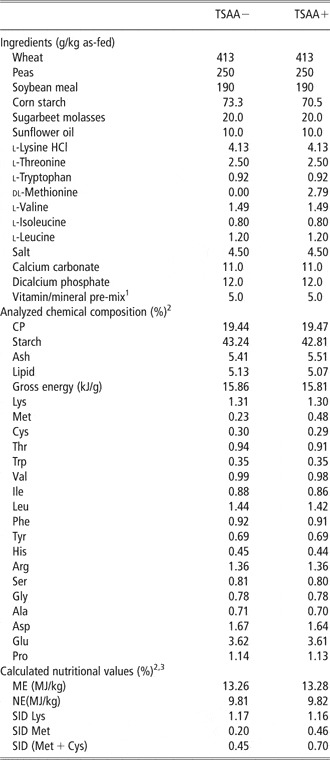
Two diets with similar CP and net energy contents were formulated based on wheat, peas, soybean meal and crystalline amino acids (Table 1). The diets provided 1.17% standardized ileal digestible (SID) Lys, which is slightly above the recommended Lys requirement for nursery pigs (NRC, 1998). The supply of amino acids other than TSAA met or exceeded current French recommendations (Henry, Reference Henry1993, Sève and Le Floc’h, Reference Sève and Le Floc’h1998). The TSAA-deficient diet (TSAA−) provided 0.20% SID Met and 0.45% SID TSAA, which is at least 25% below the recommended requirement for 10 to 20 kg pigs (Henry, Reference Henry1993; NRC, 1998). In the TSAA-sufficient diet (TSAA+), dl-Met was added to the diet by replacing corn starch to provide 0.46% SID Met and 0.70% SID TSAA. All diets were pelleted using a die with 2.5 mm holes.
Composition of the experimental diets

TSAA− = diet deficient in total sulfur amino acids; TSAA+ = diet sufficient in total sulfur amino acids; SID = standardized ileal digestible.
1Provided the following nutrients (per kg diet as-fed): vitamin A, 10 000 IU; vitamin D3, 2000 IU; vitamin E, 20 mg; vitamin K3, 2 mg; thiamin, 2 mg; riboflavin, 5 mg; niacin, 20 mg; pantothenic acid, 10 mg; pyridoxine, 5 mg; biotin, 0.2 mg; folic acid, 1 mg; vitamin B12, 0.03 mg; choline chloride, 600 mg; ascorbic acid, 40 mg; Fe, 100 mg; Cu, 20 mg; Zn, 100 mg; Mn, 40 mg; I, 0.6 mg; Se, 0.3 mg; and Co, 1 mg.
2Adjusted for 87.3% dry matter.
3Values for ME and NE were calculated from the energy values of the ingredients (Noblet et al., Reference Noblet, Fortune, Shi and Dubois1994).
4The SID values were obtained from the calculated ileal digestibility values of the ingredients (Sauvant et al., Reference Sauvant, Perez and Tran2004) combined with the measured amino acid contents.
Before the start of the experiment, piglets were offered ad libitum a commercial starter diet. Upon arrival at the experimental unit (at 42 days of age), piglets within a block were offered the same amount of feed three times daily at 0900, 1300 and 1600 hours. Daily feed allowance was approximately 25% below the ad libitum intake capacity and was adjusted two or three times per week according to appetite, while avoiding feed refusals. Refusals, if any, were dried and weighed to calculate actual feed intake. Water was freely available. Samples of the feeds were taken twice per week and pooled by feed.
Nitrogen balance study
The N balance period lasted 19 days, divided into three sub-periods of 6, 7 and 6 days each. Feces were collected on a wire mash placed underneath the slats of the cages while the urine was collected in a 0.1 N H2SO4 solution. Feces and urine were collected daily for each piglet, combined within each sub-period, weighed and stored at 2°C. At the end of each sub-period, 20% of total feces and urine were taken and stored at −20°C. After thawing overnight, these samples were mixed and sampled. Fecal samples were freeze-dried and finely ground for further chemical analysis.
Comparative slaughter study
Piglets of the initial group (n = 6) and those used in the nitrogen balance study (n = 12) were slaughtered after an overnight fast. Piglets were killed by exsanguination after electrical stunning. Without scalding and dehairing, the whole animal was divided into five compartments: carcass (without head, feet and tail), blood, intestines, liver and the remaining body components (i.e. kidneys, stomach, lungs, diaphragm, heart, genital tract, bladder and spleen together with the head, feet and tail). Blood was collected, weighed and sampled. Immediately after slaughter, the gastrointestinal tract and bladder were emptied and the contents were discarded. The empty intestines, the liver, and the remaining internal organs (i.e. kidneys, stomach, lungs, diaphragm, heart, genital tract, bladder and spleen) were weighed. The head was removed by cutting at the occipito-atlas joint and feet by cutting at the carpus-metacarpal and tarsus-metatarsal joints. The head, feet and tail were weighed together. The carcass without head was split longitudinally and both half-carcasses were weighed. After weighing, all samples were stored at −20°C and the soft tissues (i.e., blood sample, liver, intestines and remaining internal organs) were freeze-dried later. The frozen right half-carcass was cut into small pieces (Hobart RF15 cutter/slicer, Marne la Vallée, France), ground twice using 5 and 2 mm screens (Hobart 4346 mixer/grinder, Marne la Vallée, France), minced and then freeze-dried. The combined head, feet and tail were also ground twice, minced and freeze-dried, and then minced and homogenized together with the remaining organs (HFTO).
The longissimus muscle (LM) from the left half carcass was entirely removed immediately after slaughter and weighed. Samples of this muscle (oriented according the longitudinal axis of the fiber) were mounted on flat sticks, frozen in isopentane cooled by liquid nitrogen, and stored at −80°C until electrophoretic separation of MyHC and actin. The remaining LM was frozen, cut in smaller pieces and freeze-dried.
Chemical analyses
Chemical analyses were carried out according to methods of the International Organization for Standardization (www.iso.org) and the AFNOR group (NF methods, www.afnor.org/en). The dry matter (ISO 6496-1983) and ash (ISO-5984) contents were determined in feed, feces and body components. The N contents in feed, feces urine and body components were determined according to the Dumas procedure (NF V18-120, 1997 using a LECO 3000, St Joseph, MI, USA). Samples were also analyzed for gross energy using an adiabatic bomb calorimeter (ISO 9831-1998, IKA C5000, Staufen, Germany). The crude fat content (NF V18-117, 1997) of feed and body components was determined by solvent extraction using an automatic extraction system (Soxtec Avanti 2050, FOSS, Höganäs, Sweden). Lipids in the diet were extracted using ether petroleum, whereas a chloroform and methanol mixture (2 : 1 v/v) was used for body compartments.
The amino acid contents of feed samples and body compartments were analyzed by HPLC (Alliance System, Waters) after protein hydrolysis with 6 N HCl at 110°C for 23 h under reflux. The Cys and Met contents were determined after oxidation with performic acid before hydrolysis. The Trp content was determined after hydrolysis at 120°C for 16 h with barium hydroxide and separation by reverse-phase HPLC and fluorometric detection.
MyHC and actin electrophoresis
About 500 μg of 20 μm thick cross-sections of LM were obtained at −20°C using a cryostat (2800 Frigorut Reichert-Jung, Franchville, France). The average weight of muscle sections was calculated from the thickness and area of a representative section using a programmable planimeter (Hitachi, Siko, Japan). Muscles sections for protein electrophoresis were solubilized in 500 volumes (v/w) of Laemmli solution (62.5 mM Tris-HCl, pH 6.8, 10% (v/v) glycerol, 2% (w/v) SDS, 5% 2-mercaptoethanol and 0.002% bromophenol blue). After heating for 6 min at 100°C, extractions were stored at −80°C and analyzed within a few days.
The separation of MyHC and actin was obtained on poly-acrylamide slab gels as described by Lefaucheur et al. (Reference Lefaucheur, Ecolan, Lossec, Gabillard, Butler-Browne and Herpin2001) with some modifications. Slabs 18 cm wide, 16 cm high and 0.75 mm thick were used (SE 600 vertical slab gel unit, Hoefer, San Francisco, CA, USA). The separating gel contained 10% poly-acrylamide (A/B = 50/1) and 30% glycerol. Before loading, extracts were incubated for 2 min at 100°C and 15 μl (about 30 μg fresh muscle) were loaded per lane in triplicate. Electrophoresis was run at 3°C for 2 h at 70 V and 18 h at 230 V. Gels were stained in colloidal Coomassie G-250 blue solution (Candiano et al., Reference Candiano, Bruschi, Musante, Santucci, Ghiggeri, Carnemolla, Orecchia, Zardi and Righetti2004) and scanned with an UMAX ImageScanner (GE Healthcare). Using molecular weight markers (range 6.5 to 200 kDa, Bio-Rad Laboratories, Hercules, CA, USA), MyHC was identified as the most pronounced band at around 190 kDa, and actin as the second most important band at around 47 kDa. Actin and MyHC bands were quantified as optical densities after background subtraction using the Gel Doc 2000 image analysis system (Bio-Rad, Hercules). The ratio of the adjusted optical densities for MyHC and actin was calculated.
Calculations and statistical analyses
Whole empty body composition was calculated from the five compartments, assuming that the left and right half-carcasses had identical compositions. Tissue gain and composition of tissue gain was calculated as the difference between the measured composition of piglets slaughtered at the end of the nitrogen balance period and the estimated initial body composition of these piglets. The latter was obtained from the measured BW at the beginning of the nitrogen balance period and the average body composition of the initial group. As the slopes of the regression of body composition on BW did not differ from zero for the initial group, we assumed that the initial body composition was the same for all piglets.
Data were subjected to analyses of variance using the MIXED procedure (SAS Inst. Inc., Cary, NC, USA) using the individual piglet as experimental unit. The analysis of body composition for the three treatment groups was carried out through non-orthogonal, multiple comparisons using the Tukey–Kramer correction procedure. Both the effects of age (TSAA+ v. initial) and TSAA supply (TSAA+ v. TSAA−) were tested. It is acknowledged that the age effect is confounded with a diet effect because the TSAA+ group received the (theoretically non-limiting) experimental diet during 19 days, while all piglets received standard starter diets before the experiment.
Results
In general, piglets appeared to be in good health throughout the experiment. Occasional cases of diarrhea occurred and piglets were then treated with colistin sulfate (CEVA Santé Animale, Libourne, France), sulfamethoxazole/trimethoprim (Vétiquinol S.A., Lure, France), or both. In the last sub-period of the N-balance trial, three piglets (two receiving diet TSAA+ and one receiving diet TCAA−) had persistent diarrhea and the results from these animals during this sub-period were not used in the nitrogen balance analysis.
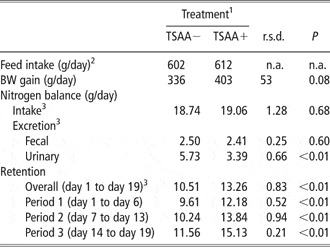
As anticipated, the supply of TSAA affected performance (Table 2) and daily gain tended to be greater in piglets receiving diet TSAA+. Nitrogen intake and fecal nitrogen excretion were not different between treatments, but urinary nitrogen excretion was lower and nitrogen retention thus greater during all three sub-periods in piglets receiving diet TSAA+.
Effect of a deficient or sufficient total sulfur amino acid supply on BW gain and nitrogen balance in piglets

TSAA− = diet deficient in total sulfur amino acids; TSAA+ = diet sufficient in total sulfur amino acids; n.a. = not applicable.
1Piglets received diets in which the total sulfur amino acid supply was either deficient (TSAA−) or sufficient (TSAA+) for 19 days. Six piglets per treatment were used.
2Adjusted for 87.3% DM. No statistical analysis was performed for feed intake because piglets were pair-fed.
3During the 19 day period. Because of diarrhea in the period 3 in 1 piglet receiving TSAA− and in 2 piglets receiving TSAA+, only the first 13 days were considered for these piglets.
Chemical composition of empty BW and empty BW gain
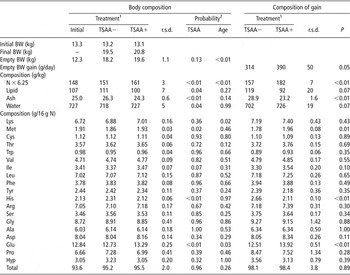
Compared with piglets that received diet TSAA−, piglets that received diet TSAA+ had higher protein and water contents and lower lipid and ash contents in the empty body (Table 3). These piglets also had higher Met and Glu contents and a lower His content in empty body protein. Compared with the initial group, TSAA+ piglets had a higher protein content in the empty body and higher Lys and Glu contents in empty body protein. These differences in body composition resulted in differences in the composition of empty BW gain. The TSAA+ piglets had a higher protein content in empty BW gain. In addition, the Met and Glu content in empty body protein gain was greater in these piglets, while the His content was lower. The Cys content in empty body protein and empty body protein gain was not affected by the TSAA content in the diet.
Effect of a deficient or sufficient total sulfur amino acid supply on the composition of the empty body and empty BW gain in piglets

TSAA− = diet deficient in total sulfur amino acids; TSAA+ = diet sufficient in total sulfur amino acids; TSAA = total sulfur amino acids.
1Six initial piglets were slaughtered at 42 days of age. The other 12 piglets received diets for 19 days in which the total sulfur amino acid supply was either deficient (TSAA−) or sufficient (TSAA+) and were slaughtered thereafter.
2Tests correspond to testing treatments TSAA− v. TSAA+ (TSAA) and Initial v. TSAA+ (Age). Probabilities were corrected using the Tukey–Kramer correction procedure for multiple comparisons.
Chemical composition of tissues and tissue gain
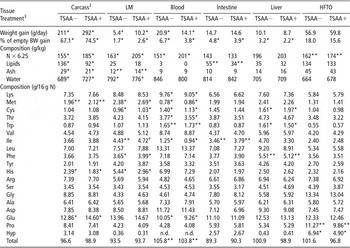
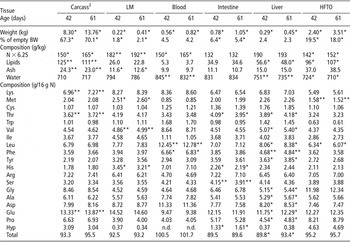
Piglets that received diet TSAA+ had a greater weight gain of the carcass and LM, but lower weight gain of blood (Table 4). These piglets also had a higher protein content in the weight gain of the carcass, LM, and blood, while it tended to be greater in HFTO. The TSAA+ piglets had a higher Met content in protein gain in LM and blood, while it tended to be greater in the carcass. Different tissues were affected differently by the TSAA supply. The intestines appeared to be least affected, followed by HFTO and the liver. In HFTO, reducing the TSAA+ resulted in an important reduction in the Hyp content of protein gain, while the Pro content tended to be lower. The carcass and LM responded in general in a similar way to the TSAA supply, although the response in LM was more important. Apart from the higher Met content, TSAA+ piglets had a considerable lower His content in protein gain in the carcass and LM. Of all tissues considered, blood responded most to the TSAA supply. The TSAA+ piglets had a higher content of Met and Trp, but a lower content of Lys, Cys, Thr, Ile, Glu and total amino acid content in protein gain.
Effect of a deficient or sufficient total sulfur amino acid supply on the composition of tissue weight gain in pigletsFootnote 1

TSAA+ = diet sufficient in total sulfur amino acids; TSAA = total sulfur amino acids; LM = longissimus muscle; HFTO = head, feet, tails and internal organs.
1 The residual s.d. is given in Table 6.
2 Including the LM, HFTO = head, feet, tails and internal organs other than the liver and intestines (i.e. kidneys, stomach, heart, lungs, diaphragm, genital tract, bladder and spleen).
3 Twelve piglets received diets for 19 days in which the total sulfur amino acid supply was either deficient (TSAA−) or sufficient (TSAA+).
* Within a row and tissue compartment, means differ (P < 0.05).
** Within a row and tissue compartment, means tend to differ (0.05 ⩽ P < 0.10).
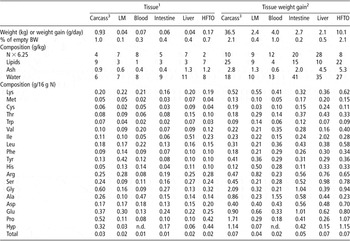
With increasing age, the carcass and LM represented an increasing proportion of the empty BW at the expense of the intestines and HFTO (Table 5). The protein content increased with age in the carcass, LM and HFTO. The amino acid composition was affected by age in most of the tissues. In the carcass, LM, blood, intestines and HFTO, the content of four or fewer amino acids differed between initial and TSAA+ pigs, whereas in the liver the content of 10 amino acids differed between both groups. In the carcass (the quantitatively most important component), the Lys, Thr and Glu contents was higher in TSAA+ pigs, compared with the initial group (Table 6).
Effect of age on the composition of tissues in pigletsFootnote 1

LM = longissimus muscle; HFTO = head, feet, tails and internal organs; n.d. = non-determined.
1 All piglets received a standard starter diet up to 42 days of age. Six piglets were then slaughtered whereas six other piglets received an experimental (nutritionally non-limiting) diet for 19 days and were slaughtered thereafter. The residual s.d. is given in Table 6.
2 Including the LM, HFTO, other than the liver and intestines (i.e. kidneys, stomach, heart, lungs, diaphragm, genital tract, bladder and spleen).
* Within a row and tissue compartment, means differ (P < 0.05).
** Within a row and tissue compartment, means tend to differ (0.05 ⩽ P < 0.10).
Residual s.d. of the composition of tissues and tissue weight gain in pigletsFootnote 1

LM = longissimus muscle; HFTO = head, feet, tails and internal organs other than the liver and intestines (i.e. kidneys, stomach, heart, lungs, diaphragm, genital tract, bladder and spleen).
1 All 18 piglets received a standard starter diet up 42 days of age. Six piglets were then slaughtered whereas 12 other piglets received experimental diets deficient (TSAA−) or not (TSAA+) in total sulfur amino acid supply for 19 days. The residual s.d. results from a model with three treatments groups (i.e. initial group, TSAA−, TSAA+) and a random bloc effect (six blocs).
2 The composition of the gain of 12 piglets was calculated from the difference in body composition between the experimental groups (TSAA− and TSAA+) and the initial group.
3 Including the longissimus muscle (LM), HFTO = head, feet, tails and internal organs other than the liver and intestines (i.e. kidneys, stomach, heart, lungs, diaphragm, genital tract, bladder and spleen).
MyHC and actin in the LM
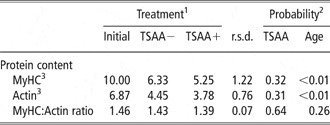
The TSAA supply did not affect the MyHC and actin content (optical density) in LD muscle protein (Table 7). However, the MyHC and actin contents were considerably higher in the piglets slaughtered at the start of the experiment compared with those slaughtered at the end. The MyHC to actin (optical density) ratio in LM was not affected by the diet or age of the piglets and averaged 1.43.
Effect of a deficient or sufficient total sulfur amino acid supply on the protein content of longissimus muscle in piglets

MyHC = myosin heavy chain; TSAA− = diet deficient in total sulfur amino acids; TSAA+ = diet sufficient in total sulfur amino acids; TSAA = total sulfur amino acids.
1Six initial piglets were slaughtered at 42 days of age. The other 12 piglets received diets for 19 days in which the total sulfur amino acid supply was either deficient (TSAA−) or sufficient (TSAA+) and were slaughtered thereafter.
2The tests correspond to testing treatments TSAA− v. TSAA+ (TSAA) and Initial v. TSAA+ (Age). Probabilities are corrected using the Tukey–Kramer correction procedure for multiple comparisons.
3Volume of the spots of myosin heavy chain and actin (arbitrary units) relative to 16 g N.
Supply and retention of methionine and cysteine
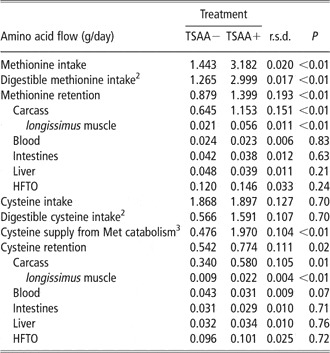
As the carcass and HFTO contribute largely to proteins of the empty body, these tissues also store the largest amounts of Met and Cys (Table 8). For TSAA− piglets, the carcass and HFTO stored, respectively, 73% and 14% of all retained Met, and 63% and 18% of all retained Cys. However, the distribution of retention changed with TSAA supply. For TSAA+ piglets, 82% and 10% of all Met, and 75% and 13% of all Cys were retained in the carcass and HFTO, respectively. Providing a TSAA-deficient diet to piglets did not decrease the Met or Cys retention in blood, the intestines and the liver (it even increased numerically). In TSAA− piglets, 69% of the SID Met intake and 53% of the total Cys supply (from the diet and from Met catabolism) was retained. As anticipated, these fractions were lower in TSAA+ piglets (47% and 22% for Met and Cys, respectively).
Effect of a deficient or sufficient total sulfur amino acid supply on methionine and cysteine retention in piglets

HFTO = head, feet, tails and internal organs other than the liver and intestines (i.e. kidneys, stomach, heart, lungs, diaphragm, genital tract, bladder and spleen); TSAA− = diet deficient in total sulfur amino acids; TSAA+ = diet sufficient in total sulfur amino acids.
1Twelve piglets received diets for 19 days in which the total sulfur amino acid supply was either deficient (TSAA−) or sufficient (TSAA+).
2The standardized ileal digestibility was obtained from table values from feed ingredients (Sauvant et al., Reference Sauvant, Perez and Tran2004).
3Calculated from the difference between digestible methionine intake and methionine retention and taking into account the difference in molar weights between Met and Cys. It was assumed that there were no material Met losses (e.g. as endogenous secretions or integuments) and that all excess Met was degraded through the trans-sulfuration pathway.
Discussion
In this experiment, a reduction of 36% in TSAA supply resulted in a decrease in protein (16 g N) retention and daily gain and an increase in lipid retention. Such a response has been observed in numerous other studies when the supply of an essential amino acid is limiting (e.g. Martinez-Ramirez et al., Reference Martinez-Ramirez, Jeaurond and de Lange2008). The increased lipid retention originates from the availability of carbon-chains from amino acids that cannot be retained as protein. Although the limiting TSAA supply reduced whole body protein retention, different parts of the body responded differently. Piglets fed diet TSAA− were able to maintain (or even increase) protein retention in blood, intestines and liver, whereas it was reduced in carcass, HFTO and LM. The largest decrease in protein retention occurred in LM, where it was reduced by more than 50% (Table 8).
The question whether (and how) an animal can change the amino acid composition of body protein remains unsolved. Bunce and King (Reference Bunce and King1969) fed young rats diets widely differing in protein content and observed that the amino acid composition of whole body protein was not constant. Similar results have been reported in growing pigs using diets differing in protein (Campbell et al., Reference Campbell, Taverner and Rayner1988; Bikker et al., Reference Bikker, Verstegen and Bosch1994) or amino acid contents (Batterham et al., Reference Batterham, Andersen, Baigent and White1990; Chung and Baker, Reference Chung and Baker1992b; Gahl et al., Reference Gahl, Finke, Crenshaw and Benevenga1996). On the other hand, Wei and Fuller (Reference Wei and Fuller2006) found no effect of a chronic amino acid deficiency on the amino acid composition in mature rats and argued that part of the observed responses may be due to differences in growth rate and body composition, rather than to the amino acid efficiency per se. However, irrespective of the mode of action of an amino acid deficiency, it questions the commonly used assumption that the amino acid composition of whole body protein is constant.
When the amino acid supply is insufficient to sustain maximum growth, the animal can reduce its growth rate or change the composition of growth. In our experiment, both mechanisms were used as piglets reduced growth rate, protein content of growth, and Met content of retained protein. Of all body tissues studied, LM had the highest Met content and was affected most by the TSAA deficiency, both in terms of growth rate and Met content. The carcass growth rate was also reduced and, to a lesser extent, the Met content of retained protein in the carcass. The difference in the magnitude of response between LM and the carcass may be due to differences in response between skeletal muscles. Purchas et al. (Reference Purchas, Morel, Janz and Wilkinson2009) showed that the Met content was higher in LM compared with the semimembranosus muscle. If the reduction in protein retention due to the TSAA− deficiency is less in the semimembranosus muscle than in LM, this would result in a more attenuated response for the carcass. Irrespective of the mechanisms, our results demonstrate that the growing piglet has a potential to modulate the amino acid composition of muscle protein. The fact that tissue growth rates are affected more than the Met content of tissue protein indicates that this adaptation potential is limited or that the animal prefers reducing its growth rather than changing the amino acid composition of protein.
As indicated earlier, Cys can be synthesized from Met. Kyriazakis et al. (Reference Kyriazakis, Emmans and McDaniel1993) observed that the Cys concentration in empty body protein decreased with BW and suggested that this may be due to a decreasing contribution of hair to total body protein. Although hair is very rich in Cys (13% in protein), Mahan and Shield (1998) showed that the contribution of hair protein to total body protein is relatively constant between birth and 140 kg of BW (averaging 1.7%). The Cys content of empty body protein was not affected by the diet in our study, but the Cys content was higher in blood but lower in liver protein gain in TSAA− piglets. Cysteine is one of the three amino acids of glutathione, which is an important antioxidant and regulator of cellular homeostasis (Richie et al., Reference Richie, Komninou, Leutzinger, Kleinman, Orentreich, Malloy and Zimmerman2004). The liver plays an important role in the synthesis of glutathione, which is transported by the blood to extrahepatic tissues. Richie et al. (Reference Richie, Komninou, Leutzinger, Kleinman, Orentreich, Malloy and Zimmerman2004) observed that a Met restriction in rats greatly reduced the Cys content in liver, blood and pancreas. Compared with the control group, a Met deficiency resulted in an important reduction in glutathione content in the liver, whereas that in the blood was increased, especially in erythrocytes. Richie et al. (Reference Richie, Komninou, Leutzinger, Kleinman, Orentreich, Malloy and Zimmerman2004) suggested that a Met deficiency may deplete liver glutathione to maintain glutathione level in extrahepatic tissues.
The His contents in protein and retained protein in the empty body, carcass and LM were higher in TSAA− piglets. Part of the His in muscle protein is methylated post-transcriptionnally to 3-methyl His. During protein turnover, free 3-methyl His released from protein cannot be re-incorporated into protein. In many species, urinary excretion of 3-methyl His is used as a measure of muscle protein breakdown, but pigs convert considerable quantities of 3-methyl His to balenine, a dipeptide stored in a free form in muscle (Harris and Milne, Reference Harris and Milne1981). In addition, other dipeptides such as carnosine and anserine may have contributed, after hydrolysis, to the higher His (or 3-methyl His) content in LM. Among all amino acids analyzed in LM, His was affected most by the TSAA supply, which may be indicative for an increased protein turnover in piglets fed diet TSAA−. Our results appear to be in contrast with those of Bikker et al. (Reference Bikker, Verstegen and Bosch1994) and Le Bellego and Noblet (Reference Le Bellego and Noblet2002), who reported lower His concentrations in retained protein in piglets fed low CP diets. It is possible that in the latter studies, the reduction in CP level resulted in a reduction in protein turnover (relative to protein deposition), thereby reducing the His content. The mechanisms of protein turnover and deposition may be affected differently for low CP diets compared with diets with an amino acid imbalance.
The composition of the intestines was little affected by the diet, confirming earlier observations that the intestines are relatively resistant to nutrient deficiencies (Ebner et al., Reference Ebner, Schoknecht, Reeds and Burrin1994). Similar results were observed in piglets fed a diet marginally deficient in Thr (Hamard et al., Reference Hamard, Sève and Le Floc’h2009), although the structure of the mucosa (i.e. intestinal villus height and crypt width) was affected in these piglets (Hamard et al., Reference Hamard, Sève and Le Floc’h2007).
Hydroxyproline is an indicator of collagen content in body protein because Hyp exists only in collagen and elastin (Pearson and Young, Reference Pearson and Young1989) and its concentration in collagen is very high (approximately 10%). Collagen is mostly associated with the skeleton but it also abundant in skeletal muscle at the epimysium (around muscles), perimysium (around myofiber fascicles) and endomysium (around each myofiber) (Pearson and Young, Reference Pearson and Young1989). The Hyp content in LM was not different between the two diets, suggesting that also the collagen content was not different. The Hyp content was 10-fold lower in LM compared with the carcass or HFTO (Tables 4 and 5). The TSAA-deficiency resulted in a high Hyp content in protein gain in HFTO, which is a compartment with a high bone and ash content (Table 4). A possible increase in collagen content could be part of the strategy of the animal to cope with a TSAA deficiency. Although collagen contains <1% TSAA, also the content of essential amino acids is low (Pearson and Young, Reference Pearson and Young1989). An increase in collagen deposition would thus serve more to spare nitrogen (or non-essential amino acids) than to spare essential amino acids.
Our interest in looking specifically at the MyHC and actin contents of LM resides in the fact that these proteins contribute largely to the total body amino acid mass and that they have a different amino acid composition. On a molar basis, MyHC contains 1.8% Met and 0.9% Cys, whereas actin contains 4.4% Met and 1.4% Cys. A possible change in the MyHC to actin ratio has thus implications for the amino acid composition of muscle proteins. Stibler et al. (Reference Stibler, Edström, Ahlbeck, Remahl and Ansved2003) showed that the MyHC to actin ratio was considerably lower in patients with critical illness myopathy compared with healthy controls (0.37 v. 1.37). The latter value is similar to that observed in our study. Critical illness myopathy results in the specific breakdown of myosin thereby reducing the myosin to actin ratio. In contrast, the density and lengths of thin filaments decreased significantly in muscle fibers of astronauts after a spaceflight (Riley et al., Reference Riley, Bain, Thompson, Fitts, Widrick, Trappe, Trappe and Costill2000), resulting in an increased MyHC to actin ratio. This shows that there are physiological or pathological situations in which the MyHC to actin ratio can be changed. Nevertheless, in this study the MyHC to actin ratio was not affected by the TSAA supply, indicating that the change in the Met content in LM was not directly related to changes in MyHC and actin.
In conclusion, the TSAA supply affects the amino acid composition of body protein and different body proteins are affected differently. The hypothesis that growing animals, when facing an amino acid deficiency, can alter the rate of deposition and composition of different body proteins appears to hold. This questions the use of a constant ideal amino acid profile in practical animal nutrition, but also illustrates the plasticity of the animal to cope with nutritional challenges.
Acknowledgments
The authors wish to thank M. Alix, N. Bonhomme, B. Carrissant, H. Demay, P. Écolan, M. Genissel, G. Guillemois, Y. Jaguelin, B. Lebret, F. Le Gouevec, J. Liger, N. Mezière, A. Pasquier, V. Piedvache and J.-F. Rouaud for their skillful technical assistance, discussions and helpful collaboration.