Introduction
Hearing loss is one of the most common chronic health problems in our society. According to a recent national survey, nearly 9 million people in the UK suffer from deafness or experience significant hearing difficulty, the majority of whom are above 60 years of age.1 Hearing impairment significantly affects quality of life, and can lead to social withdrawal, isolation and depression. The number of patients presenting to general practitioners with hearing loss has increased by 30 per cent over the last decade.2
Nearly all general practitioners and otolaryngologists will have seen a patient presenting with self-reported hearing loss. This is very often accompanied by a complaint from their partner or parent that the television (TV) is too loud when the patient controls the volume. It is difficult to know how much importance to attach to such complaints. It seems intuitively obvious that if someone has to increase their TV volume, then they are likely to have hearing loss, but how likely, and how much hearing loss?
A survey of the literature revealed no previous attempts to answer these questions, and thus inspired the present study.
Materials and methods
The study was conducted from August to October 2003 in two centres – the Cumberland Infirmary, Carlisle, and the Freeman Hospital, Newcastle upon Tyne, UK.
Participants
The study participants had all been referred for pure tone audiometry by their general practitioner or an ENT surgeon, in order to quantify suspected hearing loss. We selected patients who were undergoing their first pure tone audiogram (PTA) performed by a qualified audiologist. PTA was conducted in accordance with the British Society of Audiologist PTA guidelines.3 For practical purposes, the audiologists were not blinded to the results of a questionnaire completed prior to the PTA (see below).
The following exclusion criteria were applied: no TV use; visual impairment such that the patient did not watch TV; inability to speak English; and the use of hearing aids or other form of amplification to watch TV.
Out of 117 patients recruited to the study, 12 patients were excluded (two did not use a TV, four did not speak English, three used amplification and three produced incomplete questionnaires).
Test methods
A questionnaire was designed in order to gather data about patients' TV listening habits. The first section was completed by the patient and the second section by their accompanying partner or parent. Accompanying partners or parents were permitted to complete questionnaires on behalf of patients who were unable to do so themselves, such as children or very elderly patients. The actual TV volume was estimated on a visual analogue scale (VAS). We chose to use this method as many TVs now use an on-screen VAS to display changes in volume. The questionnaire also assessed the TV volume used for different types of programmes, specifically news, cartoons, action films and children's programmes.
Analysis
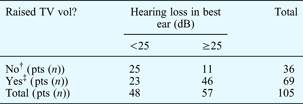
Patients were divided into two groups: those reporting increased TV volume and those reporting no increase in volume. Each patient's PTA was used as a reference standard. In general, hearing loss could be divided into mild, moderate, severe and profound based on audiometric results.Reference Catlin4 Mild hearing loss was defined as a loss of between 25 to 40 dB over an average of four frequencies (500, 1000, 2000 and 4000 kHz); a hearing loss of 25 dB or more was therefore considered significant. We subdivided participants into two groups: those with a mean hearing loss of <25 dB and those with a mean loss of ≥25 dB (Table I).
Patient distribution by raised TV volume* and hearing loss

* All programme types. †n = 36; ‡n = 69. TV vol = television volume; pts = patients
Data were collated and analysed using the Statistical Package for the Social Sciences version 9.0 software program.
Results
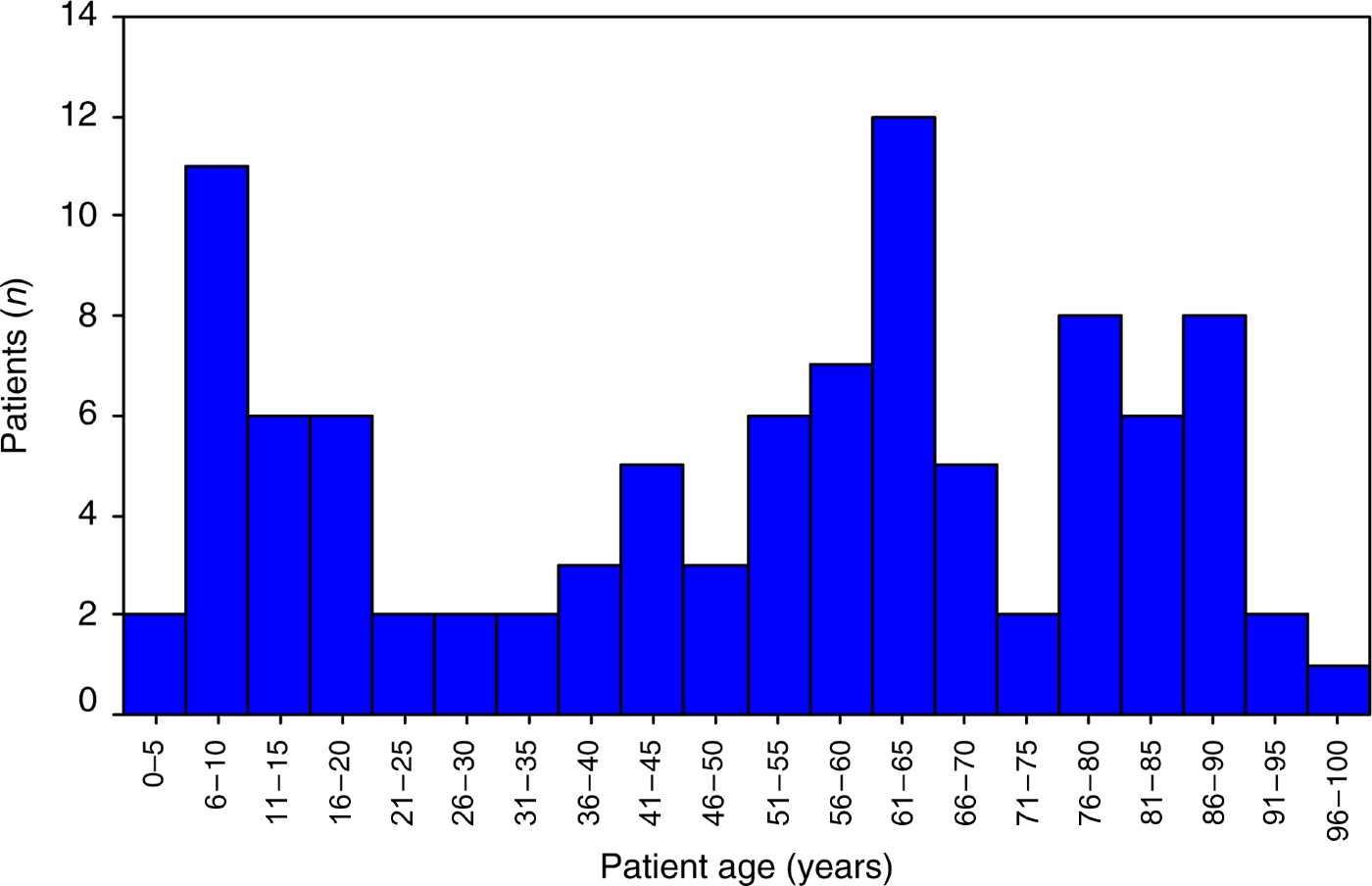
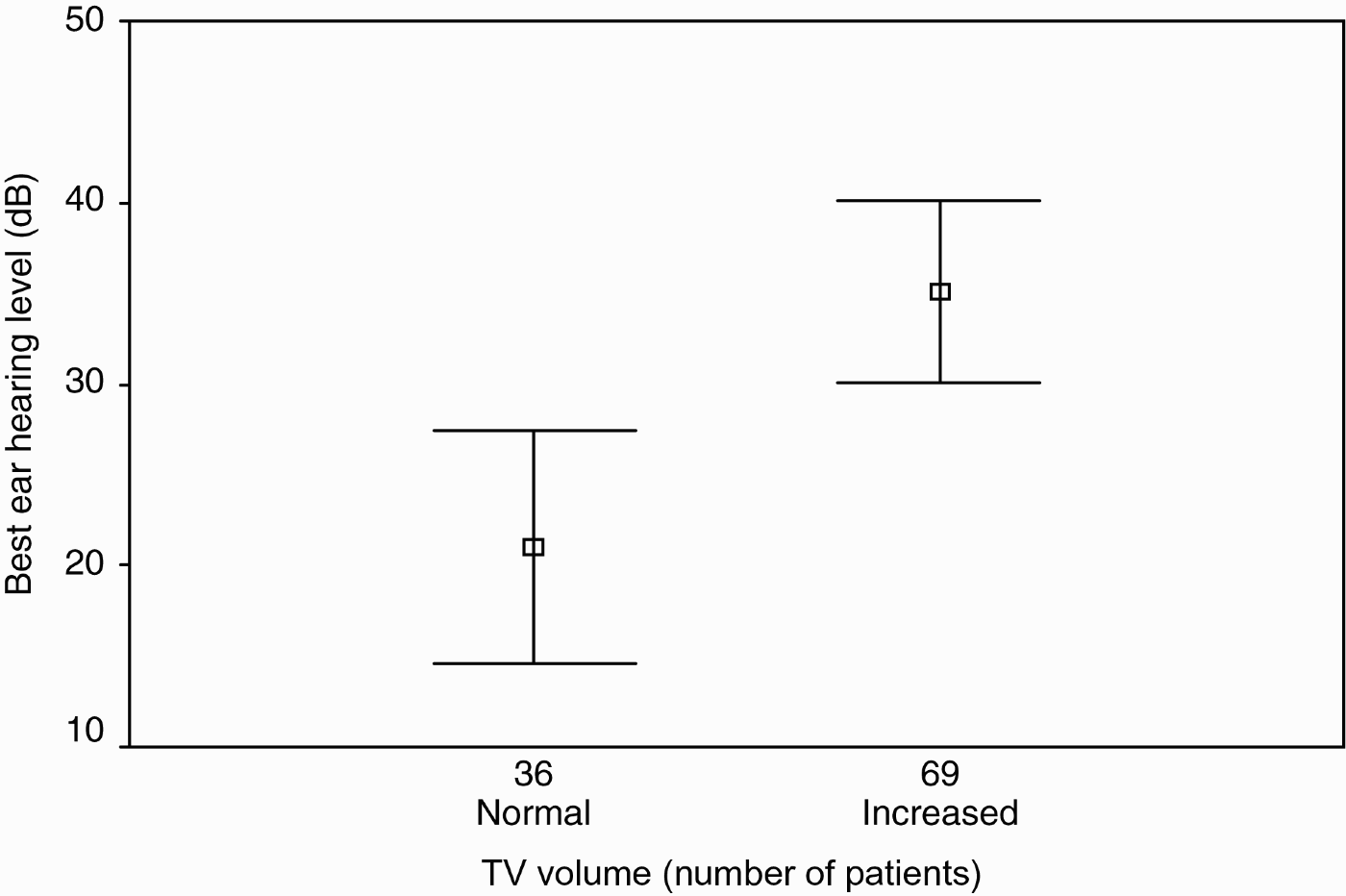
One hundred and five correctly completed questionnaires were received, together with concurrent audiometry data. Patients' ages ranged from five to 95 years (median, 56 years; interquartile range, 19–75 years) (Figure 1). There were two age peaks, the first at 10 years and a second, broader peak around 60 years. A statistically significant difference in hearing loss incidence was found between those reporting increased TV volume and those reporting no increase in volume. For patients reporting increased TV volume, the mean hearing loss was 35 dB, compared with a mean loss of 20 dB for patients not reporting increased TV volume (p < 0.005) (Figure 2).
Age distribution of study population.

Means (boxes) and 95 per cent confidence intervals (whiskers) for hearing loss in better hearing ear, for patients reporting normal television (TV) volume (n = 36) versus increased TV volume (n = 69). Difference in means = 15 dB; p = 0.00000009, Mann–Whitney U test.

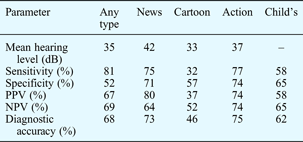
Table II presents the sensitivity, specificity, positive predictive value, negative predictive value and diagnostic accuracy of raised TV volume as a predictor of significant hearing loss. In our study group, the prevalence of hearing loss based on self-reported increased television volume was 66 per cent, whereas the prevalence of hearing loss based on PTA results was 54 per cent.
Utility of self-reported raised TV volume as predictor of hearing loss, by programme type

TV = television; PPV = positive predictive value; NPV = negative predictive value
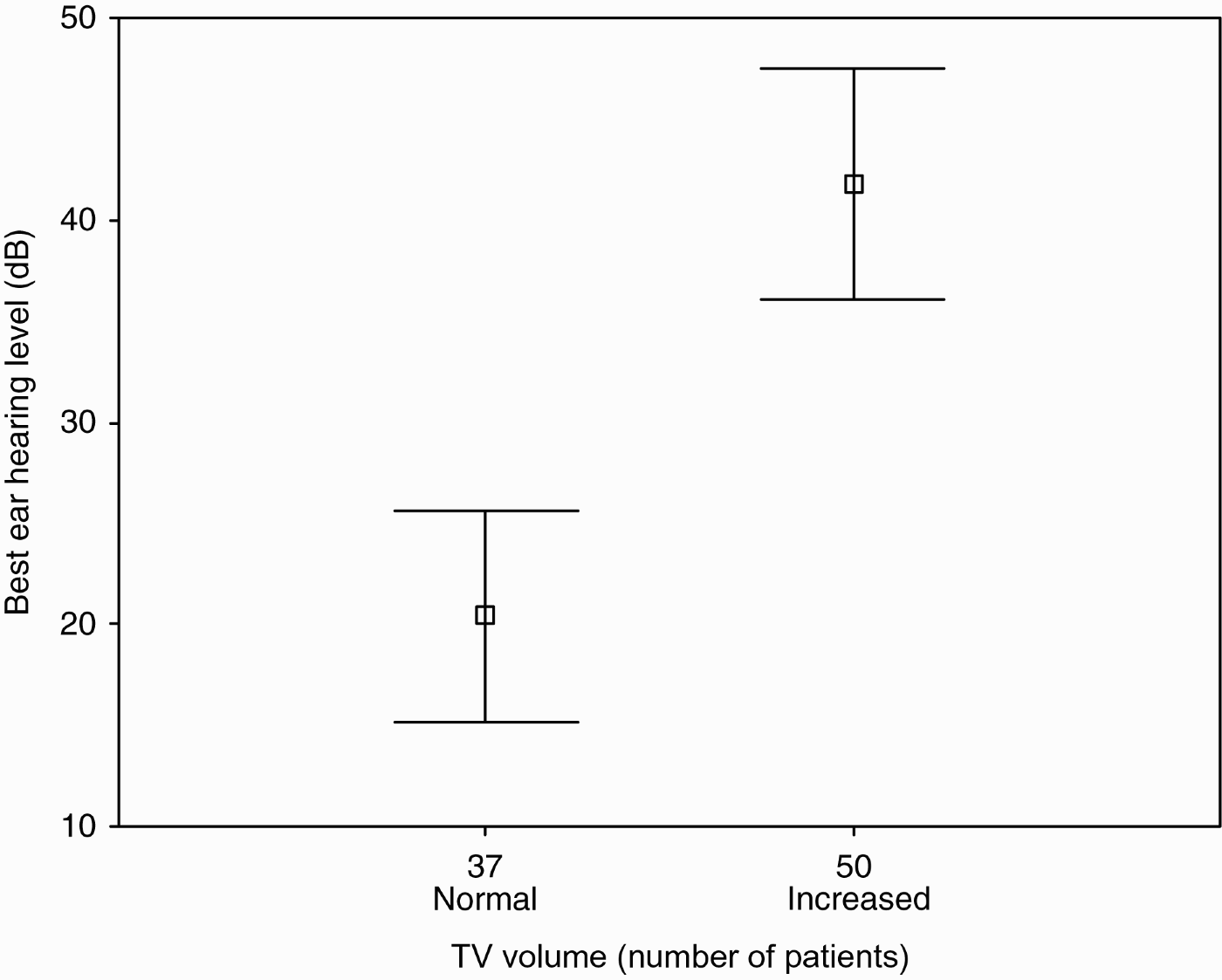
When we analysed results by television programme type, we found that the volume used while viewing news programmes showed the greatest difference with hearing loss, compared with other programme types. Those patients who reported increasing the television volume while watching the news had an average hearing loss of 41 dB. Self-reported increased television volume for news programmes had a sensitivity and specificity of 75 and 71 per cent, respectively, and a diagnostic accuracy of 73 per cent, as a predictor of hearing loss (Tables II and III, and Figure 3).
Means (boxes) and 95 per cent confidence intervals (whiskers) for hearing loss in better hearing ear, for patients reporting normal television (TV) volume (n = 37) versus increased TV volume (n = 50) while watching news programmes. Difference in means = 21.4 dB; p = 0.00000009, Mann– Whitney U test.

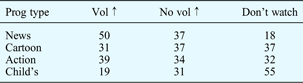
Patients' TV habits by programme type

Data represent patient numbers. TV = television; prog = programme; vol ↑= TV volume increase
Patients' ages were significantly related to their degree of hearing loss. Those aged over 25 years were likely to have much greater hearing loss. The average age of patients with hearing loss of more than 40 dB was 73.9 years.
Discussion
Self-reported hearing loss is a frequent presentation to the ENT out-patient clinic. Such patients (or their partners or parents) frequently vb report the need to increase the TV volume. Based on our study findings, the question, ‘Do you need the television volume turned up loud when you are watching the television?’ is a sensitive and acceptably specific screening tool for hearing loss. In our study, those patients reporting increased television volume had a 68 per cent chance of having a hearing loss of more than 25 dB, and an average hearing loss of 35 dB.
Self-administered screening questionnaires have been used in the primary care setting for many years to assess hearing impairment. The most popular such questionnaire is the Handicap Inventory Scale for the Elderly.Reference Ventry and Weinstein5 This is a 10-item, self-administered questionnaire developed to assess the social and emotional handicap caused by hearing impairment; it is also used as a screening tool. In studies assessing hearing loss screening using a single questionnaire, numerous variations in methodology and questionnaire wording have been reported. Nondahl et al. conducted a study of hearing loss screening in older Caucasian US adults by using a single question, ‘Do you feel you have hearing loss?’ This question had a sensitivity and specificity of 71 per cent as a predictor of hearing loss in adults.Reference Nondahl, Cruickshanks, Wiley, Tweed, Klein and Klein6 Clark et al. surveyed women aged 60–85 years using ‘Would you say that you have any difficulty in hearing?’ in this study hearing loss of >40 dB was used as a predictor of significant hearing impairment in pure-tone averages of either 1,000 and 2,000 Hz or 1,000, 2,000, 3,000 and 4,000 Hz that showed the sensitivities, 90 and 84 per cent; specificities, 71 and 75 per cent, respectively.Reference Clark, Sowers, Wallace and Anderson7
We identified two age distribution peaks of hearing loss, the first at 10 years, probably representing children attending with ‘glue ear’, and a second, broader peak around 60 years, probably representing referrals for presbycusis. Our patients' mean age was 56 years, and we found age to be significantly related to degree of hearing loss: those aged over 25 years were likely to have much greater hearing loss. This is perhaps just another way of saying that the hearing loss caused by presbycusis was worse than that due to otitis media with effusion.
The use of a VAS to indicate television volume was not very helpful, as the majority of patients marked their television volume just above halfway. We included in the questionnaire a question regarding patients' ability to hear different types of programmes in the presence of background noise. Of these programme types, the largest difference between the hearing loss of those using a normal versus an increased television volume was seen for news programmes (means of 20 and 41 dB were found, respectively) (Figure 3). We initially felt that this difference may support the use of programme type as a surrogate marker for age; however, when we excluded patients younger than 16 years there was a drop in significance (p = 0.000007 versus 0.00000009; Mann–Whitney U test), and therefore this inference is probably incorrect.
• Self-reported hearing loss is commonly encountered in clinical practice; such patients often comment on needing an increased television (TV) volume
• This study assessed the utility of TV volume as a marker of hearing loss; such research has not previously been reported
• Patients who reported an increased TV volume had a 68 per cent chance of having significant hearing loss (≥25 dB)
• Self-reported television volume may thus be a useful screening tool for hearing loss
From a general practice perspective, this study may be criticised in that the study population was drawn from an ENT clinic, and may have had an altered incidence of hearing loss compared with a general practice population. We could find no record of the prevalence of significant hearing impairment (i.e. >25 dB) amongst patients presenting to their general practitioner with hearing loss.
Conclusion
A patient's comment that they require increased TV volume indicates a quantifiable hearing loss in the majority of cases. Our study findings on this topic will hopefully help confirm what most general practitioners and ENT surgeons have long suspected. Our data indicate that self-reported television volume can be a useful screening tool in patients presenting with hearing impairment, especially in the primary care setting.