There are a number of developmental differences in the expression of anxious emotion (Weems, Reference Weems2008). As theory suggests, research has identified age differences in the predominant expression of the symptoms of childhood anxiety and phobic disorders (Warren & Sroufe, Reference Warren, Sroufe, Ollendick and March2004; Westenberg, Siebelink, & Treffers, Reference Westenberg, Siebelink, Treffers, Silverman and Treffers2001; Weems & Costa, Reference Weems and Costa2005; for a review, see Weems, Reference Weems2008). Although there may be considerable continuity in anxious emotion over time, its manifestation may often be heterotypic. Heterotypic continuity refers to the idea that there may be differences in the expression or manifestation of a construct over time or at different ages. In addition to age-related normative influences, there are also a number of atypical situations in which identifying heterotypic continuity of anxious emotion over time can help to elucidate the more subtle effects of a particular risk. For example, research suggests that exposure to natural disasters is associated with anxious emotion. The most salient and well-researched emotional responses to a disaster are symptoms of posttraumatic stress disorder (PTSD; e.g., La Greca, Silverman, Vernberg, & Prinstein, Reference La Greca, Silverman, Vernberg and Prinstein1996; Lonigan, Shannon, Taylor, Finch, & Sallee, Reference Lonigan, Shannon, Taylor, Finch and Sallee1994; Silverman & La Greca, Reference Silverman, La Greca, La Greca, Silverman, Vernberg and Roberts2002; Vernberg, La Greca, Silverman, & Prinstein, Reference Vernberg, La Greca, Silverman and Prinstein1996; Yule et al., Reference Yule, Bolton, Udwin, Boyle, O'Ryan and Nurrish2000); however, other forms of emotional problems have also been found (e.g., Hensley & Varela, Reference Hensley and Varela2008; Marsee, Reference Marsee2008).
Youths with more severe and intense traumatic experiences during a disaster are more likely to have more severe symptoms in the immediate aftermath (La Greca, Silverman, & Wasserstein, Reference La Greca, Silverman and Wasserstein1998; Weems, Pina, et al., Reference Weems, Piña, Costa, Watts, Taylor and Cannon2007). Traumatic stress has typically been defined in the literature by drawing from DSM (e.g., DSM-IV; American Psychiatric Association [APA], 1994). The two domains that define a traumatic event in Criteria A of PTSD in the DSM are exposure events (A1) and distress at the exposure events (A2). Research has indicated that the more traumatic events (e.g., physical harm, witnessing harm, or damage to home) youth experience, the more likely they are to have elevated symptoms of PTSD (La Greca et al., Reference La Greca, Silverman, Vernberg and Prinstein1996, Reference La Greca, Silverman and Wasserstein1998). Although PTSD symptoms appear to be relatively stable over time, some evidence does suggest that they may decline as time since the disaster passes (La Greca et al., Reference La Greca, Silverman, Vernberg and Prinstein1996). The extant research suggests that there are a number of factors that may influence change, and remission of symptoms may be less evident in certain circumstances and contexts (Weems et al., Reference Weems, Taylor, Cannon, Marino, Romano and Scott2010; Yule et al., Reference Yule, Bolton, Udwin, Boyle, O'Ryan and Nurrish2000). Moreover, even if a decrease in PTSD symptoms occurs, there may be lasting effects that are more insidious in nature. Drawing from the concept of heterotypic continuity, research is needed that examines the indirect manifestations of traumatic stress-related emotional and cognitive difficulties over time.
Cognitive difficulties (e.g., inability to recall aspects of the event or intrusive recollections) are core features of the diagnosis of PTSD (APA, 1994), and traumatic stress exposure has been linked to problems in several intellectual domains, including deficits in sustained attention, concentration, mental manipulation, and memory (Gil, Calev, Greenberg, Kugelmass, & Lerer, Reference Gil, Calev, Greenberg, Kugelmass and Lerer1990; Gilbertson, Gurvits, Lasko, Orr, & Pitman, Reference Gilbertson, Gurvits, Lasko, Orr and Pitman2001; McNally & Shin, Reference McNally and Shin1995; Vasterling, Brailey, Constans, & Sutker, Reference Vasterling, Brailey, Constans and Sutker1998; Vasterling et al., Reference Vasterling, Duke, Brailey, Constans, Allain and Sutker2002). These deficits have been shown in youths who have experienced childhood maltreatment and interpersonal traumatic exposure (e.g., Beers & De Bellis, Reference Beers and De Bellis2002). However, although the effects of childhood maltreatment and interpersonal traumatic exposure (e.g., physical and sexual abuse) on intellectual and emotional domains have been relatively well demonstrated, less is known about the effects of natural disaster-related traumatic stress on broader cognitive domains such as scholastic achievement (La Greca, Silverman, Vernberg, & Roberts, Reference La Greca, Silverman, Vernberg and Roberts2002).
The studies that have examined the effects of disaster-related traumatic stress on academic problems point to possible difficulties arising among war/violence-exposed youths (Saigh, Mroueh, & Bremner, Reference Saigh, Mroueh and Bremner1997), as well as prehurricane academic ability predicting postdisaster response (La Greca et al., Reference La Greca, Silverman and Wasserstein1998). Although the extant literature suggests linkages between traumatic stress exposure and academic difficulties, it appears that the effect of exposure may be largely a function of emotional disorder symptoms (such as PTSD) and not a direct effect of the traumatic stress (see Saigh et al., Reference Saigh, Mroueh and Bremner1997). This is in line with the idea that when controlling for negative outcomes, traumatic stress can sometimes be associated with positive outcomes (Calhoun & Tedeschi, Reference Calhoun and Tedeschi2006; Kilmer & Gil-Rivas, Reference Kilmer and Gil-Rivas2010). To our knowledge, no studies have examined possible indirect linkages from disaster-related traumatic stress exposure to student academic achievement in exposed youth. There is critical need for a solid developmental understanding of the potentially insidious effects of disaster exposure on anxious emotion and student achievement. Drawing from the extant research base, this paper tests a theoretical model of continuity in anxious emotion and of the indirect effects of disaster exposure on academic achievement.
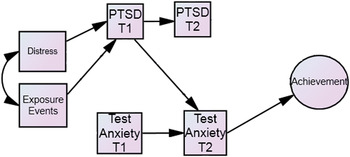
The model is outlined in Figure 1 and suggests that the association of disaster-related traumatic stress to academic achievement is indirect via linkages to PTSD symptoms. Posttraumatic stress symptoms involve anxious emotion and foster other aspects of anxious emotion (e.g., worrying about future safety or specific fears of rain). Over time, anxious emotion may be manifested in evaluative academic settings as test anxiety. Therefore, test anxiety may be a more proximal manifestation of anxious emotion interfering with the assessment (student testing) of academic achievement, as indexed by standardized student evaluation. The theoretical basis for possible indirect effects on anxious arousal generally and test anxiety more specifically is derived from a number of related research findings (Barlow, Reference Barlow2002; La Greca et al., Reference La Greca, Silverman and Wasserstein1998; Weems, Reference Weems2008; Weems, Pina, et al., Reference Weems, Piña, Costa, Watts, Taylor and Cannon2007). In this view, anxiety is part of a normative response system that prepares the individual to anticipate danger and fosters preparation for either freezing to avoid impending punishment or escaping as part of the fight/flight response (Barlow, Reference Barlow2002; Gray, Reference Gray1982; Gray & McNaughton, Reference Gray and McNaughton2000). A core defining feature of anxiety problems is dysregulation of this normal response system (Barlow, Reference Barlow2002; Watson, Reference Watson2005; Weems, Reference Weems2008). Research has highlighted the importance of general emotional dysregulation such as negative affect and trait anxiety in disaster-exposed youths (see La Greca et al., Reference La Greca, Silverman and Wasserstein1998; Weems, Pina, et al., Reference Weems, Piña, Costa, Watts, Taylor and Cannon2007). Thus, it is likely that, to the extent that disaster-related traumatic stress exposure is related to dysregulation of the normal anxiety response system (e.g., PTSD symptoms) it will also impact related anxious arousal (e.g., test anxiety), but this link may be indirect.
The theoretical model of the indirect effect of traumatic stress on academic achievement. [A color version of this figure can be viewed online at http://journals.cambridge.org/dpp]

Evidence for the importance of indirect effects is also suggested more specifically by the disaster literature. Hurricane Katrina was an intensely traumatic event for many youths and has had a substantial effect on the mental health of many survivors (Kessler et al., Reference Kessler, Galea, Gruber, Sampson, Ursano and Wessely2008; Weems, Watts, et al., Reference Weems, Watts, Marsee, Taylor, Costa and Cannon2007). Contextual analyses of the Katrina disaster (see Weems & Overstreet, Reference Weems and Overstreet2008) suggest that the pervasiveness of the disaster and the lingering effects (communities remained in serious disrepair over 3 years later) may have substantial and broad effects on youth development. Research from Katrina-exposed samples of youths suggests that disaster exposure not only is related to PTSD symptoms but also may be related to many different forms of emotional dysregulation (Hensley & Varela, Reference Hensley and Varela2008; Spell et al., Reference Spell, Kelley, Self-Brown, Davidson, Pellegrin and Palcic2008). For example, Marsee (Reference Marsee2008) showed that aggressive behavior may also follow disaster exposure in youths but that these reactions may be the indirect results of stress exposure on PTSD symptoms and general emotional dysregulation.
Extending an understanding of the long-term impact of traumatic stress on important indicators of youth functioning such as academic achievement to minority samples is also critical to developing a comprehensive picture of disaster-related emotional problems (Rabalais, Ruggiero, & Scotti, Reference Rabalais, Ruggiero, Scotti, La Greca, Silverman, Vernberg and Roberts2002). There is some evidence to suggest that the remission of symptoms is less evident in ethnic minorities (La Greca et al., Reference La Greca, Silverman, Vernberg and Prinstein1996), and ethnic minorities also may be less likely to seek community treatment and perceive less potential benefit from clinic-based treatment (Chavira, Stein, Bailey, & Stein, Reference Chavira, Stein, Bailey and Stein2003; Mojtabai, & Olfson, Reference Mojtabai and Olfson2006). In this study, we, therefore, focused on a sample of minority youths from a high-impact area within New Orleans.
Based on the theoretical model outlined above, we predicted that the association between traumatic stress and academic achievement would be indirect via linkages to PTSD symptoms and, more specifically, via PTSD's relation to later test anxiety. We examined cross-lag associations to identify if potential heterotypic continuity was important to consider in terms of the effects of posttraumatic stress being indirect via their relation to later test anxiety, which in turn was predicted to be negatively associated with academic achievement. The predictions in Figure 1 were tested using structural equation modeling, and the specificity of test anxiety as an indirect link to academic achievement was explored by testing a separate structural model with depression symptoms substituted in place of test anxiety. Depressive symptoms are another common reaction to disaster exposure (Weems, Pina, et al., Reference Weems, Piña, Costa, Watts, Taylor and Cannon2007) that may interfere with academic achievement.
Model invariance across age and sex was also tested. Although the differences in the link between exposure and PTSD symptoms across age groups have been mixed (Hoven et al., Reference Hoven, Duarte, Lucas, Wu, Mandell and Goodwin2005; La Greca et al., Reference La Greca, Silverman and Wasserstein1998; Weems, Pina, et al., Reference Weems, Piña, Costa, Watts, Taylor and Cannon2007), there is evidence to suggest that younger children exposed to Katrina may be at increased risk (Scheeringa & Zeanah, Reference Scheeringa and Zeanah2008), and theoretically there may be developmental variation in the hypothesized linkages implied by the model from a cognitive developmental standpoint (Weems & Overstreet, Reference Weems and Overstreet2008). In general, mean levels of anxiety and fear are lower in older age groups and tend to decrease longitudinally over time in community samples (Gullone & King, Reference Gullone and King1997; Gullone, King, & Ollendick, Reference Gullone, King and Ollendick2001; Weems & Costa, Reference Weems and Costa2005; Westenberg, Gullone, Bokhorst, Heyne, & King, Reference Westenberg, Gullone, Bokhorst, Heyne and King2007). In addition, female sex has been consistently associated with relatively increased PTSD symptoms (Hoven et al., Reference Hoven, Duarte, Lucas, Wu, Mandell and Goodwin2005; Weems, Pina, et al., Reference Weems, Piña, Costa, Watts, Taylor and Cannon2007; Weems, Watts, et al., Reference Weems, Watts, Marsee, Taylor, Costa and Cannon2007), and girls tend to report relatively higher levels of anxiety and fear than boys (Ollendick, Langley, Jones, & Kephart, Reference Ollendick, Langley, Jones and Kephart2001; Silverman & Carter, Reference Silverman, Carter, Worell and Goodheart2006; Weems & Costa, Reference Weems and Costa2005). Thus, although the model should theoretically have equal relevance for both males and females, few studies have examined the role of gender in the linkages between exposure and academic achievement, and so empirical evidence for gender invariance of the hypothesized model is needed.
Method
Participants
This study utilized a prospective design with a sample of 202 school children from New Orleans. One hundred ninety-one youths completed the Time 2 assessments, and written informed parental consent was obtained. These youths represented fourth through eighth graders attending school in a New Orleans neighborhood that received massive damage, almost total flooding, and continues to have a significant proportion of the community in disrepair (participants reported an average of seven exposure experiences, Table 1). Common disaster-related events reported included the following: thought someone might die (79%), clothes or toys ruined (78%), home badly damaged or destroyed (65%), witnessed others hurt during the storm (45%), pet hurt or died (41%), thought they might die during the storm (38%), and had trouble getting food and water (20%).
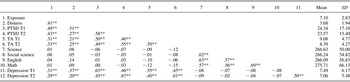
Means, standard deviations, and correlations among study variables

Note: PTSD, Posttraumatic stress disorder symptoms; T1, Time 1; T2, Time 2; TA, test anxiety.
*p = .05. **p = .01 (two tailed).
The sample was screened for exposure to traumatic experiences and distress related to Hurricane Katrina and PTSD symptoms at 24 months (Time 1, early Fall semester) and then again at 30 months (Time 2, late Spring) as part of a school-based initiative. Academic achievement was assessed via end of the school year (~31 months after Katrina) standardized test scores. The sample was aged 8–15 years (median age = 11.5 years) and was 55% male. Youths reported their ethnicities as 97% African American (n = 196), 2% mixed African American/other (n = 4), 1 as Caribbean American, and 1 as European American. The school serves youths predominantly from low-income families (school data indicate that 97% of the students receive free lunch, 2% are on a reduced payment, and 1% pays for lunch). Comparison of the youths who completed both the Time 1 and the Time 2 assessments versus the youths who only completed the Time 1 assessment revealed no statistically significant differences on Time 1 study variables of age, sex, ethnicity, exposure experiences, academic achievement, test anxiety, and PTSD symptoms.
Measures
Symptoms of PTSD were measured using a modified version of the Posttraumatic Stress Reaction Index for Children (PTSD-RI; Frederick, Pynoos, & Nadar, Reference Frederick, Pynoos and Nadar1992). The PTSD-RI is one of the most widely used instruments to assess posttraumatic stress reactions and thus allows easy comparison among studies. As done in previous research (Hensley & Varela, Reference Hensley and Varela2008; Vernberg et al., Reference Vernberg, La Greca, Silverman and Prinstein1996; LaGreca et al., Reference La Greca, Silverman, Vernberg and Prinstein1996), the PTSD-RI used in this study contains 20 items, with answer choices modified for ease of administration from the original five options to three options (none of the time, some of the time, and most of the time, which were coded as 0, 2, and 4, respectively). Total PTSD-RI scores thus range from 0 to 80. Internal consistency for the present sample was good (α Time 1 = 0.90, Time 2 = 0.89).
Test anxiety symptoms were assessed using a shortened version of the Test Anxiety Scale for Children (TASC; Sarason, Davidson, Lighthall, & Waite, Reference Sarason, Davidson, Lighthall and Waite1958). The TASC is a 30-item measure that has been used primarily in previous research for assessing test anxiety among school-aged children and adolescents (King, Mietz, Tinney, & Ollendick, Reference King, Mietz, Tinney and Ollendick1995; McDonald, Reference McDonald2001). This modified version of the TASC consists of 18 items and was designed to measure test anxiety in school-aged children and adolescents using a Yes (1) or No (0) response format, with youths being asked to report the presence/absence of test anxiety symptoms (e.g., “Do you worry a lot before you take a test?”). Total scores of test anxiety symptoms are derived from summing all the items, with total scores ranging from 0 to 18. Previous research has reported good internal consistency (α = 0.87) for assessing test anxiety symptoms in a predominately African American sample, as in the current study, using the 30-item version of the TASC (Carter, Williams, & Silverman, Reference Carter, Williams and Silverman2008). The internal consistency estimates (i.e., α coefficient) for total test anxiety scores of this modified version and with this particular sample were also good (α Time 1 = 0.85, Time 2 = 0.83).
The depression subscale of the Revised Child Anxiety and Depression Scales (RCADS; Chorpita, Yim, Moffitt, Umemoto, & Francis, Reference Chorpita, Yim, Moffitt, Umemoto and Francis2000; Spence, Reference Spence1997) was used to assess symptoms of depression. The RCADS depression scale has 10 items that assesses symptoms of depression based on DSM-IV criteria. The scale is scored 1 (never), 2 (sometimes), 3 (often), and 4 (always). The RCADS is an adaptation of the Spence Anxiety Scales (Spence, Reference Spence1997). Chorpita et al. (Reference Chorpita, Yim, Moffitt, Umemoto and Francis2000) modified the Spence scales for DSM-IV by adding the depression subscale and evaluated the RCADS by examining the measure's factorial validity in a school sample of 1,641 children and adolescents (aged 6.2–18.9 years) and its reliability and validity in an independent sample of 246 children and adolescents (aged 8.3–18.3 years). The results suggested an item set and factor definitions that were consistent with DSM-IV symptoms. Moreover, the RCADS demonstrated convergent validity with existing measures of childhood depression (Chorpita et al., Reference Chorpita, Yim, Moffitt, Umemoto and Francis2000). The internal consistency estimates (i.e., α coefficient) in this sample were also good (α Time 1 = 0.85, Time 2 = 0.81).
Academic achievement was constructed as a latent variable derived from scores of standardized test results. Specifically, the Louisiana Educational Assessment Program (LEAP—Grades 4 and 8 and iLEAP—Grades 5, 6, 7) scores were obtained from school records. The LEAP assesses four areas of academic achievement: English language arts, mathematics, science, and social studies competence (details are available at http://www.doe.state.la.us/lde/saa/2273.html). The four scores (English language arts, mathematics, science, and social studies) were used as observed variables to compose a latent construct of academic achievement. There are five achievement levels a student can earn on the LEAP and iLEAP: (a) advanced (i.e., superior performance beyond the level of mastery), (b) mastery (i.e., demonstrated competency over challenging subject matter and is well prepared for the next level of schooling), (c) basic (i.e., demonstrated only the fundamental knowledge and skills needed for the next level of schooling), (d) approaching basic (i.e., has only partially demonstrated the fundamental knowledge and skills needed for the next level of schooling), and (e) unsatisfactory (i.e., the student has not demonstrated the fundamental knowledge and skills). The average scores in this sample (Table 1) are in the published unsatisfactory and approaching basic range and are similar to most public schools in the area (http://www.doe.state.la.us/topics/interpreting_scores_leap.html). Students must score basic or higher in either English or math and approaching basic or higher in the other subject on the LEAP to advance to the next grade.
Traumatic stress was assessed from the two domains that define traumatic stress in DSM-IV (APA, 1994). These two domains are delineated as Criteria A in the DSM as exposure events (A1) and distress at the exposure events (A2). Exposure experiences (A1) and hurricane-related distress (A2) were assessed via a 16-item survey of exposure to the hurricane and its aftermath that was based on the work of La Greca et al. (Reference La Greca, Silverman and Wasserstein1998; Vernberg et al., Reference Vernberg, La Greca, Silverman and Prinstein1996). Common experiences were outlined above under Participants, and sample items include “Did you get hurt during the hurricane?” and “Was your home damaged badly or destroyed by the hurricane?” Respondents indicated Yes (1) or No (0) as to whether they were exposed to each event, and these were summed to make an exposure events (A1) score. To measure distress (A2), the survey also included two global assessments of the level of distress experienced during the storm and directly after the storm because for many youths the greatest distress was the flooding and related events that ensued after Katrina's landfall. The questions were, “Overall how scared or upset were you during the hurricane?” and “Overall how scared or upset were you after the hurricane?” They were scored from 0 (not at all) to 3 (a whole lot).
Procedures
Data collection was conducted as part of the school's counseling curriculum, and written informed consent for the use of the data in research was obtained from the parent (>90% response rate). Oral assent was obtained from the child. Children were not required to fill in the questionnaires or to participate; however, no youths declined. The institutional review board reviewed the procedures, and approval was obtained for the use of the de-identified data. The longitudinal database was created to help track and identify youths in need of school services; however, identifying information was removed from the data set for use in this study. Youths completed the measures in a group classroom setting and were assisted by trained staff. Younger children were read the instructions and each item by a staff member, and trained staff helped individual children as necessary as done in previous research (La Greca et al., Reference La Greca, Silverman, Vernberg and Prinstein1996; Vernberg et al., Reference Vernberg, La Greca, Silverman and Prinstein1996).
Results
Preliminary examination of the scores' ranges and skew indicated acceptable levels for the planned analyses. Pearson's correlations, means, and standard deviations for all the variables are presented in Table 1. In general, the pattern of correlations suggested significant associations among the distress, exposure, PTSD, and test anxiety variables with less strong and mostly nonsignificant associations with the individual indicators of academic achievement. However, there was a high degree of association among the academic achievement indicators. As shown in Table 1, exposure events (A1) and distress (A2) were both significantly related to initial (Time 1) PTSD symptoms and test anxiety. However, exposure events and distress were not significantly related to test anxiety at Time 1, controlling for Time 1 PTSD symptoms (exposure semipartial r 2 = .01, p > .1; distress semipartial r 2 = .003, p > .1), whereas both were significantly related to Time 1 PTSD symptoms, controlling for Time 1 test anxiety (exposure semipartial r 2 = .05, p < .001; distress semipartial r 2 = .10, p < .001). A similar pattern emerged for depression. Exposure events and distress were not significantly related to depression at Time 1, controlling for Time 1 PTSD symptoms (exposure semipartial r 2 < .001, p >.1; distress semipartial r 2 = .001, p > .1), whereas both were significantly related to Time 1 PTSD symptoms, controlling for Time 1 depression (exposure semipartial r 2 = .04, p < .001; distress semipartial r 2 = .05, p < .001).
In order to test the hypothesized model (see Figure 1) and test invariance across age and gender, structural equation modeling was conducted using AMOS 19.0 (Arbuckle, Reference Arbuckle1983–2010). In analyzing the fit statistics for model testing, multiple measures of fit were utilized (Kline, Reference Kline2006). The chi-square statistic (χ2) tests the hypothesis of perfect fit; that is, it evaluates whether there is any discrepancy between the observed data and the theoretical model, and so a nonsignificant χ2 is desired. The χ2 test is substantially affected by sample size; thus, in a large sample a small discrepancy can lead to a significant χ2. Consequently, both the root mean square error of approximation (RMSEA) and the comparative fit index (CFI) were also used to evaluate fit of the models. The CFI ranges from 0 to 1, with 0 indicating variation with no relation to the proposed factors and 1 indicating a perfect fit. The RMSEA also ranges from 0 to 1 and includes both a discrete value and a 90% confidence interval. The RMSEA denotes a perfect fit with 0.
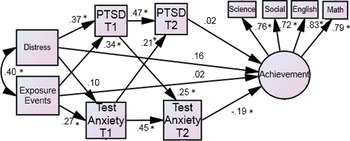
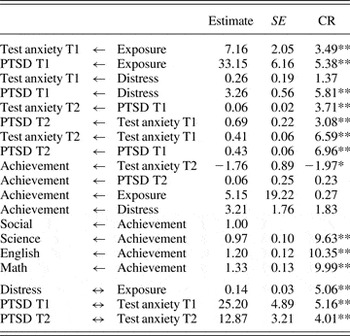
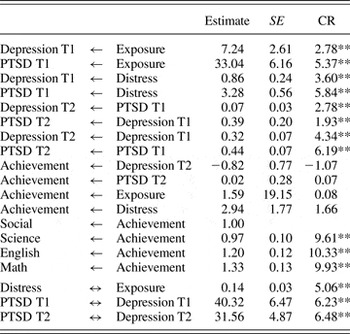
The results of the path analysis of the theoretical model are presented in Figure 2 and Table 2. The results suggested that the model provided very good fit to the data. The χ2 for the model was not statistically significant (χ2 = 29.43, df = 26, p > .1), and the fit indices indicated a good fit of the model to the data (CFI = 0.995, RMSEA = 0.026; 90% CI = 0–0.065). Standardized estimates are presented in Figure 2, and unstandardized estimates with standard errors and significance tests for the structural paths are provided in Table 2. The pattern of significant associations suggests that exposure was significantly associated with both PTSD symptoms and test anxiety at Time 1 (with a stronger association being found for PTSD symptoms). In contrast, only Time 1 PTSD symptoms were associated with distress. Time 1 PTSD was also associated with Time 2 test anxiety, and the link between distress/exposure and PTSD with academic achievement was indirect through their association with test anxiety at Time 2, consistent with model predictions. Following Hatzenbuehler, McLaughlin, and Nolen-Hoeksema (Reference Hatzenbuehler, McLaughlin and Nolen-Hoeksema2008), one-tailed Sobel testing (Sobel, Reference Sobel and Leinhart1982) suggests a significant indirect effect of PTSD at Time 1 on academic achievement via Time 2 test anxiety (z = 1.73, p < .05, one tailed), but not via time 2 PTSD (z = 0.23, p > .1, one tailed). There were also significant indirect effects from exposure events and distress to Time 2 test anxiety via time 1 PTSD symptoms (z = 3.05, p < .01 and z = 3.13, p < .01, respectively).
The structural equation model of the indirect effect of traumatic stress on academic achievement with standardized path coefficients. The asterisk indicates a significant path. [A color version of this figure can be viewed online at http://journals.cambridge.org/dpp]

Summary of estimates for test anxiety model

Note: CR, critical ratio; T1, Time 1; PTSD, posttraumatic stress disorder; T2, Time 2.
*p < .05. **p < .01.
To test specificity of test anxiety in the theoretical model's prediction of achievement, depression symptoms at Time 1 and Time 2 were substituted for test anxiety at Time 1 and Time 2, and the analysis was recalculated. The results suggested that the model again provided very good fit to the data (e.g., χ2 = 27.49, df = 26, p > .1 with similar fit indices; CFI = 0.998, RMSEA = 0.017; 90% CI = 0–0.061). The pattern of significant paths (see Table 3) was quite similar to the model with test anxiety in terms of relations to PTSD and traumatic stress; however, the path from distress to depression at Time 1 (standardized estimate = 0.27; p < .001) was significant and the path from depression at Time 2 to academic achievement was not significant (standardized estimate = –0.11; p > .1).
Summary of estimates for depression model

Note: CR, Critical ratio; T1, Time 1; PTSD, posttraumatic stress disorder; T2, Time 2.
**p < .01.
Next, gender and age variation in the fit of the test anxiety model was examined by testing invariance across boys and girls and across youths in grammar school, Grades 4–6, with youths in middle/junior high school, Grades 7–8 (similar analyses using age 12 as the cut point produced similar results and identical conclusions). The χ2 difference (Δχ2) test for boys and girls indicated that there was not a significant difference in the fully constrained model and one with the constraints removed, Δχ2 (12) = 8.73, p > .1, suggesting gender invariance. The χ2 difference test for grammar school age and middle school age youths indicated that there was a significant difference in the fully constrained model and one with the constraints removed, Δχ2 (12) = 39.11, p < .01. Following the recommendations of Byrne (Reference Byrne2001), we constrained one path at a time to identify grade level-related differences in the paths. This process identified one path that varied across the younger and older groups (i.e., in Figure 2 this is the path from test anxiety at Time 1 to test anxiety at Time 2). Allowing this path to vary (not constraining across younger and older youth) produced a nonsignificant χ2 difference, Δχ2 (11) = 17.85, p > .05, and fit was good (CFI = 0.98, RMSEA = 0.037; 90% CI = 0–0.06). The path from test anxiety at Time 1 to test anxiety at Time 2 was larger in the older youths (standardized βs = 0.67, p < .001) than in the younger youths (standardized βs = 0.25, p < .01).
Discussion
This study advances an understanding of the potentially insidious effects of disaster exposure on student achievement. The results were consistent with hypotheses derived from the theoretical model. Findings suggest that the association between traumatic stress and academic achievement was indirect via linkages to PTSD symptoms and test anxiety. Such findings are consistent with the idea that disaster-related traumatic stress exposure is related to general dysregulation (Marsee, Reference Marsee2008) and that this dysregulation may lead to a number of indirect effects. The model tested in this study posits that part of the dysregulation experienced by youths exposed to disaster-related stress may be an alteration of the normal anxiety response system in the form of PTSD symptoms (this finding is consistent with a large body of research; for a review, see, e.g., Weems & Overstreet, Reference Weems and Overstreet2008). This study adds unique findings consistent with the idea that disaster-related stress and PTSD symptoms may in turn impact anxious arousal in the form of test anxiety. The results further suggest that the model fit the data equally well for boys and girls and, although there did appear to be some developmental variation (grade level differences in the stability of test anxiety symptoms), the paths from PTSD symptoms at Time 1 to test anxiety at Time 2 and from test anxiety at Time 2 to academic achievement did not vary across grade level groupings.
The extant literature has presented linkages between traumatic stress exposure and academic difficulties, suggesting that the effect of exposure is largely a function of PTSD symptoms and not a direct effect of the traumatic stress (e.g., Saigh et al., Reference Saigh, Mroueh and Bremner1997). This study adds to this understanding in a sample of disaster-exposed youths and helps to show that the effect of disasters on academic achievement in the long term may sometimes be subtle and insidious rather than always clear and direct. Findings showing that the linkage from traumatic stress to academic achievement scores were a function of test anxiety rather than linking directly to PTSD symptoms (i.e., Time 2 test anxiety carried the effect of any relation between PTSD at Time 2 and achievement) highlight that what might be considered a relatively benign form of anxious emotion (test anxiety) should not be overlooked following disaster. Fortunately, research suggests that test anxiety interventions can be effectively administered in disaster-exposed youth, reducing test anxiety and potentially improving student grades (Weems et al., Reference Weems, Taylor, Costa, Marks, Romano and Verrett2009). Although interventions for test anxiety should not be considered an intervention of choice for severe emotional reactions to disaster such as PTSD, school-based programs and public policy for youths in the long-term aftermath of disaster might benefit from attention to a broad array of potentially negative emotional symptoms. Although replication of this study's findings is warranted before drawing firm policy implications, the results also highlight that the effect of disaster may be very long term (Yule et al., Reference Yule, Bolton, Udwin, Boyle, O'Ryan and Nurrish2000), and the evaluation of students and school success might usefully be couched in light of the potential indirect impact of disaster-related stress on academic evaluation.
The findings should be considered in light of the study's limitations, but the study's limitations should also be viewed in context. The goal of the study was not to examine predictors of school achievement in a traumatized group. The goal was to show the insidious link between trauma and school achievement (via trauma links to PTSD symptoms and later test anxiety) that may be otherwise overlooked (or unidentified) in direct models of the impact of disaster-related trauma. It is important to note that PTSD symptoms and test anxiety are not the sole reasons for negative school attainment, and findings should not be evaluated in terms of an attempt to identify the best predictors of school achievement. Thus, by its nature, the study is limited in that there are a number of factors not assessed in this study that could also be interfering with achievement. Although no single study can hope to capture all the potential influences a disaster may bring, future research is needed to further clarify the effects of natural disaster exposure on cognitive functioning.
The specificity to test anxiety was examined by testing a model that substituted depression. Although depression's relation to traumatic stress and PTSD symptoms was similar to that of test anxiety, depression did not link to academic achievement in the same manner as test anxiety. However, this study did not address the possibility of other mechanisms of poor achievement (such as cognitive) and the question “Are there more proximal mediators of the link between emotional difficulties and academic outcomes?” is left unanswered. For example, Sprung (Reference Sprung2008) found that intrusive thoughts were very common among a sample of youths (n = 145, aged 5–8 years) exposed to the Hurricane Katrina disaster. Sprung also found that a salient reminder (hurricane wind and rain sounds) altered the attention of youths who experienced major loss/disruption from the storm but not the attention of youths with little or no disruption. Reminders of a disaster may serve to focus attention away from neutral/positive cognitions and thus foster the salience of negative intrusive thoughts, thereby acting as an impairment to testing success.
It is also quite possible that students' test anxiety may have preceded the disaster, and their PTSD symptoms and preexisting test anxiety symptoms may be a vulnerability factor for PTSD symptoms (as have been found with trait anxiety; Weems, Pina, et al., Reference Weems, Piña, Costa, Watts, Taylor and Cannon2007). The same may be true for academic achievement. Thus, although the present study highlights the importance of potential emotional mechanisms of interference, additional work on the cognitive aspects of exposure to disaster is still needed. The study also relied on youth's self-reports for exposure, test anxiety, depression, and PTSD symptoms. It might be the case that reports from other sources (such as parents) would have resulted in different findings. However, youths have been consistently found to be valid reporters and sometimes better reporters of their own internalizing distress (see, e.g., Weems, Zakem, Costa, Cannon, & Watts, Reference Weems, Zakem, Costa, Cannon and Watts2005). Finding that self-reports were linked to academic achievement does suggest the usefulness of asking youths about their emotional symptoms in the wake of disaster. The need and utility of school-based mental health-related screenings for anxiety-related problems has been suggested as a cutting-edge step in prevention (see Fox, Halpern, & Forsyth, Reference Fox, Halpern and Forsyth2008), and the present results are consistent with this notion. Another limitation of the present study concerns the timing of the assessments. The impact of PTSD symptoms may be more direct at earlier time points following disaster, and we were not able to assess this possibility. Given that most schools in New Orleans did not reopen (0% of New Orleans public schools reopened immediately, 16% by January 2006, and 62% by November 2007; Liu & Plyer, Reference Liu and Plyer2007), this appears to be an inherent limitation of school-based research in the wake of a severe disaster like Katrina. The infrastructure of normal school conditions for data collection should not be assumed because the extent of disasters radically alters the context, and so this kind of data is incredibly difficult to obtain (likely the reason for so few published studies on this topic in major natural disasters to date). Finally, a limitation to generalizing results to other populations is that the study sample was composed of predominantly ethnic minority youth. Although this is a positive feature in that it extends the literature to a population that has been relatively understudied (Rabalais et al., Reference Rabalais, Ruggiero, Scotti, La Greca, Silverman, Vernberg and Roberts2002), inference to ethnic majority youths is less clear from this sample.