INTRODUCTION
Sulphonylurea herbicides are available in many forms and are widely used against broad-leaved weeds and other annual herbal weeds in wheat, soybean and maize fields, where they are considered highly effective. Chlorsulfuron is the earliest product of the sulphonylurea herbicide group. It acts by inhibiting acetolactate synthase (ALS), a key enzyme in the biosynthesis of branched-chain amino acids (valine, leucine and isoleucine).
Sulphonylureas are weak acids and easily undergo acid hydrolysis. In soils that are neutral to alkaline, they exist as anions and degrade very slowly (Sarmah et al. Reference Sarmah, Kookana and Alston1998). Black et al. (Reference Black, Pederson, Flynn, Moerkerk, Dyson, Kookana and Wilhelm1999) and Hollaway et al. (Reference Hollaway, Kookana, Noy, Smith and Wilhelm2006) found that most chlorsulfuron residue was located in the top 20 cm of soil. Studies in Queensland reported minimal carry-over of sulphonylureas in alkaline soils in a sub-tropical climate (Walker & Robinson Reference Walker and Robinson1996) and indicated that re-cropping was safe within 1 year of the application of chlorsulfuron (Osten & Walker Reference Osten and Walker1998).
However, some other studies have shown different results. A study by Stork (Reference Stork1995) found that chlorsulfuron persisted at least 18 months at Walpeup in Victoria and the herbicide was found at a depth of 50 cm (the maximum sampling depth in the study). Hollaway et al. (Reference Hollaway, Kookana, Noy, Smith and Wilhelm2006) reported that chlorsulfuron persisted for 3–5 years; it took 33–63 months to degrade to 1% (DT99) after treatment, depending on the site. Therefore, chlorsulfuron persists at levels that are potentially harmful to sensitive crops for 3–5 years in the alkaline soils of north-western Victoria and South Australia (Hollaway et al. Reference Hollaway, Kookana, Noy, Smith and Wilhelm2006). In a study from China, Zhang et al. (Reference Zhang, Zhang, Han and Liu2015) reported that as the half-life of chlorsulfuron in the soil is 21·4 days, it would theoretically take 271·8 days for chlorsulfuron to degrade to 0·2 µg/kg (below this amount is considered safe for rice roots). Chlorsulfuron has been used for several years in China and the soil in northern China is alkaline, so chlorsulfuron degrades slowly there. Due to these considerations, it is very important to study the effects of chlorsulfuron residues on the growth and metabolism of crops grown in subsequent years.
The main sources of cadmium (Cd), the most toxic heavy metal in soil, are industrial pollution, fertilizer contamination and wastewater irrigation. According to a European Communities survey conducted in 1975, 94% of Cd discharged into the environment is ultimately absorbed into the soil, after which it accumulates through food chains, threatening food security and human health (Lu et al. Reference Lu, Xiong and Shi1992).
Wastewater irrigation can alleviate the agricultural water shortage in the north-west, north-east and central parts of China. These areas are also the main grain-producing areas in China and the combined areas for crop production and mineral coal production in these regions covers c. 0·4 of the total cultivated land (Ma et al. Reference Ma, Zhang, Ma, Wang, Wang, Shao and Li2015). Studies in Taiyuan, China, a typical area that received close to 30 000 ha of sewage irrigation in the 1990s, showed that the main heavy metal pollutants in soil were Cd and mercury (Xie et al. Reference Xie, Fan, Zhou, Xie and Guan2011; Li Reference Li2012). Other studies found that Cd inevitably accumulates in the soil and that its concentration was 5·0 mg/kg soil in areas irrigated by sewage in China (Zeng & Zhu Reference Zeng and Zhu2005; Chen et al. Reference Chen, Zhao, Guo, Wang and Tian2013).
Farmers in China face a practical problem: herbicides are essential in agricultural production and wastewater irrigation is the only way to solve the shortage of water. However, herbicide residues may cause phytotoxicity to later crops and Cd in wastewater may also be toxic to plants. To date, studies have not reported how the combination of these two pollutants affects plants or whether heavy metals in the soil can aggravate or mitigate the damage caused by chlorsulfuron. Therefore, the current metabolomics study analysed the metabolites of maize seedlings using the Automated Mass spectral Deconvolution and Identification System (AMDIS) software (http://www.amdis.net/) coupled with gas chromatography–mass spectroscopy (GC–MS). The current study also determined the effects of chlorsulfuron and/or Cd pollution on the metabolic pathways of maize seedlings by comparing the amounts and types of metabolites in seedlings exposed to different treatments.
MATERIALS AND METHODS
Materials
Maize seeds (Qiangsheng 388) were obtained from Shanxi Qiangsheng Seed Co., Ltd. (Taiyuan, Shanxi, China). Soil was collected from 0 to 200 mm surface layer of an uncontaminated field at the Experimental Station of Shanxi Academy of Agricultural Sciences. The collected soil was dried at room temperature, gently crumbled, sieved through a 2 mm mesh and stored for further analysis. Soil properties were as follows: pH = 8·08; organic matter = 12·1 g/kg; cation exchange capacity = 25·4 cmol/kg; and texture (% by volume) = 24·7% clay, 32·9% silt and 42·4% sand. A commercial formulation of chlorsulfuron, 25% wettable powder, was used (Jiangsu Institute of Ecomones Co., Ltd., Jiangsu, China: Pesticide Registration Certificate no. PD20081325). For the Cd treatments, Cd chloride (CdCl2, from Chengdu XiYa Chemical Technology Co. Ltd., Chengdu, China) was used.
Experimental design
Continuous seed germination and seedling growth tests were performed by following ISO11269-2 (ISO 2013), with some modifications. A total of 48 plastic vessels were used, each containing 155 g (dry weight equivalent) of soil. Each vessel had a 90 mm top diameter, a 65 mm bottom diameter and a height of 65 mm, with a drain at the bottom. Chlorsulfuron, Cd, or a combination of the two were dissolved in water and added to the soil. Then, ten uniform undressed seeds were planted in each plastic vessel and covered with 40 g of soil. The soil moisture was checked by weighing several randomly selected pots daily. All experiments were performed under controlled conditions in an illumination incubator, at a constant temperature of 25 ± 2 °C, relative humidity between 40 and 60%, and a light cycle of 12/12-h (day/night) at 7000 lx on soil surfaces. This work was carried out three times and the results were stable.
The single-exposure experiments were performed with 0·001, 0·003, 0·005, 0·008, or 0·01 mg chlorsulfuron/kg soil or 5 mg Cd/kg. The levels of chlorsulfuron used were according to residue chlorsulfuron levels found in field research by Shan et al. (Reference Shan, Wang and Cai2001), which reported that the levels of chlorsulfuron were 0·005–0·013 mg/kg in soil after spraying at 15 and 30 g/ha. The level of Cd used was according to previous studies, which reported that Cd inevitably accumulates in the soil and that its concentration was 5·0 mg/kg soil in areas of China irrigated by sewage (Zeng & Zhu Reference Zeng and Zhu2005; Chen et al. Reference Chen, Zhao, Guo, Wang and Tian2013). The combination experiments were performed with 0·001, 0·003, 0·005, 0·008 or 0·01 mg/kg chlorsulfuron plus 5 mg Cd/kg. After 50% of the seedlings in the control group had emerged, emergence rates were determined. All experiments were carried out using six concentrations including the control, with four replicates per treatment: 48 test vessels in total. The remaining plants were harvested 3 weeks after application of the herbicide and Cd (according to the ISO11269-2 guidelines to terminate the test no sooner than 14 days and no later than 21 days after the emergence of 50% of the control seedlings), to analyse the residues of chlorsulfuron in maize seedlings and soil by ultra-high performance liquid chromatography and tandem mass spectrometry (UPLC–MS/MS) and to analyse the metabolites of maize seedlings by GC–MS.
Extraction of chlorsulfuron residues
To extract chlorsulfuron residues from seedlings, a 3·0 g sample of pulverized seedling was placed in a conical flask and 25·0 ml acetonitrile was added. The flask was placed in a shaker for 30 min, after which 2 g sodium chloride (NaCl) was added and the sample was sonicated for 10 min. The supernatant was transferred to a 50 ml flask. Next, 25·0 ml acetonitrile was added to the filter residue and it was sonicated for 10 min, after which the sample was combined with supernatant and evaporated to dryness at 40 °C using a rotary evaporator. The extracted dry samples were re-dissolved in acetonitrile and filtered into an auto-sampler vial with a 0·22 µm syringe filter, then analysed by UPLC–MS/MS.
To extract chlorsulfuron residues from soil, a 5 g soil sample was placed in a conical flask to which 25·0 ml buffer solution of methanol/sodium carbonate (pH = 9·0, 1 : 1, v/v) was added and shaken for 90 min. The supernatant was transferred to a separation funnel, 50 ml water was added and the pH was adjusted to <4·0 with 2 m phosphoric acid solution, after which 30 ml (15 ml × 2) dichloromethane was added to carry out liquid–liquid partitioning. The organic phase was dried using anhydrous sodium sulphate and evaporated to dryness at 40 °C using a rotary evaporator. The final extract was diluted with acetonitrile, filtered into an auto-sampler vial with a 0·22 µm syringe filter and then analysed by UPLC–MS/MS.
Analysis of chlorsulfuron residues via ultra-high performance liquid chromatography and tandem mass spectrometry
For UPLC–MS/MS (Waters, Acquity-Xevo TQ, Elstree, Hertfordshire, UK), the separation of chlorsulfuron was achieved on an Acquity-C18 analytical column. The mobile phase for UPLC–MS/MS analysis was a mixture of acetonitrile and water with 0·1% formic acid (v/v) flowing at 500 µl/min in gradient elution: 0–2 min, 90% acetonitrile and 10% water; 2–3·5 min, 5% acetonitrile and 95% water; 3·5–5 min: 90% acetonitrile and 10% water. The injection volume was 10 µl. The mass detection conditions utilized were a desolvation gas temperature of 450 °C, desolvation gas flow of 15 litres/min and capillary voltage of 3000 V. The MS/MS acquisition parameters (MRM mode) used for the quantification of the target compounds were (m/z) 358 > 140·8, cone (V) 25 V and collision (V) 25 V; and (m/z) 358 > 166·8, cone (V) 25 V and collision (V) 25 V.
Preparation of metabolite samples for gas chromatography–mass spectrometry
Plants were ground in liquid nitrogen and 60 mg of powder was extracted in a 10 ml centrifugal tube in 1 ml of methanol (CH3OH) and water (1 : 1). The extracts were vortexed, sonicated for 60 min and centrifuged at 4000 rpm for 20 min. Next, 100 µl of the supernatant was transferred to the sample vial and dried under a nitrogen stream. Thereafter, 50 µl of methoxamine hydrochloride in pyridine (20 g/l, 24 alkyl containing the internal standard 0·1 g/l) was added and derivatized at 37 °C for 90 min. The samples were then treated for 30 min with 50 µl BSTFA + 1% TMCS. Each derivatized sample was allowed to rest for 60 min prior to injection.
Analysis of metabolites via gas chromatography–mass spectrometry
Gas chromatography–mass spectrometry analysis was performed on a dual-stage quadrupole gas chromatography mass spectrometer (Thermo Fisher, Waltham, MA, USA). The 5% phemyl (equiv) polysilphenylene-siloxane (DB-5)MS capillary column (30 m × 0·25 mm internal diameter, 0·25 µm film thickness) was purchased from J & W Scientific (Folsom, CA, USA). The GC oven temperature was maintained at 50 °C for 1 min, increased to 100 °C at 10 °C/min and held for 1 min, increased to 200 °C at 10 °C/min and held for 1 min, and finally increased to 320 °C at 10 °C/min and held for 1 min. The temperature of the GC injection port and MS interface was set at 280 °C. Helium was used as the carrier gas and set at a constant flow rate of 1 ml/min. The mass selective detector was run in electron impact mode with electron energy of 70 eV. The ion source temperatures were set at a constant 200 °C. The analyses were performed in scan mode over a range of m/z values (50–650 m/z).
Statistical analysis
Values in the current study were the means of four replicate treatments. Statistical analyses were performed using the Statistical Package for the Social Sciences (SPSS) software (version 17). Poly-analysis of variance (POLYANOVA) was performed with the general linear model. Significant differences between the treatments were statistically evaluated by standard deviation and Student's t test methods.
RESULTS
Maize seedling growth (data not shown)
No plant growth inhibition was observed in the short-term, but over time the growth and development of maize seedlings was inhibited (P < 0·05). Higher chlorsulfuron levels inhibited shoot growth more severely after 21 days, with inhibitory rates ranging from 28 to 67% after exposure to 0·001, 0·003, 0·005, 0·008 and 0·01 mg/kg chlorsulfuron in test soil. Chlorsulfuron also significantly (P < 0·05) impaired root growth. Even at the very low concentration of 0·001 mg/kg, chlorsulfuron reduced root length by 50%.
Cadmium at 5·0 mg/kg had no significant effect on shoot elongation, but it did enhance root growth (P < 0·05).
The combination of chlorsulfuron and Cd inhibited shoot length from 4·52 to 14·24 cm, which was not significantly different from the results of a single chlorsulfuron exposure.
Accuracy of method
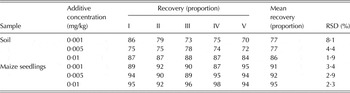
In order to evaluate the fortified recovery, precision and limits of detection of the analytical method, standard chlorsulfuron was added to blank samples of soil and maize seedlings at three different dosages (0·001, 0·005 and 0·01 mg/kg), with five replicates for each dosage. For all concentrations, the mean recovery proportion of chlorsulfuron was satisfactory, ranging from 77 to 95, with relative standard deviations ranging from 2·3 to 8·1%. These recovery values indicated good method accuracy and repeatability (Table 1).
The recoveries and relative standard deviation (RSD) at three application levels of chlorsulfuron

Analysis of residues of parent chlorsulfuron
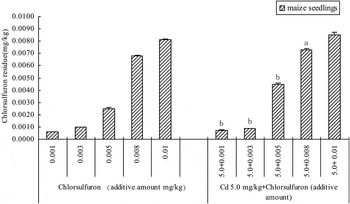
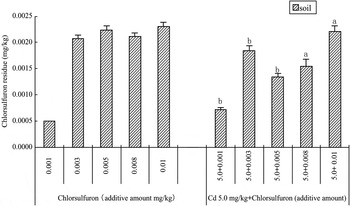
Parent chlorsulfuron residues in maize seedlings and soil were detected on the 21st day after the herbicide was applied to soil. The amounts of chlorsulfuron residues in maize seedlings were correlated (R 2 = 0·9163, P < 0·05) with the dose applied to the soil, but the dose applied to the soil was not correlated with the residue in the soil (R 2 = 0·7340, NS). In the combination treatment, chlorsulfuron residues in maize seedlings and soil were detected on the 21st day after the application of chlorsulfuron and Cd to soil. A positive correlation (R 2 = 0·9341, P < 0·01) was shown between the amounts of chlorsulfuron residue in maize seedlings and in soil, but not between the additive dose to soil and the amount of residue. The amounts of residue in maize seedlings and soil are shown in Figs 1 and 2.
The residue of chlorsulfuron in maize seedlings 21 days after application. §: (a) P < 0·05, (b) P < 0·01 using t test (two-tail) to compare result with chlorsulfuron.

The residue of chlorsulfuron in soil 21 days after chlorsulfuron and cadmium application. §: (a) P < 0·05, (b) P < 0·01 using t test (two-tail) to compare result with chlorsulfuron.

The residue data indicated that herbicide absorption in maize seedlings was 60–91%. Compared with chlorsulfuron alone, the combination of chlorsulfuron and Cd clearly promoted the absorption of chlorsulfuron in plants for all chlorsulfuron treatment levels from 0·001 to 0·008 mg/kg. For the 0·01 mg/kg level of chlorsulfuron, however, there was no difference between chlorsulfuron alone and the combination treatment. As the concentration of chlorsulfuron increased in soil, the amount of chlorsulfuron absorbed by maize seedlings increased. In addition, increasing chlorsulfuron concentration was associated with greater reductions in seedling growth especially in terms of leaf length and plant height.
In soil, the residues measured 21 days after application of chlorsulfuron to the soil were 0·20–0·70 of the initial concentrations applied. For the five different doses of the chlorsulfuron treatment alone, chlorsulfuron residues were 0·50, 0·70, 0·44, 0·26 and 0·23 of the initial concentrations applied, respectively. For the combination treatment, chlorsulfuron residues were 0·70, 0·60, 0·26, 0·20 and 0·22 of the initial concentrations, respectively. As the concentrations in soil increased, the residues in soil decreased. Therefore, increasing chlorsulfuron concentrations in soil enhanced the amount of herbicide absorbed by maize seedlings.
The total amount of chlorsulfuron residues in maize seedlings and soil was up to 0·94 of the amount added to soil, so the amount of chlorsulfuron that degraded was considered negligible.
All chlorsulfuron residue results indicated that maize seedlings could absorb chlorsulfuron from soil, even if only very small amounts of chlorsulfuron were present, and the presence of Cd promoted the absorption of chlorsulfuron in maize seedlings. Moreover, the root growth of seedlings was evidently inhibited even when only very low amounts of chlorsulfuron were added to soil.
Data pre-processing with automated mass spectral deconvolution and identification system
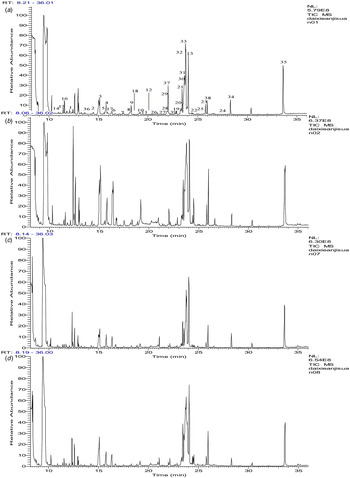
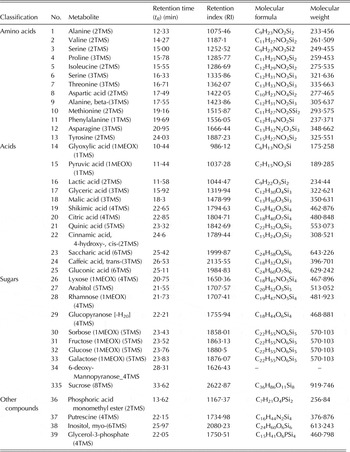
The obtained chromatograms were transferred from GC–MS to AMDIS. Background noise and matrix interferences were removed from the raw data using the AMDIS deconvolution procedure. Further data processing was carried out in two steps. First, the retention index was calculated for all the compounds present in the metabolite profile using calibration files that contained the retention time (t R ) and retention index (RI) values of the 39 selected compounds present in each analysed sample (Table A1 in the Appendix). Next, a more rigorous frequency condition was applied to the data set: only compounds present in 0·60 or more of the studied samples were retained, according to the Glom Metabolome Database. The GC–MS analysis identified 39 metabolites in maize seedlings, including 13 amino acids, 10 sugars, 12 organic acids and four other compounds. Representative chromatograms of metabolites in maize seedlings under different types of stress are presented in Fig. 3.
Exemplary chromatograms of metabolites in maize seedlings. (a) Control treatment; (b) chlorsulfuron treatment; (c) cadmium treatment; (d) combination of chlorsulfuron and cadmium treatment.

Results of Poly-Analysis of variance
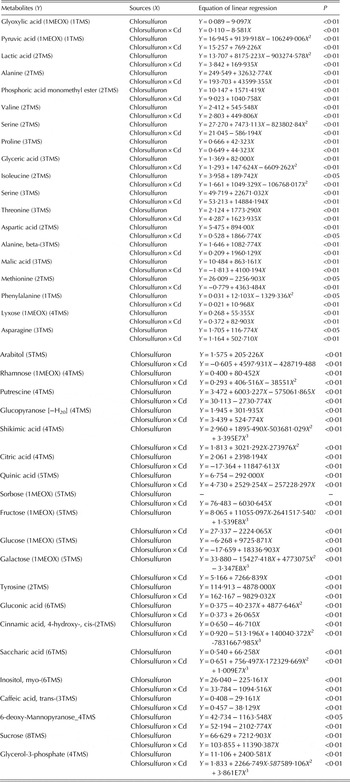
A poly-ANOVA was conducted using SPSS to find the sum of squares (SS), d.f., mean squares and significance (Appendix, Table A2). P values for chlorsulfuron × Cd were < 0·05. The linear/non-linear regression equations and P values for chlorsulfuron and chlorsulfuron × Cd are shown in Table A3 in the Appendix.
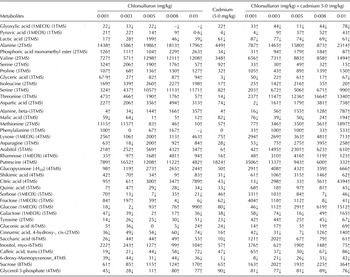
The results of linear/non-linear regression indicated that a positive correlation (P < 0·05) was shown between some metabolites (alanine, aspartic acid, threonine, serine, isoleucine, glyceric acid, proline, valine, phosphoric acid monomethyl ester, beta-alanine, malic acid, lyxose, asparagine, arabitol, rhamnose, glucopyranose, shikimic acid, citric acid, glucose, galactose, gluconic acid, cinnamic acid, saccharic acid, sucrose, glycerol-3-phosphate) and the level of chlorsulfuron, while a negative correlation (P < 0·05) was shown between others (glyoxylic acid, lactic acid, methionine, quinic acid, tyrosine, inositol, caffeic acid, 6-deoxy-Mannopyranose) and the level of chlorsulfuron. Moreover, these other metabolites had non-linear correlations with the level of chlorsulfuron, such as pyruvic acid, serine, phenylalanine, putrescine, shikimic acid, galactose, gluconic acid.
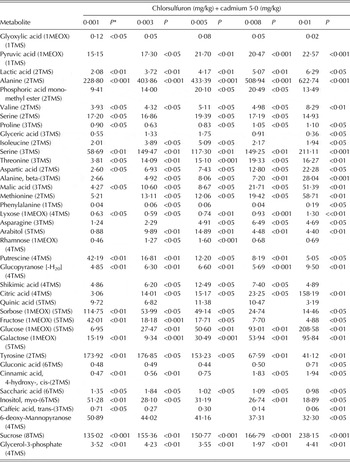
The chlorsulfuron–Cd complex also had positive effects (P < 0·05) on some metabolites (pyruvic acid, lactic acid, alanine, phosphoric acid monomethyl ester, valine, proline, serine, threonine, aspartic acid, beta-alanine, malic acid, methionine, phenylalanine, lyxose, asparagine, glucopyranose, citric acid, glucose, galactose, tyrosine, gluconic acid, sucrose) and negative effects (P < 0·05) on others (glyoxylic acid, serine, putrescine, sorbose, fructose, tyrosine, inositol, caffeic acid, 6-deoxy-mannopyranose). However, some metabolites (glyceric acid, isoleucine, rhamnose, shikimic acid, quinic acid, cinnamic acid, saccharic acid and glycerol-3-phosphate) had a non-linear correlation with chlorsulfuron–Cd.
Changes in metabolites under chlorsulfuron stress
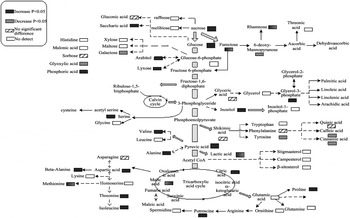
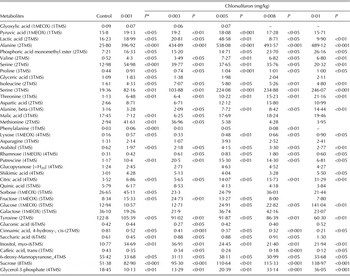
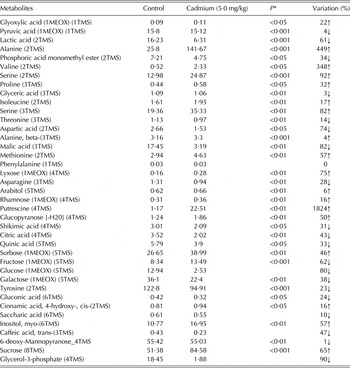
Chlorsulfuron treatment prompted a large increase in all amino acids except tyrosine (Tyr), asparagine (Asn) and methionine (Met) (Appendix, Table A4). Alanine (Ala) increased more than 15-fold as a result of chlorsulfuron treatment. The current data indicated that the amount of branched-chain amino acids such as isoleucine and valine rose compared with those in the control group, by 169–339% and 571–1208%, respectively (Appendix, Table A5). The amount of Met increased by 1315–1157% under the lowest dose of chlorsulfuron, but as the dose increased, the rates of increase fell by 83–10% (Appendix, Table A5). Threonine was increased by chlorsulfuron (i.e. this amino acid behaved antagonistically to Met; see Fig. 4). Increasing chlorsulfuron was associated with a decrease of 14–51% in Tyr (Appendix, Table A5) but caused no marked changes in phenylalanine (Phe). Caffeic acid and cinnamic acid also decreased, by 19–72% and 36–74%, respectively (Appendix, Table A5), but there was no marked change in quinic acid.
Changes of metabolites in maize seedling under chlorsulfuron stress.

A variety of plant sugars increased significantly (P < 0·05) under chlorsulfuron stress. Lyxose and arabitol increased by 106–463% and 218–569%, respectively (i.e. these sugars behaved antagonistically to galactose; see Fig. 4). The decrease in galactose levels may reduce maize quality, because galactose is a main carbohydrate. The increase in glucose levels was accompanied by strong decreases in fructose, rhamnose and 6-deoxy-mannopyranose.
The amount of inositol increased by 99–243% under chlorsulfuron stress. Moreover, proline and putrescine were also increased by chlorsulfuron, reactions that are associated with resistance. After exposure to chlorsulfuron, there were significant changes in the amounts of citric acid and malic acid, which are main organic acids in the tricarboxylic acid cycle (TCA). As chlorsulfuron in soil increased, citric acid increased (by 95–789%) and malic acid first declined (by 59–64%) and then increased (by 1–12%) (Fig. 4, Appendix Tables A4 and A5).
Changes in metabolites under combined chlorsulfuron and cadmium stress
Unlike chlorsulfuron or Cd alone (Appendix, Table A6), the combination of chlorsulfuron and Cd caused an increase of 61–315% in shikimic acid (Appendix, Table A5): Phe also increased but Tyr decreased. Moreover, amounts of quinic- and cinnamic-acid, both derived from Phe, were negatively correlated with the combined treatment (Appendix, Table A7).
Asparagine did not change significantly after exposure to chlorsulfuron stress, but it decreased markedly under Cd stress and increased markedly under chlorsulfuron–Cd stress. Moreover, glyceric acid was also affected differently by different treatments: it increased (by 27–94%) under chlorsulfuron stress, decreased (by 3%) under Cd stress, and decreased (by 50 and 67%, Appendix, Table A5) in response to the lowest and highest application levels, respectively, of chlorsulfuron. However, it increased in response to an intermediate application of chlorsulfuron combined with Cd stress. The chlorsulfuron–Cd complex affected the maize seedlings most when chlorsulfuron amounts were lowest and highest.
Of note, triphosphate glycerol increased markedly (by 11–80%) under high chlorsulfuron stress but decreased significantly (by 90 and 76–89%, P < 0·05) under both Cd stress and combined chlorsulfuron–Cd pollution. The chlorsulfuron–Cd complex may reduce the amount of secondary metabolites derived from triphosphate glycerol, namely linolenic acid, linoleic acid and hexadecenoic fatty acids.
The effects of chlorsulfuron–Cd pollution on malic- acid and citric-acid in the TCA were similar to the effects of chlorsulfuron pollution alone (Appendix, Tables A3–A7).
DISCUSSION
Some studies have reported that the chlorsulfuron parent compound previously bound to soil matrices could be re-released and transformed into methanol extractable residue during the course of plant growth (Khan Reference Khan1982; IAEA 1986; Dec & Bollag Reference Dec and Bollag1988; Ye et al. Reference Ye, Wu and Sun2004). Ye et al. (Reference Ye, Wu and Sun2004) also concluded that the molecular compound causing phytotoxicity in rape and rice is the parent compound. In order to study whether plants absorb the herbicide when it is present at very low levels in soil, it is necessary to understand whether the degradation of chlorsulfuron in soil and/or the presence of Cd promotes the absorption of chlorsulfuron by plants.
The data on residues of chlorsulfuron in maize seedlings and soil showed a positive correlation between addition of the herbicide to soil and its residues in seedlings. The presence of Cd promoted chlorsulfuron absorption by maize seedlings.
Various metabolites in maize seedlings under chlorsulfuron or/and Cd stress were separated and determined using GC–MS and 39 metabolites were identified using the deconvolution technique.
The results of Between-Subjects Effects indicated that there was a significant interaction between chlorsulfuron and Cd on metabolites in maize seedlings.
A few studies have reported the effects of chlorsulfuron on maize growth and development in the field. He & Sun (Reference He and Sun1993) reported that chlorsulfuron did not affect the germination of maize, a finding that was consistent with the current results. He & Sun (Reference He and Sun1993) also found that chlorsulfuron (applied at 7·5 g/ha to control weeds in a wheat field) had no effect on the subsequent maize in the whole principal growth stage (i.e. from germination to maturity of seed) 120 days after the herbicide was applied. However, when chlorsulfuron was applied at a higher dosage of over 22·5 g/ha in the same experiment the residue caused phytotoxicity to maize seedlings (He & Sun Reference He and Sun1993). In the current study, chlorsulfuron significantly inhibited root growth, as also reported in a previous study (Giardina & Carosi Reference Giardina and Carosi1990).
Metabolomics has been used to solve food quality problems in fruits and other plants and to explore pesticide, genotype and environmental effects on plant growth (Spraul et al. Reference Spraul, Schütz, Humpfer, Mörtter, Schäfer, Koswig and Rinke2009; Zhang et al. Reference Zhang, Breksa, Mishchuk, Fake, O'Mahony and Slupsky2012; Bernillon et al. Reference Bernillon, Biais, Deborde, Maucourt, Cabasson, Gibon, Hansen, Husted, de Vos, Mumm, Jonker, Ward, Miller, Baker, Burger, Tadmor, Beale, Schjoerring, Schaffer, Rolin, Hall and Moing2013; Pereira et al. Reference Pereira, Figueiredo, Barros, Dias, Santos, Duarte and Gil2014); to understand geographical and transgenic effects (Son et al. Reference Son, Hwang, Kim, Ahn, Park, Van Den Berg, Hong and Lee2009; Sobolev et al. Reference Sobolev, Capitani, Giannino, Nicolodi, Testone, Santoro, Frugis, Iannelli, Mattoo, Brosio, Gianferri, D'Amico and Mannina2010; Picone et al. Reference Picone, Mezzetti, Babini, Capocasa, Placucci and Capozzi2011; Kausch et al. Reference Kausch, Sobolev, Goyal, Fatima, Laila-Beevi, Saftner, Handa and Mattoo2012; Kim et al. Reference Kim, Jung, Song, Bong, Ryu, Lee and Hwang2013); and to reveal the effects of environmental contaminants (Karmakar et al. Reference Karmakar, Bhattacharya and Kulshrestha2009; Hédiji et al. Reference Hédiji, Djebali, Cabasson, Maucourt, Baldet, Bertrand, Boulila Zoghlami, Deborde, Moing, Brouquisse, Chaïbi and Gallusci2010; Beni et al. Reference Beni, Marconi, Boccia, Ciampa, Diana, Aromolo, Sturchio, Neri, Sequi and Valentini2011; Zhang et al. Reference Zhang, Breksa, Mishchuk, Fake, O'Mahony and Slupsky2012). In the current study, it was used to examine the individual and combined effects of chlorsulfuron and Cd on maize seedlings.
The primary action target of chlorsulfuron and other sulphonylurea herbicides is ALS, the enzyme specifically involved in branched-chain amino acid biosynthesis (Fan et al. Reference Fan, Qian, Yu, Chen, Li and Wang2003; Zabalza et al. Reference Zabalza, Orcaray, Gaston and Royuela2004, Reference Zabalza, Gonzalez, Arrese-Igor and Royuela2005; Zhou et al. Reference Zhou, Liu, Zhang and Liu2007; Orcaray et al. Reference Orcaray, Igal, Marino, Zabalza and Royuela2010, Reference Orcaray, Igal, Zabalza and Royuela2011). However, the current results indicated that the amounts of branched-chain amino acids such as isoleucine and valine rose compared with those in the control group. One possible reason is that the synthesis of branched-chain amino acids was inhibited under stress because protein decomposition in maize seedlings occurred faster than protein synthesis, resulting in increased amino acid levels.
Previous studies reported that the most obvious effects of chlorsulfuron were reduced root growth in Pisum sativum, Phaseolus vulgaris and Vicia faba (Fayeaz & Kristen Reference Fayeaz and Kristen1996; Deng Reference Deng2005) and an increase in the amount of proline (Fayeaz & Kristen Reference Fayeaz and Kristen1996). It has also been observed that chlorsulfuron inhibited root growth and increased proline in maize seedlings. Putrescine is a polyamine that regulates plant growth and development and improves resistance (Song et al. Reference Song, Diao and Qi2012). In the current study, putrescine accumulated in chlorsulfuron-treated groups, consistent with a previous study that reported putrescine accumulation, and chlorsulfuron also inhibited spermidine accumulation in the mitotic tissues of root tips (Giardina & Carosi Reference Giardina and Carosi1990). The consistent changes of putrescine derived from α-ketoglutarate in the TCA in the three treatment groups indicated that all three treatments produced toxic effects on maize seedlings, causing considerable accumulation of putrescine associated with stress tolerance.
Inositol is an important chemical compound that participates in a variety of metabolic regulation activities, such as formation of phytic acid storage substances, regulation of plant cell resistance, promotion of seed dehydration and modification of auxins, as well as being involved in cell wall composition (Yu et al. Reference Yu, Qin, Zhang, Liang, Song, Zhao, Tsuge, Aoyama, Liu, Gu and Qu2011). The increase in inositol was accompanied by an increase of chlorsulfuron, indicating that the maize seedlings were experiencing chlorsulfuron stress.
Phenylalanine is an important precursor in the production of phenolic substances via the shikimic acid pathway. Chlorsulfuron reduced the amounts of phenylalanine, tropinone, ф-tropine and tropine in jimsonweed seedlings when it was applied at a high concentration of 10−5 m (Deng Reference Deng2005). Recent studies have shown that ALS inhibitors and glyphosate share several physiological aspects in their modes of action (Orcaray et al. Reference Orcaray, Igal, Marino, Zabalza and Royuela2010, Reference Orcaray, Zulet, Zabalza and Royuela2012), suggesting that there is cross-regulation between the two biosynthetic pathways. However, the current study did not find that chlorsulfuron caused a significant reduction in phenylalanine; perhaps the form used or the concentration of herbicide that came in contact with the plants differed from those in previous studies. Also, Cd did not significantly influence the amount of phenylalanine in maize seedlings. Zabalza et al. (Reference Zabalza, Amaia, Gil-Monreal, Igal and Royuela2013) found that ALS inhibitors induced a short-term accumulation of the total free amino acid pool in both leaves and roots, including the amount of branched-chain acids in roots. The current study obtained similar results, implying that the protein decomposition of maize seedlings occurred faster than its synthesis in plants under stress, resulting in an increase in the amounts of branched-chain amino acids (Orcaray et al. Reference Orcaray, Igal, Marino, Zabalza and Royuela2010).
Under stress, plants respond with a series of resistance reactions, such as producing reactive oxygen species, signal transduction molecules and resistance-related proteins and metabolites (Qi et al. Reference Qi, Chen and Wang2011). These reactions all require a great deal of energy, so the energy metabolism is significantly enhanced by stress. Carbohydrate accumulation in the leaves and roots is a general physiological effect of ALS inhibition (Zabalza et al. Reference Zabalza, Orcaray, Gaston and Royuela2004).
In the current study, the amount of sucrose increased in plants that were exposed to chlorsulfuron or/and Cd. The amount of glucose also increased in plants that received chlorsulfuron and combination treatments, perhaps associated with the increase in energy metabolism. The increase in sucrose also suggests that it was being transported from the leaves to the roots at a higher rate than it was being utilized. Under these conditions, the sugar gradient required for long-distance transport is abolished; thus, phloem transport is inhibited, suggesting that the carbohydrate accumulation in the leaves of treated plants reflects a reduction in sink strength (Zabalza et al. Reference Zabalza, Amaia, Gil-Monreal, Igal and Royuela2013).
Rhamnose is a component of the plant cell wall pectin polysaccharide (Wang et al. Reference Wang, Ji, Jiang, Shen, Fan and Zhang2009). In plants exposed to chlorsulfuron, the amount of rhamnose obviously increased, indicating that chlorsulfuron inhibited root growth, leading to rhamnose accumulation in maize seedlings. Chlorsulfuron alone and combined with Cd caused arabitol accumulation in maize seedlings. However, Cd alone did not influence the amounts of arabitol and glucose in plants. Arabitol and glucose are also the ingredients of plant cells, and it may be inferred that Cd improved root growth, a process that consumed glucose and arabitol.
Of note, the increased ratio of Ser in plants exposed to the combination treatment was lower than in plants exposed to chlorsulfuron or Cd alone. Ser is crucial for the regulation of methyl group transfer in tetrahydrofolate metabolism, during which it contributes C1 units (Hanson & Roje Reference Hanson and Roje2001; Hanson & Gregory Reference Hanson and Gregory2011). Several studies have suggested that L-Ser is involved in the plant response to biotic and abiotic stresses (Ho & Saito Reference Ho and Saito2001; Waditee et al. Reference Waditee, Bhuiyan, Hirata, Hibino, Tanaka, Shikata and Takabe2007; Benstein et al. Reference Benstein, Ludewig, Wulfert, Wittek, Gigolashvili, Frerigmann, Gierth, Flügge and Krueger2013). Liu et al. (Reference Liu, Zhu, Li and Wang2010) reported that exogenous Ser can induce the aging signal, so Ser accumulation in single treatments may advance the aging process. Moreover, the variation in Met were consistent with those of Ser. Met is an important precursor for the synthesis of ethylene, the accumulation of which can inhibit plant growth. However, the combination of chlorsulfuron and Cd slowed the accumulation ratio of Ser and Met, further retarding the aging process in maize seedlings.
Changes in metabolites of maize seedlings under chlorsulfuron or/and Cd treatment indicated that Cd elicited significant changes in plant metabolism at a concentration that did not impair plant growth. The current work also found that chlorsulfuron and Cd did not have a synergistic effect on maize seedlings; in contrast, they had an antagonistic effect on some amino acids. This result is contrary to expectations, but from this result it can be inferred that Cd may reduce the phytotoxicity of herbicides in maize seedlings. Whether application of some trace heavy metal, such as zinc, copper or iron, at levels that are not toxic to humans can reduce herbicide toxicity remains to be further studied.
Future studies should repeat this work over a longer term, to take the slow action of the sulphonylurea herbicides into consideration. The experiment should also be repeated in the field to study the effect of lower residue of chlorsulfuron and Cd on the production and quality of maize.
This research was supported by grants from the National Natural Science Foundation of China (No. 30740037), the Special Fund for Agro-scientific Research in the Public Interest (No. 201103024), and the Foundation for Graduate Innovation, Shanxi University (No. 011452901009).
Appendix
Qualitative analysis of metabolites in maize seedlings using gas chromatography–mass spectroscopy

Tests of between-subjects effects

Linear regression equations between metabolites and chlorsulfuron/chlorsulfuron-cadmium (Cd)

Metabolites in maize seedlings under chlorsulfuron stress (mg/g dry weight)

Comparison of metabolite variations (%) in maize seedlings under control and stress conditions

Metabolites in maize seedlings under cadmium stress (mg/g dry weight)

Metabolites in maize seedlings under combined chlorsulfuron and cadmium stress (mg/g dry weight)