In the past 2 decades, infectious disease outbreaks have shed light on the importance of national and international preparedness for an unexpected health crisis. Reference Taschner, Nannini and Laccetti1–Reference Khan, O’Sullivan and Brown3 Global influenza, Ebola, Zika, dengue fever, 4 and the current coronavirus disease 2019 (COVID-19) pandemic showed how the rapid spread of the virus could raise global fear and panic. Reference Check Hayden5–Reference Chang, Ortiz and Ansari9 The recent pandemic of COVID-19 is a wake-up call for all countries to be well-prepared in the face of any infectious disease outbreak. Preparedness is vital to avoid overwhelming health systems during a health crisis. Unprepared countries are a potential source for the spread of diseases and become a burden on international health and political communities. Infectious disease outbreaks caused by viruses such as Zika, Ebola, coronavirus, influenza, COVID-19, and others have been declared a health emergency by the World Health Organization (WHO). 10
The WHO defined the term “public health emergency preparedness” (PHEP) as “the capability of the public health systems to prevent, protect against, quickly respond to, and recover from PHEs”. Reference Nelson, Lurie and Wasserman11 In 2018, the WHO has developed a shortlist of high-priority pathogens that included Ebola virus disease (EVD), Middle East respiratory syndrome coronavirus (MERS-CoV), severe acute respiratory syndrome (SARS), and Zika. Reference Mehand, Al-Shorbaji and Millett12 In 2019, the WHO has published the top 10 global health threats for the coming decade. 13 The report included a list of severe viral infections and related topics such as vaccine hesitancy and fragile health systems. Most items listed in the 2019 WHO report are important targets in both Millennium Development Goals and Sustainable Development Goals. Reference Sachs14,Reference Allegranzi, Kilpatrick and Storr15 An international conference held in Lyon (France) on preparedness for public health emergencies designated 2019 as “Year of action on preparedness for health emergencies”.
Research activity on preparedness for infectious disease outbreaks is one possible indicator of local, regional, and international communities to face a future health crisis. In the current study, the authors investigated the research trends and patterns on health system preparedness for specific viral infectious disease outbreaks that caused regional or global health emergencies. The selected infectious diseases included dengue, Zika, Ebola, influenza, and coronaviruses. The current study aimed to give researchers, academics, policy-makers an overview of literature focusing on health system preparedness for viral infectious disease outbreaks.
Methods
The present study used SciVerse Scopus to retrieve relevant documents for the merits it has over other databases. Reference Falagas, Pitsouni and Malietzis16 Furthermore, SciVerse Scopus allows for citation analysis and has several functions that facilitate data analysis. The study’s selected period was from January 1, 2001, to December 1, 2020. The period was selected based on the idea that several fatal outbreaks have been witnessed in the past 2 decades. Reference Bloom and Cadarette17,Reference Aris-Brosou, Ibeh and Noel18
The keyword preparedness, or readiness, was entered in the title search. The selected viral diseases were also entered in the title search. The selected infectious diseases were dengue, Zika, Ebola, coronavirus, and influenza. The coronavirus included the current COVID-19 and the previous outbreaks of SARS and MERS-CoV. To make sure that the retrieved papers pertain to the health system, the following terms were added to the search query in the title/abstract: “health system”, “health service”, “health policy”, hospital, “health facility”, “acute care”, “critical care”, “emergency department*”, “health organization”, “health institution”, “primary health care”, “primary health”, “general practice”, “Pharmacy service”, “pharmacy system”, “medication availability”, “vaccine availability”, “healthcare”
The search query was validated for the absence of false-positive by a review process carried out by colleagues in the biomedical field. The search query was modified based on the response of the reviewers. The search query was finalized when the reviewers confirmed the absence of any false-positive results. Validation of the search query for the absence of false-negative results was carried out by using the journal Disaster Medicine and Public Health Preparedness as a reference. The number of documents published in the reference journal on health system preparedness for the selected diseases (n = 22) compared with the number of documents for the same journal retrieved through the search query (n = 21). The result suggests that the search query was capable of returning more than 95% of relevant research articles.
The data obtained by the search query was exported as (csv) file to Microsoft Excel for analysis. The exported data include titles, abstracts, authors, names of journals, author keywords, list of contributing countries, list of contributing institutions, and the number of documents published each year.
The current study presented bibliometric indicators and maps. Bibliometric indicators included top active countries, institutions, journals, and citations. Bibliometric mapping was used to map the most frequent author keywords, most frequent terms in the titles and abstracts, and international research collaboration. Bibliometric maps were created using VOSviewer free online program. Reference van Eck and Waltman19
Results
The search query returned 501 documents. Research articles (n = 329; 65.7%) were the most common type followed by review articles (n = 75; 15.0%). The remaining types included letters, notes, editorials, conference papers, and short surveys (n = 97; 19.4%).
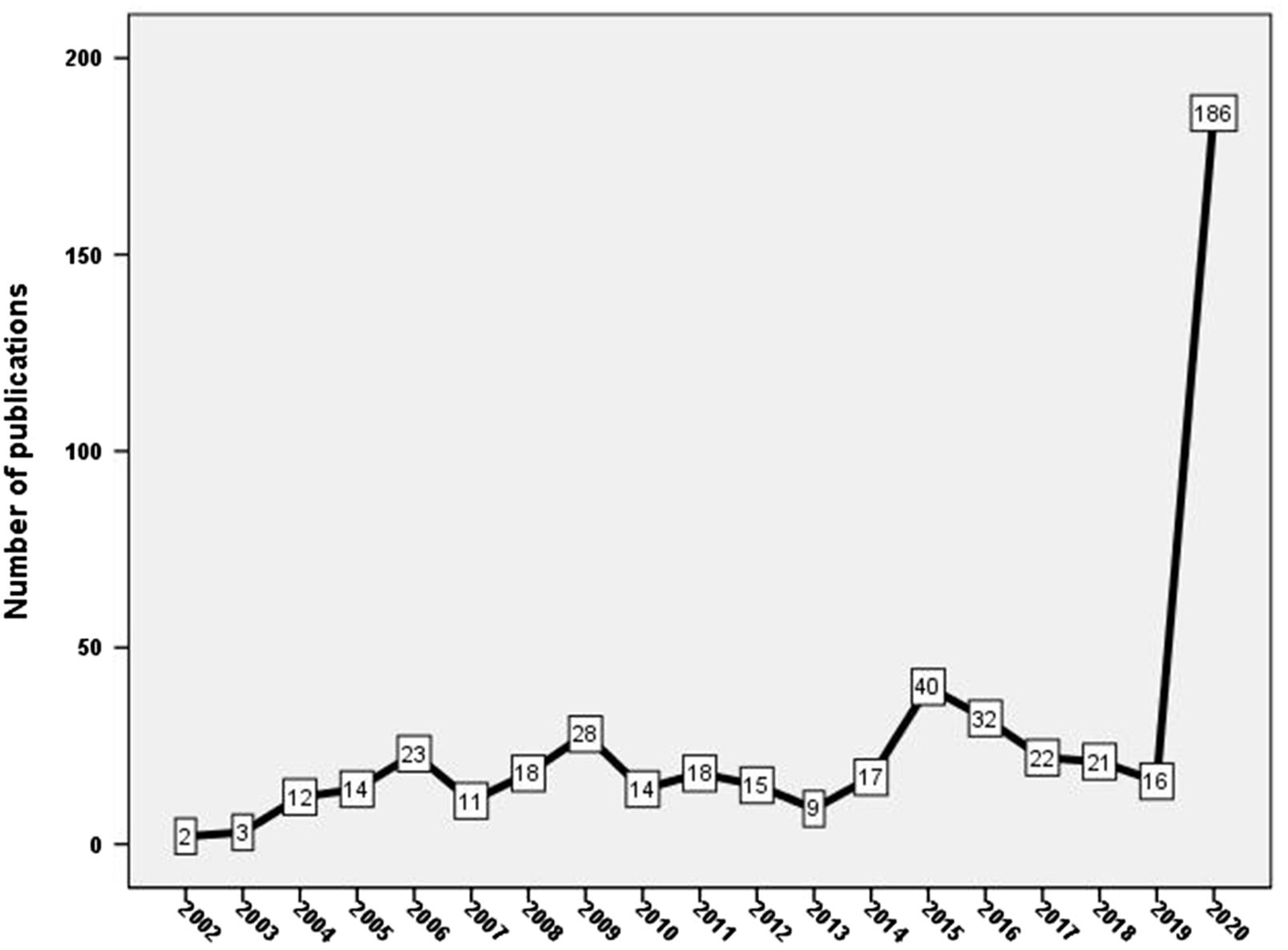
Figure 1 shows the annual growth of publications. The graph has 3 small peaks in 2006, 2009, and 2015. The chart also has a sharp rise in 2020. The retrieved documents received 4705 citations, a mean of 9.4 citations per document, and an h-index of 33. The range of citations was from 0 to 209. The top 10 cited documents included 6 on influenza, 2 on Zika, and 2 on COVID-19. Reference Rolfes, Foppa and Garg20–Reference Jennings, Monto and Chan29
Annual growth of publication on health system preparedness against specific viral infectious disease outbreaks.

The retrieved documents included 208 (40.5%) documents on influenza, 164 (32.7%) on COVID-19, 83 (16.6%) documents on Ebola, 27 (5.4%) on SARS, 7 (1.4%) on MERS-CoV, 3 (0.6%) on dengue, and 21 (4.2%) on Zika. The total percentage was above 100% due to documents focusing on more than 1 pathogen/disease. The annual number of publications on influenza showed 2 peaks (in 2006 and 2009). Publications on Ebola showed 1 peak in 2015. Publications on COVID-19 showed 1 large sharp peak in 2020.
Analysis indicated that countries in the African region published 37 (7.4%) documents while those in the South-East Asian region published 48 (9.6%) documents and countries in the Eastern Mediterranean region published 52 (10.4%) documents. Countries in the region of the Americas contributed the most (n = 221; 44.1%), followed by countries in the European region (n = 125; 25.0%) and countries in the Western Pacific region (n = 78; 15.6%). Further analysis of the region of the Americas showed that countries in Latin America contributed to (21; 4.2%) documents.
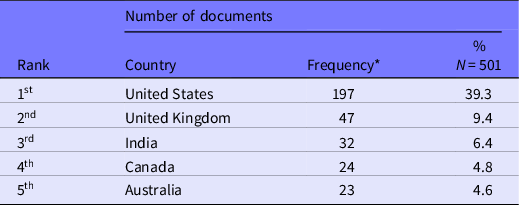
Authors from 94 different countries took part in publishing the retrieved documents. The United States ranked first with 197 (39.3%) documents followed by the United Kingdom (n = 47; 9.4%) and India (n = 32; 6.4%). Table 1 shows the contribution of each of the top 5 active countries. The US Centers for Disease Prevention and Control (CDC) (n = 51; 10.2%) ranked first, followed by the WHO (25; 5.0%).
Top 5 active countries in publishing documents on health system preparedness against viral infectious diseases

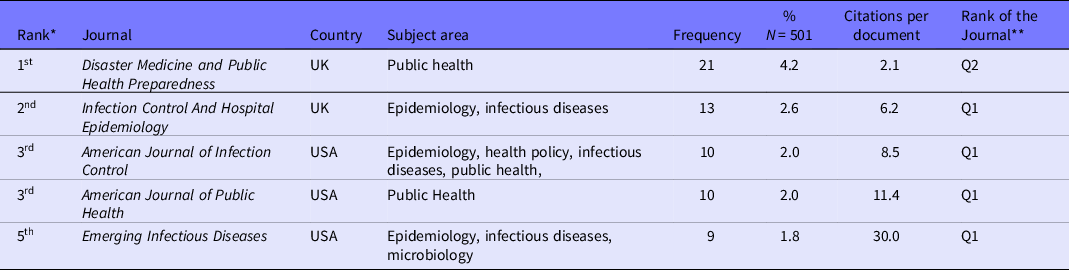
The top 5 active journals in publishing the retrieved documents were shown in Table 2. The Disaster Medicine and Public Health Preparedness journal (n = 21; 4.2%) ranked first, followed by the Infection Control and Hospital Epidemiology journal (n = 13; 2.6%). Active journals were mainly in the field of infection, primarily based in the United States and Europe, and the majority ranked Q1 in their areas. Documents published in Emerging Infectious Diseases received the highest number of citations per document.
Top 5 active journals in publishing documents on health system preparedness against viral infectious diseases

* Journals having the same number of publications were given the same rank.
** Journal ranking was obtained from Scimago. Journals in Q1 are top-ranked while those in Q4 are least ranked
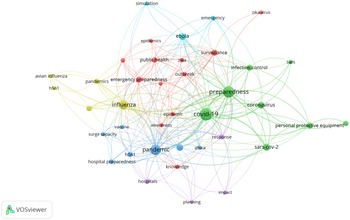
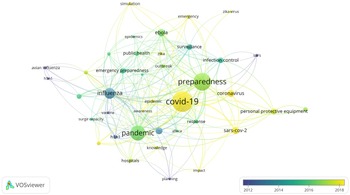
Mapping the most frequent author keywords with a minimum of 5 occurrences returned 39 keywords (Figure 2). Keywords related to preparedness (“preparedness”, “emergency preparedness”, “hospital preparedness”, and “pandemic preparedness”) made a total of 103 occurrences. Keywords related to “COVID-19” made 88 occurrences. Keywords related to influenza (“influenza”, “H1N1”, “H5N1”, and “avian influenza”) made 56 occurrences. An overlay mapping of the most frequent author keywords (Figure 3) showed that influenza documents were the oldest and COVID-19 documents were the most recent.
Network visualization map of the most frequent author keywords. The retrieved documents had 697 different author keywords. Only those with a minimum of 5 occurrences (n = 39) were visualized. Node size is proportional to the frequency of occurrence. The keywords “preparedness” and “COVID-19” had the highest frequency of occurrences. Related keywords have similar colors, and the distance between nodes reflects the strength of relatedness.

An overlay visualization of the most frequent author keywords. Keywords in yellow were the most recent. In overlay visualization, author keywords were shown based on the time of the appearance in the literature. Keywords with dark purple appeared in the literature before 2012, those with green color appeared between 2013 and 2017, while those with yellow color appeared most recently (after 2018).

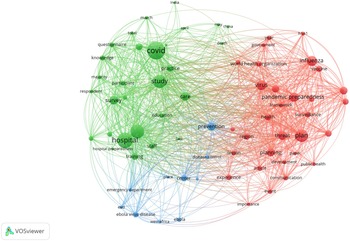
Mapping the most frequent terms in the titles and abstracts returned 3 clusters (Figure 4). The red cluster represented a research theme on health system preparedness against influenza outbreaks, while the green cluster represented a research theme on hospital preparedness against COVID-19. The smallest cluster, blue, represented research on health system preparedness against Ebola virus disease.
Network visualization map of most frequent terms in titles/abstracts of the retrieved documents. Terms with minimum occurrences of 20 times (n = 70 terms) were mapped. Terms with similar colors constitute a cluster with a certain research theme. The map included 3 clusters with different colors. The blue cluster represents publications on preparedness related to Ebola virus in African countries. The red cluster represents publications on preparedness related to influenza. The green cluster represents publications on COVID and hospital preparedness.

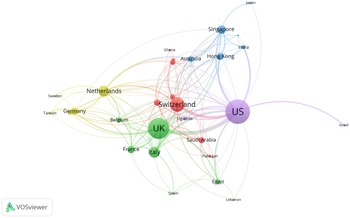
Mapping research collaboration for countries publishing a minimum of 5 documents returned 30 countries (Figure 5). Relatively thin connecting lines existed between countries on the map. Countries designated as low- or middle-income, such as Egypt, Lebanon, Pakistan, and Ghana were located at the map’s margin and far from the center. The United Kingdom had the highest number (25 links) of collaborating countries, followed by the United States (22 links), and Switzerland (21 links). Countries with similar node colors share similar research interests.
Network visualization map of international research collaboration between countries with a minimum of 5 publications. The map included 30 countries. The thickness of a connecting line is a measure of the strength of collaboration between any 2 countries. Countries with similar node colors have common research interests.

Discussion
The current study is a quantitative descriptive analysis of health system preparedness publications against viral infectious disease outbreaks. The inaugural Global Health Security Index, published by Johns Hopkins, stated that not a single country in the world is adequately prepared for epidemics or pandemics. 30 The report scores countries based on various indicators. The report indicated that the 60 highest-income countries included in the analysis scored an average of 51.9 of 100. The data obtained in the current study confirmed these findings since the total number of publications in the past 2 decades was relatively low. Furthermore, the publications in this field showed episodic patterns. The number of publications increases whenever an epidemic threatens global or national security.
The bulk of the retrieved documents were about influenza outbreaks. The importance of preparedness against influenza outbreak has led the WHO to develop a separate Pandemic Influenza Preparedness Framework. 31 The history of severe waves of influenza outbreaks could have played a role in the vast number of publications on preparedness against influenza outbreaks. The Spanish influenza pandemic in 1918-1920 caused more than 30 million deaths. Reference Johnson and Mueller32 The Hong Kong influenza outbreak in 1968-1969 caused approximately 2 million deaths. Reference Saunders-Hastings and Krewski33 Swine flu in 2009 caused more than a quarter of a million deaths. Reference Dawood, Iuliano and Reed34 Furthermore, the influenza vaccine availability made the research on preparedness for influenza outbreaks more appealing compared with other viral diseases.
The present study showed that China’s contribution was less visible than other countries. Publications on preparedness from China might be published in Chinese national journals or as gray literature. The presence of a large number of un-indexed Chinese journals underestimated the contribution of China in this field.
The present study also showed that publications on health system preparedness received a low number of citations suggestive of a limited audience and a limited interest in the subject. The weak research collaboration is a potential reason for the limited number of citations. An important point here is that documents on preparedness published in Emerging Infectious Diseases received relatively very high citations. This is because documents in this journal were co-cited by journals in the field of public health and journals in the field of molecular medicine/virology (data not shown).
The present study showed a leading role of the WHO. The WHO introduced the International Health Regulations in 2005 (IHR 2005). In February 2014, nearly 30 countries launched the Global Health Security Agenda (GHSA) Reference Katz, Sorrell and Kornblet35 aiming to endorse the IHR and other global health security frameworks.
The present study showed that the Eastern Mediterranean region had limited contribution to core documents on preparedness, despite that the area had faced several fatal infectious outbreaks such as yellow fever, MERS-CoV, and avian influenza. Reference Soghaier, Hagar and Abbas36–Reference Buliva, Elhakim and Tran Minh39 The emergence of MERS-CoV in the Eastern Mediterranean region poses 1 of the biggest threats to global health security. Reference Malik, Elkholy and Khan40 Several countries in the area are currently experiencing humanitarian crises due to internal conflicts and war. Reference Seita41,Reference Santoro, Abu-Rmeileh and Khader42 The results obtained for the WHO African region showed limited research contribution in this field. Following the 2014-2016 West-Africa Ebola virus outbreak, several African countries have improved early detection of the virus through routine surveillance Reference McNamara, Schafer and Nolen43 because of lessons learned from the Ebola outbreak. Reference Ravi, Snyder and Rivers44 The contribution of Latin American countries to the retrieved literature was also noted. The Zika virus epidemic in Latin America and South Pacific Islands and its relation to neurological disease triggered the WHO and European Union to endorse and support countries in Latin America to face the ongoing outbreaks of Zika virus. The Zika virus outbreak has underlined the need for a coordinated preparedness research network across Latin America and the Caribbean. Reference Petersen, Wilson and Touch28 The research output on preparedness from Latin America was relatively lower than that from other world regions such as the African or South-East Asia region.
The findings of the present study showed some overlap with those presented by Oppenheim et al. findings. Oppenheim et al. developed an Epidemic Preparedness Index (EPI) to assess national-level preparedness measured by national response to the flu outbreaks in 2009. Reference Oppenheim, Gallivan and Madhav45 The WHO developed a tool to measure preparedness called the Joint External Evaluation Tool (JEE tool). Gupta et al. found that of 55 countries that have undergone the JEE assessment, countries in African and South-East Asia regions scoring the least on the JEE while those in the Americas and Europe scoring the highest. Reference Gupta, Kraemer and Katz46
Limitations
The present study is the first bibliometric study on health system preparedness against specific viral infectious disease outbreaks. The present study has a few limitations. Gray literature and publications in nonindexed journals were not included in the analysis. There are several health-related journals in Africa, South-East Asia, and the Middle East that are un-indexed in Scopus. Therefore, a certain number of documents on health system preparedness might be missed. The traditional way to minimize false-negative results is to use multiple databases to retrieve the maximum number of documents. However, in the current study, the use of multiple databases will limit the use of visualization maps because different databases have different dataset formats. Furthermore, the use of other known databases such as Medline or Web of Science is not expected to change the results dramatically because Scopus is almost inclusive of both databases. The present study did not cover all viruses and bacteria that have caused outbreaks in the past 2 decades, such as cholera or chikungunya. Finally, the search query implemented and the keywords used for the term preparedness might not be fully comprehensive. Therefore, the chances of missing some documents do exist.
Conclusions
The bibliometric analysis could be used as a tool to measure and correlate research activity with the strength of readiness to face a certain health crisis. Based on the findings of the current study, an international research collaboration between less developed countries in the African region, the South-East Asian regions, and the Eastern Mediterranean region with developed countries in North America, Europe, and Australia needs to be strengthened as part of the global health security agenda. The findings of the current study should encourage countries, particularly ones with a previous history of outbreaks, to research their preparedness using WHO or any internationally accepted tool to measure preparedness. The current study showed that the bulk of research activity was on influenza. Therefore, researchers and public health experts need to give attention to outbreaks other than influenza when researching preparedness. Furthermore, countries need to invest in capacity building and research that will be used to develop evidence-based plans for future preparedness on infectious outbreaks.
Data availability statement
All data presented in this manuscript are available on the Scopus database using the search query listed in the methodology section.
Acknowledgments
The author thanks An-Najah National University for using all the sources available.
Author contributions
W.S. started the idea, designed the methodology; did the data analysis, graphics, and data interpretation; wrote and submitted the manuscript.
Competing interests
The author declares that he has no competing interests.