





No CrossRef data available.
Article contents
Challenges of infection prevention and control in Scottish long-term care facilities
Published online by Cambridge University Press: 22 April 2020
Abstract
Residents living in long-term care facilities (LTCFs) are at high risk of contracting healthcare-associated infections (HAIs). The unique operational and cultural characteristics of LTCFs and the currently evolving models of healthcare delivery in Scotland create great challenges for infection prevention and control (IPC). Existing literature that discusses the challenges of infection control in LTCFs focuses on operational factors within a facility and does not explore the challenges associated with higher levels of management and the lack of evidence to support IPC practices in this setting.1-7 Here, we provide a broader view of challenges faced by LTCFs in the context of the current health and social care models in Scotland. Many of these challenges are also faced in the rest of the United Kingdom and internationally.
Information
- Type
- Commentary
- Information
- Copyright
- © 2020 by The Society for Healthcare Epidemiology of America. All rights reserved.
References
Yoshikawa, TT, Reyes, BJ, Ouslander, JG. Sepsis in Older Adults in long-term care facilities: challenges in diagnosis and management. J Am Geriatr Soc 2019;67:2234–2239.CrossRefGoogle ScholarPubMed
Dumyati, G, Stone, ND, Nace, DA, Crnich, CJ, Jump, RL. Challenges and strategies for prevention of multidrug-resistant organism transmission in nursing homes. Curr Infect Dis Rept 2017;19(4):18.CrossRefGoogle ScholarPubMed
Travers, J, Herzig, CT, Pogorzelska-Maziarz, M, et al.Perceived barriers to infection prevention and control for nursing home certified nursing assistants: a qualitative study. Geriatr Nurs 2015;36:355–360.CrossRefGoogle ScholarPubMed
Mavrodaris, A, Sibal, B, McKerr, C, Hawker, J. Outbreak of acute respiratory infection in a care home for the vulnerable elderly: investigation, management and challenges. Public Health 2014;128:944–947.CrossRefGoogle Scholar
Montoya, A, Mody, L. Common infections in nursing homes: a review of current issues and challenges. Aging Health 2011;7:889–899.CrossRefGoogle ScholarPubMed
Longo, DR, Young, J, Mehr, D, Lindbloom, E, Salerno, LD. Barriers to timely care of acute infections in nursing homes: a preliminary qualitative study. J Am Med Dir Assoc 2002;3:360–365.CrossRefGoogle ScholarPubMed
Nicolle, LE. Preventing infections in non-hospital settings: long-term care. Emerg Infect Dis 2001;7:205.CrossRefGoogle ScholarPubMed
Care homes market study: final report. Competition and Markets Authority website. https://assets.publishing.service.gov.uk/media/5a1fdf30e5274a750b82533a/care-homes-market-study-final-report.pdf. Published 2017. Accessed April 6, 2020.Google Scholar
Changing models of health and social care. Audit Scotland website. http://www.audit-scotland.gov.uk/uploads/docs/report/2016/nr_160310_changing_models_care.pdf. Published 2016. Accessed April 6, 2020.Google Scholar
Thorlby, R, Starling, A, Broadbent, C, Watt, T. What’s the Problem With Social Care, and Why Do We Need To Do Better? UK: The Health Foundation, the Institute for Fiscal Studies, The King’s Fund and the Nuffield Trust; 2018.Google Scholar
Shortage Occupations List 2018/9 Call for Evidence: Scottish Government Response for Health and Social Care. Edinburgh: The Scottish Government; 2019.Google Scholar
Thorlby, R, Starling, A, Broadbent, C, Watt, T. What’s the Problem With Social Care, and Why Do We Need to Do Better? London: The King’s Fund; 2018.Google Scholar
Dayan, M. General election 2017: Getting a Brexit deal that works for the NHS. Nuffield Trust website. https://www.nuffieldtrust.org.uk/research/getting-a-brexit-deal-that-works-for-the-nhs. Published 2017. Accessed April 6, 2020.Google Scholar
Burnett, E. Effective infection prevention and control: the nurse’s role. Nursing Stand (2014) 2018;33(4):68.CrossRefGoogle ScholarPubMed
Stone, PW, Clarke, SP, Cimiotti, J, Correa-de-Araujo, R. Nurses’ working conditions: implications for infectious disease. Emerg Infect Dis 2004;10:1984.CrossRefGoogle ScholarPubMed
Scotland’s NHS Workforce. The current picture. Audit Scotland website. https://www.audit-scotland.gov.uk/uploads/docs/report/2017/nr_170209_nhs_workforce.pdf. Published 2017. Accessed April 6, 2020.Google Scholar
National point prevalence survey of healthcare associated infection and antimicrobial prescribing in long term care facilities, 2017. Health Protection Scotland website. https://www.hps.scot.nhs.uk/web-resources-container/national-point-prevalence-survey-of-healthcare-associated-infection-and-antimicrobial-prescribing-in-long-term-care-facilities-2017/. Published 2017. Accessed April 6, 2020.Google Scholar
Infection control in adult care homes: final standards. Scottish Government website. https://www.gov.scot/publications/infection-control-standards-adult-care-homes-final-standards/. Published 2005. Accessed April 6, 2020.Google Scholar
National infection prevention and control manual. National Services Scotland website. Published 2015. Accessed April 6, 2020.Google Scholar
Hughes, C, Tunney, M, Bradley, MC. Infection control strategies for preventing the transmission of meticillin-resistant Staphylococcus aureus (MRSA) in nursing homes for older people. Cochrane Database Syst Revs 2013(11):Cd006354.CrossRefGoogle ScholarPubMed
Uchida, M, Pogorzelska-Maziarz, M, Smith, PW, Larson, E. Infection prevention in long-term care: a systematic review of randomized and nonrandomized trials. J Am Geriatr Soc 2013;61:602–614.CrossRefGoogle ScholarPubMed
Lam, HR, Chow, S, Taylor, K, et al.Challenges of conducting research in long-term care facilities: a systematic review. BMC Geriatr 2018;18:242.CrossRefGoogle ScholarPubMed
Furuno, JP, Krein, S, Lansing, B, Mody, L. Health care worker opinions on use of isolation precautions in long-term care facilities. Am J Infect Control 2012;40:263–266.CrossRefGoogle ScholarPubMed
Cohen, CC, Pogorzelska-Maziarz, M, Herzig, CT, et al.Infection prevention and control in nursing homes: a qualitative study of decision-making regarding isolation-based practices. BMJ Qual Safety 2015;24:630–636.CrossRefGoogle ScholarPubMed
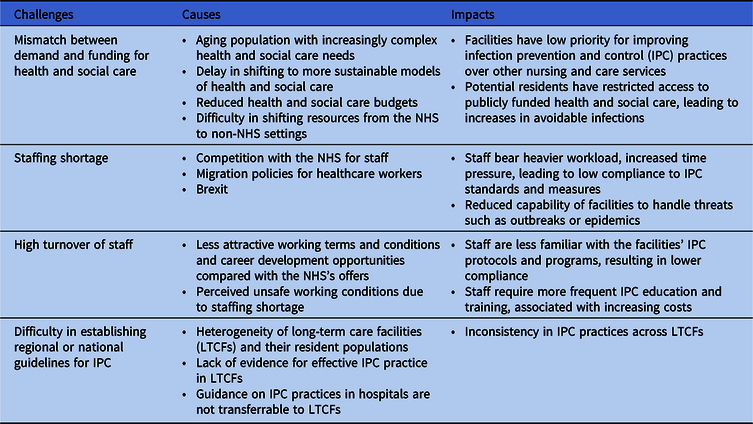
Table 1. Summary of the Challenges of Infection Prevention and Control, the Causes and Impacts of These Challenges in Scottish Long-Term Care Facilities
 You have
Access
- 3
- Cited by
The mismatch between demand and funding for health and social care provided in Scottish LTCFs, which also occurs in other parts of the United Kingdom, is likely to negatively influence the priority of IPC, which is a key element for safe care (Table 1). Most LTCFs in Scotland serve a mix of state-funded and self-funded residents.8 Councils and National Health Service (NHS) boards in Scotland who fund nursing and personal care services provided in LTCFs for entitled residents are encountering increasing financial pressure caused by an aging population with increasingly complex health and social care needs.9 Currently, the shortfall in public funding (UK-wide) for LTCFs is ~5%–10%, equivalent to ~USD1.2–2.4 million (£200–300 million).8 The facilities that are most exposed to local-authority–funded residents are most affected. As a result, they have to charge self-funded residents higher fees to maintain services.
Summary of the Challenges of Infection Prevention and Control, the Causes and Impacts of These Challenges in Scottish Long-Term Care Facilities
Note. LTCF, long-term care facility; IPC, infection prevention and control.
Additionally, the shift to more sustainable models of health and social care, which reduce costs, employ sufficient staff with the right skills, and meet the growing demand, is not occurring rapidly enough to address this issue. Cutting health and social care budgets and the difficulty in agreeing on integrated budgets between councils and NHS boards also obstruct the shift of resources to non-NHS settings such as LTCFs. Furthermore, due to lower thresholds in the financial assessment for eligibility to access publicly funded health and social care, fewer people can benefit from nursing and care services provided in LTCFs. The financial restriction to access timely and appropriate care in LTCFs has led to an increase in avoidable infections and increased use of NHS services among people aged 65 and over.Reference Thorlby, Starling, Broadbent and Watt10 Due to restricted financial resources, the Scottish government is more likely to prioritize other health and social care needs for the growing elderly population than investing to implement improved models of IPC practice. Service providers in LTCFs, most of whom are in the private sector, may also not be eager to prioritize IPC over other nursing and care services that improve resident satisfaction more directly.
Significant staffing shortage and high turnover of staff can reduce compliance to IPC practices and make it more difficult and costly to provide IPC training, thereby promoting the spread of HAIs. The 2017 survey data from Scottish Social Care Councils, Care Inspectorate and Scottish Care estimated that the nurse vacancy rate for LTCFs is at 14%–20%, and two-thirds of the facilities are struggling to recruit nurses as they have to compete with the NHS that offers better terms and conditions and career development opportunities.11,Reference Thorlby, Starling, Broadbent and Watt12 Migration policies, including the decision to retain the minimum salary threshold at USD36,700 (£30,000) for applicants seeking a Tier 2 visa and the minimum salary threshold requirement for permanent residence (USD43,000 or £35,000) also prevent the recruitment of HCWs from overseas to fill the workforce gaps in LTCFs.11 HCWs working in this setting, even those with many years of post-qualification experience, often earn less than USD36,700 (£30,000). Additionally, the possibility of limited European Union migration following Brexit may exacerbate the pressure of scarce HCWs, both in general and in LTCFs, by a projected shortfall of >70,000 nursing and social care workers by 2025.Reference Dayan13 The shortage of HCWs, which causes heavier workloads, increased time pressure, and stress, is associated with lower compliance to IPC interventions and standards and the resulting increased spread of HAIs.Reference Burnett14,Reference Stone, Clarke, Cimiotti and Correa-de-Araujo15 The nurse shortage is also a major factor that constrains healthcare facilities’ capability to handle possible future threats such as outbreaks and epidemics.Reference Travers, Herzig and Pogorzelska-Maziarz3 In addition, the insufficient number of HCWs in LTCFs hinders the implementation of many IPC procedures such as screening and surveillance. The perception of unsafe working conditions in LTCFs caused by staffing shortfalls also impedes the retention of qualified HCWs in this setting, worsening the current situation.Reference Stone, Clarke, Cimiotti and Correa-de-Araujo15 In addition to the staffing shortage, high turnover rates of HCWs in LTCFs and the reliance on temporary employees can undermine efforts to implement IPC policies and provide IPC education and training to HCWs in this setting. The annual turnover rate of 33.8% for nursing and care workers in LTCFs is substantially higher than the rate of 6.4% for NHS staff.Reference Thorlby, Starling, Broadbent and Watt12,16 These high staffing turnover rates imply that LTCFs bear additional costs to provide more frequent in-service training sessions on IPC practices and to ensure that new staff are familiar with the facility’s IPC practice protocols and annual IPC programs.
The heterogeneity of LTCFs and their resident populations makes it difficult and complicated to establish regional or national guidelines for IPC approaches in this setting. The heterogeneity in ownership across Scottish LTCFs17 creates variations in services provided, operational structures, business plans, and budgets, which affect the development of annual IPC programs in LTCFs. Although some NHS boards across Scotland set IPC guidelines and policies prior to the introduction of the Final Standards for infection control in LTCFs in 2005, they were not consistent, and regulated substances were not established.17 The standards focus on addressing the operational structures and processes in LTCFs with the provision of audit tools for self-auditing to support effective IPC rather than providing direct guidance on the best IPC practices in this setting.18 Nonetheless, almost 15 years of implementation have not guaranteed consistency in compliance with the Final Standards; in fact, compliance rates remain low. For example, standard 2 requires that LTCFs have an infection control group that endorses all IPC policies, guidelines, and procedures and provides advice and support for implementing and monitoring the progress of annual IPC programs. However, a low compliance rate with standard 2 was evident as internal or external infection control committees were available in only 27.5% of LTCFs.17 Clearly, there is no easy solution for IPC in this setting and the establishment of the Finals Standards is only a starting point.
Most evidence that guides IPC practice and decisions implemented in LTCFs has been adapted from IPC validated in hospitals, despite evidence in one setting not directly translating to the other. For example, the National Infection Prevention and Control Manual (NIPCM) is a practice guide mandatory for Scottish NHS employees to follow in order to reduce the risk of HAIs.19 Although it is considered as the best IPC practice guidance in LTCFs, the suitability and practicality of this manual and the extent to which staff in this setting comply have neither been examined nor reported. Additionally, this manual covers only basic IPC practices such as hand hygiene, safe management of equipment and environment, and the use of personal protective equipment. Other IPC measures, such as surveillance, screening, and decolonization, are not included. The effectiveness of IPC interventions, programs, and program components have not been rigorously evaluated in LTCFsReference Hughes, Tunney and Bradley20,Reference Uchida, Pogorzelska-Maziarz, Smith and Larson21 due to challenges of conducting research in this setting.Reference Lam, Chow and Taylor22 IPC strategies and policies used in hospitals may not be appropriate or effective to address the distinct problems of HAIs in an LTCF environment that serves as both a healthcare setting and as a residential home because of the differences in infrastructure, management, and culture between LTCFs and acute-care settings. For example, isolation and contact precautions are considered effective and commonly used IPC interventions in hospitals; however, they may not be preferable measures in LTCFs where social interaction is important for resident welfare.Reference Furuno, Krein, Lansing and Mody23,Reference Cohen, Pogorzelska-Maziarz and Herzig24 Additionally, residents in LTCFs are at as high a risk of contracting HAIs from HCWs as patients in acute-care settings, and they also have frequent contacts with other residents and visitors in communal areas. Consequently, interventions such as hand hygiene that target HCWs alone may not be sufficiently effective to control the spread of HAIs; thus, the active participation of residents and visitors is also required.
Prevention and control of HAIs in LTCFs is complicated, and these facilities face several challenges. Although these challenges have been discussed in the context of the Scottish health and social care system, the rest of the United Kingdom and other countries across the globe are facing similar challenges. Apart from the barriers caused by unique operational and cultural characteristics of LTCFs, other issues that challenge IPC in this setting originate from gaps in knowledge and resources common to the entire Scottish health and social care system that cannot be addressed by individual facilities. Therefore, a broad picture of challenges in IPC in this setting is useful to seek effective solutions that can both improve IPC practices and uphold the comfort and quality of life for LTCF residents.
Acknowledgments
None.
Financial support
This work was funded by the University of Strathclyde as part of LKNN’s doctoral project.
Conflicts of interest
All authors report no conflicts of interest relevant to this relevant.