Introduction
Service needs are diverse in the brain injury population. This is due to the combination of functional, cognitive, emotional and behavioural impacts of brain injury that often involve adverse psychosocial consequences and participation restrictions (Kumer, Kumer, & Singh, Reference Kumer, Kumar and Singh2019). The consensus is that access to an appropriate mix of health and rehabilitation services early in the recovery process is critical to an outcome (Khan, Baguley, & Cameron, Reference Khan, Baguley and Cameron2003; Mellick, Gerhart, & Whiteneck, Reference Mellick, Gerhart and Whiteneck2003; Nalder et al., Reference Nalder, Fleming, Cornwell, Foster, Ownsworth, Shields and Haines2012; Nalder, Fleming, Cornwell, Shields, & Foster, Reference Nalder, Fleming, Cornwell, Shields and Foster2013; Pickelsimer et al., Reference Pickelsimer, Selassie, Sample, Heinemann, Gu and Veldheer2007). Once medically stable, a mix of rehabilitation services and community supports is recommended across the broad spectrum of brain injury, including both traumatic and non-traumatic (Jolliffe, Lannin, Cadilhac, & Hoffman, Reference Jolliffe, Lannin, Cadilhac and Hoffmann2018; Turner-Stokes, Pick, Nair, Disler, & Wade, Reference Turner-Stokes, Pick, Nair, Disler and Wade2015). Ideally, in adults with moderate-to-severe brain injury, this includes a continuum of specialist rehabilitation services following acute medical care (Jourdan et al., Reference Jourdan, Bayen, Bosserelle, Azerad, Genet and Fermanian2013; Mellick et al., Reference Mellick, Gerhart and Whiteneck2003). Appropriate post-acute or community-based services are particularly important in the transition phase between leaving inpatient rehabilitation and returning home (Turner-Stokes et al., Reference Turner-Stokes, Pick, Nair, Disler and Wade2015; Pick, Nair, Disler, & Wade, Reference Turner-Stokes, Pick, Nair, Disler and Wade2015). Individualised support and structured post-discharge services are recommended to aid recovery and facilitate beneficial patient outcomes within brain injury populations (Conneeley, Reference Conneeley2012; Hall, Grohn, Nalder, Worrall, & Fleming, Reference Hall, Grohn, Nalder, Worrall and Fleming2012). This can include various service types such as outpatient day therapy, transitional living programmes and community integration, in addition to more disciplinary-orientated neurobehavioural services (Simpson et al., Reference Simpson, Secheny, Lane-Brown, Strettles, Ferry and Phillips2004).
The notion of the appropriateness of access is frequently mentioned in association with the brain injury rehabilitation continuum (Copley, McAllister, & Wilson, Reference Copley, McAllister and Wilson2013; Ottenbacher & Graham, Reference Ottenbacher and Graham2007; Turner-Stokes et al., Reference Turner-Stokes, Pick, Nair, Disler and Wade2015). It has been defined as an individual’s opportunity to use services appropriate to need (Daniels, Reference Daniels1982), considering issues of adequacy, timeliness, quality and continuity of care (Levesque, Harris, & Russell, Reference Levesque, Harris and Russell2013). The acknowledged benefits of appropriate access to rehabilitation also underpin guidelines and standards in early and longer-term recovery (Turner-Stokes et al., Reference Turner-Stokes, Pick, Nair, Disler and Wade2015) and are designed to assist decisions in specific circumstances (O’Callaghan, McAllister, & Wilson, Reference O’Callaghan, McAllister and Wilson2010). Appropriate access (or matching services to need) is challenging in practice, however, as ongoing disparities indicate. The origins of poor access and mismatch between access and needs after brain injury are likely twofold. These relate to the limitations of current knowledge about effective rehabilitation service delivery in the post-acute phase after a brain injury (Røe et al., Reference Røe, Tverdal, Isager Howe, Tenovuo, Azouvi and Andelic2019). They also relate to the rationalisation of services, which leads to prioritisation and disproportionate access (Knox & Douglas, Reference Knox and Douglas2018). Regardless of injury severity, many people miss out on rehabilitation (Collie & Prang, Reference Collie and Prang2013; Foster, Fleming, Tilse, & Rosenman, Reference Foster, Fleming, Tilse and Rosenman2000; Jourdan et al., Reference Jourdan, Bayen, Bosserelle, Azerad, Genet and Fermanian2013; Mellick et al., Reference Mellick, Gerhart and Whiteneck2003; Ta’eed, Skilbeck, & Slatyer, Reference Ta’eed, Skilbeck and Slatyer2013) and have poor access to outpatient brain injury services in the first year (Dams-O’Connor, Landau, Hoffman, & St De Lore, Reference Dams-O’Connor, Landau, Hoffman and St De Lore2018). Those with more severe injuries are arguably at greater risk of less than adequate access, particularly to comprehensive extended rehabilitation (Knox & Douglas, Reference Knox and Douglas2018). Access has also been shown to reduce across the transition from acute care to the community for people with brain injury (Abrahamson, Jensen, Springett, & Sakel, Reference Abrahamson, Jensen, Springett and Sakel2017; O’Callaghan et al., Reference O’Callaghan, McAllister and Wilson2010). Obtaining access that meets user expectations is often challenging in the community (Copley et al., Reference Copley, McAllister and Wilson2013; Foster, Allen, & Fleming, Reference Foster, Allen and Fleming2015; O’Callaghan et al., Reference O’Callaghan, McAllister and Wilson2010; Toor et al., Reference Toor, Harris, Escobar, Yoshida, Velikonja, Rizoli and Colantonio2016).
In Australia, the availability and adequacy of rehabilitation services vary. This is due to differences across states and territories in relation to the organisation of brain injury rehabilitation services and various public and private funding pathways (Muenchberger, Kendall & Collings, Reference Muenchberger, Kendall and Collings2011). In some contexts, no recognised rehabilitation pathways exist following acute management, so large numbers of people with moderate-to-severe brain injury can be overlooked (Ta’eed et al., Reference Ta’eed, Skilbeck and Slatyer2013). Alternatively, they fail to receive services at a level of consistency and intensity appropriate to recovery needs (Copley et al., Reference Copley, McAllister and Wilson2013; Mitsch, Curtin, & Badge, Reference Mitsch, Curtin and Badge2014). Unfortunately, the maldistribution of publicly funded specialist brain injury services has long impeded appropriate and equitable access across jurisdictions (Copley et al., Reference Copley, McAllister and Wilson2013; Khan et al., Reference Khan, Baguley and Cameron2003; O’Callaghan et al., Reference O’Callaghan, McAllister and Wilson2010; Toor et al., Reference Toor, Harris, Escobar, Yoshida, Velikonja, Rizoli and Colantonio2016). Further, privately provided services depend on compensation or funding support, unless there is the capacity to pay (Collie & Prang, Reference Collie and Prang2013; Copley et al., Reference Copley, McAllister and Wilson2013; Ta’eed et al., Reference Ta’eed, Skilbeck and Slatyer2013). Eligibility for services and the intensity of services received in Australia can depend on the specific funding pathway and amount of funding received (Copley et al., Reference Copley, McAllister and Wilson2013). If they satisfy specific conditions, Australian citizens who sustain a brain injury may now also be eligible to access treatment, care and support. This is provided through two broad-based insurance schemes based on no-fault frameworks, including the National Disability Insurance Scheme (NDIS) and the National Injury Insurance Scheme (NIIS). Following trial sites in 2013, the NDIS commenced a progressive nation-wide roll-out providing people with more certainty about funded support where the severe and permanent disability is proven (Forwood, Reference Forwood2018). This was followed by the NIIS. The NIIS is another national reform initiative introduced, with variations in most states and territories by 2016, but restricted to people catastrophically injured in a motor vehicle and workplace accidents (Forwood, Reference Forwood2018). Likewise, the NIIS Queensland (NIISQ) commenced implementation in July 2016, providing lifetime care and support for eligible individuals with serious injuries resulting from motor vehicle accidents.
Competing priorities occur in high-cost areas such as rehabilitation. Consequently, what is appropriate access will mean different things to different people (Turner-Stokes et al., Reference Turner-Stokes, Pick, Nair, Disler and Wade2015). Ongoing debates often centre on how best to balance competing supply-side priorities such as the distribution of resources, affordability and sustainability and the increasing and more complex demands on services (Neumann & Chambers, Reference Neumann and Chambers2012). These are increasingly tricky debates as users’ expectations grow (Penchansky & Thomas, Reference Penchansky and Thomas1981; Smith, Mitton, Davidson, & Williams, Reference Smith, Mitton, Davidson and Williams2014), alongside contemporary lifetime care schemes seeking to offer more certainty (Stone & Gumbert, Reference Stone and Gumbert2008) and choice to individuals (Foster et al., Reference Foster, Henman, Tilse, Fleming, Allen and Harrington2016). Inherent tensions can be partly, and sometimes explicitly, resolved through policy. This may occur through describing specific entitlements or access requirements (Scott & Bornstein, Reference Scott and Bornstein2009), or through the provision of standardised specialist pathways, as advocated for the early post-acute rehabilitation period after brain injury (Chesnut et al., Reference Chesnut, Carney, Maynard, Mann, Patterson and Helfand1999; Turner-Stokes et al., Reference Turner-Stokes, Pick, Nair, Disler and Wade2015). Although heavily influenced by the organisational context, clinical decision-making can also be a more implicit means of defining what is appropriate and how resources and demands are managed (Pagan et al., Reference Pagan, Ownsworth, McDonald, Fleming, Honan and Togher2015). Whether explicit or implicit, services may not ultimately accord with individuals’ perceived needs and expectations (Copley et al., Reference Copley, McAllister and Wilson2013; Foster et al., Reference Foster, Allen and Fleming2015; Foster & Tilse, Reference Foster and Tilse2003). Appropriate access is thus a guide for practice. This makes it important to further explore the access experiences of individuals who sustain acquired brain injury (ABI) and how they perceive the fit for need.
Aims
This paper reports the findings of a qualitative study on the service access experiences of adults discharged from specialist inpatient brain injury rehabilitation care. Aim 1 was to explore access experiences following discharge from inpatient rehabilitation, with a focus on participants’ experiences with post-acute specialist brain injury services within the first 6 months post-discharge. Aim 2 was to explore participants’ opportunities to access services after discharge, appropriate to their perceived needs.
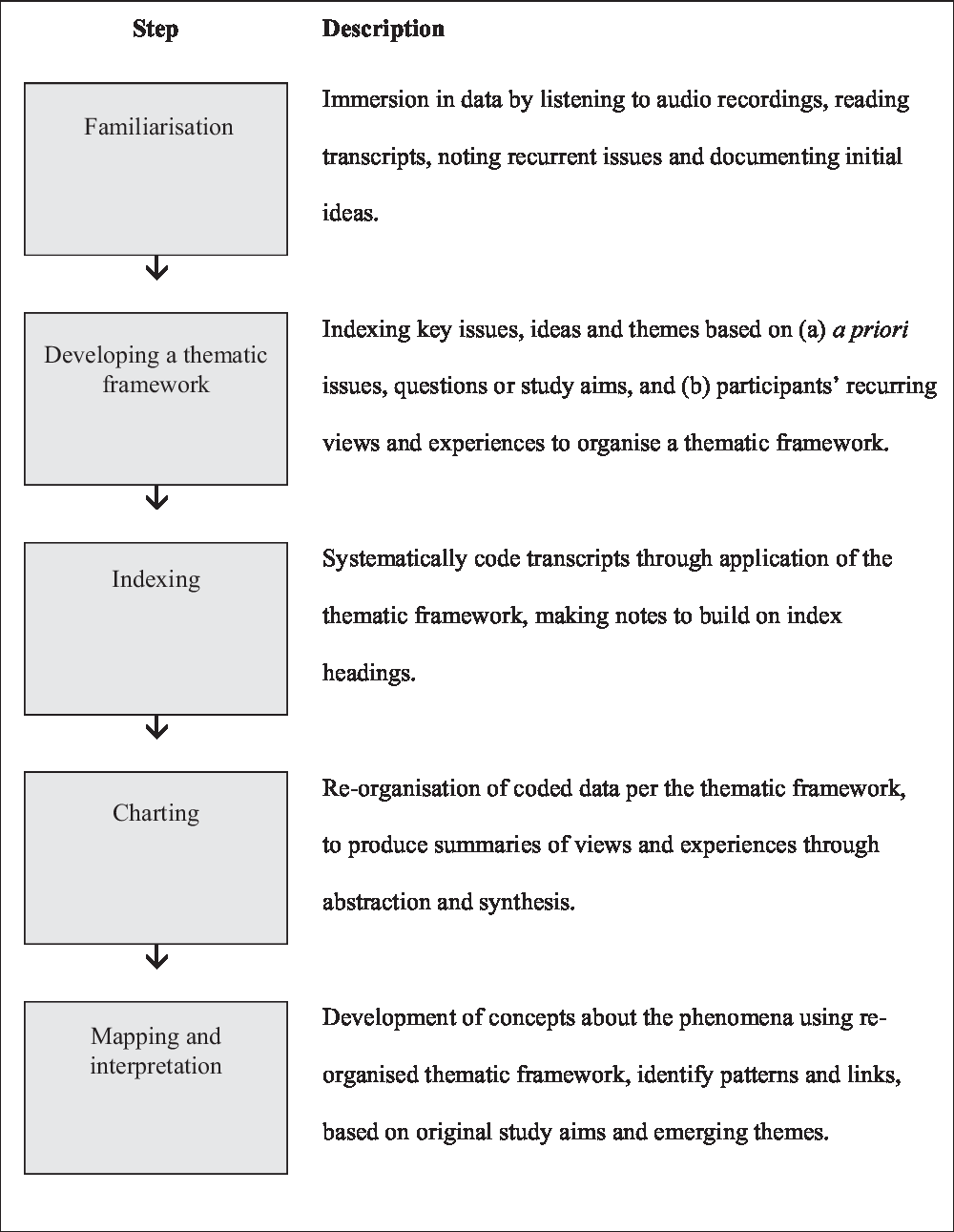
Steps in the qualitative analysis (adapted from Ritchie, Spencer, & O’Connor, Reference Ritchie, Spencer and O’Connor2003).

Method
Design
This qualitative study was a component of a mixed-methods prospective cohort study and incorporated face-to-face semi-structured interviews. The larger study tracked rehabilitation and health service use and wellbeing of participants with ABI or spinal cord injury for 12 months after inpatient rehabilitation (Legg et al., Reference Legg, Foster, Parekh, Geraghty, Nielsen, Jones, Kendall and Fleming2019). Between March 2017 and March 2018, 165 participants were recruited into the larger cohort study from a specialist inpatient brain injury rehabilitation unit in South East Queensland, Australia. The qualitative component aimed to explore experiences of realised access and how participants viewed their access experiences in relation to their personal needs. Qualitative research is an appropriate method for exploring a specific phenomenon (e.g. appropriate access), with the intentional selection of individuals in the most appropriate context to optimise the collection of rich insights (Johnson, Adkins, & Chauvin, Reference Johnson, Adkins and Chauvin2020). Qualitative findings on the ABI participants’ service access experiences are reported here to develop an understanding of appropriate access based on fit with perceived needs.
Setting
The Brain Injury Rehabilitation Unit (BIRU) at Princess Alexandra Hospital in Queensland, Australia, provides state-wide specialised inpatient and day hospital services for the brain injury population. Services are provided by BIRU for people with ABI in the broad working-age group, complemented by an ABI Transitional Rehabilitation Service (ABI TRS) and the community-based ABI Outreach Service (ABIOS).
Ethics
Ethical approval was obtained from Metro South Hospital and Health Service Human Research Ethics Committee (HREC/16/QPAH/684) and Griffith University Human Research Ethics Committee (GU Ref No.: 2016/915).
Participants
Participants for the qualitative study were purposively sampled from consenting ABI participants recruited to the larger study between March 2017 and June 2018. A broad definition of ABI was used to include traumatic causes, diffuse brain injury, vascular causes such as stroke, or other sudden-onset events such as brain haemorrhage (Turner-Stokes et al., Reference Turner-Stokes, Pick, Nair, Disler and Wade2015). Patients were eligible if aged ≥18 years, and residing within 100 km of the specialist rehabilitation unit from which the participant was discharged. They needed to be able to provide informed consent as determined by a medical practitioner or for consent to be provided by a substitute decision-maker. To purposively select information-rich cases on service access, a matrix of the ABI participants in the larger cohort (n = 65) was developed based on a set of primary characteristics. These included age (e.g. <30, 31–54, 55–65), gender, funding scheme (e.g. whether eligible for NDIS, NIISQ or other government-funded supports) and time since injury. Participants who lived outside of 100 km were then excluded, leaving 52 from which to purposively recruit for qualitative interviews. One member of the research team (MF) then purposively selected up to 20 participants from the interview matrix, giving primary consideration to the diversity of age, gender and funding support. A member of the research team (EH) contacted these participants to explain the qualitative study and to ascertain their willingness to participate in a face-to-face interview about access. Two participants contacted declined to be interviewed, one could not be interviewed because of ill health, and despite several attempts another was not contactable. Although written consent was obtained as part of the larger study, consent was confirmed at the time of contact and immediately prior to the interview. A total of 16 participants were interviewed within the timeframe of the study.
Data collection
A semi-structured interview of up to 60 min was conducted with each participant in the research office, the participant’s home or an appropriate community setting as preferred by the participant. Interviews occurred between March and August 2018 and were conducted by two members of the research team (MF and EH) who used an interview guide for consistency. Levesque et al. (Reference Levesque, Harris and Russell2013) conceptualisation of access provided a general direction about the topic areas to be addressed in the interview. Questions focused on key topics: predisposing and enabling factors in service access; accessibility of services; appropriateness according to continuity, timeliness and convenience and perceived needs and general benefits and challenges. Interviews were audio-recorded for transcription. Family members or other support persons attended in five of the interviews, as requested by the participant. However, as family and support persons were not specifically included as research participants or formally consented, any comments they made during the interview were excluded from the analysis. The five interviews that involved family/support persons showed the value of joint recall about service access. For example, family/support person input was sometimes requested by participants unable to recall exact details about their access, or otherwise the family/support person corrected information about service access.
Data analysis
An inductive approach involving several discrete steps was used to analyse the transcripts (Pope, Ziebland, & Mays, Reference Pope, Ziebland and Mays2000; Ritchie, Spencer, & O’Connor, Reference Ritchie, Spencer and O’Connor2003), as summarised in Fig. 1. Data analysis was conducted after all 16 interviews were completed. Two members of the team (MF and LB) analysed a sample of the transcripts independently (n = 7), then met to discuss and organise the initial codes that would comprise the coding framework. An initial 103 descriptor codes were organised into 18 categories with a descriptor of what these captured to enable consistent application across the remaining transcripts. One member (MF) then used the coding framework to index all remaining interview transcripts, during which all text was sufficiently accommodated within the categories indicating code saturation. This ensured that the framework was adequate to capture the range of issues represented in the data (Hennink, Kaiser, & Marconi, Reference Hennink, Kaiser and Marconi2017). The data were interrogated to identify relationships between the various categories to derive the main themes and sub-themes. Quotations were chosen to illustrate themes and overall patterns and discrepancies in the findings (Patton, Reference Patton2002). Finally, two members (MF and ML) workshopped the table outlining the main themes and sub-themes with descriptions and exemplar quotes to discuss and finalise the thematic framework.
Findings
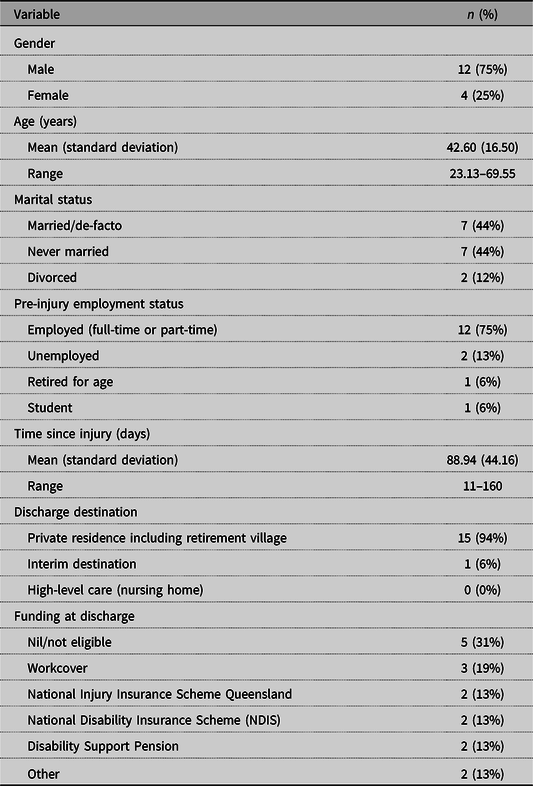
The 16 interviewees are described in Table 1. Similar to the larger ABI cohort, most were male (n = 12), and were aged either <30 years (n = 4) or 30–54 years (n = 4). Most received disability funding of some kind, including the NDIS, NIISQ, Workcover and Disability Support Pension. However, a small number reported no funding support on discharge (32%, n = 5). Of the 16 participants interviewed, 13 had gained access to a specialist brain injury transition service following discharge from inpatient rehabilitation. The median time since discharge at the interview was 261 days (range: 141–480 days).
Demographic characteristics of interviewees (N = 16)

Note. Demographic data collected at discharge from inpatient rehabilitation. Continuous variables are reported as mean (standard deviation) and range. Percentages may not equal 100% owing to rounding.
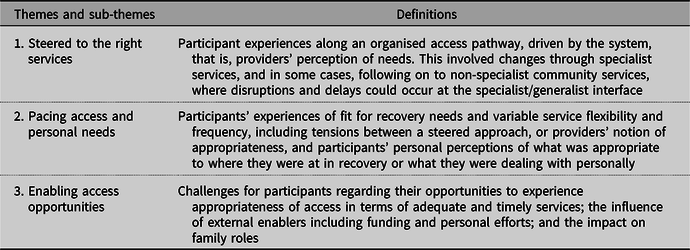
Three main themes were derived from the analysis (Table 2). These themes are described and discussed in more detail, drawing upon participants’ comments to illustrate the analytic ideas. Illustrative extracts are labelled to indicate data diversity. Brief in-text extracts are italicised. Unique identifiers include a participant number (based on the larger cohort) and gender (e.g. 001M refers to a male participant).
Thematic framework

Theme 1: steered to the right services
Due to the nature of the study setting’s rehabilitation continuum, brain injury transitional and community rehabilitation services featured strongly in most participants’ reports about access immediately after inpatient rehabilitation. Experiences in general suggested that in the early months after hospital, most participants perceived they were being steered to the right services at the right time. This resembled continuity of care that was driven by the system, that is, a providers’ view of rehabilitation needs. Further, despite many changes of access involving movement into specialist brain injury rehabilitation services, participants spoke of this as a positive attribute of appropriateness. These sentiments are captured in the following extract by one participant who described the dual benefits of being bounced but not forgotten:
I’ve never felt left out or forgotten about. Things have changed, and you’re bounced from BIRU to TRS to [community-based rehabilitation team] to ABIOS. So things change along the way…I’ve never felt I’ve not got someone within the health community I can turn to for assistance [014M].
Many perceived the follow-up…[was]…actually very reassuring [105F]. Of relevance to both appropriateness and fit with need, this was perceived by one participant as assistance from the right people at the right time:
I’m a believer in what they do and how they do it and happy to do what I can for my recovery… I’ve been looked after by the right people at the right time in the right way [086M].
In a few examples, the value of being steered, or having some sort of structure [014M] also accounted for the lack of expectations about access or need, as this participant expressed:
I didn’t feel like anything that I was being steered into was a waste of time or not useful for me. So, I think it was a good fit. I mean I wouldn’t have gone in with any expectations because I didn’t really know what to expect… I always felt supported through the whole thing [014M].
Further, this same participant described how contact with services actually influenced his perceptions of need. As he explained, I didn’t know what I needed until it was provided to me…I didn’t know I was going to benefit from them until it happened [014M]. Likewise, for other participants initially unsure about the specialist brain injury service or community rehabilitation services that they were steered towards, their realised access ultimately shaped their sense of appropriateness:
…I wasn’t classing it inappropriate, but I didn’t quite feel like I did have to go in twice a week like it would help me. But now looking back on it, I felt I was a lot better than what I really was back then [101F].
I wasn’t open to it at first, because I didn’t know what I was getting involved in…and I did learn with them [119M].
As these two examples [101; 119] show, participants were developing an awareness of personal needs over time, which likely reflects recovery, but also the quality of access experiences. Being steered also meant a sense of continuity early after leaving inpatient rehabilitation. For example, they experienced having the plan flagged…a few weeks out [127M] or being included in planning and discussion about what may be involved in the next step [014M]. It also meant an important reference point for timely access to funded supports: [He’s] not a figurehead but he’s there coordinating, helping out with the NDIS [130M]. Likewise, expert recommendations about access to generalist community rehabilitation services after concluding specialist brain injury programmes were a definite advantage over just going home and having nothing [112M].
A contrast to the last example above [112], it was generally beyond the specialist continuum when disruptions to continuity and access occurred for participants. This concerned the movement between specialist brain injury services and other rehabilitation or mainstream health services, which involved communication disruptions. A participant reported upon referral to an outpatient physiotherapy service, I didn’t even know I was going there…I wasn’t told, I wasn’t advised [130M]. Others experienced delayed access, as in this example of referral from the specialist brain injury service to a community rehabilitation service, where follow-on rehabilitation began a month after initial assessment:
The [community rehabilitation programme], now…that took a while to get it going and it was a little bit broken at the beginning, but then it’s been working fairly well [112M].
The other notable interface breakdown for three participants was with specialist medical services such as neurology. For some, there was a…really long waiting for the neurologist, like 12 months [138M] and delayed appointments: I just need to wait for the ophthalmology clinic to reschedule [127M]. These interface problems were often mentioned in relation to other access frustrations and delays, such as barriers to driving assessments which were perceived as important in regaining independence. This is discussed in Theme 3.
Theme 1 indicates that despite multiple changes, participants were generally positive about their access early on after inpatient rehabilitation, valuing the sense of being steered to the right service. Further, being steered provided both recovery time and beneficial awareness-raising interactions for participants who may be unaware of their access needs. However, as Theme 2 shows, there was also dissonance in how some participants viewed the adequacy of access in relation to a perceived recovery status.
Theme 2: pacing access and personal needs
The second theme shows how the steered approach to access could be at odds with personal experiences of recovery. It addresses the subtler aspects of timing and fitting therapeutic services appropriate to personal circumstances, and how differences in service adequacy might be perceived. Almost half of the participants described their post-discharge therapy as either overwhelming or reducing before they wanted or expected, or sometimes both. In terms of this mismatch, one participant believed the frequency and timing of therapy were out of sync with the complexity of needs that she struggled with early after discharge:
I was having quite a lot of difficulty being awake for the appointments, even the 10 o’clock ones, I’d still be sleeping. So that was a bit incongruent with the fact that I did want the services and the opportunities that they were giving me…I pushed through it and now, of course, I’m feeling better because the drugs have reduced, …one thought was that instead of straight after hospital, possibly having that service three months later or six months later, that might be more helpful [060F].
Fatigue was a common issue for several participants wanting to take advantage of access to therapy, but struggling with the pacing of their rehabilitation. One participant spoke positively about access to a reading group as part of her transitional rehabilitation programme. However, she found the combination and intensity of therapies in the early weeks a difficult activity burden to manage with her fatigue:
If it was in the future and I was planning it, I probably would have…any exercise in the morning when I’m fitter anyway.…and schedule the reading, say, in the afternoon…Because it fatigued me that much if I had it in the morning and then I had an exercise in the afternoon I was zonked [105F].
Another participant was conflicted about whether his access to therapy sessions through the brain injury transition service diminished prematurely: it thinned out, sort of sooner than I expected [112M]. At the same time, he recognised the necessity of having provider-organised access to manage demands and cost, which might shed some light on the first theme of steered access:
Well it’s going to cost them a lot of money having me in a house and going to cost a lot for people to come and be seeing you. So I can see it’s not the easiest program for them to run [112M].
Others wanted more from therapy: I wish it was longer [136M], or: they probably could have pushed me a little bit more in certain areas [030M]. This was particularly the case in terms of rehabilitation goals. For example, this participant was keen to get the ball moving [127M] on a return-to-work trial:
Quality, excellent, and the expertise of the therapist…[because] all they do is brain injury so they know their stuff. If there was going to be any criticism it would be frequency. They could do more. You can never have enough therapy, right?…Physio and OT in particular…[which is] usually once a week, but sometimes more…It was pretty much set…If you needed to find something to improve, that would be the only thing [127M].
This example [127] highlights dimensions of appropriateness such as quality and expertise. However, the reference to pretty much set also relates back to the first theme, highlighting how steered access might conflict with a user’s sense of appropriateness for recovery needs. This tension was mentioned by another participant:
I don’t really know what the solution is because you do want to capture people when they leave hospital and help them…I wouldn’t have minded a bit of delay…I can understand you don’t want to delay it because you don’t want people to get into a routine or a rut, you want to get in there quickly [060F].
Theme 2 shows dimensions such as quality and adequacy are important for service access, along with pacing and timing. Getting the balance of the right service and the right time is challenging, particularly given the heterogeneity of needs, or as evident in these examples, when fatigue hampers the desire to engage. Expanding on this, the third theme addresses the broader issue of enabling access opportunities.
Theme 3: enabling access opportunities
Theme 3 highlights funding avenues for enabling access and the personal challenges to secure services appropriate to need. Support people, especially family members, are indicated as important enablers of access opportunities. In most examples, this was primarily related to families ensuring transport for participants unable to drive.
Funding or capacity to cover costs to secure appropriate services was a dominant theme. A few participants were NIISQ clients, and consequently had the opportunity to use private services, twice a week one on one [136M] to complement publicly funded brain injury services or reach services:
Eventually NIISQ insurance, they covered me for a gym membership…I spent time with a different exercise physio…that was a private one, separate from [transitional service] but that was funded by NIISQ [030M].
Well, whoever I was seeing down at [community rehabilitation], it was either the OT, or the speech pathologist, was saying, ‘Well your mum only gets one day off work to take you to your appointments, so the other day, we could ring NIISQ and they will be able to transport you’ [101F].
There were two notable examples [136; 138] where such funding made counselling services accessible, which these participants identified as a gap within the service system. Without funding, one participant was unable to access a psychologist or social worker…to explore some of those feelings of difficulties… [138M].
General practitioners (GPs) were also enablers of access opportunities. GPs facilitated access for a few participants to Medicare-funded therapy services including five appointments to a speech therapist [112M], private psychology which was a referral from the GP [014M] and physiotherapy:
I have a physio that’s been coming here for 12 months that’s part of what we organised with my GP. They’ve got some interaction with physios and I’m entitled to three visits or something like that, so my physio comes once a fortnight [086M].
The alternative was to bear the financial cost personally, as this participant expressed about needing more physiotherapy for pain but knowing there was a limit in terms of affordability:
I’ll know tomorrow if it’s two more weeks. I’m hoping, my god, because the [private insurance] excess has been working, so I’ve been paying the full amount $112 every time I go [130M].
Without available funding or capacity to pay, one area of inadequate and delayed access was driving assessments. This was particularly pertinent to ‘fit for need’ as participants equated driving to regaining their independence: it still feels like going back to school when you can’t drive [030M]. Furthermore, funding was a critical enabler of access because of the waiting times to access these tests through the public system:
NIISQ funded my test for [my driver’s licence] which was pretty important because…That was over $500…to go through the government system; the waitlist is at least a year to get a driving test [030M].
I would like to get my licence and that independence…the private version is $600 or through the hospital 12 months’ wait…at the moment we’ve got no money [060F].
Driving and transport were mentioned by more than half the participants as problematic in terms of enabling access. They were unable to drive, because of either waiting times for driving assessment or other unresolved medical issues such as visual problems [135F]. This was expressed as a frustrating limitation on personal independence and, in some instances, gave participants a sense of adding to a family burden, as these extracts show:
I think it’s more of an impact on me not being able to drive, and hav[ing] to rely on other people, I think is the hardest part. But my mum is awesome. She’s fine with all of it… I feel I’m being a burden sometimes, because I want to be able to drive myself, rather than relying on everybody else [135F].
Yeah and what I’ve been doing, when I get really blue, I get out of the house…I have to rely on my parents to take me places, which is a pain in the butt, for them as well as me. Even though they don’t say it, they’re quite happy to do it, but it takes a lot out of them [130M].
The adaptability of families was important in enabling appropriate access as was the availability of funding:
My mum gets Wednesdays off work to take me to appointments, and she will drive me there every Wednesday. There were a few times that they wanted me to come in twice a week, and so I couldn’t – mum wouldn’t be able to drive me there. But yeah, we organised it with NIISQ to get me in the other day that wasn’t a Wednesday [101F].
Like Theme 2, Theme 3 highlights the demand-side of appropriate access, particularly what makes sense for individuals’ personal circumstances and what enabling conditions are necessary to ensure appropriate access.
Discussion
The heterogeneity of service needs of the brain injury population and dual challenges of managing demand and supply, mean appropriateness of access is a pressing issue. This paper presented findings of the service access experiences of 16 individuals after leaving inpatient rehabilitation. The theme of steered to the right services made clear that participants appreciated having their access directed by providers early after leaving inpatient rehabilitation. Nonetheless, some also had a sense of dissonance in terms of the timing, either too much or too little, according to how they viewed their recovery status and needs. The continuum of specialist services that many spoke about resembled a more typical pathway from inpatient rehabilitation to a range of outpatient and community rehabilitation services (Knox & Douglas, Reference Knox and Douglas2018). It is possible that the appropriateness of this for participants in the current study was due to an experience of integrated management. The experience included knowing what was happening next, which patients and carers have previously valued early after leaving the hospital for greater certainty (Abrahamson et al., Reference Abrahamson, Jensen, Springett and Sakel2017). In part, this might also account for why some participants downplayed negative aspects of a more structured pathway. They spoke of multiple service changes and a sense of being bounced around, and appreciated direction given the lack of awareness of needs early after discharge. However, leaving behind the structured routines of the rehabilitation unit can be unsettling and disruptive (Turner, Ownsworth, Cornwell, & Fleming, Reference Turner, Ownsworth, Cornwell and Fleming2009). This is particularly so where there are information gaps in regard to services (Abrahamson et al., Reference Abrahamson, Jensen, Springett and Sakel2017), or delays as was evident in the findings. Notably, the value of being steered to the right specialist services contrasted with interface problems experienced by some when needing to access other specialist medical services or general support services. This resonates with previous research on brain injury access experiences, which has shown disruptions and delays in access to specialist medical services such as ophthalmology and neurology (Dams-O’Connor et al., Reference Dams-O’Connor, Landau, Hoffman and St De Lore2018).
The importance of maintaining some flexibility within standard pathways to account for recovery diversity is supported by the findings. For some participants, the amount of contact with specialist brain injury rehabilitation services after discharge was less than adequate according to their perceived recovery needs. This was especially the case in terms of facilitating personal goals such as returning to driving or work. As previously reported, these findings verify adequacy as an important dimension of appropriate access (Piccenna, Lannin, Gruen, Pattuwage, & Bragge, Reference Piccenna, Lannin, Gruen, Pattuwage and Bragge2016), which is consistent with current definitions of the appropriateness of access (Levesque et al., Reference Levesque, Harris and Russell2013). Other participants dealing with fatigue, however, found a mismatch between the timing of services and their needs – a matter of too much, too soon. Fatigue is a common consequence of brain injury (Stubberud et al., Reference Stubberud, Edvardsen, Schanke, Lerdal, Kjeverud, Schillinger and Løvstad2019), although self-awareness and interpretation of fatigue is problematic in brain injury (Chiou, Chiaravalloti, Wiley, DeLuca, & Genova, Reference Chiou, Chiaravalloti, Wylie, DeLuca and Genova2016). Others (Chiou et al., Reference Chiou, Chiaravalloti, Wylie, DeLuca and Genova2016) argue that a person’s perception of fatigue is not without an emotional dimension, which frequently involves depression, and this can impact experiences and lead to differences in expectation about functioning. Furthermore, the effects can be exacerbated when engaged in therapeutic tasks (Kohl, Wylie, Genova, Hillary, & Deluca, Reference Kohl, Wylie, Genova, Hillary and Deluca2009). The critical issue in terms of appropriateness is how individuals’ personal experiences reconcile with providers’ knowledge of assessed needs. This is of particular importance where self-awareness may be compromised, to ensure individuals fully benefit from the right services at the right time. However, multi-layered interventions to fatigue are recommended, not only a standardised continuum of care (Stubberud et al., Reference Stubberud, Edvardsen, Schanke, Lerdal, Kjeverud, Schillinger and Løvstad2019). Taking a whole-of-continuum approach, future research on access experiences might consider the interrelationships between fatigue, emotional wellbeing and the intensity and timing of services to match expressed needs.
The findings also point to enablers of opportunity to realise appropriate access, and the importance of external support to avoid imposing personal burdens. Consistent with a previous review of access in rehabilitation populations (Ottenbacher & Graham, Reference Ottenbacher and Graham2007), the findings of this study highlight the importance of both external funding and personal efforts in enabling more appropriate access opportunities. However, it was also the case that the availability of funding, particularly private funding through compensation, can make the difference in getting the right services at the right time. Funding is cited as an important protective factor against delayed or inadequate access (O’Callaghan et al., Reference O’Callaghan, McAllister and Wilson2010). This was the case for some participants in the current study who had injury insurance or personal resources. In these examples, the receipt of funding circumvented public waiting lists for access to a driving assessment. Consistent with previous research on access experiences of people with brain injury, personal contributions of family through funding and transportation, were enablers of more appropriate access when gaps were evident (Dams-O’Connor et al., Reference Dams-O’Connor, Landau, Hoffman and St De Lore2018; Eliacin, Fortney, Rattray, & Kean, Reference Eliacin, Fortney, Rattray and Kean2018). As past research shows, it is not uncommon for people with acquired disabilities to finance their personal access needs to ensure adequate access (Foster et al., Reference Foster, Allen and Fleming2015). However, restrictions on external funding can impose undue stress on families and a disproportionate hardship on vital support systems (Dams-O’Connor et al., Reference Dams-O’Connor, Landau, Hoffman and St De Lore2018; Eliacin et al., Reference Eliacin, Fortney, Rattray and Kean2018). The findings, therefore, suggest potential merit in further research on funding and other personal enablers of appropriate access and how they might distribute access dependencies and hardships in unfair ways.
Although an exploratory study to attempt to understand appropriate access through the experiences of individuals with ABI, this study is not without limitations. First, the sample size is limited. Given further resources and time, ideally sampling and data collection would be broadened. This would accommodate further variability in the data to more fully develop the personal nuances of appropriate access, which in turn would strengthen meaning saturation (Hennink et al., Reference Hennink, Kaiser and Marconi2017). Second, participants were drawn from a specialist rehabilitation unit accommodated in one urban-based tertiary referral hospital. The findings have some relevance however to specialist services in other jurisdictions regarding flexibility to ensure personalised access despite the benefits of a streamlined process in the early post-acute phase. At a national level, the findings show that lifetime care funding, such as the NIISQ, is an important enabler of access. The limited sample prevented further insights about funding and financial hardship to secure appropriate access, which is critical given eligibility restrictions of schemes in most jurisdictions. Likewise, interface issues could not be fully explored in the current study. However, the findings do suggest integration between rehabilitation and other specialist and primary care services is important in enabling appropriate access after brain injury. These interface issues have been raised previously as critical to building a national rehabilitation plan in Australia (New & Poulos, 2008). Third, participants in this study were also advantaged in following a more traditional pathway (Knox & Douglas, Reference Knox and Douglas2018). This is not necessarily normative in the study site (Foster & Tilse, Reference Foster and Tilse2003), or for rural and remote populations where there is also likely to be cultural diversity in terms of the appropriateness of access (Mitsch, Curtin, & Badge, Reference Mitsch, Curtin and Badge2014). Consequently, future research should consider a larger sample size that provides more variability. The current sample was limited to 100 km from the facility. Thus, focussing on geographical diversity and variations in pathways out of inpatient rehabilitation, including non-specialist units, would expand understanding of access fit for the need. To date, quantitative research methods generally operationalise access as the use of services or unmet needs in order to identify shortfalls and opportunities to improve the system. The present study reveals that this approach to measurement does not cover the ‘fit for need’ as it relates to a personal context. These findings could be used as a reference point in future research that focuses on expanding the conceptualisation and measurement of appropriate access (Levesque et al., Reference Levesque, Harris and Russell2013).
Conclusions
The findings of this study provide valuable insights into the meaning of appropriate access, based on the idea of the opportunity to use services appropriate to a perceived need. Experiences were positive overall. However, the findings also show heterogeneity of needs and the tensions and constraints in trying to balance traditional directed pathways with personal meanings of the right services at the right time. Moreover, the findings raise questions about the enablers of appropriate access and the hidden hardships that might ensue. Further attention to conceptualising the dimensions of appropriateness for the ABI populations is warranted to design person-centred rehabilitation that provides the right services at the right time.
Supplementary material
To view supplementary material for this article, please visit https://doi.org/10.1017/BrImp.2020.12.
Acknowledgements
We are grateful to Ms Rachel Jones, Clinical Nurse Consultant, for providing some of the demographic data.
Financial Support
This research was supported by The Hopkins Centre – a joint initiative of the Division of Rehabilitation, Metro South Health and Menzies Institute of Health Queensland, Griffith University, Queensland Australia. This research received no specific grant from any funding agency, commercial or not-for-profit sectors.
Conflict of Interest
Michele Foster has no conflicts of interest to disclose. Melissa Legg has no conflicts of interest to disclose. Eloise Hummell has no conflicts of interest to disclose. Letitia Burridge has no conflicts of interest to disclose. Kirsty Laurie has no conflicts of interest to disclose.
Ethical Standards
The authors assert that all procedures contributing to this work comply with the ethical standards of the relevant national and institutional committees on human experimentation and with the Helsinki Declaration of 1975, as revised in 2008.