Introduction
Ageing, urbanisation and international migration are major trends shaping social life in the 21st century. By 2050, two-thirds of the world population will be living in urban areas (United Nations 2008). At the same time, the urban population is ageing and becoming more ethnically diverse (ERA-AGE 2007; World Health Organization (WHO) 2007a). Ageing as well as migration are predominantly seen as social problems and economic burdens (Ministerie van Volksgezondheid, Welzijn en Sport 2005; Razin and Sadka Reference Razin and Sadka2000; Warnes Reference Warnes1990). Although a more positive perspective on ageing has developed (Baltes and Baltes Reference Baltes and Baltes1990), gerontological research shows that loss and the risk of dependency and vulnerability are still connected to ageing (Deeg Reference Deeg2002; Van Tilburg Reference Van Tilburg2005). Consequently, the combination of ageing and international migration, and the spatial manifestations of both, are likely to result in a growing number of vulnerable older people in cities. The most disadvantaged and socially excluded groups include older non-Western migrants ageing in place in deprived urban neighbourhoods (Scharf, Phillipson and Smith Reference Scharf, Phillipson and Smith2005a, Reference Scharf, Phillipson and Smith2005b; Warnes et al. Reference Warnes, Friedrich, Kellaher and Torres2004).
Disadvantaged urban settings may impose limitations on all inhabitants. Many studies have reported on the potentially negative effects of living in deprived neighbourhoods; areas marked by an accumulation of physical and socio-economic problems, such as bad housing and bad neighbourhood conditions, unsafe public spaces, poor service provision, a lack of social cohesion, low participation levels and a large share of low-income households (Atkinson and Kintrea Reference Atkinson and Kintrea2004; Galster, Andersson and Musterd Reference Galster, Andersson and Musterd2010). Others have more specifically dealt with older people in relation to their socio-spatial and urban environments (Buffel, Phillipson and Scharf Reference Buffel, Phillipson and Scharf2013; Phillipson Reference Phillipson2007; Smith Reference Smith2009; Subramanian et al. Reference Subramanian, Kubzansky, Berkman, Fay and Kawachi2006). Ample attention has also been paid to the residential dynamics and patterns of exclusion of ethnic minorities in urban neighbourhoods (Arbaci Reference Arbaci2007; Bolt, Van Kempen and Van Ham Reference Bolt, Van Kempen and Van Ham2008; Phillips Reference Phillips1998). So far, however, there has been little attention given to both ageing and international migration in combination (Reinprecht Reference Reinprecht2006), let alone on the residential conditions of older minorities of certain origins and their age- and culture-specific housing and neighbourhood orientations. Older non-Western people are generally considered more disadvantaged than native older adults, but most comparisons are based on data aggregated at a rather crude level, seldom paying attention to dynamic developments and socio-economic factors.
This paper focuses on the socio-spatial experiences of different groups of older non-Western migrants and socio-economically similar native Dutch older people in Amsterdam in the Netherlands, between 2001 and 2009. Amsterdam is not necessarily an average, representative case for Western Europe; not all Western European cities attract the same migrant populations and deprivation levels differ, not only between similar groups in different cities and countries, but also between distinctive migrant groups within the same city. This diversity can partly be explained by migration history. However, there are also important similarities between Western European cities. In the 20th century, many cities in Western Europe attracted numerous migrants from former colonies, as well as labour migrants (and their families) from countries like Morocco and Turkey. In most countries, these migrants ended up in the ‘weaker’ sections of the housing market, mainly due to a lack of resources. Individual orientations, cultural preferences, economic restructuring and discrimination are also generally well-known determinants of patterns of residential concentration and housing conditions for minority groups, though in many Western European countries the State also has a strong influence on the supply and demand side of the housing market. In the Netherlands, the provision of social rented dwellings and individual rent subsidies ensures that low-income households have access to adequate housing. Compared to cities in the United States of America (USA), for instance, this has resulted in relatively mixed neighbourhoods with respect to ethnic origin. Moreover, research shows that residential patterns of migrant concentrations in Amsterdam are fairly dynamic (Musterd and Van Kempen Reference Musterd and Van Kempen2009). However, the question remains about whether this also holds true for older ethnic minorities. Apart from taking into account specific migration histories, there are two special contributions of this study that advance our understanding of ageing in place, namely the specific welfare state context, as well as the analysis of aspects of the lives of various categories of older migrants. We will therefore address the following research questions:
• To what extent do different groups of older migrants (of Surinamese, Moroccan and Turkish origin) and socio-economically similar native Dutch older people concentrate in deprived urban neighbourhoods in Amsterdam, and how have these residential patterns developed between 2001 and 2009?
• How do the neighbourhood and housing conditions of low-income older migrants (of the above-mentioned origins) and socio-economically similar native Dutch older people living in Amsterdam affect their feelings of safety and housing and neighbourhood satisfaction?
This paper is structured as follows. The first section presents a literature review. In the second section, we discuss the concepts, methods and data used in the analysis. The third section is divided into three empirical sub-sections. The first examines the residential development of older non-Western migrants, in particular their socio-spatial patterns and orientations towards their own group of origin. This allows us to explore (changing) potentials for cohesion and integration amongst different groups of older people. The second concentrates on deprivation and the housing conditions of older non-Western migrants as compared to a socio-economically similar older native population. The third links this information to housing and neighbourhood satisfaction and feelings of safety. We conclude with some final thoughts on the implications of age-friendliness that arise from the types of population distributions and deprivation dynamics presented here and make some suggestions for further research.
Literature review
Migrants and residential environments
Research has shown that non-Western migrants in the Netherlands are highly concentrated in large cities, and within these cities they often live in deprived neighbourhoods (Bolt and Van Kempen Reference Bolt, Van Kempen, Kempen, Hooimeijer, Bol, Burgers, Musterd, Ostendorf and Snel2000). This is regarded as a double problem. First, the socio-economic consequences of living in deprived neighbourhoods are generally perceived to be negative and harmful for individual life chances (Atkinson and Kintrea Reference Atkinson and Kintrea2004; Pinkster Reference Pinkster2009). Second, the concentration of ethnic minorities themselves is seen as problematic, since this is expected to contribute to social inequality and to have undesirable effects on integration and social cohesion (Bolt, Özüekren and Phillips Reference Bolt, Özüekren and Phillips2010). These problems are considered especially serious when concentrations of migrants and deprivation occur simultaneously.
Nevertheless, in Western Europe only inconclusive links have been found relating the spatial concentration of the relatively poor with integration and socio-economic opportunities for individuals (Bolster et al. Reference Bolster, Burgess, Johnston, Jones, Propper and Sarker2007; Cheshire Reference Cheshire2007; Musterd and Andersson Reference Musterd and Andersson2005; Musterd et al. Reference Musterd, De Vos, Das and Latten2012). Strong welfare regimes in Western Europe may have resulted in moderate levels of segregation and income inequality, which has perhaps mitigated the negative impact of the spatial concentration of poverty (Ostendorf, Musterd and De Vos Reference Ostendorf, Musterd and De Vos2001). However, in contrast to these experiences, some European studies demonstrate that the neighbourhood does play a significant role in, for instance, social integration, employment opportunities and experiences with crime (Clark and Drinkwater Reference Clark and Drinkwater2002; Nieuwbeerta et al. Reference Nieuwbeerta, McCall, Elffers, Eising and Wittebrood2008; Van der Klaauw and Van Ours Reference Van der Klaauw and Van Ours2003; Van der Laan Bouma-Doff Reference Van der Laan Bouma-Doff2007).
Ageing in deprived residential environments
Many European countries currently face rapid population ageing. In response to expected increases in social welfare expenditure and long-term care, Western governments have implemented policies to foster active citizenship and increasing self-responsibility. In the Netherlands, local governments and local civil society are increasingly responsible for enabling vulnerable people to live independently in their own homes for as long as possible (Van Vliet and Oudenampsen Reference Van Vliet and Oudenampsen2004; Verhoeven and Tonkens Reference Verhoeven and Tonkens2013). This implies that the immediate environment and local community will play a more critical role in determining individual outcomes in old age. In fact, researchers have already shown that neighbourhoods clearly affect older people's health (Krause Reference Krause1996; Subramanian et al. Reference Subramanian, Kubzansky, Berkman, Fay and Kawachi2006). Others have noted the risk of social exclusion, especially of older people living in deprived areas (Buffel, Phillipson and Scharf Reference Buffel, Phillipson and Scharf2013; Scharf, Phillipson and Smith Reference Scharf, Phillipson, Smith, Walker and Hennessy2004, Reference Scharf, Phillipson and Smith2005a, Reference Scharf, Phillipson and Smith2005b; Scharf et al. Reference Scharf, Phillipson, Kingston and Smith2001). Older people with inadequate household resources and functional limitations that make their lives increasingly difficult are particularly affected by environmental deprivation (Van der Meer, Droogleever Fortuijn and Thissen Reference Van der Meer, Droogleever Fortuijn and Thissen2008). Furthermore, researchers have reported on the importance of place and community in old age (Becker Reference Becker2003; Rowles Reference Rowles1978; Smith Reference Smith2009). According to Phillipson (Reference Phillipson2007), the meaning of the neighbourhood as a place and a community has changed considerably in the last half century for older people. Seeing familiar neighbours move away and finding themselves surrounded by ‘strangers’, older people have found their existing local networks coming under increasing pressure, making way for new, more separate and loose ties (Buffel, Phillipson and Scharf Reference Buffel, Phillipson and Scharf2013; De Jong Gierveld and Fokkema Reference De Jong Gierveld and Fokkema1998; Scharf et al. Reference Scharf, Phillipson, Kingston and Smith2001). Awareness about the need to develop supportive urban communities for ageing city populations has stimulated discussion about the ‘optimal’ places in which to age. According to the World Health Organisation (WHO 2007a: 1), age-friendly cities are encouraging ‘active ageing by optimizing opportunities for health, participation and security in order to enhance quality of life as people age’. In an attempt to stimulate cities to become more ‘age-friendly’, the WHO has developed a Global Age-friendly Cities guide and an accompanying checklist of action points covering the various domains of urban life (WHO 2007b).
Older non-Western migrants in deprived urban areas
The number of non-Western migrants aged 65 and over in the Netherlands is predicted to grow from 78,000 in 2011 to a total of about 708,000 in 2060 (Garssen Reference Garssen2011). The main categories are Moroccans (16,815), Surinamese (21,182) and Turks (17,831) (Statistics Netherlands 2014, authors' selection for 2011). Most of the immigrants from Morocco and Turkey came to the Netherlands in the 1960s and early 1970s, during their early working and child-raising years as labour migrants. In the 1970s and 1980s, the inflow of Moroccans and Turks then intensified as a result of family reunification and family formation. In most cases, they settled in relatively cheap dwellings in one of the big cities. The colonial migration of Surinamese has a longer history. Originally, Surinamese migrants came to the Netherlands for higher education or work. The majority of immigrants from Surinam, however, moved to the Netherlands for economic and political reasons shortly before and after the independence of Surinam in 1975 (Schellingerhout Reference Schellingerhout2004; Van Huis, Nicolaas and Croes Reference Van Huis, Nicolaas and Croes1997). Today, older non-Western migrants are heavily concentrated in the large cities and, within these cities, in deprived neighbourhoods (Nitsche and Suijker Reference Nitsche and Suijker2003); 20 per cent of Moroccan, 25 per cent of Surinamese and 10 per cent of Turkish older migrants in the Netherlands live in Amsterdam (Dienst Onderzoek en Statistiek 2011, own calculation).
Research in Britain demonstrates that older non-Western migrants in deprived urban neighbourhoods show the greatest risk of being affected by multiple forms of disadvantage and social exclusion (Scharf, Phillipson and Smith Reference Scharf, Phillipson, Smith, Walker and Hennessy2004, Reference Scharf, Phillipson and Smith2005a, Reference Scharf, Phillipson and Smith2005b). The life situation of older migrants in cities in the Netherlands might be different from the situation elsewhere, however, partly because of differences in migration history, and partly because of differences in urban design and welfare systems. The urban setting in Amsterdam (as in many European cities) is relatively compact, which makes it easier to address health and social exclusion issues. Access to health services and urban mobility is therefore not a big issue, even in deprived neighbourhoods in Amsterdam. Moreover, the generous welfare system in the Netherlands, as compared to countries such as the USA and Great Britain, has resulted in lower levels of social inequality and less rigid spatial segregation patterns in the cities. However, political, demographic and socio-economic processes and global capitalist economic developments are beginning to undermine the Dutch welfare state model. This implies more inequality between the well-off and the less fortunate (Deurloo and Musterd Reference De Jong Gierveld and Fokkema1998). Hence, it may be assumed that the combination of Western European welfare states that are becoming less generous, and the current social attitudes and political climate towards migrants, will put older migrants in a position of further disadvantage as compared to native Dutch older people. This, in turn, may cause the former to increasingly age in place in deprived residential domains in which their own group is dominant, which might result in them living ‘parallel lives’ with other vulnerable native older people residing nearby (Phillips Reference Phillips2006). This may create further risks for social isolation. Research suggests, however, that the proximity of children, family members, acquaintances and other older people with a similar ethnic and cultural background may bring significant opportunities for developing social networks. Furthermore, access to specialist forms of ethnic services and religious and culturally relevant recreational opportunities may foster positive urban ageing (Buffel and Phillipson Reference Buffel and Phillipson2011; Buffel, Phillipson and Scharf Reference Buffel, Phillipson and Scharf2012; Nitsche and Suijker Reference Nitsche and Suijker2003).
Concepts, data and methods
Migrants and older people
This research employs data on ethnicity derived from the Amsterdam City Monitor, a joint project of the Department of Research and Statistics of the municipality of Amsterdam and the Urban Geography programme of the University of Amsterdam, and the WiA (Wonen in Amsterdam; Housing in Amsterdam) survey, a random sample of individuals and households in Amsterdam, conducted by the municipality of Amsterdam. Since 1998, Amsterdam has defined ethnicity in the same way as is done for the Netherlands as a whole: residents are considered migrants if they themselves or at least one parent was born outside the Netherlands. This is a standard definition, employed by Statistics Netherlands for the classification of the population with a foreign background. This research only considers migrants from Morocco, Surinam and Turkey, as they are the most important groups in terms of numbers within the category of older non-Western migrants, and are expected to remain so in the coming decade. In general, an individual is considered to be old after reaching the retirement age (65 yearsFootnote 1). However, in many Dutch research projects, older people include individuals aged 55 and over, the latter of which are called ‘young older’ people. Furthermore, compared to native Dutch older people, non-Western migrants are often more vulnerable and considered ‘old’ at an earlier age. Finally, most people who migrate to the Netherlands settle in one of the larger cities, and in this paper we will focus on the largest city: Amsterdam.
Neighbourhood deprivation
Neighbourhood deprivation is a multi-dimensional, complex and contested concept. In general, deprived areas are marked by an accumulation of physical and socio-economic problems that adversely affect the quality of the living environment. We distinguished between socio-economic and liveability indicators to measure different aspects of neighbourhood deprivation. Socio-economic information (indicated by the number of people on social assistance and by the number of unemployed) was provided by the Amsterdam City Monitor and available at the six-digit postcode level. With regard to the socio-economic conditions in the residential environments of older migrants, we calculated the Kendall's tau-b rank correlation coefficients between the proportion of a 55+ migrant group and the relative number of people aged 40–64 (all ethnic groups) on social benefits (receiving social assistance), and between the proportion of a 55+ migrant group and the proportion of unemployed people aged 30–64 (all ethnic groups). The use of a rank correlation measure of association fits the data structure. It is also common internationally to use age cut-offs to define the working population. In the Netherlands, the working-age population includes all persons aged between 15 and 65. As this definition includes young people under school leaving age and students, and because in the Netherlands most people under the age of 27 are not entitled to social assistance, a higher ‘lowest level’ was preferable. With this in mind, the 40–64 and 30–64 cut-offs were the most suitable and available for providing information on the socio-economic position and participation levels of residents living in the immediate vicinity of older people. Because of a large number of six-digit postcode areas with no older people, which would produce highly skewed results, we only tested the impact of areas with more than five people older than 55.
Data regarding liveability were available for social safety, housing quality, and housing and neighbourhood satisfaction, as well as opinions about social relations and safety. Social safety was investigated by gathering information on vandalism and nuisance caused by youth (complaints about youth). Problems with youth and vandalism are typical for many deprived urban neighbourhoods (Hastings et al. Reference Hastings, Flint, McKenzie and Mills2005; Nitsche and Suijker Reference Nitsche and Suijker2003). Data according to four-digit postcodes were derived from registrations provided by the Research Division of the Amsterdam-Amstelland Police. The postcodes refer to the places where vandalism or incidents of youth nuisance had occurred. We calculated the tau-b correlation values once more to analyse the social safety conditions in the residential environments of older migrants. Housing quality indications and housing and neighbourhood satisfaction were calculated on the basis of WiA data (a random sample with approximately 17,000 responses per year of data collection). In 2009, Amsterdam counted over 400,000 households (and almost 800,000 inhabitants). Response rates in the years of study were around 22 per cent (from samples of almost 10 per cent). Outcomes are considered to be representative of the population of Amsterdam (Booi, De Waal and Slot Reference Booi, De Waal and Slot2009; Gemeente Amsterdam and Amsterdamse Federatie van Woningcorporaties 2010; Teune, Uittenbogaard and Jeurissen Reference Teune, Uittenbogaard and Jeurissen2002; Teune et al. Reference Teune, Jeurissen, Dignum and Vermazen2006). In the analysis, we calculated the percentages for each group of older residents that experienced certain housing conditions that would be especially relevant to older people (social housing; access to the home without having to use stairs; having all spaces in the dwelling on the same floor; access to special housing), and compared the housing situation of different groups of older non-Western people to those of older native Dutch residents with a similarly low income. Analysing data specific to housing and neighbourhood satisfaction, and related to neighbourhood conditions, safety and exposure to vandalism, contributes to our understanding of the consequences for different groups of older non-Western people of living in certain neighbourhoods.
Concentrations
Spatial concentrations are defined as areas in which a particular population category is clearly over-represented relative to the city-wide figure. In this study, meaningful concentrations are those that constitute at least 0.25 per cent of the total population category in Amsterdam. Concentrations were determined according to information for the entire population (no sample) available at the level of six-digit postcode areas and provided by the Amsterdam City Monitor. In 2009, there were more than 17,000 populated postcode areas in Amsterdam. On average, just over 40 people reside within each postcode area. The requirement of over-representation is considered to have been met when the share of a population category was at least two postcode-level standard deviations higher than the total share of the group in Amsterdam. When adjacent postcodes fulfilled the requirement, they were taken together to form a larger spatial concentration (see Deurloo and Musterd Reference Deurloo and Musterd1998).
Isolation and exposure indexes
Again at the six-digit postcode level, we used the isolation index to measure the probability that ethnic older people encounter someone else of their own ethnic and age group in their own postcode area (see Robinson Reference Robinson1980). Andersson and Musterd (Reference Andersson and Musterd2010) found that encounters at the smallest scale had the most effects, hence the focus on six-digit postcodes. Two exposure indices were calculated to establish the likelihood that older people with a non-Western background would encounter younger members of their ethnic group, and the likelihood that ethnic older people encounter Dutch older individuals in their own postcode area. The isolation and exposure indices are commonly used as measures of segregation to evaluate spatial encountering or interaction opportunities (see also Massey and Denton Reference Massey and Denton1993). They thus provide more information on the living conditions of older non-Western people and the neighbourhood potential for cohesion and integration amongst and between different groups of older adults, as well as between older adults and younger generations. For instance, a high probability of meeting a younger member of the same ethnic group may indicate that the neighbourhood potential for community and elderly care is high. We also investigated at the level of the neighbourhood correlations between 55+ migrant groups and native Dutch residents, for low-income households and for all households separately.
Analytical methods
Methods used in the first part of the empirical analysis include detailed cartographic representations and in-depth analysis of the concentrations of the various migrant groups, following the methods of analysis as applied by Philpott (Reference Philpott1978: 141). As previously mentioned, the index of isolation was used to measure the isolation of older migrants, per category, relative to various reference categories;Footnote 2 we also investigated at the level of the neighbourhood the correlations between 55+ migrant groups and native Dutch residents, for low-income households and for all households separately. In the second part of the empirical analysis, we focused on comparisons over time of direct correlations between the proportion of a migrant group and indicators of socio-economic deprivation for their place of residence (six-digit postcode areas); comparisons over time of correlations between the share of a migrant group and indicators of social safety (four-digit postcode areas); and individual-level associations between categories of older migrants and native Dutch residents, and indicators of housing quality and housing satisfaction. For these individual-level analyses, we also compared older migrants with older natives, controlling for their income situation. A comparison between migrants and natives only makes sense when controlling for socio-economic composition, since there are huge socio-economic differences between these groups.
Empirical findings
Residential patterns of older non-Western migrants
The share of older people living in Amsterdam is low and has generally declined over the past decades. Large cities attract young people who come for higher education or to look for a job. This includes migrants, most of whom are also young when they first settle in the city. When a family is formed, the household predominantly moves to the suburbs. This process is more common for native households, but recently Moroccans, Turks and especially Surinamese have also been settling outside the city (De Groot Reference De Groot2004). As a result, Amsterdam has a relatively small cohort of older people. However, the number of people aged 55+ has increased since 2001, which is caused by former migrants getting older and by the ageing native baby-boom generation. The share of non-Western migrants (including Antilleans and others) aged 55+ increased from 5.9 per cent in 1992 to about 18 per cent in 2009. Surinamese older people made up the largest group, followed by Moroccan and Turkish older people. At this moment, ageing forecasts do not anticipate a major relocation of older people from the city; it is also unlikely that large numbers of older migrants will go back to their country of origin (Nitsche and Suijker Reference Nitsche and Suijker2003; Schellingerhout Reference Schellingerhout2004).
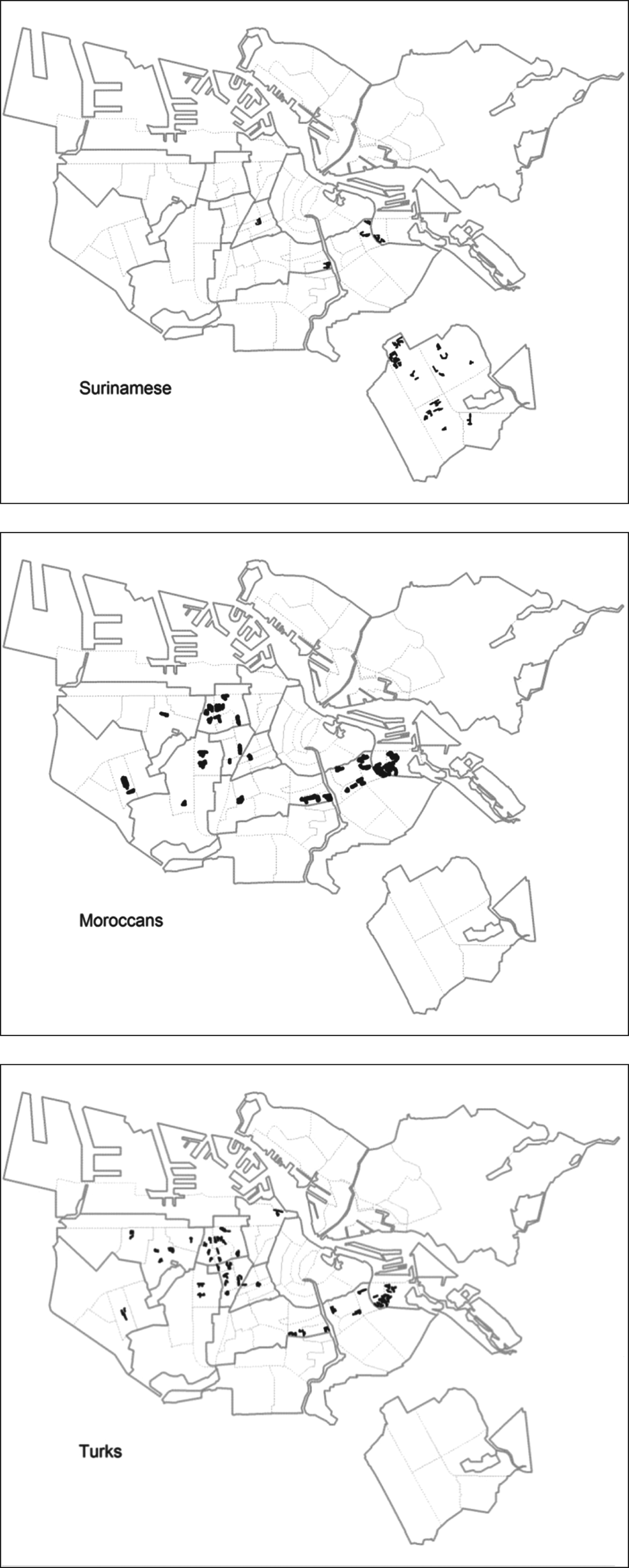
The residential patterns of concentrations of older migrants, here presented for 2009 (Figure 1), strongly reflect the places of settlement of when they first came to the city (after a short period of living in privately rented lodging houses and pensions in even older neighbourhoods closer to the city centre). Today, most Surinamese older people continue to live in the South East and East districts. Moroccan and Turkish older people mainly live in the East, West and New West districts. A comparison with similar data for 2000 (not included) shows concentrations in the same parts of the city, but during the decade that followed the number of concentrations has increased significantly. While the patterns for Turkish and Moroccan migrants are generally very distinct from those of Surinamese migrants, there are some neighbourhoods, predominantly in the Amsterdam East district, that show overlapping concentrations of older Moroccans, Turks and Surinamese. The spatial distribution of different groups of older non-Western minorities can be explained by various factors, including the year of migration, migration type and access to social housing (Musterd and Ostendorf Reference Musterd and Ostendorf2009). The peak influx of Surinamese, for example, coincided with the availability of newly built, though relatively unattractive, high-rise social housing in Amsterdam South East. The newly arrived Surinamese were often not in a position to refuse them, but Surinamese migrants arriving later tended to settle there mainly by choice (Deurloo and Musterd Reference Deurloo and Musterd2001).
Concentrations (areas where the percentage of a population category is at least two postcode-level standard deviations above the city-wide average) of older migrants (55 and older) in Amsterdam, 2009.

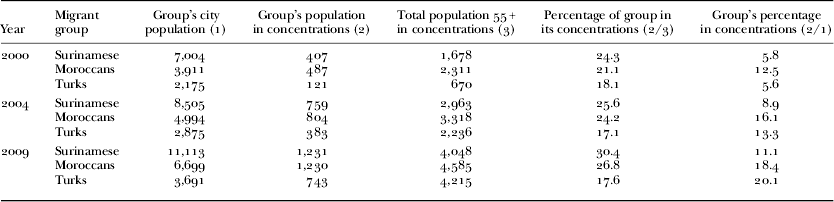
Table 1 presents additional information on the concentrations illustrated in Figure 1. This reveals some interesting findings regarding the orientations of migrants 55 years and older. In 2000, only 5.8 per cent of all Surinamese aged 55 and above in Amsterdam were living in a Surinamese 55+ concentration, that is, among many other 55+ Surinamese; the vast majority lived elsewhere. This figure, however, grew to 11.1 per cent by 2009. Turkish 55+ residents show an even steeper increase. In 2000, only 5.6 per cent of all Turkish 55+ residents lived in Turkish 55+ concentrations; in 2009, this was 20.1 per cent. Older Moroccan residents are also increasingly surrounded by other Moroccan older adults, but the increase has not been as rapid as for the other groups of migrants (from 12.5 to 18.4 per cent).
Characteristics of residential patterns of older migrants (55+), relative to total population 55+ in Amsterdam, 2000, 2004 and 2009
Source: Stadsmonitor Amsterdam, Dienst Onderzoek en Statistiek, municipality of Amsterdam and Urban Geography, University of Amsterdam (own calculations).
The rapidly increasing concentration of non-Western migrants aged 55+ is surprising when compared to the dynamics of the total migrant population in Amsterdam. Since 2000, Surinamese, Turks and Moroccans (all ages together) have also increasingly settled in their own concentrations, though with much lower levels of increase (Stadsmonitor Amsterdam, Dienst Onderzoek en Statistiek, own calculation). We speculate that the different dynamics between older migrants and all migrants are due to the lower levels of residential mobility of older migrants compared to younger migrants. Furthermore, since the latter are also settling in other and newer areas, even suburban areas, the areas left behind are increasingly seeing concentrations of older migrants who are ageing in place. Another speculative interpretation is that the importance of living in a concentration of one's own group increases with age, especially for those who have become more reliant upon their immediate environment. Nitsche and Suijker (Reference Nitsche and Suijker2003) even claim that the proximity of ethnic services and associates with a similar ethnic background is a major reason for older non-Western people to continue living in unsuitable dwellings in disadvantaged neighbourhoods. This leads to the hypothesis that older non-Western people might be retreating into their concentrations according to their own preferences. Nevertheless, for those 55+ migrants living in a concentration of their own age and origin group, the proportion of their own group within these concentrations has remained rather stable at around 20–25 per cent (Table 1, column 6). This is related to the dynamics of the rest of the population group.
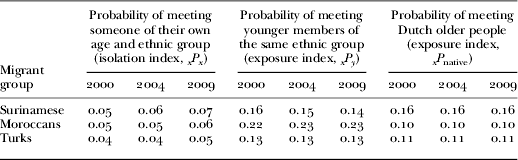
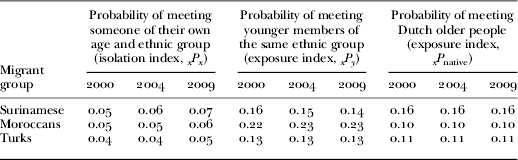
Segregation of specific groups can cause social isolation and low levels of social integration with other urban groups. However, as shown in Table 2, isolation levels are overall still low and only slightly increasing, even at the micro-level of the six-digit postcode area. For each migrant aged 55+ of a certain origin, the probability of being exposed to a younger person of their own migrant group is much higher, and the probability of meeting a native Dutch resident aged 55 years and above is two to three times as high as meeting someone of the same age and ethnic group. As argued, the welfare system in the Netherlands has likely contributed to these moderate segregation levels. Of particular importance is the provision of social housing and housing subsidies in the Netherlands. In 2009, 66.3 per cent of Surinamese, 53.9 per cent of Moroccans and 50 per cent of Turkish low-income older people aged 55 and above in Amsterdam received a housing allowance, a compensation given by the Dutch government to people whose income is too low to pay their rent (WiA 2009, own calculation). The probability of meeting younger members of the same migrant group is relatively high for Moroccan older people and low for Turkish older adults. The probability of meeting an older Dutch inhabitant is relatively high for Surinamese older people and low for Moroccan older people. Again, differences in migration history may account for these findings. Additionally, the relatively small cultural distance between Surinamese and native Dutch older people could be important in explaining the relatively low segregation levels between these groups.
Levels of isolation and exposure of older migrant people (55+), Amsterdam, six-digit postcode level, 2000, 2004 and 2009, no sample
Source: Stadsmonitor Amsterdam, Dienst Onderzoek en Statistiek, municipality of Amsterdam and Urban Geography, University of Amsterdam (own calculations).
In general, older migrants live in areas where younger members of their own ethnic group also reside. This holds true for all of the migrant groups, but particularly for Moroccan older people. Concentrations of older Moroccans can typically be found in the older parts of the city where households first settled after the guest worker phase. There, the elderly might be ageing in place.
The geographic information system analyses, as previously described, do not take into account the socio-economic situation of the groups involved. The WiA data allowed us to include migrants' socio-economic position and to calculate the proportion of a group of 55+ at the neighbourhood combination level (there are approximately 100 neighbourhood combinations in Amsterdam). This calculation can also be made specifically for low-income households. In this study, ‘low-income’ refers to households meeting the criteria of the ‘primary income group’. In 2009, this group was defined as earning below €1,200 per month for single households, and below €1,700 per month for multi-person households (Gemeente Amsterdam and Amsterdamse Federatie van Woningcorporaties 2010). When socio-economic position is taken into account, we see that correlation levels between migrant older people and native Dutch older people from lower socio-economic classes are rather unstable over time (Table 3). The correlation between older Surinamese with a low income and older natives with a low income is highest when compared to similar correlations between Moroccans and natives, and between Turks and natives. The spatial correlation between Moroccan and Turkish older residents, both with a low income, is the strongest among all groups.
Co-presence (Kendall's tau-b correlation) of older people (55+): native Dutch and three migrant groups at neighbourhood combination level in Amsterdam 2001, 2005 and 2009: all income groups (top right section, italic) and low-income groups (bottom left section, upright)

Source: Wonen in Amsterdam (Housing in Amsterdam), sample, weighted by population (own calculation).
Significance levels: * Significant at the 0.05 level, ** significant at the 0.01 level (two-tailed).
Residential conditions of older non-Western migrants and native Dutch older people
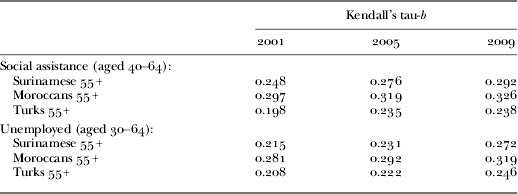
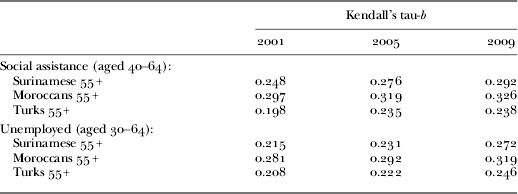
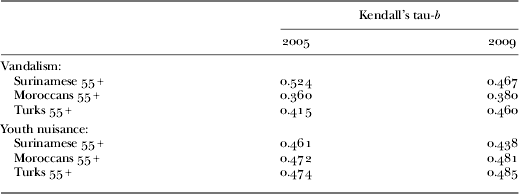
The second key question concerns the residential conditions that older migrants (and native Dutch residents) are exposed to and how these evolve over time. On the basis of three complementary data-sets (Stadsmonitor, Police data, WiA data), we are able to say more about the socio-economic conditions (Table 4), social safety conditions in their neighbourhoods (Table 5) and individual housing conditions of low-income 55+ migrant groups and native Dutch residents (Table 6).
Correlation between the presence of older migrants (at six-digit postcode level, >five people 55+) in Amsterdam and levels of social assistance (benefits) and share of unemployed, 2001, 2005 and 2009
Significance levels: All correlations are significant at the 0.01 level (two-tailed).
Source: Stadsmonitor Amsterdam, Dienst Onderzoek en Statistiek, municipality of Amsterdam and Urban Geography, University of Amsterdam (own calculations).
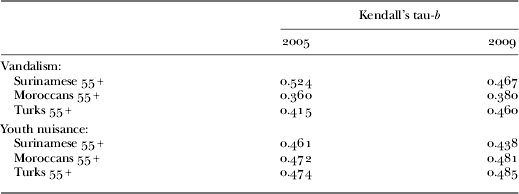
Correlation between the presence of older migrants (at four-digit postcode level, >five people 55+) in Amsterdam and levels of vandalism and youth nuisance, 2005 and 2009
Significance levels: All correlations are significant at the 0.01 level (two-tailed).
Source: Stadsmonitor Amsterdam, Dienst Onderzoek en Statistiek, municipality of Amsterdam and Urban Geography, University of Amsterdam, and DRI Amsterdam-Amstelland Police (own calculations).
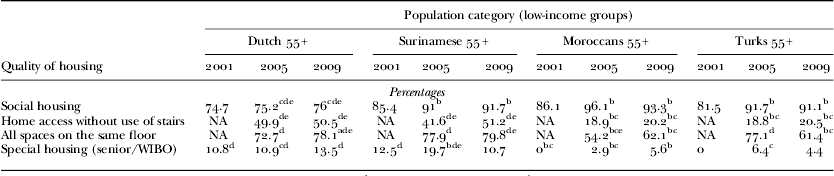
Share of low-income older migrants and native Dutch living in housing conditions relevant to the living situation of older people in Amsterdam in 2001, 2005 and 2009
Notes: Ninety-five per cent confidence interval compared to a 2005; b native Dutch; c Surinamese; d Moroccans; e Turks. NA: not available. WIBO (Living In a Protected Environment).
Source: Wonen in Amsterdam (Housing in Amsterdam), sample, not weighted (own calculations).
With regard to the socio-economic conditions in the residential environments of older migrants, it is clear that for all migrant groups the correlations between the two indicators for social deprivation in the direct, small-scale residential environment are relatively high and increasing over time. When the share of elderly migrants in these environments increases, the share of people (aged 40–64) that receives social assistance, and the share of unemployed people (aged 30–64) also increase (Table 4). The strongest correlations can be found with Moroccan older people.
Social safety conditions in the neighbourhood are indicated through vandalism and nuisance caused by youth in a four-digit postcode area for which we were also able to calculate the proportion of older migrants. The same logic holds for these analyses, and therefore the tau-b values were once again calculated (Table 5). The correlation values are rather high for all older migrant groups, and the differences between the three groups are limited. This implies that neighbourhoods with a higher proportion of older migrants show higher levels of vandalism and nuisance created by youth, but this also seems irrespective of ethnic origin. Nonetheless, it is interesting that the association between Surinamese older residents and levels of vandalism and youth nuisance are decreasing over time, with lower values in 2009 compared to 2005; this is in contrast to the correlations between the other groups of older migrants and levels of vandalism and youth nuisance, which are increasing. This may be a consequence of urban restructuring processes, which have been significant in residential areas where Surinamese residents are well represented, while restructuring in neighbourhoods with Moroccan and Turkish populations has only just begun and has so far not been very successful. Consequently, there appears to be a trend towards convergence.
The individual housing conditions of older migrants can be compared to those of older native Dutch residents with a similarly low income. Table 6 shows the percentage of each group of older residents (for each year) that has experienced certain housing conditions. There is a very high share of households with persons aged 55 and above with a low income living in social rental housing. Interestingly, the percentages are significantly higher for migrants compared to native Dutch residents. Their over-representation in the social rental sector can partly be explained by their life and residential histories. Many older non-Western people entered the housing market in a period when owner-occupied dwellings were limited. Because of their low and insecure incomes, many were unable to move to owner-occupied housing. Limited knowledge of the housing market and cultural reasons may also account for the difference (Dienst Onderzoek en Statistiek 2011). Most Turkish and Moroccan older people are, for instance, involved in the Islamic religion; it is likely that this has influenced their housing market orientations, in terms of preferring long-term renting rather than participating in bank loans that are inconsistent with the principles of Islamic culture (Van der Kloor Reference Van der Kloor2007). Additionally, the prevailing idea of returning to their country of origin may have prevented older migrants from buying houses (Schellingerhout Reference Schellingerhout2004).
With regard to the other conditions mentioned, namely access to the home without having to use stairs, having all spaces in the dwelling on the same floor and having access to special housing (living in an independent but protected environment in close proximity to special services), we find a division between, on the one hand, native Dutch and Surinamese 55+, and on the other, Moroccan and Turkish 55+. Overall, the first two groups appear to have access to housing that is considered suitable for older people. The latter two groups clearly have more limited access to such housing; furthermore, compared to 2001, their housing situation has not improved. Differences in residential patterns may partly account for these findings. Surinamese older people are generally concentrated in areas with a large number of high-rise flats with elevators, while concentration areas of Turkish and Moroccan older people are characterised by mid-rise portico homes that can only be accessed using stairs. The share of special housing in these neighbourhoods is relatively low and the possibilities for renovating unsuitable housing are often unknown or financially unattractive due to the consequent rise in rents. Higher rental costs of special housing (WiA 2009, own calculation) may also partly explain the under-representation of Turkish and Moroccan older people in these living arrangements, but other group specifics, such as unfamiliarity with special housing, the unavailability of housing facilities that meet the culture-specific housing preferences of older people with a Muslim background, and the relatively young age structure of Turkish and Moroccan residents (and related household arrangements, including children and other family members) must also be highlighted (Heygele, Vreeswijk-Manusiwa and Schellekens Reference Heygele, Vreeswijk-Manusiwa and Schellekens2009; Nitsche and Suijker Reference Nitsche and Suijker2003; Schellingerhout Reference Schellingerhout2004).
Environmental satisfaction of older non-Western migrants and native Dutch older people
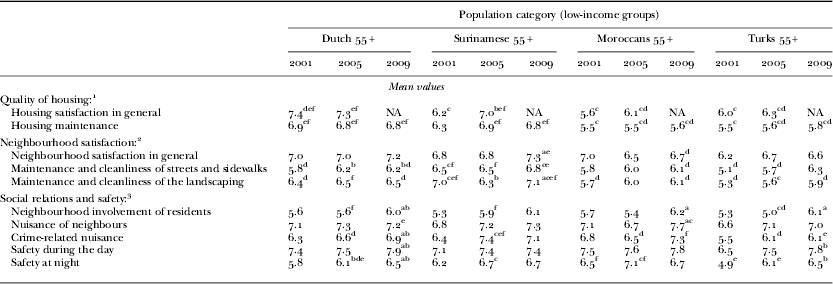
The evidence presented until now describes the potential conditions for cohesion and integration of different groups of older adults. Table 7 shows how this can affect older people's housing and neighbourhood satisfaction and feelings of safety. In terms of older people's opinions about their dwelling, their nearby neighbourhood and the environment further from home, the mean scores per group are represented on a 1 to 10 interval rating scale, with 10 being the most positive.
Housing and neighbourhood satisfaction and opinions about social relations and safety of low-income older migrants and native Dutch in Amsterdam on a scale of 1 to 10 (with 10 being the most positive, interval scale), 2001, 2005 and 2009
Notes: Ninety-five per cent confidence interval compared to a2005; b2001; cnative Dutch; dSurinamese; eMoroccans; fTurks. NA: not available. Questions behind the variables: 1. Housing satisfaction in general: ‘Please indicate to what extent you are you satisfied with your home’. Housing maintenance: ‘How do you assess the condition of your home?’ 2. Neighbourhood satisfaction in general: ‘How satisfied are you with your neighbourhood?’ Maintenance and cleanliness of streets and sidewalks: for 2005 and 2009, we created a composite variable, consisting of two questions: ‘How do you rate the cleanliness of streets and sidewalks in your neighbourhood?’ and ‘How do you rate the condition of streets and sidewalks in your neighbourhood?’ Maintenance and cleanliness of the landscaping: for 2005 and 2009, we created a composite variable, consisting of two questions: ‘How do you rate the cleanliness of the landscaping in your neighbourhood?’ and ‘How do you rate the state of maintenance of the landscaping in your neighbourhood?’ 3. Neighbourhood involvement of residents: ‘How do you assess the involvement of local residents in the neighbourhood?’ Nuisance of neighbours: ‘Could you indicate to what extent you are experiencing nuisance from neighbours? A low number means that you are experiencing much nuisance and a high score means that you have little inconvenience.’ Crime-related nuisance: ‘Could you indicate to what extent you are experiencing nuisance from crime? A low number means that you are experiencing much nuisance and a high score means that you have little inconvenience.’ Safety during the day: ‘How safe do you feel in your neighbourhood during the day?’ Safety at night: ‘How safe do you feel in your neighbourhood at night?’
Source: Wonen in Amsterdam (Housing in Amsterdam), sample, not weighted (own calculations).
Compared to the Amsterdam 55+ population in all income categories and irrespective of ethnic origin (not in the table), the figures presented in Table 7 are in general, though not always, somewhat lower. Furthermore, compared to 2001, we find modest developments over time. Surinamese older people have become more positive about their housing and neighbourhoods, while the levels of housing and neighbourhood satisfaction among other groups of older people have remained relatively stable over time. Social relations and feelings of safety have improved for all low-income groups, irrespective of ethnic origin (with the exception of Surinamese 55+, where this has remained stable).
Differences between the distinctive migrant groups are limited, but show a clear pattern. With regard to housing satisfaction, we find a division between, on the one hand, native Dutch and Surinamese 55+, and on the other, Moroccan and Turkish 55+. The latter express lower levels of housing satisfaction. This corresponds with the better housing conditions we found for socio-economically similar groups of native Dutch and Surinamese older people, compared to Turkish and Moroccan older people. Surinamese older people are also more positive about their neighbourhood. They show high scores, even higher than the scores for all income 55+ (not shown), in terms of the maintenance of the physical environment. This may be related to the restructuring of neighbourhoods where Surinamese are concentrated. Although neighbourhoods with a higher proportion of older migrants show higher levels of vandalism and nuisance created by youth, this does not translate into dissatisfaction with social relations or feelings of lack of safety. A possible explanation is that older non-Western people generally live in close proximity to members of their own ethnic group, the latter of whom are likely to have become a crucial source of community and elderly care (Buffel and Phillipson Reference Buffel and Phillipson2011). There are several indications that older people express dissatisfaction generally further from home: satisfaction with their own dwelling is higher than with their neighbourhood, fewer nuisances are experienced from neighbours than from crime, and they feel safer during the day than at night.
Conclusion, discussion and avenues for further research
As in many urban societies, the share of older people living in Amsterdam is predicted to grow. While the ageing native baby-boom generation can partially explain this, an additional explanation is that many earlier migrants are ageing in place in the city. In this paper, we investigated the specific geographies of older non-Western migrants in the city of Amsterdam, while analysing detailed information on the residential conditions of the largest migrant groups that have settled in the city. We paid particular attention to situations of neighbourhood deprivation and housing circumstances that older migrants and native Dutch older residents face. Finally, we investigated recent dynamics, mainly over the past decade, and satisfaction levels with regard to housing, neighbourhood, social relations and safety.
In the first set of empirical analyses, we demonstrated that there is strong path dependence with regard to the places where we find older ethnic minorities. Older migrants tend to be located in the neighbourhoods where they found their first permanent dwellings after having lived in temporary accommodation in the very initial phase of their residency. This applies especially to the first waves of labour migrants. This finding also indicates that these groups are lagging behind in the housing market. We also demonstrated that these patterns among older migrants overlap with those of younger migrants of the same ethnic origin, although these younger migrants clearly also have access to larger homes in more recently built neighbourhoods. The overlap may offer a potential source of community and elderly care. Even though older non-Western migrants in Amsterdam have become increasingly concentrated over the past decade, for those 55+ migrants living within a concentration of their own age and origin group, the overall proportion of their own group within these concentrations has remained rather modest. We did not find indications of isolation of older migrants, that is, isolation from other 55+ residents and from younger households of a similar ethnic origin. One might argue that there are socio-spatial conditions, manifest in the demographic and ethnic structure of the neighbourhood, that allow older migrants to stay in touch with older residents of a similar ethnicity, but also with others of the same age and of a different ethnicity and with younger residents of their same ethnic group. This suggests that there is no immediate likelihood of parallel societies developing within the city, but also that the volume of potential support is perhaps limited and the importance of family networks is increasing. Research in inner-city neighbourhoods in England and Belgium has already shown that older non-Western migrants who do not have family members or friends living close by are particularly prone to social isolation (Buffel and Phillipson Reference Buffel and Phillipson2011). This may hold especially true for minority older people living in ethnically mixed and age-differentiated urban environments such as Amsterdam. At the same time, cultural beliefs about supporting older people are changing rapidly; it is no longer self-evident that children will provide care for their ageing parents, especially when they move to other urban areas or regions (Abraham Reference Abraham1996; Heygele, Vreeswijk-Manusiwa and Schellekens Reference Heygele, Vreeswijk-Manusiwa and Schellekens2009; Yerden Reference Yerden2013). Further research is needed to provide more insight into the social support networks of older non-Western people living in residential concentrations.
In the second set of empirical analyses, we focused on the neighbourhood and housing conditions of various older migrant groups and socio-economically comparable native Dutch older residents. Currently, there is a relatively high and increasing correlation between the share of older migrants and the level of social deprivation in their immediate residential environment. In terms of social safety, there are clear signs of a clash between older residents and youth in their neighbourhoods. Correlations between the share of 55+ residents and nuisance from vandalism and youth are positive and high. Yet, there is also an interesting exception to this. While for Moroccans and Turks aged 55+ the correlation is increasing, for Surinamese aged 55+ the correlation is declining. This may be a consequence of urban restructuring processes, which have been significant in residential areas where Surinamese residents are well represented, while restructuring in neighbourhoods with Moroccan and Turkish populations has only just begun and has so far not been very successful.
Indeed, our third set of empirical analyses demonstrates that Surinamese older people are significantly more positive about their physical environment than the other categories of older adults. In general, high levels of social deprivation do not seem to translate into dissatisfaction with social relations and feelings of lack of safety. In fact, all low-income groups – irrespective of ethnic origin – have either become more positive or did not significantly change their opinion. This result seems to support studies suggesting that even in deprived neighbourhoods, older people may feel attached to and able to identify positive features of their social environment (Buffel and Phillipson Reference Buffel and Phillipson2011; Scharf et al. Reference Scharf, Phillipson, Smith and Kingston2002). A possible explanation is that older non-Western people generally live in close proximity to other members of a similar ethnic origin. However, we should keep in mind that the analyses presented here are mainly based on 55+ migrants and native Dutch residents. A large number of these older people will not have reached the age at which daily life becomes more difficult and problems bigger, even though older migrants tend to have personal problems much earlier than native older people. Qualitative research is needed to explain the high levels of satisfaction within a residential context of social and economic deprivation.
With regard to housing conditions at the level of the dwelling, we also found better conditions for socio-economically similar groups of native Dutch older people and Surinamese 55+ residents, compared to Turkish and Moroccan 55+ citizens. This corresponds with the higher levels of housing satisfaction of native Dutch and Surinamese older people. The findings refine academic and policy assertions that crudely argue that older non-Western migrants will face more disadvantages than native Dutch older people. Differences are again possibly due to neighbourhood characteristics and urban restructuring, but one might also argue that Moroccan and Turkish older people are more reluctant to move to suitable housing because they perceive the options available to them as unattractive or not meeting their cultural needs and desires. New knowledge is required in order to gain a better understanding of the age- and culture-specific housing and neighbourhood preferences of older minorities.
To conclude, Western European countries and cities host a wide variety of international migrants. Today, the cohorts of migrants who arrived in Europe half a century ago are growing old. In Amsterdam, as in other Western European cities, many of them tend to live in disadvantaged urban neighbourhoods. These environments present particular risks for older people and less likely provide the factors found critical for successful ageing. In many Western European welfare states, the government assumes responsibility for the well-being of vulnerable citizens, including older migrants. In Amsterdam, this has contributed to relatively modest spatial segregation patterns and high levels of neighbourhood satisfaction and feelings of safety. However, the welfare system stemming from the 20th century is becoming less generous and, in the 21st century, is gradually being replaced by a ‘participation society’ in which citizens will be less reliant on the government and (have to) create their own safety nets. One aspect of this is that older people are expected to remain independent and in their own homes for as long as possible. This requires cities to be more accessible and inclusive, especially in the context of ageing minorities. Adequate and affordable housing for particular groups of older migrants is already a pressing issue, and will become even more demanding when a larger share of the total migrant population gets older. The pathway towards an inclusive city necessarily involves being critically receptive to alternative living arrangements, such as group accommodation for minority older people, and a willingness to rethink ethnically mixed housing policies in terms of giving more consideration to the social networks of older non-Western people and the potential advantages of the residential concentration of minority (and, for that matter, majority) groups. Qualitative follow-up research about the residential conditions of older minorities of certain origins and their age- and culture-specific housing and neighbourhood preferences in a changing welfare state context is essential for developing ‘age-friendly’ environments that enable the full participation of older people with different capacities and needs.
Acknowledgements
This research is supported by the Hans Jongstra Fund. The Hans Jongstra Fund has played no role in the design, execution, analysis and interpretation of the data or the writing of the paper. The authors wish to acknowledge the support of the Hans Jongstra Fund. We would like to thank Sjoerd de Vos for his methodological advice.