Background
Common mental disorders such as anxiety and depression are responsible for significant psychosocial burden in palliative care patients (Lloyd-Williams, Reference Lloyd-Williams2001; Laird & Mitchell, Reference Laird and Mitchell2005; Robinson & Crawford, Reference Robinson and Crawford2005). The prevalence of depression in patients with advanced disease is 15%, with a further 10–15% suffering from significant degrees of anxiety and other psychological symptoms (Hotopf et al. Reference Hotopf, Chidey and Addington-Hall2001). Psychological interventions have been show to alleviate emotional distress in early and advanced disease (Greer et al. Reference Greer, Moorey, Baruch, Watson, Robertson, Mason, Rowden, Law and Bliss1992; Moorey et al. Reference Moorey, Greer, Watson, Baruch, Robertson, Mason, Rowden, Tunmore, Law and Bliss1994; Kissane et al. Reference Kissane, Bloch, Smith, Miach, Clarke, Ikin, Love, Ranieri and McKenzie2003; Trask et al. Reference Trask, Paterson, Griffith, Riba and Schwartz2003). For instance, Savard et al. (Reference Savard, Simard, Giguère, Ivers, Morin, Maunsell, Gagnon, Robert and Marceau2006) demonstrated in a randomized controlled trial (RCT) that cognitive therapy was an effective treatment for depression in women with metastatic breast cancer. However, trials in advanced disease have used subjects who were well enough to attend out-patient clinics. Psychological therapy in very advanced disease has yet to be evaluated. Delivery of psychological therapy in palliative care presents unique challenges. The severity of physical symptoms and the fatigue and disability experienced by terminally ill patients mean that the traditional model of a course of hourly out-patient sessions may not be relevant for a significant number. Access to psychological services for palliative care patients with mental health needs can be poor and uncoordinated (Lawrie et al. Reference Lawrie, Lloyd-Williams and Taylor2004) so much of the responsibility for these problems remains with palliative care professionals. Clinical nurse specialists (CNSs) often form the front line in terms of management of these conditions. A high proportion of their referrals are for social support (Skilbeck & Payne, Reference Skilbeck and Payne2003) but they often feel ill-equipped to deal with them. Giving nurse specialists basic skills to deal with anxiety and depression as part of their work with people in their own homes could therefore be of substantial benefit to patients. Despite the acknowledged need for training, few evaluations of training exist (de Haes & Teunissen, Reference de Haes and Teunissen2005). A recent pilot study has demonstrated that palliative care professionals can learn ‘first aid’ cognitive therapy skills (Mannix et al. Reference Mannix, Blackburn, Garland, Gracie, Moorey, Reid, Standart and Scott2006). These professionals improved in their competence in using cognitive and behavioural techniques following a training programme. The group was randomized to either receive further supervision or just to practise as usual; those who received supervision continued to improve, in contrast to those who were not supervised. Mannix et al. (Reference Mannix, Blackburn, Garland, Gracie, Moorey, Reid, Standart and Scott2006) demonstrated effects of training on competence but did not evaluate outcome.
This study was designed to evaluate a training programme for nurses at St Christopher's Hospice, which is one of the world leaders in palliative care. It serves the London boroughs of Bromley, Croydon, Lambeth, Lewisham and Southwark. Patients with incurable illness are referred by their general practitioner (GP), hospital doctor, district nurse, hospital or community palliative care team. CNSs in the Home Care Team hold a personal case-load working with professionals in primary care to offer advice on symptom control and helping patients and families to adjust to the stresses of terminal illness. Out of working hours, nurses are on call to provide advice and support to patients, families and health-care professionals through telephone contact or a home visit. Patients are seen in their own homes by the nurse and referred on to other services as appropriate. The nurses carry a case-load of between 25 and 30 patients at any one time and approximately 40% of patients remain at home to die. All nurses provide emotional support as part of their core role. Patients also have access to a range of other professionals providing liaison psychiatry, social work, pastoral care and complementary therapies.
The aim of the first phase of the study was to determine whether palliative care nurses given a basic training in cognitive behaviour therapy (CBT) are able to use core components of this training when treating patients with anxiety or depression. The second phase evaluated whether this training had any effect on outcome.
Method
Design
This was a cluster RCT on the effect of nurse training in CBT on the outcome of anxiety and depression in palliative care patients with advanced cancer. The unit of randomization was the nurse, and the ‘intervention’ consisted of a structured training and supervision package. The outcomes were (1) the effects of the training on the nurse's knowledge, practice and competency in CBT and (2) the effects of the training on the patient's symptoms.
Practical and ethical concerns prevented us from randomizing individual patients directly to CBT or treatment as usual (TAU). All new cases seen by these nurses were screened for the trial; the nurses in both groups administered the Hospital Anxiety and Depression Scale (HADS) to all their new patients with a diagnosis of cancer. Our two research workers (E.C. and M.K.) regularly checked the referrals to the home care teams to ensure the questionnaires had been administered. If questionnaires were not given, the reasons for this were recorded and demographic details of the patients collected. Patients were excluded if there were significant cognitive, communication or language difficulties that made it difficult for them to participate in the research interviews or psychological therapy. Patients were also excluded if the severity of their illness or debility was so great that they were unable to participate. Patients who scored ⩾8 for anxiety or depression on the HADS were considered to be possible cases and were asked if the researcher could visit them to discuss the study. At the research visit the HADS was given a second time to confirm that there was still significant emotional distress. Those who continued to score ⩾8 on either subscale were invited to take part in the study. Informed consent was obtained and the researcher then interviewed each participant and invited them to complete the full set of questionnaires as described below.
Patients then received their usual treatment from the home care team; if they were under the care of a CBT trained nurse this included some CBT focused on their emotional problems as part of the home consultation. Patients were reassessed by the researcher at 6, 10 and 16 weeks after entering the trial. At each interview they were asked a few introductory questions about themselves and their illness and then completed the questionnaires.
Randomization
All CNSs in the Home Care Service of St Christopher's Hospice were informed about the study and asked for their willingness to participate. Fifteen from a possible 29 nurses expressed an interest, and were prepared to be randomized. Nurses were informed about the nature of the training package and that they would either be randomized to receive the training immediately or have an opportunity to receive it after the end of the trial. Randomization was stratified by team (n=5) to ensure that a similar number of nurses would be allocated to each group for each team. Randomization was performed by the Institute of Psychiatry Clinical Trials Unit, who had no knowledge of the trial or the nurses involved.
CBT training
The aims of the training were to give nurses an understanding of how to conceptualize cases and some simple techniques they could use in their home visits. The training programme was based on that reported by Mannix et al. (Reference Mannix, Blackburn, Garland, Gracie, Moorey, Reid, Standart and Scott2006). All training and supervision was conducted by S.M. Nurses randomized to learn CBT attended a 2-day introductory workshop followed by seven 1-day workshops and one refresher day. The training covered the cognitive model as applied to cancer, problem definition, goal setting, structuring sessions, using collaborative empiricism and guided discovery, and homework in the palliative care setting. Nurses were taught the application of CBT to commonly occurring problems (helplessness and hopelessness, perceived loss of control, panic, worry, insomnia and fear of death and dying). Cognitive Behaviour Therapy for People with Cancer (Moorey & Greer, Reference Moorey and Greer2002) was used as the basic text for the training. Nurses were supervised in a weekly supervision group over a year before recruiting patients into the trial and during the course of the trial. Demands from other clinical commitments sometimes restricted the availability of the supervisor and nurses so that meetings averaged at two every 3 weeks.
Measures of training effect
Nurses in both groups were seen by E.C. at the beginning of the trial, then at the end of the 1-year training and at 3 years post-randomization. They completed a set of questions to assess their knowledge of CBT and their use of it in their usual practice. A semi-structured interview was carried out to investigate the subjective experience of receiving the training and its effect on their work. Competence in the use of CBT techniques was assessed. In this paper we report the effect of training on competency and clinical outcomes.
Tapes of sessions with patients in this context are difficult to rate. They contain discussion of physical and social care issues as well as emotional issues. To increase the homogeneity we used an actor to role play the same patient for each nurse. At the end of the 2-year study, the nurses took part in a 20- to 30-minute role play with an actor experienced in playing the role of a psychiatric patient. They were asked to conduct a clinical interview as they would in the patient's home, focusing on helping him with an emotional issue. The actor played the role of a married man with small children suffering from incurable cancer; he presented with symptoms of depression including hopelessness and severe lack of motivation as well as fear that activity might cause the disease to progress more quickly. These sessions were videotaped and viewed blind by two practitioners experienced in the application of CBT in serious physical illness (K.M. and L.F.). The raters used the Cognitive Therapy First Aid Rating Scale (CTFARS; Mannix et al. Reference Mannix, Blackburn, Garland, Gracie, Moorey, Reid, Standart and Scott2006) to assess competence in CBT. Means of the two raters' scores were calculated and used in the analysis. This scale was specifically designed to measure cognitive therapy (CT) skills in a palliative care setting. It has high internal consistency (Cronbach's α=0.93) and good inter-rater reliability [median intra-class correlation (ICC)=0.75].
Measures of clinical outcome
The Hospital Anxiety and Depression Scale (HADS; Zigmond & Snaith, Reference Zigmond and Snaith1983)
This is a 14-item measure of mood designed for use with patients with physical illness. Seven items measure anxiety and seven depression. Its psychometric properties have been investigated in cancer patients, and it has been used successfully in previous trials in cancer patients.
The Mental Adjustment to Cancer Scale (MAC; Greer & Watson, Reference Greer and Watson1987)
The MAC was designed to measure the styles of adjustment to cancer, first posited by Greer and co-workers (Greer & Watson, Reference Greer and Watson1987). The shortened, 29-item version of the MAC was used (mini-MAC; Watson et al. Reference Watson, Law, Santos, Greer, Baruch and Bliss1994) because it is easier for very ill patients to complete.
The Cancer Coping Questionnaire (CCQ; Moorey et al. Reference Moorey, Frampton and Greer2003)
This 21-item scale was developed to measure the coping strategies taught in CBT for cancer. It is sensitive to change during therapy with patients with early and advanced cancer (Moorey et al. Reference Moorey, Greer, Bliss and Law1998).
The Multi-dimensional Scale of Perceived Social Support (MSPSS; Zimet et al. Reference Zimet, Dahlem, Zimt and Farley1988)
This is a 12-item self-report measure of perceived social support. It has good psychometric properties (Zimet et al. Reference Zimet, Powell, Farley, Werkman and Berkoff1990; Dahlem et al. Reference Dahlem, Zimet and Walker1991) and has been used with cancer patients (Hann et al. Reference Hann, Oxman, Ahles, Furstenberg and Stuke1995, Reference Hann, Baker, Denniston, Gesme, Reding, Flynn, Kennedy and Kieltyka2002).
The Eastern Cooperative Oncology Group (ECOG) Performance Status Scale (Oken et al. Reference Oken, Creech, Tormey, Horton, Davis, McFadden and Carbone1982)
The ECOG performance score has been used extensively in oncology research and is one of the most widely accepted measures of functional performance. The score ranges from 0 (fully active, able to carry on all pre-disease performance without restriction) to 5 (dead). At the mid-point, 3, the patient is capable of only limited self-care, confined to bed or chair for more than 50% of waking hours.
Statistical analysis
We used ICCs to assess the reliability of the raters of nurses' competence and t tests to compare the competency scores in the two groups. We analysed clinical outcomes on the basis of intention to treat. We modelled the effect of intervention on our two principal outcomes, depression and anxiety scores, using the gllamm program within Stata, version 9.0 (Stata Corporation, College Station, TX, USA); this allowed for missing data to be taken into account within the statistical model. Data were analysed taking account of the clustering by nurses, and clustering by individual in a random intercept model. We tested first for interactions between treatment group and time, and if none were detected, for the effect of allocated group on score.
Power calculation
There were no previous studies in palliative care on which to base a power calculation, and one of the explicit aims of this study was to provide data to allow a power calculation for a larger-scale study in the future. The evidence available demonstrates that CBT with a mixed sample of people with primary and metastatic disease produces a 35% reduction in HADS anxiety scores (Moorey et al. Reference Moorey, Greer, Bliss and Law1998). TAU is associated with only a 2% reduction in anxiety in an early disease sample (Greer et al. Reference Greer, Moorey, Baruch, Watson, Robertson, Mason, Rowden, Law and Bliss1992). Conservatively estimating a difference between change scores of 25%, with 80% power and a significance level of 0.05% (two-tailed), a sample of 50 subjects is required. Assuming 25% loss through death or severity of illness before study completion, we aimed to recruit 62 patients.
Results
Demographic characteristics of nurses
Fourteen nurses took part in the trial; one TAU nurse was absent on long-term sick leave and so did not participate in the training or the trial. All of the nurses were female. Six were aged between 36 and 45 years and six between 46 and 55 years. Two were <36 years and one was in the 56–65 years age range. Eighty per cent had been qualified as nurses for over 16 years. All of the nurses were graded as CNSs in palliative care and 73% had over 6 years of experience in palliative care. The nurses had received very little formal training in counselling skills or any other type of psychological therapy. Four reported no post-registration counselling training, nine had had training lasting a week or less, one had been on a course lasting under 1 year and only one nurse had received input for 1–3 years. There were no statistically significant differences between the groups in age, training or experience.
Nurses' competence in CBT
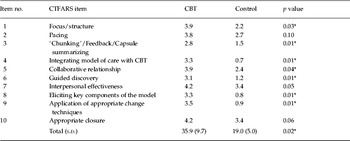
Six CBT and five control nurses were available to participate in the role play. The ICC for the total CTFARS score was 0.84 (p<0.001), indicating that inter-rater reliability was high. The ICCs for the individual items varied from 0.46 to 0.91. The mean score for the CBT group was 35.9 and for the TAU group 19.0 (p=0.02). All the control nurses scored <30 on the CTFARS. All the CBT nurses except one scored >30. Table 1 contains the scores for individual items. The CBT nurses scored higher than controls on all items of the CTFARS. This was of statistical significance for seven of the 10 items. The items assessing pacing, interpersonal effectiveness and appropriate closure of the session did not demonstrate a significant difference between the groups. Both raters correctly identified the training status of 10 of the 11 nurses. Rater 1 named the lowest scoring CBT nurse as a control. Rater 2 named the highest scoring control nurse as a CBT nurse.
CTFARS scores for videotaped role play of a session with a terminally ill patient

CTFARS, Cognitive Therapy First Aid Rating Scale; CBT, cognitive behaviour therapy; s.d., standard deviation.
* Significant at 0.05 level.
Outcome of new home treatment cases

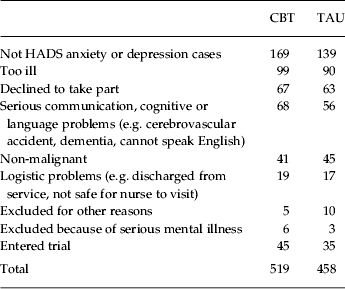
CBT, Cognitive behaviour therapy; TAU, treatment as usual; HADS, Hospital Anxiety and Depression Scale.
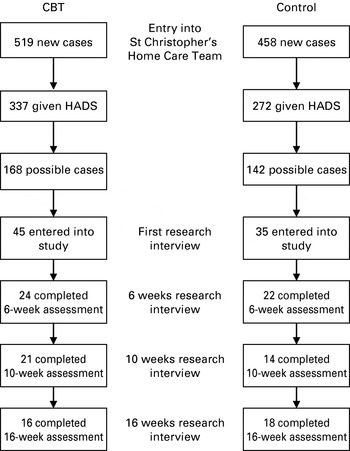
Screening and entry of patients into the trial (Fig. 1, Table 2)
A total of 977 new cases were seen by the home care nurses between March 2004 and December 2005 (519 CBT and 458 control group nurses). The HADS was administered to 609 of these (337 CBT and 272 control group). The main reasons that patients were not given the HADS were that they were too ill (136 patients) or had significant cognitive/language impairment or communication problems (125). Only 41 (4%) declined to complete the screening questionnaire. To ensure there was no bias in selection, the demographic details of patients who were not given the HADS in the CBT and control groups were compared; no statistically significant differences were found for age, sex, marital status, ethnicity or cancer type. However, patients in the control group who were not given the HADS did have a significantly higher ECOG performance score (2.81 v. 2.49, t=2.11, p=0.035), suggesting that patients with greater functional impairment were more likely to be excluded in the control group. In total, 310 patients scored >8 on anxiety or depression and 250 of these were visited by the researcher. Severity of illness was the main reason patients did not receive a research visit.
Flow of patients through the study. CBT, Cognitive behaviour therapy; HADS, Hospital Anxiety and Depression Scale.

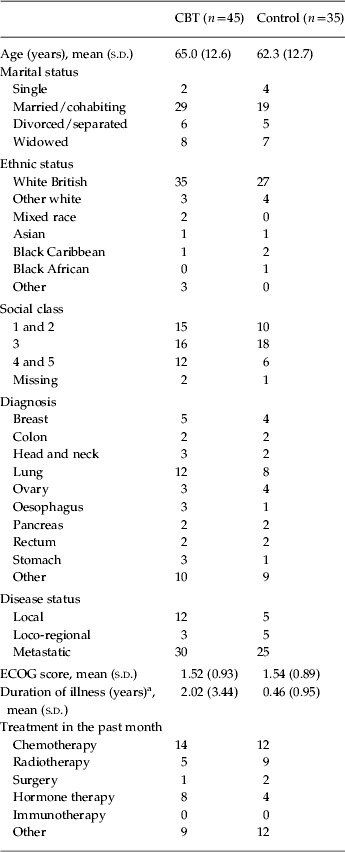
Demographic characteristics of patients seen by the nurses (Table 3)
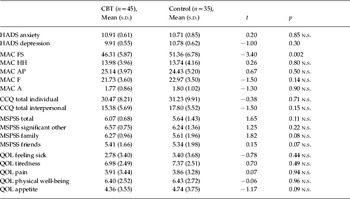
Eighty patients entered the trial (45 CBT and 35 TAU). The mean age was 64 years (s.d.=12.6). Most patients (48) were married or cohabiting, 15 were widowed, 11 divorced or separated and six were single. Twenty-five patients were social class 1 or 2, 34 social class 3, and 21 social class 4 or 5. The sample was predominantly white British (78%). There was a wide spread of cancer diagnoses, with lung cancer (25%) the most common. Most patients (69%) had metastatic disease and the mean ECOG score was 1.53 (s.d.=0.9). The treatment groups were compared on demographic variables, past psychiatric history and treatment and questionnaire scores (Table 4). The CBT group had been ill for a longer period than the TAU group (2.0 v. 0.5 year, t=2.6, p=0.005). The TAU patients scored significantly higher on Fighting Spirit (FS) than the CBT patients (51.4 v. 46.3, t=−3.4, p=0.002). This comparative analysis was also carried out for the 26 patients for whom data were available at all four assessment visits. These patients who survived the 16 months of the study did not differ on any variables, and the duration of illness and MAC scores were not significantly different for this sample.
Demographic and clinical data

CBT, Cognitive behaviour therapy; ECOG, Eastern Cooperative Oncology Group Performance Status; s.d., standard deviation.
a Significant difference: t=2.62, p=0.005.
Scores at first research visit

CBT, Cognitive behaviour therapy; HADS, Hospital Anxiety and Depression Scale; MAC, Mental Adjustment to Cancer scale; FS, Fighting Spirit; HH, Helplessness/Hopelessness; AP, Anxious Preoccupation; F, Fatalism; A, Avoidance; CCQ, Cancer Coping Questionnaire; MSPSS, Multi-dimensional Scale of Perceived Social Support; QOL, quality of life; n.s., not significant.
Survival and drop-out over the course of the trial (Fig. 1)
Forty-six patients (24 CBT and 22 TAU) were available at the 6-week assessment point: 11 had died following the first research interview, 13 were too ill to allow the interviewer to visit and nine declined the 6-week interview. Thirty-five patients (21 CBT and 14 TAU) were available at the 10-week assessment: six died between the 6-week and 10-week assessment, 17 were too ill and 10 declined. Thirty-four patients (16 CBT and 18 TAU) were available at the 16-week assessment: six died between the 10-week and 16-week assessment, 15 were too ill and six declined the interview. The distinction between a failed assessment because of ill health and refusal was not always clear and some patients who declined assessment at one time-point were available at another.
Five patients dropped out completely from the study at the 6-week interview (four CBT, one control), none at the 10-week point and only one further patient at the 16-week assessment. Eleven patients dropped out due to illness at the 6-week interview and were not then available due to continued illness or death, a further five dropped out at 10 weeks, and five more were lost due to illness or death at 16 weeks. The mean survival time from the CNS screening assessment was 173 days (s.d.=156) in the control group and 218 days (s.d.=232) in the CBT group. The physical health of patients who remained in the study deteriorated, as measured by an increase in ECOG scores (F=2.5, p=0.06).
Number of home visits by CNSs
The CBT nurses saw patients for an average of 5.7 sessions (s.d.=5.4) whereas the control group saw patients for 4.1 sessions (s.d.=3.2). This difference was not statistically significant (t=1.99, p=0.09). There was no significant correlation between the number of sessions and the change in HADS anxiety.
Other physical and psychosocial treatment
There were no differences between groups in terms of physical treatment received. Small numbers (5%) received psychological therapy outside of the trial. The TAU group were significantly more likely to have seen a social worker (p=0.04) or chaplain (p=0.02) during the first 6 weeks of the study. More patients were referred to liaison psychiatry in the CBT group in the latter part of the study: the numbers were small (three CBT v. one TAU at 10 weeks) and the difference was not statistically significant. Twenty-nine per cent of patients were on antidepressants at the start of the trial, 25% at 6 weeks, 31% at 10 weeks and 27% at 16 weeks. Twenty-six per cent were on anxiolytics at the start of the trial, 17% at 6 weeks, 37% at 10 weeks and 32% at 16 weeks. There were no significant differences between groups in prescription of psychotropic medication.
Effect of treatment on primary outcome measures
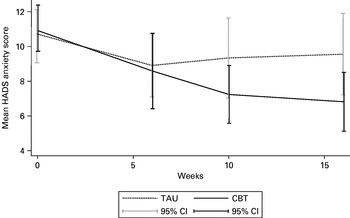
For HADS anxiety (Fig. 2), there was an interaction between group and time, with individuals assigned to the CBT nurses having a significantly lower anxiety score over time [coefficient −0.20, 95% confidence interval (CI) −0.35 to −0.05, p=0.01]. For depression, no interaction or group effects were detected, indicating that the patients seen by the trained nurses had no benefits over the TAU group. The percentage of HADS cases of anxiety reduced consistently over time in the CBT group but not in the control group. This difference was significant at 16 weeks (χ2=4.9, p=0.04), with 19% of the CBT group scoring high compared with 56% of the TAU group. Depression also reduced over time but there were no significant differences between groups. At 16 weeks the percentage of depressed cases was 17% in the CBT group and 19% in the TAU group.
Effect of intervention on anxiety. TAU, Treatment as usual; CBT, cognitive behaviour therapy; HADS, Hospital Anxiety and Depression Scale.

Effect of treatment on other outcome measures
There were no effects for time or treatment group on MAC scale scores. The two initial items on the CCQ ask about the extent to which an individual has felt stressed and has felt the need to cope in the preceding week. Repeated-measures ANOVA showed a definite effect of time in the 24 patients who completed all four assessments (F=7.4, p<0.001 for stress and F=20.1, p<0.001 for perceived need to cope) but no interaction with group. There were no significant changes in the total CCQ or its subscales. On the MSPSS there was a reduction in perceived social support from significant other over time (F=3.4, p=0.02) but no effect for group. There was no change in the other subscales of the MSPSS.
Discussion
Methodological challenges of a RCT of psychological intervention in palliative care
Conducting a trial with palliative care patients is fraught with difficulty (McWhinney et al. Reference McWhinney, Bass and Donner1994). The methodological limitations arose from the constraints we experienced in researching this patient group: first, the severity of their physical illness led to high attrition rates; second, it was not possible to use a standard randomization design; and third, the heterogeneity of symptoms and interventions in palliative care created significant ‘noise in the system’.
Perhaps the most important finding from this study is that it is possible to carry out an RCT of psychological treatment in people with terminal illness. This required considerable stamina on the part of the research workers and nurses to continue recruiting and following patients in the face of high attrition rates. Less than 10% of new cases were recruited into the treatment arm. This was largely due to the physical debility of these extremely ill patients: 32% of the sample were either too ill, too cognitively impaired or unable to communicate to take part in the study. A further 32% were ineligible as they scored too low on the HADS to count as cases. Only 13% declined to take part in the study, and it was our impression that many of these declined because they knew they were too ill to participate. Once patients entered the study, the sample size almost halved over the first 6 weeks because of their deteriorating condition, but this loss then slowed down. This attrition rate is comparable with that found by Savard et al. (Reference Savard, Simard, Giguère, Ivers, Morin, Maunsell, Gagnon, Robert and Marceau2006) in a group of women with metastatic breast cancer attending clinics in Quebec. A total of 497 women were approached for screening but only 45 randomized to therapy (9% of the screened sample compared to 8% in our study).
There was considerable fluctuation in the clinical status of patients, with some patients going downhill rapidly but others being admitted to hospital and then stabilized and returned home. However, it should be remembered that in RCTs of antidepressants, one-third of patients have dropped out at 6 weeks (Hotopf et al. Reference Hotopf, Hardy and Lewis1997). The loss of 43% at 6 weeks in the current study compares favourably with this, given the nature of the population we studied. The use of multi-level statistical modelling allowed the missing data to be accounted for in a way not possible with less sophisticated statistical techniques, but there was inevitably some loss of power as a result of the patients lost from the original sample.
The second methodological difficulty arises because the study could not be an RCT in the traditional sense. The St Christopher's Home Care Team is organized on a locality basis, with nurses covering a small set of GP practices. Consequently, each nurse has a close working relationship with the primary care team in their area. Randomization of patients would mean that if a patient was, for instance, allocated to CBT but was not in a patch covered by a CBT nurse, they would have to be transferred to the care of a control nurse in another area. This would not have been acceptable to the professionals involved. We therefore opted to randomize nurses and make sure that we captured all their new case-load. It was therefore possible for nurses to bias the trial by selecting patients who were more likely to benefit from their intervention. We compared the two groups at each point in the study where bias might have occurred. There was no evidence that nurses were selecting less severely ill patients or excluding patients they thought might not do well in the trial. There were no differences between the groups on almost all of the variables that might influence outcome at screening, beginning of treatment or other stages of the trial. The groups did differ for two variables: MAC FS and length of time since diagnosis. The control group in fact had a higher FS score and therefore might have been expected to do better than the CBT group. Cases in the CBT group had been living with the diagnosis for longer, but they did not differ from the control group on any measures of function or illness severity. We are therefore fairly confident that the patients in the two groups were comparable.
Finally, the end of life is a time where there are considerable changes and very little remains constant. Changes from day to day in physical, psychological and social circumstances are common, and professionals often respond by changing pharmacological and psychosocial interventions. This is, therefore, a very heterogeneous sample. The fluctuation in clinical status had an effect on the continuity of the CBT intervention; it was not uncommon for a patient to be hospitalized after the first session and it might then be several weeks before the nurse was able to see them for the next session. The CBT techniques were used as part of a broader package involving both primary care and hospice facilities, and there were differences in the referral rates to other support services. The TAU group received significantly more input from the social work and chaplaincy department. This was a very heterogeneous sample and this might have mitigated against a treatment effect.
Training CNSs in CBT
This study showed that CBT training increases competence in the application of cognitive behavioural techniques in palliative care. The CBT nurses' competency ratings were considerably higher than those of the control nurses. The mean score of 35.9 is comparable to the level of competence achieved after training plus 6 months of supervision in the study described by Mannix et al. (Reference Mannix, Blackburn, Garland, Gracie, Moorey, Reid, Standart and Scott2006). As might be expected, the trained nurses were more skilled in structuring the session and applying CBT techniques. The groups did not differ in interpersonal effectiveness or ability to pace and close sessions. This confirms that the nurses already possessed important skills for managing palliative care consultations. The raters noted that the more focused approach used by the CBT nurses had a containing effect on the patient's distress. Some nurses in the control group suggested homework in the form of behavioural activation. One rater observed that there was a qualitative difference between the groups in the way they set homework; the CBT group placed the suggestion within a clear rationale and were more specific in getting agreement on when and where the activity would take place. It was felt that this focus would have increased the chances that the patient would engage in the activity. Despite the differences in skills between the two groups, there was still some overlap. One CBT nurse carried out the interview in a very unstructured manner whereas one control group nurse was very systematic and behaviourally oriented. This raises interesting questions about the extent to which all professionals can be trained in CBT. No evaluation of motivation or aptitude was made prior to the training, but the trainer's impression was that competency was related to the extent to which nurses understood and accepted the CBT rationale, had confidence in their skills and were able to engage freely in the training.
We asked the CBT nurses not to share their skills with the control group because we were concerned that the control group might learn CBT methods through observation or discussion. This ‘contamination’ effect was not observed. There was a very marked difference between the groups in their use of CBT in the role play.
This is the second study to demonstrate that palliative care professionals with no mental health training can learn basic or first-aid CBT techniques. Further work is needed to identify which professionals benefit most from this type of training and which techniques are most applicable in this setting. The cognitive behavioural model gives professionals a framework that contains and makes understandable the confusing array of thoughts and feelings experienced by people with advanced cancer. It also empowers professionals and patients by giving them skills that can be applied in a situation where both often feel helpless and powerless.
Effects on primary outcome measure
Despite the heterogeneity of the sample and loss of power through loss of subjects, there were significant differences in outcome. The addition of CBT skills to the work of CNSs reduced the anxiety experienced by terminally ill patients. The subjects of the study were selected on the basis of scoring 8 or above on the HADS subscales on two occasions, placing them all as probable or definite cases for anxiety or depression. There was less of a differential effect for depression, and in fact both groups became less depressed over the course of the study. This may be a result of lack of change sensitivity in the HADS; Savard et al. (Reference Savard, Simard, Giguère, Ivers, Morin, Maunsell, Gagnon, Robert and Marceau2006) compared CT with a waiting list control in advanced breast cancer and found significant differences on the Hamilton Depression Rating Scale but not for HADS depression. The finding that levels of distress reduce in such severely ill patients even though their physical condition is worsening is surprising. It is not possible to say whether the improvement in depression is a result of the benefits of being engaged with palliative care services or simply a regression to the mean. Savard et al. (Reference Savard, Simard, Giguère, Ivers, Morin, Maunsell, Gagnon, Robert and Marceau2006) also found that depression scores improved in both groups, both through treatment and at 6-month follow-up. There is evidence to suggest that the differences in anxiety scores were of clinical significance. Using the more conservative cut-off point of 10 on the HADS subscales, we found that less CBT patients scored as cases and this reached statistical significance for the 16-week assessment. The design of this study is similar to the Greer et al. (Reference Greer, Moorey, Baruch, Watson, Robertson, Mason, Rowden, Law and Bliss1992) RCT of a cognitive behavioural treatment in early stage cancer. In that study a sample of consecutive patients attending the Royal Marsden Hospital with a new diagnosis of cancer or recurrence were screened using the HADS and MAC scale and high scorers randomized to receive CBT or TAU. Therapy was delivered over six sessions in an out-patient setting by psychiatrists trained in CBT. Assessments were conducted at baseline, 8 weeks, 16 weeks and 1 year. It is therefore possible to compare the outcome at 16 weeks from entry into the trial in the two groups. In the early cancer patients, 20% of the CBT group were still anxiety cases (HADS anxiety >10) at 16 weeks compared to 41% of the TAU group. In the current study 19% of the CBT patients were still anxiety cases at 16 weeks compared to 56% of the TAU group. This suggests that results for palliative care patients may be as good as those seen in people with early disease.
Effects on secondary outcome measures
We did not find any differences for the other variables. This is surprising because other studies have found substantial changes in the MAC scale (Greer et al. Reference Greer, Moorey, Baruch, Watson, Robertson, Mason, Rowden, Law and Bliss1992; Moorey et al. Reference Moorey, Greer, Bliss and Law1998) and the CCQ (Moorey et al. Reference Moorey, Greer, Bliss and Law1998) after a course of CBT. The techniques taught in CBT might be expected to influence these instruments, which are tapping into cognitive factors such as beliefs about cancer and coping strategies. There was basically no change in these measures in either group over the course of the study. This may be a function of using measures developed for patients with early stage disease in a palliative care sample. The MAC scale was developed in patients with early stage disease. It has been used in patients with advanced disease but no data are available for patients with end-stage cancer and it may be that the types of coping described in its items, particularly FS, may be less applicable in this group. Our clinical impression was that the types of coping methods taught to the patients were very much along the lines of the strategies assessed by the CCQ, so the lack of change in this measure is puzzling. An alternative explanation is that when CBT is used as part of nurses' generic work, this in some way dilutes its effect, making it more difficult to detect changes on these CBT-specific measures. As with many studies of psychological therapy, it is possible that the effect was non-specific. The time and training may have given the CBT nurses more motivation to do well with their patients and a greater attention to emotional factors than would be the case in their usual practice. They reported increased confidence in managing emotions and referred less to other support services. Another possibility is that the CBT nurses spent more time with their patients than the TAU group. They did see patients for more sessions than the control group but this difference was not statistically significant. Cancer patients receiving structured therapies such as relaxation and CBT value most the supportive element of the therapeutic relationship (MacCormack et al. Reference MacCormack, Simonian, Lim, Redmond, Dunn and Butow2001). However, if this were simply a non-specific effect we might have expected to find changes across the board rather than a specific effect for anxiety.
In conclusion, we found a statistically significant change for one of our two primary outcome measures. Nurses trained to use basic CBT skills reduced anxiety symptoms more than nurses not trained in these methods. Further research is needed to understand the effective ingredients of CBT in palliative care, to focus on strategies that might help depression as well as anxiety, and to establish if this training effect can be replicated in other settings.
Acknowledgements
We are grateful to the management and staff of St Christopher's Hospice for their support for this project. The home care nurses who took part in this study (Siobhan Aris, Sheila Barrett, Kathy Burn, Anna Butt, Gill Early, Sam Davies, Ann Smith, Pauline Palmer, Sally Stannard, Min Stackpole, Evie Weston, Jan Wickings, Linda Woods, Junia Woolgar and Debbie Worwood) generously allowed us to assess and evaluate their clinical skills. Without their dedication and hard work this trial would not have been possible. We are grateful to the Gatsby Foundation for their financial support. M.H. is funded by the South London and Maudsley NHS Foundation Trust/Institute of Psychiatry NIHR Biomedical Research Centre.
Declaration of Interest
None.