1. Introduction
Pearl millet, the most drought tolerant of the cereals grown in Mali, dominates cropped land along the desert fringe. For literally millennia (as long as 3,000–5,000 years ago), farming economies in this region have been based on cattle, goats, millet and, where rainfall is higher, sorghum (Smith, Reference Smith1998). Farmer knowledge, variety names, local dishes and customs attest to the cultural centrality of the crop.
Millet is also central to the agricultural economy. Most farmers in Mali are subsistence-oriented growers who depend on their harvests in risk-prone, dryland environments for food. Of the area planted to cereals in 2009, millet represented roughly 44 per cent of the area planted, followed by maize, sorghum, rice and fonio. When other dryland crops are included (groundnuts and cowpea), millet still represents 40 per cent of the total area. Yet AFRE (2011) estimates that over years, an average of only 10 per cent of both national millet and sorghum production is marketed. In addition, in 2006 millet represented 15 per cent of the food budget of urban Malians, following only rice (at 17 per cent) (AFRE, 2011).
Yields for millet, which is a heavily outcrossing crop, also remain low. Touré et al. (Reference Touré, Sanogo, Diakité and Sidibe2006) reported national average yields of under 0.66 per hectare. Low yields are often attributed to low adoption rates for improved seed, and low adoption rates have been blamed on poor performance of the formal seed system. The most recent draft Agricultural Census reports that the proportion of cereals area under improved seed does not exceed 10 per cent. By contrast, 89 per cent of the area in industrial crops is planted to improved seed (Bureau Central de Recensement Agricole, 2006). Despite a continuing process of seed sector reform, the formal seed sectors for dryland cereals continue to be largely state run, with some participation by registered farmer cooperatives in multiplying seed. So far, commercialization of farmer-produced seed on more than a pilot scale has posed an insuperable challenge. At the time of the survey summarized here, no certified millet seed was sold in any of the 12 markets studied.
Responding to devastating drought, international and national research centers accelerated breeding efforts as early as 1973, but new cultivars in the dry savannahs made little impact on yields (Sanders et al., Reference Sanders, Shapiro and Ramaswamy1996). Initially, emphasis was placed on material that was successful in India but was not adapted to the high soil temperatures in the Sahel. Local sorghum and millet varieties also have photoperiodicity, which enables plants to adjust the length of the growth cycle to synchronize with the length of the rainy season. Unfortunately, early selection programs, combined with the effects of drought, led to the gradual elimination of photoperiodism in favor of a range of varieties with short, fixed cycle lengths (Vaksmann et al., Reference Vaksmann, Traoré and Niangado1996).
Such limitations have since been overcome by national and international breeding programs (Weltzien et al., Reference Weltzien, Christinck, Touré, Rattunde, Diarra, Sangaré, Coulibaly, Almekinders and Hardon2006), but challenges remain. Attaining more than marginal changes in yield is difficult without hybrids, but while promising materials are in the pipeline, none have yet been released. Although the West African Sahel is a center of origin and diversity of pearl millet, this diversity is not yet well understood by nor fully accessible to professional breeders and farmers (Haussmann et al., Reference Haussmann, Boubacar, Boureima and Vigouroux2006). Declining public funds have led to the abandonment of some programs. No breeding is conducted in some agroecologies in Mali, including that of Douentza, where part of this survey was conducted.
Researchers have consistently called for more public research funding, more private involvement in seed trade, and also the development of the informal seed system – although the meaning of this phrase is not made explicit (Weltzien et al., Reference Weltzien, Christinck, Touré, Rattunde, Diarra, Sangaré, Coulibaly, Almekinders and Hardon2006). Millet seed grown by most farmers in Mali is obtained from their own stocks or the stocks of other farmers in their community, exchanged principally through informal exchanges and social networks in the form of non-cash transactions.
This farmer-based, informal system is inadequate when many farmers in the same locality suffer the same climatic conditions, such as drought or pest infestation. In these instances, farmers may purchase grain to plant as seed. A seed security assessment conducted in 2006 revealed that open-air market fairs served a vital purpose by re-circulating the seed of well-adapted maize varieties from surplus to deficit areas (Sperling et al., Reference Sperling, Weltzien and Sangaré2006).
The purpose of this research was to ask two questions: (1) How do market purchases of millet grain affect the food security and diets of farm families? (2) How do purchases of millet grain as seed affect the genetic diversity of millet grown on farms? As expected, we found that grain purchase was not always differentiable from seed purchase. In the two sites we studied, farmers reported planting seed purchased with cash only in the Douentza site. We identify the determinants of millet purchase in market fairs after the onset of the planting rains, and relate purchases to household welfare, measured in terms of food insecurity and dietary diversity scores later in the season. We then identify the determinants of seed purchase in the Douentza site, and the effects of seed purchase on millet genetic diversity.}
Section 2 presents elements of the research design. Highlights of descriptive analysis are reported in section 3, along with definitions of welfare and diversity indicators. The econometrics strategy and findings are summarized in section 4. Conclusions are presented in section 5 and policy implications are offered in the final section.
2. Research design
Our research methodology consisted of four principal elements: (a) an analysis of the seed value chain (Diakité et al., Reference Diakité, Sidibé, Smale and Grum2008); (b) a sample survey of farm households; (c) a sample survey of vendors in markets most frequented by farm households (Smale et al., Reference Smale, Diakité, Dembélé, Seni Traoré, Guindo and Konta2008); and (d) analysis of genetic diversity of seed samples collected on farms and in markets. Methods applied in each component are fully described in Lipper et al. (Reference Lipper, Anderson and Dalton2010) and Smale et al. (Reference Smale, Diakité, Grum, Lipper, Anderson and Dalton2010). As compared to other publications, this article analyses the farm survey data and tests hypotheses concerning the relationships among millet purchases on markets, farmer welfare and seed genetic diversity.
Sites were purposively selected in two dryland areas located in different rainfall isohyets with contrasting market development, where a project aiming to improve and diversify millet varieties on farms had previously been conducted. In order to test hypotheses statistically, a random sample of 300 farmers was drawn from 14 villages in the two sites, with constant probability of farmer selection.
The villages in the San site are located in the CerclesFootnote 1 of San and Tominian, Region of Segou, Sahelo-Sudanian zone, straddling the southern edge of the 400–600 mm rainfall zone. Variation in vegetative cover is linked to variation in soils, and the landscape is a mosaic of cultivated, woodland savanna, heavily populated by shea nut trees (karité). Bambara and Bobo are the major ethnic groups in this site. The villages in the Douentza site are located in the Cercle of Douentza, Region of Mopti, Sahelian agroclimatic zone, clustered on the border of the 200–400 mm isohyets. The zone is composed of a series of rocky plateaus and outcroppings, interspersed with sandy plains, forest cover, cultivated areas and pasture. Villages are located on both the rocky plateaus and the plains. The major ethnic groups in this region are Dogon, Peulh and Sonrhaï}.
Villages in the San site and markets most frequented by villagers are well served by a nexus of feeder roads linked to the city of San on the main tarmac road. This site is closest to Bamako and has a higher density of large, weekly markets and other types of physical infrastructure. Douentza town, 400 km from San city on the Route Nationale, is the market hub in the Douentza site. Douentza is commercially linked to a nexus of smaller scale, weekly markets that are dispersed among villages. These markets have a much more restricted physical infrastructure.
A repeat-visit baseline household survey was implemented in 2006, including multiple instruments that explored the characteristics of the production unit, farm, market participation, millet and sorghum seed management, and yield information by variety. The following year, data on variety names and yields were collected a second time, as well as data on food insecurity and dietary diversity. A vendor survey was also implemented in April 2007, and seed samples drawn from a random sample of vendors in the 12 markets with the highest frequency of participation reported by the farmers surveyed (see Smale et al. (Reference Smale, Diakité, Grum, Lipper, Anderson and Dalton2010) for protocol details).
The research team selected food insecurity and dietary diversity as indicators of household welfare. Indicators were based on extensive field testing by various organizations, and were simple to implement with low respondent burden. Scores for food insecurity were constructed as defined in Coates et al. (Reference Coates, Swindale and Bilinsky2008). The higher the score, the more insecure is the household. Among the agricultural production units (APUs) surveyed, the patriarch ‘holds the keys to the granaries’ (figuratively or literally) of millet, and is responsible for allocating the harvest. Data were collected twice from the APU patriarch – once shortly after harvest and once around planting time. With respect to staple foods, the first period corresponds to a period of relative abundance, and the second to the onset of a relatively hungrier season with respect to the staple foods.
A second indicator of household welfare, a dietary diversity score, was calculated for each APU surveyed, according to FAO guidelines (FAO, 2007). APU structure in Mali suggested that individual dietary diversity scores (IDDS) were appropriate. In each APU in Douentza, because of APU structure, the wife of the APU head and the woman responsible for cooking in another randomly selected household in the APU were interviewed. In both San and Douentza, the same respondent was interviewed post-harvest and at planting.
Three indicators of on-farm millet diversity and two indicators of millet diversity in market fairs were constructed to analyze the relationship of cash seed purchases by farmers in Douentza markets with genetic diversity. All indicators of on-farm diversity are based on variety names. The relationship between variety names and genetic distinctiveness, and thus the suitability of variety names as a means of identifying a unit of conservation, depends on whether the name represents a plant population that is recognized by farmers to be managed differently (Sadiki et al., Reference Sadiki, Jarvis, Rijal, Jarvis, Padoch and Cooper2007). Among farmers in the Douentza site, where there is a high degree of local adaptation in millet varieties, names generally refer to a specific village or location, in the local dialect, combined in some cases with references to traits (see names and descriptions in Smale et al. (Reference Smale, Diakité, Dembélé, Seni Traoré, Guindo and Konta2008)).
Two of the indicators of on-farm millet diversity are commonly used indexes of spatial diversity. A count of millet varieties per farm is the simplest indicator of richness. The Shannon–Weaver index, constructed from plot frequencies, measures both richness and proportional abundance, or evenness.
A third indicator of distinctiveness was developed by Grum and Atieno (Reference Grum and Atieno2007). The index weights each variety name for rareness by dividing the number of observations of that variety name among the millet plots managed by the APU by the total number of observations of that variety name in the market cluster or site. The square root of the value for each household is then summed across all varieties as in  $DI = \Sigma \surd a_{ij}/A_{i}$, where aij is the number of plot observations of variety i in APU j, and Ai is the total number of plot observations of variety i in the market cluster (site).
Grum also developed indicators of millet diversity in markets. The first is the sum of the morphological dissimilarities among the materials found within each market, based on the characterization of the seed samples collected during the vendor survey and grown out for measurement under controlled conditions on the station at Cinzana, in Mali. This indicator is highly correlated with the number of samples taken in the markets (0.88), which was a function of the total number of petty millet vendors. Therefore, it also measures market size. In the Douentza marketshed, the largest numbers of samples were taken in the market hub of Douentza town. The second indicator of millet diversity in markets is mean morphological dissimilarity among the materials sampled, which is uncorrelated with the number of samples or the sum of dissimilarities.
3. Descriptive statistics
3.1. Market characteristics
All markets surveyed except those located in San city or Douentza town are open-air markets held once a week, known as ‘foires hebdomadaires’ (weekly fairs). The markets in San and Douentza are held daily and, compared to weekly fairs, have many permanent buildings, lighting, water sources and refuse containers. We refer to these as ‘market hubs’.
Vendor survey data indicated that access to millet grain that is suitable for seeds is significantly different in the two market clusters (Smale et al., 2010). The market cluster around the city of San is known for the quality of millet grain assembled and exported from the region of Segou by a nexus of wholesalers. Wholesalers are linked to villages by traveling intermediaries who collect and bulk millet grain purchased directly from farmers. Numerous petty vendors, many of them women, sell smaller quantities on the market floor, scattered among extensive spreads of permanent and semi-permanent shops or stalls. Millet grain sold is of good quality for food, but because it is often bulked and vendors may not know its origin, it is rarely suitable for seed.
By contrast, wholesalers in the Douentza town market import and trade grain from Segou, as well as lower quality millet from other regions, because the region produces a deficit. The small weekly markets in the Douentza cluster generally do not export millet grain to other regions and consist of, to a large extent, exchanges among neighboring farm communities in kind or in cash. The relative scarcity of grain at the time we conducted interviews was reflected in smaller quantities sold and higher market prices in the Douentza markets relative to markets in San.
Seed trade displays the opposite pattern. None of the farmers surveyed reported procuring seed with cash in the San site. All seed transactions were reported to be gifts or non-cash exchanges. Farming communities in San, although not necessarily individual farmers, are generally self-sufficient in millet seed. On the other hand, farmers in Douentza reported both cash and non-cash seed transactions. Cash transactions for seed among farmers in Douentza occurred primarily during weekly grain markets. The most recent year of seed procurement they described was 2005 – a planting season that followed two seasons of bad weather and a disastrous locust attack. A Catholic Relief Services (CRS) seed security assessment (Sperling et al., Reference Sperling, Weltzien and Sangaré2006) confirmed that, after three successive poor harvests, the intra-village, informal exchange system had failed to meet farmers' need for millet seed because so many farmers were affected. Because the range of adaptation of millet varieties in the Douentza area can be as narrow as 30–40 km, Sperling et al. (Reference Sperling, Weltzien and Sangaré2006) concluded that traders played a crucial role in resolving the crisis by bringing the seed of locally adapted, early-maturing varieties from nearby villages to weekly markets. Informal interviews preceding our vendor survey validated this interpretation.
3.2. Farm household characteristics
In Mali, the APU, rather than the household, is the fundamental unit of agricultural statistics. The APU, headed by a patriarch, typically includes the patriarch's sons, the households of his sons, and his unmarried daughters. Some but not all meals are shared by all members of the APU, and the division of labor and products is governed by social and cultural norms which vary by ethnicity as well as among villages settled by the same ethnic groups. Generally, the allocation of tasks and labor is highly structured and although decision making processes are consultative, the patriarch has the final word. The capacity to organize labor to satisfy the consumption needs of extended families through farm work and off-farm employment is perhaps the single most important aspect of survival in the Sahelian zones where study sites are located. Production is labor intensive and land extensive, with highly variable soil and moisture conditions. Capital is composed largely of land, labor, livestock, and crop genetic resources.
According to the latest census, APUs average 11 persons nationally and, in the most highly commercialized zones such as Segou, only 1 per cent of units are managed by women. In our survey, mean APU sizes were 15 persons in Douentza and 10 persons in San, with a much higher number of multiple wives and extended family members in the APUs of Douentza.
Agricultural production in Mali is extensive. The 2004 agricultural census reports that roughly half of production units (46 per cent) farm more than 3 ha (Bureau Centrale du Recensement Agricole, 2006). In the years of the surveys, APUs farmed an average of 5–6 ha in millet, sorghum and cowpeas in Douentza and about 4 ha in the same crops in San. Millet represented 82 per cent of the area in Douentza and 56–64 per cent in San. In Douentza, the principal crops grown were these three, with relatively little diversity of crop species other than in intercrops. In addition to these major crops, farmers in San frequently planted groundnuts, fonio and vouandzou (Bambara nut). Maize, watermelon and vegetables were also grown as principal crops in a few plots.
3.3. Market purchases
Seventeen per cent of APU heads or household members responsible for their own millet or sorghum fields in Douentza reported that they sold millet or sorghum seed in local markets at least once during the three years preceding the survey, which were crisis years. No farmer reported having sold seed in San over this time period. In San, none of the farmers reported having procured seed with cash in their most recent transaction, apart from a single purchase of improved seed from the technical service. All seed transactions were reported as gifts or exchange that were not for cash. By contrast, 15 per cent of farmers in Douentza reported that their most recent seed purchase was for cash.
In the year preceding the survey, APUs were more likely to sell millet or sorghum grain in San (23 per cent) than in Douentza (9 per cent), but nearly half of them purchased grain at least once in both sites (48 and 46 per cent, respectively), with no significant differences. As expected, most purchases took place during the rainy season as APUS ran short of food. In Douentza, 99 per cent of transactions were with farmers in the same or other villages, as compared to only 40 per cent in San. One per cent was with traders. In San, 42 per cent of grain transactions were with traders, 14 per cent of transactions were purchases from village cereal banks and another 3 per cent were from youth associations.
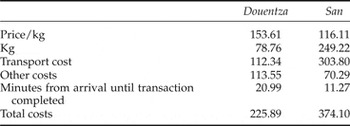
Most transactions by APU heads are perfunctory; over half (54 per cent) occurred within 15 minutes of arriving at the point of transaction, and 95 per cent occurred within 45 minutes. Only one APU head reported a wait of longer than an hour (three hours), perhaps because he was accomplishing other business or the transaction was larger than usual. Transactions in Douentza took nearly twice as long as in San (table 1). In the vendor survey, we observed that both barter and cash transactions are conducted in markets, and often the cash earned in a quick sale is used to make other purchases before returning home the same day.
Millet grain/seed transaction characteristics, by site

Notes: T-tests indicate that means are significantly different (5%) by site for all variables except other costs and total costs. Other costs include meals or incidental expenses at the market.
Average prices/kg were higher in Douentza (FCFA 154 as compared to FCFA 116),Footnote 2 and the mean amounts that exchanged hands per transaction were smaller (79 kg as compared to 249 kg) than in San. Mean transport costs were over twice as high in San (FCFA 304) as in Douentza (FCFA 112), because vehicles and horse-drawn carts are more available. Mean differences in other costs associated with the transaction, which varied widely, were not statistically significant – nor were differences in total costs. Only three of 329 transactions included intermediaries. Cooperating with others for transport was more common in San (52 per cent of transactions) than in Douentza (only 14 per cent). Half of the respondents in San (51 per cent) and 80 per cent of those in the Douentza site paid no transport costs at all in their transactions. Names of the varieties of the grain sold were reported only in the Douentza site, consistent with vendor survey results cited above. In the Douentza site, the markets most frequented by individuals who were not the APU head were on average only 4.5 km away, suggesting that most of these transactions were undertaken in the home or nearby villages.
3.4. Household welfare
Mean scores for food insecurity are similar in the two sites when both periods are taken into account (table 2), and appear to be relatively low on a scale that attains a maximum of 27. The frequency distribution of scores is shifted toward lower values in San than in Douentza, but includes a number of observations with very high food insecurity – which is not the case in Douentza. Shortly after harvest, on average, APUs in Douentza appeared to be significantly better off than those in San. By planting time, household food insecurity had risen dramatically on average in Douentza, but had not changed significantly in San.
Mean household food insecurity and access scores, by site and season

Notes: T-tests (5%) show that means do not depend on site in both seasons; within sites, means differ by season only in Douentza. Measurement detailed in Coates et al. (Reference Coates, Swindale and Bilinsky2008).
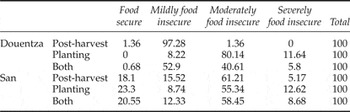
Coates et al. (Reference Coates, Swindale and Bilinsky2008) recommend a second indicator that classifies households according to degrees of food insecurity, rather than a score (table 3). In the period after the harvest, the vast majority of APUs in both sites fell into the first three categories, but the distributions differed significantly and meaningfully by site. Eighteen per cent of APUs in San, as compared to only 1 per cent in Douentza, were classified as food secure, but no APUs in Douentza, as compared to 5 per cent in San, were classified as severely food insecure. This is supported by other baseline findings regarding relative inequality in San. The vast majority of APUs in Douentza (97 per cent) were classified post-harvest as mildly food insecure. The majority of APUs in San (61 per cent) were classified as moderately food insecure. By planting, however, the percentage distribution in Douentza had shifted sharply to higher degrees of food insecurity relative to San. Nearly a quarter of APUs in San were still food secure, but none were food secure in Douentza.
Percentage distribution of APUs by category of food insecurity, by site and season

Notes: Pearson χ-squared tests (5%) show that means depend on site and season. Measurement detailed in FAO (2007).
The diets of women in San are more diverse in terms of numbers of food groups represented and sources of vitamin A, but not in iron (table 4). In a count of 14 food groups (excluding sweets, coffee, tea and spices), women in San consumed from seven groups during the day preceding the interview on average, while women in Douentza consumed an average of only five. Mean dietary diversity and vitamin A intake declined significantly between seasons in Douentza only, but iron intake declined statistically and meaningfully in both sites. The frequency distributions of dietary diversity scores are shifted toward lower values for women in Douentza as compared to San. Thus, based on measurement in two seasons, women in Douentza, and the children they feed, appear to be at greater dietary risk than women in San. We found no statistical differences in paired comparisons between wives of APU heads and other wives in the APUs of Douentza.
Mean scores for dietary diversity, vitamin A and iron intake, by site and village type

Notes: T-tests (5%) indicate that means in both seasons differ by site for dietary diversity and vitamin A, but not for iron. In each site, iron intake differs by season. Dietary diversity and vitamin A intake differ by season in Douentza, but not in San.
3.5. Millet diversity
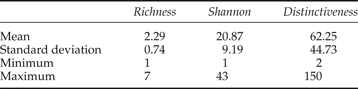
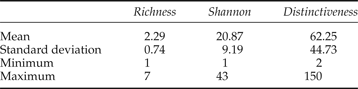
Descriptive statistics for indicators of on-farm millet diversity in Douentza are shown in table 5. The range of the distinctiveness index is several times greater than the range in the Shannon index.
Descriptive statistics for indices of on-farm millet diversity in the Douentza site
4. Econometric analysis
We estimated two sets of regressions. The first set explores the determinants of the APU decision to purchase millet grain in rural markets, and the effect of purchasing on household welfare, measured with the indicators described above. The second set tests the relationships among procurement of seed planted with cash, market diversity and on-farm diversity. The second set is relevant only in the Douentza site, where variety information is preserved in market transactions and farmers reported that they procured the seed they planted with cash.
4.1. Grain purchase and household welfare
To investigate the relationships between millet purchases in weekly markets and APU welfare, we defined the dependent variable as grain purchase in the rainy season. We know that, across the full sample of households in San and Douentza, purchases in the rainy season are predominantly for food.
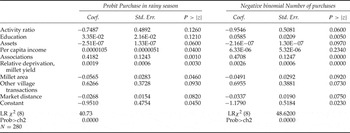
Two initial regressions were estimated to identify the determinants of grain purchase during the rainy season: a probit regression (purchase or not) and a negative binomial (number of purchases in the rainy season). The number of purchases is a count variable, and the data displayed a high proportion of zeros. A negative binomial model, a zero-inflated Poisson model and a zero-inflated negative binomial model are all candidates for regression of count data that includes many zeros. We compared the zero-inflated Poisson (ZIP) to the Poisson model and the Vuong test favored the ZIP model. A χ-squared test also favored the negative binomial over the Poisson model. We then attempted to compare the zero-inflated negative binomial model to the negative binomial, but the zero-inflated negative binomial regression did not converge. We concluded that either the zero-inflated Poisson or the negative binomial regression models are supported by the data. The statistical results were better with the negative binomial model.
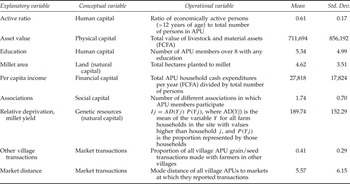
Although there are major differences between the APUs and the markets in the two sites, the percentage of APUs that purchased grain/seed in village markets did not differ. Similarly, the dummy variable for site was not statistically significant in the regressions and the likelihood ratio test comparing separate to pooled regressions did not converge. Thus, for both probit and negative binomial regressions of grain/seed purchase, we pooled data from the San and Douentza sites. The pooled regression expresses average relationships over sites. Explanatory variables in these regressions represent APU characteristics and market transaction characteristics (table 6). Market transaction characteristics are represented by village-level variables built from the APU data, in order to ensure exogeneity with respect to the decisions of individual farmers. Market transaction variables include the proportion of grain/seed transactions made by all farmers in the village with farmers in other villages, and the mode (most frequent) of the distribution of distance from each farmer surveyed in the village to each market in which they reported transactions.
Definition of explanatory variables and descriptive statistics

Conceptually, roughly consistent with a livelihoods framework, APU characteristics include human capital, social capital, physical capital, natural capital (genetic resources, land), and financial capital. Human capital variables are (a) the ratio of active adults in the APU to all APU members, including children and elderly, and (b) the total number of APU members with more than a primary education (more than eight). Physical capital is the value of all assets. Financial capital is per capita income in the APU (farmers do not use credit for millet production). Social capital is the number of different associations in which APU members participated at the time of the survey. Natural capital includes millet area, and relative yield deprivation – a measure of inequality that has been applied in studies of migrant laborers (Stark and Taylor, Reference Stark and Taylor1989). The index is constructed as Ij = AD(Yj) P(Yj), where AD(Yj) is the mean of the variable Y for all farm households in the site with values higher than household j, and P(Yj) is the proportion represented by those households. In this study, Y = yield of millet. The index compares the status of each APU in the sample to all other APUs in Douentza with respect to millet yields (genetic resources), and is constructed by weighting the mean of all individuals with higher status than the APU by their sample proportion. The larger the number, the lower is the status of the APU with respect to yield.
Econometric results indicating the determinants of grain purchase are shown in table 7, and are similar for the probit and negative binomial regressions. The ratio of working-age adults to the total number of APU members, the value of material and livestock assets, and the extent of millet area, reduce the likelihood of grain purchases during the rainy season. Given how APUs are organized in Mali, households with more area in the staple crop, higher value farm equipment, and ready access to more labor endowments will have greater chances of self-sufficiency. APUs which have lower yields relative to other APUs in their marketshed are also more likely to make purchases – these are households which are less well-endowed in terms of genetic resources. As predicted by economic theory, the higher the modal distance of villagers to the village markets they frequently visit, the less likely they are to participate in market purchases because of cost implications. Two of the coefficients have less straightforward interpretations. First, farmers who are more active in village associations appear to be more likely to engage in grain purchases – perhaps as a reflection of their social responsibilities (providing for functions or festivals). Second, there is a positive association between participation in markets and villages with higher proportions of farmers who exchange grain/seed with farmers from other villages. This finding could be interpreted as suggesting that these farmers have a greater propensity to ‘trade’. It also reinforces the notion that rural markets (weekly fairs) are often places of social exchange, and that in these Sahelian villages, social exchanges are often associated with commodity exchange.
Determinants of farmer purchase of grain in market fairs during rainy season

In order to take account of the factors that explain why some APUs are more likely to purchase than others, the instrumental variables method was used to examine the relationship of grain/seed market purchase and household welfare. The first-stage equation was the purchase regression estimated above with probit. With a dichotomous endogenous variable, instrumental variables methods estimate causal effects for those who would take the treatment (purchase) if assigned to that group, but otherwise would not. Thus, the estimated parameter on participation in the second-stage regression is the ‘local average treatment effect’ (Angrist and Krueger, Reference Angrist and Krueger2001: 77). Angrist (Reference Angrist1999) has shown that, in models with binary endogenous variables and non-negative outcome variables, if the focus of the analysis is to estimate the causal effects of treatment rather than the magnitude of structural parameters, a number of simple strategies, such as two-stage least squares, can be applied. Two-stage least squares produces consistent estimators of the local average treatment effect that are less sensitive to assumptions about functional form than probit or logit (Angrist and Krueger, Reference Angrist and Krueger2001: 77). To improve the efficiency of estimation when heteroskedasticity is present, the generalized method of moments is recommended. Standard diagnostic statistics include tests of (a) the endogeneity of the first-stage dependent variable, (b) the relevance of the instruments, and (c) model identification.
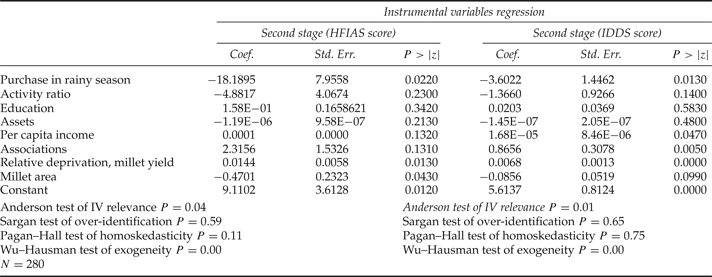
The second-stage equation includes all of the first-stage explanatory factors except the market transaction characteristics, which serve as instruments. Strictly speaking, both APU food insecurity and women's dietary diversity are count variables. To determine whether or not treating these variables as continuous variables in the second stage generates statistical bias, we estimated the regressions with ordinary least squares (OLS) and count (negative binomial) specifications and compared the statistical significance of the explanatory variables. There was no appreciable difference, and we applied the instrumental variables method with OLS. Second-stage results are shown in table 8.
Relationship of market purchase and other factors with household food insecurity and dietary diversity
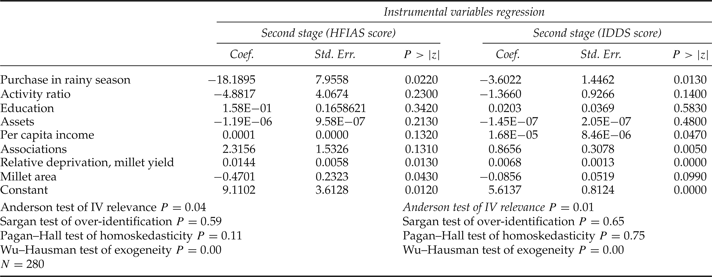
Greater food security in APUs is associated positively with grain purchases during the rainy season, as might be expected, but negatively with dietary diversity. It may be that households using scarce cash to purchase grain are unable to allocate cash to purchase the foods that diversify their diets. This is supported by the coefficient on the per capita income in the IDDS equation. The effect of greater per capita income offsets the negative effect of market purchases of the staple food for grain on dietary diversity. Women in households whose members participate in a larger number of village associations have a more diverse diet. APUs with lower millet yields relative to other farmers in the site were also more food insecure with respect to this staple grain. However, the diets of their households may be more diverse – either through production of other crops or by gathering wild plants, which is common among poorer households. Similarly, the greater the area planted to millet, the lower are both the food insecurity and dietary diversity scores. Food insecurity is reduced when more millet is available but, at the same time, there may be more dependence on millet in the diet. The Anderson canonical correlation statistic for these regressions is significant at less than 5 per cent in each regression, supporting the relevance of the instruments. The value of the Sargan statistic leads to failure to reject the null hypothesis for each of the second-stage equations. Thus, the instrumental variables in the first-stage regression are uncorrelated with the error term in the second-stage regression. Rejection of the null hypothesis would have indicated either a misspecification of the second-stage regression or an invalid instrument. We conclude that purchase in the rainy season is endogenous (Wu–Hausman), and that there is no strong evidence of heteroskedasticity (Pagan–Hall test). The model is recursive because purchases were made before the scores were measured.
4.2. Seed purchase and millet diversity
Variables hypothesized to influence cash seed purchase in Douentza included not only the household and farm characteristics noted above, but also vendor characteristics, market infrastructure characteristics, and millet prices in the early stages of the rainy season. Vendor characteristics tested were those found to be statistically significant in explaining quantities sold by vendors in April 2007 (Smale et al., Reference Smale, Diakité, Dembélé, Seni Traoré, Guindo and Konta2008), including vendor age, vendor education, and total hours selling in local markets, which measures the degree to which part-time farmers who sell grain/seed are specialized in these sales as compared to other occupations.
Market infrastructure characteristics included the number of permanent shops, permanent stalls, semi-permanent stalls, floor vendors, mobile vendors, motorized market transport and horse- or donkey-drawn transport. As mentioned in the Methods section, these characteristics were enumerated during the vendor surveys (Smale et al., Reference Smale, Diakité, Dembélé, Seni Traoré, Guindo and Konta2008). Expected millet prices calculated from triangular distributions elicited from vendors for April 2007, as well as actual millet prices in the markets in May 2007, were other variables hypothesized to influence the probability that farmers had procured seed with cash. While prices would have differed in the last year of seed purchase (2005 or 2006), we hypothesized that relative prices among markets were likely to have been similar.
Genetic diversity, expected price, market infrastructure and vendor characteristics were averaged for the markets that APUs reported as most frequently visited during the household survey and the averages of the market combinations were assigned to each household observation. APUs in the Douentza marketshed reported up to five market fairs. Each household cited at least one of the markets the team visited during the vendor and market infrastructure survey. Since it was often but not always the case that households in the same village shared the same markets, these variables vary more than village-level variables and less than household-level variables.
In exploratory analysis of the variables before regression, we found that both indicators of millet diversity in rural markets were highly and significantly correlated with all of the market infrastructure variables. The larger the markets, the smaller the number of traders selling grain as seed and the lower the millet diversity. The physical form and structure of a market is strongly associated with the genetic diversity of the grain sold by its small-scale vendors. Thus, only variables measuring millet diversity were used to represent genetic diversity.
Next, a set of probit regressions were estimated to explore the relationship between the hypothesized variables and seed purchases. This analysis demonstrated that none of the vendor characteristics was significantly associated with the probability that a farmer would procure seed with cash. In the Douentza market zone in particular, this finding reflects the fact that vendors are themselves farm women who sell their grain to meet particular needs – such as to earn cash to purchase ingredients for the sauces that accompany the staple dish (Smale et al., Reference Smale, Diakité, Dembélé, Seni Traoré, Guindo and Konta2008). In other words, vendor characteristics are not significantly different from farmer characteristics.
Another general finding is that the effects of expected and actual prices are similar, and that there is little variability within a market on a given market day. Price variability among markets had no significant effect on the likelihood that a farmer would procure seed with cash.
These findings were used as the basis for selecting the instruments for the instrumental variables regression relating the probability that seed had been purchased for cash in market fairs with on-farm millet diversity. Expected prices and market distance, each as defined above, were used as instrumental variables in the seed purchase equation. Each of the three indicators of market diversity (also defined above) was tested as an explanatory variable that was included in both the cash purchase (first-stage) and the on-farm diversity (second-stage) equations, rather than as instruments. Each of the three on-farm diversity indicators was used as a dependent variable in second-stage estimations with each of the combinations of market diversity indicator and other explanatory variables.
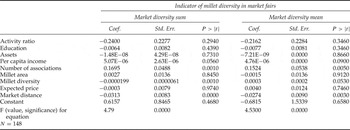
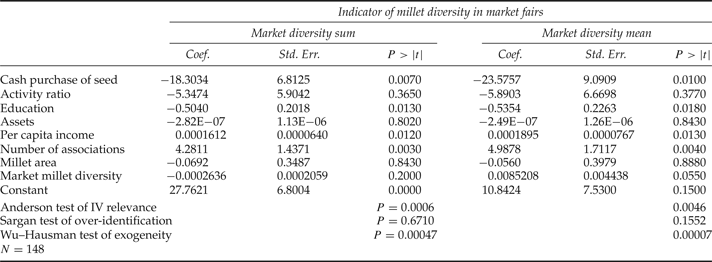
The two first-stage regressions are shown in table 9. For both market diversity indices, the first-stage regressions are the same regardless of the on-farm diversity indicator used as a dependent variable in the second stage. The same APU characteristics are statistically significant in all three first-stage equations. The higher the per capita (cash) income, the more likely the APU is to have procured seed with cash, although the effect is only significant at the 10 per cent level. The number of different associations in which the APU members participate is positively and strongly associated with the likelihood that seed was procured with cash, suggesting that social capital could be a means of gaining information about and access to seed in times of seed stress. Social capital may even provide ‘convenient’ (in the sense of gaining information about seed outside of markets when it is socially unacceptable to exchange seed for cash) links to vendors, since vendors are themselves part-time farmers. Seed ‘gifts’ in such times are likely to be ‘token’, according to Sperling et al. (Reference Sperling, Weltzien and Sangaré2006) – not enough to meet needs. Greater distances of farmers from the markets they depend upon is also strongly associated with a lower probability that they procured seed with cash, which is predicted by theory.
First-stage regressions explaining the probability that seed was procured with cash in the Douentza site, by indicator of millet diversity in market fairs

Millet diversity in the market has a significant effect on the probability that an APU member procured seed with cash – but this effect differs in sign depending on the indicator. The sum of dissimilarities is associated negatively with the chances of cash purchase. Since this indicator is highly correlated with the size of the market, and it is largest for Douentza town, this finding suggests that those depending most on larger markets, such as the Douentza market, are less likely to have procured seed for cash. This makes sense because the market hub, and larger markets in general, tended to be dominated by grain trade for food and establishing the variety identity that is fundamental to using this grain as seed is more difficult. Average dissimilarity in the market is positively associated with purchasing seed for cash, because this measure relates to the presence of recognizably distinct, identifiable varieties that can be used as seed by farmers.
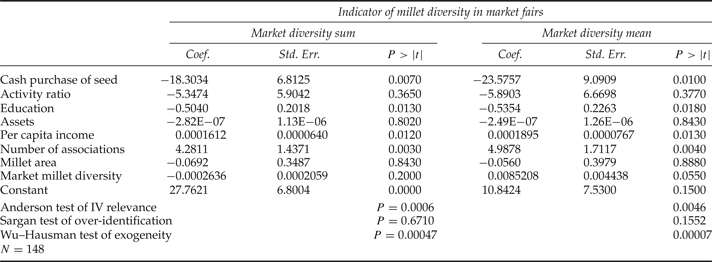
Only three of the nine possible second-stage combinations are reported here. All of the regressions with the on-farm distinctiveness index in the second-stage regression failed the Sargan test. Thus, the instruments in the first-stage regression were correlated with the error term in the second-stage regression, suggesting that the instruments were invalid in these equations. Two of the second-stage regressions with richness as a dependent variable were statistically insignificant. In the third, only three explanatory variables were statistically significant.
The second-stage regressions with the Shannon–Weaver index of on-farm millet diversity are shown in table 10. Seed purchases are associated negatively with millet diversity on farms, regardless of the market diversity indicator. The sum of dissimilarities and distinctiveness among vendor lots in local markets is negatively associated with on-farm diversity, although mean dissimilarities and on-farm diversity are positively related. The market hub of Douentza is associated with numerous vendors and grain lots but not necessarily recognizable varieties and trusted sources of seed. As in the first-stage regression, per capita (cash) income and social capital influence millet diversity on farms positively. Surprisingly, whether or not any member of the APU has formal education is negatively related to on-farm diversity, perhaps because education is related to the prospects of employment outside of the APU and reduces time for variety management. The diagnostic tests support the rejection of exogeneity and the relevance of the instruments. The hypothesis of homogeneity could not be rejected with the Pagan–Hall test at the 5 per cent level of statistical significance.
Second-stage regressions testing the effect of seed purchase in market fairs on on-farm millet diversity, measured with the Shannon–Weaver index, by indicator of millet diversity in market fairs
5. Conclusions
We studied farmers and vendors in grain markets in two sites located in distinct rainfall zones with different amounts of market infrastructure. In the southernmost site, with higher expected rainfall, more advanced physical infrastructure, and where farmers export millet grain known for its quality to other areas of the country, farmers are also more often self-sufficient in seed, place a greater social stigma on procurement of seed with cash, and reported no seed purchases. Especially following their recent rainfall and pest problems, farmers in the more northern site had procured seed with cash more frequently. Simply speaking, both sets of farmers traded millet grain but only farmers in the Douentza site traded millet seed.
This article explores grain and seed transactions in market fairs using the farm survey data and some of the data obtained from vendors. We found that although San APUs are more likely to sell grain, the propensity of APUs to purchase millet grain in the market during the rainy season is similar in the two sites, as are its determinants. Although these purchases might also include acquisition of seed for replanting, farmers' statements, particularly in San, suggested that most were for food.
As might be expected, human and physical capital endowments reduce the chances that APUs will purchase millet in this season, as does the modal distance of villages to the market fairs they frequent. APUs with more social capital, and in villages where APUs have a greater propensity to exchange grain or seed with APUs in other villages, are more likely to purchase grain in the rainy season. These APUs may be more oriented toward ‘trade’, and/or have greater social responsibilities to satisfy. APU food insecurity was reduced by purchases made in the rainy season, but so was dietary diversity – suggesting, along with other results, that households using scarce cash to purchase grain are unable to allocate cash to purchase the foods that diversify their diets.
Next, we explored the determinants of seed purchases by APUs in the Douentza site, and the relationship of seed purchase to market and on-farm millet diversity, measured with indicators derived from grow-outs of grain (seed) samples and variety names. Preliminary analyses showed that millet diversity in rural markets was highly and significantly correlated with market infrastructure. None of the vendor characteristics in a market was associated with APU propensity to procure seed with cash, which reflects the similarities between vendors and purchasers (both farmers) in this site.
APU social capital was associated with procuring seed with cash, suggesting that this is a means to access seed and seed information. Average dissimilarity of millet lots in a market was positively associated with purchasing seed for cash, supporting the notion that farmers need recognizable, distinct, identifiable varieties in order to use grain for seed. However, the sum of dissimilarities, which is correlated with market size and thus the Douentza market hub, has a negative impact on on-farm diversity. Average dissimilarity in the market counteracts this effect.
6. Policy implications
The need for improved millet seed that performs well in the Sahelian zone, and the lack of certified millet seed in Mali, was evident at the time of this study. Based on our learning from this research, we conclude that both formal seed channels, and the informal channels we studied here, require further development. Seed shortage, rather than experimentation with new varieties, appears to be the primary motivation for seed purchase. Introducing certified seed in rural markets through small-scale traders will require provision of market services, training and promotional efforts.
In the formal sector, greater investment in millet breeding for Mali's diverse agroecologies, which will probably have to be accomplished primarily through public investments because of the nature of the crop and clientele, is a prerequisite. In more productive millet growing areas, the relative success of improved sorghum suggests that even millet hybrids may have a market – if, of course, the social stigma of purchasing millet seed is overcome by the status of growing improved seed.
‘Institutionalizing’ seed ‘diversity’ fairs, as a means of encouraging the exchange of seed between deficit and surplus areas, may improve the availability of distinct, local millet varieties in difficult zones such as the Douentza site. These might be launched within or alongside weekly market fairs at planting and re-planting times, supported at first by local NGOs and, later, co-financed by private traders. Sales of truthfully labeled, farmer-retained seed could be considered in this context. Weekly fairs do have some standards and regulations regarding trade, and some minimal regulations in seed fairs may provide incentives for more exchange through reinforcing trust. Fairs might be launched among formal or informal farmer groups, rotated among villages, and include part-time, women farmers – who represented a majority of petty vendors in the smaller-scale grain markets we studied.
By moving certified millet seed into market fairs, and by openly recognizing and supporting the exchange of truthfully-labeled local seed for cash in those same markets, farmers would have better access to two seed supply channels at once, and to more diversity.