Obtaining vascular access in children undergoing cardiac catheterization might be a very tedious and time-consuming procedure and may consume up to 25% of the entire procedure time.Reference Radtke1 The introduction of percutaneous arterial catheterization and the use of smaller catheters have reduced the incidence of vascular complications; however, these are still among the most common complications in infants and young children. Pulse loss after cardiac catheterization is reported to occur in 8–39% of infants weighing less than 14 kilograms despite the prophylactic use of heparin.Reference Balaguru, Dilawar, Ruff and Radtke2, Reference Qiong, Chao-wu and Shi-hua3
In contrast to adults with iatrogenic femoral injuries, the paediatric population presents special challenges. Children's vascular injuries are complicated by specific characteristics of paediatric anatomy and physiology.Reference Mommsen, Zeckey and Hildebrand4 In addition, recognition of limb ischaemia in infants may be delayed because of the inability to communicate and the presence of more subtle signs, other than pulselessness, such as decreased skin temperature, skin discolouration, and decreased range of motion that may be indicative of impaired circulation.Reference LaQuaglia, Upton and May5, Reference Friedman, Fabre, Netscher and Jaksic6
Our hospital represents a tertiary centre for congenital cardiac disease. The current workload for congenital cardiac catheterizations in our centre ranges from 800 to 1000 catheterizations per year. We sought to characterise the frequency, severity, and attributability of vascular access complications among our patients and identify patient and procedural characteristics associated with these complications in the current era.
Methods
This study was approved by our institutional review board and informed consent was obtained from the parents of all the children enrolled in the study. All procedures were performed by an experienced interventional paediatric cardiologist with a minimum of 3 years’ experience in performing diagnostic and interventional procedures; the cardiologist was assisted by a fellow who was not involved in establishing vascular access.
Collection of patient and procedural data
The assisting cardiology fellow entered data into a custom-made application form that included the entire period from hospital admission before cardiac catheterization till hospital discharge. The attending physician in charge of our post-catheterization paediatric cardiology care unit was responsible for performing the routine follow-up during hospitalisation. Our post-catheterization paediatric cardiology care unit is an independent unit with the primary objective of preparing children before catheterization and monitoring them to detect any complications for 24 hours post catheterization; the unit has its own dedicated attending physician. The data entry was revised and compared with the patients’ records every week by the senior paediatric cardiologist in charge of this study. Any patient who experienced any vascular access complication was examined by the primary operator of the catheterization before administering any medication and prior to discharge to confirm successful reperfusion. As for patients who did not experience any vascular complications, the integrity of the peripheral pulsations was established inside the catheterization laboratory after sheath removal and before patient transfer to the post-catheterization care unit.
The database included the following patient and procedural characteristics: case type – diagnostic or interventional; admission source – elective-outpatient, elective-inpatient, or non-elective/emergent); prior catheterization; age; weight; body surface area; method of airway management; diagnosis – based on underlying functional anatomy such as single ventricle physiology; access data – time to gain access, planned or unplanned site, number and size of sheaths inserted; case duration – time from catheter insertion to removal; fluoroscopy time; and total contrast. Time to gain access was defined as the time from the administration of local anaesthesia to the groin till successful sheath insertion. Time to gain access and total case duration was recorded using a digital timer within our monitors. Cases conducted for the purposes of evaluating rhythm disturbances and performing ablation or pacemaker procedures were not included.
Collection of adverse event data
All patients were observed to detect the development of any vascular access complication during hospital stay and to document the severity level of these adverse events and their management protocols till hospital discharge. After collecting all vascular access complications during the study period, these complications were subdivided into five subgroups: lost pulsation, subcutaneous haematoma, bleeding, vessel tear, and vein thrombosis. Complications that were not encountered during the study, such as pseudoaneurysms or fistulae, were not included in the analysis.
Event seriousness was designated according to “The Congenital Cardiac Catheterization Outcomes Project”. This project adopted the following adverse events severity levels.Reference Bergersen, Marshall and Gauvreau7
Severity level 1: none
No harm; no change in condition; may have required monitoring to assess for potential change in condition with no intervention indicated.
Severity level 2: minor
Transient change in condition; not life threatening; condition returns to baseline; required monitoring; required minor intervention such as holding a medication or obtaining a laboratory test. For example, transient loss of pulsations that recovered spontaneously by adequate hydration and warming of the patient, or rebleeding that was controlled by manual compression.
Severity level 3: moderate
Transient change in condition may be life threatening if not treated; condition returns to baseline; required monitoring; required intervention such as reversal agent, additional medication, or transfer to the intensive care unit for monitoring. For example, lost pulsation that recovered by administration of intravenous heparin or streptokinase, or rebleeding that required administration of protamine sulphate to achieve complete haemostasis.
Severity level 4: major
Change in condition; life threatening if not treated; change in condition may be permanent; may have required an intensive care unit admission or emergent readmission to hospital; may have required invasive monitoring, transcatheter interventions, or major invasive procedures to correct condition. For example, any massive bleeding or severe limb ischaemia that required surgery.
Severity level 5: catastrophic
Any death and emergent surgery to prevent death with failure to wean from bypass support.
Arterial access was obtained percutaneously using the Seldinger technique.Reference Seldinger8 Our standard arterial sheath after obtaining arterial access was a 5 French short sheath (5 centimetres) that was introduced over a 0.021-inch guide wire. This sheath was used in all patients who required arterial access during their procedure and were above 4 kilograms body weight. A 4 French short sheath was used initially for all patients who were below 4 kilograms. In 13 of the patients undergoing left heart intervention, the arterial sheath was upsized from the initial sheath to a larger size.
The standard sheath size for all patients older than 1 year of age, who required venous access, was a 6 French short sheath introduced over a 0.021-inch guide wire, whereas a 5 French short sheath was used for children less than 1 year of age. This sheath was upsized to a maximum of 8 French sheath size for patients who required balloon pulmonary valvuloplasty using a Tyshak II balloon more than 13 millimetres in diameter. Only two patients who underwent atrial septal defect device closure required a venous sheath larger than 8 French.
For infants and young children, a single bolus injection of heparin sulphate (50 international units per kilogram) was given after obtaining arterial access. For children undergoing atrial septal defect device closure, 75–100 international units per kilogram of heparin was administered immediately after placing the long sheath across the inter-atrial septum. All sheaths and catheters were routinely flushed with heparinised saline (1 international unit per millilitre). Manual compression was used in every case following sheath removal at the end of the procedure.
Before and after catheterization, bilateral femoral artery pulses, pedal pulses, skin temperature, and skin colour of the lower extremities were assessed. In this study, the criteria used to determine the femoral artery spasm with or without thrombosis after cardiac catheterization included any of the following three aspects: non-palpable or markedly diminished pedal pulses; lower skin temperature and pale skin; and thrombosis detected by Doppler technique.
After catheterization, pulses in the extremity were assessed by palpation and by measurement of systolic blood flow using Doppler technique. If the extremity was cold with non-palpable or markedly diminished pedal pulses 4 hours post procedure, an intravenous heparin infusion of 25 international units per kilogram per hour was started. Further adjustment of the heparin doses was made on the basis of partial thromboplastin time twice that of the control. Another 4 hours later, if the pulse in the affected extremity was still absent, and the ipsilateral extremity was showing signs of decreased perfusion, antithrombotic treatment with streptokinase was started. Following the administration of an initial loading dose of 4000 international units per kilogram, a maintenance dose of 1000 international units per kilogram was given through a continuous drip for a maximum period of 48 hours with few exceptions. Clinically, return of a normal pedal pulse in the affected foot was considered a complete success of thrombolytic therapy, and return of a palpable but diminished pedal pulse compared with the pulse in the unaffected foot was considered a partial success.
Statistical analysis
All data were collected, tabulated, and statistically analysed. Patient and procedural characteristics were tabulated and reported as frequencies or medians. Continuous variables were expressed as mean plus or minus standard deviation, and categorical variables were expressed as a percentage. Statistical significance was assessed by paired t-test for numerical values and Chi-square test for categorical values. Values were considered significantly different when p was less than 0.05. Logistic regression was used to establish a multivariate model for the occurrence of lost pulsations. A p value of less than 0.05 was required for retention in the final model. Only significant patient and procedural characteristics were entered into the final multivariate models. Odds ratios with 95% confidence intervals are reported for each of these variables. All statistical analyses were conducted using Statistical Package for the Social Sciences statistics software program.
Results
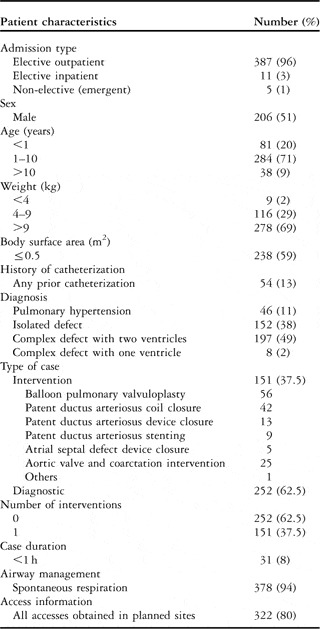
The study included 403 patients with congenital cardiac disease who were referred for cardiac catheterization in our congenital and structural heart disease unit over a 6-month period. Of these patients, 252 (62.5%) underwent diagnostic cardiac catheterization and 151 (37.5%) underwent interventional procedures. Patient and procedural characteristics of the study group are listed in Table 1.
Patient and procedural characteristics (n = 403).

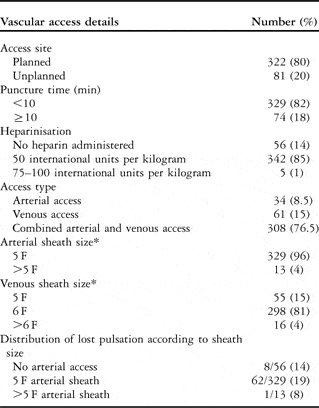
Vascular access details
Vascular access was established in planned access sites in 80% of the cases. Combined arterial and venous access was established in 308 patients, whereas arterial access only was required in 34 patients and venous access only was required in 61 patients. A total of 342 (85%) patients received 50 international units of heparin per kilogram body weight intravenously immediately after establishing arterial access. Higher doses of 75–100 international units per kilogram body weight were administered to the five patients who underwent atrial septal defect device closure, whereas no intravenous heparin was administered to patients who underwent balloon pulmonary valvuloplasty.
In infants weighing 4 kilograms or less, a 4 French sheath was initially introduced into the femoral artery; however, at the end of the procedure the vast majority of the patients who required arterial access (96.2%) required a 5 French short sheath. Vascular access details are listed in Table 2.
Vascular access details (n = 403).

*Final sheath size at the end of the procedure. This might be more than the initial sheath size depending on the type of balloons or devices introduced during the procedure
Access problems
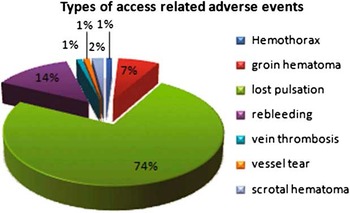
In all 96 access-related adverse events occurred in 84 of the 403 patients studied, with an overall incidence of access-related adverse events of 21%. Access-related adverse events represented the second most common adverse event following non-specific intra-procedural self-limiting arrhythmias. The most common access-related adverse event was transient loss of pulsation, which occurred in 71 cases (17.6%). Other access-related adverse events included subcutaneous haematoma, which occurred in 9 patients (2%); bleeding, which occurred in 13 patients (3%); vessel tear in one patient (0.2%); vein thrombosis in one patient (0.2%); and haemothorax in one patient (0.2%) (Fig 1).
Distribution of access-related adverse events by type.

There was no significant difference between the different procedures regarding the incidence of lost pulsations. The overall incidence of lost pulsations following catheterization was 17.6%. Among patients undergoing diagnostic cardiac catheterization, 17.8% had lost pulsations compared with 17.2% of the patients undergoing interventional procedures.
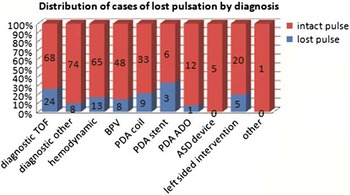
The incidence of lost pulsations varied considerably according to the diagnosis, ranging from 0% in patients undergoing atrial septal defect device closure to 33% in patients undergoing patent ductus arteriosus stenting. It is important to note that 14% of patients undergoing balloon pulmonary valvuloplasty experienced lost pulsation after the procedure despite having femoral vein access only without attempting to establish an arterial access. Figure 2 shows the distribution of cases of lost pulsation according to the patients’ diagnosis.
Distribution of cases of lost pulsations by diagnosis.

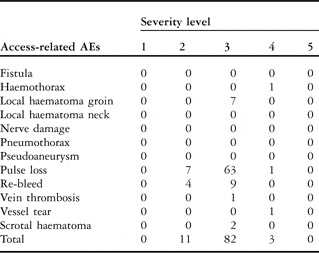
Access-related adverse events are summarised in Table 3 according to their severity level. Approximately 97% of these adverse events were severity level 3 or less and none of these adverse events resulted in death or permanent debility. Of the few patients who had more serious access-related adverse events, one patient had haemothorax following a failed attempt to establish a subclavian venous access and required intercostal tube insertion and hospitalisation for 4 days till the chest condition resolved. Another patient was a neonate who had critical aortic stenosis defect and an iatrogenic tear in the common femoral artery following the introduction of an 8 French sheath that necessitated vascular surgery, and the limb was eventually salvaged. The last patient had extending femoral artery thrombosis confirmed by Doppler and the operator in charge decided to readmit the patient into the catheterization laboratory and inject the bolus thrombolytic dose intra-arterial at the site of the thrombus using the contralateral femoral artery as an access point.
AEs summarised by severity level and attributability.

AEs = adverse events
Factors affecting vascular access complications
There was no significant difference between patients who had no access-related adverse events and those who experienced one or more access-related adverse events with regard to gender, procedure type, total amount of contrast received, fluoroscopy time, or sheath size.
The incidence of vascular access complications was highest among patients below 1 year of age (32.5%) compared with patients between 1 and 10 years of age (20%) and those above 10 years (15%). When the incidence of vascular access complications was investigated according to body weight, the highest incidence was among those patients who were below 4 kilograms (37.5%) followed by those between 4 and 9 kilograms (29%), and the lowest incidence was among patients whose body weight was more than 9 kilograms (17%).
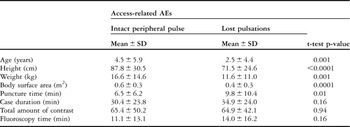
In univariate analysis, the two outcomes studied; any access-related adverse event and the development of lost pulsation were associated with younger age, lower body weight, obtaining access in unplanned access sites, and longer puncture time. Patients who had any access-related adverse event were significantly younger (3 plus or minus 5.5 years) than those who did not have any access-related adverse event (4.5 plus or minus 6 years; p value less than 0.001). In addition, these patients had significantly lower body weight and body surface area compared with those who did not have any access problems (p value less than 0.001). Patients who had any access problems had significantly longer puncture time (9.4 plus or minus 9.6 minutes) compared with those who did not have any access problems (6.5 plus or minus 6.3 minutes; p value less than 0.001). Other numerical and categorical factors studied were found to be non-significant.
When the data were re-analysed with respect to the presence of lost pulsations, similar results were obtained. Table 4 illustrates the patients and procedural numerical variables studied in the univariate model with respect to lost pulsations. A p value less than or equal 0.05 was considered significant. There was significant difference between patients who had lost pulsations and those who did not with regard to access data. Among the 81 patients who had vascular access established in unplanned access sites, 30 patients (37%) had lost pulsations. However, among the 322 patients who had vascular access established in planned access sites, only 41 patients (13%) had lost pulsation (p value less than 0.001).
Paired t-test to determine relation between patient and procedural characteristics and lost pulsations.

AEs = adverse events
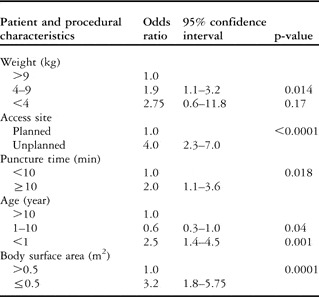
On the basis of the data obtained from the univariate analysis, logistic regression was used to establish a multivariate model for the occurrence of lost pulsations. In this multivariate model, body weight less than 9 kilograms, age less than 1 year, body surface area less than 0.5 square metre, puncture time more than or equal 10 minutes, and establishing access in unplanned access sites were found to be independent predictors for lost pulsation. Among the most significant of these factors were age less than 1 year (odds ratio = 2.5, 95% confidence interval 1.45–4.5, p value = 0.001); body surface area less than or equal 0.5 square metre (odds ratio = 3.2, 95% confidence interval 1.8–5.75, p value = 0.0001); and establishing access in unplanned access sites (odds ratio = 4, 95% confidence interval 2.3–7, p value less than 0.0001) (Table 5).
Multivariate model – risk factors for lost pulsations.

Patients’ outcome
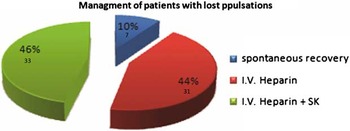
All cases that experienced lost pulsations post procedure were transient and none of them required surgical intervention. The pulsations recovered spontaneously in seven patients (10%) within 4 hours post procedure. A total of 31 patients (44%) had regained their pedal pulse after receiving intravenous heparin infusion at a dose of 25 international units per kilogram per hour over a period of 12.4 plus or minus 6.5 hours. The recovery of the pedal pulse was established by clinical examination and confirmed by the presence of triphasic flow by Doppler examination. The remaining 33 patients (46.5%) did not show any improvement after an initial administration of intravenous heparin for 4 hours. They responded to intravenous streptokinase at an initial loading dose of 4000 international units per kilogram, followed by a maintenance dose of 1000 international units per kilogram through a continuous drip for a minimum period of 1 hour and a maximum period of 45.5 hours, with the exception of one patient who had intravenous streptokinase for a period of 71 hours. Normal pedal pulse before discharge was achieved in 96% of the cases, whereas slightly weaker pulse compared to the contralateral limb with triphasic Doppler signal of both lower limbs was present in 4% of the cases on discharge (Fig 3).
Management of patients with lost pulsations.

Discussion
The concept of percutaneous arterial catheterization was first introduced by Seldinger in 1953Reference Seldinger8 and was modified by Lurie nearly a decade laterReference Lurie, Armer and Klatte9 for use in children and infants. The advancement in catheter-based technologies in the past two decades has significantly enhanced the physician's ability to perform both diagnostic and therapeutic procedures in children. Nevertheless, vascular access complications remain one of the most common complications that occur following cardiac catheterization in this age group.Reference Vitiello, McCrindle, Nykanen, Freedom and Benson10, Reference Mehta, Lee, Chaturvedi and Benson11 In this study, we sought to identify factors that would influence the development of vascular access complications in children undergoing congenital cardiac catheterization other than sheath size. In our study group, 96% of the patients who required arterial sheath had a 5 French arterial sheath in place, and thus we could identify factors such as age below 1 year, body weight less than 4 kilograms, longer puncture time, and obtaining access in unplanned access sites as independent factors associated with the development of vascular access complication irrespective of sheath size.
However, a wide variation in the incidence of vascular access complications is present in the literature most probably due to marked differences in the characteristics of the study groups. Bergersen et alReference Bergersen, Gauvreau, Jenkins and Lock12 reported a low incidence of 2.4% in their study of 1727 patients. This low incidence is explained by the fact that 40% of their patients were older than 11 years compared with only 9% in our study. In addition, 17% of their cases were biopsy cases, a subgroup that is known to have a very low incidence of arterial complications, compared with 0% in our study group. Mehta et alReference Mehta, Lee, Chaturvedi and Benson11 reported an incidence of vascular access complications as high as 33% in their study group, which had a median age of 4 years. This study reports an incidence of 17.6% of lost pulsation and 84 patients experiencing any type of vascular access complications (21%). We believe that this is representative of everyday practice in the paediatric catheterization laboratory where the data are not biased by including very small infants and neonates or underestimated by including larger children or patients undergoing biopsy procedures. This assumption was confirmed when we analysed the incidence of lost pulsation according to diagnosis, where the highest incidence of 33% was found in critically ill neonates undergoing patent ductus arteriosus stenting.
The use of a relatively larger sheath size (5 French) did not have an impact on the incidence of these complications, as the majority of our patients (69%) weighed more than 9 kilograms and only 2% were less than 4 kilograms. It has also to be noted that in this latter group a 4 French sheath was initially introduced. This was supported by Kulkarni et alReference Kulkarni and Naidu13 who stated that “Prolonged procedure time or use of larger sized sheath did not have higher incidence of arterial occlusion”.
We classified vascular access complications reported in this study according to their severity level into five categories similar to the severity level classification proposed by Bergersen et al.Reference Bergersen, Gauvreau, Jenkins and Lock12 Approximately 97% of these adverse events were severity level 3 or less and none of these adverse events resulted in death or permanent debility. Bergersen et alReference Bergersen, Gauvreau, Jenkins and Lock12 reported a similar incidence of 98% among their study group.
In a study by Filis et al,Reference Filis, Arhontovasilis and Theodorov14 the sheath size ranged between 6 and 8 French, and as a result they could not demonstrate any relation between sheath size and the probability of complications. This was similar to our data in which a 5-French sheath was used in most of the patients who required arterial access and thus allowed us to determine factors other than sheath size that would influence the development of vascular access complications. Moreover, among a subgroup of our patients who underwent balloon pulmonary valvuloplasty through femoral vein, 14% experienced lost pulsation post procedure. This should point out to factors other than arterial sheath insertion or sheath size that could result in loss of arterial pulses. Among these factors, compression from an adjacent sheath inserted into the femoral vein or arterial spasm induced by accidental puncture of the femoral artery while establishing a venous access remains a possibility. Other factors may include hypovolaemia and dehydration or excessive compression after sheath removal.
In agreement with the data from our study, Huang et alReference Huang, Chang, Lai and Li15 stated that therapeutic cardiac catheterization did not present a higher incidence of adverse events occurrence than diagnostic catheterization. This reflects the great advancement in the equipment used in these procedures in the last decade compared with earlier reports that considered interventional procedures as an independent risk factor of developing complications.Reference Vitiello, McCrindle, Nykanen, Freedom and Benson10
In this study, patients who had no access-related adverse events were significantly older (4.5 plus or minus 6 years) than those who experienced one or more access-related adverse events (3 plus or minus 5.5 years; p value less than 0.001). In addition, these patients had significantly higher height, body weight, and body surface area compared with those who had one or more access problems (p value less than 0.001). This was similar to many reports in the literature, which points out to younger age as an independent risk factor of developing adverse events post catheterization in the paediatric population.Reference Mehta, Lee, Chaturvedi and Benson11, Reference Bergersen, Gauvreau, Jenkins and Lock12
Huang et alReference Huang, Chang, Lai and Li15 stated that a young age (p value less than 0.0001) and low body weight (p value less than 0.0001) appeared to be risk factors for obvious and severe adverse events. Lin et alReference Lin, Dodson and Bush16 also described younger age than 3 years as an independent risk factor that correlated with an increased risk of iatrogenic groin complications that necessitated surgical intervention.
In this study, patients who had no access problems had significantly shorter total case duration (29 plus or minus 19 minutes) and puncture time (6.45 plus or minus 6.3 minutes) compared with those who had any access problems (39 plus or minus 35.5 minutes) and (9.5 plus or minus 9.6 minutes) respectively (p value less than 0.001). Qiong et alReference Qiong, Chao-wu and Shi-hua17 stated that fewer attempts at arterial puncture and maintaining a minimum procedure time can achieve minimal incidence of femoral thrombosis post catheterization.
Saxena et alReference Saxena, Gupta, Kumar, Kothari and Wsir18 found that fewer attempts at arterial puncture and a shorter procedure time minimised the incidence of arterial complications. We found the concept of counting the number of arterial puncture attempts to be impractical. Instead, we used the time spent in establishing vascular access as an indicator of the degree of difficulty in obtaining arterial access. In addition, establishing vascular access in sites other than the originally planned site was used as an indicator of the degree of difficulty in obtaining access.
Despite the fact that arterial complications were considered a surgical entity, conservative treatment for arterial complications was proposed years ago to be feasible in many cases.Reference Rivers, Lee, Lyon, Monrad, Hoffman and Veith19 As a matter of fact, iatrogenic femoral artery complications in children that necessitate operative interventions remain relatively uncommon.Reference Lin, Dodson and Bush16 The same conclusion could also be drawn from our study. All of the patients who had lost pulsations in this study regained their pedal pulse either spontaneously (10%) or after administration of intravenous heparin (44%) or streptokinase (46%).
Study limitations
Long-term follow-up of patients after pharmacological management of vascular access complications that develop post catheterization with emphasis on the quality of the femoral pulse and the ipsilateral extremity length and size is needed before firm recommendations can be made concerning the optimal management of these patients.
Ultrasound guidance was not used for access purposes, but this may reduce the time to access and thus have an impact on the incidence of complications. Among other factors that should be studied to determine whether they have a role in the development of vascular access complications is the relationship between the patient size and the sheath size. This relationship might be difficult to establish as we believe that the size of the artery itself is what matters and not the size of the patient. In addition, whether or not these vascular access complications could be operator dependent is another area of interest that will need further research.
Conclusions
Factors other than sheath size can contribute to access-related adverse events in children undergoing cardiac catheterization. Obtaining vascular access in unplanned access site and longer puncture time increase the incidence of lost pulsations after catheterization. Younger age and lower body weight are also associated with significant increase in access-related adverse events.