INTRODUCTION
Is it right to end a pregnancy prematurely? Are people in same-sex relationships entitled to the same rights and privileges as heterosexual couples? Or is deviant behavior such as taking drugs or heavy drinking justifiable at any time? Although some would argue that public attitudes concerning these moral issues have become increasingly liberal over the last few decades, religion continues to play a pivotal role in the formation of core values and beliefs of what is right or wrong (Flanagan and Lee Reference Flanagan and Lee2003; Inglehart and Baker Reference Inglehart and Baker2000; Minkenberg Reference Minkenberg2002; Toft et al. Reference Toft, Philpott and Shah2011). Numerous studies have highlighted the importance of religious forces in explaining moral policy outcomes (Donovan et al. Reference Donovan, Tolbert and Smith2008; Fairbanks 1978; Feddersen et al. Reference Feddersen, Gailmard and Sandroni2009; Fink Reference Fink2008; Haider-Markel Reference Haider-Markel and Mooney2001; Hutcheson and Taylor Reference Hutcheson and Taylor1973; Minkenberg Reference Minkenberg2002; Morgan and Meier Reference Morgan and Meier1980; Olson et al. Reference Olson, Cadge and Harrison2006; Roh and Haider-Markel Reference Roh and Haider-Markel2003). These studies have scrutinized the effects of religion at the state level (e.g., Morgan and Meier Reference Morgan and Meier1980), religious orientations in parliaments (Haider-Markel Reference Haider-Markel and Mooney2001), the influence of religious groupings and predominant churches on legislating abortion, homosexuality, or gambling (Fabrizio Reference Fabrizio and Mooney2001; Olson et al. Reference Olson, Cadge and Harrison2006), or the differences in moral policy legislature across nation states and religions (Engeli Reference Engeli2009; Fink Reference Fink2008; Schiffino et al. Reference Schiffino, Ramjoué and Varone2009).
Moral issues and their connection to religiosity have recently also attracted considerable attention in the study of political behavior. Heated debates in the United States revolved around the so-called culture wars, pitting orthodox and progressive groups against one another on moral issues such as abortion, gay rights, or family values. This culture war resulted in a striking religious gap in the 2000 and 2004 presidential elections (e.g., Campbell Reference Campbell2007; Donovan et al. Reference Donovan, Tolbert and Smith2008; Fiorina Reference Fiorina2005; Green Reference Green2010; Hunter Reference Hunter1991; Layman and Green Reference Layman and Green2005). In Europe, scholars have focused renewed interest on the stability and change of the traditional religious cleavages that once shaped the formation of party systems and that continue to structure mass electoral behavior in many European countries (e.g., Ackermann and Traunmüller Reference Ackermann and Traunmüller2014; Brooks et al. Reference Brooks, Nieuwbeerta and Manza2006; Elff Reference Elff2007; Essmer and Pettersson 2010; Knutsen Reference Knutsen2004; Minkenberg Reference Minkenberg2010).
In this study, our aim is to combine these two research strands of moral politics and political behavior by focusing on the effect of individual and contextual religiosity on individual vote decisions in popular initiatives and public referenda concerning morally charged issues, such as abortion or drug abuse. Although these issues are highly salient to the public and many countries beyond the United States legislate moral issues through direct democratic instruments (e.g., Italy, Ireland, Portugal, and New Zealand), explanatory factors which could explain citizens' vote decisions on these issues have, for the most part, been neglected in empirical research.
The present study expands existing research on religion and moral policies in two important ways. First, we depart from the traditional policy-based research field of moral politics. Most of the research in this field has focused exclusively on the policy-making process or the framing of moral issues on various levels, such as the parliament or the federal and the subnational levels of government (Engeli and Varone Reference Engeli and Varone2011; Haider-Markel Reference Haider-Markel and Mooney2001; Mooney and Lee Reference Mooney and Mooney2001; Morgan and Meier Reference Morgan and Meier1980). While this certainly is where policy-making and legislating mainly takes place, this is not true for countries offering a wide range of direct democratic instruments where the citizens decide on laws and regulations. Although here citizens' characteristics may play a crucial role in decisions to liberalize or restrict moral policies, the extant research has focused primarily on state-level attributes in explaining variations in moral policy outcomes in public referenda and initiatives (see Fairbanks Reference Fairbanks1977; Morgan and Meier Reference Morgan and Meier1980). In contrast, we focus on the effects of individual-level attributes and attitudes, particularly religious belonging and behaving, for the liberalization of moral issues. In addition, we further consider possible contextual-level religious factors, such as the prevalence of Catholicism on the cantonal-level and the party paroles on the vote-specific level that may influence the relation between individual religiosity and voting decisions on moral issues.
Second, we add a new perspective on the relationship between direct democracy and moral politics by extending existing research on the United States to another country with well-established direct democratic instruments, namely Switzerland. Although Swiss direct democracy differs from what is practiced in the United States, as it is not limited to the state or local level but is practiced at all federal levels, both countries are very similar with regard to their long-lasting experience, extensive use as well as their specific types of direct democratic instruments, such as the referendum and popular initiative (Linder Reference Linder2010, 162). Moreover, the United States and Switzerland are often declared as “Sister Republics” due to their enduring republican system as well as their extensive federalist structure (Hutson Reference Hutson1991). In the past, Switzerland has held a wide range of national referenda and public initiatives on moral issues and may therefore be regarded as an exemplary case for assessing direct democracy's effect on moral policy.
Moreover, Switzerland is characterized by a strong traditional confessional cleavage between reformed Protestantism (initiated by Zwingli and Calvin in Zurich, Geneva, and Bern) on the one hand and Catholicism (in the rural cantons of central Switzerland) on the other. This confessional divide between Protestants and Catholics was once the source of considerable conflict and continues to play a decisive role in party identification and voting behavior, such as Catholics' preference for the CVP (Christ-Democratic Popular Party) (Geissbühler Reference Geissbühler1999; Geser, Reference Geser1997; Kriesi and Trechsel Reference Kriesi and Trechsel2008; Lachat Reference Lachat2012; Lijphart Reference Lijphart1979; Linder Reference Linder2010; Voll Reference Voll1991). The mechanisms and individual factors explaining vote decisions for political candidates or party programs in elections do not however necessarily overlap with the factors influencing vote decisions on specific policy questions in referenda. In fact, it has been argued that political loyalties based on the traditional confessional cleavage may be stronger and more durable for party identification and more volatile in terms of direct democratic voting behavior (Voll Reference Voll1991, 379).
Methodologically, we rely on a total of 13 surveys with approximately 1,000 respondents each conducted after each referendum on moral policies in Switzerland between 1992 and 2012. The information provided by these surveys allows us to investigate individual political behavior concerning moral issues in great depth. By going beyond the effect of moral issues on voter turnout (Biggers Reference Biggers2011; Tolbert et al. Reference Tolbert and Smith2005), we not only further the research on moral policies and direct democracy, but also investigate the origins of liberalized moral policies reached through direct democratic means and what role the religious factor plays in decision-making.
We proceed by outlining the key features of moral policies, focusing on how religion influences the liberalization of these policies. After defining our main research hypotheses, we present our data and methods. In the section to follow, we discuss our main results concerning individual religious behavior and the liberalization of moral policies. A discussion of these results and a conclusion finally complete the article.
CONFLICTS OF BASIC VALUES – MORAL ISSUES
Within recent years the clash of fundamental values regarding moral issues has fuelled heated public debates and scholarly research (Kirchner et al. Reference Kirchner, Freitag and Rapp2011; Knill Reference Knill2013; Mooney Reference Mooney and Mooney2001; Mooney and Schuldt Reference Mooney and Schuldt2008; Studlar Reference Studlar and Mooney2001; Studlar et al. Reference Studlar, Cagossi and Duval2013). This clash of values revolves mainly around questions of first principles such as matters of life and death or deviant behavior. An issue is declared as moral as soon as one group feels its core values or belief system threatened by an issue. Moral issues are therefore primarily defined by their framing rather than by their mere content (Engeli and Varone Reference Engeli and Varone2011, 241; Mooney Reference Mooney and Mooney2001, 3; Mooney and Schuldt Reference Mooney and Schuldt2008, 201; Meier Reference Meier and Meier1994, 4). Mooney (Reference Mooney and Mooney2001, 4) further specifies that “a policy is classified as a morality policy based on the perceptions of the actors involved and the terms of debate among them.” Against this background any issue may become morally charged as soon as it affects a group's core principles. Following the literature (especially Knill Reference Knill2013; Mooney Reference Mooney and Mooney2001; Mooney and Schuldt Reference Mooney and Schuldt2008; Studlar Reference Studlar and Mooney2001; Studlar et al. Reference Studlar, Cagossi and Duval2013), the most common morally charged issues are abortion, euthanasia, homosexuality, and questions on drug abuse.Footnote 1
Moral issues are further connected to three basic attributes: First, they are technically simple due to their straightforward conception of right and wrong (Mooney and Schuldt Reference Mooney and Schuldt2008, 201). Moral issues only allow two positions, being in favor or against it, whereas issues on taxation or economic matters allow positions between these two opposing poles. Additionally, moral issues are often framed in simple pictographic ways: there is the “sexual sinner” or the “irresponsible drinker” (see e.g., Engeli and Varone Reference Engeli and Varone2011, 241). Even rather technical issues such as stem cell research are easily understandable since they may be reduced to the question of life and death. Second, it is difficult to reach compromises on moral issues, as they concern issues of the heart and are constituted of two opposing positions. They comprise a zero sum game: a new regulation, the liberalization of abortion for example, allows a new set of values win; the old values are consequently defeated. Since they are based on the dichotomy of right and wrong, moral issues are thus not divisible (Engeli and Varone Reference Engeli and Varone2011; Mooney Reference Mooney and Mooney2001). Third, due to their simplicity, moral issues are highly salient in public debates. Every citizen can easily build his or her opinion on these issues since there are only two possible positions. Along these lines, Grummel (Reference Grummel2008) found that voter turnout is higher when moral issues are on the ballot. In this line, the turnout for the votes in our sample tends to be higher than in non-moral ballot votes. Moral issues are matters of the heart, which, by definition, are salient to the public and are decided on according to gut feelings.
The three above-mentioned features suggest increased difficulties in implementing decisions on moral issues, due especially to their high public salience and their indivisibility. Compared to non-morally charged policies, decisions on liberalizing or restricting moral policies are often more aligned to the prevailing public opinion (Camobreco and Barnello Reference Camobreco and Barnello2008; Mooney and Lee Reference Mooney and Lee2000; Mooney and Schuldt Reference Mooney and Schuldt2008). Consequently, moral issues frequently find their way onto the ballot, thereby leaving the decision process to the public (Biggers Reference Biggers2011). Politicians can easily withdraw from these highly conflictual issues and avoid playing a zero sum game with their voters (Tolbert et al. Reference Tolbert and Smith2005). Despite this top-down decision-making process, groups that feel their core beliefs to be affected use popular initiatives, so-called bottom-up instruments, as a channel to enforce regulations on moral issues. According to Studlar (Reference Studlar and Mooney2001, 40), “moral issues are one of the major categories of issues subjected to initiatives and referenda where they are available.”
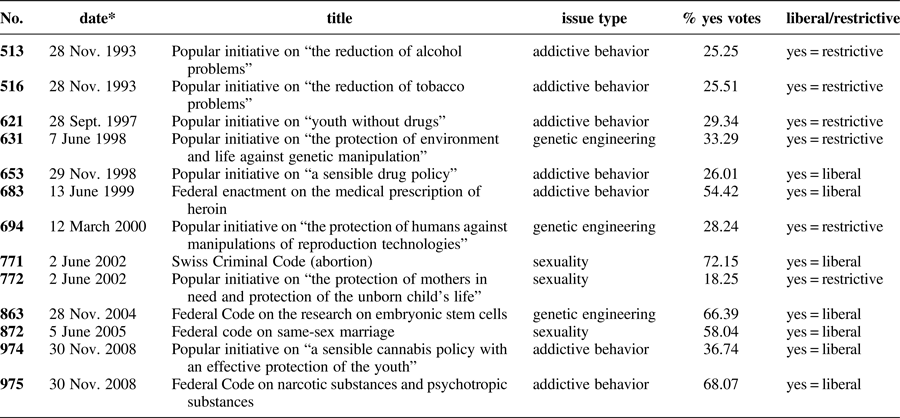
For the case of Switzerland, the prototype of direct democracy, this means that the most important decisions on moral policies take place via public referenda and initiatives. Similar to the United States, Switzerland also offers direct democratic instruments at the subnational level, although most of the decisions on moral issues are made on the national level. And unlike in the United States, most of the issues may only be regulated on the national level in Switzerland (e.g., abortion or same-sex marriage). Regarding moral issues, we were able to identify 13 national moral initiatives and referenda that occurred between 1992 and the present in Switzerland (see Table 1 for more details).
Swiss Votes concerning moral issues (1992 – present)

*Note: information was retrieved from http://forsdata.unil.ch/projects/Voxit/docu_xl_htmD/ListeVoxDispoD.htm?lang=d&menu=4; The numbers refer to the numbering of the Voxit homepage; for the empirical analysis the votes were recoded so that a value of one always indicates a liberal voting decision.
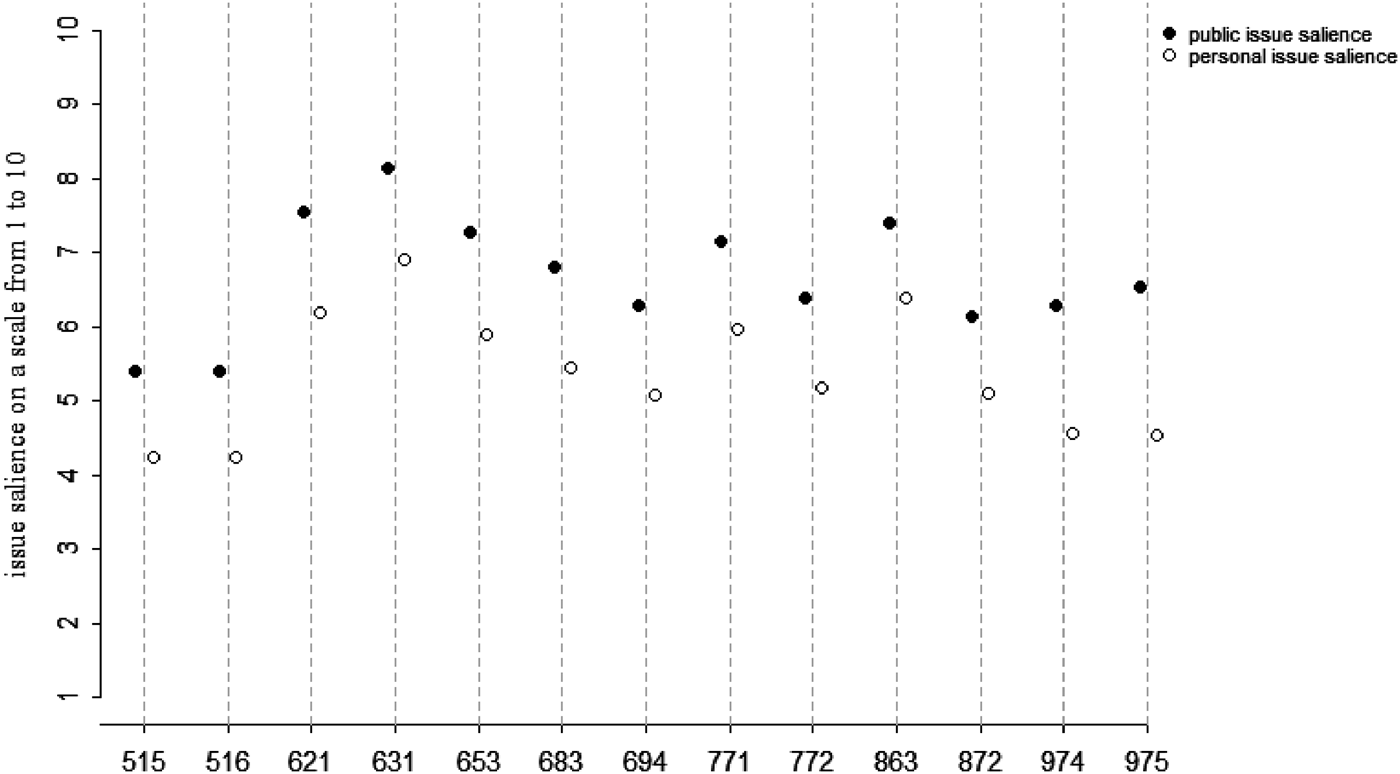
As we and existing research in this field claim that moral issues are generally salient to the public, Figure 1 depicts the public and personal saliency of the respective moral ballot vote (on a scale ranging from 1 to 10). Overall we can see that the public salience on these issues is slightly higher in each of the 13 referenda for which data is available than the personal salience of the issue. Additionally, we took the turnout rates for these issues into account. The turnout gives a hint about the general saliency as more salient issues will draw more people to the ballot box (see e.g., Grummel Reference Grummel2008; Smith Reference Smith2001; Tolbert et al. Reference Tolbert, Grummel and Smith2001). In general, the long-term average turnout rate for Swiss ballot votes is 45 percent (see Vox Analysis). Our selected moral issue votes, however, exhibit an average turnout of 50 percent for the 13 votes. These comparatively higher turnouts as well as the descriptive statistics in Figure 1 underscore the increased public saliency of morality issues at the ballot box in Switzerland.
Public and personal issue salience of morality issue. Note: The results are based on the following survey question: (1) How salient is this ballot issue for you personally?? (2) How salient do you think is this issue for the general public? These questions weren't asked for the first two ballot votes. The numbers on the x-axis identify the different ballot issues as depicted in Table 1.

RELIGION AND MORAL VOTES
Since moral policies are based on first principles researchers often rely on cultural factors to explain moral policy outcomes (see e.g., Castles Reference Castles1994; Fink Reference Fink2008; Minkenberg Reference Minkenberg2002; Pickel Reference Pickel, Pickel and Krüggeler2001). Decisions on moral issues are made in political conflicts over indivisible values, which, in turn, are often firmly rooted in religious conceptions of right and wrong (Biggers Reference Biggers2011, 4). Since religion is a key determinant of “competing notions of how we should and should not live — the moral order” (Leege et al. Reference Leege, Wald, Krueger and Mueller2002, 13), it is not surprising that it is considered one of the most important factors in explaining moral policy outcomes (Fairbanks Reference Fairbanks1977; Fink Reference Fink2008; Hutcheson and Taylor Reference Hutcheson and Taylor1973; Minkenberg Reference Minkenberg2002; Morgan and Meier Reference Morgan and Meier1980). Fink (Reference Fink2008), for instance, shows that although economic interest plays a decisive role in stem cell research, variations in embryo research laws across Europe can only be explained if religious factors are taken into consideration. A predominant Catholic church and a larger proportion of Catholics within a country lead to more restrictive laws. Minkenberg (Reference Minkenberg2002) arrives at similar conclusions concerning abortion regulations: A strong Catholic church leads to more restrictive abortion regulations, whereas Protestants seem to be in general more liberal concerning abortion issues. The study by Morgan and Meier (Reference Morgan and Meier1980) concentrates on the religious effects on referenda voting in Oklahoma and concludes that religious factors on the county-level are just as important as economic factors in explaining moral policy outcomes in referenda voting. This is in line with findings by Fairbanks (Reference Fairbanks1977) on state liquor and gambling laws in the United States: Religious forces offer better explanations of the variance across states than economic interests.
Drawing on these insights and with regard to direct democratic decision-making, religion should factor heavily into individuals' vote decisions (liberalizing or restrictive) on moral issues. On a general level an affiliation or self-identification with a particular religious tradition should impact on political behavior because it provides a social context in which individuals can connect their faith to political choices (Green Reference Green2010, 24). First, an individual's core values are rooted in a respective religious tradition and these core values are an important source for voting decisions. Second, religious leaders or members of the clergy provide internal cues by emphasizing the importance of these core values and by taking positions on political issues (Djupe and Gilbert Reference Djupe and Gilbert2008). However, these social processes are not limited to the local parish. Individual positions may also be influenced by the prevailing religious norms within the wider community (Kotler-Berkowitz Reference Kotler-Berkowitz2001; Lenksi Reference Lenski1961; Traunmüller Reference Traunmüller2011). And third, political parties, interest groups, and candidates seek support from religious communities by providing them with actionable information. As a result, individual voting behavior may be strongly influenced by general party alignments and the positions political parties take on moral issues. Actual religious participation reinforces all of these three mechanisms, since the most active members will be likely to most strongly adhere to the core values of their religious community and will also be more likely to be exposed to internal cues or external appeals (Djupe and Gilbert Reference Djupe and Gilbert2008; Green Reference Green2010; Norris and Inglehart Reference Norris and Inglehart2004; Verba et al. Reference Verba, Schlozman and Brady1995).
Regarding the traditional confessional cleavage in Switzerland — and therefore the belonging dimension of religionFootnote 2 — we hypothesize that Protestants and Catholics will differ in their voting behavior on moral issues. An influential line of thought stresses the lasting role religious traditions play in forming the cultural and social life in a given nation or region (Fox Reference Fox2013; Inglehart and Baker Reference Inglehart and Baker2000; Norris and Inglehart Reference Norris and Inglehart2004; Toft et al. 2013; Weber [Reference Weber1920] 1988). According to this perspective, distinctive worldviews that were historically linked with or that once originated from religious traditions have left deep imprints on contemporary moral beliefs and values. Today, these values are part of the general culture and are shared by most of the citizens in a given context — regardless of whether they actually identify with the religious tradition. For example, the Protestant ethic of hard work and an ascetic life became imprinted in peoples' minds following Calvin's sermon in Geneva, and still has a psychological impact on Protestants, even on those who do not believe in predestination (Geissbühler Reference Geissbühler1999, 227). Accordingly, we not only expect that citizens differ in their voting decisions on moral issues depending on their individual religious belonging, i.e., whether they are Protestant or Catholic (Hypothesis 1), but also depending on the dominant religious tradition in the regional context within which they are situated (Hypothesis 2).Footnote 3
One fundamental difference between Protestant and Catholic worldviews with far reaching consequences for moral values concerns the role of the individual in its relation to God and the wider community: Whereas Protestants emphasize the individual's relationship with God, Catholics believe that the individual is related to God through the community (Greeley Reference Greeley1989, 485). The opposing positions of the generally more conservative Catholics who support traditional moral issues and the more liberal and flexible attitudes of Protestants are thus deeply rooted in the traditions' respective communalism and individualism (Norris and Inglehart Reference Norris and Inglehart2004; Scheepers and van der Slik Reference Scheepers and van der Slik1998; Scott Reference Scott1998). This also suggests that the moral positions of the two religious traditions will depend on the specific content of the respective issue: “Protestants will be especially likely to deplore vices which diminish personal integrity, honesty, and sense of duty. Catholics will be especially likely to be offended by actions which seem to violate relationship networks — adultery, prostitution, suicide” (Greely 1989, 487). As a result, we expect that Catholics will in general vote more restrictively on issues such as stem cell research as well as on abortion or homosexuality, but will be more liberal on issues concerning alcohol and drug use or gambling as compared to Protestants who may be inclined toward a rather ascetic and pious lifestyle (Greely 1989; Richard et al. Reference Richard, Bell and Carlson2000) (Hypothesis 3).
Although religious belonging has long been the primary mode connecting religion and political behavior, scholars in both the United States and Europe argue that differences within religious traditions are becoming more politically relevant than differences among religious traditions (Geissbühler Reference Geissbühler1999; Green Reference Green2010; Voll Reference Voll1991; Wolf Reference Wolf1996). In other words, the old confessional gap of the Protestant/Catholic divide is increasingly replaced by a new religious gap dividing the religious from the secular. Religious behaving is more or less independent of an individual's denomination and reflects true religiosity as well as the actual incorporation of religious beliefs and values (Nicolet and Tresch Reference Nicolet and Tresch2009). It is therefore important to compare individuals who are highly religious to those who are less or not religious. Moreover, the effect from religious belonging on the voting decision may be affected by the actual religious behavior. For instance, a negative effect from Catholic religious belonging should be even stronger for individuals that regularly attend religious service. Concerning the religious behaving dimension we thus hypothesize that, first, religious behavers will vote more restrictively on moral issues (Hypothesis 4). And second, that the effect of religious belonging on the voting decision concerning moral issues will be stronger for individuals that regularly attend religious service (Hypothesis 5).
The juxtaposition of the old confessional and the new religious cleavage already suggests a changing role of individual religiosity on voting behavior over time, but the exact nature of this dynamic is far from clear. There are heated debates concerning the changing role of religion in the public and political sphere. The popular view of secularization predicts that the effect of religious belonging as well as religious behaving will decline over time as the moral authority of the churches weakens and people become more individualized in their preferences and values. Moreover, rapid social changes, urbanization, enhanced political mass participation, and economic prosperity undermine the importance of religion for individuals and modern states (Bruce Reference Bruce2002; Reference Bruce and Haynes2009; Fox Reference Fox2013; Norris and Inglehart Reference Norris and Inglehart2004). Despite this emphasis on the social irrelevance of religion in secularized democracies, the opposite may be just as plausible. In fact, proponents of post-materialism, such as Ronald Inglehart (Reference Inglehart1977), argue that the shift from materialist politics to more value-based politics actually increases the salience of religiosity for political orientations as well as behaviors and thus renders religion more important. Accordingly, Geser (Reference Geser1997, 3) asserts that “while these developments certainly help to bring attitudinal divergences between religious and non-religious population segments into sharper relief (e.g., in the abortion issue), they may also favor the survival (or even the strengthening) of inter-confessional divergences.” In this line, Toft et al. (Reference Toft, Philpott and Shah2011) as well as Fox (Reference Fox2013) argue that the religious divide still persists but has changed from the animosities between different religious groupings to greater conflicts between religious and secular segments of the population. Summarizing these two arguments we cannot formulate a clear-cut hypothesis as the effect of religious belonging and behaving on decisions concerning moral issues could both decrease or increase over time (Hypothesis 6).
As already mentioned party politics may further play a crucial role in defining the relationship between individual religiosity and voting decisions on moral issues, since parties seek to mobilize the support of their constituencies, and further provide information as well as political recommendations. In Switzerland, the Christ-Democratic Popular Party (CVP) — which originated from the classical confessional cleavage in Switzerland — may have a strong influence on how Catholics and religious individuals in general vote on moral issues. In this line, we predict that a liberal party parole from the CVP should influence religious belongers and behavers to cast a more liberal vote on moral issues (Hypothesis 7).
DATA AND METHODS
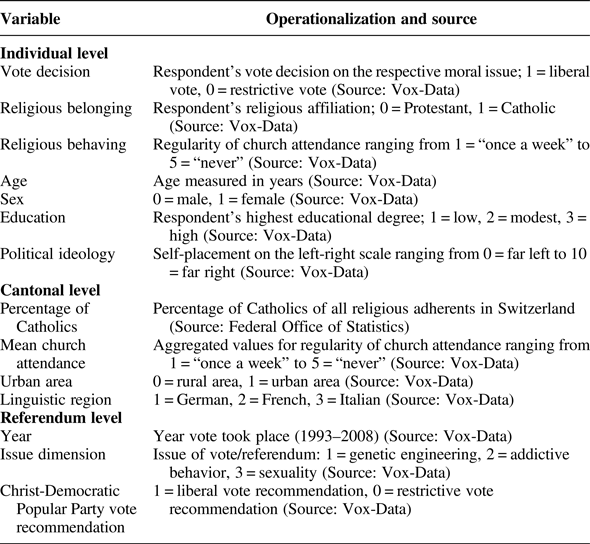
To test our seven hypotheses we draw on the Vox Analysis, which comprise standardized surveys of 1,000 respondents conducted for each issue of every national public vote in Switzerland since 1977. These Vox surveys were established to receive better insights into individual voting behavior in Swiss initiatives and referenda. Accordingly, they not only ask vote-specific questions (e.g., participation, decision), but also collect information on general socio-economic variables such as sex, age, education, or religious affiliation. Overall we identified 15 moral issue votes for the period between 1992 and 2012, but unfortunately, since one of our main explanatory variables — church attendance — is missing for two referenda, we had to limit our sample to 13 referenda and initiatives. Among them are three concerning questions of genetic engineering, seven concerning issues of drug abuse or gambling (addictive behavior), and three on abortion and homosexuality (sexuality). Individual decisions in these moral referenda are our dependent variable and are coded 1 for a liberal decision and 0 for a restrictive decision on the respective moral issue.Footnote 4 Out of the 13 moral issues on the Swiss national ballot between 1992 and 2012, 11 resulted in a liberal decision.
Our main explanatory variables are an individual's religious affiliation (belonging) and church attendance (behaving), both of which capture the institutional dimension of religion as well as the old and new religious cleavage in Switzerland (Nicolet and Tresch Reference Nicolet and Tresch2009). As we are mainly interested in the difference in voting behavior of Catholics and Protestants, we restrict our sample to these two-denominational categories. Forty-three percent of the respondents in our sample identify as Protestant and 42 percent as Catholic. All other confessions as well as the non-religious are not considered in the following analysis. The religious denomination dummy is coded 0 for Protestants and 1 for Catholics. Overall Protestants and Catholics are equally distributed in each of the 13 surveys.
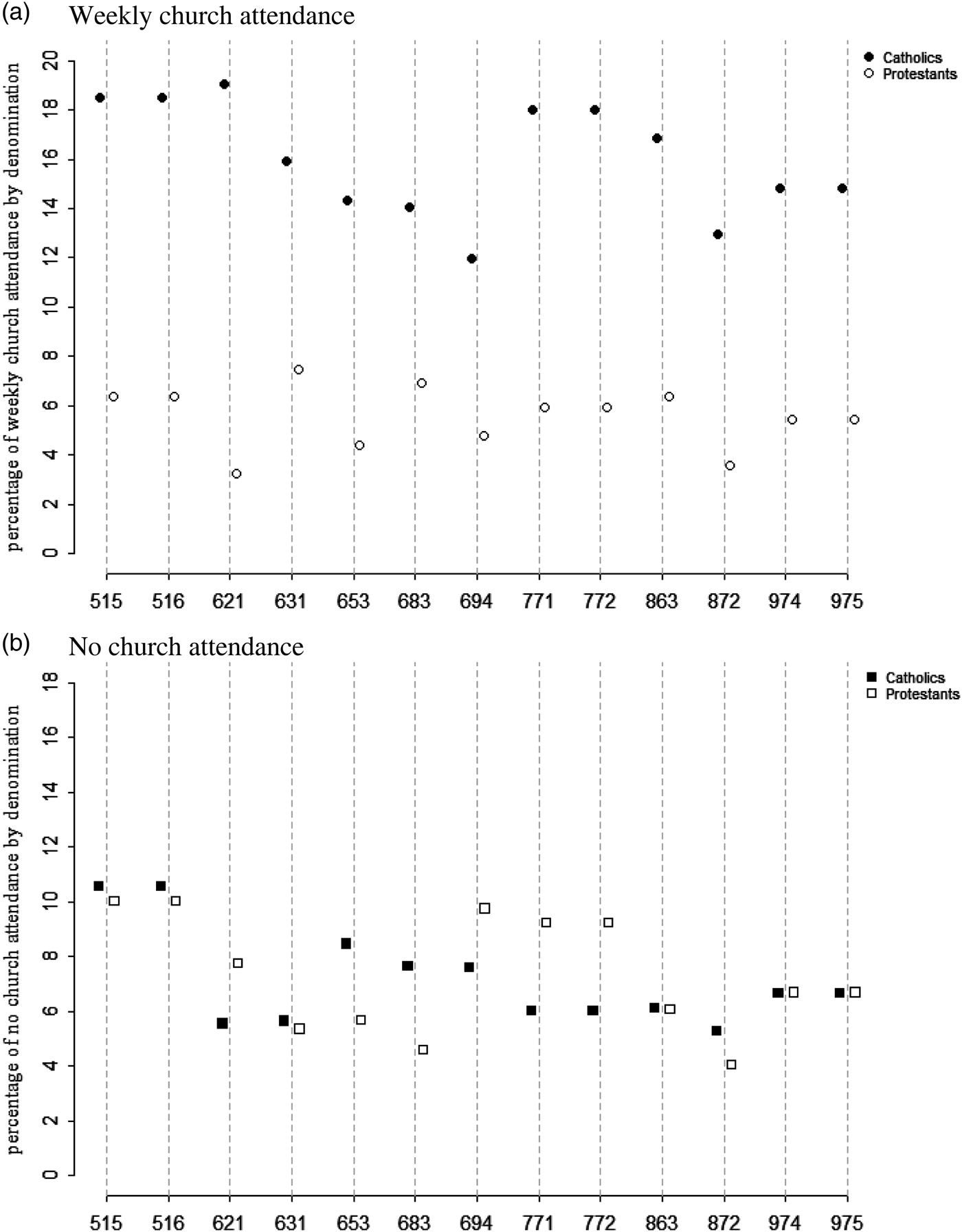
Religious behaving is measured as a respondents' church attendance which ranges from 1 (never) to 5 (once a week) and is treated as continuous. Figure 2 depicts the percentages of weekly (upper graph) and no church attendance (lower graph) for Catholics and Protestants in the 13 moral issue votes in Switzerland. From the upper graph we can conclude that Catholics are more frequent church goers than Protestants, whereas they hardly differ in the category for no church attendance (see lower graph). In sum, there are some minor fluctuations throughout the 13 popular votes, but in general both percentages of weekly and no church attendance are rather stable over the years.
Minimum and maximum church attendance by denomination and moral issue vote. Note: The numbers on the x-axis identify the different ballot issues as depicted in Table 1.

We further consider the percentage of Catholics on the cantonal level as well as the regional mean of church attendance to test the effects of contextual religiosity. Information for the former is taken from official Swiss census data (Eidgenoessische Volkszaehlung 2000); information on cantonal religious behaving was aggregated from the individual level survey data. Following our argumentation from Hypothesis 7 we further include the vote recommendation from the Christ-Democratic Popular Party (0 = restrictive, 1 = liberal) on the referendum level in order to capture a potential political party influence.
Finally, we take into account additional control variables that are said to influence individual political behavior in popular votes. These are age, gender, educational level, and political ideology on the individual level. The prediction is that older, less educated, and ideologically right individuals will generally hold more conservative attitudes leading to a less liberal voting decision (see for example, Milic Reference Milic2008). Concerning gender we assume that females will generally be more restrictive in their voting pattern, although they are said to be more liberal on issues concerning homosexuality (Olson et al. Reference Olson, Cadge and Harrison2006). As a Swiss specific variable we add a measure for the linguistic region to the models and further control for urbanization as this factor is often said to lead to more liberal values (Inglehart and Baker Reference Inglehart and Baker2000). All variables except for the dummies are standardized by subtracting the mean and dividing by two standard deviations (Gelman and Hill Reference Gelman and Hill2007).
To test the hypotheses on religion's role in individual voting behavior, we estimate a series of Cross-classified Logistic Multilevel Models where N = 5147 individual respondents are cross-classified according to two grouping levels: J = 13 referenda and K = 26 cantons (Gelman and Hill Reference Gelman and Hill2007). The estimation procedure is based on Maximum Penalized Likelihood, which is equivalent to Bayesian estimation with priori-distribution of the unknown variance component (Chung et al. Reference Chung, Rabe-Hesketh, Dorie, Gelman and Liand2012). We use the blme-package in R for the estimation (Dorie Reference Dorie2011).
RESULTS
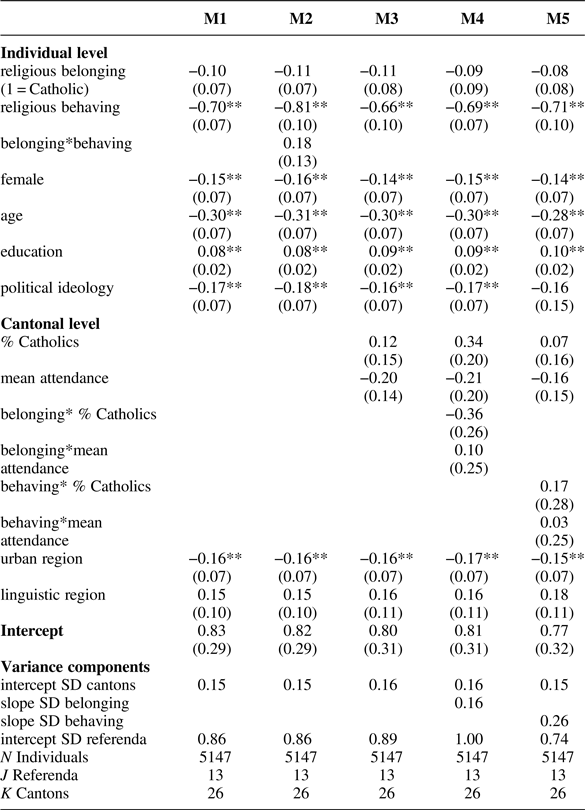
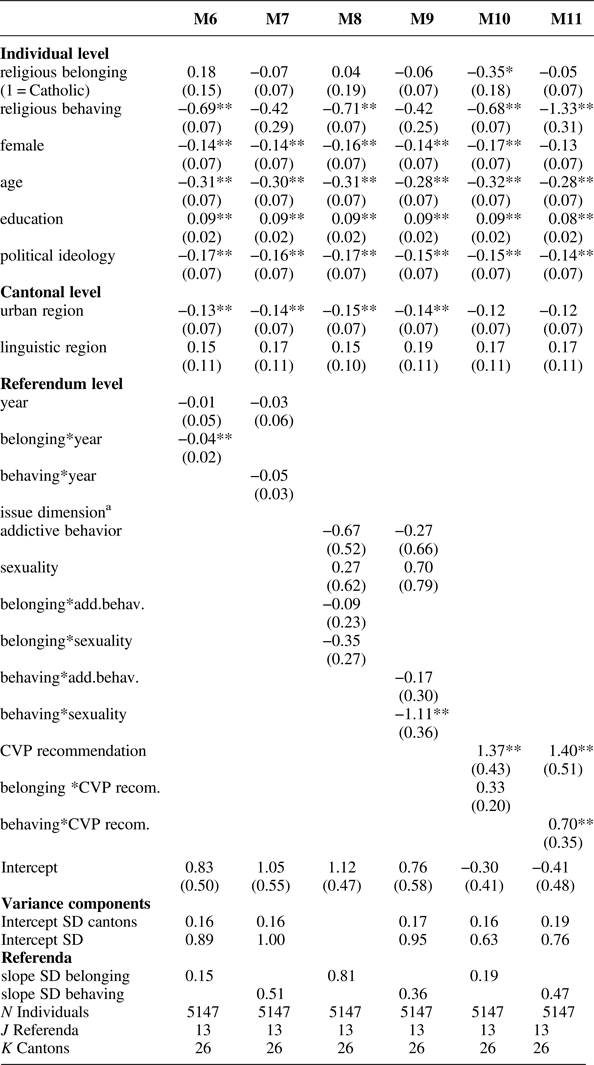
Our results are presented in Tables 2 and 3. To test our hypotheses we proceed as follows: First, we ran a model testing the traditional confessional cleavage between Protestants and Catholics together with the new divide along religious behaving (M1). In the next step, we add the interaction between both of these variables (M2). Model M3 further includes the variables for the religious contexts on the cantonal level, and models M4 and M5 test the cross-level-interactions between individual and cantonal level religiosity allowing a varying slope for individual religiosity. We then turn to the referendum level where models M6 and M7 introduce the time perspective analyzing the potential secularization processes. We accommodate this in the models by letting the slopes of individual religiosity vary over referenda and including a cross-level interaction between individual religiosity and year on the referendum level. As we further predict that Catholics and Protestants will differ in their voting behavior based on the specific moral issue dimension, we then introduce a model testing the cross-level interaction between individual religiosity and the referendum specific moral issue dimensions (M8 and M9). Last, we test whether the vote recommendation by the CVP in a given referendum affects the way individual religiosity is related to vote choice in M10 and M11.
Regression results from multilevel analysis on the effect from religious belonging and behaving on liberal vote decisions – individual and cantonal influences

Note: Results from cross-classified logistic multilevel models; unstandardized coefficients (logits) presented; standard errors in parentheses; *p < 0.05, **p < 0.01; correlations between varying intercepts and varying slopes not shown.
Regression results from multilevel analysis on the effect from religious belonging and behaving on liberal vote decisions – influences on referendum-level

Note: Results from cross-classified logistic multilevel models; unstandardized coefficients (logits) presented; standard errors in parentheses; *p < 0.05, **p < 0.01; correlations between varying intercepts and varying slopes not shown, areference category is genetic engineering.
Before turning to the results of primary interest we can quickly summarize the effects of the control variables. Throughout the models as depicted in Tables 2 and 3 we see that younger and higher educated respondents as well as males and persons whose political views tend toward the left will be more likely to vote liberally on moral issues. Living in a more urbanized area adds to this positive effect, whereas language region is unimportant.
Turning to the effects of religion and looking at M1 in Table 2, we find that religious belonging has a negative but not significant impact on a liberal vote decision concerning moral issues. Thus substantively, and contrary to our Hypothesis 1, Protestants and Catholics do not differ in their vote choice regarding moral policy. In contrast to this, the effect of church attendance on liberal vote decisions is highly significant and negative indicating that regular church goers will be more likely to vote restrictively on moral issues. This result is in line with our prediction from Hypothesis 4. Based on these results one may further assume that only religious adherents, which regularly attend religious services will differ in their voting behavior on moral issues. Turning to the results of M2 which test this assumption as stated in Hypothesis 5 we see, however, that this prediction is not confirmed as the interaction term between religious belonging and behaving is far from significant. The effect from religious belonging on a liberal vote decision, thus, is not conditional on the level of an individual's actual religious behaving. The new religious cleavage between the religious and the secular is clearly more relevant when it comes to referenda voting on moral issues than the traditional confessional cleavage between Protestants and Catholics. Whatever value differences may have existed between the two confessions in the past, they are not visible any more today. This also holds when we look at religion as explanatory factors on the cantonal level. Here, neither the regional share of Catholics nor the average church attendance rates in the cantons affect the probability of casting a liberal vote on moral issues (M3). Religious contexts also do not moderate the effects of individual religious belonging or behaving on voting behavior concerning moral issues (M4 and M5).
Table 3 introduces explanatory factors on the referendum level. M6 and M7 test the assumptions of the (non-)secularization theory (Hypothesis 6). We estimated two separate models for the time dependency of the effects of religious belonging and religious behaving, respectively, by adding interactions with years to the equations. However, we only find a significant interaction between religious belonging and year of the referendum. Relative to Protestants, Catholics tend to vote slightly more restrictively over the years. Whereas the two denominations did not differ in their voting behavior in 1993, Catholics voted more restrictive than Protestants in referenda from 2003 onwards (see Figure 3 for an illustration). The effect of individual church attendance in turn is not moderated by time but stays stable over the period of investigation. Both results run counter to the idea of a decreasing public relevance of religion as put forward by classical secularization theory. That the increase in restrictive voting of Catholics cannot be reduced to specific issues decided at the ballot becomes apparent when we look at whether Protestants and Catholics differ in their voting behavior depending on the content of the moral issue in question (M8). This is not the case as the non-significant findings for the interactions between issue dimensions and individual religious denomination suggest. While the graph in Figure 3 shows that Catholics tend to vote more restrictively on issues on sexual morality the confidence interval includes zero. Instead, and turning to the results of M9 which includes the interaction between religious behaving and the moral issue dimensions, we find that regular churchgoers will vote markedly less liberal on policies concerned with questions of abortion and homosexuality than on other moral policy issues. Indeed, differences in the attitudes toward abortion and homosexuality seem to lie at the very heart of the moral cleavage between religious and secular segments of the Swiss population.
Cross-level interactions between individual religiosity and referendum characteristics. Note: Based on the results reported in Table 3; Conditional effects (logits) and 95% confidence intervals shown.

Finally, the results of M10 and M11 show that part of the connection between individual religiosity and voting behavior depends on the mobilization by political parties. Regardless of respondents' denomination, the nature of the CVP's vote recommendation has a strong effect on their vote decision: if the CVP recommends a liberal vote decision both Protestants and Catholics are more likely to cast a liberal vote on the moral issue. Moreover, as the significant interaction between vote recommendation and religious behaving shows, a liberal vote recommendation from the CVP considerably decreases the general restrictive vote intention of regular churchgoers. This result, which is in line with our Hypothesis 7, clearly demonstrates an important political mechanism of how individual religiosity translates into political decisions at the ballot.
CONCLUSION
The aim of our study was to investigate the religious factor in referenda voting on moral issues. We went beyond the existing research literature on direct democracy and moral politics by shifting our focus away from the policy outcomes of referenda and instead turning to the input side of direct democracy: how does religion influence citizens' vote decisions in referenda and popular initiatives regarding moral issues? Although 11 out of the 13 moral referenda in Switzerland since 1992 resulted in a liberal decision, suggesting growing liberal tendencies overall, religion turns out to be a crucial factor in explaining differences in individual voting behavior.
In particular, our results show that religious behaving, and not nominal religious belonging, plays a crucial role in decision making on issues concerning abortion, genetic engineering, drug abuse gambling, and homosexuality. Actual religious practice in terms of church attendance leads to more restrictive votes. This effect has been very stable over the years and gives evidence for the continuing role of religion in explaining moral issue votes. However, Protestants and Catholics do not differ in their voting patterns on moral issues, even when taking into account the religious behaving dimension. In addition, the voting patterns of Catholics and Protestants do not differ across specific moral issues.
This result supports the general idea that traditional confessional cleavages between members of different denominations are increasingly being replaced by a new religious cleavage that divides the religious from the secular and thus adds to the current debate on the stability and change of religious cleavage voting in Europe (e.g., Ackermann and Traunmüller Reference Ackermann and Traunmüller2014; Brooks et al. Reference Brooks, Nieuwbeerta and Manza2006; Elff Reference Elff2007; Essmer and Pettersson 2010; Knutsen Reference Knutsen2004; Minkenberg Reference Minkenberg2010). As our findings on the moderating role of the CVP's vote recommendation for the vote choices of regular churchgoers show, this “new” religious cleavage is characterized by clear party alignments and political loyalties that extend from electoral to direct democratic voting behavior.
While we took a slightly different analytic perspective due to the unique availability of referenda specific surveys in Switzerland, our study also lends support and generalizes some of the previous findings drawn from American research on moral politics, direct democracies, and the role of religion (Campbell Reference Campbell2007; Donovan et al. Reference Donovan, Tolbert and Smith2008; Fairbanks Reference Fairbanks1977; Feddersen et al. Reference Feddersen, Gailmard and Sandroni2009; Fiorina Reference Fiorina2005; Green Reference Green2010; Morgan and Meier Reference Morgan and Meier1980; Olson et al. Reference Olson, Cadge and Harrison2006; Roh and Haider-Markel Reference Roh and Haider-Markel2003). Heated political debates pitting religious and secular segments of the population against one another on moral issues such as abortion or gay rights are by no means unique to the United States. In fact, questions of abortion rights and the recognition of homosexuality are also the core issues that divide the religious and non-religious in the Swiss case. Since the question of opening up morality issues to the ballot box arises in more and more democratic countries, future research should undertake similar analyses in countries such as Italy, Ireland, Portugal, or New Zealand to increase our understanding of how religion and politics define how we should and should not live.
APPENDIX
Variable Description