In 1959 the governors of Uganda and Kenya complained that the fast pace toward independence in neighboring Tanganyika put pressure on them to hasten independence in their own territories. The problem, as these officials saw it, was that Julius Nyerere and the Tanganyika African National Union (TANU) had galvanized the overwhelming support of Africans for responsible self-government, with only token opposition from Asians, Europeans, and other Africans. Richard Turnbull, the Governor of Tanganyika, explained that, in spite of British efforts to manipulate Tanganyikan politics in order to delay independence, “here every African is a nationalist.”Footnote 1 As a result, the colonial administration was unable to stave off independence for two or three decades by stoking political divisions. If it tried to do so, Turnbull warned, they would soon be confronted with a series of strikes, boycotts, and protests that would ultimately blossom into “a combination of Mau Mau and the Maji Maji rebellion, with all the support of modern techniques in guerilla warfare, sabotage, and fifth column activities.”Footnote 2 British security forces in Tanganyika, he noted, were weak and not up to the task of dealing with a guerilla war or even general disorder.
In his explanation of TANU's rapid success in leading the territory to independence in December 1961, Nyerere offered a different perspective. He wrote that TANU and its supporters eschewed violence and kept the goal of independence clearly in their sites. “We had to choose whether to exploit the daily grievances of the people or whether to ignore these and concentrate quite simply on Uhuru, Freedom …. This meant that we were not involved in wildly promising the people to remove all of their grievances tomorrow. All we were saying was ‘Let us unite and once we have achieved Uhuru the rest will take care of itself.’”Footnote 3 Nyerere's assertion leaves the impression that achieving independence was simply a matter of the nationalist party calling out the people to force political change. Yet, in contrast to views such as his that focused on the role of Western-educated elites in bringing their territories independence, a common theme in the recent historiography of nationalism has been how grass-roots movements provided a pre-existing climate of opposition that nationalist elites could mobilize. As Elizabeth Schmidt has recently summarized in her case study of French Guinea, political elites tapped into the aspirations of groups “already engaged in struggle against the colonial state.”Footnote 4 Rather than simply being mobilized from the top, common people—peasants, workers, war veterans, and women—“had an impact on the ideas, objectives, strategies, and methods of nationalist leaders.” This “inclusive nationalism” has focused on several common themes in seeking to explain the success of anti-colonial nationalism: methods of mobilizing subalterns; how differences in class, gender, and ethnicity were bridged in the nationalist struggle; how vastly disparate regions and cultures were drawn into a unified movement. Studies in this vein have investigated mainly urban associations such as labor unions, self-help societies, dance groups, leisure clubs, youth organizations, and religious societies.Footnote 5
One of the specific ways in which colonial grievances have been related to nationalist movements has been in the study of conservationist interventions, especially anti-erosion campaigns that required Africans to construct terraces and ridges, cull their livestock, cease using fire to open new fields, and adopt “progressive” farming techniques that dramatically changed household labor allocations, land use, and techniques of production. Historians of Africa have catalogued how such interventions often elicited open, sometimes violent protest. In Kenya, for example, a famous conservation-oriented settlement scheme helped to spark the Mau Mau uprising.Footnote 6 In Malawi and Southern Rhodesia, anti-erosion controls led directly to peasant support of violent anti-colonial protest and the nationalist war of independence.Footnote 7 In Apartheid South Africa, state intervention through rural betterment schemes spawned revolt in Pondoland and elsewhere.Footnote 8 In Tanzania, as well, some episodes of anti-conservation protest approached armed conflict following World War II. In the Usambara Mountains, plans to introduce erosion control measures on a wide scale led to public protests directed against chiefs chosen to implement the scheme, which verged on a local rebellion.Footnote 9 A public protest against forced terracing in the Uluguru Mountains in 1955 involved an estimated 4,000 residents who flung rocks at British officials and African chiefs and police, and one rioter was killed.Footnote 10 Population removals and livestock culling on Mt. Meru under the guise of erosion controls led peasant protestors to petition the United Nations to redress their grievances.Footnote 11 These were well-publicized episodes of anti-colonial protest, which, despite Nyerere's assertions to the contrary, drew TANU to the local level in an effort to tap into peasant grievances. Most of these case studies of “local nationalism” were situated in Tanzania's mountain environments, where unusual population densities and farming on steep slopes elicited colonial fears about erosion and declining soil fertility at a time when faith in science to solve such problems characterized the colonial psyche.Footnote 12
Although protest against anti-erosion measures are well known in Africa, a gap remains in the historiography with respect to nationalist-era mobilizations against a universal agenda of forest reservation known as scientific forestry.Footnote 13 Scientific forestry was practiced in virtually the entire colonized world, in regions as different as Botswana, British Guiana, Palestine, and Burma. Although methods of scientific forestry might differ from one colony to another, its basic premise was the need for the state to assume control over forests and woodlands so that they might be managed productively for their timber and other forest resources as part of a strategy of colonial development. Forest reservation meant demarcating forests, emptying them of peasants and pastoralists, and policing them against encroachment by people and livestock. It meant mustering laborers to cut fire lines, fight forest fires, and fell and transport trees, often for private corporations, while at the same time villagers would be largely deprived of the use of these forests for their own subsistence or commercial purposes. The result was widespread opposition to forest reservation and other manifestations of scientific forestry, which often intersected with nationalist movements.
Scholars of Asian colonialism have noted this intersection of scientific forestry and nationalism. In Burma, whose direct influence on Tanganyikan forestry in the nationalist decade is discussed below, peasant resistance to restrictions on forest access was an integral part of forest conservation.Footnote 14 Burmese politicians as well came to view concessions granted to European timber corporations as inherently discriminatory against Burmese firms. Therefore, Burmese colonial forestry created grievances that united elite and grass roots anti-colonial activism. In Malaya, the British used forest policy as a means of preventing a Communist-led insurgency from fostering support among indigenous forest dwellers.Footnote 15 In Indonesia, nationalists used anger at forced labor and loss of land in the forests under the Japanese occupation and following the return of the Dutch to mobilize support in forest villages.Footnote 16 The Indian National Congress tapped into peasant grievances against the forest laws, and peasants in turn came to see Gandhi as ushering in a return to the forests.Footnote 17
In contrast to the well-developed literature on forest policy and nationalism in Asia, few studies have discussed the intersection between colonial forestry and nationalism in Africa. In analyses of conservation and land controls in colonial Zimbabwe, for example, forests enter into the nationalist equation mainly as backdrop, “a place of refuge and rebellion, darkness and disease,” as sites for guerilla fighters to organize resistance, rather than as colonized spaces that intersected fundamentally with nationalist-era grievances.Footnote 18 In spite of the close association between Kenya's Mau Mau rebellion and fighting in the forests, few historians have noticed that forest themselves were an object of policy and conflict in Kenya.Footnote 19 During the Mau Mau Emergency, forests became targets of attack, as insurgents set fire to thousands of acres of forest reserves and tree plantations.Footnote 20 In French Guinea following World War II, forest reservation became a fundamental aspect of policy in a territory where colonial fear of savanna expansion was rife.Footnote 21 Despite Schmidt's masterful job of piecing together widespread, grass-roots opposition to the French regime, she does not explore the repercussions of forest policy in a colony where state demands for reafforestation and curbs on tree felling and peasant control over trees were enforced by repressive forest police in parts of the colony called Forest Regions.Footnote 22 In South Africa also, despite a well-developed conservationist literature, few studies have looked for the intersection between forest conservation (as opposed to land rehabilitation) and protest politics.Footnote 23
There are several reasons why historians of Africa have failed to relate colonial forestry to anti-colonial nationalism. One is because of the “startling neglect of the non-arable landscape” as a subject of enquiry.Footnote 24 Another is that, influenced by modern environmentalism, some scholars have viewed scientific forestry as a benign, if not wholly positive, aspect of colonialism, a view promoted by colonial administrations, post-colonial states, and conservationists alike.Footnote 25 In contrast, the perspective of political ecology helps to explain why forestry spawned such intense opposition and organized resistance. Because political ecology is attentive to “power relations inherent in defining, controlling, and managing nature,” it views the environment as contested space, and conservation itself as a manifestation of political and economic forces.Footnote 26 This was clearly the case during the colonial period, when the state, often in conjunction with private corporations and local elites, wrested control of the forests mainly to make the timber industry profitable. Although scientific forestry had a preservationist dynamic in terms of protecting watersheds, preventing erosion, and hopefully moderating climate, in the case of Tanganyika during the 1950s, when the extent of forest reserves was expanded by fourteen times, virtually all new reserves were designated as production reserves, meant to be sustainably exploited for profit. Invariably this also meant calling on chiefs to muster local peasants to do forest work while forcing them to vacate land in forests and woodlands. By viewing forests as a contested resource, the political ecology framework helps to identify the expansion of forest reserves and concomitant crimes against the forests as a moment in which capitalism began to penetrate the colonial periphery, just as Marx noted that forest crimes “represented an important moment in the development of German capitalism.”Footnote 27 By positing conservation not simply as a means of managing the landscape, but also as a struggle over land, resources, and labor, the actions of Tanganyikan peasants and pastoralists during the 1950s, faced with prosecution for a host of crimes against the forests, become intelligible.
In Tanganyika, new forest reservation focused on a distinct African landscape known as miombo woodlands, after their dominant tree genus. These were regions of sparse populations of shifting agriculturalists and thin stands of marketable trees. Yet by the 1950s they emerged as a colonial problem. The discovery of the importance of woodlands for development—mining, railway construction, forestry, and mechanized agriculture—elicited a colonial hysteria that peasants and pastoralists using fire to open up new farmlands and pastures threatened to desiccate the continent. The status of the woodlands and the concomitant problem of shifting cultivation were debated in both the House of Lords and the United Nations, and inaugurated conflicts over how this landscape should be managed that still go on today.Footnote 28
What I refer to as forest nationalism—widespread opposition to scientific forestry broadly construed, including new forest reservation, eviction of peasants and pastoralists from forest lands, racialized access to forest resources, and sometimes compulsory tree planting—belongs mostly to the realm of hidden or everyday resistance.Footnote 29 Scott has summarized such resistance as rarely dramatic, “the vast aggregation of petty acts” which succeeded in derailing or modifying state policies that threatened peasant survival.Footnote 30 As Feierman points out, everyday resistance must frustrate the historian by being mostly invisible.Footnote 31 Everyday resistance makes it particularly difficult to uncover the motives of the resisters, or sometimes whether their actions were indeed resistance. Thus, the agency or consciousness of subalterns was often as hidden as the resistance, and was as much a problem of discernment for the colonizer as it is for the historian.Footnote 32 For example, during the 1950s, Tanganyikan forests, woodlands, and tree plantations were beset with fires that had many potential causes, including lightning strikes; misapplied forest policies that allowed the unstable accumulation of ground matter; peasant field fires which jumped fire lines; beeswax collectors who used fire in their husbandry; hunters of rock hyraxes, whose pelts had an international market in the 1950s; and arsonists seeking to attack the most obvious manifestations of forest policy. Resistance to forest policy may have taken the form of simply not showing up to fight forest fires. Yet the public acts of defiance lend credence to the claim that the hidden and day-to-day acts were really resistance. Most importantly for the peasants under discussion here, resistance helped to ensure survival. It helped maintain access to land to grow crops; to forests that could be used as sources of famine food, fuel, a cash income, refuge, and often spiritual sustenance; to family or village labor that could be used to repair a hoe rather than plant a tree of dubious value. The weight of evidence is that resistance to forest rules was widespread, and gained momentum during the nationalist decade, acting in a dialectical way with the nationalist movement itself. Nationalism inspired forest resistance, and forest and other resistance helped propel nationalism forward, beyond what Nyerere and other nationalist leaders had hoped for in the mid-1950s. Forest workers, pitsawyers, licensed forest cultivators, and landless peasants aggrieved by forest policy sought and received support from TANU and its surrogate institutions, or read into TANU political mobilization an implicit support of their grievances and a promise that they would be redressed under a TANU-led government.
Colonial Scientific Forestry and Late Colonial Rule
Scientific forestry emerged in eighteenth-century Europe owing to state fears of a rapidly diminishing forest estate at a time of nascent industrialization, when wood was the dominant industrial fuel, construction material, and an important source of revenue.Footnote 33 The goal of forestry was to identify fast-growing tree species of uniform height and girth that could be easily quantified and exploited and that would replace diverse, slow-growing species that were difficult to quantify and uneconomic to exploit. Through rotational planting and harvesting of economic tree species over the long term, the forest estate could be completely remade to secure a continuous timber and fuel supply. This could only be done by ensuring state or private ownership of the forests, ending their role as a commons, thereby evicting peasants, and guarding trees from illegal exploitation, including wood poaching, grazing, and farming. It also required a permanent forest bureaucracy to manage the forests over generations. Although scientific forestry was premised on viewing forests as economic assets that should be rationally exploited, by the late eighteenth century some naturalists concluded that forests were valuable for protecting watersheds and preventing flooding, aridity, and desertification. Forestry was thus viewed as crucial to agriculture, and some foresters came to believe that European landscapes could be replicated in arid lands through proper reafforestation and silviculture. From the late nineteenth century a new field of ecology emerged that saw the relationship between a region's soils, vegetation, insects, animals, and people as interrelated and mutually dependent.Footnote 34 Ecological surveys provided foresters with a tool to determine whether exotic tree species were suitable to the soils of a region. Ecology therefore aided forest administrations in introducing species known to be fast growing into totally alien environments where their impact was untested. Although ecological thinking was the beginning of the idea of protecting forests for their own intrinsic worth, it would not be until the 1980s that biodiversity protection would become the leitmotif of forest conservation.
As Europeans colonized Asia, they introduced state forestry into valuable tropical forests, most famously the teak forests, which were viewed as under threat by indigenous farmers and European timber companies.Footnote 35 Although colonial administrations believed that the state must control forests, necessity led to the continuation of concession relationships with private corporations, since forest management relied on revenues from royalties on large-scale timber marketing. Furthermore, as a labor-intensive industry, forestry sometimes had to accommodate to rural communities whose labor was needed to demarcate and maintain forest boundaries, plant and tend young trees, and cut and transport timber. From 1869 British foresters in Burma adopted a system in the teak forests known as taungya cultivation to manage the related problems of rural resistance and a labor shortage for forest work.Footnote 36Taungya, meaning ‘hill cultivation,’ was a method of co-opting shifting cultivators to clear land within a forest reserve that the colonial forest department designated for reafforestation. Peasants were enlisted to clear trees and foliage on parcels in forest reserves, where they could plant food that was intercropped with marketable trees. After a few years, by which time the new tree canopy blocked sunlight and the soil was exhausted of nutrients needed for food crops, the cultivators were granted a new parcel of land nearby, and the process began again. Taungya allowed a labor force to be mustered for forest work while alleviating peasant land shortage. It channeled to positive ends the cultural practice of shifting cultivation, usually considered to be primitive, antithetical to colonial pursuits, and harmful to forestry. In some regions it gave peasants a stake in forest management and forest protection, and thereby secured “the participation of people in the making of the forests.”Footnote 37 Yet because taungya added an undesirable work burden to the peasant planting regimen that, in East Africa at least, was often born by women, it was only successful where arable land was scarce. From its roots in Burma, forms of taungya cultivation were employed in Indonesia, India, and most British colonies in Africa, including Tanganyika.
Railways, Pitsawyers, and State Forestry in Post-War Tanganyika
During the interwar years the Tanganyika Forest Department was under-funded in what was considered to be a peripheral colonial territory, and the 1930s Great Depression further limited the capacity of the Forest Department to protect forests from encroachment and reafforest parcels that had been cut out. Tanganyikan hardwood trees struggled to compete in a world market dominated by softwoods. Forestry took a back seat to agriculture, which was considered to be far more important for colonial revenues, and political officers usually won in their battles to open up reserved forests for agriculture. However, the Forest Department nevertheless increased control over forest resources in key ways. It categorized specific tree species with a known export value as “scheduled” trees and strictly regulated their use.Footnote 38 It established tree plantations on a modest scale to experiment with indigenous and exotic trees, some using taungya labor. On the whole peasants were kept out of forest reserves, and state authority over forest resources was made known.
The crucial transformation of the forest sector began during World War II. Wartime exigency, coupled with the Japanese occupation of Southeast Asia in 1942, created a Western demand for new sources of timber and other forest resources. Timbers that did not have an identifiable market before the war, especially those that were scattered in unreserved miombo woodlands, suddenly had a limitless demand. As a timber merchant wrote, “In Tanganyika, acceptance of miombo bush as forest has changed the whole country's forest potential.”Footnote 39 This demand would be sustained after the war with the expansion of the British imperial railway network in the Middle East and Africa. The Palestine Railway, for example, the main land route between Port Said in Egypt and Haifa in Palestine, was extended during the war to connect Tripoli to Beirut.Footnote 40 In the late 1940s about 80 percent of Tanganyikan construction timber was sent to Egyptian and other Middle East ports. In 1947 Palestine Railways placed an order for 50,000 pit-sawn sleepers from Tanganyika, most of which came from the “savannah timbers of Tabora District,” primarily the valuable hardwood mninga (Pterocarpus angolensis).Footnote 41 Although orders for the railway ceased when the British quit Palestine in 1948, the British military interest in the region remained strong well into the 1950s. A South African market for mine shoring also revived after the war, and increasingly Uganda and Kenya emerged as important destinations for Tanganyikan timber.
Even as the world market for hardwood timber was expanding, the major demand for Tanganyikan woods came from a growing internal market that was sustained by regional geopolitics. A postwar world coal and steel shortage boosted local consumption of Tanganyikan wood for railway fuel and sleepers, especially after the Colonial Office directed that all imports be rationed. The Tanganyikan Power and Lighting Company used wood fuel exclusively along the Central Railway. Gold and diamond mining and the railway sector expanded after the war, creating a tremendous demand for sleepers, fuel, and mine shoring. In the late 1940s British policy makers and military planners aimed to use British-controlled territory in Central and East Africa to support their bases in the Middle East.Footnote 42 They envisioned a new railway line from Walvis Bay in Southwest Africa to Mikindani in Tanganyika, and another branch to Mombasa in Kenya, in order to provide an outlet for strategic raw materials from the Rhodesias—copper, coal, chrome, and mica.Footnote 43 In 1953 the creation of the Central African Federation gave the Southern Province Railway an added justification as a means for Rhodesian minerals to bypass Portuguese and South African ports.Footnote 44 The European Recovery Program required that Britain supply the United States with “raw materials necessary for American rearmament,” and the strategic nature of the Southern Province Railway allowed its construction using European Recovery funds.Footnote 45 By that time the boom in raw material exports from Central Africa created by the Korean War choked some of the feeder ports and railways, such as Beira in Mozambique, which proved unable to handle the increased traffic.Footnote 46
The extension of the railway system was justified by massive development projects, especially the infamous Groundnut Scheme, which briefly made Tanganyika one of the biggest arenas of imperial investment.Footnote 47 In 1946 the Managing Director of the United Africa Company of Unilever proposed a large-scale project whereby the Ministry of Food (through a newly-created Overseas Food Corporation) would grow groundnuts on 3.2 million acres in Kenya, Northern Rhodesia, and most importantly Tanganyika, which would provide 75 percent of the acreage. The Groundnut Scheme was a response to a shortage of fats and oils, estimated at about five million tons of groundnuts globally and a one-and-a-half-million-ton shortfall for Britain alone.Footnote 48 Besides huge swaths of land around Nachingwea, Tunduru, and Liwale in southeastern Tanganyika, groundnut acreage was opened up along the line of the Central Railway in Dodoma and Tabora districts. The failure of the Groundnut Scheme is well known; abandoned by 1950 after an expenditure of £36,000,000, the project only succeeded in clearing 46,000 acres. However, because of the “blow for British prestige” that complete abandonment of the project would entail, a mechanized agricultural scheme was continued into the 1950s on 150,000 acres around Nachingwea, growing mixed crops on parcels ranging from “peasant farms” of about twenty acres to “production” farms of 1,000 to 2,000 acres.Footnote 49
In spite of retrenchment, the Groundnut Scheme had important consequences for forestry in Tanganyika for the duration of the 1950s. The most important was that it required a new port at Mtwara, from which the Southern Province Railway would be built as far as Nachingwea to import heavy equipment and to export groundnuts. Both the Overseas Food Corporation and the Tanganyika Government committed themselves to increase traffic on the railway to 190,000 tons by 1960 by increasing exports of agricultural products, coal from mines near Lake Nyasa, and timber. In order to supply the Groundnut Scheme, Shell Oil built a pipeline from Mtwara to Mtua using timber from surrounding woodlands.Footnote 50 The Southern Province Railway also required one million cubic feet of wood fuel annually for its locomotives, most of which the Forest Department hoped to salvage from land set to be cleared for groundnuts. The decision to extend the Southern Province Railway therefore immediately influenced forest policy by increasing the value of forests and woodlands once considered to be marginal or worthless.
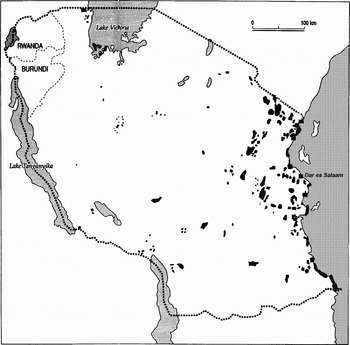
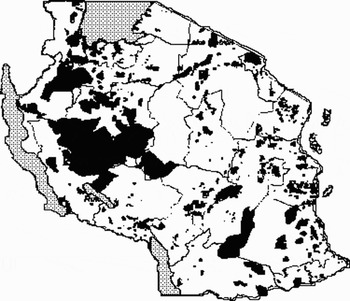
The postwar demand for Tanganyikan timber led to an aggressive policy of forest reservation. Suddenly the Forest Department was no longer a marginal branch of the government, but a key player in the formulation of development policy. In line with this policy shift, in 1946 the Conservator of Forests emphasized, “the protection side of forestry in Tanganyika, although of course important, had perhaps in the past been over stressed.”Footnote 51 The new Forest Development Plan sought to reserve 14.6 percent of the territory as mainly production forests, altogether some 50,000 square miles, which would target the miombo woodlands that had not been considered worth reserving before the war. When compared to the 1.37 percent of the territory (4696 square miles) under forest reserves in 1944, this meant a dramatic departure from past policy and a major restructuring of settlement and land use (see Figures 1 and 2). Because colonial officials believed that each province of Tanganyika must strive for a uniform extent of land under forest reserves in order to promote economic development, the new forest policy fostered intense struggles over land, grazing, and forest access that affected virtually all parts of the territory, not just coastal mangroves, lowland canopy forests, and mountain rain forests on which past forest reservation had focused.
Forest Reserves, Tanganyika, 1945.

Forest Reserves, Tanganyika, 1961.

These plans for rapid reservation were made possible by the new revenue-generating capacity of the Forest Department owing to domestic and export demand for timber and aid from the Colonial Development and Welfare Corporation (CDW), whose commitments in 1947 doubled the Department's budget and its European staff.Footnote 52 Following the war, the new Labour government embraced the CDW as a means of improving African economic and social conditions in light of continued currency controls, economic planning, and shortages of imported consumer goods. The Labour government hoped that development would ameliorate the worst effects of capitalism, while contributing to the kind of material improvement that was a prerequisite for eventual African independence. Development would also enable the colonies to produce consumer goods for the British public as well as exportable products for the U.S. market that would help to ease the United Kingdom's dollar shortage. Following the war Britain depended on the United States for food imports, which created a drain on dollars.Footnote 53 The colonies were expected to do what they could to increase production of exportable goods while decreasing imports, especially from dollar zones, as dollar import ceilings were fixed for each colony in 1949. CDW was furthermore an investment in long-term economic links between the colonies and the metropole that would hopefully ensure political allegiance in the Cold War era and the long-term maintenance of the British Commonwealth.
The growth of the Forest Department that was taking place throughout Tanganyika was most dramatic in the southeast, where the Groundnut Scheme and the Southern Province Railway drove development. Late in 1947, as the first bulldozers began to clear groundnut land in Nachingwea, the Forest Department opened up a new station in Lindi “in anticipation of considerable development and new timber demands there.”Footnote 54 The “virtual exclusion of the Forest Department from the Southern Province” that had marked the interwar years now came to an end, financed with CDW aid and the demand for construction timber and especially railway sleepers, for which Tanganyikan hardwoods were ideal.Footnote 55 There were many factors affecting sleeper durability, including extreme climate fluctuations, moisture, termites, and fungi.Footnote 56 Poorly seasoned sleeper timbers, especially pines, cracked and warped under the weight of heavy axles over time, demanding replacement every decade or so. For this reason, durable tropical hardwoods with characteristics similar to Asian teak were in great demand as sleepers. In Tanganyika this favored the two hardwood tree species most like teak, mninga and mvule (Milicia excelsa), which had an expected life of thirty years when creosoted.Footnote 57 The Tanganyika administration pressed the Forest Department to “open chains of sawmills all over the place” to meet the sleeper demand.Footnote 58 The Overseas Food Corporation itself built two sawmills that were hard pressed to produce sufficient sleepers. The 50,000 produced in 1949 left a shortage of sawn timber needed for port and housing construction, and African pitsawyers attempted to make up the difference.
Pitsawyers were so named because they dug a pit and constructed a platform beneath felled trees, which enabled them to saw the trunk into planks using extended saws. Although migrants from Iringa District emerged as specialist pitsawyers during the colonial period, most pitsawyers emerged locally to supply timber and planks to carpenters or to sell in town markets.Footnote 59 During the 1930s pitsawyers opened up the woodlands to exploitation because sawmillers were reluctant to harvest trees in these inaccessible woodlands, where known marketable timbers were few and far between. As the World War II demand for sleepers and construction timber burgeoned, local pitsawyers organized themselves into associations, called vyama in Swahili (sing. chama), which sought licenses to supply government contracts. Sawing planks at the felling site obviated the need and expense of bringing in tractors to haul out logs to be cut at sawmills.
African pitsawyers faced competition in the post-war period from small-scale entrepreneurs from the Asian and Greek communities, who invested in circular and mobile saws that milled a better product. As a consequence, the Forest Department began to view pitsawing less as a heroic opening up of marginal woodlands than as a wasteful exploitation of valuable tree species. By the 1950s Forest Department concession agreements mandated that saws be used for felling scheduled tree species. The expense of saws and their upkeep priced many Africans out of the business,Footnote 60 and in some regions Africans were barred outright from receiving licenses to cut mvule and mninga. Forestry instead tried to get pitsawyers to exploit miombo trees (Brachystegia spp and Isoberlina), allowing unlimited licenses for these and other marginal timber species. Miombo hardwoods were considered to be secondary timbers because their hardness and interlocking grain made them difficult to saw, nail, or drill, but by 1949 they were beginning to find a market as sleepers and pit props because of their strength.Footnote 61 By then Africans had begun to use miombo for general construction timber, in part because mvule and mninga were becoming too expensive for them. In Uzaramo region in 1948, African pitsawyers complained of racial discrimination when they were refused licenses to cut mvule and mninga because they did not have circular saws.Footnote 62 In 1949 Africans protested when two Asians were allowed to cut mvule and mninga even though they did not possess a circular saw, this case demonstrating that British racial sensibilities, not technology, determined who was to be licensed to cut first-schedule trees.Footnote 63 The racialized exploitation of Tanganyikan trees, which favored Asians and Europeans for the cutting of mvule and mninga and Africans only for the less-profitable tree species, became a common grievance in the 1950s, intersecting with widespread African resentment over racial access to land, jobs, participation in government, and discrimination in wage levels.Footnote 64
While most pitsawyers had licenses, by the post-war years, in light of the burgeoning demand for timber, there was widespread illegal cutting of timber and construction poles, necessitating more African staff to patrol reserves and prosecute offenders. In 1949 the Southern Province Forest Officer banned pitsawing for a time in an effort to bring the black market under control, but found it necessary to revive it through a licensing system so that it could provide sufficient timber for the emergent African market. At the time there were about ten pitsawing associations operating in Southern Province, which were initially each restricted to cutting ten mninga trees per month before this quota was halved.Footnote 65
Burma in Tanganyika
Into this scene of frenzied tree cutting that characterized Southern Province by the late 1940s arrived the British timber corporation, Steel Brothers (also known as “Steels”), one of the largest teak merchants in Burma. In 1948 Burma became independent, withdrew from the Commonwealth, and began to nationalize its teak industry, creating a teak scarcity for much of the 1950s.Footnote 66 Steels in turn sought new investment arenas, and Tanganyika seemed to be a good prospect, in part because after 1948 a handful of British forest officers with prior service in India and Burma were reassigned to Tanganyika, one becoming an Assistant Conservator of Forests.Footnote 67 W. A. Robertson, in 1947 the Forestry Adviser to the Secretary of State for the Colonies, who had a hand in formulating the new expansion of Tanganyikan forestry, had twenty-five years' experience in Burma and India.Footnote 68 With its new “Asian” blood, the Forest Department looked to Steels to help ease the Southern Province timber bottleneck, and granted the corporation an unusually favorable concession to exploit the mvule stands of the Rondo Plateau and its environs.Footnote 69
Mvule, with characteristics similar to teak, attracted Steels to Tanganyika.Footnote 70Mvule was one of Tanganyika's most valuable timber species in terms of local use and exportability because of its suitability for construction, furniture, and flooring. It was a dominant species of the mixed dry forests of the coastal zone, but ranged from riverine swamp forests to the foothills of the Eastern Arc rainforests to as far afield as the woodlands of western Tanganyika.Footnote 71 By the interwar years it was considered to be mainly a woodlands tree because of its depletion in the most accessible closed forests. As early as 1923 mvule was reported to be scarce within easy reach of the Central and Northern railways on account of construction demand in the state sector and for the railways themselves.Footnote 72 Its rapid depletion led the Forest Department to begin mvule silviculture trials near Moshi, Mombo, and Pongwe in the northeast highlands as well as on the outskirts of Dar es Salaam, with poor results on account of gall fly attacks, snail infestations, insufficient labor for weeding, wildlife destruction, and greater success at planting more familiar species, especially fast-growing exotics and teak.Footnote 73 By the postwar years the 1500 square mile Rondo Plateau, a coastal dry forest located in southeast Tanganyika in close proximity to the Overseas Food Corporation's groundnut lands and just north of the Southern Province Railway, was thought to be the last remaining concentrated stand of mvule, estimated at some ten million cubic feet. In addition, Rondo possessed substantial numbers of mninga trees, which rivaled mvule for durability, seasoning properties, and workability, and there were also some secondary miombo species that now had market potential.Footnote 74 Rondo Forest had originally been declared a reserve under German rule in 1910 on 36,000 acres of coastal forest.Footnote 75 Owing to its inaccessible location away from rail lines in a periphery of a colonial periphery, Rondo survived as the last major preserve of mvule until the arrival of Steels.
Steels' concession marked a major departure in the relationship between the Tanganyika Forest Department and private forest concessionaires, approaching a near parastatal association. The Conservator of Forests recommended that a twenty-year concession be granted to Steels to exploit mvule and mninga, with the government obtaining a 50 percent share of the operations, exempting Steels from paying royalties on the timber it extracted. The twenty-year concession implied a twenty-year planting-and harvesting rotation, negotiated down from the 80- to 100-year rotations that were considered to be most sound from a forestry point of view in terms of reafforesting Rondo's hardwood timbers. This meant that Rondo forest would be cut out four to five times faster than with the longer rotations. The Conservator wrote, “We could make very good profits from such a scheme ….”Footnote 76 The concession allowed Steels “to cut out practically the whole Mvule growing stock on the Rondo Plateau” making “impossible at a stroke the working of these stands on a sustained yield basis.”Footnote 77 Once the natural mvule stands were cut out, tree plantations growing mvule and Burmese teak would be created in their place, the Imperial Forest Adviser writing, “we will have created a forest capable of yielding over five times as much timber as is standing on Rondo today.” Steels' concession was one of the factors that led the Tanganyika Government to argue for the extension of the Southern Province Railway in 1950, being assured of 13,000 tons of timber exports from the Rondo Plateau annually.Footnote 78 Although some professional foresters criticized the Rondo concession for its unsustainable and destructive exploitation of timber, the Conservator held firm to the contract because the government stood to benefit from a large share of profits.Footnote 79 In 1950 this partnership produced 3,545 tons of timber from Rondo forest and its environs.Footnote 80 A few years later Steels produced 700 to 800 tons of sawn timber per month, with the goal of increasing production to 1,100 tons per month.Footnote 81 Yet in 1957 the Forest Department reported that the “special agreement” that the Tanganyika Government had made with Steels “failed to provide the profits expected.”Footnote 82 This was in part because Steels was exempted from royalties. Nevertheless, the Rondo concession and its rapid felling of timber accounted for almost one-fifth of all log timber cut in Tanganyika in 1954.Footnote 83Mvule extraction from Tanganyika doubled from 1948 to 1949, and tripled by 1952, after which time it declined as the Rondo Plateau was rapidly cut out. In 1959, 84 percent of mvule cut in Tanganyika still came from Rondo.Footnote 84
Steels' concession created the seeds of conflict for Africans who lived in the vicinity of Rondo and others who arrived as labor migrants, encapsulating nationalist-era struggles over wage levels, working conditions, racial job preference, and access to land. In September 1949 the first trees of the Rondo concession were felled by contracted African loggers, some of whom were local casual laborers.Footnote 85 A prefabricated sawmill was sent from England, and by 1950 an average labor force of 640 skilled workers was employed. By 1954 the labor force grew to about 1,200, including some Burmese and Chinese skilled laborers and some sixteen Europeans recruited from Steels' Burma operations.Footnote 86 Half of the African labor force at Steels was employed in logging, while the other half initially worked in the sawmill in three eight-hour shifts, replaced after 1954 with a five-and-a-half-day workweek of fifty-five hours. Workers lived in labor camps to which local people gravitated as wives, squatters, “hangers on,” and shopkeepers. Some local peasants moved into the forest concession as illegal squatters to supply food to the workers. The operation was often beset with labor shortages. Local casual laborers often left to work on their own farms during important growing seasons, and workers often deserted for better-paying jobs in the region. Tree fellers were employed on a piecework basis, each team cutting about forty trees per month and receiving 3.50 shillings per team per tree. Sawmill workers received minimum monthly wages of 35 shillings per month plus rations valued at 30 shillings. Periodic labor shortages led Steels to recruit migrant workers from Masasi, Newala, and Mbeya districts in southwest Tanganyika.Footnote 87 The labor structure of Steels' operation is thus of interest here because of its diversity, incorporating waged sawmill workers, some foreign “labor aristocrats,” local casual laborers, long-distance labor recruits, and local peasants.
Steels became the target of labor conflict as the decade progressed. Attempts by sawmill workers at Rondo to obtain better wages and working conditions came at a time when the British colonial governments sought to stabilize the African wage labor force, particularly in urban areas. This would be done by increasing wages for urban workers in order to end the labor migration system that was based on single-man's wages, and which connected wageworkers to the rural homestead.Footnote 88 Wives and children would accompany men, and the wage labor force would become more productive as a new generation grew up at the work site. It was hoped that stabilization would moderate the politics of the working class, helping to maintain colonial rule for another generation. The 1950s was a time of high prices for African commodities, which helped to offset the costs of stabilization. Across Africa wage increases were also the result of steady strike activity that forced employers and colonial governments to accede to worker demands. Racial parity at the job site was also a notable demand in many strikes, reflecting a much more politicized generation in the aftermath of World War II. In Tanganyika labor organizing and unionization took place throughout the country, particularly after the creation of the Tanganyika Federation of Labour in 1955, which coordinated unionization efforts and encouraged territorial-wide unions. As a result, average monthly wages rose from 57 shillings in 1956 to 80 shillings by 1960.Footnote 89
Steels' sawmill therefore had to contend with a period of conscious union activity at a time of labor shortage, competing for labor with the rump Groundnut Scheme, ongoing railway construction, the Mtwara harbor, rival timber companies in the region, and regional sisal plantations.Footnote 90 Begun as a steam-driven operation in 1949, Steels' rapid timber output and large labor force of 600 to 700 workers per shift, some working overtime owing to labor shortages, created a chaotic atmosphere.Footnote 91 Exposed circular saws posed a hazard to workers, and the government labor inspector cited dangerous conditions on several occasions. In 1959 a worker was electrocuted as he passed by a winch. The sawmill was processing what was effectively a nonrenewable resource, since Steels was not committed to maintaining production after the original mvule and mninga had been cut out, and reafforestation was not taking place fast enough to sustain production. Thus, the work force had no real security. The timber market experienced periodic slumps that created worker layoffs, and periodic labor shortages that created production bottlenecks.
Beginning in 1956, Steels' workers began to organize, and they sought out a local farmer named Juma Saidi as their spokesman. Saidi had his own grievances against the timber concession, which had expanded onto his land. In September 1957 he led a strike after five workers were fired for presenting grievances to the sawmill manager. The labor inspector concluded that Saidi was the moving force behind the strike, and that “his motives for entering into these discussions were tinged with political considerations. There is a history of political trouble on the Rondo Plateau connected with the cutting of logs by Steel Brothers, and it is known that Juma Saidi has been active in opposing any extension of the cutting rights of Steel Brothers, and has objected to the cutting of logs by Steel Brothers.”Footnote 92 The District Commissioner from Lindi was flown in on a Steel Brothers airplane when it appeared that the strike, although peaceful, was taking on a political tinge. The central grievance was for higher wages and an increase in the food ration. Although the sawmill manager agreed to the demands if the men would return to work, they refused until the wage increases were actually implemented and put in writing, which the manager refused to do. In the course of the strike some of the workers traveled to Lindi and joined the Building and Construction Workers Union, led by carpenters and masons, and sought to negotiate through them.Footnote 93 Thereafter the majority of Steels' work force voted to affiliate with this union. The workers refused to return to work by the 10 October deadline set by the mill manager. Finally, Rashidi Kawawa, general secretary of the Tanganyikan Federation of Labor and a member of TANU's central committee, arrived and convinced the workers to return to work after the mill manager guaranteed a raise in wage levels. Kawawa used the Steels strike as an opportunity to increase the influence of the Tanganyikan Federation of Labor and TANU, while convincing the government of their moderation. There is little doubt that most workers perceived the union movement to be operating in sync with the nationalist movement. In 1957 some 1500 people responded to a meeting of union members called by TANU at Nachingwea “to demonstrate their strength and to present a petition.”Footnote 94 As Steels' workers were politicized, the expansion of Steels' concession politicized local peasants as well, including taungya forest cultivators, at a time of widespread evictions in the face of dramatic increases in the extent of Tanganyika's forest reserves.
Forest Fires, Taungya Cultivation, and Struggles over Land
The Burmese forestry practice of taungya was a means of anchoring peasant shifting cultivators in forest reserves in order to reafforest cut out parcels. While taungya provided the state with access to forest labor under conditions of labor shortage, it allowed peasants access to fertile forestland where they could interplant food crops with trees before moving on to another parcel after a few years. In virtually all cases, taungya cultivators (often misnamed “forest squatters”) took their contracts to be grants of permanent occupancy in forest reserves.Footnote 95 Indeed, in some forests the Forest Department expected that taungya occupation would be “in perpetuity,” because it was assumed that over a ten-to-twenty year period, cut-out forest parcels would be replanted and harvested on a rotational basis, creating an ongoing need for labor. However, in cases where the Forest Department sought removal of taungya cultivators, they were met with resistance. Many taungya cultivators, after all, were recruited from local peasants who had traditions of collective ownership of those very tree stands, in which their ancestors were often buried. Forests were frequently locales of rain shrines and sacred trees, which people appealed to in times of crisis. In some cases, taungya cultivators, who were often women, resented the added work burden of tending trees alongside food crops. Because of the conflict that was often implicit in the taungya relationship, it failed to enlist peasants in forest policy to the degree that the government had hoped. The Forest Department was furthermore opposed by illegal squatters residing in forest reserves, whom they discovered as they set out to re-demarcate German-era reserves. Finally, as the Forest Department expanded the forest estate during the decade into huge miombo woodlands, it targeted peasants residing within the new reserves for eviction, although in some cases they were sufficiently entrenched that the forest reserve was simply excised or its borders amended.
The most overt symbols of the expanding authority of the Forest Department in the 1950s were tree plantations located in Native Authority or central government forest reserves, where fast-growing exotics or unnatural concentrations of indigenous tree species were planted. Native Authority forest reserves were the administrative counterpart to indirect rule, meant to bolster local government-appointed chiefs, who in theory had historical legitimacy. Drawing on colonial Asian precedents, the Forest Department believed local people were more ready to accept Native Authority forest reserves than those controlled by the colonial state.Footnote 96 In some cases the Forest Department allowed the preservation of tiny parcels of ancestral forests just to legitimate local government, arguing in one early report that “preservation and reafforestation can be effected with the aid of Native Authorities and elders of the area by making use of their ancient customs and tabus in modified forms.”Footnote 97 Yet common people often resented Native Authorities because it was their job to collect taxes and enforce unpopular colonial laws, and many abused their authority while enriching themselves.Footnote 98 Moreover, Native Authority tree plantations were maintained with peasant corvée labor, and often usurped land that had once been part of peasant land allocations. Some livestock keepers disparaged tree plantations as places where grass did not grow, thus where their stock could not be pastured, since Eucalyptus trees, one of the most common plantation exotics, dried out the soil.Footnote 99 Some forests became Native Authority reserves only after timber companies had cut them out, and after “certificates of extinction” of the land rights of local inhabitants were issued.Footnote 100 For example, Steel Brothers was granted concessions to exploit the timber in three forests of Southern Province, Mtama, Nandimba, and Makangala, which surrounded the Rondo Plateau. After Steels had completely worked out their timber in about 1958, they were all declared to be Native Authority forest reserves. Even tree schemes aimed at peasant production, such as a wattle-growing scheme in southwestern Tanganyika that was meant to produce bark for leather dye, were often viewed by peasants as a colonial ruse to appropriate land or to benefit chiefs or wealthy villagers.Footnote 101
For all of these reasons, Native Authority forest reserves and tree plantations became targets of attack during the nationalist decade, following a pattern common in colonial forests.Footnote 102 Forest reserves in general were known as mashamba ya bibi, meaning “the Queen's plantations” (before 1952 under King George as mashamba ya bwana), so there was no doubt that peasants knew that they were attacking government property.Footnote 103 In African systems of usufruct, possession of trees usually meant de facto possession of land, and often required that a symbolic tax or tribute be paid to the lineage on whose land the tree was planted.Footnote 104 Forest reserve borders were often planted with exotics such as Eucalyptus to make their location obvious. Therefore, attacks on government and even Native Authority tree plantations were attacks on usurpations of local land rights. Cases of arson directed at Native Authority tree plantations arose in the Uluguru Mountains in 1955 and at Malya, Ibindo, and Talago in Lakes Province in 1956. In the last case the Forest Department reported, “The incendiarists took particular care to defeat the firebreak system by systematically lighting each section in the dead of night.”Footnote 105 In 1959 five fires in one day were reported at Mbeya eucalyptus plantations, and other cases of arson were reported in Native Authority plantations of Songea.Footnote 106 The following year Native Authority plantations at Masasi in Southern Province were deliberately burned, as was an experimental plot at the Steel Brothers concession in the Rondo Forest Reserve. In Njombe district there were many instances of peasants burning wattle plantations or single wattle trees, as well as opposing chiefs who they believed were profiting from wattle growing at the expense of peasant access to land.Footnote 107
From 1945 to 1959 the number of fires in forest reserves and tree plantations averaged 155 prosecutions annually.Footnote 108 Not all fires were acts of arson. The eviction of peasants and pastoralists deprived the forests of regular, seasonal burning, allowing a buildup of explosive ground matter.Footnote 109 While preventive burning became part of forest management in the 1950s, sufficient labor was not available for the entire territory as reserves were expanded exponentially. This made forests especially vulnerable to natural, negligent, and intentional fires. On the Rondo Plateau, for example, peasants resisted orders that they surround their farms with fire breaks to prevent flames from annual bush fallowing jumping into the surrounding forest lands. Yet some fires that beset Rondo forest were deliberately set.Footnote 110 In Chomme Forest Reserve in Tanga Province, where squatters and their cattle had been evicted so that camphor could be grown on land formerly used for grazing, the people refused to help Native Authorities put out arson fires, even though fire fighting was compulsory in such cases.Footnote 111 In Tanganyika as a whole, recorded cases of arson in forests fluctuated dramatically during the decade from a high of 368 in 1949 to a low of 64 in 1959. Fifty fires alone were reported in the forest reserves of Northern Province on the eve of independence, but the Forest Department specified that “there were, in fact, many more.”Footnote 112
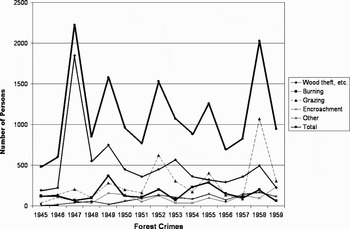
Although forest statistics undercounted forest crime in the 1950s, they offer a gauge of its extent and nature (see Figure 3). Grazing in forest reserves typically accounted for half of all forest crimes. Grazing offenses peaked in 1958 with over one thousand perpetrators, compared to just over one hundred at the end of World War II. Forest encroachment, including illegal cultivation and residence in forest reserves, rose steadily throughout the 1950s to peak in 1959 with 234 cases. Wood theft and other illegal exploitation of forests spiked in 1947, in that year accounting for 83 percent of all forest crime. Yet in 1958 there were still about five hundred cases of illegal exploitation. Overall, on average just over 1,100 persons annually were charged with forest crimes in colonial courts, although far more were likely to have been charged in local and district courts, where most crime was prosecuted. These figures must be weighed against the increased policing of the forests, which apparently curtailed certain categories of forest crime while leading to greater apprehension of perpetrators in others. From 1945 to 1958 the number of forest rangers increased by over eight times to 155, patrolmen increased by four-and-a-half times to 197, and forest guards almost tripled to 458. Nevertheless, with a forest estate that increased by fourteen times, policing could not have stemmed the tide of forest offenses. The Itulu Hill Forest Reserve of Tabora District alone encompassed 1500 square miles. The combined forest reserves of Western Province in 1959, at 27,465 square miles, were about as big as Belgium and the Netherlands combined.
Forest Crimes, Tanganyika, 1945–1959.

The rapid creation of forest reserves throughout the territory led to clashes over land access in all provinces of Tanganyika. Furthermore, following the indolent interwar years, when the Forest Department had largely turned a blind eye to peasant encroachments in German-era forest reserves in much of the territory, the revived department of the 1950s was intent on firmly establishing forest boundaries “so that there should be no doubt in the minds of the public where these are situated.”Footnote 113 In 1954 “sizable intrusions” occurred in the Balangai, Mkusu, Jasini, and Mutai forests of Tanga Province. In 1955 destruction of the cement beacons marking the borders of the Kilimanjaro and Rau forest reserves was on the increase, and two years later Meru peasants shifted the entire line of boundary markers in a line paralleling the marked border in order to wrest land from the reserve.Footnote 114 In Southern Highlands Province “antagonism of the people put a brake on reservation.”Footnote 115 Almost immediately after the Lung'onya Forest Reserve had been gazetted in 1957 in Liwale district “some hundreds of people entered … on the plea that the boundary river had changed its course.”Footnote 116 In Tanga District in 1957, “two hundred invaders of Kihuwi and Kwamsambia Reserves were evicted by police action.” In 1958 the Forest Department recorded forty-nine cases of forest encroachment, but specified that this was an undercount because most cases were prosecuted in local courts and therefore not recorded.Footnote 117
All of these examples of peasant and pastoralist resistance to colonial forestry were present on the Rondo Plateau. There, foresters sought to regenerate parcels cut out by Steels with mvule and Asian teak, which required much longer growing times than the fuel-and-pole exotics used in other parts of the territory. Taungya cultivators were introduced onto the Rondo Plateau after 1948 for this work, but already in the early 1950s foresters recognized that, once granted a license, the farmers refused to leave.Footnote 118 For this reason, in 1951 the Forest Department abandoned taungya at Rondo in favor of employing wage laborers for reafforestation. Yet labor shortages forced the Forest Department to reintroduce taungya peasants in 1957 at Rondo for mvule and teak silviculture.Footnote 119 At the same time, forest officials enlarged the Rondo Reserve as demanded by the policy goal of increasing the total extent of Tanganyika's forest reserves, “the achievement of which aim the Government attaches the highest importance.”Footnote 120 As Rondo Reserve was enlarged, peasants living on the plateau, including taungya cultivators, were targeted for eviction, which is likely the reason why the farmer Juma Saidi involved himself in the labor dispute at Steels' sawmill.Footnote 121 Villagers repeatedly returned to the Rondo Reserve after being evicted, often arguing that they had been granted licenses as forest cultivators. Tensions also flared over peasant refusal to protect mvule growing in their own fields. In spite of prosecutions for illegal cutting of mvule, in 1950 it was reported that at Rondo “The inhabitants are indifferent to the fate of the mvule and are in complete ignorance of the Native Authority regulations covering shamba [field] burning.”Footnote 122 As a result, the destruction of mvule was on the increase because, “The view is commonly held that they are preserved for the sole purpose of supplying timber for European houses.” Throughout Tanganyika in the 1950s there were incidents of forest boundary destruction, repeated peasant and pastoral incursions into forest reserves, burning of tree plantations and forest reserves, destruction of mvule and other protected trees growing in peasant fields, poaching of the same species for the black market, and refusal of taungya cultivators to vacate forests after their contracts had expired.
Conclusion: TANU and Forest Nationalism
Peasants who resisted scientific forestry believed that their actions were sanctioned by the nationalist party, TANU. In 1956, for example, TANU representatives helped negotiate the contract that allowed taungya cultivators to farm land in Mogo Forest Reserve outside Dar es Salaam. In 1959, when their contracts expired and they were told to vacate the forest, two TANU-affiliated organizations acted as advocates of the Mogo squatters.Footnote 123 The squatters were emboldened by TANU's electoral successes, as the British began to bow to political pressure and allow Africans a real voice in government. In 1958 TANU won 68 percent of the vote for African seats in the Legislative Council, and called for African responsible government by 1959 despite continued British stalling.Footnote 124 Leading up to the September round of elections, TANU established branches at the local level throughout the country. With continued electoral successes in 1960, Nyerere formed his first ministry in October, and TANU called for independence in 1961, years ahead of the British timetable. Rashidi Kawawa, who helped negotiate the end to the Steel Brothers strike, became Prime Minister in 1962 as a prelude to Nyerere becoming president of the Republic of Tanganyika at the end of the year, replacing the Queen as head of state. Paralleling these successes, the Forest Department reported in 1960 that encroachments were on the rise as “political changes gave rise in some quarters to a misguided notion that forest reserves were there for the taking.”Footnote 125 In Nachingwea a “criminal attitude toward land” was reported to be prevalent. In Chilungula village a headman organized an invasion of a Tanganyika Agricultural Corporation (successor to the Overseas Food Corporation) estate, while others were said to be “living a wild life in the woods.”Footnote 126 Independence was greeted throughout Tanganyika with “an alarming increase in encroachments” despite Nyerere's directive that forest boundaries be respected.Footnote 127
In the late 1950s British officials responded to pressure from TANU for an African majority government in part because “the build-up of an African nationalism made it necessary for us to travel faster than we had planned.”Footnote 128 TANU's demand for an African state and accelerated progress toward self-government was spurred on in part because local radicalism emboldened the party to demand universal suffrage and not accept domination by whites and Asians under the guise of a multiracial state. At moments when the Tanganyika Government attempted to marginalize TANU, such as in 1957 when it believed that Nyerere was too radical, TANU demonstrated its support by “making a nationalist issue out of every one of Government's policies.”Footnote 129 Although forest policy did not stand alone as a colonial problem, it nevertheless created territorial-wide grievances that TANU exploited for electoral success, despite the limited African franchise for the 1958–1959 Legislative Council elections. In turn, peasants and taungya cultivators, as well as pitsawyers, sawmill workers, and other wage earners, believed that TANU's victories were an endorsement of their resistance based on myriad complaints. British officials were forced to take TANU seriously because of the fear of a “combined Mau Mau and Maji Maji rebellion” that was most likely to emerge from the kinds of rural grievances associated with forest reserve expansion. Yet once TANU became the state, for much of the 1960s it experienced the same kind of peasant resistance directed at the forests as the British had, including farm encroachment and illegal grazing of livestock in forest reserves, arson directed against tree plantations, and theft of forest produce.Footnote 130
As an epilogue, we return to the Rondo Plateau. From the late 1950s, as Steel Brothers cut out the remaining stands of mvule, the company began to dismiss sawmill workers, marking an abrupt change from the labor shortages of just a few years previously. In spite of these layoffs, in late 1959 all the remaining 600 workers at Steels went on strike for four days for higher pay.Footnote 131 Following independence in 1961, Steel Brothers left Tanganyika for British Guiana, and mvule exports dropped by half. Forestry reported the closing of many sawmills in the first year of independence, which benefited pitsawyers, whose renewed activity accounted for 22 percent of the total cut of sawn timber, including more than half of all mvule and mninga.Footnote 132 The Forest Division continued its activity on the Rondo Plateau after Steels' departure, seeking to regenerate mvule in addition to growing plantations of teak and pine by reintroducing taungya licensed cultivators as the cheapest method of forest management. The Chief Forester noted that the cultivators had to be handled “softly” because there was plenty of land available outside the reserve for them to farm without having to do the added work of tending plantation trees.Footnote 133 For reasons that are unclear, by 1971 the Regional Forest Officer sought to eliminate taungya squatting from Rondo, while the Chief Forester worried about the “political storm” that would ensue if the farmers were evicted. Yet food shortages throughout the country in the next few years led to the opening up of many of the country's forest reserves to food crop production. In Rondo forest 360 acres were given over to maize production under the slogan “Freedom is Work, Freedom is Planting Food.”Footnote 134 In spite of setbacks in its timber production, the Chief Forester of the Rondo Forest Project asserted, “we foresters feel we have an important role to play in the development of socialist Tanzania.”Footnote 135