In this article, we summarize the legacy of Norman Garmezy as embodied in his research group at the University of Minnesota, specifically highlighting the contributions of the Project Competence Longitudinal Study (PCLS) of resilience. We collaborated with Norm on this project from its initiation in the late 1970s and continuing as long as he was able to participate, for more than 20 years. The second author collaborated with Norm for many years as a colleague on the faculty in Psychology at Minnesota and participated in the PCLS from its inception. The first author joined this research group in 1976 when she began graduate training in the clinical program, and eventually became project director after she joined the faculty down the block at the Institute of Child Development in 1986.
Masten came to Minnesota to study with Norm, whom she met while working at the National Institute of Mental Health (NIMH) for a close friend and colleague of his, David Shakow. Shakow at that time was the first scientist emeritus at NIMH, but he earlier headed the experimental psychopathology research program at Worcester State Hospital in Massachusetts, which was focused on schizophrenia, and subsequently headed the laboratory of psychology at NIMH. At Worcester, Shakow mentored Elliott Rodnick, who in turn mentored Garmezy during the time he was completing his clinical internship training there after Shakow had departed. Shakow and Garmezy, both studying schizophrenia with experimental methods, became lifelong friends and colleagues. Garmezy frequently visited Shakow, where he would always stop to talk with Shakow's young assistant. Masten was drawn to Minneapolis by Garmezy's engaging personality, her interest in his new research on high-risk children who succeed, the quality of training in clinical psychology at Minnesota, and Shakow's strong endorsement of both Garmezy and Minnesota psychology.
This overview of the contributions of the PCLS to developmental psychopathology is presented in five sections. In the first, we describe the context for the study, highlighting the origins of resilience research in relation to Garmezy's history and the specific background of the PCLS. In the second, we highlight conceptual contributions of the PCLS team to resilience science, in terms of core concepts and models. In the third section, we provide an overview of the PCLS design, highlighting contributions in measurement, and approaches to analysis. In the fourth section, we summarize some of the main findings from the PCLS by topic. In the fifth and final section, we comment on the role of Garmezy's personality and style of mentoring in shaping resilience science and practice across many fields, as well as developmental psychopathology.
Risk Research Begets Resilience Science: Origins of the PCLS
In psychology and psychiatry, the study of resilience grew out of research on children at risk for mental health problems in the search for understanding etiologies of disorder (Masten, Reference Masten2007; Masten, Best, & Garmezy, Reference Masten, Best and Garmezy1990). Resilience research coemerged with developmental psychopathology from the same nexus of influences (Cicchetti, Reference Cicchetti, Cicchetti and Cohen2006; Masten, Reference Masten2007). Pioneers in the study of resilience studied children believed to be at risk for various problems due to environmental adversities or genetic vulnerabilities, or some combination of the two, in an effort to study early influences and pathways to disorder. These investigators, however, soon noticed that they were observing enormous variation in the life course development of young people believed to have a higher probability than the general population for psychopathology. Moreover, they realized the significance of the variability, and the potential for informing prevention, practice, and policy if the pathways that led away from psychopathology could be understood. This insight motivated the first generation of investigators, and they in turn motivated many other students and colleagues.
There was considerable cross-fertilization of ideas and sharing of methods among the early resilience scientists. Many of them knew, admired, and visited each other. They attended many of the same conferences and introduced their students to each other. For example, Garmezy met Michael Rutter at one of the seminal conferences that brought together key leaders in this nascent science, in Bled, Slovenia (formerly Yugoslavia) in 1972. The Bled conference was sponsored by the William T. Grant Foundation, a leading funder in this area of work, and it resulted in a well-known volume edited by Anthony and Koupernick (Reference Anthony and Koupernik1974). Subsequently, Garmezy spent a sabbatical year with Rutter at the Institute of Psychiatry in London. The two of them organized a group of scholars to come together for a subsequent seminar on stress and coping held in 1979–1980 at the Center for the Advanced Study in the Behavioral Sciences in Palo Alto. Visitors during the year included Emmy Werner, another pioneer, who had just completed her book on the children of Kauai, Vulnerable but Invincible: A Study of Resilient Children (Werner & Smith, Reference Werner and Smith1982). Garmezy wrote the preface, noting that he and Rutter both were struck by how this exemplary study illustrated the themes addressed by the seminar group that year. The seminar year resulted in another influential book edited by the two of them, called Stress, Coping and Development (Garmezy & Rutter, Reference Garmezy and Rutter1983).
Always gregarious, Garmezy had interactions with many other leading figures in psychology, psychiatry, and other fields concerned with child health and human development. These colleagues included many others who influenced the course of resilience science, such as E. James Anthony, Jack Block, Manfred Bleuler, Robert Cairns, James Comer, Emory Cowen, Glen Elder, Stuart Hauser, Mavis Hetherington, Lois Murphy, Arnold Sameroff, and Ed Zigler. Garmezy also interacted frequently with colleagues at the University of Minnesota in psychology, child development, and pediatrics, including Vernon Devine, Byron Egeland, Irving Gottesman, Bill Hartup, Paul Meehl, Alan Sroufe, and Frank Wright, all of whom contributed to his thinking about risk and resilience as well as the education of Norm's graduate students.
Garmezy attracted a large number of students to work with him over the years, and he followed a collaborative and reciprocal mentorship model that we continued to follow throughout the PCLS. The design of the PCLS benefitted from the cumulative input of many students and colleagues of Norm's spanning decades.
The PCLS also was shaped in many ways by Garmezy's specific history of research on competence, schizophrenia, and children at risk for various disorders. His first publication, dating from graduate training days at the University of Iowa with Kenneth Spence, was a study of competence in veterans (Garmezy & Crose, Reference Garmezy and Crose1948). Subsequently, during the early phase of his academic career at Duke University, Garmezy studied premorbid competence (retrospectively) in schizophrenia with his mentor and now collaborator, Elliott Rodnick (Garmezy, Reference Garmezy, Cancro and Dean1985a). When Garmezy moved to Minnesota in 1961, his research shifted to focus on children at risk for schizophrenia and other disorders. Garmezy was instrumental in forming the international Consortium of Risk Research Groups in Schizophrenia (see Watt, Anthony, Wynne, & Rolf, Reference Watt, Anthony, Wynne and Rolf1984).
The Minnesota risk studies carried forward Garmezy's interest in competence, focusing on manifest competence as key indicators of adaptation to evaluate (Garmezy, Reference Garmezy, Anthony and Koupernik1974; Garmezy & Devine, Reference Garmezy, Devine, Watt, Rolf and Anthony1984). The risk studies had to assess how well a child was doing in the absence or early stages of psychopathology. Thus, it made sense to assess achievements in common domains of expected adaptive behavior. Competence measures also held the appeal of relatively robust psychometric properties. At this time, Norm and his students began adapting and developing measures that would be further developed for the PCLS, including for example, the first adaptation by then graduate student Jon Rolf of the peer reputation measure that would become the Revised Class Play for the PCLS. The Minnesota studies of risk also focused on individual differences in selective and sustained attention and their significance for competence, because difficulties in attention had long been implicated in studies of competence, risk, and psychopathology.
Around 1974, Garmezy began to call his research group “Project Competence” and his faculty–student team began to lay the groundwork for the PCLS. Students had already begun to review the literature on competence in children at risk, including the literature on poverty reviewed by Keith Nuechterlein for his undergraduate honors thesis. The year that Margaret O'Dougherty (Wright) began clinical training (1973–1974), Norm and she visited schools to talk with school principals, social workers, and counselors about examples of children showing competence despite adversity, building essential rapport as well as ideas for community-based research (see Garmezy & Tellegen, Reference Garmezy, Tellegen, Morrison, Lord and Keating1984). Shortly thereafter, the team that would launch the PCLS assembled.
After Garmezy returned from his sojourn in London with Rutter in 1976, Garmezy and the Project Competence team (now including first-year doctoral student Masten, as well as Tellegen) began to plan several interrelated studies aimed at understanding what he was then calling “stress resistance.” They planned studies with three distinctly different groups of children (Garmezy & Tellegen, Reference Garmezy, Tellegen, Morrison, Lord and Keating1984). These included a normative, community group of children recruited from urban schools (which became the PCLS); a cohort of children who were born with transposition of the great arteries (see Wright & Wright, Reference Wright, Wright, Rolf, Masten, Cicchetti, Nuechterlein and Weintraub1990), and a small cohort of children with physical disabilities who were mainstreamed into regular classrooms.
The new work reflected a shift in the nature of Garmezy's research, from primarily experimental and quasiexperimental studies of psychopathology and risk to correlational studies of individual differences. The context of psychology at Minnesota, where some of the world's leading scholars on individual differences and their measurement in psychology were congregated, undoubtedly played a role. Tellegen was a strong advocate of this approach for the nascent field of research on resilience, which was all about individual differences in adaptation in the context of adversity.
Core Concepts in the PCLS
The PCLS was the last empirical project initiated by Garmezy. The goal was to learn about resilience, and specifically to search for clues to protective processes that might explain how children overcome adversity to manifest competence at home and at school. The focus on competence reflected Garmezy's interest in competence in relation to psychopathology, a focus spanning decades, as noted above. The work of the Project Competence research group and its graduate students preceding the longitudinal study was instrumental in shaping the ideas and measures of the new study. Yet in numerous ways, we also were venturing into new territory, with very little in the way of conceptual or methodological precedent. We deliberately tried to establish trails and signposts for this new work, in terms of concepts, models, and methods, but with a keen awareness of the likelihood that our own ideas would evolve and that we would likely explore some directions that would prove less fruitful. Here, we highlight some of the key concepts and models that guided the study, but also evolved along the way.
Defining resilience
Concepts central to the PCLS have deep roots in the study of risk, vulnerability, and adaptation, and in research that aimed to understand observable variations in the life course of individuals believed to be vulnerable or have high risk for psychopathology due to their genes or life experiences. Most of the pioneers in the study of resilience were clinicians trying to understand, prevent, or treat mental health problems. As noted above, Garmezy's early research in collaboration with Elliott Rodnick focused on schizophrenia, and particularly the variation in premorbid adjustment or competence as a predictor of prognosis and differential diagnosis (Garmezy & Rodnick, Reference Garmezy and Rodnick1959). After he moved to the University of Minnesota and began to focus on the study of children at risk for psychopathology, Garmezy and his graduate students, together with a generation of international colleagues, began a series of studies of children believed to be at high risk for mental health and behavioral problems. They were trying to understand the etiology of mental disorders, again focusing on the observable variation in outcome among groups of children believed to be vulnerable to or at risk for mental disorders due to biological factors or environmental factors or some combination of these (Watt et al., Reference Watt, Anthony, Wynne and Rolf1984). The diathesis–stressor model of schizophrenia underscored the idea that many factors shape the development and course of disorder over time (Gottesman, Reference Gottesman and Pick1974; Gottesman & Shields, Reference Gottesman and Shields1972). When the pioneers shifted their attention to positive adaptation among the cohorts of children in various risk studies, it is understandable that they temporarily adopted the term “invulnerable” to describe children who developed well. The popularity of this term, however, was short lived for numerous reasons, including the untenable idea that there were children impervious to horrible experiences.
During the initial planning stages for the Project Competence Study that would evolve into the PCLS, the conceptual framework described resilience phenomena in terms of “stress resistance,” defined as manifestations of competence in children despite exposure to stressful life events (Garmezy, Masten, & Tellegen, Reference Garmezy, Masten and Tellegen1984). In other words, to study resilience, the team set out to operationalize and measure key aspects of competence (our criteria for adaptive success) and exposures to stressors (our risk criteria), as well as the attributes of child or family that might account for variations in adaptation in the context of stressful experiences (clues to protective processes).
From the outset, the concept of resilience was inferential, describing patterns of positive adaptation in the context of risk or adversity. These patterns represented the phenomena that drove the science to search for understanding of processes that might explain how positive adaptation was achieved under difficult circumstances. Two sets of criteria were required to infer resilience, whether in a single individual's life or a group of people: positive adaptation and adversity. The Project Competence investigators also recognized that resilience developed and changed over time. Thus, an individual might show resilience at one point in life and not another. Moreover, we had to accommodate developmental differences in the ways we defined good adaptation.
Over time, the concept of resilience in the Project Competence studies also developed, in concert with the infusion of systems theory throughout the developmental sciences. In one of his earlier accounts of the work on resilience, Garmezy described the focus of his team on stress resistance as follows: “stress-resistant children . . . implies the presence of two components in the lives and makeup of these children: (1) the presence of sustained and intense life stresses and (2) the maintenance of mastery and competence despite such stress exposure” (Garmezy, Reference Garmezy, Rabin, Aronoff, Barclay and Zucker1981). In 1990, we defined resilience as “the process of, capacity for, or outcomes of successful adaptation despite challenging or threatening circumstances” (Masten et al., Reference Masten, Best and Garmezy1990, p. 426). By 2011, resilience was defined as “the capacity of a dynamic system to withstand or recover from significant threats to its stability, viability or development” (Masten, Reference Masten2011, p. 494). This most recent definition has the advantage of scalability across system levels (cellular to neural to whole organism to family to larger social and cultural systems) as well as applicability to different fields of study, such as ecology (see Masten & Obradović, Reference Masten and Obradović2008). Nonetheless, the same core concepts continued to dominate our conceptual models and measures. To investigate resilience, we defined and measured the quality of adaptive behavior in multiple, expected domains: the nature and severity of adversity or risk encountered, and the individual or contextual differences that might account for the variable patterns of adaptation observed among people experiencing what appeared on the surface to be similar adversities.
Competence and developmental tasks as the PCLS criteria of positive adaptation
The choice to focus on the construct of competence by Garmezy during his career, first in studies of schizophrenia and later in studies of resilience, was profoundly important for the contributions of the PCLS group to both resilience research and developmental science, and also for shaping the principles of developmental psychopathology as this integrative science emerged (Cicchetti, Reference Cicchetti, Cicchetti and Cohen2006; Masten, Reference Masten2006; Masten, Burt, & Coatsworth, Reference Masten, Burt, Coatsworth, Ciccheti and Cohen2006; Masten & Coatsworth, Reference Masten, Coatsworth, Cicchetti and Cohen1995; Sroufe, Reference Sroufe1990). One of these core principles is that psychopathology is best understood in relation to normative adaptation and development. Similarly, developmental psychopathologists recognized the importance of research on competence and resilience as well as studies of poor adaptation and the need to study processes and pathways to success as well as those leading to maladaptive outcomes.
The concept of competence also evolved over time in the PCLS and the evolution of the concept in our work clearly reflected the merging of two historically important streams of ideas and research focused on adaptation, one flowing from psychopathology and clinical practice and the other stream from developmental theory and research (Masten & Coatsworth, Reference Masten, Coatsworth, Cicchetti and Cohen1995). These two streams came together at the University of Minnesota in the 1960s and 1970s in the interactions described above of faculty and graduate students in developmental psychology, clinical psychology, behavior genetics, personality, and psychiatry. Garmezy facilitated this interplay of ideas, encouraging his students in clinical psychology to study with faculty in the Institute of Child Development, as well as in personality, behavior genetics, and other areas. This confluence shaped the emergence of developmental psychopathology and resilience science, while also influencing the PCLS. The concept of competence in the study was shaped by Garmezy's early work on premorbid competence and his many colleagues in psychology and psychiatry, as noted above, but also by developmental theory central to the teaching and research at the Institute of Child Development, half a block down the road, and most particularly the ideas of Alan Sroufe.
Competence is inferred from manifested behavior, although the concept refers to the capacity for adaptive behavior. One does not ascribe competence to an individual who never has shown any observable signs of competence. In addition, competence was always viewed as multidimensional, whether expressed in the colloquial language of someone who “loves well and works well,” stemming from the definition of mental health attributed to Sigmund Freud (Erikson, Reference Erikson1950), or the language of “age-salient developmental tasks,” stemming from the work of Havighurst (Reference Havighurst1972), Sroufe (Reference Sroufe1979; Waters & Sroufe, Reference Waters and Sroufe1983), and others (see McCormick, Kuo, & Masten, Reference McCormick, Kuo, Masten, Fingerman, Berg, Smith and Antonucci2011).
In our first major review of the competence construct, published in the first edition of Cicchetti and Cohen's (Reference Cicchetti and Cohen1995) landmark work on Developmental Psychopathology, we defined competence as follows: “a pattern of effective performance in the environment, evaluated from the perspective of development in ecological and cultural context” (Masten & Coatsworth, Reference Masten, Coatsworth, Cicchetti and Cohen1995, p. 724). We later noted that this definition “carries the dual meaning that there is a track record of such achievement (competent performance) and also that the individual has the capability to perform well in the future” and that it referred to “good adaptation and not necessarily to superb achievement” (Masten & Coatsworth, Reference Masten and Coatsworth1998, p. 206).
How does one know that a person is doing well? To study resilience or positive development in any context, one must address this question, first conceptually and then empirically. In the PCLS, we focused on achievement in developmental tasks. Developmental tasks refer to the accomplishments expected within a given society or culture in historical context for people during different age periods over the life course (Havighurst, Reference Havighurst1972; Masten & Braswell, Reference Masten, Braswell and Martin1991; Masten & Coatsworth, Reference Masten, Coatsworth, Cicchetti and Cohen1995, Reference Masten and Coatsworth1998; Masten, Burt, et al., Reference Masten, Burt, Coatsworth, Ciccheti and Cohen2006; McCormick et al., Reference McCormick, Kuo, Masten, Fingerman, Berg, Smith and Antonucci2011; Sroufe, Reference Sroufe1979). These expectations represent the criteria by which progress in individual development is usually judged by community members and often by individuals themselves. Some developmental task accomplishments are expected across human societies, such as learning to walk and speak the language. Others are common, such as going to school and learning to read, whereas some are unique to a culture or community, such as learning to weave or make a specific kind of pottery.
In the PCLS, at Time 1, we set out to measure adaptive behavior in three primary domains that we viewed as important criteria of success for school-aged children: academic achievement, peer relations, and conduct (e.g., compliance or following rules versus aggressive or disruptive behavior). These domains had a long history of conceptual and empirical support as important criteria by which normative or pathological child development was evaluated. As the cohort grew older, the assessments changed in two ways to be consistent with development. First, within a given domain, such as social competence with peers, the nature of the criteria changed to reflect development. For example, measures of competence with peers shifted from a focus on getting along with classmates and having friends in elementary school to assessments of close and supportive relationships with self-chosen friends in adolescence or adulthood. Second, new domains were assessed to reflect areas of growing significance in development. Work, romantic relationships, and parenting, for example, were added as competence domains of interest as the cohort grew up.
At the time of the 20-year follow-up, as we developed the criteria and measurements for the assessments of competence in early adulthood, we were curious whether the Project Competence cohort of young people would hold similar or different criteria of competence from those we were planning to assess. Working with an anthropologist, we had developed an “emic” method of gleaning the implicit competence criteria by which people judge whether someone is doing well in life, using a method that would avoid providing our own criteria (see Durbrow, Peña, Masten, Sesma, & Williamson, Reference Durbrow, Peña, Masten, Sesma and Williamson2001). A random sample of males and females from the PCLS cohort were invited to be part of this substudy prior to the 20-year follow-up and results from 42 interviews (balanced for sex) were analyzed (Boelke & Masten, Reference Boelcke and Masten2001). These PCLS participants were told the following: “It would be very helpful for us to know how you can tell a person's life is going well. Think of a person your age that you know is doing well, but don't tell me who it is. Then I am going to ask you a few questions about this person.” They were asked the sex and age of the person and then invited to provide “3 or 4 ways that you can tell their life is going well.” Most participants had little difficulty describing first one person and then a second example (the other sex). These descriptions were then placed onto individual cards for sorting by a group of 10 people not part of the PCLS, but around the same age as the cohort, who were blind to our concepts. The sorters were told simply to sort the cards into piles of items that “go together.” This procedure (developed by Tellegen) generated a co-occurrence matrix suitable for factor analysis and the resulting factors yielded the implicit criteria of competence held by the participants of the PCLS at about age 30. Their criteria fell into three groups: internal well-being, accomplishments, and financial achievements. Happiness was the most salient factor in their descriptions. The accomplishment group of factors was very similar to our developmental task domains (e.g., successful in work, happily married, pursuing education, friendship). Their criteria of competence also included factors pertaining to financial security, such as owning a home and other material goods (e.g., car).
Findings from the PCLS repeatedly corroborated the multidimensional nature of competence (discussed below), but we also attended to the interrelations among developmental tasks domains, both within and across time. This interest, which originated from the study of competence in relation to psychopathology, led to a series of papers on developmental cascades.
Developmental cascades refer to the idea that functioning in one domain or at one level of adaptation can spread to influence other domains or levels of adaptive function (Masten & Cicchetti, Reference Masten and Cicchetti2010c). This idea has a long history in theory and research on adaptive behavior, both in psychopathology and in developmental science (Masten, Burt, et al., Reference Masten, Burt, Coatsworth, Ciccheti and Cohen2006). We always assumed that competence in childhood held significance for the future; this is a central tenet of developmental task theory (McCormick et al., Reference McCormick, Kuo, Masten, Fingerman, Berg, Smith and Antonucci2011) that has been widely corroborated in Project Competence and many other longitudinal studies. We expected both continuity and change. In terms of continuity, we expected competence within domains to show coherence over time, and also that new domains would show connections with earlier function in closely related domains, such as romantic competence with social competence in peer friendships. However, we also expected that problems or successes in one domain could spill over to affect other areas of function. Conduct problems, for example, were expected to undermine academic and work success, both directly and indirectly, whereas social problems could lead to distress. In contrast, we ascribed to the general idea that competence begets competence, especially in regard to developmental task domains. We propose that the reason that families and communities invest in developmental task success is that they believe from generations of observation and cumulative cultural wisdom that these accomplishments facilitate as well as signify the development of tools needed for future success in that context (McCormick et al., Reference McCormick, Kuo, Masten, Fingerman, Berg, Smith and Antonucci2011). Evidence from the PCLS would add to the burgeoning support for this basic tenet of developmental theory and developmental psychopathology.
Over the years, investigators from the PCLS contributed a series of papers on developmental cascades that delineated conceptual models, methods for analyzing cascades, reviews of the literature, and empirical evidence from the longitudinal data set (e.g., Burt, Obradović, Long, & Masten, Reference Burt, Obradović, Long and Masten2008; Masten et al., Reference Masten, Roisman, Long, Burt, Obradović and Riley2005; Masten, Burt, et al., 2006; Masten, Desjardins, McCormick, Kuo, & Long, Reference Masten, Desjardins, McCormick, Kuo and Long2010; McCormick et al., Reference McCormick, Kuo, Masten, Fingerman, Berg, Smith and Antonucci2011; Obradović, Burt, & Masten, Reference Burt, Masten, Grant and Potenza2010; Roisman, Masten, Coatsworth, & Tellegen, Reference Roisman, Masten, Coatsworth and Tellegen2004; Shaffer, Burt, Obradović, Herbers, & Masten, Reference Shaffer, Burt, Obradovic, Herbers and Masten2009). Growing interest in such cascade effects is reflected in two special issues of this journal published in 2010 (Masten & Cicchetti, Reference Masten and Cicchetti2010a, Reference Masten and Cicchetti2010b).
Risk and adversity
Resilience research required concepts of risk as well as positive adaptation. In the absence of any unusual risk or challenge posed for development or adaptive function, people who were doing well in life might be called examples of competence or success but they would not be examples of resilience, because to establish resilience there must be evidence there is or has been some kind of significant threat in the lives of the individuals in question. Risk, which generally refers to an elevated probability of an undesirable outcome, is a very broad concept with a long history (see Obradović, Shaffer, & Masten, in press). In the PCLS, we focused on cumulative risk in the form of acute and chronic life experiences that would be challenging or stressful for most people, including a wide range of life events and conditions that could affect a child directly or through the family, including child maltreatment; loss of home or job; illness, incarceration, or death in a parent or sibling; interparental conflict and divorce; fires or floods or tornadoes; and many other potentially serious adversities. We developed and adapted many methods to assess such events and conditions, as well as strategies of pooling information over time to gauge the cumulative level of challenge a child faced during a period of time. We were careful to distinguish between the kinds of experiences that are usually out of the child's control (such as parental illness or job loss) from those that may be stressful but often result from the child's own behavior (e.g., getting arrested, getting expelled from school, or breaking up a romantic relationship). We differentiated acute onset from chronic experiences, and events with typically negative valence (e.g., loss) from those with positive (e.g., award) or ambiguous valence (e.g., having a baby). We also measured perceived stress (reported by participating parents or young people) and sociodemographic risk factors (such as income, family size, and parent education), but for our evaluations of resilience and hypothesis testing about competence in the context of adversity, risk was conceptualized and measured in terms of experienced and cumulative adversity. Multiple methods of assessment included life event questionnaires, contextual life experience interviews, and life charts and clinical ratings described below.
Promotive and protective factors and functions
The concepts of positive adaptation and adversity were crucial to our study, but the goal was not simply to identify resilience in the life of the participants in the PCLS. We wanted to know “What makes a difference?” and “How do we account for resilience versus maladaptive life patterns?” These were the potential resources or protective factors that might counteract or ameliorate the effects of adversity exposure on child function and development. Often described in the literature initially and broadly as “protective factors,” these explanatory concepts would later be differentiated into two broad categories: promotive factors (Sameroff, Reference Sameroff2000; also known as assets or resources, human or social capital) that were helpful both in low and high adversity conditions, and protective factors that functioned in special ways at high levels of adversity to mitigate or reduce the effects of adversity on adaptive function in one or many domains.
The naming of such factors as promotive or protective was in many cases arbitrary, although not always. Many of the most common attributes associated with resilience are individual or relationship qualities that vary along a continuum. Some factors appear to have primarily “good” (promotive or protective) effects, in that they are good if they were present but not necessarily bad if they are not present, such as a valued talent or a loving grandparent. Others seem to have primarily negative effects when they are present, such as accidents, the gene for a specific disorder, or a stress-prone personality. But many potential adaptive factors could be defined either way, as a risk factor or an asset, either because the attribute in question is bipolar, such as poor or good self-regulation skills, or because the effects of that attribute vary depending on the context. Thus, a widely reported moderator of risk, such as parenting quality (harsh or neglectful vs. positive) could be described as a vulnerability or protective factor. The choice of name could be a matter of preference or it could reflect the expected norm of reaction. If in the absence of this moderating factor adversity typically has a negative effect that is mitigated by the presence of the factor, it would be identified as “protective” in function. If the effect of the adversity appears to be substantially worse in the presence of the moderating factor, then it would be identified as a vulnerability or liability. But again, in some cases, the factor could work both ways, along a continuum, functioning as a liability at one end and a protection at the other end of the spectrum.
Promotive and protective factors might better be termed promotive and protective functions because they were defined by their effects and not their nature (Masten, in press-a; Rutter, Reference Rutter1987). Indeed, the same attribute could conceivably function as a protective factor for one outcome or context and as a vulnerability with respect to another outcome or situation (Masten et al., Reference Masten, Best and Garmezy1990). Moreover, in a developing organism interacting with a changing environment, processes of adaptation would be expected to change. In addition, the capacity of one's family and friends or community would also be changing. Over the course of development, friendships, for example, embody different capabilities, and the functional capacity of friends to help or protect each other would be expected to change. Nonetheless, there do appear to be very powerful adaptive systems that play a considerable role in resilience across many different situations.
Adaptive systems and “ordinary magic”
Early in the study of resilience, Garmezy (Reference Garmezy and Stevenson1985b) recognized that there were rather impressive consistencies observed in the protective factors implicated by a diverse literature. Every major review of resilience in children we are aware of has underscored this point. There is a striking regularity in the attributes of individuals, families, and other contextual supports observed across diverse situations. The first author (Masten, Reference Masten2001, Reference Masten2004, Reference Masten2007) nicknamed the recurrent list of factors associated with resilience “The Short List” and posited that these factors represent fundamental adaptive systems that have evolved biologically and culturally because they promote and protect human development. She has argued that these powerful adaptive systems (including, e.g., the attachment system, the mastery motivation system, cognitive systems associated with problem-solving and executive functions, and religious/spiritual systems) afford much of the capacity for resilience in human individuals when they are functioning within the normal range or better. Except under the most extraordinary and prolonged situations of adversity that are outside the range of normal experience, once adversity abates, resilience would be normative and expected in individuals with ordinary adaptive systems and the capacity for resilience these systems represent.
Models
The constructs described above comprise the “ingredients” for conceptualizing (and later measuring and analyzing) resilience. But models were also needed for how they worked together. Garmezy, a gifted communicator, was a master at painting these models in words and case examples that captivated audiences and inspired a generation of students and colleagues to pursue resilience studies (for written examples, see Garmezy, Reference Garmezy, Garmezy and Rutter1983, Reference Garmezy and Stevenson1985b). The first author (Masten) had a penchant for visual models (e.g., Masten, Reference Masten and Cicchetti1989, Reference Masten2001, in press-b; Masten & Obradović, Reference Masten and Obradović2008; Masten, Burt, et al., Reference Masten, Burt, Coatsworth, Ciccheti and Cohen2006; Masten et al., Reference Masten, Garmezy, Tellegen, Pellegrini, Larkin and Larsen1988, Reference Masten, Coatsworth, Neemann, Gest, Tellegen and Garmezy1995, Reference Masten, Hubbard, Gest, Tellegen, Garmezy and Ramirez1999), and the second author (Tellegen) had a particular fondness for quantitative expression (e.g., Garmezy et al., Reference Garmezy, Masten and Tellegen1984; Masten et al., Reference Masten, Garmezy, Tellegen, Pellegrini, Larkin and Larsen1988, Reference Masten, Coatsworth, Neemann, Gest, Tellegen and Garmezy1995, Reference Masten, Hubbard, Gest, Tellegen, Garmezy and Ramirez1999). But none of these ideas were generated in isolation; our collaboration with each other, with colleagues, and with many talented graduate students over the years shaped our models. This interplay was fruitful in advancing all of our thinking and communicating our ideas to diverse audiences. A few examples follow.
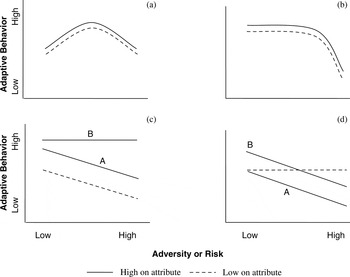
Figure 1 shows examples of models linking adversity, adaptive behavior, and factors that have promotive, protective, vulnerability, and other or no effects on the outcome of interest (Garmezy et al., Reference Garmezy, Masten and Tellegen1984; Masten, Reference Masten2001, in press-b; Masten et al., Reference Masten, Garmezy, Tellegen, Pellegrini, Larkin and Larsen1988). Figure 1a illustrates a challenge model, and Figure lb illustrates a depletion model. In these two models, the attribute makes little difference. Figure 1c illustrates two models: a main effects model and a classic moderator model with a protective effect. In both cases, adaptive behavior declines as a function of increasing risk or adversity when the attribute is low. However, the two cases differ when the attribute is high. Attribute “A” illustrates a main effect: this attribute of the person (or a relationship or context) is associated with better adaptive function across all levels of risk; moreover, the advantage is about the same for low and high adversity. In this situation, assets like A have been described as compensatory factors because even though the effect of A is about the same across risk levels, when risk is high, it is more likely that adaptive behavior stays in an acceptable zone when there are attributes like A to counterbalance high risk (Garmezy et al., Reference Garmezy, Masten and Tellegen1984). In contrast, attribute “B” illustrates a protective factor that has a larger effect when adversity or risk is high. Attribute B appears to be a risk moderator. The difference between the effects of A and B in Figure 1c illustrate the difference between a promotive effect A and a protective effect B, as well as the difference between a main effect and moderating effect of an attribute with respect to risk. Figure 1d illustrates two different moderating effects of an attribute on adversity with respect to adaptive behavior. In Figure 1d, attribute A illustrates a vulnerability effect where the impact of the adversity is much greater at high levels in the presence of this vulnerability. Attribute B shows a moderating effect that has quite different significance under low and high adversity conditions, conveying advantage in low risk or benign environments and disadvantage in high risk contexts. Recent interest in individual differences that convey “sensitivity to context” (Ellis & Boyce, Reference Ellis and Boyce2011) or “differential susceptibility to context” (Belsky & Pluess, Reference Belsky and Pluess2009) would be examples of this type of moderator.
Examples of models illustrating the relation of adversity to adaptive behavior in the presence of additional factors that may promote or protect adaptive behavior in the context of risk or adversity. (a) A challenge model, where moderate levels of adversity elicit better adaptation than no adversity or very high adversity. (b) A depletion model in which adaptive function is fine until adaptive capacity is depleted, then adaptive behavior falls. (c) Two models: line A shows a promotive, compensatory, or asset model in which there are main effects for both adversity (negative effect on adaptive behavior) and the asset (positive effect of the asset). At all levels of risk, attribute A has a similar effect on adaptive behavior. Line B illustrates a moderator model of a protective factor in which high levels of attribute B has a protective or buffering effect. (d) Two additional moderating models that differ with respect to the effect of the moderator. Line A illustrates a vulnerability effect of attribute A and line B illustrates a moderator with effects that differ by risk level. In a benign environment (low risk) attribute B is associated with better adaptive behavior, but at high levels of adversity the same attribute is associated with worse adaptive behavior; Model B illustrates a “sensitivity to context” effect.

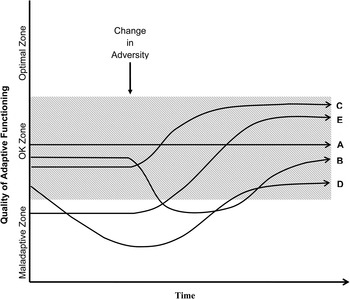
Figure 2 provides an example of pathway models of resilience under changing conditions of adversity (Masten & Narayan, Reference Masten and Narayan2012; Masten & Obradović, Reference Masten and Obradović2008; Masten & Reed, Reference Masten, Reed, Snyder and Lopez2002). These types of pathway models owe a debt to Irving Gottesman (Reference Gottesman and Pick1974), who illustrated the pathways toward and away from schizophrenia in similar models. All of the paths illustrated in Figure 2 show resilience because adaptive behavior following exposure to adversity continues, returns to, or achieves a normative developmental pathway. Various paths in this figure illustrate the ideas of stress-resistance, recovery, posttraumatic growth, and normalization.
The model of resilience pathways. Path A shows a stress-resistance path with little disturbance in adaptive function with change in exposure to adversity. Path B shows a catastrophe and recovery path following an acute, overwhelming stressor (e.g., disaster, acute trauma). Path C illustrates posttraumatic growth in response to acute trauma exposure. Path D shows recovery following alleviation of chronic, severe adversity (e.g., removal from maltreating home to good foster care). Path E shows normalization following a major improvement in rearing conditions (e.g., adoption to a good home following institutional care).

Overview of the PCLS Design: Method Contributions
A full description of the PCLS design is beyond the scope of this article. We provide a basic overview here, highlighting what we see as contributions stemming from the methods and statistical approaches. Details of the design and methods can be found in empirical publications from the study.
The study that became the PCLS was not planned as a longitudinal study. It began with cross-sectional assessments of life events and competence implemented in two waves (1977 and 1978) in two urban schools. The district school superintendent who facilitated the study recommended these schools as representative of the families in this diverse district and their principals were enthusiastic about the project. A third school helped by serving as a pilot site for some of the methods. All of the families with a child in third to sixth grade were invited to participate in this preliminary stage of the study. Parents were invited to complete the original Life Events Questionnaire (LEQ), teachers completed classroom behavior ratings, and peers completed the Revised Class Play. When funding for more intensive assessments was secured, families who had returned the initial LEQ (59%) were invited to participate in the core study that led to the PCLS. These families agreed to three parent interviews as well as multiple individual assessments of their children. When the longitudinal follow-up studies were initiated, the core cohort was defined as the group of families who participated in these more intensive assessments, which included 205 children (91 boys, 114 girls, including 26 sibling pairs) initially in third to sixth grade of the approximately 600 children in those grades in the two schools at the time. Children from the group of families who completed the original LEQ and were willing to make this commitment were slightly more competent than their classmates, although they were quite diverse in ethnicity and occupation, with a minority proportion (29%) similar to the district as a whole at the time. The schools drew from large and overlapping areas of the city, with a wide range of social class and occupations, but predominantly comprised of low- to middle-income families. On the Duncan Socioeconomic Index, scores ranged from 7 to 92 on this 100-point scale, a large range, and averaged about 43, the level of positions in skilled labor and clerical work. Incomes ranged from welfare to very high levels.
As the initial data were analyzed, the advantages of following the cohort to understand their adaptation over time became compelling. With additional funding, a follow-up study was initiated by mail 7 years after the initial assessments (Time 2), with 88% of the original 205 participating, along with most of their parents. This set the stage for an in-person, in depth 10-year follow-up 3 years later (Time 3), in which 98% of the cohort participated. Some of the interviews for this follow-up were conducted by telephone but every effort was made to see the youth and parents in person, sometimes waiting for a return from college, jail, or the military. Ten years later (Time 4), another follow-up assessment was conducted by mail and telephone, with 90% of the original cohort participating again, along with most of the surviving parents. Because the original cohort ranged in age from 8 to 12 and the follow-up intervals varied somewhat (we focused on high retention rather than exactness of interval), the cohort ranged in age at Time 2 from 14 to 19, at Time 3 from 17 to 23, and at Time 4 from 27 to 33. The age range was not optimal for a longitudinal study, but it afforded interesting examinations of age effects in some respects.
The normative, school-based nature of the sample was reflected in the scores on standardized tests over the years, which often were very close to the test mean with a normal curve distribution. For example, Peabody Individual Achievement Test scores, standardized on a mean of 100, had a cohort mean of 97 at Time 1.
A multiple-method, multiple-informant approach was taken to assessment throughout the study, which would prove useful for some methods of analysis (e.g., structural equation modeling [SEM]). In each time period of major assessments, we measured adaptive behavior defined both by competence (our central focus) in salient and emerging developmental tasks and by symptoms. We also measured exposure to adversity and risk in multiple ways. The third major component of our assessments focused on the individual and contextual differences that were viewed by the project directors or graduate students as potential candidates for protective factors or resources that could explain the variation in adaptive behavior, particularly in relation to adversity. Measures of parenting quality, cognitive skills, and personality were important candidate sets of measures over the course of the study, but there were many other attributes of child, relationships, family, and home that were assessed as a result of student interests at one or multiple points. These included assessments of family function, home environment, parent IQ, and the children's humor, creativity thinking, interpersonal problem solving, delay of gratification, physical attractiveness, self-worth, and many other attributes.
Measurement contributions
The goals of this study required good assessment of competence in developmental tasks as well as adversity and other attributes of interest. One of the challenges we faced was the lack of suitable measures at each phase of the study. There was a particular shortage of methods for assessing competence and child adversity. Out of necessity, we found ourselves developing and adapting methods to bolster the assessment of positive aspects of adaptive behavior. This quandary led to work on measures and related publications that were useful to others facing the same issues. One example is the Revised Class Play measure, which we adapted from earlier versions of this peer reputation method (especially the Lambert and Bower instrument) to expand the assessment of social competence and positive behavior (see Gest, Sesma, Masten, & Tellegen, Reference Gest, Sesma, Masten and Tellegen2006; Masten, Morison, & Pellegrini, Reference Masten, Morison and Pellegrini1985; Morison & Masten, Reference Morison and Masten1991). Other examples include a set of Competence Rating Scales (created with the help of Susan Harter and similar to her perceived competence scales; Harter, Reference Harter1986; Neeman & Harter, Reference Neemann and Harter1986) and the Status Questionnaire, which was originally created to provide a means for participants and their parents to readily provide brief evaluations of how the participant was doing in various domains of life at Time 2 for the 7-year follow-up by mail, and later was revised for further follow-ups, with versions created for friends and romantic partners to complete as well (Morison & Masten, Reference Morison and Masten1991; Masten et al., Reference Masten, Coatsworth, Neemann, Gest, Tellegen and Garmezy1995, Reference Masten, Hubbard, Gest, Tellegen, Garmezy and Ramirez1999, Reference Masten, Burt, Roisman, Obradović, Long and Tellegen2004). When we created an adapted instrument, we often conducted psychometric substudies that extended beyond the core assessments. We frequently created parallel measures for other informants as well. In the case of the Competence Rating Scales, for example, there were versions for self-report and also reporting by parents, friends, and romantic partners.
We also invested considerable time in the assessment of adversity, using multiple approaches over the years. Our initial instrument, the LEQ, was adapted from an instrument developed by Coddington, which itself was based on the Holmes and Rahe measure for adults (Garmezy & Tellegen, Reference Garmezy, Tellegen, Morrison, Lord and Keating1984; Masten et al., Reference Masten, Garmezy, Tellegen, Pellegrini, Larkin and Larsen1988; see also Gest, Reed, & Masten, Reference Gest, Reed and Masten1999, for an overview of the adversity measures). We also conducted a contextual life events interview during the third of three home visits with parents at Time 1, which was inspired by Garmezy's interactions with George Brown (Brown & Harris, Reference Brown and Harris1978). Harvey Linder (Reference Linder1985) completed a detailed dissertation study of the contextual interview, with implications for adversity assessment. Among his findings, we learned that weighting systems for life events on the LEQ added surprisingly little information, that simple tallies of LEQ events (yes or no) captured most of the variation that could be garnered from time-consuming and detailed interviews on specific events. A second dissertation by Jeanne Herzog (Reference Herzog1984) also focused on the LEQ, with a detailed content analysis based on clinical ratings of each item and also information that families had reported on life experiences not included in our initial measure. These studies provided extremely helpful guidance for the revision of the LEQ undertaken for the follow-up studies, which targeted adolescents (LEQ-A), mothers in the study (Hillman, Reference Hillman1987), as well as the participants in early adulthood (see Masten et al., Reference Masten, Burt, Roisman, Obradović, Long and Tellegen2004; Masten, Neemann, & Andenas, Reference Masten, Neemann and Andenas1994). Self-report and parent report versions of the LEQ-A were created and the items of these later LEQ instruments were classified on three aspects based on pooled ratings by a group of independent clinical judges: independence or nonindependence (whether the experience likely the result in part of the behavior of the person it was happening to or not); chronic or discrete in nature; and valence (negative, positive, or ambiguous). This made it possible to create scores that included only “independent” life experiences, for example, which are less confounded with the person's personality and behavior (see Masten et al., Reference Masten, Neemann and Andenas1994).
At Time 3, we created a Lifetime Events Questionnaire and also a Life Chart for the parent interview (with a time line) to help parents provide a comprehensive account of major adversities over the participant's life to date. At this time, we also decided it was important to integrate all of the information we had collected on life adversity into a single measurement framework. The result of this effort was the Life Chart and Rating Scale approach (see Gest et al., Reference Gest, Reed and Masten1999), which effectively combined all the information from multiple assessments and methods into a single computerized life chart organized by age that could generate various life history charts of adversity, separated into intervals falling between our competence assessments and also into categories of event type (e.g., arising in the family or in the community) and independence. Over 22,000 experiences were entered into this data base and checked. The life charts generated from the data based could then be rated by trained judges on severity of cumulative adversity within an interval. The 7-point stressor scale from the Diagnostic and Statistical Manual of Mental Disorders (American Psychiatric Association, 1987) was used to anchor these ratings, which had good to excellent interrater reliability (see Gest et al., Reference Gest, Reed and Masten1999). Adversity scores (independent of the person's behavior) from this comprehensive and integrative approach were used for the variable- and person-focused analyses of resilience at Time 3 and Time 4 (see Masten et al., Reference Masten, Hubbard, Gest, Tellegen, Garmezy and Ramirez1999, Reference Masten, Burt, Roisman, Obradović, Long and Tellegen2004).
Analytic approaches: Contributions to analysis of promotive and protective effects, cascades, and other models of competence or resilience
Strategies for analyzing the linkages among competence domains, adversity, and other factors that might explain patterns of adaptive behavior or resilience also required consideration. There were few models to guide the study in the beginning, but we were able to draw on the analytic strengths of numerous colleagues, students, and the Minnesota faculty at the time. Analytical quandaries also were a favorite pastime of the second author.
Over the years, we employed both variable-focused and person-focused approaches to examine patterns of competence and resilience, sometimes in the same publication (e.g., Masten et al., Reference Masten, Hubbard, Gest, Tellegen, Garmezy and Ramirez1999, Reference Masten, Burt, Roisman, Obradović, Long and Tellegen2004). Variable-focused approaches for data reduction and model testing frequently have included factor analysis, SEM, and hierarchical regression. Robert Cudek, along with Tellegen, guided the earliest SEM analyses in the PCLS (e.g., Masten et al., Reference Masten, Coatsworth, Neemann, Gest, Tellegen and Garmezy1995). Recent cascade analyses have been conducted by Jeffrey Long or former students he guided (e.g., Burt, Desjardins, and Obradovic). Person-focused approaches have included case analyses, comparisons of people identified by diagnostic criteria as showing competence or resilience or maladaptive patterns, and very limited analyses of growth or trajectories (the data have limited repeated measures suitable to study of intraindividual change). Person-focused and variable-focused methods have both been valuable to our analyses of competence and resilience and our thinking about the meaning of our models and results.
Major Findings
The findings from the PCLS undoubtedly reflect the sample, which was a normative, urban cohort, and the focus on domains of manifest competence as the criteria for evaluating adaptive behavior over the years. This study, like all studies, also has a number of important limitations as well as strengths that we have attempted to document in each of the individual empirical reports. Some of the major limitations include the modest sample size (205 in the core longitudinal cohort), the age spread of the cohort, and the representativeness of the sample (limited to an urban school sample in a single city) for purposes of generalizing the findings. Major strengths include the retention of the cohort (90% over 20 years), the depth and breadth of measurement (especially of adversity, competence, and individual differences), multiple informants and methods, the normative nature of the cohort, and the psychometric strengths of many of the measures in the study. We attempted to exploit the strengths and work within the constraints of the inherent limitations of the study design. We assumed that rigorous methods, theory-based hypothesis testing, and a commitment to hold ourselves to as high a standard as our unknown critics might hold would serve the science. We trusted that the meaningful results would be replicated and that others would fall away with time. Norm did not flinch from failure, which instilled a surprising degree of confidence in his students to venture into uncharted territory. He liked to say that studies that came out the way you expected, confirming your hypotheses, were all well and good, but research that came out in unexpected ways often led the way to breakthroughs and new studies.
It was not possible in a single article to describe all the findings in specific areas that were explored by a cadre of very talented graduate students during the PCLS to date. Here we highlight a sample of what we believe to be the some of the more robust and interesting findings from this project, arranged by topic.
Meaningful patterns of competence, resilience, and maladaptation can be identified
It may seem obvious to note this general finding, but we did not know, of course, if the patterns we expected to see in the lives of children would be corroborated. We assumed that we could measure competence and adversity and that there would be young people who manifested competence under apparently high adversity conditions, as well as those who were not doing so well. Multiple strategies over the years supported this rather basic assumption. In our 1999 report on resilience 10 years into the PCLS, we noted some of the findings corroborating this idea (Masten et al., Reference Masten, Hubbard, Gest, Tellegen, Garmezy and Ramirez1999). This paper presented person-focused as well as variable-focused results consistent with the presence of individuals showing life patterns of good or poor competence in the context of high adversity. In addition, we presented findings supporting the validity of these patterns, using additional methods. Interviewer nominations of young people in the cohort showing resilience were congruent with outcomes obtained by using cut scores, as were results of cluster analysis of the variables used to define groups manifesting competence (in a low adversity context), resilience (competence in the context of high adversity), and maladaptation (high adversity). When we set out, we thought of ourselves as scientists studying real phenomena (the variations in adaptation following adversities) who were trying to learn more about them; these basic data supported that belief.
People who manifest resilience have more adaptive capacity
Generally, in the PCLS, higher adversity exposure was related to fewer resources, and specifically to relatively (compared to the overall cohort) less positive parenting and more limited cognitive skills (Masten et al., Reference Masten, Hubbard, Gest, Tellegen, Garmezy and Ramirez1999, Reference Masten, Burt, Roisman, Obradović, Long and Tellegen2004). Yet if parenting and cognitive skills were reasonably good in childhood and adolescence, adversity notwithstanding, young people with high adversity exposure showed adequate or better competence across age-salient developmental tasks in childhood, adolescence, and early adulthood. Overall, it was the combination of high adversity and few resources, particularly in the form of parenting quality and cognitive function, that was associated with maladaptive patterns of adjustment in the cohort.
Person-focused analyses were interesting in this regard. These analyses began by categorizing the cohort in terms of low or high adversity over time and adequate or better competence across salient domains in a given period of development (functioning okay across key competence domains) using cut scores (see Masten et al., Reference Masten, Hubbard, Gest, Tellegen, Garmezy and Ramirez1999, Reference Masten, Burt, Roisman, Obradović, Long and Tellegen2004), leaving out mixed or middling cases. This resulted in three clear groups and a nearly “empty cell” for the low adversity, low competence category. In this normative, urban sample, there were few maladaptive cases with low adversity, a group that might suggest such high vulnerability that even in relatively benign life conditions, development did not go well. This left three groups for comparison, defined by competence (in the absence of high adversity), resilience (competence with a history of very high adversity), and maladaptation (low competence with a history of very high adversity).
With respect to many individual differences assessed in childhood, adolescence, and adulthood, as well as family characteristics, the groups characterized by competence and resilience shared a general pattern of positive traits and advantages in terms of average or better (compared to the overall cohort) socioeconomic resources, cognitive skills, openness to experience, drive for mastery, conscientiousness, close relationships with parents, adult support outside the family, and feelings of self-worth (e.g., Masten et al., Reference Masten, Hubbard, Gest, Tellegen, Garmezy and Ramirez1999, Reference Masten, Burt, Roisman, Obradović, Long and Tellegen2004; Shiner & Masten, Reference Shiner and Masten2012). The group manifesting competence problems in a context of high adversity within and across time appeared to have many disadvantages. For example, their scores on neuroticism in childhood (see Shiner & Masten, Reference Shiner and Masten2012) and negative emotionality on Tellegen's Multidimensional Personality Questionnaire were very high in emerging adulthood (EA) and 10 years later, while their IQ scores were low compared to their competent and resilient peers (Masten et al., Reference Masten, Hubbard, Gest, Tellegen, Garmezy and Ramirez1999). This group with life patterns of maladaptation also had a tendency to generate their own negative life experiences as they became older. This group showed much higher levels of negative, controllable life experiences by late adolescence (e.g., being arrested, conflict in relationships) than the group that showed resilience, even though the two groups had similar childhood levels of these nonindependent life experiences in childhood and very similar overall levels of “independent” adversity (unrelated to their own behavior; Gest et al., Reference Gest, Reed and Masten1999). In other words, the young people with apparently the fewest resources for adapting to adversity were more likely to experience growing adversity of their own making as they became adolescents, with sometimes disastrous consequences. Nonetheless, some of the adolescents in this group staged a “turnaround” in the transition to adulthood.
Late bloomers and turnaround cases
Despite considerable stability in competence and resilience evident in this study (described further below), there was evidence of change over time in adaptive behavior and also evidence of turnaround cases of individuals shifting from the maladaptation category to resilience in the transition to adulthood (Masten et al., Reference Masten, Burt, Roisman, Obradović, Long and Tellegen2004; Obradović, Burt, & Masten, Reference Obradović, Burt and Masten2006; Shiner & Masten, Reference Shiner and Masten2012). Change was particularly notable between adolescence and young adulthood (YA; assessments completed around age 20 and 30), revealed both in variable-focused analyses within domains of competence and also in person-focused analyses of change from one category to another. Predictors of change in variable-focused studies (e.g., Masten et al., Reference Masten, Burt, Roisman, Obradović, Long and Tellegen2004; Shiner & Masten, Reference Shiner and Masten2012) indicated that other domains of competence, personality, and adaptive resources available in EA were playing a role in changes of relative competence among the cohort over time (interindividual change). But perhaps the most dramatic evidence of change was provided by person-focused analyses of those who changed category from the maladaptive group in EA to resilience in YA. This group, although small in number (seven), were intriguing to us. How did they differ from their peers who did not show this favorable change? Planfulness, autonomy, and adult support outside the family appeared to play a role. Individual case data showed a variety of pathways toward resilience in these individuals, including moving away from troubled friends and families, formation of healthy romantic relationships, and a new job or educational opportunity. Most of these cases were women, as observed also by Werner and Smith (Reference Werner and Smith1992) in the late bloomers among the children of Kauai. Results for these turnaround cases aligned well with a small but congruent literature on resilience in the transition to adulthood suggesting that this period in development may open a window of opportunity for change, as new opportunities, motivations, and executive function skills become available (see Masten, Obradović, & Burt, Reference Masten, Obradović, Burt, Arnett and Tanner2006; Burt & Masten, Reference Burt, Masten, Grant and Potenza2010). Data from childhood also indicated that this group was more conscientious as children, hinting that they may have some earlier signs of capacity for self-control that was perhaps not sufficient during their adolescence for adaptive success but was an early sign of later developing capacity for self-direction (see Shiner & Masten, Reference Shiner and Masten2012).
Competence and resilience show considerable continuity and coherence over time
Both variable-focused and person-focused analyses in the PCLS revealed considerable continuity in competence from childhood into adolescence and then into adulthood. Individuals classified into a group as competent, resilient, or maladaptive often were classified in the same group 10 years later. Competence in a given domain of adaptation often predicted competence in the same or a closely related domain later in the study. Adaptive success in childhood or adolescence generally was a harbinger of adaptive success in the future, 10 or 20 years later, although there was notable change in the case of some individuals (see Masten et al., Reference Masten, Coatsworth, Neemann, Gest, Tellegen and Garmezy1995, Reference Masten, Hubbard, Gest, Tellegen, Garmezy and Ramirez1999, Reference Masten, Burt, Roisman, Obradović, Long and Tellegen2004, Reference Masten, Roisman, Long, Burt, Obradović and Riley2005, Reference Masten, Desjardins, McCormick, Kuo and Long2010). Results generally are consistent with the notion that competence begets competence, although this correlational study cannot provide the causal explanations for this continuity.
It is worth noting that personality, intellectual function, socioeconomic resources, and adversity all showed considerable continuity over time. The scores estimating IQ, for example, were correlated 0.78 over the 10-year interval from Time 1 to EA assessments (Masten et al., Reference Masten, Burt, Roisman, Obradović, Long and Tellegen2004). Personality scores on the Multidimensional Personality Questionnaire spanning 10 years also were very stable; the stability correlations for Positive Emotionality and Constraint were both 0.60 over the 10-year interval from EA to YA (Shiner & Masten, Reference Shiner and Masten2002). Cumulative adversity scores were correlated 0.63 for independently rated scores spanning large consecutive time periods (Gest et al., Reference Gest, Reed and Masten1999). Socioeconimic status scores were correlated 0.67 over a 10-year interval (Masten et al., Reference Masten, Burt, Roisman, Obradović, Long and Tellegen2004). It is likely that the observed continuities in manifested competence, reflecting many interactions of person with context, were generated in part by continuities in the context as well as stable processes in the person and their relationships.
Competence is multidimensional
This study provides strong evidence that manifested competence, defined as it was here in terms of major developmental tasks with multiple measures, is multidimensional. Results support the reliability, construct, and predictive validity of these multiple dimensions as well, via multiple methods, including structural equation modeling, factor analysis, hierarchical regression, and other strategies. In childhood, we measured academic achievement, conduct (rule-abiding vs. rule-breaking behavior), and social competence with peers (e.g., Masten et al., Reference Masten, Coatsworth, Neemann, Gest, Tellegen and Garmezy1995, Reference Masten, Hubbard, Gest, Tellegen, Garmezy and Ramirez1999, Reference Masten, Desjardins, McCormick, Kuo and Long2010). In adolescence and adulthood, we continued to measure adaptive function in these domains, with age-appropriate measures, and also added assessments of work and romantic relationships, parenting, and civic engagement (Masten et al., Reference Masten, Coatsworth, Neemann, Gest, Tellegen and Garmezy1995, Reference Masten, Hubbard, Gest, Tellegen, Garmezy and Ramirez1999, Reference Masten, Burt, Roisman, Obradović, Long and Tellegen2004, Reference Masten, Desjardins, McCormick, Kuo and Long2010; Obradović & Masten, Reference Obradović and Masten2007; Roisman et al., Reference Roisman, Masten, Coatsworth and Tellegen2004). Competence dimensions showed differential antecedents and also discriminant predictive validity, as well as different correlates with socioeconomic indicators, family qualities, personality, and other individual differences (e.g., Burt et al., Reference Burt, Obradović, Long and Masten2008; Gest, Reference Gest1997; Masten, Reference Masten1986; Masten et al., Reference Masten, Coatsworth, Neemann, Gest, Tellegen and Garmezy1995, Reference Masten, Hubbard, Gest, Tellegen, Garmezy and Ramirez1999, Reference Masten, Burt, Roisman, Obradović, Long and Tellegen2004; Neemann, Hubbard, & Masten, Reference Neemann, Hubbard and Masten1995; Pellegrini, Reference Pellegrini1985; Pellegrini, Masten, Garmezy, & Ferrarese, Reference Pellegrini, Masten, Garmezy and Ferrarese1987; Shiner & Masten, Reference Shiner and Masten2012). Developmental timing also mattered, with correlates of a given domain of competence changing over the course of development. Evidence of “early” romantic involvement, for example, had different significance than later involvement (Neemann et al., Reference Neemann, Hubbard and Masten1995).
Individual measures that assessed perceived competence or adaptive behavior broadly, such as interviews of children and parents, status questionnaires, Revised Class Play, Harter-style scales of perceived and observed competence, and teaching rating scales, all showed multidimensionality in observable adaptive behavior. As noted above, the cohort participants themselves came up with a multidimensional set of items describing people their age that they thought were “doing well in life” that on analysis bore striking resemblance to the criteria of competence independently planned by the investigators.
Symptoms were also assessed in this study by traditional symptom checklists, and they, too, showed a multidimensional structure, as commonly observed (e.g., internalizing, externalizing). It was clear that the broad, external domain of symptoms, characterized by antisocial and aggressive or disruptive behavior, represented the negative end of a broader “conduct” domain of competence, although omitting behaviors at the positive pole of this dimension (i.e., rule-governed and socially appropriate conduct). Thus, in the externalizing/conduct domain, there were closely related indicators drawn from traditional “psychopathology” measures and competence measures.
In contrast, we excluded measures of subjective and internal well-being (e.g., self-esteem, happiness, satisfaction) and its cousin, internalizing symptoms (distress, anxiety, depressed affect), from our definitions of competence in age-salient developmental tasks. We viewed such internal adaptation concepts as important and interesting but distinctly different constructs from manifest competence in developmental tasks. We recognized that a given individual might show external competence while suffering internally or a combination of external and internal well-being. This was one respect in which our participants, as noted above, differed in their implicit views of how one can tell that a person is doing well in life from the competence criteria we applied to them as a group in YA. Happiness was one of the primary indicators to them of a person their age doing well (around age 30). In a sense, they were on target; competent young adults, and especially those with work and romantic competence, reported greater happiness and life satisfaction, but we suspect that these achievements contributed to their sense of well-being, although a bidirectional process is quite plausible. Cascade data linking academic and social competence with internalizing symptoms over the 20-year span of the study suggested that success or failure in salient developmental tasks spilled over to internalizing problems, in addition to any concurrent bidirectional effects between competence and internal adaptation within a given assessment time (Burt et al., Reference Burt, Obradović, Long and Masten2008; Obradovic et al., Reference Obradović, Burt and Masten2010; see below).
Early adult competence has roots in childhood
As probably evident by this point, this study provided considerable evidence of the childhood antecedents of competence in early adulthood. Good outcomes in early adulthood had childhood roots in competence in multiple domains, in personality and other individual differences, and a range of family qualities, from socioeconomic advantages to warmth and structure. Adaptive children generally became adaptive adults, although a few veered off track. Some maladaptive children and adolescents became more adaptive in adulthood. Adversity exposure did not seem to play a major role in the presence or with emergence of basic adaptive capacities indexed by broad measures of effective parents and supportive relationships, cognitive problem solving and self-control skills, achievement motivation, and personality characteristics associated with maintaining well-controlled, stable functioning in emotional, social, and motivational domains (see Shiner & DeYoung, in press, for a discussion of such traits). However, when high adversity was accompanied in childhood and adolescence by little indication of protection and much evidence of vulnerability or limited adaptive capacity, with high stress reactivity and little capacity to contain negative emotion or impulsivity, adaptive problems were often observed in childhood as well as adulthood.
Dimensions of competence and symptoms are linked over time: Developmental cascades
Although the resilience analyses in the PCLS were focused on competence criteria, adaptive behavior was measured at each time point in terms of two traditions: competence and symptoms, each with multiple dimensions. The definition of competence did encompass the symptoms of externalizing behavior problems within the broader construct of conduct, which was conceived as a continuum from rule-breaking/aggressive behavior at the negative end to rule-abiding conduct at the positive end. Not surprisingly, if scores on the traditional symptom measures such as the Child Behavior Checklist (e.g., Achenbach & Edelbrock, Reference Achenbach and Edelbrock1991) were kept separate from “competence” measures, various conduct scores and externalizing scores were highly related.
Beginning in 2005, as an extension of earlier work on the links among competence domains, we began to focus on what we called cascade effects across domains of both competence and symptoms, including internalizing behavior (Masten & Powell, Reference Masten, Powell and Luthar2003; Masten et al., Reference Masten, Roisman, Long, Burt, Obradović and Riley2005). Cross-domain effects from one domain of adaptation to another had long held interest in developmental psychology and clinical practice. Gerald Patterson and his team at the Oregon Social Learning Center had proposed a compelling “coercion” model of the processes by which early disruptive and disobedient behavior in childhood combined with inept parenting escalated into more serious disruptive and aggressive behaviors over time and interactions, leading to problems with peers, teachers, and achievement at school (Patterson, Reid, & Dishion, Reference Patterson, Reid and Dishion1992). This model predicted that antisocial behaviors would snowball into problems with peers and achievement (dual failure) that would in turn contribute to emotional problems (internalizing symptoms). We were also interested in the possibility that success in key domains of adaptation, and particularly in developmental task domains, would snowball and lead to better adaptation across domains and contexts.
Advances in SEM made it possible to test the models with greater ease and rigor over the past decade. In a series of “cascade” papers, beginning in 2005, we tested cross-domain effects of specific domains of adaptive function on other domains over time, controlling for both within-time covariance and across-time continuity within domains (Burt et al., Reference Burt, Obradović, Long and Masten2008; Masten et al., Reference Masten, Roisman, Long, Burt, Obradović and Riley2005, Reference Masten, Desjardins, McCormick, Kuo and Long2010; Obradović, Burt, & Masten, Reference Obradović, Burt and Masten2010). Our findings suggest that externalizing problems, academic achievement, social function, and internalizing symptoms were already related at the outset of our study. Over time, externalizing problems appeared to undermine academic achievement and, indirectly, social function over time, with additional negative effects on internal well-being. This pattern is consistent with coercion theory and related dual failure models, with some action prior to the initiation of our study and some action continuing. However, it should be noted that these results would also fit a “dual success” model in which better function in developmental tasks spills over to improve well-being. We also consistently found that controlling for all other covariance, internalizing symptoms predicted better function in the externalizing/conduct domain. This is consistent with the idea that anxiety or fearfulness may contain the growth of antisocial behavior, especially during the surge of risk-taking behaviors in adolescence.
More recent cascade analyses have focused again on competence, to examine more rigorously how early competence in the age-salient domains of conduct, academic achievement, and peer social competence lead to success or failures in newly emerging developmental task domains of work and romantic competence. Work competence in EA and YA shows strong direct and indirect links to multiple competence domains in childhood and adolescence, with social competence showing particularly strong predictive significance over time from childhood, controlling for all other effects (Masten et al., Reference Masten, Desjardins, McCormick, Kuo and Long2010). Romantic competence in EA and YA also shows direct and indirect strong links to earlier competence in multiple domains (conduct, academic, social; McCormick, Desjardins, Kuo, Long, & Masten, Reference McCormick, Desjardins, Kuo, Long and Masten2010).
We also have tested one intergenerational cascade model, focused on the subset of the cohort who had already become parents by the 20-year follow-up (Shaffer et al., Reference Shaffer, Burt, Obradovic, Herbers and Masten2009). Results suggest that social competence mediates the intergenerational transmission of parenting quality. This finding is congruent with developmental theory on the enduring significance of parent–child relationships for success in the development of salient developmental tasks, even across generations, actively carried forward in ongoing relationships with peers and later romantic partners and one's own children (Masten, Burt, et al., Reference Masten, Burt, Coatsworth, Ciccheti and Cohen2006; Sroufe, Egeland, Carlson, & Collins, Reference Sroufe, Egeland, Carlson and Collins2005). However, genetic and epigenetic processes may also be involved in the observed links, a possibility that this study could not address.
Some of these cascade effects may prove to be robust across replication in other studies, while other will not. It remains to be seen. Some of our findings support widely reported effects in the literature on competence and symptoms, which seems promising. Moreover, the recent special issues of this journal on cascade effects (Masten & Cicchetti, Reference Masten and Cicchetti2010a, Reference Masten and Cicchetti2010b) suggest some corroboration of some of our findings.
Personality and competence
Rebecca Shiner has taken the leading role on the theme of personality in the PCLS, dating from her orals preliminary paper (Shiner, Reference Shiner1998) and dissertation study (Shiner, Reference Shiner2000). We like to think her leadership reflects the benefits of coadvising in personality (Tellegen) and development (Masten). Her studies within the PCLS were among the first to bridge personality studies of childhood with studies of adolescence and adulthood. She has documented the presence of the Big 5 dimensions of personality in the PCLS data from childhood, their significance for later competence and resilience, continuities and change in personality over time, and the bidirectional effects of competence and personality dimensions on each other over time (Shiner & Masten, Reference Shiner and Masten2002, Reference Shiner and Masten2008, Reference Shiner and Masten2012; Shiner, Masten, & Roberts, Reference Shiner, Masten and Roberts2003; Shiner, Masten, & Tellegen, Reference Shiner, Masten and Tellegen2002).
More specific elements of personality also have been investigated within the PCLS. For example, Scott Gest (Reference Gest1997) examined the stability and significance of individual differences in behavioral inhibition for peer relations, internalizing symptoms, and the timing of life-course transitions, such as moving away from home. Inhibition in the presence of unfamiliar others (stranger wariness) showed considerable stability over time (r = .57 over 10 years). Although not related to peer acceptance with (familiar) classmates in childhood, behavioral inhibition predicted a less positive, active social life and less positive emotionality in EA 10 years later, as well as more distress and negative emotionality (in males). Childhood inhibition also predicted delays in leaving home during the transition to adulthood.
The Future of the PCLS
It is our hope that it will be feasible to continue following the PCLS cohort as they move through their middle years of adulthood. We are keenly interested in their long-term outcomes in regard to the developmental tasks of adulthood, healthy aging, and personality. Moreover, we would like to see assessments expanded beyond behavioral levels of analysis.
Closing Comments
Norm Garmezy was a famously effective mentor of students and younger colleagues as well as an engaging colleague and popular figure in multiple fields of study. The PCLS benefitted tremendously from the ideas, methods, and critiques shared among Norm's team and colleagues over the years. If a Project Competence student was looking for a measure or stumped by some methodological problems, Norm invariably had a friendly colleague who was happy to help. Over the years, the students and “grandstudents” of Garmezy and his contemporaries often interacted, with beneficial results for resilience science and developmental psychopathology. Examples include the interactions among Dante Cicchetti (student of Sroufe, although also mentored by Garmezy and Meehl), Suniya Luthar (student of Zigler), the first author, and Tuppett Yates (student of Egeland and Sroufe). Garmezy also talked about the study with many people as it unfolded, absorbing criticisms and ideas along the way, as well as spreading the ideas, methods, and findings of the group.
As a result of all these interactions, the contributions of the PCLS were greatly enhanced by the pooled wisdom of numerous students and colleagues. Certainly the two of us benefitted and expanded our thinking as a result of this dynamic research context. We also comentored students with Norm and with each other, which we think was helpful (and often entertaining) for all concerned. Certainly we enjoyed it. Our shared students have gone on in many cases to notable careers of their own, some in fields related to the PCLS and other in radically different areas of endeavor, but most, we believe, have carried forward the traditions of integrity, humor, generosity, and generativity that Norm embodied so well.
In addition, we think that the same qualities in Norm's personality and life that inspired his students and colleagues also gave great impetus to the emergence and spread of resilience ideas in science and practice, as well as the concepts of developmental psychopathology more broadly. Good ideas are contagious, but the spread rate is facilitated by interpersonal transmission among genial and generous mentors, colleagues and collaborators. The PCLS offers a glimpse into the extraordinary and cascading influences that a single infectious individual can have on science and practice, and the people who pursue the related goals of understanding and improving the human condition.