INTRODUCTION
This paper examines the choice between private and government provision of infrastructure capital and its consequences for the welfare and macroeconomic performance of a growing economy.1
“Infrastructure” refers to inputs that enhance an economy's productive capacity, including roads, power, transport and communication systems, dams, water and sewerage systems, and so on.
Binding fiscal constraints and growing public disenchantment with the performance of state-provided infrastructure services have led many governments to seek private solutions for both financing and providing infrastructure (Dailami and Klein, 1998). The trend toward privatizing infrastructure provision began in the 1980s with a few countries including Chile, Argentina, New Zealand, and the United Kingdom. Between 1984 and 1989, only 26 developing countries had allocated a total of 72 infrastructure projects for private provision, attracting a modest $19 billion in investment financing. In contrast, the 1990s witnessed a huge boom in private-sector participation, with 132 low- and middle-income countries encouraging wide-scale private participation in previously government-controlled sectors such as transport, energy, telecommunications, and water and sewerage. Between 1990 and 2001, developing countries awarded or transferred about 2,500 infrastructure projects to the private sector, attracting investment commitments of more than $750 billion. The growing opportunities for private provision of public goods are perhaps a reflection of the rapidly changing view of the role of the government in the quest for economic growth and development over the last two decades.
Although economists generally agree that infrastructure capital plays an important role in the process of development, the question of whether such goods ought to be publicly or privately provided has been largely overlooked.2
Academic interest in the role of infrastructure began with the seminal contribution of Arrow and Kurz (1970). However, it was Aschauer's (1989) empirical findings that spurred the growth of a voluminous but controversial empirical literature in this area. See Gramlich (1994) for a comprehensive survey of the early empirical literature. Notable theoretical contributions include Barro (1990), Futagami, Morita, and Shibata (1993), Glomm and Ravikumar (1994), and Turnovsky (1997, 2004).
By contrast, a growing body of research in both the public economics and development literature has explored the possibilities of providing public goods through the private sector.3
As Besley and Ghatak (2001) point out, the mere existence of market failure does not necessarily justify government provision of a public good. Furthermore, in an overview of the choice between state and private provision of public goods, Shleifer (1998) contends that incomplete contracts, non-benevolent governments, corruption, and political uncertainty translate into strong evidence on the failures of government provision of public goods and strengthen the case for their provision through market forces. Although the existing literature on private provision has focused mainly on public consumption goods, the argument can readily be extended to public investment goods like infrastructure. Furthermore, public capital has some characteristics of a private good, too, as it facilitates the use of human and physical capital, and consequently enhances the productive capacity of an economy. This makes the issue of its provision even more interesting.It is well known that in the presence of externalities, a decentralized economy would end up providing an insufficient amount of investment in public capital. Although this provides a rationale for government action, it does not necessarily imply direct government provision. Specifically, three modes of government involvement can be identified in a decentralized economy: (i) direct provision of the entire stock of public capital (which is the traditional assumption in the literature), which has been the predominant form of public capital provision in most developing countries until the recent wave of privatization; (ii) contracting out the task of provision to the private sector and controlling investment by regulation, such as in the transportation and telecommunications sectors; or (iii) relying on market forces and the private sector to make optimal choices regarding public investment, while at the same time using corrective taxes and subsidies to bring private costs and benefits in line with social costs and benefits, such as in water and irrigation, power generation, and in highway construction.4
Kohli, Mody, and Walton (1997) and Mody (1997) present several examples and case studies of the policy shift toward private participation in infrastructure provision in East and South Asia, Latin America, and Australia.
The starting point of our analysis is the observation of Devarajan, Xie, and Zou (1998) that, when the government does not have access to non-distortionary financing instruments, the choice between government and private provision of public capital matters for growth and welfare.5
Another paper in this nascent literature on infrastructure provision is by Turnovsky and Pintea (2006), who distinguish between “public” and “private” firms in a two-sector version of the neoclassical growth model.
Recent evidence by Duffy and Papageorgiou (2000) indicates that the elasticity of substitution in production varies widely across countries. Kohli et al. (1997) presents extensive evidence of private-sector borrowing from international capital markets as a significant source of financing infrastructure investment, whereas evidence of borrowing constraints in international capital markets can be found in Edwards (1984).
From a social welfare standpoint, the costs and benefits of each form of government intervention eventually determine the desirability of each regime. The central question we ask is: what determines these costs and benefits? Given the complexity of the structural model we develop, most of our analysis is conducted numerically. Our calibration exercises indicate that the interaction between (i) the size of the production externality associated with public capital accumulation, (ii) the elasticity of substitution in production, and (iii) the borrowing externality generated by capital market imperfections crucially determine the welfare gains from a given government intervention in each regime. In a decentralized economy, the size of the externality determines the allocation of output to public and private investment, whereas the elasticity of substitution dictates the extent to which private investment responds to a given change in public investment. Both these factors directly influence the economy's equilibrium resource allocation, productive capacity and, hence, welfare. On the other hand, the existence of a borrowing externality and installation costs makes the accumulation of capital costly and, in turn, impinges differentially on the economy's resource allocation depending on whether public capital is being provided by the private sector or the government. Therefore, even with an efficient government, the mode of provision of public capital is important, as the economy's underlying structural conditions and externalities jointly determine the desirability of each regime.
The contribution of this paper can be highlighted by evaluating its results relative to those in the related literature, namely Devarajan et al. (1998). The two main results obtained in their analysis were that (i) welfare under direct government provision may be lower than under laissez faire, and (ii) subsidization of private providers is better than (in terms of welfare) direct government provision. Our analysis shows that these results must be modified once we generalize their model to the open economy and introduce borrowing externalities, imperfect factor substitutability in production, and installation costs for investment. In the presence of a borrowing externality and installation costs, welfare under direct government provision is always higher than that under laissez faire or regulation, irrespective of the elasticity of substitution in production. On the other hand, subsidization of private providers is the preferred outcome only when the elasticity of substitution is sufficiently low and the production externality is sufficiently high. Otherwise, it is direct government provision or regulation that is the preferred regime. Finally, although Devarajan et al. (1998) restrict their analysis to the long-run balanced growth path, we focus ours on the transitional dynamics as well. Therefore, our structural model and corresponding results can be viewed as more general, from which the results of Devarajan et al. (1998) can be obtained as a special case.
THE ANALYTICAL FRAMEWORK
A Decentralized Economy
Consider a representative household-firm that maximizes intertemporal utility, U, by choosing its rate of consumption, C, from a private consumption good over an infinite horizon using an intertemporal isoelastic utility function:

The household-firm (henceforth the “private agent”) produces the economy's output, Y, using two inputs: the stocks of private and public capital. Private capital, K, can be thought of as encompassing both human and physical capital, whereas public capital is identical to the economy's stock of infrastructure. The crucial distinction between the two types of capital is that although the effects of private capital are all privately appropriable, the productive effects of public capital are split into a privately appropriable part, KG, and a positive externality generated by its economy-wide aggregate stock,
, which is not internalized by the private household-firm.7
The social benefits generated by the aggregate stock of public capital,
, can be rationalized as a Marshallian externality, similar to the role played by private capital in Romer (1986). One can think of a firm appropriating the benefits of a subset of the economy's infrastructure (local roads, highways or airports), but its productivity also being influenced by the aggregate stock of available infrastructure (the aggregate highway or airport network in the country), which it takes as exogenously given. Other examples of such externalities include universities and health care. The production function has constant returns to scale in all the factors of production, thereby enabling it to support an equilibrium of ongoing growth with each factor being paid its respective marginal physical product.

where σ ≡(1/1+ρ) is the intratemporal elasticity of substitution between private and public capital. The constants a and b represent the output elasticities of public and private capital, respectively, whereas η(=1−a−b) represents the production externality associated with the aggregate stock of public capital, that is, the marginal contribution of public capital to output that is not internalized.
The accumulation of each type of capital is costly and involves adjustment (installation) costs, given by the following quadratic (convex) functions:

I represents the flow of investment in private capital, and G represents the flow of investment in public capital. The net rates of accumulation of each type of capital are given by:

where δK and δG denote the rates of depreciation for private and public capital, respectively.
Financing investment in the two types of capital is enabled by access to an international capital market. However, the key factor we wish to take into account is that the creditworthiness of the economy influences its cost of borrowing from abroad. Essentially, we assume that world capital markets assess an economy's ability to service debt costs and the associated default risk, the key indicator of which is the country's debt-capital (equity) ratio. This leads to an upward-sloping supply schedule for debt, expressed by assuming that the borrowing rate, r(N/KI), charged on the stock of (national) foreign debt, N, relative to the economy's total stock of capital, KT≡K+KG, is of the form:

where r* is the exogenously given world interest rate, and ω(N/KI) is the country-specific borrowing premium that increases with the nation's debt-capital ratio.8
Equation (5) represents a reduced-form specification that is supported by empirical evidence; see Edwards (1984), who finds a significant positive relationship between the spread over LIBOR (r*) and the debt-GNP ratio. For alternative formulations, see Obstfeld (1982) and Aizenman and Turnovsky (2002).
The Government
The externality associated with public capital accumulation provides a rationale for some form of government intervention. We will assume that the government can adopt any one of the following three strategies: (i) indirectly support the private provision of public capital by subsidizing the total cost of public investment, (ii) regulate private provision by imposing constraints on the private sector's choice of investment in public capital, or (iii) directly provide public capital without any direct participation from the private agent. In this case, the private agent makes its investment decisions by taking the stock of the publicly provided capital as given.
Policy regimes (i) and (iii) require that the government have some financing instruments at its disposal. In the absence of lump-sum or consumption taxes, the government must levy a distortionary tax on private income. In either case, the government maintains a balanced budget by using the income tax revenue to finance the subsidy or its own expenditure on public investment. In regime (ii), taxes are unnecessary, and government policy simply represents a constraint imposed on private allocation decisions.
We will now consider the allocation problem for each regime of public capital provision.
Private Provision with a Government Subsidy
In this regime, the private agent is responsible for providing both types of capital. For the sake of exposition, all variables in this version of the model will be indexed by a superscript “L.” The agent's flow budget constraint is then given by:

where
is the income tax rate, and sL is the rate of subsidy tied to the cost of installing public capital. Equation (6) asserts that to the extent that the private agent's expenditures on consumption, private and (subsidized) public investment, and interest payments exceeds its after-tax flow of income, it will accumulate debt from international capital markets, using an internationally traded bond. The government plays a passive role in this economy and continuously balances its budget by financing the subsidy to public investment through income tax revenues:

The private agent chooses its rates of consumption, investment in the two types of capital, and debt accumulation to maximize (1), subject to (2), (6), and (4). The objective of government intervention is to enable the private agent to internalize the aggregate production externality. However, the benefits of this intervention must be weighed against its costs, which come from three sources: the distortionary effects of the underlying tax increase, the cost of installing public capital and the cost of financing public investment through borrowing, which, through the borrowing externality, raises the economy's debt-servicing costs. In the absence of government intervention,
, and the equilibrium allocation represents that of a pure laissez-faire economy.
Private Provision with Government Regulation
In this regime, rather than collect income tax revenues and grant subsidies, the government regulates the private agent, imposing an additional constraint on its investment decisions regarding public capital. Indexing all variables with the superscript “R,” the corresponding flow budget constraint can be expressed as:

The government requires the private agent to allocate a specified proportion gR of output to public investment:

In this case, gR is a policy variable for the government, which it can use to regulate public investment decisions made by the private agent. The private agent's optimization problem is now subject to the additional constraint (9), which it must satisfy in equilibrium. However, the benefits of this action must be weighed against the resource cost of exogenous regulation.
Direct Government Provision
Under this regime, the economy still operates in a decentralized fashion, but public capital is directly provided by the government and, as before, is financed through distortionary taxation of private income. The private agent thus takes the stock of the government-provided public capital as exogenously given. We will denote all variables in this model with a superscript “D.” Because the government directly provides public capital, we set
in (2). Consequently, the output elasticity of public capital, a=1−b, and η=0. The flow budget constraint for the private agent in this version of the model is:

Note that the installation cost function for public capital, Ω(.), does not appear in (10). The private agent's optimization problem entails maximizing (1) subject to (10) and the accumulation equation for private capital, as given in (4).
The government uses income tax revenues to finance its expenditure on public capital:

Also, to maintain an equilibrium of ongoing growth, the flow of public investment must be tied to the scale of the economy:

By directly providing the stock of public capital, the government bears the entire cost of its provision and, consequently, the tax burden on the economy is generally higher. At the same time, direct government provision also frees up resources for the private agent by reducing its investment borrowing needs and installation costs. However, the private agent, treating the stock of public capital as exogenously given, does not internalize the effect of its private investment decisions on the shadow price of public capital. This imposes an externality on resource allocation along the transition path to the steady state equilibrium. In contrast, under private provision, the endogenous shadow price of public capital (to be defined in the subsequent section) plays a crucial role in ensuring its provision by the private agent by equating private marginal benefits to costs.
MACROECONOMIC EQUILIBRIUM
We will express the macroeconomic equilibrium and dynamics in terms of the following stationary variables: z = KG/K, the ratio of public to private capital, c = C/K, the consumption-private capital ratio, n = N/K, the debt-private capital ratio, and y = Y/K, the output-private capital ratio. The equilibrium dynamics also depend on the shadow price of private capital, qK, and the shadow price of public capital, qG, both denominated in terms of the (unitary) price of the foreign bond. The steady-state equilibrium is one of sustained balanced growth, denoted by
, and is attained when
.
Private Provision with a Government Subsidy
The steady-state equilibrium under this regime is characterized by the following conditions:




where,
.
Equation (13a) equates the equilibrium growth rates of public and private capital. It can easily be seen from the left-hand side of (13a) that the investment subsidy plays a dual role in enabling the agent to internalize the production externality: on the one hand, it increases the shadow price of public capital, and, on the other, it reduces the cost of its installation. Equations (13b) and (13c) equate the growth rates of debt and consumption to that of private capital, respectively. Equations (13d) and (13e) equate the net private marginal returns on private and public capital to the cost of borrowing, respectively. In computing the private rate of return on public capital, the agent fails to take into account the social benefits of such investment, as measured by the externality coefficient η. Equation (13f) describes the equilibrium allocation of output to public investment,
. The choice of gL is time-varying along the transition path to its steady-state value
.
Equations (13a)–(13f), and the government's flow budget constraint (7), jointly determine the five dynamic variables
, the equilibrium allocation of output to public investment,
, and the government's subsidy to the private agent,
, given the income tax rate
. The linearized local dynamic system around this steady-state equilibrium can be shown to be saddle-path stable and is defined explicitly in an appendix, available upon request from the author.
Private Provision with Government Regulation
The steady-state equilibrium conditions with government regulation of the private sector are:


The interpretations of the steady-state equilibrium conditions are analogous to (13a)–(13f). However, there are a number of differences in the equilibrium allocations in the two regimes. Note that gR, the allocation of output to public investment is a policy variable for the government and a constraint on the private agent's choice of public investment. Therefore, it is arbitrarily set and not endogenous as under the subsidy regime. As a result, regulation of the private agent thus leads to a resource cost, vR, which is the shadow value of allocating an extra unit of output to new public investment, measured in terms of the (unitary) price of the foreign bond. The shadow price of public capital must then be adjusted for this resource cost, as shown on the left-hand side of (15a). Also, note from (15d) and (15e) that the marginal product of both types of capital reflect the fact that because investment in public capital is now subject to the regulation constraint (9), an increase in public capital also will induce an increase in private investment, the contribution of which is measured by the term vRgR. Equations (15a)–(15f) then jointly determine the five dynamic variables
, and the resource cost of regulation
, for an announced level of gR by the government.
Direct Government Provision
When the government directly provides public capital, the private sector treats its stock as exogenous in performing its optimization. The equilibrium allocation is therefore independent of the shadow price of public capital, qG. The steady-state equilibrium can be described as follows:


Conditions (16a)–(16d) determine the steady-state equilibrium values of
and, given the government's flow budget constraint (11) and a preannounced level of public expenditure gD, the appropriate income tax rate
necessary for its financing.
PROVIDING PUBLIC CAPITAL IN A DECENTRALIZED ECONOMY: A NUMERICAL ANALYSIS
As a result of the complexity of the models in Sections 2 and 3, we will compare their qualitative and quantitative implications numerically. The table below describes the structural parameters that are used to calibrate these models.

The benchmark values for the structural parameters are calibrated to their corresponding empirical estimates. The preference parameters βandγ imply an intertemporal elasticity of substitution in consumption of 0.4, consistent with the findings of Ogaki and Reinhart (1998). We shall allow the size of the externality (η) to vary from 0 to 0.19. Therefore, the contribution of public capital that is internalized by the private sector (a) varies from an upper bound of 0.20 to a lower bound of 0.01, while that of private capital (b) is set at 0.8, consistent with corresponding empirical evidence (see Gramlich, 1994). The elasticity of substitution in production (σ) is allowed to vary from 0.25 (low substitution possibilities) to 1.50 (high substitution possibilities), with σ = 1 representing the Cobb-Douglas production function. The motivation for varying the elasticity of substitution in production comes from Duffy and Papageorgiou (2000), who find that this parameter varies significantly across countries.9
It should be noted that Duffy and Papageorgiou's (2000) findings pertain to the degree of substitutability between capital and labor. Although it is plausible that a similar relationship might also hold for the case of private and public capital, there is no empirical study documenting such a relationship. Moreover, there is also no evidence on the externality component of the productivity of public capital. These empirical shortcomings lead us to conduct sensitivity analyses for the two parameters σand η.
The functional specification of the upward-sloping supply curve of debt that we use is:
.
The strategy we adopt for our calibration can be described in the following manner. The benchmark equilibrium in the regime with private provision represents the laissez faire case in which there is no government intervention and consequently,
. Given the equilibrium allocation of output to public investment,
, in the laissez faire economy, we note that the corresponding allocations under regulation, gR, and direct government provision, gD, represent arbitrary policy choices. Because the government can always allocate at least as much output to public investment as the private agent in a laissez faire economy, we set
for our benchmark calculations. This ensures that each regime allocates the same amount of output to public investment, thereby enabling us to compare their equilibrium resource allocations, growth rates and welfare.
Benchmark Equilibrium and the Size of the Externality
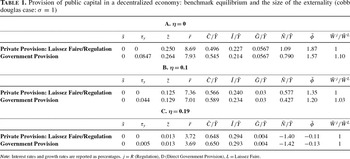
Table 1 illustrates the benchmark equilibrium in each regime for different values of the externality coefficient η. To isolate the effect of the production externality, the experiments in Table 1 control for the elasticity of substitution by setting σ=1 (Cobb-Douglas production function).

In the absence of subsidies and taxes, the laissez faire and government regulation of the private sector equilibria coincide, as
. However, the equilibrium under direct government provision is different, as a distortionary income tax is required to finance the needed investment in public capital. In the laissez faire economy (η = 0, Table 1A), the equilibrium ratio of public to private capital is 0.25, whereas the private sector allocates about 5.7 percent of output to public investment (
. The allocations to private investment and consumption are 22.7 percent and 49.6 percent, respectively. The private agent's investment financing needs lead to long-run current account deficit and an equilibrium interest rate of 8.69 percent, suggesting a borrowing premium of 2.69 percent above the world rate. The long-run equilibrium growth rate is about 1.87 percent. In comparison, under direct government provision, financing an identical level of public investment (the allocation under laissez faire), requires an income tax of about 8.5 percent. The lower after-tax marginal product of private capital leads the private agent to allocate a smaller fraction of output to private investment than under laissez faire. This causes a substitution toward consumption, reflected in a consumption-output ratio of 0.55, higher than under laissez faire. The lower private investment, coupled with the fact that the government provides the entire stock of public capital lowers the private sector's borrowing needs for investment, leading to a lower debt-output ratio and equilibrium interest rate compared to laissez faire. However, the bias towards consumption yields a lower equilibrium growth rate compared to laissez faire, of 1.57 percent. The last column of Table 1A reports the benchmark welfare level under direct government provision relative to laissez faire. In the absence of a production externality, benchmark welfare under direct government provision is 10 percent higher than under laissez faire. This is in contrast to the result obtained by Devarajan et al. (1998), where welfare under laissez faire is higher than under direct government provision. However, it must be noted that their result was derived under the assumptions of a closed economy and perfect capital markets. In our framework, the equilibrium resource allocation under laissez faire is biased towards investment due to the borrowing externality. Moreover, installation costs also divert resources towards investment, thereby lowering consumption and welfare. By contrast, under direct government provision, the benefits of the tax rate outweigh its distortions not only by shifting the cost of public investment to the government, but also by restricting borrowing and consequently, private investment. This leads to a bias toward consumption, and thereby higher welfare. Therefore, even in the absence of a production externality, capital market imperfections can play an important role in determining the desirability of private or government provision of public capital.
As the size of the externality increases (Tables 1B–C), the allocation of output to public investment in the laissez faire economy declines, while that to private investment increases. This is also reflected in a decline in the ratio of public to private capital. The private sector's borrowings needs consequently decrease, leading to lower debt-output ratios and interest rates. Substitution towards consumption and the lower productivity of private capital causes the long-run growth rate to decline. In fact, when the externality is very large, (η = 0.19, Table 1C), the economy becomes a net creditor to the rest of the world with a negative equilibrium growth rate. In comparison, as
declines, the tax burden under direct government provision also decreases, and so do the benefits. As fewer resources are devoted to public capital, consumption in the two regimes gradually converges, consequently leading to a convergence of the benchmark welfare levels. However, irrespective of the size of the externality, equilibrium growth under laissez faire is unambiguously higher than under direct government provision.
Benchmark Equilibrium and the Elasticity of Substitution
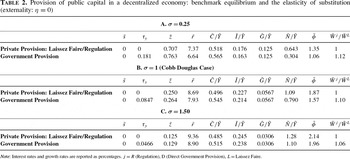
Table 2 illustrates the effect of the elasticity of substitution on the benchmark equilibrium allocations under each regime of public capital provision. We vary σ from 0.25 to 1.50, and control for the size of the production externality by setting η=0.

As in Table 1, we see that irrespective of σ, growth is always higher under private provision, while benchmark welfare is higher under government provision. However, as σ increases, the differences between the two regimes narrow. When the elasticity of substitution is low, a large amount of public investment is required for any given level of private investment. This comes at the cost of low private investment, high consumption, and low growth. The corresponding tax rate under government provision skews resource allocation away from investment and toward consumption, leading to lower growth than under private provision. As σ increases, the required increase in public investment becomes smaller for any given level of private investment. The corresponding tax burden under government provision also declines, narrowing the gap in welfare levels between the regimes.
Government Intervention and Macroeconomic Performance
The objective of an intervention by the government is to enable the private sector to internalize the externality to some extent and stimulate investment in public capital.11
The design of optimal fiscal policy in the present framework will be time-inconsistent due to the absence of nondistortionary sources of taxation; see Kydland and Prescott (1977). However, introducing lump-sum taxes it can be shown that optimal government intervention will differ across regimes: whereas the optimal subsidy under private provision would be time-invariant, the optimal tax rate under government provision would be time-varying, tracking the evolution of the shadow value of public capital, which is not internalized by the private agent. The formal results of this extended version of the model are presented in the Appendix, available from the author on request.
, from its benchmark rate of 0 to 5 percent. The amount of subsidy that is financed is then determined from equilibrium. To enable a comparison across regimes, a similar intervention in the economy where the government regulates private providers takes the form of an increase in gR, such that
and
. Under direct government provision, we calculate the increase in the income tax rate,
, required to finance an increase in government expenditure on public capital that mimics the government intervention under private provision, that is,
and
. Two potential determinants of the efficacy of government intervention in each regime are the size of the externality and the elasticity of substitution in production. The corresponding results are presented in Tables 3 and 4 and in Figures 1 and 2.


Stimulating public investment: transition dynamics and the size of the externality.

Stimulating public investment: transition dynamics and the elasticity of substitution.
The size of the externality.
Tables 3A and 3B present the effects of a government intervention in the three regimes in two cases: (i) η = 0.01 (Table 3A), and (ii) η = 0.19 (Table 3B). In each case, we control for the elasticity of substitution by setting σ = 1.
Government intervention in each regime is generally expansionary: the higher allocation of output to public investment increases the ratio of public to private capital, the productivity of private capital, and the long-run growth rate. This leads to an increase in the flow of output that is proportionately larger than the increase in consumption and private investment. The higher investment demand worsens the economy's current account, as agents increase their borrowing to finance capital accumulation. The magnitude of the economy's response increases with the size of the externality. Although the net effect on the growth rate is always positive, the resultant change in welfare depends on the size of the externality. When the externality is small, government intervention may reduce welfare by distorting resources towards investment, whereas large welfare gains accrue to the economy from the same government intervention when the externality is large (see the last column of Tables 3A and 3B). Also note that, when the externality is small, the long-run welfare gains are the highest under direct government provision. By contrast, a subsidy to private providers in a laissez-faire economy is the preferred regime when the externality is large. Section 5 presents a more detailed discussion of welfare gains.
An interesting feature of Table 3 is the effect of the production externality on the equilibrium subsidy, the resource cost of regulation and, under government provision, the income tax rate. When η = 0.01, a 5 percent tax increase in the laissez-faire economy finances a subsidy equal to 33 percent of the cost of public investment. By contrast, when η = 0.19, the same tax increase translates into a subsidy equal to 90 percent of the cost of public investment. Similarly, the resource cost of regulation, vR, also declines as the size of the externality increases. The tax increase under direct government provision required to maintain
also increases with the size of the externality. The differential effect of the externality on subsidies, resource costs, and tax rates in the three regimes lead to differences in their long-run responses from a given intervention by the government.
Transitional dynamics
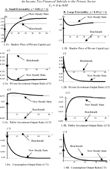
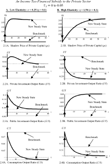
Although the long-run response of a government intervention is expansionary, the dynamic adjustment path is very sensitive to the size of the externality. Figure 1 illustrates the dynamic response when private providers receive a tax-financed subsidy from the government.
Figures 1A and 1B correspond to the two cases considered in Tables 3A and 3B, that is, η = 0.01andη = 0.19, respectively. Because the subsidy is tied to investment in public capital, its instantaneous effect is to raise the shadow price of public capital, thereby inducing an increase in the flow of public investment. In Figure 1.1A, when η is small, the shadow price of private capital, qK(we drop the indexing for the sake of exposition), jumps down instantaneously on impact of the shock and then gradually increases over time to its higher long-run level. By contrast, in Figure 1.1B, when η is large, the response of qK is exactly the opposite: it jumps up instantaneously, overshooting its long-run equilibrium and then declines for a while before adjusting to its long-run equilibrium level. When the production externality is small, a tax-financed subsidy is distortionary, as it induces an unwarranted reallocation of resources in favor of public capital. This reduces the after-tax marginal return from private capital, leading to an instantaneous decline in its shadow value, as shown in Figure 1.1A. However, when the externality is large (Figure 1.1B), the expected long-run benefits of public capital accumulation increase, and when the externality is very large, qK actually jumps up as the expected long-run gains more than outweigh the short run decline in its marginal return. Thereafter, it declines slightly in the short run because of the small initial amount of public capital. As the stock of public capital increases, the decline in qK is reversed.
The size of the production externality also leads to contrasting responses for the private investment-output and public investment-output ratios. When η is small, the fraction of output allocated to private investment (I/Y) falls and undershoots its (lower) long-run equilibrium (Figure 1.2A), whereas that allocated to public investment (g = G/Y) rises and overshoots its (higher) long-run equilibrium (Figure 1.3A), as the agent substitutes away from private investment in favor of public investment. As the size of the externality increases, the initial substitution away from private investment toward public investment declines. This is because the magnitude of the subsidy is positively related with the size of the externality. The larger the externality, the cheaper it is for the private agent to invest in public capital. In fact, when the externality is large, the subsidy finances 90 percent of the cost of public investment. This frees up resources for private investment, causing an upward jump in I/Y (Figure 1.2B) that overshoots its long-run equilibrium. As both private and public capital increase, the economy's productive capacity also increases over time, thereby leading to a gradual decline in this ratio. On the other hand, the upward jump in G/Y is muted as the large subsidy reduces the initial substitution toward public investment. In transition, the stimulus to public capital accumulation causes it to grow faster than output, thereby gradually raising G/Y toward its higher long-run equilibrium.
Figures 1.4A and 1.4B illustrate the dynamics of the consumption-output (C/Y) ratio. When the externality is small and as the agent reallocates resources in favor of public investment in the short run, consumption declines instantaneously, reflected by a downward jump in C/Y (Figure 1.4A). Thereafter, the higher growth rate of public capital causes output to grow faster than consumption, leading to a decline in C/Y over time. As the size of the externality increases (Figure 1.4B), the expected long-run benefits of investment lead to an instantaneous increase in the flow of consumption, as agents smooth out the higher expected consumption in the long run. As a result, C/Y increases instantaneously, before gradually adjusting to its long-run equilibrium level.
The elasticity of substitution
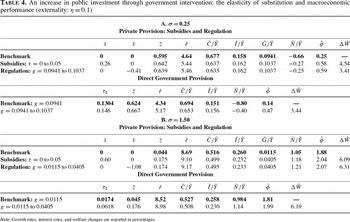
Another crucial determinant of the efficacy of government intervention is the elasticity of substitution in production, whose role is illustrated in Table 4. We consider two cases: (i) σ = 0.25 (Table 4A), and (ii) σ = 1.5 (Table 4B). We control for the size of the externality by setting η = 0.1. A positive production externality is maintained in order to justify government intervention.
When private providers are subsidized, the fraction of public investment that is being subsidized increases with the elasticity of substitution. This increases the fraction of output allocated to public investment and the ratio of public to private capital. In Table 4A, when σ = 0.25, a 5 percent tax increase leads to a subsidy equal to 26 percent, whereas in Table 4B, when σ = 1.5, the same tax increase finances a subsidy of 60 percent. Similarly, the resource cost from an equivalent government intervention under regulation declines as σ increases. Under government provision, a lower σ requires a higher tax rate to maintain
, whereas the tax increase required to maintain
also increases with σ.
As in Table 3, the long-run response to a government intervention in each regime is expansionary. However, the magnitude of these responses decline with the elasticity of substitution, as a given increase in public investment now requires a smaller increase in private investment. By contrast, the long-run welfare gains from government intervention increases with σ. From the last column in Tables 4A and 4B, we see that when σ is low, the welfare gains from subsidization dominate the gains from regulation or direct government provision. However, when σ is high, it is private provision with regulation that emerges as the preferred outcome. A more detailed discussion is provided in Section 5.
Transitional dynamics
The sensitivity of the dynamic response of the economy to the elasticity of substitution in production is depicted in Figure 2, for σ = 0.25(Figure 2A) and σ = 1.5(Figure 2B), respectively.
In Figure 2.1A, when σ is low, a tax-financed subsidy induces a slight upward jump in qK, which thereafter gradually increases to its long-run equilibrium. On the other hand, when σ is large (Figure 2.1B), the initial response of qK is exactly the opposite: it jumps down and then increases over time. This is because the lower the elasticity of substitution, the larger is the required increase in private investment for any given increase in public investment. This is also reflected in Figures 2.2A and 2.2B, which illustrate the dynamic response of I/Y. When σ is low, the private investment-output ratio jumps up and overshoots its long-run equilibrium, whereas the response is exactly opposite when σ is high. The dynamic response of the ratio of public investment to output, G/Y, is to overshoot its long-run equilibrium when σ is low and then decline gradually to its new, but higher, long-run equilibrium. When σ is large, the subsidy is also larger, and this requires a smaller increase in G/Y, as it undershoots its long-run equilibrium and then gradually increases over time (Figures 2.3A–B). When σ is low, the large amount of resources devoted to investment causes a slight downward jump in the consumption-output ratio (C/Y). In transition, as output grows faster than consumption, C/Y declines to its lower long-run equilibrium. When σ is high, the short-run fall in private investment and the larger subsidy frees up resources for consumption, leading to an upward jump in C/Y, after which the transitional adjustment entails a gradual decline to its long-run equilibrium.
PRIVATE VERSUS GOVERNMENT PROVISION: A COMPARISON OF THE WELFARE GAINS
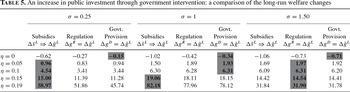
Table 5 presents a comparison of the long-run welfare gains and losses from a government-induced increase in the flow of public investment in the three alternative regimes of public capital provision. As before, we set
and
, that is, the government under the regulation and direct provision regimes mimic both the level and the change in the flow of public investment in the privatized economy that receives an investment subsidy.

The following patterns emerge from Table 5:
- In the absence of a production externality, direct government provision always dominates any form of private provision, irrespective of the elasticity of substitution.
- When the elasticity of substitution is low and the externality is positive, subsidizing private providers of public capital yields the highest welfare gains.
- As the elasticity of substitution increases, the benefits of direct government provision dominate for low levels of the externality, but for a larger externality, subsidizing private providers is still the preferred outcome. To see this, consider the case in which σ=1 and η=0.05. The welfare gain under direct government provision is 1.93%, whereas those under subsidization and regulation of private providers are 1.5 and 1.89%, respectively. By contrast, for σ=1 and η=0.15, the regime with subsidies yields a welfare gain of 19.06% whereas regulation and government provision yield 18.11 and 18.15%, respectively.
- When the externality is positive and the elasticity of substitution is large, regulating private providers now emerges as the preferred outcome.
The numerical comparisons in Table 5 provide an insightful ranking of the three regimes of public capital provision. It is evident that the interaction between the elasticity of substitution and the externality in production is crucial for this ranking. In a recent panel study of 82 countries over a 28-year period, Duffy and Papageorgiou (2000) report a higher degree of factor substitutability in developed countries than in developing countries. Furthermore, it would be reasonable to assume that the difference between social and private benefits from infrastructure investment is larger in developing countries than in their richer counterparts. Then, a policy implication of the welfare analysis is that developing countries are better off with governments encouraging private provision of public capital by intervening indirectly through incentive-creation schemes like targeted investment subsidies. This result seems consistent with the recent wave of private participation of infrastructure provision observed in developing countries. By contrast, countries that have relatively small externalities and flexible substitution possibilities are better off either with governments directly providing the public capital, with an indirect contribution from the private sector through an appropriate tax policy, or through governments regulating private providers by imposing accumulation constraints on their resource allocation decisions.
Intuitively, when η is large, the laissez faire outcome would lead to a suboptimal and small amount of public investment. When this is combined with a low σ, the equilibrium increase in public investment is proportionately larger than the corresponding increase in private investment. Moreover, because of the higher equilibrium subsidy rate (as a result of a large η), the marginal increase in the private agent's borrowing and installation costs is low. This in turn implies that the borrowing externality generated by capital market imperfections does not impinge much on private resource allocation. Therefore, the distortions of the tax increase are outweighed by the benefits of the subsidy it finances. By contrast, when the government directly provides capital, it has to bear the cost of installation too, and as a result, needs to impose higher taxes. This in turn leads to larger distortions and hence, lowers welfare gains.
As σ increases, for low values of η, the subsidy is smaller. Now, private provision is costlier, as the smaller subsidy increases borrowing and installation costs. In the same scenario, government provision requires lower taxes, which in turn free up resources for private consumption, leading to higher welfare gains. When σ is very large (σ = 1.5), the increase in public investment from a given government intervention leads to a fall in private investment (Figure 2.2B), and this partially offsets the increase in installation and borrowing costs for the private agent. In this case, regulation reduces resource costs enough to offset the distortions of a tax-financed subsidy. This happens because, under regulation, the private agent is required to maintain a fixed g = G/Y in transition. This in turn leads to a larger instantaneous fall in private investment, thereby freeing up more resources for consumption. By contrast, when the private agent receives a subsidy, g is time-varying and must increase in transition. This leads to a smaller decline in private investment, and hence lower welfare gains. Under government provision, the maintenance of a high flow of public investment and the consequent installation costs requires higher taxes and therefore leads to lower welfare gains.
Conventional wisdom tells us that if public goods do not generate externalities, then the laissez faire outcome is at least as socially desirable as government provision. Taking this rationale a step further, Devarajan et al. (1998) show that when the government does not have access to non-distortionary sources of financing, private provision can strictly dominate government provision. Also, in the presence of a public good externality, subsidies to private providers may dominate direct government provision. However, our analysis indicates that these results may not hold when one considers non-public good externalities, such as capital market imperfections, in conjunction with public good externalities. The existence of a borrowing externality makes the accumulation of public capital costly and, along with convex installation costs for public investment, impinges asymmetrically on the government and the private sector, depending on which of these entities is providing public capital. One way to reconcile our results with those of Devarajan et al. (1998) would be to note that their model and results emerge as a special case of the more general framework we have developed when (i) there are no borrowing externalities (perfect capital markets), and (ii) the elasticity of substitution between private and public capital is one (Cobb-Douglas case).
CONCLUSIONS
This paper argues that the accumulation of public capital in a growing open economy need not require direct government provision, as is the standard assumption in the literature. We show that even with an efficient government, the costs and benefits of government and private provision depend crucially on the economy's underlying structural conditions and borrowing constraints in international capital markets. Countries that have limited substitution possibilities and large production externalities may benefit from governments encouraging private provision of public capital by intervening indirectly through incentive-creation schemes such as targeted investment subsidies. By contrast, countries that have flexible substitution possibilities and relatively smaller externalities may benefit either from governments directly providing the public capital, or from regulation of private providers. The transitional dynamics are also shown to depend crucially on the underlying elasticity of substitution and the size of the production externality.
The recent wave in government encouragement for private-sector participation in infrastructure provision has underscored the importance of market forces for the provision of public goods, especially in developing countries. This paper not only attempts to contribute toward the understanding of this policy shift but at the same time opens the door to many other interesting research questions in this area. An interesting extension would be to analyze the case of regulation by incorporating elements of public-private cooperation in public good provision, especially with respect to questions of building, owning, and operating infrastructure services. The effect of congestion on private incentives to provide public capital is another important question in the design of public policy. One also could extend this framework to introduce a wider array of financing instruments in order to determine efficient means of financing investment subsidies to the private sector. On the empirical front, a significant drawback of the current literature on public capital and growth is the lack of any evidence on the elasticity of substitution between private and public capital, as well as on the magnitude of externalities generated by public capital accumulation. Given that this paper provides a rich set of theoretical hypotheses, a very promising direction for future research would be to empirically obtain estimates of these crucial parameters and consequently test the theoretical predictions of the model.
I would like to thank George Selgin, Stephen Turnovsky, and two anonymous referees for their comments. The paper also has benefited from presentations at the University of Arkansas, University of Georgia, Louisiana State University, the Fall 2005 Midwest Economic Theory Group Meetings at the University of Kansas, and the 2006 Midwest Macroeconomics Meetings at Washington University in St. Louis. Financial support from the Terry-Sanford Research Grant at the University of Georgia is gratefully acknowledged.