





Introduction
Psychotic-like experiences (PLEs), including subclinical hallucination- and delusion-like phenomena, are relatively common in the general population and are increasingly conceptualized as existing on a continuum with clinical psychotic disorders (Hinterbuchinger & Mossaheb, Reference Hinterbuchinger and Mossaheb2021; Van Os et al., Reference Van Os, Linscott, Myin-Germeys, Delespaul and Krabbendam2009). Epidemiological studies indicate that a substantial minority of individuals report such experiences at some point in their lives, although only a small proportion transition to clinically significant psychotic conditions (Lindgren et al., Reference Lindgren, Numminen, Holm, Therman and Tuulio-Henriksson2022; McGrath et al., Reference McGrath, Saha, Al-Hamzawi, Alonso, Bromet, Bruffaerts, Caldas-de-Almeida, Chiu, de Jonge, Fayyad, Florescu, Gureje, Haro, Hu, Kovess-Masfety, Lepine, Lim, Mora, Navarro-Mateu and Kessler2015). Nevertheless, the presence of PLEs is associated with elevated risk of later mental disorders, including not only psychotic but also anxiety, stress-related, and dissociative disorders (Bourgin et al., Reference Bourgin, Tebeka, Mallet, Mazer, Dubertret and Le Strat2020; Giocondo et al., Reference Giocondo, Salum, Gadelha, Argolo, Simioni, Mari, Miguel, Bressan, Rohde and Pan2021; Healy et al., Reference Healy, Brannigan, Dooley, Coughlan, Clarke, Kelleher and Cannon2019; Sun et al., Reference Sun, Wang, Ricard, Wang, Zhong, Yang and Zhou2026), suicide risk (Karska, Rejek, & Misiak, Reference Karska, Rejek and Misiak2024; Yates et al., Reference Yates, Lång, Cederlöf, Boland, Taylor, Cannon, McNicholas, DeVylder and Kelleher2019), functional impairment (Carey et al., Reference Carey, Gillan, Healy, Dooley, Campbell, McGrane, O’Neill, Coughlan, Clarke, Kelleher and Cannon2021; Cullen, Roberts, Fisher, & Laurens, Reference Cullen, Roberts, Fisher and Laurens2024), and increased service use (Misiak & Frydecka, Reference Misiak and Frydecka2024), highlighting their relevance as early markers of vulnerability. Understanding the factors that contribute to the emergence and persistence of PLEs in nonclinical populations has therefore become an important focus of contemporary psychiatric research.
Exposure to stress has consistently been implicated as a key environmental risk factor for PLEs. Evidence from population-based studies indicates that individuals exposed to higher levels of adversity are more likely to report psychotic experiences across the psychosis continuum (Cristóbal-Narváez et al., Reference Cristóbal-Narváez, Sheinbaum, Ballespí, Mitjavila, Myin-Germeys, Kwapil and Barrantes-Vidal2016; Turley, Drake, Killackey, & Yung, Reference Turley, Drake, Killackey and Yung2019). In particular, childhood trauma has been repeatedly associated with elevated risk of later PLEs (Pastore et al., Reference Pastore, de Girolamo, Tafuri, Tomasicchio and Margari2022; Varese et al., Reference Varese, Smeets, Drukker, Lieverse, Lataster, Viechtbauer, Read, van Os and Bentall2012), and major stressful life events have been linked to their onset and persistence (Beards et al., Reference Beards, Gayer-Anderson, Borges, Dewey, Fisher and Morgan2013). Importantly, more proximal and cumulative stressors may also contribute, with experience sampling method (ESM) studies showing graded, dimensional associations between everyday stress and PLEs (Grąźlewski et al., Reference Grąźlewski, Samochowiec, Gelner, Gawęda, Piotrowski and Misiak2025; Reininghaus et al., Reference Reininghaus, Kempton, Valmaggia, Craig, Garety, Onyejiaka, Gayer-Anderson, So, Hubbard, Beards, Dazzan, Pariante, Mondelli, Fisher, Mills, Viechtbauer, McGuire, van Os, Murray and Morgan2016). Despite this consistency, the pathways through which stress exposure translates into increases in PLEs remain incompletely understood.
Accumulating evidence suggests that cognitive mechanisms may play an important role in shaping individual responses to stress and in conferring vulnerability to PLEs. Cognitive models of psychosis propose that maladaptive information-processing styles – such as belief inflexibility (BIB), external attribution bias (EAB), reliance on safety behaviors (SB), and attention to threat bias (ATB) – can amplify the impact of adverse experiences and contribute to the emergence of anomalous beliefs and perceptions (Garety et al., Reference Garety, Kuipers, Fowler, Freeman and Bebbington2001; Gawęda et al., Reference Gawęda, Kowalski, Aleksandrowicz, Bagrowska, Dąbkowska and Pionke-Ubych2024). Consistent with this framework, cognitive biases have been linked to PLEs across populations (Gawęda et al., Reference Gawęda, Kowalski, Aleksandrowicz, Bagrowska, Dąbkowska and Pionke-Ubych2024; Livet, Navarri, Potvin, & Conrod, Reference Livet, Navarri, Potvin and Conrod2020) and shown to mediate the association between childhood trauma and PLEs (Appiah-Kusi et al., Reference Appiah-Kusi, Fisher, Petros, Wilson, Mondelli, Garety, Mcguire and Bhattacharyya2017; Cortes Hidalgo et al., Reference Cortes Hidalgo, Hammerton, Heron, Bolhuis, Madley-Dowd, Tiemeier, van IJzendoorn, Zammit and Jones2024; Gawȩda et al., Reference Gawȩda, Pionke, Hartmann, Nelson, Cechnicki and Frydecka2021; Mętel et al., Reference Mętel, Arciszewska, Daren, Pionke, Cechnicki, Frydecka and Gawęda2020; Pionke-Ubych et al., Reference Pionke-Ubych, Frydecka, Cechnicki, Nelson and Gawęda2021). However, less is known about mediation in the context of proximal stressors. Evidence from ESM studies indicates that daily stress increases threat anticipation, with stronger effects in clinical and high-risk groups (Grąźlewski et al., Reference Grąźlewski, Samochowiec, Gelner, Gawęda, Piotrowski and Misiak2025; Klippel et al., Reference Klippel, Myin-Germeys, Chavez-Baldini, Preacher, Kempton, Valmaggia, Calem, So, Beards, Hubbard, Gayer-Anderson, Onyejiaka, Wichers, McGuire, Murray, Garety, van Os, Wykes, Morgan and Reininghaus2017; Reininghaus et al., Reference Reininghaus, Kempton, Valmaggia, Craig, Garety, Onyejiaka, Gayer-Anderson, So, Hubbard, Beards, Dazzan, Pariante, Mondelli, Fisher, Mills, Viechtbauer, McGuire, van Os, Murray and Morgan2016). Experimental stress exposure may also increase JTC in patients with psychosis (Moritz, Köther, Hartmann, & Lincoln, Reference Moritz, Köther, Hartmann and Lincoln2015).
Taken together, important research gaps remain. First, most prior research has focused on distal adversities, particularly childhood trauma, whereas the potential mediating role of cognitive biases in the context of more proximal and cumulative stress exposure has received considerably less attention. Second, the majority of existing studies have relied on cross-sectional designs, limiting inferences about temporal ordering and within-person change processes. As a result, it remains unclear whether longitudinal changes in cognitive biases account for the association between stress exposure and subsequent changes in PLEs. Finally, none of the previous studies have simultaneously examined the specificity of these pathways with respect to different symptom domains. The present study sought to address these gaps by examining whether changes in cognitive biases mediate the longitudinal association between stress exposure and changes in PLEs in a large drug-naïve sample of adults aged 18–40 years. This approach avoids confounding by antipsychotic medication and captures an early phase of vulnerability consistent with continuum models (Feber et al., Reference Feber, Peter, Chiocchia, Schneider-Thoma, Siafis, Bighelli, Hansen, Lin, Prates-Baldez, Salanti, Keefe, Engel and Leucht2025; Papanastasiou et al., Reference Papanastasiou, Mouchlianitis, Joyce, McGuire, Banaschewski, Bokde and Shergill2018). We hypothesized that stress would predict increases in PLEs partly mediated by cognitive biases, with effects more pronounced for PLEs than for negative or depressive symptoms.
Methods
Participants
This panel study employed quota sampling to ensure the sample was representative of key sociodemographic characteristics, including age, gender, education level, employment status, and geographic distribution across all Polish federal states. Baseline recruitment was conducted until a sample size exceeding 4,000 participants was reached, based on a priori power simulations (see below). The baseline internet-based survey was conducted between June and July 2024, with a follow-up in June 2025. A research agency administered the assessments using its proprietary online access panel, which recruits members through ongoing campaigns. To enhance representativeness, individuals from underrepresented groups, such as ethnic minorities, were actively recruited through targeted supplementary campaigns. Eligibility criteria for this study included being aged 18–40 years and having no lifetime history of psychiatric treatment. Participants received financial compensation of 10 EUR per wave. All individuals provided informed consent before participating and were assured of the confidentiality of their responses. The study protocol was approved by the Bioethics Committee at Wroclaw Medical University, Wroclaw, Poland (approval number: 272/2024). The present study represents a secondary analysis of this longitudinal cohort. The primary objective of the parent study is to examine whether temperament moderates the longitudinal associations between stress exposure and PLEs, whereas the current analysis focuses on the role of cognitive biases in predicting changes in PLEs, negative symptoms, and depressive symptoms over time.
Measures
PLEs, negative, and depressive symptoms
PLEs were assessed using the Community Assessment of Psychic Experiences (CAPE), an instrument designed to measure the frequency and associated distress of subclinical psychotic symptoms in the general population (Gaweda, Prochwicz, & Cella, Reference Gaweda, Prochwicz and Cella2015; Mark & Toulopoulou, Reference Mark and Toulopoulou2015). The CAPE comprises items representing three dimensions: positive symptoms (including hallucination-like and delusion-like experiences), negative symptoms (such as social withdrawal and affective flattening), and depressive symptoms. Each item is evaluated on two scales: frequency (ranging from 1 = never to 4 = nearly always) and distress (ranging from 1 = not distressing to 4 = very distressing). Total scores for each dimension are derived by multiplying the frequency and distress ratings for relevant items. In the present study, Cronbach’s α of CAPE subscales ranged from 0.70 to 0.84 for PLEs, from 0.80 to 0.82 for negative symptoms, and from 0.70 to 0.73 for depressive symptoms across waves of the study.
Cognitive biases
This study used the 42-item version of the Davos Assessment of Cognitive Biases Scale (DACOBS-42) (Gawęda et al., Reference Gawęda, Pionke, Krężołek, Prochwicz, Kłosowska, Frydecka, Misiak, Kotowicz, Samochowiec, Mak, Błądziński, Cechnicki and Nelson2018a, Reference Gawęda, Prochwicz, Adamczyk, Frydecka, Misiak, Kotowicz, Szczepanowski, Florkowski and Nelson2018b; Van der Gaag et al., Reference Van der Gaag, Schütz, ten Napel, Landa, Delespaul, Bak, Tschacher and De Hert2013). Each item is rated on a 7-point Likert scale ranging from 1 (‘strongly disagree’) to 7 (‘strongly agree’). The DACOBS-42 assesses the following domains: BIB, SB, EAB, ATB, JTC, subjective cognitive problems (SubCog), and social cognition problems (SocCog). In this study, the Cronbach’s α ranged from 0.69 to 0.73 for BIB, 0.83 to 0.85 for SB, 0.74 to 0.77 for EAB, 0.63 to 0.66 for ATB, 0.69 to 0.70 for JTC, 0.78 to 0.82 for SubCog, and 0.72 to 0.77 for SocCog across waves of the study.
Stress exposure
The Social Readjustment Rating Scale (SRRS) was used to assess the impact of life event stress (Holmes & Rahe, Reference Holmes and Rahe1967). The SRRS comprises 43 life events that have been found to predict the onset of illness. In the present study, a modified version of the scale was applied (Terelak, Reference Terelak2001). Instead of using standardized life change units (LCUs), participants were asked to rate the subjective impact of each experienced life event on a 5-point scale (1 = ‘the event wasn’t a stressor for me’ to 5 = ‘this event was a very severe stressor for me [a major life crisis]’). Participants were instructed to indicate which events they had experienced within the last year. The total score was calculated by summing the ratings of all endorsed events, with higher scores indicating greater cumulative subjective life stress in the past year. This modification is consistent with transactional stress theory, which emphasizes that the pathogenic impact of a stressor depends on individual appraisal, and with prior evidence that individually rated life change scores better capture the potential impact of events than normative weights (Hurst, Jenkins, & Rose, Reference Hurst, Jenkins and Rose1978; Lazarus & Folkman, Reference Lazarus and Folkman1984). The Cronbach’s α of the SRRS was 0.97 in the present study.
Power simulations
Given uncertainty regarding longitudinal retention and the expected magnitude of mediated effects, a design-stage Monte Carlo sensitivity analysis was conducted for the indirect effect (a × b) under plausible small-to-moderate standardized path coefficients (e.g. a = 0.05–0.10; b = 0.15–0.25; indirect effect = 0.0075–0.025). The simulations indicated that a longitudinal sample of ~1,500–2,500 participants is required to achieve adequate power (1 – β = 0.80, α = 0.05) for indirect effects in the range of 0.01–0.02, whereas power is substantially reduced for very small indirect effects (<0.01).
Because mediation was tested in a series of single-mediator models across multiple cognitive bias domains, additional simulations evaluated statistical power under false discovery rate (Benjamini–Hochberg correction) across seven planned mediation tests per outcome. These analyses indicated high power at sample sizes of ~1,600–2,500 when multiple mediators were truly associated with the outcome, but reduced power when only a single mediator was active or when indirect effects were very small. Assuming ~50% longitudinal retention, achieving about 2,500 completers would require baseline recruitment exceeding 5,000 participants.
Data analysis
Baseline characteristics of completers and noncompleters were compared using independent-samples t-tests for continuous variables and χ 2 or Fisher’s exact tests for categorical variables. Standardized mean difference (SMD) was additionally calculated to quantify the magnitude of between-group differences. To examine predictors of study completion, logistic regression models were estimated. Moreover, stabilized inverse probability weights were derived from the completion model, and their distribution was examined using descriptive statistics and percentile diagnostics to evaluate the potential impact of selective attrition.
Primary hypotheses were tested using longitudinal mediation models based on change scores between waves. For each symptom domain (PLEs, negative, and depressive symptoms), separate models were estimated in which: (1) stress exposure served as the independent variable, (2) change in cognitive bias represented the mediator, and (3) change in symptom severity represented the outcome. Unstandardized regression coefficients were estimated for paths a (from stress to change in cognitive bias), b (from change in cognitive bias to change in symptoms), and c (direct effect of stress on symptom change, controlling for the mediator). Indirect effects (a × b) were evaluated using nonparametric bootstrap procedures with bias-corrected 95% confidence intervals (2,000 resamples). All models were first adjusted for levels of symptoms and cognitive biases. Subsequently, sociodemographic covariates (age, gender, and education) were included in the model. Change-score mediation models were selected because they directly operationalize the study’s hypothesis that stress-induced changes in cognitive biases account for changes in PLEs. All models were adjusted for baseline levels of both the mediator and the outcome to mitigate regression to the mean. To account for multiple testing, Benjamini–Hochberg false discovery rate correction (FDR) was applied separately within each symptom domain across the seven indirect effects corresponding to the seven cognitive bias domains.
To examine whether the observed mediation effects reflected unique contributions of specific cognitive biases or shared variance among correlated cognitive processes, parallel multiple-mediator models were additionally estimated. In these models, all seven cognitive bias change scores were entered simultaneously as mediators of the association between stress exposure and change in each symptom domain. Mediator-specific indirect effects and the total indirect effect were evaluated using bootstrap procedures with bias-corrected 95% confidence intervals (2,000 resamples). Because only one parallel model was estimated per symptom domain, FDR correction was not applied to these supplementary analyses.
To probe the temporal ordering of associations, sensitivity analyses were conducted for mediation pathways that remained significant after FDR correction, as well as adjustment for age, gender, and education. In these complementary models, change in PLEs was specified as the mediator and change in cognitive bias as the outcome. Indirect effects from hypothesized and reverse models were additionally compared using paired bootstrap procedures.
The analyses were carried out in R (version 4.4.0). All statistical tests were two-tailed, with p < 0.05 considered statistically significant before FDR correction.
Results
General characteristics of participants
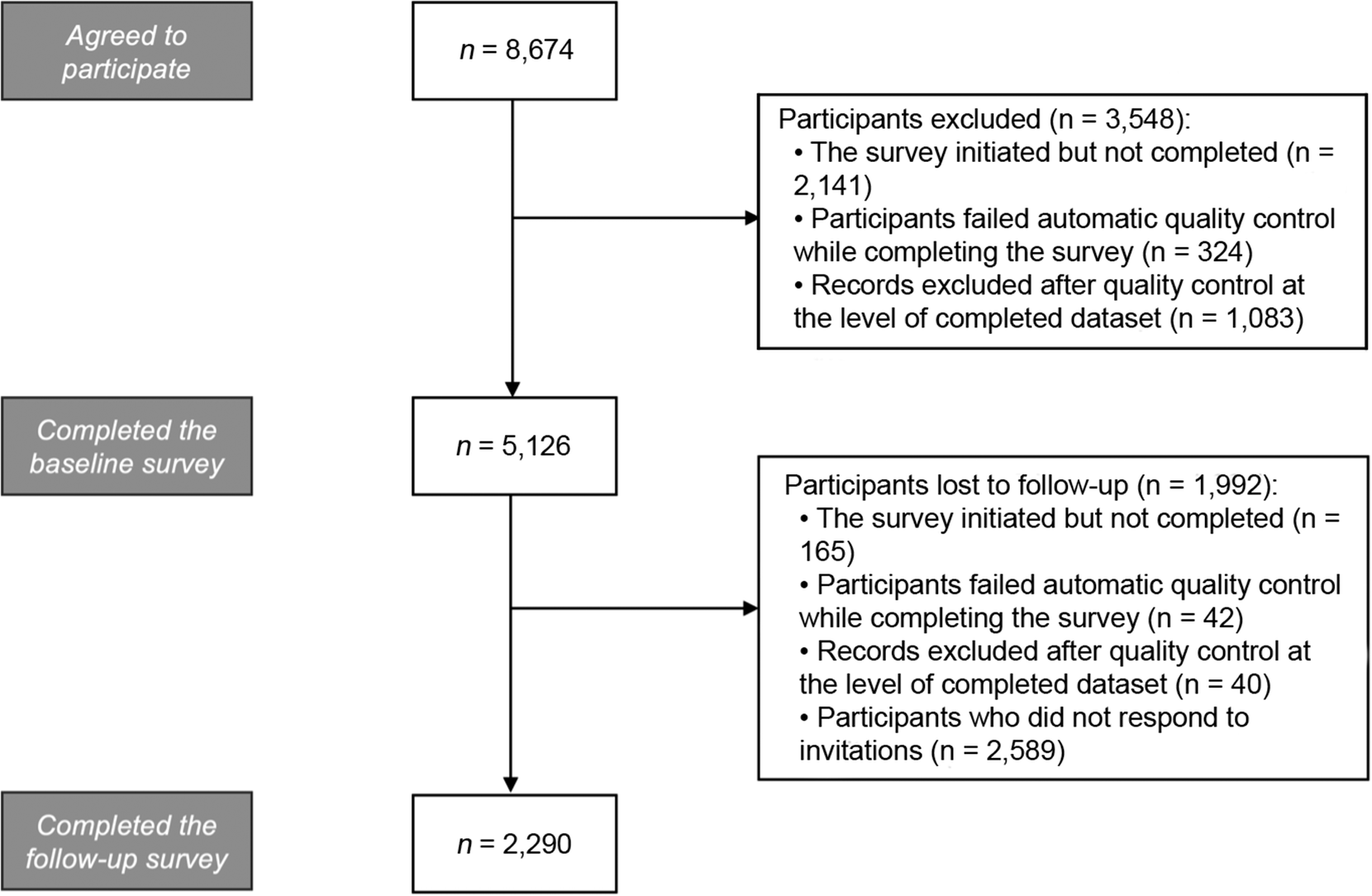
Out of 43,891 individuals invited to participate, a total of 5,126 individuals agreed to complete the baseline assessment (Figure 1). From this initial sample, 2,290 participants (44.7%) completed both waves, whereas 2,836 (55.3%) were classified as noncompleters (Table 1). Completers were older than noncompleters (32.1 ± 5.6 vs. 30.0 ± 6.2 years; t = 12.30, df = 5,074, p < 0.001; SMD = 0.342). There were no significant differences between groups in gender distribution (Fisher’s exact test, p = 0.215) or urbanicity (χ 2 = 3.68, df = 4, p = 0.451). In contrast, completers had higher educational attainment (χ 2 = 64.10, df = 3, p < 0.001) and were more likely to be employed full-time (χ 2 = 36.60, df = 3, p < 0.001), although SMD values for individual categories were small. Regarding baseline psychopathology, completers showed slightly lower CAPE-P scores than noncompleters (48.4 ± 25.9 vs. 50.0 ± 27.8; p = 0.028; SMD = 0.061), whereas differences in CAPE-N and CAPE-D were not statistically significant. Cognitive bias measures were largely comparable between groups, with all SMD values in the small range (<0.10).
Flow diagram of study participants.

Figure 1 Long description
The flow diagram summarizes participant recruitment and retention throughout the study. A total of 8,674 individuals agreed to participate. Of these, 3,548 were excluded before the baseline dataset was finalized because they did not complete the survey, failed automated quality control, or were excluded during dataset quality control. The baseline sample consisted of 5,126 participants. At follow-up, 2,290 participants completed the survey. Loss to follow-up resulted from incomplete surveys, failed quality control, exclusions during dataset quality control, or non-response to follow-up invitations.
Baseline characteristics of participants

Table 1. Long description
The table compares participants who completed follow-up with those who did not. Demographic characteristics include age, gender, education, employment status, and urbanicity. Clinical variables include psychotic-like experiences, negative symptoms, depressive symptoms, and cognitive bias measures. Standardized mean differences and statistical tests are reported. Most baseline differences between completers and non-completers are small.
Note: Data reported as mean ± SD for continuous variables or n (%).
ATB, attention to threat bias; BIB, belief inflexibility; CAPE-D, depressive symptoms; CAPE-N, negative symptoms; CAPE-P, positive psychotic experiences; EAB, external attribution bias; JTC, jumping to conclusions; SB, safety behaviors; SocCog, social cognitive problems; SRSS, the Social Readjustment Rating Scale; SubCog, subjective cognitive problems.
Attrition analysis
Logistic regression indicated that study completion was associated with older age and higher educational attainment. Small associations were also observed for JTC (OR = 0.98, 95% CI: 0.97–1.00, p < 0.001) and EAB (OR = 1.02, 95% CI: 1.01–1.04, p = 0.001), whereas baseline symptom scores and other cognitive biases were not significant predictors of attrition (Supplementary Table S2).
The stabilized inverse probability weights were well-behaved (mean = 1.00, SD = 0.21, range = 0.61–3.09). Percentile diagnostics indicated no evidence of extreme weighting (P99 = 1.63), and visual inspection of the weight distribution showed no substantial right-tail inflation (Supplementary Figure S1), indicating adequate overlap and no apparent violations of the positivity assumption.
Mediation models
Exposure to stress showed significant direct effects on changes in the levels of depressive symptoms, negative symptoms, and psychotic experiences in the majority of the hypothesized mediation models (except for the models testing for the mediating effect of ATB and JTC; Supplementary Table S3). Specifically, greater exposure to stress was associated with greater increases in symptom severity. Almost all direct paths from changes in cognitive biases to psychotic experiences were significant and positive (except for the model with changes in JTC as a mediator). These effects were less consistent when changes in negative symptoms (significant in the models with changes in EAB, SubCog, and SocCog as mediating variables) and depressive symptoms (significant in the models with changes in SocCog as mediating variables) were used as outcome variables. Notably, direct paths from stress exposure to symptom change were significant and positive across all tested models. The same significant direct paths were observed after adjustment for age, gender, and education (Table 2).
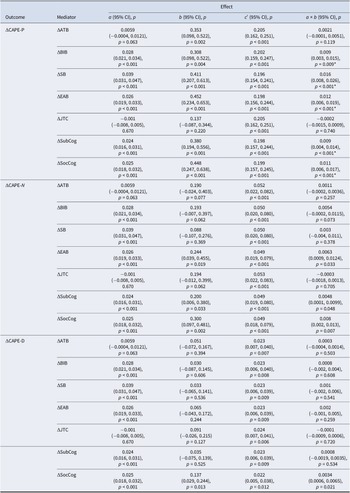
Baseline- and sociodemographic-adjusted mediation models of stress-related changes in cognitive biases and changes in psychopathology

Table 2. Long description
The table presents mediation analyses adjusted for baseline values, age, sex, and education. For each cognitive bias domain and symptom outcome, the table reports path a, path b, direct effects (c′), indirect effects (a × b), 95% bootstrap confidence intervals, and p-values. Significant false discovery rate-adjusted indirect effects are indicated with an asterisk. The strongest and most consistent indirect effects are observed for psychotic-like experiences.
Note: Reported values are unstandardized regression coefficients with 95% bootstrap confidence intervals. Path a represents the association between stress exposure and change in the cognitive bias; path b represents the association between change in the cognitive bias and change in symptoms; c′ denotes the direct effect of stress on symptom change controlling for the mediator; a × b denotes the indirect (mediated) effect. All models additionally included age, sex, and education as covariates. Δ indicates change scores between assessment waves. Significant FDR-adjusted p-values are marked with asterisk (*). ATB, attention to threat bias; BIB, belief inflexibility; CAPE-D, depressive symptoms; CAPE-N, negative symptoms; CAPE-P, positive psychotic experiences; EAB, external attribution bias; JTC, jumping to conclusions; SB, safety behaviours; SocCog, social cognitive problems; SubCog, subjective cognitive problems.
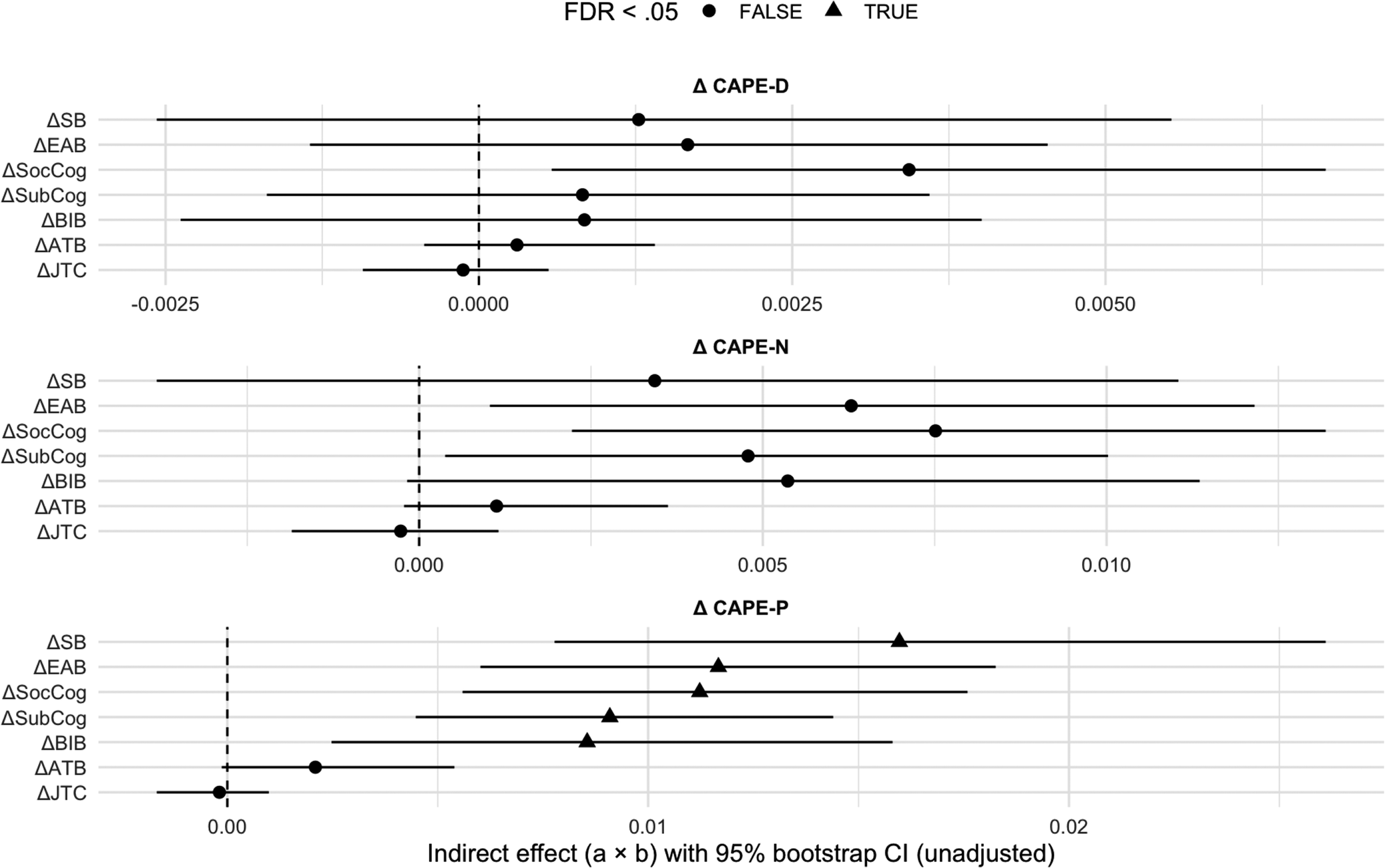
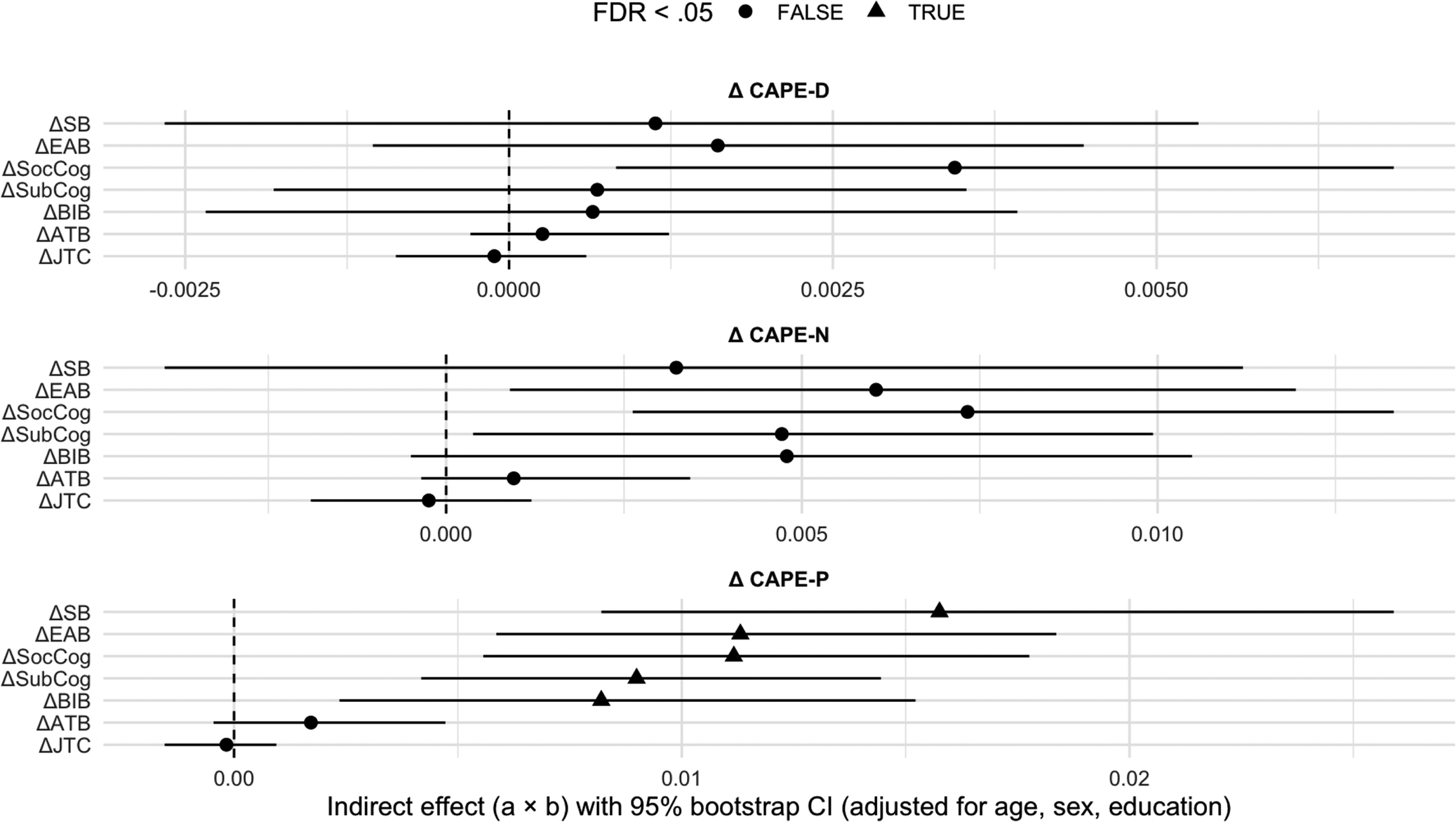
Indirect paths, indicating mediation by change in cognitive biases, were significant after adjustment for multiple testing and sociodemographic covariates (age, gender, and education) only in models with psychotic experiences as the outcome (Figures 2 and 3, Table 2, and Supplementary Table S3). These mediation effects were observed for changes in BIB, SB, EAB, SubCog, and SocCog, but not for ATB and JTC. Reverse mediation models (i.e. mediation of stress effects on cognitive biases by psychotic experiences) yielded significant indirect effects for SB, EAB, SubCog, and SocCog, but not BIB (Supplementary Table S4). However, paired bootstrap comparisons indicated that these reverse effects were consistently smaller than those observed in the hypothesized direction (Supplementary Table S5), supporting the predominance of the proposed temporal pathway.
Indirect effects (a × b) of stress exposure on changes in psychotic experiences, negative symptoms, and depressive symptoms via changes in cognitive biases, with 95% bootstrap confidence intervals, unadjusted. Note: CAPE-D, ‘depressive symptoms’; CAPE-N, ‘negative symptoms’; CAPE-P, ‘positive psychotic experiences’; ΔATB, ‘change in attention to threat bias’; ΔBIB, ‘change in belief inflexibility’; ΔEAB, ‘change in external attribution bias’; ΔJTC, ‘change in jumping to conclusions’; ΔSB, ‘change in safety behaviours’; ΔSocCog, ‘change in social cognitive problems’; ΔSubCog, ‘change in subjective cognitive problems’; FDR, ‘false discovery rate’.

Figure 2 Long description
The figure presents forest plots of indirect effects (a × b) for seven cognitive bias domains on three symptom dimensions: psychotic-like experiences, negative symptoms, and depressive symptoms. Points indicate indirect effect estimates and horizontal lines represent 95% bootstrap confidence intervals. Filled symbols indicate effects remaining significant after false discovery rate correction, whereas open symbols indicate non-significant effects. Several cognitive bias domains show significant indirect effects for psychotic-like experiences, whereas fewer significant associations are observed for negative and depressive symptoms.
Indirect effects (a × b) of stress exposure on changes in psychotic experiences, negative symptoms, and depressive symptoms via changes in cognitive biases, with 95% bootstrap confidence intervals, after adjustment for age, gender, and education. Significant indirect effects were observed only for psychotic experiences. Note: CAPE-D, ‘depressive symptoms’; CAPE-N, ‘negative symptoms’; CAPE-P, ‘positive psychotic experiences’; ΔATB, ‘change in attention to threat bias’; ΔBIB, ‘change in belief inflexibility’; ΔEAB, ‘change in external attribution bias’; ΔJTC, ‘change in jumping to conclusions’; ΔSB, ‘change in safety behaviours’; ΔSocCog, ‘change in social cognitive problems’; ΔSubCog, ‘change in subjective cognitive problems’; FDR, ‘false discovery rate’.

Figure 3 Long description
The figure presents forest plots of indirect effects from mediation models additionally adjusted for age, sex, and education. Overall patterns are similar to the baseline-adjusted models. Significant indirect effects remain primarily for psychotic-like experiences, whereas fewer significant effects are observed for negative and depressive symptoms.
In parallel multiple-mediator models, in which all seven cognitive bias domains were entered simultaneously, the pattern of results was largely comparable before and after adjustment for sociodemographic covariates (Supplementary Tables S6–S9). In the baseline-adjusted model, as well as in the model additionally adjusted for sociodemographic covariates, no individual mediator-specific indirect effect for PLEs reached statistical significance (Supplementary Tables S6 and S8). However, the total indirect effect of stress on PLEs through the combined set of cognitive biases was significant in both models (Supplementary Tables S7 and S9). Changes in SocCog were the only cognitive bias showing a significant mediator-specific indirect effect for both negative and depressive symptoms (Supplementary Tables S6 and S8).
Discussion
The current study examined whether longitudinal changes in cognitive biases mediate the association between stress exposure and changes in PLEs in a large general population sample of adults aged 18–40 years. Our results indicated that greater exposure to stress was associated with increases in PLEs, negative and depressive symptoms. Importantly, significant indirect effects consistent with mediation were observed only for PLEs. In single-mediator models, significant indirect effects were observed for BIB, SB, EAB, SubCog, and SocCog, whereas no significant effects were found for ATB or JTC. Although reverse indirect effects were also observed, their relatively smaller magnitude was more consistent with the hypothesized direction from stress through cognitive biases to PLEs. However, when all biases were entered simultaneously in parallel multiple-mediator models, no individual bias showed a unique indirect effect, whereas the total indirect effect remained significant – indicating that mediation operates through a network of interrelated cognitive biases rather than any single cognitive process.
Our findings are broadly consistent with previous research showing that stress exposure is associated with changes in psychotic symptom domains and represents an important risk factor for psychosis (Beards et al., Reference Beards, Gayer-Anderson, Borges, Dewey, Fisher and Morgan2013; Gerritsen et al., Reference Gerritsen, Bagby, Sanches, Kiang, Maheandiran, Prce and Mizrahi2019; Ma et al., Reference Ma, Chiappelli, Kvarta, Bruce, van der Vaart, Goldwaser, du, Sampath, Lightner, Endres, Yusuf, Yuen, Narvaez, Campos-Saravia, Kochunov and Hong2023). However, PLEs are increasingly recognized as transdiagnostic phenomena associated with anxiety, stress-related, and dissociative disorders (Bourgin et al., Reference Bourgin, Tebeka, Mallet, Mazer, Dubertret and Le Strat2020), suggesting that the cognitive mediation pathways identified here may extend beyond psychosis liability. The observed associations extend prior work by demonstrating longitudinal changes in response to cumulative stress exposure over 1 year, as most previous studies have focused on distal adversities, particularly childhood trauma (Pastore et al., Reference Pastore, de Girolamo, Tafuri, Tomasicchio and Margari2022; Varese et al., Reference Varese, Smeets, Drukker, Lieverse, Lataster, Viechtbauer, Read, van Os and Bentall2012). Notably, while direct effects of stress were evident across all three symptom domains, cognitive biases functioned as statistical mediators specifically in the pathway to PLEs, suggesting differential vulnerability of symptom domains to cognitive mediation. Testing this symptom-domain specificity was enabled by the multidimensional structure of CAPE designed for the assessment of PLEs and co-occurring symptoms in community samples (Mark & Toulopoulou, Reference Mark and Toulopoulou2015), though future studies could complement self-report assessment with structured interviews offering richer phenomenological detail (Rossell et al., Reference Rossell, Schutte, Toh, Thomas, Strauss, Linszen, van Dellen, Heringa, Teunisse, Slotema and Sommer2019).
The pattern of mediation findings for PLEs, rather than negative or depressive symptoms, aligns with theoretical models positioning cognitive biases as particularly relevant to the formation and maintenance of the psychotic dimension, including paranoia (Pot-Kolder et al., Reference Pot-Kolder, Geraets, Veling, van Beilen, Staring, Gijsman, Delespaul and van der Gaag2018). However, the specificity of this relationship warrants nuanced interpretation. While cognitive biases show stronger associations with positive PLEs, meta-analytic evidence demonstrates they may also be associated with negative PLEs, though with smaller effect sizes (Livet et al., Reference Livet, Navarri, Potvin and Conrod2020). Critically, for negative and depressive symptoms, cognitive biases may function as moderators rather than mediators, amplifying affective states rather than serving as pathways from stress to symptoms (Prochwicz & Kłosowska, Reference Prochwicz and Kłosowska2018). It is consistent with ESM evidence that the stress–depressive symptom pathway operates primarily through affective disturbance (Klippel et al., Reference Klippel, Myin-Germeys, Chavez-Baldini, Preacher, Kempton, Valmaggia, Calem, So, Beards, Hubbard, Gayer-Anderson, Onyejiaka, Wichers, McGuire, Murray, Garety, van Os, Wykes, Morgan and Reininghaus2017).
The significant mediation effects for specific cognitive biases can be understood through existing theoretical frameworks. The effect for BIB aligns with evidence from a recent umbrella review linking belief inflexibility to delusion conviction and severity (Samson et al., Reference Samson, Livet, Gilker, Potvin, Sicard and Lecomte2024). The mediation by SB is consistent with cognitive models positing that safety behaviors maintain persecutory beliefs by preventing disconfirmation of threat appraisals (Berkhof et al., Reference Berkhof, van der Stouwe, Geraets, Pot-Kolder, van der Gaag and Veling2024; Freeman, Garety, & Kuipers, Reference Freeman, Garety and Kuipers2001). The effect for EAB is in line with meta-analytic evidence that EAB is specific to paranoia and associated with symptom severity (Pot-Kolder et al., Reference Pot-Kolder, Geraets, Veling, van Beilen, Staring, Gijsman, Delespaul and van der Gaag2018)(Pankow et al., Reference Pankow, Katthagen, Diner, Deserno, Boehme, Kathmann, Gleich, Gaebler, Walter, Heinz and Schlagenhauf2015). The mediation by SubCog is consistent with research showing that subjective cognitive complaints mediate vulnerability–positive symptom associations, though studies in the context of stress remain limited (Flückiger et al., Reference Flückiger, Michel, Grant, Ruhrmann, Vogeley, Hubl, Schimmelmann, Klosterkötter, Schmidt and Schultze-Lutter2019). Finally, the effect for SocCog aligns with evidence that social-cognitive deficits contribute to paranoid appraisals and that improvements in social cognition reduce paranoid ideation (Buck et al., Reference Buck, Tauscher, Whiting, Wang, Campbell and Ben-Zeev2024).
The results of parallel multiple-mediator models provide additional insight into the nature of cognitive mediation. When all seven cognitive biases were entered simultaneously, none showed a unique indirect effect on PLEs, yet the total indirect effect remained significant. This pattern indicates that the individual mediation effects observed in separate models largely reflect shared variance among correlated cognitive processes rather than independent contributions of specific biases. This finding is consistent with network perspectives on cognitive vulnerability, which emphasize that cognitive biases operate as an interconnected system rather than as isolated risk factors (Gaweda et al., Reference Gaweda, Prochwicz and Cella2015). Notably, SocCog emerged as the only bias with a specific indirect effect on negative and depressive symptoms, highlighting social cognition as a potentially distinct mediating pathway that warrants further investigation.
The null finding for JTC is consistent with meta-analytic evidence showing no meaningful relationship between JTC and delusional ideation across the psychosis continuum, suggesting JTC may be a correlate of clinical state rather than a developmental mechanism (Doherty et al., Reference Doherty, Weber, Hillier, Ross and Balzan2025). This is further supported by experimental evidence that JTC does not mediate the stress-paranoia association (Krkovic et al., Reference Krkovic, Nowak, Kammerer, Bott and Lincoln2023). It is also consistent with meta-analytic findings indicating that JTC has the smallest effect size among cognitive biases associated with PLEs (Livet et al., Reference Livet, Navarri, Potvin and Conrod2020). Regarding ATB, the lack of mediation may reflect its transdiagnostic nature, as attention biases are implicated in anxiety disorders rather than being psychosis-specific (Lavigne et al., Reference Lavigne, Deng, Raucher-Chéné, Hotte-Meunier, Voyer, Sarraf, Lepage and Sauvé2024; Wieser & Keil, Reference Wieser and Keil2020). Although ESM research links threat anticipation to stress-psychosis effects (Klippel et al., Reference Klippel, Myin-Germeys, Chavez-Baldini, Preacher, Kempton, Valmaggia, Calem, So, Beards, Hubbard, Gayer-Anderson, Onyejiaka, Wichers, McGuire, Murray, Garety, van Os, Wykes, Morgan and Reininghaus2017), this may reflect shared affective mechanisms. Notably, ATB (α = 0.63–0.66) and JTC (α = 0.69–0.70) were also the least reliable subscales, and lower measurement precision may have attenuated associations. However, BIB showed significant mediation despite comparable reliability (α = 0.69–0.73), suggesting measurement precision alone does not fully explain the pattern. Replication with performance-based measures is warranted.
The finding that indirect effects were consistently larger in the hypothesized direction is consistent with cognitive models positioning biases as processes through which adversity may contribute to psychotic symptoms (Livet et al., Reference Livet, Navarri, Potvin and Conrod2020; Samson et al., Reference Samson, Livet, Gilker, Potvin, Sicard and Lecomte2024). Prior path analyses similarly showed that the stress–psychosis proneness association becomes nonsignificant when cognitive biases are included as mediators (Gawęda et al., Reference Gawęda, Pionke, Krężołek, Prochwicz, Kłosowska, Frydecka, Misiak, Kotowicz, Samochowiec, Mak, Błądziński, Cechnicki and Nelson2018a, Reference Gawęda, Prochwicz, Adamczyk, Frydecka, Misiak, Kotowicz, Szczepanowski, Florkowski and Nelson2018b). However, the presence of smaller reverse effects is consistent with bidirectional relationships, suggesting that PLEs may further amplify cognitive biases in a self-perpetuating cycle (McLean et al., Reference McLean, Mattiske and Balzan2016; Misiak, Reference Misiak2025).
The present findings, while based on small indirect effects from an observational study, may inform future intervention research. The cognitive biases that showed significant indirect effects in separate mediation models overlap with targets of existing interventions, including cognitive behavioral therapy for psychosis (CBTp) and metacognitive training (MCT), which have shown efficacy in reducing positive symptoms and transition rates in high-risk individuals (Mayer et al., Reference Mayer, Corcoran, Kennedy, Leucht and Bighelli2024; Penney et al., Reference Penney, Sauvé, Mendelson, Thibaudeau, Moritz and Lepage2022; Zheng et al., Reference Zheng, Xu, Zhu, Li, Wang, Livingstone and Zhang2022). Additionally, social cognitive training programs improve emotion perception, theory of mind, and social functioning, domains for which significant indirect effects were observed in the present study (Nijman, Veling, van der Stouwe, & Pijnenborg, Reference Nijman, Veling, van der Stouwe and Pijnenborg2020). However, the parallel multiple-mediator results – in which no single bias showed a unique indirect effect while the total indirect effect remained significant – suggest that interventions addressing multiple cognitive processes simultaneously may be more appropriate than approaches targeting individual biases, although this hypothesis requires direct testing. Future research should examine whether targeting these specific biases can attenuate stress-related increases in PLEs in at-risk populations.
The present study has certain limitations. First, although the longitudinal design improves upon cross-sectional studies, the two-wave design and 1-year assessment interval do not allow direct observation of the temporal sequence between changes in cognitive biases and PLEs. Because mediators and outcomes were assessed over the same interval, the findings are consistent with, but do not establish, the proposed temporal ordering. Moreover, change scores derived from observed variables are sensitive to measurement error, and future studies with three or more assessment waves could apply more flexible longitudinal mediation models. Second, cognitive biases were assessed using self-report measures, which may capture different aspects of cognitive processing than behavioral tasks (Pena-Garijo et al., Reference Pena-Garijo, Palop-Grau, Masanet, Lacruz, Plaza, Hernández-Merino, Edo-Villamón and Valllina2022). Internal consistency for the JTC, ATB, and BIB subscales was modest but comparable to previous DACOBS validation studies (Gaweda et al., Reference Gaweda, Prochwicz and Cella2015; Van der Gaag et al., Reference Van der Gaag, Schütz, ten Napel, Landa, Delespaul, Bak, Tschacher and De Hert2013), and may have attenuated associations involving these domains. Third, the modified SRRS combines event exposure with subjective appraisal, potentially introducing shared method variance (Klippel et al., Reference Klippel, Myin-Germeys, Chavez-Baldini, Preacher, Kempton, Valmaggia, Calem, So, Beards, Hubbard, Gayer-Anderson, Onyejiaka, Wichers, McGuire, Murray, Garety, van Os, Wykes, Morgan and Reininghaus2017). However, subjective stress severity is a stronger predictor of health outcomes than objective exposure (Monsonet, Rockwood, Kwapil, & Barrantes-Vidal, Reference Monsonet, Rockwood, Kwapil and Barrantes-Vidal2022), and the specificity of the mediation effects to PLEs argues against a purely artifactual explanation. Furthermore, although similar modifications have been used previously (Hurst et al., Reference Hurst, Jenkins and Rose1978; Ngai & Chan, Reference Ngai and Chan2012), the specific version used here has not been independently validated. Fourth, stress exposure was assessed only over the preceding 12 months, and lifetime adversity, including childhood trauma, was not measured. Consequently, residual confounding by earlier stress exposure cannot be excluded. Finally, the relatively low response rate, attrition at follow-up, the use of an internet-based panel, and the restricted age range (18–40 years) may limit the generalizability of the findings despite the application of inverse probability weighting. As an observational study, the present findings describe temporal associations rather than establish causality.
In conclusion, the present findings support a multidimensional perspective on cognitive biases, suggesting that their collective evolution over time may be more informative than changes in individual biases when examining the relationship between stress and psychosis-related experiences. This work extends current models of stress-related psychopathology by highlighting cognitive biases as dynamic processes that may contribute to the emergence of PLEs. Future studies should determine whether modifying these cognitive processes can reduce vulnerability to PLEs in response to stressful experiences.
Supplementary material
The supplementary material for this article can be found at http://doi.org/10.1017/S0033291726105819.
Funding statement
This research was funded in whole or in part by the National Science Centre, Poland (Narodowe Centrum Nauki), grant number 2023/49/N/HS6/01588. For the purpose of Open Access, the author has applied a CC BY public copyright licence to any Author Accepted Manuscript (AAM) version arising from this submission.
Competing interests
The authors declare none.
Data availability statement
The research data underlying this article are available in the Polish Medical Platform (PPM) repository at: https://doi.org/10.60956/phn0-g589



 Open access

