

Since the late twentieth century, the kingdoms of the Arabian Gulf have dedicated titanic resources to expanding their national militaries. Most recently, Saudi Arabia, Qatar, and the United Arab Emirates have upgraded their military capacity, purchased lavish Western arms, developed indigenous defence industries, and utilised their armed forces in offensive operations abroad – so much so that some consider these three states as having reached ‘middle power’ status.Footnote 1 In terms of proportional military expenditures and arms imports, the Gulf, which also includes Kuwait, Bahrain, and Oman, is now the most militarised region in the world.Footnote 2 The UAE has attracted particular attention, prompting Western observers to anoint it as ‘Little Sparta’ given its revamped defensive prowess and offensive interventions in conflicts across Yemen, Libya, Sudan, and the African Horn.Footnote 3
Yet not all the Gulf kingdoms have militarised to the same degree. Among them, Kuwait stands as a peculiar outlier: it represents a puzzling case of constrained militarisation, in which a sovereign state attempted to enlarge and modernise its military institutions in response to dire external threats – but failed. This martial campaign unfolded after the 1990–1 Gulf war, when Iraq’s occupation nearly exterminated Kuwait’s existence. Following that traumatic event, the ruling Sabah monarchy launched one of the most rapid, intensive military build-ups witnessed in the Middle East at the time. With vigorous US support, this royal autocracy sought to turn the tiny and underequipped Kuwaiti armed forces, which had collapsed in two days against the Iraqi invasion, into a larger, more effective fighting force that could hold out against aggressors long enough for allied help to arrive. Over the decade, however, these efforts floundered. Despite its initially grand ambition, Kuwait’s royal government throttled defence spending, abandoned strategic reforms, and even rejected major arms deals. By the 2000s, the original vision of fielding a competent military apparatus vanished.
Had its post-war militarisation succeeded, today Kuwait, rather than the UAE, might bear the moniker of being the Arab world’s Little Sparta. Instead, Kuwait has stayed the military runt of the Gulf, one still dependent upon a large US presence. Despite securing more Western technology and weaponry since the 2000s, its armed forces remain a glorified constabulary force, lacking a coherent strategic doctrine and unable to mount proficient combat operations. Well into the 2010s, security analysts doubted its ‘ability to employ and sustain’ modern combat or ‘actively defend Kuwait’, indicating that its ‘contributions during wartime’ would ‘likely be negligible, at best’.Footnote 4
What explains this counter-intuitive outcome? The structural variables that facilitated rapid militarisation in other Gulf kingdoms – regional conflict, territorial vulnerability, oil-rentier wealth, and autocratic monarchical rule – fail to account for this. To fill this gap, we offer a novel explanation for constrained militarisation: domestic politics. Contextual analysis of the Kuwaiti case shows that even under conditions of authoritarianism, political contestation and popular dissent can impede state-directed militarisation from above. After the Gulf war, political opposition to militarisation emerged through the elected parliament and civil society. Throughout the 1990s, Kuwaiti critics increasingly resisted the lavish defence budgets, forced modernisation, and other strategic directives proposed by the royal government. Crucially, such dissent did not seek more radical political change by attacking the Sabah monarchy. However, it did subject defence policies to the rhythms of bigger public disputes about corruption, reforms, and resources. In the late 1990s, this struggle climaxed in the unprecedented cancellation of a $1 billion US artillery weaponry deal. Such ferocious confrontation ultimately convinced state officials to relinquish their militarisation goals: Kuwait was not to be Little Sparta.
Analytically, post-war Kuwait represents a ‘deviant’ case, the value of which stems from how an expected outcome predicted by antecedent theory did not occur.Footnote 5 This is a canonically weak, small state whose leadership failed to ramp up its military capabilities in response to existential territorial threats despite having the incentive and resources to do so. Indeed, if anything, Kuwait has historically suffered the most insecurity of all the Gulf kingdoms, given its near-death experience in the Gulf war. Explaining this mismatch between systemic expectations and empirical reality hence speaks to multiple literatures, such as those on military politics, security assistance, and Gulf affairs, which surprisingly do not address the Kuwaiti case at all.Footnote 6
In advancing these findings, this paper offers three contributions. First, it provides a close-range exploration of constrained militarisation. Considerable work, such as classic expositions on wartime restraintFootnote 7 and military norms,Footnote 8 addresses why well-armed states can curb their bellicose impulses even when facing imminent threats. However, few studies leverage the variable of domestic politics to explain why autocratic states fail to militarise in the first place. To better capture this dynamic in Kuwait, we take as inspiration Charles Tilly’s exploration of fiscal politics in his influential account of European state-building. Tilly highlighted a budgetary ‘ratchet effect’ for many militarising polities, whereby the costs of mobilising for war engender social legacies and bureaucratic inertia that justify ever-increasing post-war military spending.Footnote 9 Kuwait demonstrates the opposite – a reverse ratchet effect, whereby fiscal and social constraints upon militarisation deepen over time. As Kuwait’s experience in the 1990s denotes, a regime’s efforts to direct human and material capital towards its armed forces can intensify due to domestic opposition, eventually scuttling its commitment towards military mobilisation.
Second, this paper enriches the Gulf politics literature by advancing a more flexible understanding about the sources of foreign policy and state behaviour. Mainstream work on Gulf security still reflects neo-realist presumptions drawn from the small state literature in postulating the physical vulnerability of these monarchical states as the primary determinant for defence policy and alliance commitments.Footnote 10 Over the past decade, more reflexive analyses have emphasised how domestic politics can also contour the external stance of the Gulf kingdoms, for which military and defence-related issues constitute a major component. Recent work has stressed societal-level variables such as national identity, popular legitimacy, and social interests as drivers of royal policy-making.Footnote 11 Kuwaiti studies, in particular, has cultivated a small but growing scholarship situating social variables like role conceptions and transnational diffusion as key influences upon foreign relations.Footnote 12 This work buttresses this critical turn towards domestic politics.
Finally, these findings encourage scholars of military politics to rethink the sources of variation for militarisation across the world. Today, as the Russo–Ukrainian and Iran wars have demonstrated, groundbreaking advances in AI technology, operational strategies, and systemic multipolarity have engendered creative pathways for aspiring states to improve their military capabilities and wage effective combat. Yet permissive conditions that enable effective militarisation do not always ordain it. As the Kuwaiti case confirms, even in highly securitised or authoritarian environments, defence modernisation can hinge upon unexpected factors like internal balances of power and public scrutiny. Kuwait had all the motivation and resources to become Little Sparta – but failed to do so given unexpected domestic conflict.
Our case-oriented study draws on a variety of data. We conducted field-based interviews with Kuwaiti journalists, retired Kuwaiti army officers, former members of parliament (MPs), and current or former US and European military officers and advisers to extract insight regarding the scope and process of the country’s post-war defence policies. We supplement these by analysing historical materials, the international defence press, and archives of local Kuwaiti media by using Al-Qabas, one of the oldest and most independent Arabic dailies, as a newspaper of record. Such triangulation is critical, because though Kuwait has a liberalised political environment – or rather, it did prior to the 2024 suspension of parliament – military politics during the 1990s remains a sensitive topic, as it touched upon controversial issues like corruption and citizenship. Comparative data on government expenditures, military spending, and labour force information further flesh out the analysis.Footnote 13
This paper proceeds in four parts. First, it unpacks the puzzle of constrained militarisation by defining this term and framing Kuwaiti politics. It argues that Kuwait represented an ‘easy’ case for rapid militarisation after the Gulf war, given its external vulnerability, profuse oil revenues, US support, and ruling monarchism. These variables explain why the Kuwaiti state began to modernise and expand its armed forces in the 1990s – but they do not demonstrate why this scheme failed. Second, it explores Kuwait’s military and politics following the Gulf war. Against the baseline of the pre-war years, the government’s initial plans to reconstruct and transform the armed forces was incredible in terms of its financial cost, manpower expansion, arms procurement, and organisational enhancements.
Third, we trace how the reverse ratchet effect emerged after the early 1990s. By 1993, the royal government’s military initiatives and projects had become imbricated within intense domestic debates driven by political opposition and public concerns. As issues of force expansion and arms imports attracted polemical criticism, royal commitments to militarisation wilted. Finally, to provide a fine-grained example of how such domestic resistance thwarted state-led militarisation, we investigate a failed US arms deal in the late 1990s. The ‘cannon crisis’, as Kuwaiti interlocutors termed it, encapsulated an ambitious state effort to acquire the expensive Paladin artillery system. This spurred such discord with critics over corruption and mismanagement that officials were forced to renege on the deal. To date, this still ranks as one of the largest failed US arms contracts in Middle East history – and one that, like Kuwait’s military politics itself, has attracted little scholarly attention until now.Footnote 14
Militarisation and the Kuwaiti case
Militarisation refers to the totality of the organisational commitments, financial resources, and political activities that nourish martial institutions and thus produce the ‘steady growth in the military potential’ of a state.Footnote 15 As directed by rulers and governments that command state power, it manifests through ‘increases in military spending, in the size of the armed forces, and in arms import and production’, as well as other indicators that accentuate a state commitment to enlarge and upgrade its military.Footnote 16 Militarisation therefore requires the extensive mobilisation of physical and human resources.Footnote 17 Constrained militarisation, thus, refers to situations in which states initiate this exhaustive process but then choose to abandon it because they are no longer willing to pay its steep social, economic, or political costs.
Crucially, militarisation is not equivalent to military effectiveness, meaning whether armed forces field the combat skills, coercive equipment, and strategic doctrines needed to win conflicts.Footnote 18 Indeed, a resounding theme in the literature on militarisation holds that well-armed powers can still suffer from low military effectiveness and lose wars.Footnote 19 In the Gulf, for instance, the Saudi and Emirati armed forces have made impressive leaps in expanding their defence sectors, technical capabilities, and raw coercive firepower since the 2000s.Footnote 20 However, despite such intensive militarisation, critics argue they have sometimes struggled to achieve their goals on the battlefields of Yemen and other conflict theatres across the Middle East due to operational deficiencies and tactical mistakes.Footnote 21
Nonetheless, militarisation is a necessary antecedent to military effectiveness. A country like Kuwait cannot pose a defensive challenge if it does not field a martial apparatus capable of meeting its operational goals. Why some states seek to militarise as a starting point therefore represents an important question – as does the puzzle that guides this study, namely why some militarisation efforts fail. Here, prevailing theories about state behaviour and military politics apply. In the context of the Arabian Gulf, three structural variables predict successful and sustained militarisation: small state vulnerability, rentier authoritarianism, and American hegemony. All apply to Kuwait, but none account for why its post-war militarisation became so constrained. Approaches emphasising external vulnerability and rentier authoritarianism explain the initial Kuwaiti effort towards upgrading its armed forces in the 1990s, but not why these efforts halted. Arguments invoking American hierarchy suggest that Kuwait does not need to militarise at all given its US protection – but this explains neither why its rulership launched its militarisation doctrine in the first place nor why other Gulf states also under the aegis of US hegemony more successfully militarised in recent decades.
Vulnerability and smallness
Neo-realist approaches emphasising systemic constraints struggle to explain Kuwait’s trajectory. Chronic external threats impose high incentives for weak, insecure states to militarise as a rational response to safeguard their territory: the more dangerous the regional environment, the more likely constituent states will keep their figurative guard up.Footnote 22 Smallness, too, matters. The diminutive size and strategic weakness of geographically small states amplify the risk of foreign predation, making them lean upon their foreign policy and military resources to ensure survival.Footnote 23
Kuwait typifies such structural vulnerability. Its historical development has been punctuated by endemic perils of foreign belligerence. This coastal emirate took political shape at the head of the Arabian Gulf in the mid-eighteenth century, when the Sabah tribal family arose to govern local tribal and merchant communities. As this polity crystallised under British imperialism in the early twentieth century, external conflict loomed. In 1920, the area fell under siege by tribal forces allied to the neighbouring Saudi dynasty, whose campaign of peninsular conquest would culminate in 1932 with the creation of modern Saudi Arabia. Only a costly British-backed defensive effort repelled the invasion.Footnote 24 Subsequent negotiations, however, resulted in Kuwait losing two-thirds of its southern territory to the budding Saudi state. In the 1930s, new threats loomed over its western and northern borders due to Iraqi irredentism. Iraqi claims of sovereignty over Kuwait emboldened local merchants when they rebelled against the Sabah sheikh, or ruler, in 1938 over taxation, triggering a popular democratic struggle.Footnote 25 Upon gaining independence in 1961, Kuwait narrowly averted an Iraqi invasion thanks to British military protection, but this new crisis reinforced deep insecurity among the Sabah leadership.Footnote 26
Existential threats magnified by precarious borders worsened in subsequent decades. In terms of foreign policy, Kuwait invested heavily in ‘dinar diplomacy’ from the 1960s onwards, providing generous economic aid to other Middle East states, including Iraq, to buy goodwill.Footnote 27 Nonetheless, regional conflicts spilled over. In the 1980s, Kuwait was caught in the crossfire of the Iran–Iraq war. Heightened sectarianism, stoked by the new Islamic Republic regime in Iran and aimed at Kuwait’s Shi’a minority, produced unprecedented domestic terrorism against the government.Footnote 28 In this climate of emergency, the Kuwaiti monarchy bandwagoned with fellow Gulf states in forming the Gulf Cooperation Council (GCC) in 1981, a regional security alliance intended to ward off Iran.Footnote 29 However, the GCC lacked a reliable mechanism of mutual defence.
Neither the GCC nor Kuwaiti dinar diplomacy deterred Iraq under Saddam Hussein from invading in August 1990, crushing its military and proclaiming Kuwait’s annexation. This cast the Sabah monarchy and many citizens into exile. Such violent state death shocked all the GCC states, so much so that decades later, Emirati officials cited the Gulf war as a ‘focusing event’ to justify their own rapid militarisation.Footnote 30 While Kuwait regained its sovereignty with the US-led liberation in February 1991, the occupation left deep scars given its $100 billion economic toll, catastrophic ecological ruin, and grotesque human rights abuses. Above all, it stressed Kuwait’s profound insecurity as a small and weak state, which neither dinar diplomacy nor GCC bandwagoning could mitigate.
As neo-realist logic would predict, Kuwait sought to overhaul its armed forces in response to its wartime defeat. However, the very systemic conditions that instigated military modernisation fail to explain why the Sabah leadership abandoned this aspiration after the early 1990s, despite the fact that Kuwait remained a small state susceptible to regional conflict. Contrast this with other small, weak states that historically reacted to external threats with sustained commitments to defence sector build-ups – including not just neighbouring Gulf states like the UAE and non-Gulf Middle East cases like Jordan, but also non–Middle East cases like Eritrea and Rwanda.Footnote 31 These have ranked among the world’s most militarised states for the past two decades in terms of proportional defence spending, per capita combat personnel, institutional prominence of the armed forces, and other martial indicators. If structural vulnerability alone predicts such outcomes, then Kuwait should belong on this list as well. Yet it is not.
Authoritarianism and oil
Beyond external vulnerability, domestic structural variables in regime type and resource endowment falter in explaining Kuwait’s constrained militarisation. Kuwait’s Sabah monarchy qualifies as an autocracy. The unelected hereditary ruler, the Emir, holds inviolable supreme powers, including the prerogative to suspend parliament and curtail basic rights; his royally appointed government enacts all policies and controls state institutions, including the armed forces. Second, Kuwait is also an oil-rentier state. With one of the world’s largest crude oil reserves, this emirate attained rapid urbanisation and economic affluence shortly after gaining independence from British rule in 1961. Such rentier dependence remains its financial lifeline, with hydrocarbon exports accounting for 80 to 90 per cent of public revenues since the 1990s.
Theoretically, both authoritarianism and oil rents favour militarisation. Cross-national studies show that dictatorships need large, well-equipped armies to repress domestic opposition,Footnote 32 practice coup-proofing,Footnote 33 and launch diversionary wars.Footnote 34 Likewise, oil rents negate the need for domestic taxation.Footnote 35 So long as global energy markets hum, they provide substantial resources for governments to promulgate otherwise unfeasible policies, such as over-investing in their defence sectors.Footnote 36 Reasonably, analysts highlight authoritarianism fuelled by oil-rentierism as critical factors for the dizzying militarisation seen in some Gulf kingdoms since the 2000s, such as Saudi Arabia, Qatar, and the UAE.Footnote 37 Counterfactually, it would certainly be difficult to imagine these GCC states financing their defence policies without oil or gas wealth, or the heavy-handed guidance of royal leaders eager to create more muscular armed forces.Footnote 38
Comparatively, however, autocracy and money have limited analytical traction for the Kuwaiti case. Like external vulnerability, these explain why and how the Sabah leadership sought to militarise the country after the Gulf war. However, they do not account for its failure to sustain this commitment after fierce political fights with domestic critics. This underscores a deeper critique that critical scholars have advanced: authoritarian rule and rentier wealth enable rich non-democracies to pursue new policies, but they do not dictate which policy options they eventually choose.Footnote 39 Other variables, such as social conflict and institutional costs, often intervene to change the decision-making calculus of autocratic regimes – something especially pertinent to Kuwait, given its exceptional legacy of popular mobilisation and inclusive politics.
Hierarchical protection
Finally, theories of hierarchy go furthest in explaining Kuwait’s failed militarisation. Hierarchies, or stable transnational structures of authority and subordination that sublimate weaker states under larger hegemons, proliferate in the world.Footnote 40 Dominant powers protect client states under their sway in return for foreign policy support, economic resources, and other concessions. In such give-and-take relationships, smaller states gain hegemonic protection, which alleviates the burden of investing in national defence.Footnote 41 Insecure states like Kuwait, hence, may not need to militarise at all so long as great powers guarantee their survival.
The United States has played the role of hegemonic guardian for Kuwait and much of the Gulf since the 1980s. Enshrining this arrangement are its mammoth diplomatic presence and military bases in Kuwait and other GCC kingdoms, which aggrandise Washington’s wider global influence while allowing it to set the rules of regional order – such as when war can be launched, which peace treaties can be inked, and what regimes deserve international support.Footnote 42 US hierarchy in Kuwait began coalescing in the 1980s, when American military forces escorted its oil tankers from Iranian attacks during the Iran–Iraq war. The leading US role in liberating the country in February 1991 cemented Kuwait’s status as an American client state, while tethering its foreign relations and oil production to Washington’s geopolitical interests.Footnote 43 After the Gulf war, the United States established its fourth largest global military base here, behind only Germany, Japan, and South Korea – a fact that made Kuwait a prolific target for Iranian airstrikes during the 2026 Iran war.
That hierarchical arrangements explain Kuwait’s failed post-war militarisation deserves further scrutiny. As David Roberts has argued, American hegemony induces a ‘protection curse’ for its Gulf allies.Footnote 44 By guaranteeing the survival of these hydrocarbon-rich kingdoms against perceived regional threats, the United States ironically discourages the development of local military capacity. It allows the Gulf monarchies to avoid making risky reforms – such as promoting officers based upon merit rather than feckless loyalty, which might weaken their control over the armed forces – while favouring aimless policies such as expensive weaponry imports that merely give the appearance of military effectiveness. Under this rationale, Kuwaiti leaders may have never truly intended to militarise after the Gulf war, given the luxury of US protection.
However, upon closer glance, this proposition does not validate Kuwait’s experience. For one, as the next section shows, its military modernisation policies after 1991 broke from pre-war patterns: at the time, they were singular for Kuwait and unique in the Gulf. Empirical evidence suggests that royal elites incubated a genuine effort to revamp their armed forces to meet new defensive goals, so much so that it broached push-back from a society unaccustomed to such military mobilisation. Indeed, some proposed reforms, such as adopting Western training methods and securing practical arms for specific missions, were precisely those implemented by the UAE – widely perceived as the most successful case of Gulf militarisation – years later. The protection curse may explain Kuwaiti policies since the 2000s, insofar as increased defence expenditures have not markedly improved its defence capacity. But it does not explain the rise and fall of its military imperatives in that post-war decade.
For another, in comparative perspective, hierarchical protection functions more as a permissive rather than a wholly determinative condition in undermining sustained militarisation in client states. The American security umbrella (at least until its lacerations from the Iran war) may rightly explain why some Gulf armed forces remain paper tigers. However, the UAE has notably ‘overperformed’, with distinctive factors like foreign military commanders and top-down royal commitments nurturing a relatively well-functioning defence sector.Footnote 45 In Jordan, likewise, US security guarantees thanks to the Hashemite Kingdom’s 1994 peace treaty with Israel have not foreclosed its wholesale military build-up. On the contrary, the United States has facilitated Jordan’s militarisation, given that its coercive apparatus plays an integral role in maintaining domestic order.Footnote 46 We suggest a critical difference in these cases may be the absence or weakness of the kind of Kuwaiti domestic political constraint that we unpack below.
Contentious domestic politics
External threats, oil wealth, authoritarianism, and US hierarchical protection do not fully capture constrained militarisation in Kuwait. Orienting a more robust explanation towards domestic politics requires first reinforcing that militarisation entails extensive public effort and coordination between political institutions, social forces, and the economy.Footnote 47 In Kuwait, what makes domestic politics relevant to this exhaustive process is its ‘hybrid’ model of authoritarian rule, in which popular voices and political opposition historically exercised limited yet impactful influence upon state decision-making.Footnote 48 The 1961 constitution grants the Emir, as titular head of the Sabah dynasty, immense executive authority, including the prerogative to appoint the government. Both the Emir and this royal government – always led by a senior Sabah prince serving as prime minister – constitute the figurative core of the political regime that commands the state. They appoint senior officials, oversee the ministries, and control the military.
However, this political system also furnishes liberal opportunities for semi-democratic participation. The constitution allows for a unicameral parliament, the National Assembly, whose fifty elected seats are filled through mostly competitive elections. This legislature labours under some restriction. For instance, political parties are banned, MPs seldom draft bills, and the Emir can suspend parliament and rule by decree. However, while in session, the legislature wields considerable weight.Footnote 49 As Kuwait’s sole elected institution, it must ratify all laws. Obstructive MPs can not only block government legislation but also subject individual ministers to interpellation (e.g., public questioning). In this way, blocs of opposition-minded MPs can stymie the monarchy with political gridlock. Over the past decade, such contestation allowed parliamentary blocs to paralyse royal lawmaking with relentless defiance, engendering a crisis that ended only when current Emir Mish’al suspended the assembly in May 2024.Footnote 50
Mirroring parliament is civil society. Though political parties are banned, vibrant independent organisations – many originating in 1920s and 1930s, well before independence – have long allowed Kuwaiti citizens to mobilise interests and pressure their leadership from below.Footnote 51 Such prolific actors include chambers of commerce, cooperative associations, ideological movements, and religious networks. These provide coherent social groups, such as business elites, the Shi’a minority, tribal groups, and Islamists; articulate platforms to opine on issues; and convey policy demands. Kuwait’s press and media sector has likewise operated more freely than in most other Arab countries, allowing critical voices to comment on national governance and foreign policy.Footnote 52
Rooted in traditional social practices that predate Kuwait’s 1961 independence, such norms of pluralism and voice have historically shaped public culture, despite fluctuating levels of repression. Provided they do not challenge the Sabah dynasty’s legitimacy, citizens have historically viewed protest, mobilisation, and criticism as central elements of ordinary opposition.Footnote 53 Despite the monarchy’s overarching executive power, thus, ‘cross-linked and multi-layered political contestation’ permeate the public routines of many state institutions.Footnote 54 For instance, the royal government can stipulate any military doctrine it prefers. Yet so long as parliament stays in session, little impedes sceptical commentators from scrutinising spending for that doctrine and MPs from questioning officials. The Ministry of Defence (MoD) may award lucrative contracts within the defence sector, but those contracts must pass muster through the State Audit Bureau (SAB), which reports to parliament whether such spending complies with financial and anti-corruption laws. For arms imports, not just the Bureau but also the Foreign Procurement Office within the MoD has a role in ensuring that the foreign weapons systems meet cost and operational guidelines.Footnote 55 Ultimately, parliament has final approval on all purchase of weapons that fall outside of the annual defence budget.
In sum, while nominally dictated by an authoritarian regime, state decision-making in Kuwait has frequently run through various choke points that allow societal actors to challenge official policies. As the next section elaborates, this underlies the inimitable political clashes that stymied post-war militarisation in the 1990s.
Kuwaiti militarism before and after the Gulf war
To accentuate the drastic nature of Kuwait’s militaristic pursuits following the 1990–1 Gulf war, consider its pre-war military. As in other Gulf kingdoms, Kuwait’s armed forces were long viewed by as equal parts minuscule and ‘hapless’.Footnote 56 Upon its 1961 independence, Kuwait had just 2,000–2,500 security personnel and police. In 1971, parliament budgeted its first national Defence Development Program to create a national military, which by 1979 had 10,000 to 15,000 personnel.Footnote 57 On the eve of Iraq’s invasion, the army was centred around two armoured brigades, equipped with late 1970s British Chieftain battle tanks and supported by two mechanised infantry brigades. A 2,000-person air force flew French-made Mirage jets procured in a mid-1980s arms deal with Paris, while a tiny navy comprised a handful of coastal patrol boats.
The Kuwaiti state also acquired expensive foreign arms, but largely to cement diplomatic ties with larger allies. For instance, it purchased both US and Soviet anti-air missile systems in the 1970s. When the US began protecting Kuwaiti oil tankers during the Iran–Iraq war in the mid-1980s, Kuwait began buying more expensive American kit, including armoured personnel carriers and, in its most significant arms import yet, a 1988 deal to purchase $1.9 billion of F/A-18 fighter aircraft. It also procured other weaponry and equipment from the United Kingdom, France, West Germany, and Italy. The difficulty of operating such different weapons systems – with distinctive technologies and requirements – suggested that Kuwaiti leaders saw such arms more as diplomatic tools and prestige acquisitions, not components to be fielded by an effective military. In the 1980s, a secondary goal of this arms stockpiling was to support the US strategy of ‘pre-positioning’ military equipment for use by the American military in the event of future regional conflict.Footnote 58
Such evidence highlights the predominant pre-war view of the Kuwaiti armed forces as unskilled at best and incompetent at worst. It is striking, for instance, that despite the Middle East spawning a thick social science literature on military politics by the 1970s and 1980s, Kuwait, like other tiny littoral Gulf states, received almost no attention. Likewise, within Western policy-making and defence industry circles, publications of record like the Military Balance and Jane’s Defence Weekly devoted far more attention in their Middle East coverage to larger states like Egypt and Iran, dismissing Kuwait’s military as a non-entity. When its government did purchase major Western arms, security analysts interpreted those sales in terms of their potential effects on the security of Israel, in the context of the Arab–Israeli conflict, rather than on Kuwait itself. When visiting Washington in 1984 to lobby for the purchase of Stinger anti-aircraft missiles, Kuwait’s foreign minister, Sheikh Sabah al-Ahmad al-Sabah, notably stated: ‘I hope there will be no objections in the US Congress. Some people think we want the Stingers in order to fight Israel. But we want them only in self-defense.’Footnote 59
The hardware view, however, reveals just one dimension of Kuwait’s weak pre-war military commitments. Social politics furnishes another window. Given the availability of lucrative civilian jobs in a public sector bloated by oil revenues, most privileged Kuwaiti citizens in prosperous urban areas saw the military as a low-tier, undesirable vocation. While serving in the command staff and senior officer corps carried some stature, mobility in these upper echelons depended upon sectarian favouritism or loyalty to senior Sabah princes rather than merit.Footnote 60 Otherwise, working in the armed forces, particularly as rank-and-file soldiers, brought little esteem. The vast majority of military personnel were thus non-Kuwaitis, such as bidun (in Arabic, short for those without nationality) – mostly tribal Arabs who could not prove their residence in Kuwait prior to 1920, the litmus test for citizenship under the 1959 Nationality Law.Footnote 61 Lacking other economic and political opportunities, the heavily recruited bidun came to comprise 80 per cent of enlisted ranks by the 1980s. Soldiers and officers from other countries, such as Pakistan and Jordan, also served.
Conscription practices further revealed the defence sector’s meagre political importance under a rentier state focused more upon dinar diplomacy and economic modernisation. Unique among the GCC kingdoms, Kuwait enacted compulsory military service in 1964, although authorities did not enforce this stipulation until the 1970s. Even then, however, exemptions for male citizens were rife. By the 1980s, it became clear that officials selectively implemented the policy not to create a truly national army but rather to furnish temporary work for some disadvantaged citizens in rural tribal areas, or else to balance out bidun-heavy units with token Kuwaiti members.Footnote 62
Post-war militarisation
On 1 August 1990, about 100,000 Iraqi soldiers – many battle-tested after years of prior combat against Iran – crossed the Iraqi–Kuwaiti border. Most Kuwaiti forces collapsed in a day, with confused combat units failing to coordinate an effective defence with other units and the government.Footnote 63 Others simply acquiesced to the Iraqi advance without resistance: ‘the response of Kuwaiti military leaders to the invasion was just like the response of the Kuwaiti government … they got out as quickly as possible’.Footnote 64 Moreover, while a homegrown resistance movement did crystallise under the Iraqi occupation, it drew more upon grassroots civilian networks rather than Kuwaiti military personnel.Footnote 65
The US-led coalition liberated Kuwait in February 1991. However, the returning ruler, Emir Jabir al-Ahmed al-Sabah, met a bittersweet reception.Footnote 66 Well before the war, Kuwaitis recalled that the Emir had suspended parliament in 1986 after heated confrontations with legislative critics, which in turn galvanised a national opposition movement against the royal government. In fact, during the Iraqi occupation, exiled Kuwaiti oppositionists refused to support the Emir’s return unless he first pledged to reinstate parliament and hold new elections following any future liberation.Footnote 67 Soon after liberation, old parliamentary opposition, civil society groups, and the independent press swiftly mobilised in Kuwait to ensure those royal promises were met.
Simultaneously, the political ramifications of the country’s dreadful military defeat took hold. As the late Mary Ann Tétreault observed, in analysing the emotional impact of wartime defeat upon Kuwaiti public discourse in the 1990s:
The invasion destroyed the myth of diplomatic prowess that had been an important element in the regime’s claim to popular support: a broad spectrum of Kuwaitis agreed that the invasion marked a failure of the system itself … from the perspective of most Kuwaitis, the actions of the government were primarily responsible, both for the invasion itself and for the complete unreadiness of the population and most of its putative defenders to protect themselves against it. […] If Kuwaitis, including those in the military and police forces, had realized the danger they were in, would they have been better able to protect themselves? And were Kuwaiti defenses properly organized and supplied to do the job they were expected to do?Footnote 68
Dissent from military personnel, including some Kuwaiti citizens who fought against Iraqi forces, escalated these tensions. Resentment quickly coalesced around senior commanders’ lack of preparation, the absence of effective strategic communication during the invasion, and the high number of personnel, particularly officers, who fled during the invasion. Army dissidents issued unprecedented petitions threatening mass resignation unless senior officers, many of them Sabah princes, were held to account. They committed ‘acts of civil disobedience’ to illustrate their disgust, with many soldiers refusing assignments and altering their uniforms.Footnote 69
This was the context in which the Sabah monarchy and its royal government envisioned a dramatic new direction – intensive militarisation. Besides the obvious need to reconstitute the shattered armed forces, which had lost most of its equipment and weapons during the war, officials recognised that expanding and upgrading the defence sector more broadly could erode the ugly memory of the Iraqi victory while satisfying mass demands for a more robust, muscular state in the face of external threats. Just months after liberation, Kuwait thus launched a rearmament and modernisation programme that, at the time, ranked as among the most expensive and ambitious in the Arab world. The goal was to make the Kuwaiti military larger, stronger, and more credible in its capacity to wage effective combat and defend its borders.Footnote 70
Critically, despite guaranteeing Kuwaiti sovereignty under its Gulf-wide security umbrella, the United States encouraged such national militarisation. Rather than allay local fears of future Iraqi or Iranian predation, Washington chose to offer the diplomatic cover, arms access, and technical skills needed for Kuwait’s proposed martial transformation. In September 1991, Kuwait (along with Bahrain) became the first Gulf state to conclude a Defense Cooperation Agreement (DCA) with the United States. Kuwait also inked bilateral defence agreements with the United Kingdom, France, and Russia to supplement this treaty backbone. The MoD soon contracted with the US Army Corps of Engineers to rebuild the emirate’s damaged bases and construct large new basing facilities for US forces.
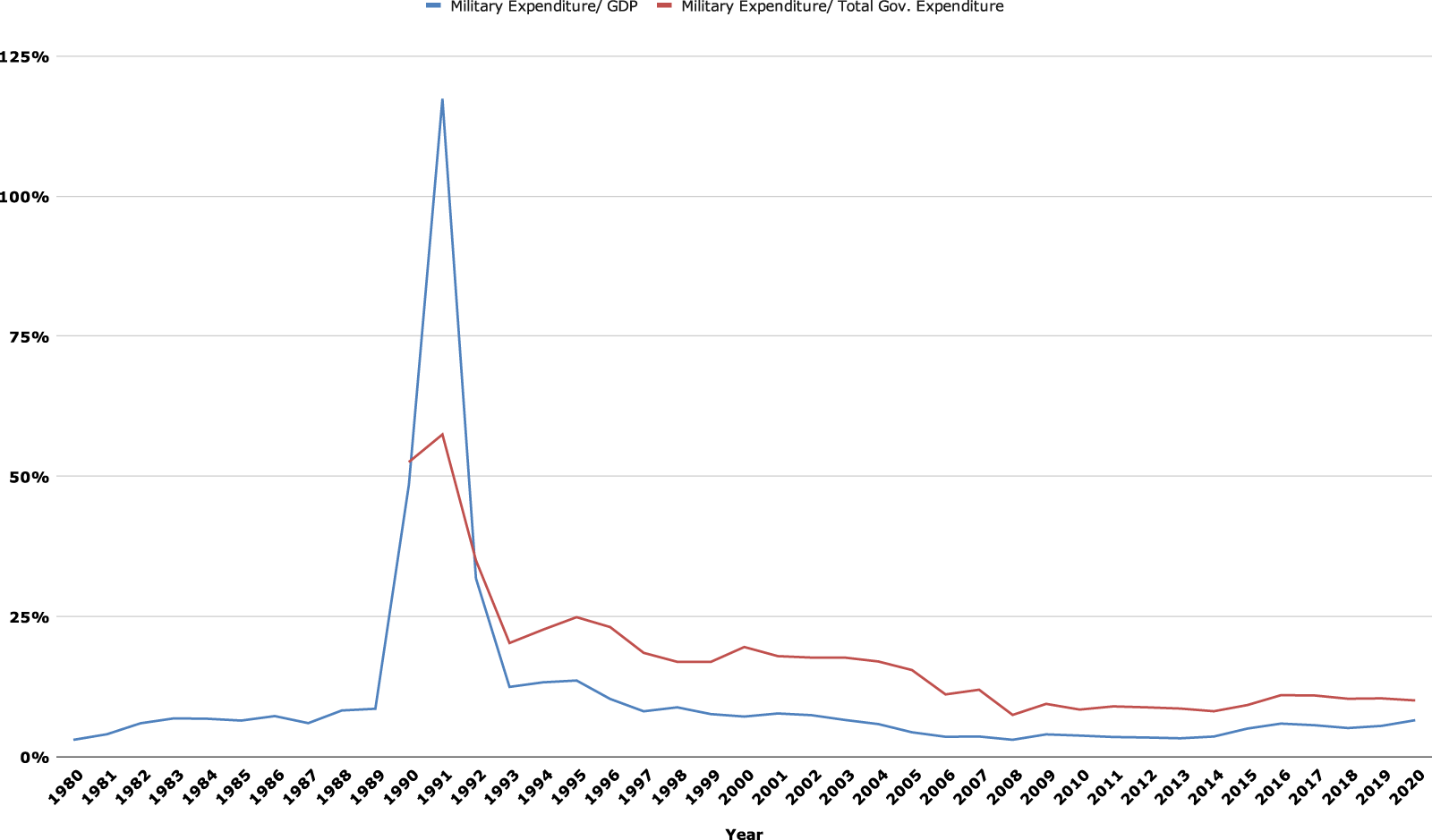
Above all, with parliament still suspended, the post-war government immediately launched a gargantuan defence budget – the largest in Kuwaiti history, and one appreciated as ‘ideally cooperative’ by US officials.Footnote 71 In 1991, military expenditures spiked at well over 110 per cent of the country’s national GDP and nearly 60 per cent of the total public budget (Figure 1). Even this under-estimates the scope of defence-related spending, as it does not include the partial sell-off of Kuwait’s sovereign wealth fund to compensate the US-led coalition after liberation. Such capital underwrote new arms deals with the United States, which far exceeded the cost and footprint of past purchases. Among them were hundreds of the most advanced American battle tank, the M1A2 Abrams; dozens of updated F/A-18 Hornet fighter aircraft; and hundreds of advanced Hawk and Patriot anti-air defence systems. Such a strategy replaced Kuwait’s pre-war stance of possessing diversified, but often incompatible, weapons systems in favour of heavy reliance upon the US armoury, with the goal of maximising interoperability with American troops and streamlining training.
Military expenditure as per cent of GDP and per cent of government spending in Kuwait, 1980–2020.

Beyond this, the Sabah monarchy formulated political responses to rejuvenate its armed forces. In addition to restoring parliament as promised and holding general elections in October 1992, the Emir obliged military dissidents by removing many senior officers who had failed to perform during the invasion. Moreover, signalling a desire for competence over favouritism, at least at the uppermost ranks, in 1993 the Emir appointed a commoner rather than a Sabah prince, General Ali al-Moumen, as the chief of staff for the armed forces for the first time. This signalled momentum for reorganising the military’s entire operational doctrine along technocratic procedures borrowed from the United States. Calls to ‘Kuwaitise’ the defence sector resonated, and by the mid-1990s the MoD had ceased hiring Jordanians, Palestinians, and other foreign military staff in its support bureaucracy.Footnote 72 The government also announced plans to more than double the size of the armed forces to 40,000 personnel, anchored by proposals to utilise conscription to replace the bidun with citizens. By 1995, such policies bore initial fruit: just 25 per cent of the army were bidun, down from the pre-war figure of 80 per cent.Footnote 73
Fairly, a cynical view would hold that such efforts were purely symbolic, and that the Sabah leadership simply desired to woo the United States with more arms purchases and superficial policies. While this national militarisation programme certainly floundered over the decade, it is necessary to appreciate these institutional reforms in the context of the early 1990s rather than hindsight. For one, crucial indicators of Kuwaiti state behaviour – including not just arms imports but also defence spending, recruitment policies, and strategic doctrine – sharply diverge from the pre-war era. They suggest a decisive intention to generate what the emirate had lacked: a proficient military able to pose a defensive challenge in war. For another, Western observers themselves believed this campaign was genuine rather than hyperbole. In 1995, one American analyst praised the minister of defence, Sheikh Ahmad Hamoud al-Sabah, when he pronounced that the Kuwaiti military would soon rank among the Gulf’s strongest: Kuwaiti forceshave been rebuilt and improved to the point where they can play an important role in demonstrating that Kuwait has the will to protect its sovereignty. They are developing an improved ability to deal with the kind of threatening movements, infiltrations, and low-level attacks and Iran and Iraq can use.Footnote 74
Finally, the burgeoning nature of the US–Kuwaiti relationship itself over the 1990s divulges evidence regarding the ambitious reach of national militarisation. Though the 1991 DCA was classified, it reportedly covered ‘mutual discussions in the event of a crisis; joint military exercises; US evaluation of, advice to, and training of Kuwaiti forces; US arms sales; pre-positioning of US military equipment; and US access to a range of Kuwaiti facilities’.Footnote 75 These mechanisms made US–Kuwaiti military relations among the closest in the Middle East, encompassing far more than arms. US grand strategy situated Kuwait as a vital outpost in its expanding basing infrastructure across the Gulf, one designed to contain Iraq and Iran.Footnote 76 However, according to one American officer, it also envisioned assisting Kuwaiti leaders in creating an operationally proficient military for its own sake.Footnote 77 Here, context matters: in the early 1990s, Iraq – encaged by international sanctions and with a still-sizeable military – appeared to post a plausible threat to attack its southern neighbour once more. In October 1994, for instance, when Iraqi Republican Guard divisions moved towards the Kuwaiti border, a mini-crisis ensued.
Importantly, American officials overseeing US–Kuwaiti military engagements in the early 1990s – field officers, senior advisors, support liaisons, defence industry representatives – also sought to renovate the emirate’s defence doctrine. They did not believe Kuwait could completely seal its borders, as the terrain was too open and the coastline too vulnerable. Instead, they counselled their Kuwaiti counterparts to embrace a new strategic framework of disciplined, mobile defence. Properly bolstered and restructured, its armed forces would fortify static strongpoints, field agile armoured units, and deploy the air force as rapid-strike assets.Footnote 78 With deadly kinetic capabilities guided by pinpoint precision, this new Kuwaiti military would easily deter minor Iraqi or Iranian incursions; but if another full-scale invasion exploded, it would hold out for precious weeks, giving the United States time to mobilise its own armada to level the playing field.
Representing a quantum leap in long-term planning, this national strategy required US involvement that went well beyond arms sales. The first US base in Kuwait, a small outpost called Camp Doha west of Kuwait City, soon gave way to far bigger facilities in Camp Arifjan and Ali Al Salem Air Base. A growing stream of US military units deployed to Kuwait led training programmes to transfer strategic expertise to local personnel. In 1991, American forces began conducting ‘Intrinsic Action’, a joint exercise that within years became the US military’s second large bilateral training exercise behind only the ‘Bright Star’ programme in Egypt.Footnote 79 Though Kuwaiti units also began training with French and British forces, American planners hoped to impart interoperable skills to Kuwaiti forces under the assumption that future regional conflict would require the two partner militaries to work together. Kuwaiti defence authorities also began working with the Office of Military Cooperation, representing the Department of Defense and stationed at the US Embassy, over issues such as arms acquisitions and force expansion. These engagements aimed to inject Kuwait’s post-war militarisation with American knowledge and materiel.
Constraints upon militarisation
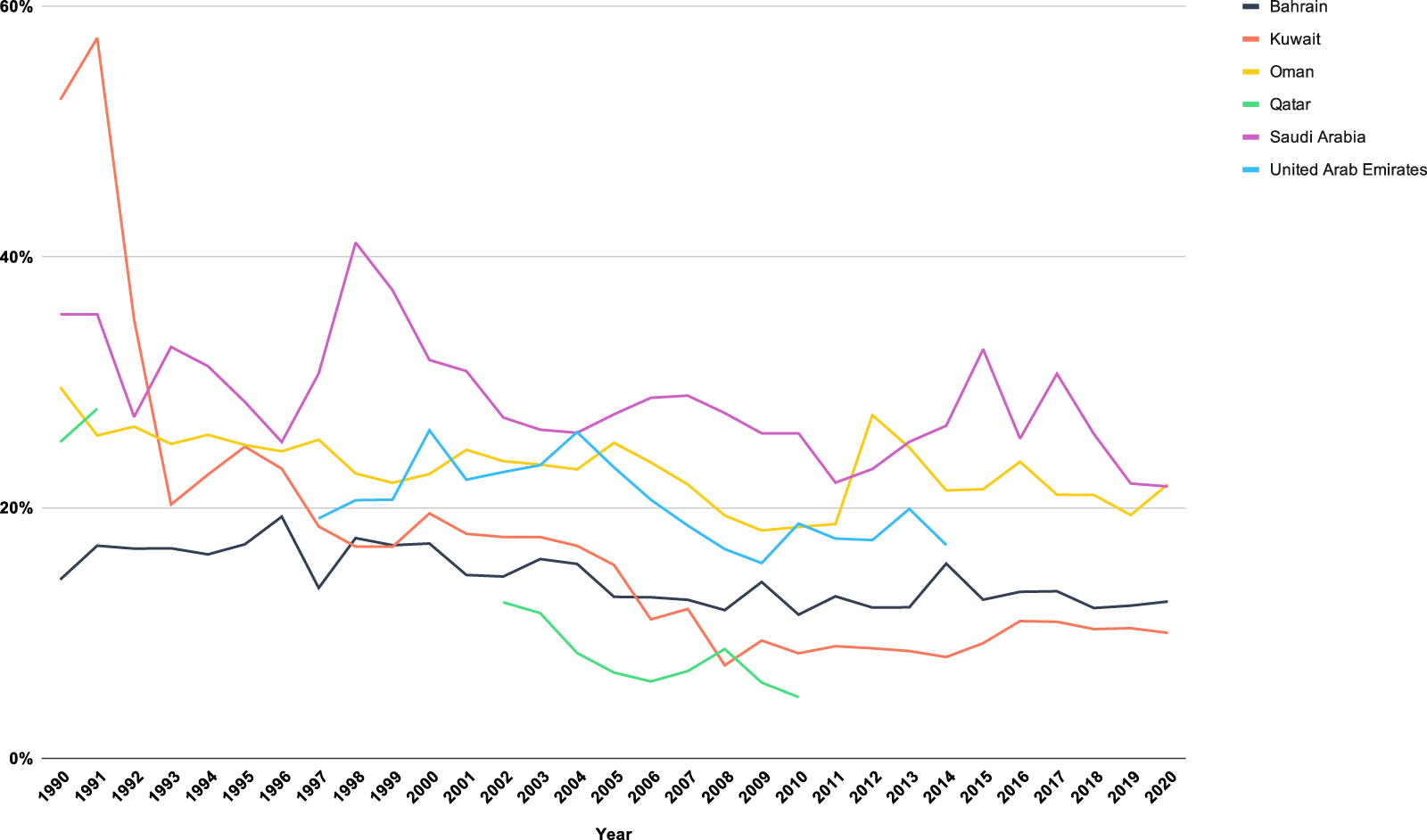
Despite post-war momentum towards militarisation, a remarkable dynamic unfolded after the early 1990s. Kuwait’s initial level of defence spending began tailing off, and by decade’s end had returned to its pre-war levels (Figure 1). This commenced the reverse ratchet effect invoked earlier in this paper. Unlike war-making states that find their military commitments paradoxically expand even when war ends, in Kuwait defence investments further declined by the mid-1990s, as the Sabah monarchy and government incrementally abandoned their post-war commitment to remake the armed forces. This occurred despite the persistence of external regional threats, US support for defence-related reforms, and a continuously ruling monarchy underwritten by oil wealth. By the early 2000s, Kuwaiti military spending had settled near the bottom of all six GCC kingdoms – a far cry from its top place a decade earlier (Figure 2).
Military expenditure as per cent of government spending in six Gulf kingdoms, 1990–2020.

Figure 2 Long description
The detailed data points are as follows: - In 1990, Bahrain had oil rents as 14 percent of GDP, Kuwait had 45 percent, Oman had 27 percent, Qatar had 24 percent, Saudi Arabia had 33 percent and United Arab Emirates data was not available. - In 1991, Bahrain had oil rents as 16 percent of GDP, Kuwait had 58 percent, Oman had 25 percent, Qatar had 24 percent, Saudi Arabia had 33 percent and United Arab Emirates data was not available. - In 1992, Bahrain had oil rents as 16 percent of GDP, Kuwait had 20 percent, Oman had 25 percent, Qatar had 24 percent, Saudi Arabia had 28 percent and United Arab Emirates data was not available. - In 1993, Bahrain had oil rents as 16 percent of GDP, Kuwait had 25 percent, Oman had 24 percent, Qatar had 24 percent, Saudi Arabia had 27 percent and United Arab Emirates data was not available. - In 1994, Bahrain had oil rents as 16 percent of GDP, Kuwait had 24 percent, Oman had 24 percent, Qatar had 24 percent, Saudi Arabia had 25 percent and United Arab Emirates data was not available. - In 1995, Bahrain had oil rents as 16 percent of GDP, Kuwait had 23 percent, Oman had 24 percent, Qatar had 24 percent, Saudi Arabia had 25 percent and United Arab Emirates data was not available. - In 1996, Bahrain had oil rents as 19 percent of GDP, Kuwait had 23 percent, Oman had 24 percent, Qatar had 24 percent, Saudi Arabia had 25 percent and United Arab Emirates data was not available. - In 1997, Bahrain had oil rents as 14 percent of GDP, Kuwait had 22 percent, Oman had 17 percent, Qatar had 24 percent, Saudi Arabia had 24 percent and United Arab Emirates data was not available. - In 1998, Bahrain had oil rents as 17 percent of GDP, Kuwait had 17 percent, Oman had 17 percent, Qatar had 24 percent, Saudi Arabia had 42 percent and United Arab Emirates had 20 percent. - In 1999, Bahrain had oil rents as 18 percent of GDP, Kuwait had 17 percent, Oman had 20 percent, Qatar had 24 percent, Saudi Arabia had 28 percent and United Arab Emirates had 22 percent. - In 2000, Bahrain had oil rents as 17 percent of GDP, Kuwait had 20 percent, Oman had 22 percent, Qatar had 23 percent, Saudi Arabia had 26 percent and United Arab Emirates had 24 percent. - In 2001, Bahrain had oil rents as 15 percent of GDP, Kuwait had 17 percent, Oman had 22 percent, Qatar had 23 percent, Saudi Arabia had 25 percent and United Arab Emirates had 23 percent. - In 2002, Bahrain had oil rents as 15 percent of GDP, Kuwait had 17 percent, Oman had 22 percent, Qatar had 12 percent, Saudi Arabia had 24 percent and United Arab Emirates had 23 percent. - In 2003, Bahrain had oil rents as 15 percent of GDP, Kuwait had 17 percent, Oman had 22 percent, Qatar had 12 percent, Saudi Arabia had 24 percent and United Arab Emirates had 23 percent. - In 2004, Bahrain had oil rents as 14 percent of GDP, Kuwait had 17 percent, Oman had 22 percent, Qatar had 12 percent, Saudi Arabia had 24 percent and United Arab Emirates had 24 percent. - In 2005, Bahrain had oil rents as 14 percent of GDP, Kuwait had 15 percent, Oman had 22 percent, Qatar had 12 percent, Saudi Arabia had 29 percent and United Arab Emirates had 24 percent. - In 2006, Bahrain had oil rents as 13 percent of GDP, Kuwait had 14 percent, Oman had 22 percent, Qatar had 8 percent, Saudi Arabia had 29 percent and United Arab Emirates had 24 percent. - In 2007, Bahrain had oil rents as 13 percent of GDP, Kuwait had 13 percent, Oman had 22 percent, Qatar had 8 percent, Saudi Arabia had 29 percent and United Arab Emirates had 23 percent. - In 2008, Bahrain had oil rents as 13 percent of GDP, Kuwait had 12 percent, Oman had 22 percent, Qatar had 8 percent, Saudi Arabia had 29 percent and United Arab Emirates had 22 percent. - In 2009, Bahrain had oil rents as 13 percent of GDP, Kuwait had 10 percent, Oman had 20 percent, Qatar had 5 percent, Saudi Arabia had 24 percent and United Arab Emirates had 20 percent. - In 2010, Bahrain had oil rents as 13 percent of GDP, Kuwait had 10 percent, Oman had 19 percent, Qatar had 5 percent, Saudi Arabia had 22 percent and United Arab Emirates had 19 percent. - In 2011, Bahrain had oil rents as 13 percent of GDP, Kuwait had 10 percent, Oman had 21 percent, Qatar data was not available, Saudi Arabia had 21 percent and United Arab Emirates had 19 percent. - In 2012, Bahrain had oil rents as 13 percent of GDP, Kuwait had 10 percent, Oman had 21 percent, Qatar data was not available, Saudi Arabia had 24 percent and United Arab Emirates had 19 percent. - In 2013, Bahrain had oil rents as 13 percent of GDP, Kuwait had 10 percent, Oman had 21 percent, Qatar data was not available, Saudi Arabia had 24 percent and United Arab Emirates had 20 percent. - In 2014, Bahrain had oil rents as 15 percent of GDP, Kuwait had 10 percent, Oman had 21 percent, Qatar data was not available, Saudi Arabia had 23 percent and United Arab Emirates had 20 percent. - In 2015, Bahrain had oil rents as 13 percent of GDP, Kuwait had 10 percent, Oman had 21 percent, Qatar data was not available, Saudi Arabia had 26 percent and United Arab Emirates had 17 percent. - In 2016, Bahrain had oil rents as 13 percent of GDP, Kuwait had 10 percent, Oman had 20 percent, Qatar data was not available, Saudi Arabia had 23 percent and United Arab Emirates data was not available. - In 2017, Bahrain had oil rents as 13 percent of GDP, Kuwait had 11 percent, Oman had 20 percent, Qatar data was not available, Saudi Arabia had 28 percent and United Arab Emirates data was not available. - In 2018, Bahrain had oil rents as 13 percent of GDP, Kuwait had 11 percent, Oman had 20 percent, Qatar data was not available, Saudi Arabia had 20 percent and United Arab Emirates data was not available. - In 2019, Bahrain had oil rents as 13 percent of GDP, Kuwait had 11 percent, Oman had 20 percent, Qatar data was not available, Saudi Arabia had 21 percent and United Arab Emirates data was not available. - In 2020, Bahrain had oil rents as 13 percent of GDP, Kuwait had 11 percent, Oman had 21 percent, Qatar data was not available, Saudi Arabia had 21 percent and United Arab Emirates data was not available.
Renewed popular contestation
Precipitating this turn was political conflict. Throughout late 1991 and 1992, Kuwait’s post-war government passed defence policies by royal fiat, as the Emir had not yet recalled the National Assembly from its pre-war suspension. However, the October 1992 elections produced an opposition-dominated parliament led by urban liberals and Islamist blocs. Supported by a raucous media, with temporary censorship laws having ended in January 1992, these voices ‘were united in their criticism of the government’ and eager to restore some semblance of legislative authority.Footnote 80 A bruising crisis followed over defence spending. In late 1993, the opposition-led National Assembly rejected the government’s $12 billion multi-year proposal to finance a new raft of military projects, including ‘off budget’ weapons purchases. MPs complained that such breakneck spending would augur widespread corruption, while questioning whether it would drain the battered post-war economy.Footnote 81 Backed by public sentiment, the obstinate parliament assented to just some of these measures – and only after embarrassing the government by installing stricter oversight rules through the SAB and MoD’s Foreign Procurement Office. In this way, legislative scrutiny relentlessly pruned the government’s annual defence spending for the rest of the decade.
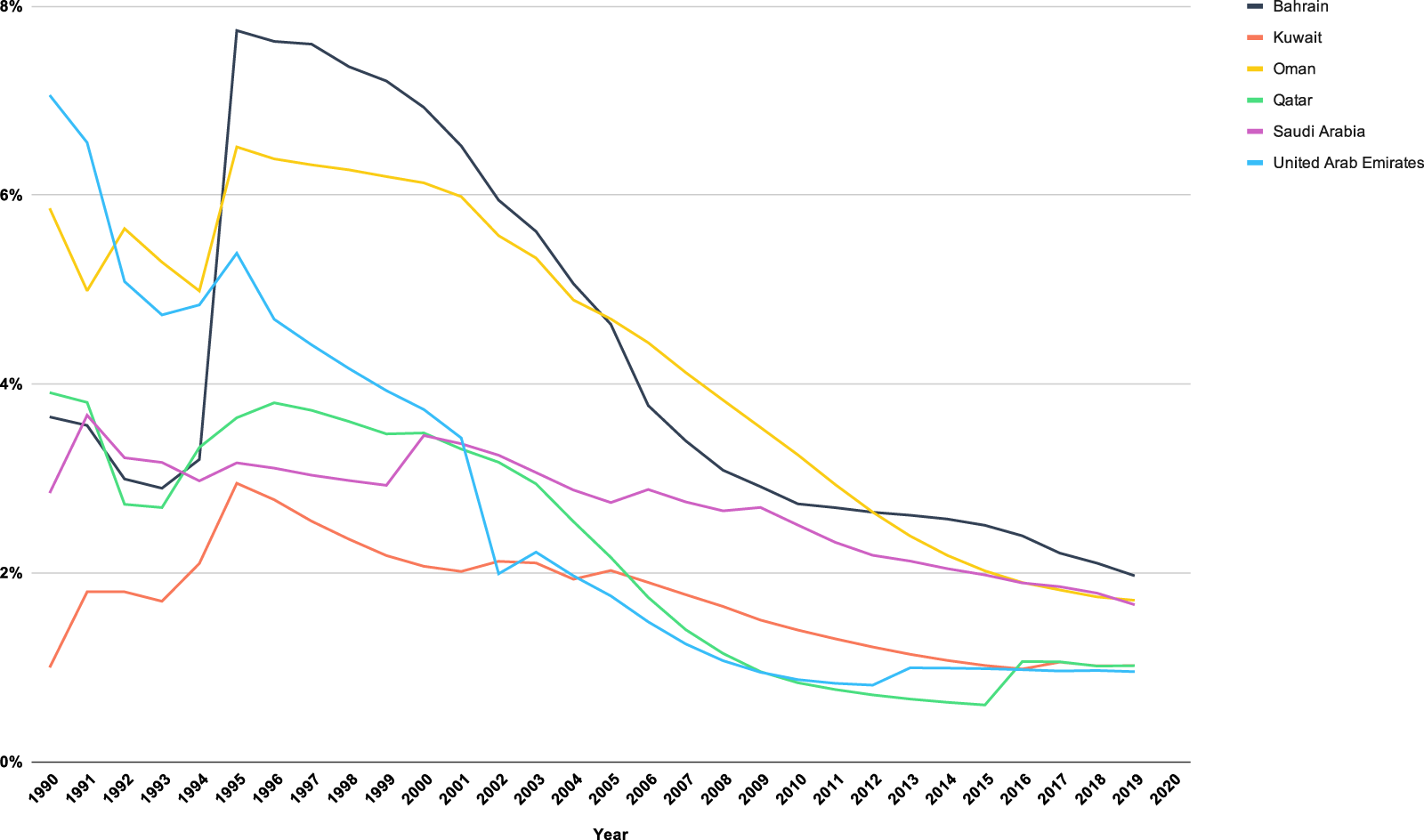
Constrained militarisation through such domestic political clashes also implicated post-war plans to double the military’s manpower. As Figure 3 indicates, Kuwait’s military personnel as per cent of the total labour force peaked at 3 per cent in 1995 but declined afterwards. By the early 2000s, the Kuwaiti armed forces measured only modestly bigger than their pre-war size, with about 20,000 personnel. The manpower issue touched upon national controversy regarding identity politics. Calls to Kuwaitise the armed forces drew support from nationalist MPs, journalists, and pundits who blamed bidun soldiers for the military’s ruinous defeat during the war; in turn, this raised the ire of more liberal activists, who called for granting Kuwaiti citizenship to the stateless.Footnote 82 In parallel, rural tribal MPs backed Kuwaitisation and army expansion, hoping to create more military work for their constituencies – but clashed with others calling for fiscal austerity and ending conscription.
Military personnel as per cent of total labour force in six Gulf kingdoms, 1980–2020.

Figure 3 Long description
Military Personnel as Percent of Total Labor Force in Six Gulf Kingdoms, 1980 to 2020. X-axis: Year, ranging from 1990 to 2020. Y-axis: Percent, ranging from 0 to 8 percent. The graph includes six lines representing Bahrain, Kuwait, Oman, Qatar, Saudi Arabia and United Arab Emirates, distinguished by different colors. Bahrain shows a sharp peak in the mid-1990s near 8 percent, followed by a long decline. Oman starts high in the mid-1990s and steadily declines. United Arab Emirates has higher values in the early 1990s, then drops. Kuwait rises into the mid-1990s, then gradually declines. Qatar and Saudi Arabia generally have lower values, trending downward. The lines converge towards lower percentages by 2020, with Bahrain and Oman showing the most significant declines. The graph highlights the overall reduction in military personnel as a percent of the labor force across these countries over the period.
Such legislative gridlock foreclosed Kuwaitisation, making defence officials wary of proposing further initiatives lest it broach withering backlash. Unable to overcome popular distaste for military service, which most citizens still saw as unviable and lowly, the military continued recruiting bidun troops, whose proportion of manpower jumped from its low point of 25 per cent in 1995 back to 40 per cent in 2004.Footnote 83 Officials quietly halted conscription in 2001, conceding its failure. Simultaneously, other institutional practices previously targeted for reform persisted. Within the officer corps, Western observers by the late 1990s began reporting that the same type of candidates predominated: Kuwaitis from rural tribal neighbourhoods with some urbanites thrown in, all of whom expected promotion because of loyalty and favouritism rather than proficiency and performance.Footnote 84
By the mid-1990s, such flashpoints of back-breaking resistance discouraged the monarchy, which assumed that national militarisation would garner consensual support. Instead, defence policy had become drawn into the quotidian rhythms of daily political clashes. Leveraging the press to broadcast their ideas, emboldened parliamentary groups mounted more contentious demands after the early 1990s – from the liberal push for female suffrage and greater democracy to Islamist calls for more conservative religious practices.Footnote 85 Accusations of government corruption and financial mismanagement roiled legislative spaces and drove public debate. Twice in the decade (1996 and 1999), the Emir dissolved parliament and called for new elections; but both times, opposition blocs emerged victorious thanks to outspoken voters and sectarian networks and resumed haranguing the government. Indeed, Kuwaiti observers see this decade as the decisive moment in which parliament’s role as the flag-bearer for royal accountability ‘became consolidated and deeply rooted’.Footnote 86
The demotion of militarisation within the royal agenda became apparent to outsiders. By the early 2000s, frustrated Western advisers reported that Kuwaiti officials routinely ignored their advice to update planning, communication, and organisational practices essential to defence proficiency: the effort to create a ‘leaner and meaner’ local military was ‘a lost cause’.Footnote 87 While joint training exercises with the US and other Western armed forces continued, they had become ‘spectacles where Kuwaiti units carry out simple pre-planned manoeuvres. There is little unit coordination between Kuwaiti forces [ground units working with air units]. Allied training units operate independently.’Footnote 88 In the same way, planned reforms to develop an innovative combined-arms and mobile strategic framework never materialised. Neither did initiatives to create agile special forces modelled after Western units. Such torpor continues today, especially when compared to other Gulf kingdoms. In recent years, Saudi Arabia, Qatar, and the UAE have developed sprawling defence industrial complexes, driven by not only military institutions but also think-tanks, defence offset corporations, and AI startups attracting immense foreign investment. Kuwait’s defence industry has few such markers of twenty-first-century militaristic modernity, possessing instead small service and support firms for the national military.
These issues had deleterious effects upon military operations. On paper, the Kuwaiti army and air force in the early 2000s were certainly better equipped than their pre-war versions, thanks to the United States. However, analysts noted that even the best-outfitted combat brigades were understaffed by as much as 40 per cent, and that beyond the bidun, Kuwaiti commanders had resorted to recruiting foreign troops – mostly from Arab allies, as well as Muslim Asian states like Bangladesh and Pakistan – to fill these gaps. Jane’s Information Group, an influential British defence industry outlet, lambasted this weakness: ‘Many soldiers are foreign, poorly paid, and poorly trained. It is highly unlikely they would fight for Kuwait’s freedom and independence in the case of war.’Footnote 89 When the government re-introduced compulsory military service in 2015, mirroring new conscription programmes in Qatar and the UAE, these old conundrums resurfaced. The policy proved wildly unpopular, far fewer eligible men registered, and loopholes allowed many potential recruits to avoid enlistment.Footnote 90
In the same way, arms purchases tailed off from their frenetic post-war pace. Global defence industry publications rang the first alarm in 1994, when the Kuwaiti government announced sudden reductions in several European defence contracts. Some observers blamed falling energy prices and reduced financial revenues for this.Footnote 91 Yet this does not tell the whole story. Kuwait began scaling back arms imports well before oil prices crashed in 1998. Moreover, the UAE and Saudi Arabia – also vulnerable to depressed energy prices – began planning their own military build-up programmes in this time.Footnote 92 The next section provides close details of how one spectacular arms cutback involved the United States, underscoring the linkage between the ambient climate of political contestation and constrained militarisation.
The American cannon crisis
If any post-war policy in Kuwait reifies the reverse ratchet effect of declining militarisation, it is arms procurement. In 2000, the Kuwaiti government rescinded an $800 million agreement to purchase the Paladin M-109A3 self-propelled artillery system from a US subsidiary of the British defence firm BAE. Despite years of negotiations and a last-minute visit to Kuwait City by US Secretary of Defense William Cohen, Kuwaiti officials failed to obtain legislative approval – statutorily required for all arms contracts, which fall outside normal government budgeting. Interlinked with wider popular support and suspicion, parliamentary opposition thus accounts for one of the largest failed US arms contracts in Middle East history. As Defence Minister Sheikh Jabir al-Mubarak al-Sabah conceded in a 2002 interview with Defense News, ‘The real problem is the lack of trust between the Parliament and the Defence Ministry, and it’s harming the Army’.Footnote 93
Plans to upgrade the Kuwaiti artillery began in 1995, following the acquisition of new US tanks and armoured personnel carriers. The new US-directed strategy to turn the Kuwaiti military into a mobile defence force called for two battalions of self-propelled artillery. In 1996, the MoD released contractual tenders to purchase and service a new mobile artillery system. Four suppliers, including firms from the United States and China, were identified and allowed to submit bids. The final decision fell upon the Kuwaiti chief of staff, which began field-testing the candidates.
The parliamentary buzzsaw
When the MoD submitted the Paladin purchase contract to parliament for approval in 1998, however, a buzzsaw of criticism awaited. Previously in April 1995, a parliamentary committee had documented thirty-three financial and legal violations in previous weapons deals, many of them occurring following the 1986 legislative suspension.Footnote 94 This compelled MPs to expand the SAB’s purview to cover all public contracts, including arms purchases, over 100,000 dinars (about $300,000). Additionally, Law No. 25 of 1996 required that all ‘commissions, presents, or donations’ tied to public contracts be reported to the Bureau.Footnote 95 This covered the activities of local Kuwaiti agents representing foreign contractors and firms in their dealings with the government, who received commissions or percentages from successfully sold services and products.Footnote 96
Such exacting oversight procedures in Kuwait are often contrasted by Western observers with less onerous processes in the UAE, Qatar, or Saudi Arabia. While US military officers can have almost daily contact with their Kuwaiti counterparts in the MoD’s procurement office, there is no such relationship with the civilian SAB. When foreign weapons deals come under discussion, ‘MOD officers are constantly looking over their shoulders in fear of what the audit bureau or parliament might look into’.Footnote 97 While a general belief holds that the SAB lacks expertise in military affairs, ‘its inquiries are deemed serious and sometimes rigorous’. Beyond the letter of a government-to-government weapons contract, the SAB has wide authority to assess the fairness of a contract.Footnote 98 Press coverage, political leaks, and public opinion play an important role in these bureaucratic politics. American officials in the Office of Military Cooperation in Kuwait acknowledge that, at times, even they have assisted Kuwaiti MoD authorities in responding to auditors’ questions and media inquiries about pending US weapons sales. Moreover, under US law, congressionally mandated public announcements of all foreign military sales can sometimes be the first notice for the Kuwaiti public and parliament about their own government’s purchase plans.
This oversight has impacted Kuwaiti relations with its Western defence suppliers. Western advisors perceive that Kuwaiti military leaders are ‘obsessed with reporting high levels of readiness for the weapons they have purchased and deployed’, not least because MPs regularly request readiness reports after major arms procurements.Footnote 99 Indeed, this has made US defence contractors alter their local marketing strategies to maximise their profitability given the possibility of political opposition. In other Gulf kingdoms like the UAE and Saudi Arabia, foreign defence firms often secure one local agent to represent all sales to the government. In Kuwait, they typically employ multiple agents for each system they intend to market: they ‘flood the zone’, so that if one agent’s sales pitch falls under public scrutiny, others may get by.Footnote 100 The public struggle over Kuwait’s effort to purchase American artillery exemplifies how these decentralised institutions can emerge as choke points in decision-making around the military.
The Paladin collapse
This terrain of popular enquiry ensconced the Paladin deal in heated wrangling within parliament, magnified by public discussion. MPs questioned why the MoD had chosen the Paladin over a less-expensive Chinese artillery system. They argued that preferencing the United States equated to Kuwait still unfairly paying for its liberation, despite having liquidated much of its sovereign wealth fund to pay for the US-led coalition’s wartime operations. They further noted that the military already had eighteen self-propelled artillery units purchased from France in 1991. Local press discussions of budgetary austerity reinforced suspicions about the wisdom of this massive deal, which in turn spurred public inquiries in more sensitive directions – in particular, which Kuwaiti firms and businessmen acting as agents benefited from the cannon contract.
In response, Kuwaiti officials desperately sought to convince the public throughout 1999. To little avail, they argued in parliament that comparative tests of the competing artillery systems showed the Paladin better fitting the military’s modernisation strategy. They rejected allegations of corruption. Yet they were contravened by the SAB’s official report on the Paladin contract, which cited an array of financial problems and accused the MoD of failing to exercise proper oversight. Opposition MPs seized on this and used the media to amplify their disparagement of a weaponry deal already seen as unnecessary and wasteful. Like public scrutiny over health and oil spending, opposition MPs found political leverage in the tension between public transparency in the amounts spent with outcomes that were opaque.Footnote 101 When MoD officials criticised the audit findings, the national daily Al-Qabas published the entire SAB report alongside the MoD’s responses. This exposed to a national audience the precise cost of the artillery, associated servicing expenses, the relative merits of competing systems, and whether agent fees were involved.Footnote 102 It was an astonishing amount of detail about an issue involving national security. In the July 1999 snap elections, several MPs even cited the need to quell corruption in military sales – a clear reference to the Paladin dispute – which ensured that the fracas would continue on to the next parliament.
When parliament resumed its sessions in October 1999, five opposition MPs called for the special Committee for the Protection of Public Funds to investigate the Paladin contract. The speaker of the parliament, Ahmed al-Sa’adoun, approved the move, further upsetting government authorities. As a last gasp, defence officials, and even Crown Prince Sa’ad al-Salim al-Sabah, countered with their own corruption accusations by alleging unnamed MPs had met with rival artillery producers. Amid this turmoil, the US secretary of defense and Kuwait’s minister of defence exchanged visits in late 1999 and early 2000. While both officials remained silent regarding the agreement, the precise timing of this exchange left little doubt about the underlying tension. In the end, Kuwaiti authorities cancelled the contract rather than face continued public investigation. This marked a vivid triumph of popular interests and parliamentary opposition over the government’s defence policies.
Conclusion
The American cannon crisis punctuates the core argument of this paper. Following its invasion and occupation during the Gulf war, Kuwait’s government embarked upon an elaborate militarisation framework aiming to dramatically transform its moribund armed forces. Within years, however, these ambitious plans stumbled in the throes of heated political contestation with domestic opposition. There was no single moment that decisively ended this US-backed defence modernisation scheme. Rather, military politics became ensconced within the humdrum cadence of ordinary politics. Such paralysis sidelined aspirational initiatives such as force expansion and arms purchases, inducing royal decision makers to forsake their initial aspirations.
This highlights the analytical value of exploring Kuwait as a case of constrained militarisation. None of the structural variables that shaped its initial push towards greater militarism – external threats, oil-fuelled monarchism, and American support – predict this fascinating outcome. Instead, domestic politics provides the most satisfying explanatory logic for the downward slide of Kuwait’s post-war military impetus, which complicates prevailing theories about defence politics, Gulf security, and foreign policy-making. These findings also carry implications beyond Kuwait. They underscore how the heavily publicised martial ascent of Saudi Arabia, Qatar, and the UAE obscures the tremendous variation in how modern states perceive threats, mobilise resources, and reorient their external posture. For other small and vulnerable states in the world, the Kuwaiti case illustrates that even oil wealth and systemic threats do not dictate a more intensively military pathway. In this way, while Kuwait’s stagnant militarisation pales alongside its more heavily armed Gulf neighbours, in global context it may be those Gulf cases – and not Kuwait – that are the true outliers in terms of how successfully small or weak states can upgrade their armed forces.
Meanwhile, state policy-making in Kuwait has remained embedded in its domestic context. Over the past two decades, public opposition has scuttled many economic projects and defence initiatives advanced by the royal government. In 2008, for instance, parliamentary defiance forced humiliated officials to bow out of a groundbreaking $17 billion deal to create a joint petrochemical venture between the state-run oil conglomerate and US-based Dow Chemical. Defence-related scandals erupted a decade later. One involved the MoD’s \$9 billion contract for new Eurofighter Typhoon aircraft, which prompted legislative interrogations about cost overruns and military bloat. Another detonated in 2019, when whistleblowers uncovered that high-ranking authorities – among them the prime minister and minister of defence, both senior Sabah princes – had embezzled over \$800 million from the army’s social fund. Incensed critics bemoaned that such massive corruption amounted to another ‘invasion of Kuwait’, invoking the Gulf war to further demonstrate the perils of government mismanagement.Footnote 103
Endemic parliamentary gridlock and tenacious popular outcry invigorated by such scandals led the current ruler, Emir Mish’al, to suspend the legislature altogether in May 2024 for at least four years. Since then, the monarchy has ruled with an iron fist by curbing media freedoms, jailing dissidents and former MPs, and revoking the citizenship of over 71,000 Kuwaitis by April 2026, effectively reducing the citizenry by 5 per cent.Footnote 104 Nonetheless, if Kuwaiti history is any guide, the pendulum of pluralism will eventually swing back towards openness and opposition. When it does, domestic political contestation will continue to shape the trajectory of Kuwait’s military policies.
Acknowledgements
The authors would like to acknowledge funding and institutional support from the Kuwait Program at Sciences Po. We thank Jing-Syuan Wong at Sciences Po for her extensive support with data and research. Sarah E. Parkinson and Jason Brownlee provided insightful comments on early drafts. We would also like to thank two anonymous reviewers for their constructive feedback.
Pete W. Moore is MA Hanna Associate Professor of Politics at Case Western Reserve University. His research focuses on the political economies of state-building and war in the modern Middle East. His recent work has been published in Middle East Report, Studies in Comparative International Development, The Middle East Journal, and Middle East Law and Governance. From 2021 to 2022, he held the Visiting Kuwait Chair at the Paris School of International Affairs. He currently directs research in the collaborative project Security in Context.
Sean Yom is Professor of Political Science at Temple University, United States. His research explores authoritarian institutions and political economy in the Middle East. He is author of Jordan: Politics in an Accidental Crucible (Oxford University Press, 2025), co-editor of The Political Science of the Middle East: Theory and Research since the Arab Uprisings (Oxford University Press, 2022), and articles in Comparative Political Studies, Global Studies Quarterly, European Journal of International Relations, and other journals. He sits on the editorial board of the International Journal of Middle East Studies and the editorial committee of Middle East Report.

 Open access

