Introduction
Guanidinoacetic acid (GAA) is synthesized from glycine and arginine by l-arginine:glycine amidinotransferase in kidney and liver of avian species (Dilger et al., Reference Dilger, Bryant-Angeloni, Payne, Lemme and Parsons2013). Subsequently, guanidinoacetate N-methyltransferase enzyme catalyses the synthesis of creatine through methyl group transfer from S-adenosylmethionine to GAA (Walker, Reference Walker1979). Moreover, creatine is considered as an important element in energy metabolism in the cells of vertebrates and birds (Michiels et al., Reference Michiels, Maertens, Buyse, Lemme, Rademacher, DIerick and Desmet2012). Generally, about 1.7% of the creatine content is irreversibly converted to creatinine each day and usually excreted in the urine (Wyss and Kaddurah-Daouk, Reference Wyss and Kaddurah-Daouk2000). Therefore, creatine must be regularly replaced. The animal's demand for creatine can be provided by endogenous synthesis or directly from the dietary animal protein.
Farm animals fed the diets containing a low amount of animal protein might be deficient in creatine. Hence, in view of the decreasing amounts of protein from animal-origin included in animal feeds, supplementation with creatine or its precursor, such as the GAA, might retrieve the creatine load in the tissues. Although birds endogenously synthesize creatine, approximately 25–33% of the total requirement of this component must be provided in the diet. Thus, GAA supplementation may be crucial to meet the needs of creatine and optimize the performance of broilers fed vegetable diets (Lemme et al., Reference Lemme, Ringel, Sterk and Young2007). Additionally, creatine as a feed additive shows some drawbacks, such as instability and high cost, compared with GAA, which is more stable and less expensive (Baker, Reference Baker2009).
The decline in egg production with advancing age was expected, this being the result of the genetically determined decline in ovulation rate over time (Johnston and Gous, Reference Johnston and Gous2003). At the end of the laying period, egg production rate and shell quality were declined which resulted in substantial economic losses (Saleh et al., Reference Saleh, Ahmed and Ebeid2019). Moreover, several physiological changes coincide with the end of the laying period including the reduction of circulating levels of estrogens (Williams et al., Reference Williams, Ames and Kiparissis2005). Meanwhile, some poultry farmers prefer to keep their hens in the late production period in order to obtain higher egg weights and for economic aspects (Nobakht et al., Reference Nobakht, Shivazad, Chamany and Safameher2006). Indeed, different dietary supplements may be a possible tool to achieve this goal. Several studies evaluated the efficacy of GAA as a creatine precursor in broilers (Michiels et al., Reference Michiels, Maertens, Buyse, Lemme, Rademacher, DIerick and Desmet2012; Mousavi et al., Reference Mousavi, Afsar and Lotfollahian2013; Abudabos et al., Reference Abudabos, Saleh, Lemme and Zakaria2014), but literature contains only limited data on their effects on the performance of laying hens. In broilers, GAA supplementation improves the feed utilization and the cellular energy metabolism (Michiels et al., Reference Michiels, Maertens, Buyse, Lemme, Rademacher, DIerick and Desmet2012). In addition to energy-related effects of creatine or its precursors, it also has anti-apoptotic and anti-oxidation effects on the cells (Meyer et al., Reference Meyer, Machado, Santiago, da-Silva, de Felice, Holub, Oliveira and Galina2006). Considering the reproductive performance of meat-type quail breeders, Murakami et al. (Reference Murakami, Rodrigueiro, Santos, Ospina-Rojas and Rademacher2014) recommended to use 0.15% of the GAA in the diet. Meanwhile, some authors suggested that the GAA supplements is not an appropriate strategy for improving the performance of commercial layers during the early stages of production (Khakran et al., Reference Khakran, Chamani, Foroudi, Sadeghi and Afshar2018). In addition, the dietary creatine supplements increased the feed intake of laying hens, with no significant changes in the egg production rate (Halle et al., Reference Halle, Henning and Köhler2006). Hence, the present study was conducted to assess the effects of dose-dependent GAA supplements on the egg production rate, energy metabolism and blood chemistry of commercial laying birds during the late stage of production.
Materials and methods
The care and handling procedures of the experimental birds were in accordance with regulations of the animal care committee of the New Valey University, Egypt.
Birds, management and experimental design
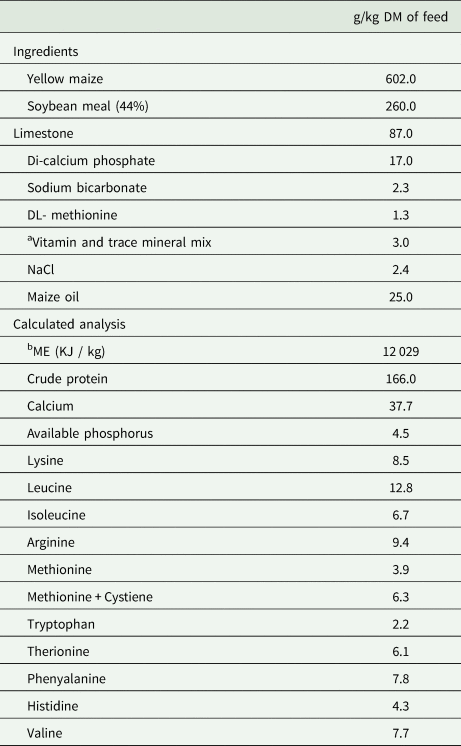
A total of 128, 72-week-old ISA Brown laying hens were randomly chosen from a flock with an average hen-day egg production (HDEP) of 72.56 ± 1.2%. The birds were divided into four equal groups (32 birds), and each subgroup had eight replicates (experimental cages) of four hens each. The experiment lasted for 6 weeks (week 78 of age). The laying birds were housed in wire cages (50 cm × 46 cm × 42 cm, L × W × H), with a schedule of 16 h/d light regimen. Over the whole experimental period, the average ambient temperature and relative humidity were 26 ± 1.5°C and 60 ± 3.0%, respectively. Feed supply was provided ad libitum, with a nipple watering device. In accordance with the standards of the NRC (1994), the basal diet was adjusted to provide the typical layer requirements (Table 1). The first group considered as a control one (GAA0) and fed the basal diets with no supplements. The other experimental groups fed the basal diets supplemented with 0.5 (GAA1), 1.0 (GAA2) and 1.5 (GAA3) g of GAA/kg diet. The GAA was obtained from Evonik (CreAmino®; > 96% guanidinoacetic acid).
Ingredients, composition and calculated chemical analysis of the basal diets

a Providing the following per kg of diet: of diet: vitamin A 10 000 IU; vitamin D3 (cholecalciferol), 3000 IU; vitamin E (all-rac-a-tocopherol), 30 IU; menadione, 1.3 mg; thiamine, 2.2 mg; riboflavin, 8 mg; nicotinamide, 40 mg; choline chloride, 400 mg; calcium pantothenate, 10 mg; pyridoxine, 4 mg; biotin, 0.04 mg; folic acid, 1 mg; vitamin B12, 0.013 mg; Fe (ferrous sulphate), 80 mg; Cu (copper sulphate), 8.0 mg; Mn (from manganese sulphate), 110 mg; Zn (zinc oxide), 60 mg; I (from calcium iodate), 1.1 mg; Se (from sodium selenite), 0.3 mg.
b ME: metabolizable energy.
Laying performance and egg quality traits
All eggs were collected and recorded on a daily basis to calculate the HDEP rate. Feed intake was recorded on a replicate basis over the whole experimental period. For each replicate cage, the average egg mass per hen per day in grams was estimated as the percentage of HDEP multiplying by the average egg weight in grams. Also, the feed conversion ratio (FCR) was expressed as grams of feed consumed per each gram of egg produced.
On a weekly basis, 16 eggs from each dietary group were chosen (two eggs per each replicate cage, incorporating the effect of replication) to determine the external and internal egg quality parameters. Individually, each egg was weighed and labelled. Using a sensitive electronic Vernier calliper (0.01 mm), egg width and egg length were recorded in mm. The egg-shape index was calculated as: egg width/egg length × 100. The internal egg quality traits were determined after evacuating the contents on a flat glass surface. The yolk index was calculated according to the procedure described by Saleh (Reference Saleh2013). The albumin height was measured in mm, with a subsequent calculation of corresponding Haugh units (Saleh, Reference Saleh2013). The eggshells were left to dry at room temperature and the shell thickness was measured from three regions (both poles and the equator) of each eggshell using a dial gauge micrometer (0.01 mm). Also, the absolute and relative weights were estimated for eggshell, yolk and albumin.
Liver antioxidant activity, nitric oxide and adenosintriphosphate levels
At the end of this trial (78 weeks of age), one bird from each replicate was chosen randomly (eight birds per group) and slaughtered according to the pre-stunning technique described by the Malaysian institutes (JAKIM, 2011). Liver samples were thoroughly rinsed with normal saline and deep-frozen for further analyses. The malondialdehyde (MDA) standards were prepared according to the procedure described by Karatepe (Reference Karatepe2004). The liver MDA levels were determined using an HPLC apparatus (Agilent HP 1100 series, USA). The thiols compounds of reduced glutathione (GSH) were estimated by HPLC using the procedure described by Jayatilleke and Shaw (Reference Jayatilleke and Shaw1993). According to the procedure of Teerlink et al. (Reference Teerlink, Hennekes, Bussemaker and Groeneveld1993), the detection of liver adenosintriphosphate (ATP) level was done using the HPLC apparatus. The nitric oxide level in the liver homogenate was determined according to the protocol described by Papadoyannis et al. (Reference Papadoyannis, Samanidou and Nitsos1999). The analytical HPLC column was anion exchange PRP-X100 Hamilton, 150 × 4.1 mm, 10 μm.
Statistical analyses
The data were analysed by ANOVA procedures of the IBM SPSS software program (Version 16.0; IBM Corp., NY, USA). Each cage (replicate) was considered as the experimental unit for laying performance traits. The model comprised the fixed effects of the dietary supplements (four levels: GAA0, GAA1, GAA2 and GAA3) and the random effect of experimental error. The differences between different means were estimated by the Duncan Multiple Range Test (DMRT). All results are expressed as means and the residual standard deviation (RSD). Orthogonal polynomials for diet responses were determined by linear and quadratic effects.
Results
Effect of dietary Guanidinoacetic acid supplements on laying performance
The effects of GAA dietary supplements on laying performance are illustrated in Table 2. The HDEP and egg mass were significantly increased in the GAA3 group as compared with the control group (P = 0.016 and 0.003, respectively). The GAA3 group showed the highest HDEP (75%) and egg mass (54.2 g). Furthermore, laying hens in the GAA2 and GAA3 groups had better FCR when compared with GAA0 group (P = 0.018).
Effect of dietary supplementation with guanidinoacetic acid on production indices of laying hens

a Control group.
b Group supplemented with GAA (0.5 g/kg diet).
c Group supplemented with GAA (1.0 g/kg diet).
d Group supplemented with GAA (1.5 g/kg diet).
e Residual standard deviation.
Effect of dietary Guanidinoacetic acid supplements on egg quality traits
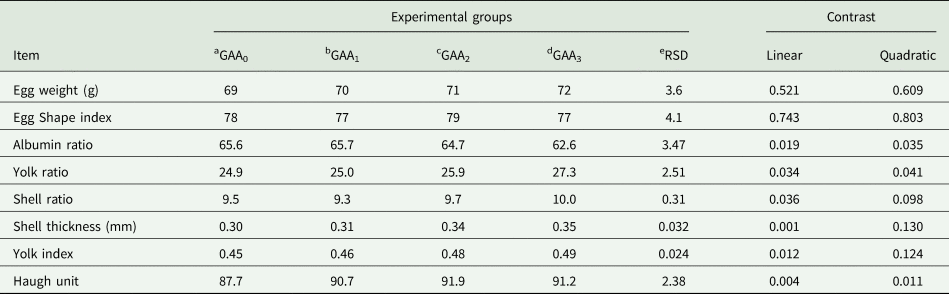
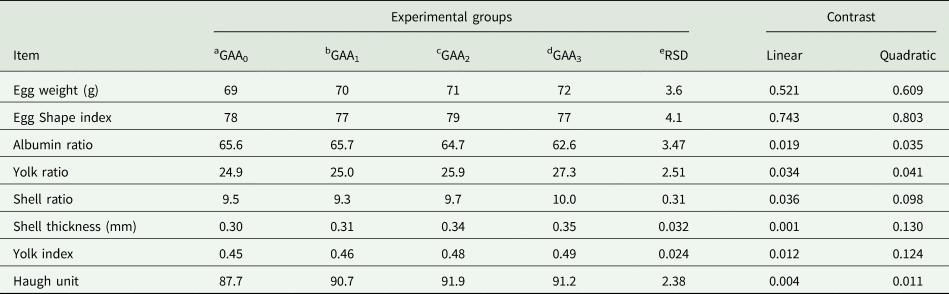
Data describing the effect of GAA dietary supplements on egg quality parameters are presented in Table 3. Although the egg weight was not affected (P = 0.521) by the dietary supplements, the shell ratio, shell thickness, yolk index and Haugh units increased linearly with the increase in the dietary supplements of the GAA (P = 0.036, 0.001, 0.012 and 0.004, respectively). Birds in the GAA2 and GAA3 showed better shell thickness (0.34 and 0.35 mm, respectively) and yolk index (0.48 and 0.49, respectively) when compared with GAA0 and GAA1 groups. There was hardly any difference noted across the different experimental groups regarding the egg shape index.
Effect of dietary supplementation with guanidinoacetic acid on the external and internal egg quality of laying hens
a Control group.
b Group supplemented with GAA (0.5 g/kg diet).
c Group supplemented with GAA (1.0 g/kg diet).
d Group supplemented with GAA (1.5 g/kg diet).
e Residual standard deviation.
Effect of dietary Guanidinoacetic acid supplements on liver antioxidants, nitric oxide and ATP levels
The effect of GAA dietary supplements on liver antioxidants, nitric oxide and ATP levels in laying hens are illustrated in Table 4. The current work reported a non-significant linear increase in the liver GSH level with the increase in the dietary supplements of the GAA (P = 0.212). Meanwhile, the liver MDA levels decreased linearly with the increment in the dietary levels of the GAA (P = 0.012). Birds in the GAA2 and GAA3 showed significantly higher liver NO level (52.5 and 54.2 mg/g, respectively) when compared with GAA0 and GAA1 groups (P = 0.029). Compared to the GAA0 group, all GAA-supplemented groups showed significantly higher liver ATP levels (P = 0.047).
Effect of dietary supplementation with guanidinoacetic acid on liver antioxidants, nitric oxide and ATP levels in laying hens

a Control group.
b Group supplemented with GAA (0.5 g/kg diet).
c Group supplemented with GAA (1.0 g/kg diet).
d Group supplemented with GAA (1.5 g/kg diet).
e Residual standard deviation.
f Malondialdehyde.
g Glutathione reductase.
h Nitric oxide.
i Adenosintriphosphate.
Discussion
With regard to the fact that the egg-laying ability in females is known to deteriorate with age, the present work was designed to investigate the effect of dietary GAA supplements on performance, liver antioxidant activity and energy metabolism in aged laying hens. In view of limited information about the effect of GAA supplements on laying hen performance, the discussion of some aspects is somewhat difficult. The current study recorded considerable positive effects of dietary GAA supplements on HDEP and egg mass in commercial laying hens. While some authors reported that the different supplements of GAA resulted in a non-significant increase in the egg production rate of commercial laying hens (Khakran et al., Reference Khakran, Chamani, Foroudi, Sadeghi and Afshar2018) and meat-type quail breeders (Dilger et al., Reference Dilger, Bryant-Angeloni, Payne, Lemme and Parsons2013; Murakami et al., Reference Murakami, Rodrigueiro, Santos, Ospina-Rojas and Rademacher2014), the results of the current work showed that the addition of GAA at a rate of 1.5 g kg−1 significantly increased the HDEP and egg mass in commercial laying hens. This effect may be attributed to the increased liver nitric oxide level in the GAA-supplemented groups. It has been known that GAA spares arginine in poultry diets and it consequently improves growth performance in broilers (Michiels et al., Reference Michiels, Maertens, Buyse, Lemme, Rademacher, DIerick and Desmet2012). Moreover, earlier research has reported an important role of arginine for protein and nitric oxide synthesis in vertebrate (Wu and Morris, Reference Wu and Morris1998). Indeed, nitric oxide activates the pituitary nitric oxide synthase, with a subsequent release of gonadotropinreleasing hormones (GnRH) which finally regulate the activity of FSH and LH hormones (McCann et al., Reference McCann, Mastronardi, Walczewska, Karanth, Rettori and Yu1999). In this context, dietary phytoestrogens supplements might have a part in promoting steroidogenesis resulting in a significant increase in the egg production rate in laying hens during the late stage of production (Saleh et al., Reference Saleh, Ahmed and Ebeid2019). The FSH enhances the recruitment, growth and maturation of new growing follicles into the ovarian hierarchy (Li and Johnson, Reference Li and Johnson1993). In accordance with such theory, some authors reported that supplementing the laying hen diet with 1.5% digestible arginine increased the egg production rate from 52% to 67.86% (Basiouni et al., Reference Basiouni, Najib, Zaki and Al-Ankari2006). In a more recent study, Khakran et al. (Reference Khakran, Chamani, Foroudi, Sadeghi and Afshar2018) reported that the addition of GAA to the laying hen diets increased the LH and FSH levels compared with control diets.
The current study reported that laying hens in the GAA2 and GAA3 groups had better FCR when compared with GAA0 group. This would be attributed to the contribution of the GAA in creatine synthesis and would conservation of arginine, which could then be utilized for other functions such as protein anabolism. Considering that most GAA-feeding trials were conducted in broilers, Ringel et al. (Reference Ringel, Lemme and Araujo2008) reported that dietary GAA supplements may have beneficial effects in improving the FCR in broiler chickens. Indeed, the GAA supplements have more beneficial effects on the FCR of broiler chickens during the finisher period (Michiels et al., Reference Michiels, Maertens, Buyse, Lemme, Rademacher, DIerick and Desmet2012). Meanwhile, others stated that the addition of GAA to the diets did not have any significant effects on the FCR of laying hens (Khakran et al., Reference Khakran, Chamani, Foroudi, Sadeghi and Afshar2018) and broiler chickens (Tossenberger et al., Reference Tossenberger, Rademacher, Németh, Halas and Lemme2016).
In the current study, the GAA supplements resulted in a non-significant linear increase in the fresh egg weight. This may be attributed to the suspected increase of FSH and LH activity in the GAA-supplemented groups, with a subsequent increase in the oviduct secretions (Zuelke and Brackett, Reference Zuelke and Brackett1993). Consistent with these results, Murakami et al. (Reference Murakami, Rodrigueiro, Santos, Ospina-Rojas and Rademacher2014) reported that the addition of GAA to the meat-type quail diets increased slightly the egg weight (P > 0.05). On the contrary, others reported that dietary inclusion of 0.171% GAA to the diet significantly reduced the egg weight in Hy-Line laying hens (Khakran et al., Reference Khakran, Chamani, Foroudi, Sadeghi and Afshar2018). Considering the fact that eggshell quality declines as hens approach the end of a laying period (Mazzuco and Hester, Reference Mazzuco and Hester2005), the current work reported a clear linear improvement in the shell quality parameters (shell ratio and shell thickness) with the increased levels of dietary GAA supplements. This could be indirectly attributed to the ability of GAA supplements to spare the dietary amino acid arginine in laying birds. In this context, it has been reported that arginine is involved in calcium metabolism and usually recommended in the alleviation of metabolic disturbance in calcium absorption (Fiore et al., Reference Fiore, Pennisi, Cutuli, Prato, Messina and Clementi2000). In a recent study, Sahin et al. (Reference Sahin, Orhan, Tuzcu, Hayirli, Komorowski and Sahin2018) recorded that the addition of arginine-silicate-inositol complex to laying hen diets during the peak production period could improve the eggshell thickness and eggshell calcium deposition. Lieboldt et al. (Reference Lieboldt, Halle, Frahm, Schrader, Weigend, Preisinger and Dänicke2015) also stated that L-arginine enriched diets improved the eggshell proportion in commercial laying hens. In the current trial, the criteria of internal egg quality (yolk index and Haugh units) were linearly improved with the increased dietary GAA levels. The assumed ability of GAA supplements to spare the dietary amino acid methionine may be a possible explanation (Ostojic et al., Reference Ostojic, Niess, Stojanovic and Idrizovic2014). In accordance with these suggestions, Li et al. (Reference Li, Zhang, Gong, Zhou, Zhan and Zou2017) showed that dietary methionine supplements can improve the internal egg quality (albumin height and Haugh units) after 8 weeks of feeding.
Although the current research did not record considerable differences in the liver GSH levels between different experimental groups, the GAA supplements resulted in a significant reduction in the liver MDA levels. Consistent with these results, Nasiroleslami et al. (Reference Nasiroleslami, Torki, Saki and Abdolmohammadi2018) reported that the dietary supplementation of 1200 mg/kg GAA significantly decreased the serum MDA level in broilers subjected to cold stress. In growing-finishing pigs, Wang et al. (Reference Wang, Shi, Shan and Zhang2012) had reported that a higher dosage of dietary GAA supplements increased the total antioxidant capacity, with an eventual reduction in the plasma MDA level. The positive effects of GAA on the liver antioxidant activity may be attributed to the expected higher creatine level. In this context, Demenice et al. (Reference Demenice, de Castro, Brosnan and Brosnan2016) summarized that creatine supplementation reduces the levels of oxidative stress biomarkers, such as TBARS, in the liver cells. On the contrary, others had reported that GAA supplements might decrease the cellular nonenzymatic antioxidant activity (Zugno et al., Reference Zugno, Stefanello, Scherer, Mattos, Pederzolli, Andrade, Wannmacher, Wajner, Dutra-Filho and Wyse2008).
Nitric oxide is a potent vasodilator which can increase blood flow to the uterus, ovaries and other reproductive organs (Khan et al., Reference Khan, Scholtz and Chenier2015). The current study demonstrated a linear increase in the liver NO levels with the increased dietary GAA supplements. In agreement with these outcomes, Khakran et al. (Reference Khakran, Chamani, Foroudi, Sadeghi and Afshar2018) reported a linear increase in the serum NO level with increased GAA supplements up to 0.114%. This may explain the improved HDEP in the GAA-supplemented groups. In this context, nitric oxide activates the pituitary nitric oxide synthase, with a subsequent release of gonadotropin-releasing hormones (GnRH), which finally stimulate the secretion of FSH and LH hormones (McCann et al., Reference McCann, Mastronardi, Walczewska, Karanth, Rettori and Yu1999). Previous reports have also indicated that FSH is involved in the arrangement of the ovarian hierarchy and also the growth and maturation of the growing follicles (Imai, Reference Imai, Mikami, Homma and Wada1983; Li and Johnson, Reference Li and Johnson1993).
The current trial demonstrated significantly higher liver ATP levels in all GAA-supplemented groups as compared with the GAA0 group. Based on the findings from five field trials, the European Food Safety Authority (2009) stated that creatine and ATP contents in the breast muscles of chickens were significantly increased in the GAA-supplemented groups. Ringel et al. (Reference Ringel, Lemme, Knox, McNab and Redshaw2007) also summarized data indicating an increase of ATP molecules with increasing GAA supplementation while the molecules with a lower energy load, such as Adenosin-monophosphate (ADP), were reduced in the breast muscles of broilers during the first few hours of the postmortem period. Considering that the phosphorylated creatine to ATP ratio is one of the most accurate indicators for the status of cellular energy, several trials reported an improved ratio with GAA supplementation in broilers (Michiels et al., Reference Michiels, Maertens, Buyse, Lemme, Rademacher, DIerick and Desmet2012) and turkeys (Lemme et al., Reference Lemme, Gobbi, Helmbrecht, Van Der Klis, Firman, Jankowski and Kozlowski2010). Indeed, an increase in the phosphorylated creatine to ATP ratio improves the efficacy of several biochemical processes in all cells and tissues, consuming energy sources in the form of ATP molecules such as muscular contractility, cellular motility, cell metabolism, and ion-homeostasis (Wallimann et al., Reference Wallimann, Tokarska-Schlattner, Neumann, Epand, Epand, Andres, Widmer, Hornemann, Saks, Agarkova, Schlattner and Saks2007). It may also be suggested that the increase of muscle creatine is usually associated with the more effective backup process for ATP/ADP. Interestingly, the GAA supplements have been used to reduce the caloric intake per kilogram of body gain and carcass weight in broiler chickens (Mousavi et al., Reference Mousavi, Afsar and Lotfollahian2013). Hence, the GAA supplements could be used to keep the overall energy homeostasis of the bird, depending on the arginine sparing effect of GAA (Dilger et al., Reference Dilger, Bryant-Angeloni, Payne, Lemme and Parsons2013).
Conclusion
From the aforementioned results, it could be concluded that dietary supplementation of GAA can improve the performance, eggshell characteristics and the internal egg quality of commercial laying hens during the late stage of production. Moreover, the dietary GAA supplements at doses of 1.0 or 1.5 g/kg may improve the antioxidant activity and the status of cellular energy metabolism in the laying hens.
Financial support
This research received no specific grant from any funding agency, commercial or not-for-profit sectors.
Conflict of interest
The authors declare that they have no conflict of interest.
Ethical standards
The experiment followed the guidelines of the Animal care committee, New Valley University, Egypt.