INTRODUCTION
Invasion and successful colonization of non-indigenous species is no longer a matter of isolated incidents, but a regular event in a globalized world. In a strict sense invasions are neither new nor exclusively human driven phenomena, but the geographical scale, frequency, and the number of invasive organisms recorded during the past decades have increased dramatically as a direct consequence of expanded transportation and commerce (e.g. Wells et al., Reference Wells, Poynton, Balsinhas, Musil, Joffe, van Hoepen, Abbott, Macdonald, Kruger and Ferrar1986; di Castri, Reference di Castri, Drake, Moyle, Rejmánek and Vermeij1989; Minchin et al., Reference Minchin, Gollasch, Cohen, Hewitt, Olenin, Rilov and Crooks2009). Thus the number of species that have entered new areas through human activity has increased by orders of magnitude especially during the last 200 years. This alarming progress is now broadly recognized as a critical element of ecosystem change and a major threat to global diversity. Although only a small fraction of the many species introduced outside of their native range are able to colonize new habitats successfully, their effects may be dramatic. The biological impacts of invaders on affected ecosystems and their native faunal and floral components are multifaceted and complex (Mack et al., Reference Mack, Simberloff, Lonsdale, Evens, Clout and Bazzaz2000), including, for example, competition for resources (Usio et al., Reference Usio, Konishi and Nakano2001), endemic species being lost by hybridization with invasive species (Rhymer & Simberloff, Reference Rhymer and Simberloff1996), alteration of habitats (Denslow, Reference Denslow2002) and so forth. Additionally, governments are faced with drastic economic consequences. For example, through damage to agriculture, forestry and fisheries (de Wit et al., Reference de Wit, Crookes and van Wilgen2001), introduced species inflict enormous costs, estimated at $120 billion per year to the US economy alone (Pimentel et al., Reference Pimentel, Zuniga and Morrison2005). For marine species a variety of introduction pathways has been documented: ballast water (Wasson et al., Reference Wasson, Zabin, Bedinger, Diaz and Pearse2001); biofouling by adhering to ships and floating anthropogenic debris (Barnes Reference Barnes2002a, Reference Barnesb; Convey et al., Reference Convey, Barnes and Morton2002); canals such as the Suez Canal and the Panama Canal (Golani et al., Reference Golani, Azzurro, Corsini-Foka, Falautano, Andaloro and Bernardi2007); and the aquaculture industries (Wolff, Reference Wolff2005).
In 1996 an unknown sponge species was discovered in the Ria of Etel, French Brittany, and since 1999 it was repeatedly recorded in the nearby Gulf of Morbihan. The sponge remained unidentified until Perez et al. (Reference Perez, Perrin, Carteron, Vacelet and Boury-Esnault2006) established a new genus and species, Celtodoryx girardae, for it and concluded its probably invasive nature. Shortly afterwards or even simultaneously, an abundance peak of C. girardae was recorded in several localities around Oesterschelde, Netherlands (van Soest et al., Reference van Soest, de Kluijver, van Bragt, Faasse, Nijland, Beglinger, de Weerdt and de Voogd2007). The exact origin of this invader remains unknown so far, although oyster farms have been assumed to be the probable introduction source, because spat of the Pacific oyster (Crassostrea gigas) has been imported from British Columbia and Japan to the Oosterschelde estuary and the Gulf of Morbihan since the 1960s. At present C. girardae is part of the dominant macrofauna in shallow waters of the Gulf of Morbihan and Dutch coast and competes successfully with other macrobenthic organisms, overgrowing some of the other sessile invertebrates such as other sponges and octocorals (Perez et al., Reference Perez, Perrin, Carteron, Vacelet and Boury-Esnault2006). Moreover, it is thought to be distributed within a much wider range than has been recorded so far (van Soest, personal communication).
During our recent survey of the Chinese Yellow Sea sponge fauna, we found an abundant species with close morphological similarities to C. girardae. A detailed morphological and taxonomic investigation revealed that both Chinese and European sponges are in fact conspecific with Cornulum ciocalyptoides described by Burton (Reference Burton1935) from the Sea of Japan and later recorded from other localities of the North West Pacific (Koltun, Reference Koltun1959, Reference Koltun1971; Hoshino, Reference Hoshino1987; Khodakovskaya, Reference Khodakovskaya2005). In this paper we transfer the species of Burton from Cornulum to Celtodoryx and it consequently becomes the senior synonym of C. girardae. We confirm the invasive origin of the North East Atlantic Celtodoryx ciocalyptoides and document morphological variation between the Atlantic and Pacific populations.
MATERIALS AND METHODS
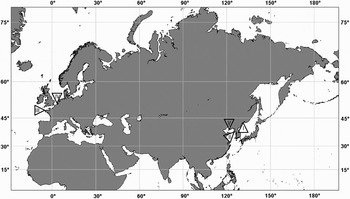
The type series of Celtodoryx ciocalyptoides (Figure 1I) was provided by the Zoological Institute of the Russian Academy of Sciences, St Petersburg (ZIN RAS), whereas the paratype of Celtodoryx girardae (Figure 1III) was made available by the Muséum National d'Histoire Naturelle, Paris (MNHN). Comparative material included a specimen sampled from the Dutch waters (Figure 1IV), deposited in the ZMA, Amsterdam, as well as 15 sponges collected by us by SCUBA diving from four different shallow-water localities in the Chinese Yellow Sea (Figure 1V) and deposited in Senckenberg Naturmuseum, Frankfurt am Main (SMF). We kept our specimens in seawater for several hours after sampling, then fixed them in 6% formaldehyde and later transferred them to 96% ethanol. Five specimens were examined in detail including a study of the skeletal architecture, SEM documentation and spicule measurements; others were studied less intensively. Skeletal architecture was observed in 200–400 µm thick sections under a light microscope. The preparation of sections mainly followed Vacelet (Reference Vacelet2006) and included dehydration, embedding in epoxy resin and cutting using a precise saw with a diamond wafering blade. Spicules were prepared by dissolution of the sponge organic components in nitric acid and then examined and measured under light microscope after mounting in Canada balsam on slides and by SEM (CamScan) after sputtering (Sputter Coater S 150B) of the spicules on stubs. A minimum of 35 spicules of each category in each specimen was measured.
Geographical distribution of Celtodoryx ciocalyptoides (Burton, Reference Burton1935) in chronology of discovery: (I) ‘Posiet Bay’, ‘Peter the Great Bay’, Russian part of Sea of Japan; (II) ‘Anhŭng’, South Korean part of the Yellow Sea; (III) ‘Gulf of Morbihan’, Brittany, France; (IV) ‘Oosterschelde’, Netherlands; (V) ‘Dalian’, Chinese part of the Yellow Sea.

RESULTS
SYNONYMS
Cornulum ciocalyptoides: Burton, Reference Burton1935: 72–73, figure 4; Koltun, Reference Koltun1959: 25–26, figure 3. Khodakovskaya, Reference Khodakovskaya2003: 76, table 1; 2005: 210, table 1.
Homoeodictya ciocalyptoides: Koltun, Reference Koltun1971: 93, figure 48, plate XI (3); Hoshino, Reference Hoshino1987: 26.
Coelosphaera physa (non-sensu Schmidt, Reference Schmidt1875): Sim & Byeon, Reference Sim and Byeon1989: 44, plate X. figures 1–6.
Celtodoryx girardae: Perez et al., Reference Perez, Perrin, Carteron, Vacelet and Boury-Esnault2006: 205–214, figures 2–3.
Isodictya ciocalyptoides: van Soest Reference van Soest2009.
TYPE MATERIAL
Two syntypes of Cornulum ciocalyptoides consist of two fragments in alcohol: Posiet Bay, Sea of Japan; water depth 3–4 m (ZIN 11137). Collected by Tazasov, 20 August 1926.
Posiet Bay, Sea of Japan, Station 34; water depth 2 m (ZIN 10844). Collected by Tazasov, 24 August 1926. Since Burton did not constitute a holotype, (ZIN 10844) is herewith designated as lectotype.
Paratype of Celtodoryx girardae: one specimen in alcohol: Les Gorets, Gulf of Morbihan, French Brittany; water depth 7 m (MNHN D JV 93). Collected by B. Perrin, July 2001.
COMPARATIVE MATERIAL EXAMINED
(ZMAPOR 19826) (1 specimen in alcohol): Wemeldinge, Oosterschelde, North Sea, 2.5 m, collected by M. de Kluijver 22 August 2005, initially identified as Celtodoryx girardae by R.W.M. van Soest.
Our material from the Dalian area, Chinese Yellow Sea: Dalian Wan Bay, Liaoning Province, China 38°52′07.84′′N 121°41′48.73′′E (9 specimens): (SMF 10851), 3.4 m, 23 August 2006; (SMF 10785), 3 m, 13 September 2006; (SMF 10790), 4.8 m, 13 September 2006; (SMF 10791), 6 m, 13 September 2006; (SMF 10794), 4.5 m, 13 September 2006; (SMF 10788), 5.9 m, 29 August 2007; (SMF 10792) (examined in detail), 5.2 m, 29 August 2007; (SMF 10793), 4 m, 29 August 2007; (SMF 10795), 4 m, 13 September 2006. Fujizhuang Beach, Liaoning Province, China 38°52′22.47′′N 121°35′45.49′′E (4 specimens): (SMF 10786) (examined in detail), 3.4 m, 1 September 2006; (SMF 10787), 2.9 m, 1 September 2006; (SMF 10789), 2.9 m, 1 September 2006; (SMF 10797) (examined in detail), 2.7 m, 1 September 2006.
Er Tuo Islands, Liaoning Province, China 38°52′07.47′′N 121°35′46.69′′E (1 specimen): (SMF 10796) (examined in detail), 5 m, 5 September 2006. Lv Shun, Liaoning Province, China 38°43′50.35′′N 121°12′44.19′′E (1 specimen): (SMF 10798) (examined in detail), 4 m, 5 September 2007.
DIAGNOSIS (EMENDED FROM PEREZ ET AL. 2006)
Coelosphaeridae with a plumose to plumoreticulate choanosomal skeleton of ascending tracts consisting of anisostrongyles and tylotes with terminal spines fanning out towards the surface, loosely connected. Ectosomal skeleton of a loose tangential arrangement of scattered anisostrongyles/tylotes and microscleres. Microscleres consist of arcuate isochelae of two distinct size categories and oxychaetes of one size category. Microscleres are distributed randomly within the choanosome.
External morphology
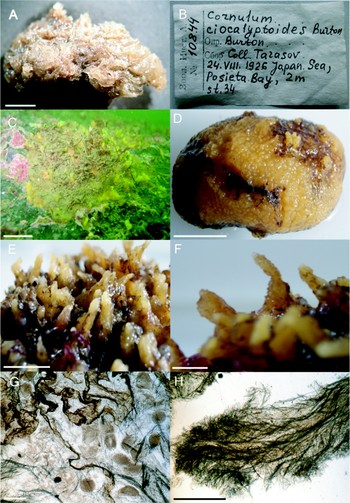
Lectotype (ZIN 10844]) of Cornulum ciocalyptoides a fragment of approximately 1.5–2.5 cm in length and 0.8 cm in width (Figure 2A). Texture soft, surface irregularly tattered. Colour in ethanol brownish. Paratype (MNHN D JV 93) of Celtodoryx girardae a fragment of approximately 1.5–2 cm in length and 1.5 cm in width. Texture soft, surface irregular. Colour in ethanol beige.
Celtodoryx ciocalyptoides (Burton, Reference Burton1935): (A) Lectotype of Cornulum ciocalyptoides (ZIN 10844) with (B) original label of Burton; (C) habit in situ (SMF 10796); (D–F) freshly collected; (D) globular with smooth surface (SMF 10794); (E (SMF 10791)–F (SMF 10790)) encrusting with fistulouse surface; (G–H) cross-section of choanosomal skeleton; (G) fracture of a histological choanosomal cross section (300 µm thick) showing developing embryos (SMF 10787); (H) cross-section (SMF 10788). Scale bars: (A, F) 0.5 cm; (C, D, E) 1 cm; (G) 0.5 mm; (H) 1.4 mm.

Colour of living Chinese specimens quince-yellow to golden yellow (Figure 2C–F), turning to whitish grey after fixation. Sponges of encrusting (Figure 2C, E), massive or globular (Figure 2D) growth form. Most specimens of a rugose, thickly incrusting base (mean thickness less than 3 cm) with fistulose surface (Figure 2E, F). Fistules from few millimetres to ~1 cm in length (Figure 2F). No visible oscules on the top of the fistules in either living or dead specimens. A number of freshly collected specimens with conspicuous brown spots on the surface (Figure 2D). Sponge with very soft, non-elastic texture, easy to cut or tear. Surface smooth, produces large amounts of mucus after cut off. Living specimens with an area of less than 20 cm2 (maximum size for Pacific specimens) up to 25 m2 (recorded from Oosterschelde, Netherlands). Thickness from few centimetres (for all localities) to 50 cm (recorded for Atlantic specimens). Specimens with incorporated detritus and sediment particles often associated with rhodophytes (Figure 2C, E).
Skeleton
Ectosomal skeleton with a loose tangential arrangement of single tylote or anisostrongylote megascleres, contains numerous microscleres and abundant foreign material such as diatoms and sediment particles.
Choanosomal skeleton densely plumose to plumoreticulate with perpendicular tracts of megascleres (tylotes or strongylotes) loosely connected, ending in surface brushes (Figure 2H). Diameters of bundles with a width range of 35–120 µm. Megascleres do not appear to be localized. Microscleres loosely distributed within the skeleton.
Spicules
Spicule dimensions presented in the text below are the values summarized for all specimens. Results for individual specimens are given in Table 1.
Spicule dimensions in different specimens of Celtodoryx ciocalypoides (Burton, Reference Burton1935). All values in µm; underlined numbers indicate mean values; numbers in parentheses indicate SD.

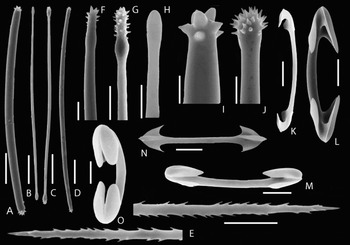
Megascleres of two types: (1) corresponds to proper tylote type, thin, usually shorter (Figure 3C), straight with well defined equal tyles, with the head either completely covered by spines (Figure 3C, J) or with smooth heads, then thinner and longer (Figure 3B, H); underlined numbers indicate mean values; numbers in parentheses indicate SD: 125–210 (±36)–335×1.6–4 (±1.1)–8 µm, tyle diameter of 2.4–4.7 (±1.1)–8 µm; (2) called anisostrongyles hereafter, intermediate type of style and strongyle, ends often asymmetrical (Figure 3A, D, F, G & I). They are straight or slightly curved with less and stronger spines on extremities compared to tylote type, generally longer and thicker than the other type, 150–290 (±47)–370×2.4–7 (±1.5)–12 µm.
Spicule types of Celtodoryx ciocalyptoides (SMF 10797) at SEM. Megascleres: (A–D, F–J), anisostrongyles (A, D) with different heads (F, G, I); tylotes (B, C) with different heads (H, J); microscleres: arcuate isochelae (K–O) of two size categories, large (L, M), small (O); reduced isochela (K); oxychaetes (E). Scale bars: (A, B, C, D) 30 µm; (F, G, J, K, L, M, N) 10 µm; (E, H, I, O) 5µm.

Microscleres of two types: (1) arcuate isochelae of two distinct size categories: (I) 33.6–49 (±3.6)–62 µm (Figure 3L, M & N) and (II) 16–23 (±1.9)–30 µm (Figure 3O), reduced forms of isochelae in both categories 43–48 (±2.9)–53 µm and 20–24 (±1.1)–28 µm (Figure 3K); (2) oxychaetes: 48–68 (±5.7)–87 µm, straight with ends tapering to thin points (Figure 3E).
Length and diameter of spicule categories do not vary between the specimens of both oceans or within the representatives of the respective areas.
Distribution and ecology
Records from the North West Pacific: Sea of Japan in the Posiet Bay and Peter the Great Bay (Burton, Reference Burton1935; Koltun, Reference Koltun1959, Reference Koltun1971; Khodakovskaya, Reference Khodakovskaya2005); Yellow Sea at the west coast of South Korea near Anhŭng (Sim & Byeon, Reference Sim and Byeon1989) and Chinese Yellow Sea around Dalian (more precisely Lv Shun, Dalian Wan Bay, Er Tuo Islands and Fujizhuang Beach, this study). Depth range 2.5–16 m.
Records from the North East Atlantic: North Sea, Oesterschelde, Netherlands (van Soest et al., Reference van Soest, de Kluijver, van Bragt, Faasse, Nijland, Beglinger, de Weerdt and de Voogd2007) and Gulf of Morbihan, French Brittany (Perez et al., Reference Perez, Perrin, Carteron, Vacelet and Boury-Esnault2006). Depth-range: 4–38 m.
The species occurs on rocky substrate, mussel shells and on soft-bottoms. The morphology of the specimens from the Pacific Ocean is more or less thinly encrusting with an area less than 20 cm2, whereas in the North East Atlantic Ocean massive representatives with a mean of 8–10 cm and a maximum thickness of 50 cm covering an area of 25 m2 were observed (van Soest et al., Reference van Soest, de Kluijver, van Bragt, Faasse, Nijland, Beglinger, de Weerdt and de Voogd2007). Observations by Perez et al. (Reference Perez, Perrin, Carteron, Vacelet and Boury-Esnault2006) in the Gulf of Morbihan indicate that the more massive forms are restricted to the shallow waters whereas thinly encrusting forms occur deeper. This phenomenon was not observed in the North West Pacific Ocean. In the Chinese Yellow Sea, Celtodoryx ciocalyptoides was not recorded below 6 m depth.
All localities were semi-enclosed environments characterized by high turbidity and strong hydrodynamic forces. Water circulation is primarily driven by a semi-diurnal tide. The water temperatures for all localities are subject to seasonal variations (from 4–25°C). The temperature differences in the Chinese Yellow Sea and Sea of Japan are much more pronounced than in Western Europe. The climate in Dalian is monsoon-influenced, humid, continental, characterized by humid summers due to the East Asian monsoon, and cold, windy, dry winters that reflect the influence of the vast Siberian anticyclone. Regular icing occurs. In contrast, the climate in the North East Atlantic is moderate with relatively cool summers and mild winters with infrequent icing. All Chinese localities are isohaline (31–32.5 ppm), eutrophic and with low concentrations of silica (SiO2, 0.01 µmol/m3).
According to the description by Burton (Reference Burton1935), C. ciocalyptoides exhibits a blackish external layer in preserved condition. Several specimens from the Chinese Yellow Sea possess patches of a brownish crust, caused by incorporation of sediment particles and diatoms. Chinese specimens are often associated with rhodophytes, which are in some cases completely incorporated into the sponge tissue (see Figure 2C, E & G).
Reproduction
Embryos were found in two Chinese specimens ((SMF 10787) and (SMF 10789)). They are distributed abundantly within the choanosome (Figure 3). Embryos are round, flattened, 195–370 µm wide, slightly orange, containing close-packed cells.
DISCUSSION
Taxonomic remarks
Burton (Reference Burton1935) located his species to Cornulum, which belongs to the Acarnidae, suborder Microcionina. Koltun (Reference Koltun1959) and Khodarkovskaya (2005) followed this, although in his later paper Koltun (Reference Koltun1971) moved the species to Homoeodictya, Isodictyidae (formerly Esperiopsidae), suborder Mycalina. This decision has been accepted until the present study, only Homoeodictya was synonymized with Isodictya (van Soest Reference van Soest2009). An interesting record came from the South Korean part of the Yellow Sea. Under the name Coelosphaera physa (Schmidt, Reference Schmidt1875) (Coelosphaeridae, suborder Myxillina), Sim & Byeon (Reference Sim and Byeon1989) documented a sponge which strongly resembled Celtodoryx ciocalyptoides. Their SEM pictures clearly revealed oxychaetes although these spicules were referred to as rhaphides. In spite of the lack of data on its skeletal structure, the types and dimensions of spicules and ex situ images of this specimen leave no doubt that it is conspecific with C. ciocalyptoides. Finally, comparing all Pacific records of the latter with the detailed documentation of Atlantic Celtodoryx girardae by Perez et al. (Reference Perez, Perrin, Carteron, Vacelet and Boury-Esnault2006) and van Soest et al. (Reference van Soest, de Kluijver, van Bragt, Faasse, Nijland, Beglinger, de Weerdt and de Voogd2007), we can undoubtedly conclude that these belong to the same species, and this species should better be kept as the only representative of Celtodoryx known so far, rather than allocated to Cornulum, or Isodictya or Coelosphaera. For the sake of completeness and to avoid confusion, it should also be mentioned that the Atlantic representatives of C. ciocalyptoides are sometimes incorrectly referred to Celtodoryx morbihanensis, e.g. in reference lists (Webster, Reference Webster2007) or in genetic databases (e.g. NCBI). Celtodoryx morbihanensis is a nomen nudum.
Sim & Byeon (Reference Sim and Byeon1989) had some reasons to attribute their specimen to Coelosphaera, since Celtodoryx does belong to the Coelosphaeridae. Among other features, this family is characterized according to van Soest (Reference van Soest, Hooper and van Soest2002) by ‘a skeletal architecture of reticulate tracts forming an isodictyal skeleton’. However, he placed Acanthodoryx Lévi, Reference Lévi1961, which possesses a distinct plumose skeleton, as a subgenus of Lissodendoryx Topsent, Reference Topsent1892, a genus of the Coelosphaeridae. Lissodendoryx (Acanthodoryx) fibrosa (Lévi, Reference Lévi1961) is the only species of the subgenus Acanthodoryx and shows the following clear differences from C. ciocalyptoides: L. (Acanthodoryx) fibrosa has a plumoreticulate skeleton with acanthostyles rather than the plumose to plumoreticulate skeleton of C. ciocalyptoides with tylotes and anisostrongyles, which are exclusively spined on tips. Furthermore L. (Acanthodoryx) fibrosa lacks oxychaetes, which are very abundant in the Celtodoryx species. Moreover L. (Acanthodoryx) fibrosa is exclusively recorded from tropical coral reefs in the Philippines, while C. ciocalyptoides was found only in temperate zones. L. (Acanthodoryx) fibrosa is red whereas C. ciocalyptoides is yellow. Within Coelosphaeridae the only genus other than Celtodoryx that shares the presence of oxychaetes is Chaetodoryx, but in the latter the skeleton is reticulate consisting of choanosomal acanthostyles.
Varieties and their possible ecological implications
Although skeletal structure, types and dimensions of spicules from all studied specimens of Celtodoryx ciocalyptoides are similar, a few minor differences were observed. Burton (Reference Burton1935) indicated three different size categories of isochelae, but we found only two distinct types in the type series. Perez et al. (Reference Perez, Perrin, Carteron, Vacelet and Boury-Esnault2006) suggested that tylotes are restricted to the ectosome and the thicker and longer anisostrongyles to the choanosome, but we found that megascleres do not appear to be localized and there are more discrepancies in the description by Perez et al. (Reference Perez, Perrin, Carteron, Vacelet and Boury-Esnault2006). In addition to the original description, our study shows the presence of thin tylotes with smooth tyles, which are not abundant but still present both in the Pacific and in Atlantic specimens.
Moreover, besides proper isochelae, reduced forms were found, but exclusively in the Chinese specimens. They appear in both size categories of isochelae, which makes it likely that these spicules are developmental stages, possibly due to the growth period and spiculogenesis at the time of collection of the specimens. But why were those stages not found in the type series, also collected during the same season? In addition to these reduced forms of isochelae, we also found pronounced deformations of other spicules not only in C. ciocalyptoides (Henkel & Janussen, in preparation). All these facts make it conceivable that they are a result of seasonal variation, due to fluctuations of both water temperature (Sarà & Vacelet, Reference Sarà, Vacelet and Grasse1973; Simpson, Reference Simpson1978; Jones, Reference Jones and Jones1987; Bavestrello et al., Reference Bavestrello, Bonito and Sarà1993a) and dissolved silica concentration (Jørgensen, Reference Jørgensen1944; Lowenstam & Weiner, Reference Lowenstam and Weiner1989; Bavestrello et al., Reference Bavestrello, Bonito and Sarà1993b; Wiedenmayer, Reference Wiedenmayer1994; Maldonado et al., Reference Maldonado, Carmona, Uriz and Cruzado1999; Mercurio et al., Reference Mercurio, Corriero, Scalera-Liaci and Gaino2000) in the seawater. Maldonado et al. (Reference Maldonado, Carmona, Uriz and Cruzado1999), for example, demonstrated for the Mediterranean species Crambe crambe (Schmidt, Reference Schmidt1862) that variations in spicule size and shape correspond to elevated concentrations of Si(OH)4 under experimental conditions. As a consequence of increased Si(OH)4 concentrations, several ‘new’ spicule types were found in great abundances. These results clearly indicate that availability of the dissolved silica is a limiting factor for structures of the silica skeleton, not only for sponges, but for all organisms that use Si(OH)4 for their skeleton (e.g. diatoms and radiolarians). The habitat of specimens of C. ciocalyptoides in China belongs to an environment that is strongly affected by the East Asian monsoons and riverine inputs. Particularly the Yellow River, the biggest river system which empties into the Yellow Sea and Bohai Sea, carries enormous loads of sediment and dissolved silica. In the course of distinct drought periods, damming projects and artificial drainage activities during the last decades, the output of the Yellow River has decreased by more than 50% compared to the 1960s. Several studies (Zou et al., Reference Zou, Zhang, Pan and Zhang2001; Liu et al., Reference Liu, Zhang, Chen and Raabe2004) stated that today's low dissolved silica concentration in the Bohai Sea and Yellow Sea is a consequence of this reduction of freshwater input from the Yellow River and other rivers. Their conclusion is supported by the results of this study, because even before the autumn algae bloom, low silica concentrations were measured. As ‘diancistra-like’ spicules, found in the Chinese specimen of C. ciocalyptoides, may be regarded as derivates of proper isochelae, their presence can be explained by the reduction of the spicule structure as a response to low values of dissolved silica in seawater. Additionally, we conclude that extreme variations in temperature, such as found at our study site in the North West Pacific, can be the reason for reduced spicule forms as a response to temperature stress.
The sponge shows a rapid population growth within the invaded areas. The external morphology of C. ciocalyptoides varies significantly between representatives from both Oceans. Celtodoryx ciocalyptoides from the north-west Pacific localities tends to be encrusting with a limited spatial extension, while the North East Atlantic specimens are often massive or thickly encrusting and of large individual size (Perez et al., Reference Perez, Perrin, Carteron, Vacelet and Boury-Esnault2006; van Soest et al., Reference van Soest, de Kluijver, van Bragt, Faasse, Nijland, Beglinger, de Weerdt and de Voogd2007). Differences in nutrient supply are unlikely due to the fact that all locations are more or less strongly eutrophic. The varieties in population dynamics and external morphology may be rather a consequence of different climatic conditions. The extensive range in temperatures coupled with very cold winter periods may cause an adverse effect on C. ciocalyptoides growth in Chinese specimens. Observations by Perez et al. (Reference Perez, Perrin, Carteron, Vacelet and Boury-Esnault2006) support this possibility. A mass mortality in C. ciocalyptoides populations occurred in the Gulf of Morbihan as a result of a relatively severe winter in 2003. After this, the sponge population recovered but its growth forms were mainly encrusting. Results of previous studies, based on growth experiments on several other sponge species from temperate waters, showed the decrease in sponge population density and individual size during winter season (Candelas & Candelas, Reference Candelas and Candelas1963; Barthel, Reference Barthel1986, Reference Barthel1988; Duckworth & Battershill, Reference Duckworth and Battershill2001). Further studies are needed to confirm this correlation for C. ciocalyptoides.
Celtodoryx ciocalyptoides, an invader to the North East Atlantic?
According to the Delivering Alien Invasive Species Inventories for Europe (DAISIE: http://www.europe-aliens.org) currently more than 1000 marine exotic species have been recorded in Europe with no records of sponges so far. Mycale armata Thiele, Reference Thiele1903, a tropical sponge from the Indo-West Pacific, which was recently introduced to Hawaii, is currently listed in the Global Invasive Database (http://www.issg.org) as the only sponge representative. The lack of records of invasive sponge species does not mean that they do not exist. It is more likely to be due to the complexity of sponge taxonomy and deficiency in regular monitoring. Nevertheless, 15 sponge invaders have been described recently for the Dutch inshore waters, including Celtodoryx ciocalyptoides (van Soest et al., Reference van Soest, de Kluijver, van Bragt, Faasse, Nijland, Beglinger, de Weerdt and de Voogd2007).
Several characteristics suggest that C. ciocalyptoides is an invasive species. First of all, C. ciocalyptoides is new to the North East Atlantic, whereas its original distribution is strictly localized. According to the findings by Perez et al. (Reference Perez, Perrin, Carteron, Vacelet and Boury-Esnault2006) the dispersal followed a chronological order from the first evidence in 1996 in the Ria of Etel. The sponge strongly proliferates within populated biotopes, i.e. competes successfully for space with various other marine invertebrates, such as Octocorallia and other poriferan species.
Both Perez et al. (Reference Perez, Perrin, Carteron, Vacelet and Boury-Esnault2006) and van Soest et al. (Reference van Soest, de Kluijver, van Bragt, Faasse, Nijland, Beglinger, de Weerdt and de Voogd2007) pointed out that aquaculture is the most evident source of C. ciocalyptoides in Europe. According to Gollasch et al. (Reference Gollasch, Minchin, Wolff, Rilov and Crooks2009), more than 70 invasive species are established in the North Sea, verifiably introduced by aquaculture activities. The distribution of C. ciocalyptoides is considered to be directly related to the transfer of the Pacific oyster C. gigas to aquaculture farms in lagoons along the French and Dutch coasts. Although the invasion pathway cannot be easily determined, previous studies already demonstrated a presumably causal relationship of the introduction of C. gigas with the occurrence of non-indigenous species for the North East Atlantic and the Pacific coast of North America (e.g. Scagel, Reference Scagel1956; Sauriau, Reference Sauriau1991; Reise et al., Reference Reise, Gollasch, Wolff, Leppäkoski, Gollasch and Olenin2002; Wolff & Reise, Reference Wolff, Reise, Leppäkoski, Gollasch and Olenin2002; Smaal et al., Reference Smaal, van Stralen, Craeymeersch, Dame and Olenin2005; Dijkstra et al., Reference Dijkstra, Harris and Westerman2007).
Taking all these facts into account we conclude that the North East Atlantic populations of C. ciocalyptoides originated from the North West Pacific. Our findings confirm the hypothesis that aquaculture of the Pacific oyster C. gigas may be the source of the invasion of C. ciocalyptoides. To our knowledge, C. ciocalyptoides is likely the first verified ‘non-cosmopolitan’ sponge species that has been transferred from one world ocean into another by human activity.
The results of this study confirm the need for taxonomic and ecological surveys, especially in poorly investigated regions, in order to detect potential sources for invasive species and finally adopt measures to break the transmission path.
Further investigation should deal with the following questions: What is the impact of C. ciocalyptoides on native benthic community? And, do rising water temperature and mild winters, due to global warming, support the proliferation of C. ciocalyptoides on coastlines of north-east Europe?
ACKNOWLEDGEMENTS
The authors owe deep gratitude to Stefanie George and Esther Novosel for their assistance in sampling. We express our gratitude to numerous Chinese students for assistance during our field surveys. We thank Professor W. Zhang (DICP, China) and Professor F. Brümmer (Zoological Institute, University of Stuttgart) for logistical support. We express our warm thanks to Dr R.W.M. van Soest (Zoological Museum Amsterdam), Dr T. Perez (Centre d'Océanologie de Marseille) and Dr Olga Sheiko (Zoological Institute of Russian Academy of Sciences in St Petersburg) for the provision of specimens. We wish also to express our deep gratitude to Dr J. Gugel (Zoological Institute, University of Stuttgart) for his scientific support. We also thank anonymous referees for their constructive comments. This work was supported by SYNTHESYS (NL-TAF-4600).