INTRODUCTION
The survival of fish can be significantly disturbed by the presence of skeletal anomalies, which are considered a fundamental problem in fish development. Skeletal spontaneous abnormalities are present in wild fish populations, but they are fairly rare (Ferrei et al., Reference Ferrei, Nicolais, Boglione and Bertolini2000; Gavaia et al., Reference Gavaia, Domingues, Engrola, Drake, Sarasquete, Dinis and Cancela2009; Jawad et al., Reference Jawad, Sadighzadeh, Salarpouri and Aghouzbeni2013). The abnormalities in fishes, either so severe that they affect fitness, or so slight that they do not affect their survival, may be caused by various external and internal factors (Ershov, Reference Ershov2008).
Members of the family Stromateidae are distributed throughout North and South America, western Africa and the Indo-Pacific (Froese & Pauly, Reference Froese and Pauly2013). This family contains 17 species belonging to three genera; Pampus, Peprilus and Stromateus. The members of Pampus are commercially important in the areas where they are distributed in the Indo-Pacific region (Liu et al., Reference Liu, Li and Li2002). This study is the first to document the severe anomalies in four species of the genus Pampus from China and Japan.
MATERIALS AND METHOD
The cases of vertebral deformity observed in the four species of the genus Pampus were revealed while studying the vertebral column of the members of this genus. These specimens were collected from Guangdong, China and from the Kii Peninsula, Honshu Island, Japan in April 2012 and January 1998, respectively (Table 1). The three specimens from China were collected by the second author and deposited in the fish collection of the Institute of Oceanology, Chinese Academy of Sciences, China, while the fourth specimen was obtained from the National Science Museum of Tokyo, Japan. The fish specimens exhibited different levels of vertebral deformities, and the normal vertebrae found adjacent to the abnormal ones were used for comparison. Radiograph images obtained for the four abnormal specimens were used to determine the extent of the deformities.
Data on abnormal species of the genus Pampus. TL, total length; SL, standard length.

RESULTS
SYSTEMATICS
Order PERCIFORMES
Family STROMATEIDAE
Genus Pampus
Pampus cinereus (Bloch, 1795)
Pampus echinogaster (Basilewsky, 1855)
Pampus liuorum Liu & Li, 2013
Pampus punctatissimus (Temminck et Schlegel, 1845)
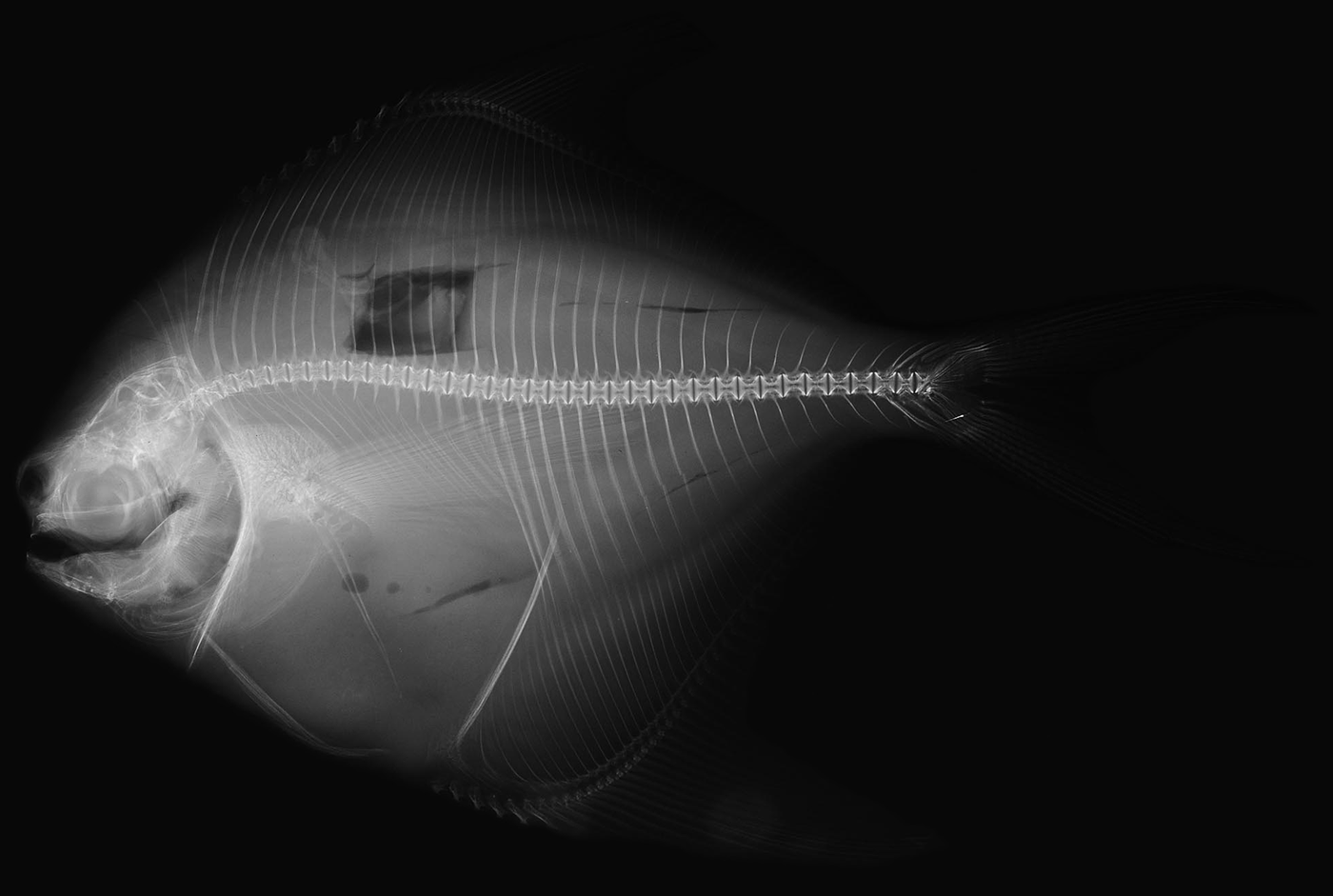
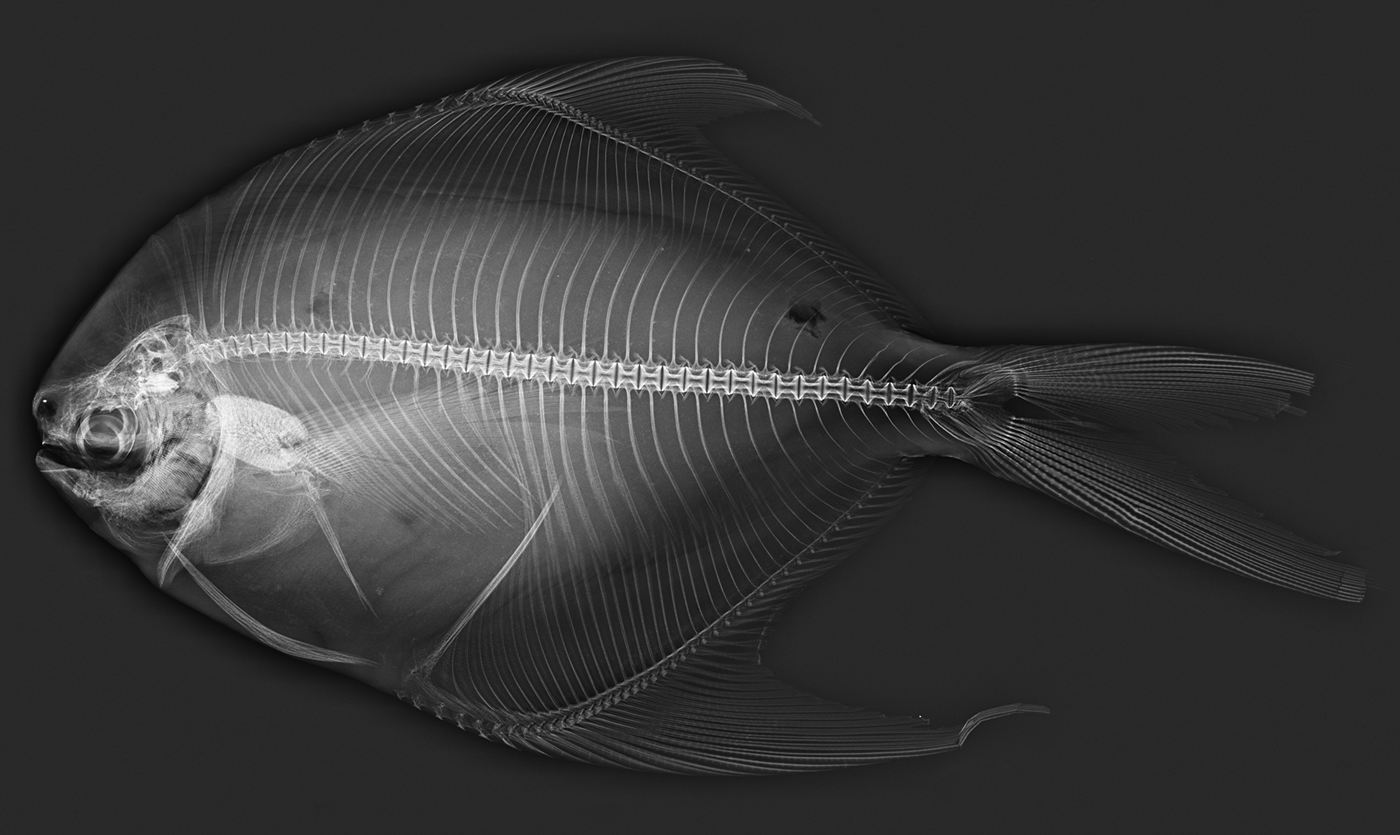
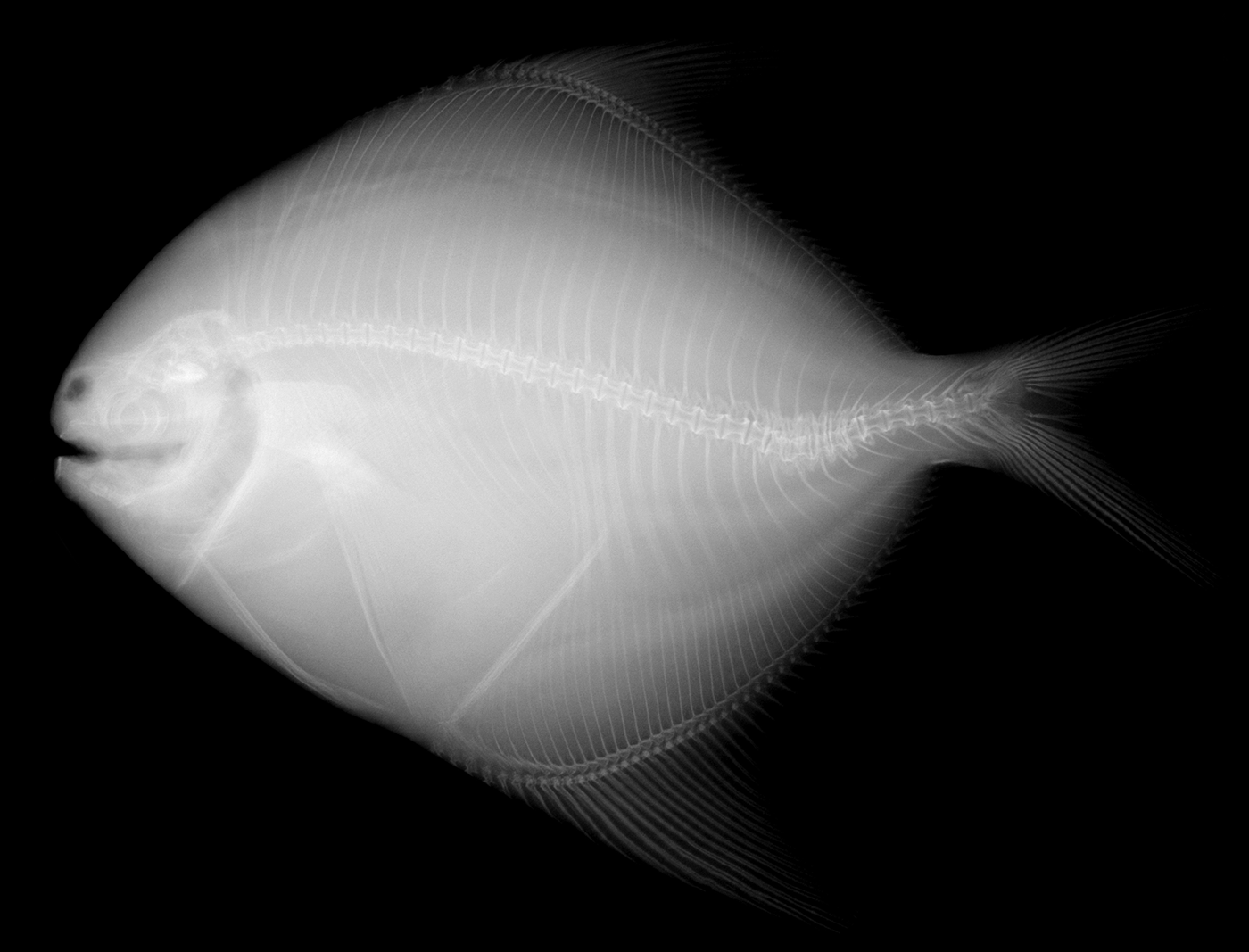
There are two types of abnormalities observed in the four Pampus species examined in this study; the severe and the minor cases. The former case is found in all four specimens, while the latter is observed in the specimen of Pampus liuorum. In the specimen of Pampus cinereus, the vertebral deformity is situated at the end of the vertebral column at the position where the third and the fourth preural vertebrae (PU3 and PU4) are fused with the anterior and posterior parts of the centrum of the PU3 and PU4, respectively. The haemal spines of these two vertebrae are incompletely joined (Figure 1). In the specimen of Pampus echinogaster, the vertebral deformity is situated at the end of the vertebral column, where the PU3 is missing and its neural and haemal spines are left sitting on the centrum of the PU4 (Figure 2). In the specimen of Pampus liuorum, there are severe and minor anomalies. The severe case in this species is similar to that found in Pampus echinogaster, where the PU3 is lost and its neural and haemal spines are left sitting on the centrum of the PU4. In the minor abnormalities, the neural and haemal spines of the 17th and 18th caudal vertebrae are undulated, and the pterygiophore that supports the last anal fin ray is slightly waved (Figure 3).The specimen of Pampus punctatissimus is the only specimen among the four specimens studied that showed a complicated severe case of abnormalities. The vertebral column of this specimen had cases of lordosis and deformed centra. The vertebrae that are involved in the lordosis case were the 10th to 15th caudal vertebrae. The lordosis was shallow, the deformity of the vertebrae involved was severe. The 10th vertebra had a slight deformation in the posterior end of the centrum, the 11th and 12th vertebrae had a complete deformation of their centra, the 13th and 14th vertebrae exhibited a deformed and compacted centra, and the 15th vertebra displayed a deformed posterior end of the centrum. The neural and haemal spines of the vertebrae involved in the lordosis case were curved instead of straight (Figure 4).
Pampus cinereus, 158 mm TL, Zhuhai, Guangdong, China, 9 April 2013, ASIZP2013100.
Pampus echinogaster, 190 mm TL, Qingdao, Shandong, China, ASIZP0064879.
Pampus liuorum, 185.2 mm TL, Zhuhai, Guangdong, China, ASIZP20120486.
Pampus punctatissimus, 177 mm TL, Kii Peninsula, Wakayama Prefecture, Honshu Island, NSMT-P 54470.
DISCUSSION
There is a considerable amount of literature on wild fish abnormalities today (Divananch et al., Reference Divananch, Boglione, Menu, Koumoudouros, Kentouri, Cataudella, Chantain, Saroglia, Sweetman and Lavens1996; Jawad et al., Reference Jawad, Sadighzadeh, Salarpouri and Aghouzbeni2013) that describes the causes of different deformities. They include both genetic (Ishikawa, Reference Ishikawa1990) and epigenetic factors as a possible source of such aberrations (Fjelldal et al., Reference Fjelldal, Glover, Skaala, Imsland and Hansen2009), as well as environmental factors such as temperature, light, salinity, pH, low oxygen concentrations, inadequate hydrodynamic conditions and parasites (Chatain, Reference Chatain1994; Gavaia et al., Reference Gavaia, Domingues, Engrola, Drake, Sarasquete, Dinis and Cancela2009).
In the present deformed specimens, the anomalies represent cases of lordosis, deformed and fused vertebrae. Usually, the spinal fusion case in the specimens of Pampus cinereus, Pampus echinogaster and Pampus liuorum is characterized by the presence of changes in the extracellular matrix (ECM) components and mineralization of intervertebral regions and arch centra (Ytteborg et al., Reference Ytteborg, Torgersen, Baeverfjord and Takle2010). It might be possible that these deformed fish specimens have faced the unfavourable environmental factors that might cause this type of vertebral abnormality and the changes at the cellular level in the body of the vertebrae.
The deformity in the vertebral column of Pampus punctatissimus was severe, although the curvatures are moderate. However, it is still employing actual pressure on the daily activity of the fish and interferes with the ability of the fish to swim normally (Başaran, Reference Başaran2006). It seems that it had been in great competition for food and such struggle is the main component for survival in the wild environment.
There are several factors that might cause lordosis in fishes: genetic, i.e. mutation (Chatain, Reference Chatain1994); biological, i.e. absence of swimbladder (Chatain, Reference Chatain1994); effect of pollutants (Villeneuve et al., Reference Villeneuve, Curtis, Jenkins, Warner, Tilton, Kent, Watral, Cunningham, Markle, Sethajintanin, Krissanakriangkrai, Johnson, Grove and Anderson2005); nutritional (Al-Harbi, Reference Al-Harbi2001); ecological, i.e. temperature (Wang & Tsai, Reference Wang and Tsai2000); water current (Backkiel et al., Reference Backkiel, Kokurewicz and Ogorzalek1984); and mechanical stress (Tutman et al., Reference Tutman, Glamuzina, Skaramuca, Kožul, Glavić and Lučić2000). Certainly, it is not the absence of swimbladder that causes this case of lordosis, as the deformity is found in the caudal region of the body.
In Guangdong, China the environment is reported to have different levels of different types of pollutants (Fu et al., Reference Fu, Mai, Sheng, Zhang, Wang, Peng, Xiao, Ran, Cheng, Peng, Wang and Tang2003; Zeng et al., Reference Zeng, Sheng, Xiong and Fu2005; Cao et al., Reference Cao, Wang, Yang, Yang, Yuan, Xiong and Diana2007; Zhoumeng et al., Reference Zhoumeng, Zeng, Pingyu, Xianmai, Junluo and Yongran2007). Similarly, in the Kii Peninsula area, different pollutants occur that might have direct effects on the fitness of fishes living in this area (Takatsu & Uchiumi, Reference Takatsu and Uchiumi1998; Sato, Reference Sato2006; Yamamoto et al., Reference Yamamoto, Morita, Yokoyama, Miyamoto, Sato and Maekawad2013).
Pollutants disturb a number of internal mechanisms inside the fish's body during its early life stages (Kihara et al., Reference Kihara, Ogata, Kawano, Kubota and Yamaguch2002). They may interfere with the level of pH by elevating carbon dioxide. Cells will react to sustain normal serum osmosis and resume the normal blood pH. This may cause bone decalcification due to the presence of excessive carbonic acid, generated as blood pH normalizes (Sarkar & Kapoor, Reference Sarkar and Kapoor1956; Andrades et al., Reference Andrades, Berrara and Fernandez-llebrez1996).
The combination of genome, environment and developmental noise can produce what is known as a phenotype (Scheiner, Reference Scheiner1993). It is quite obvious that diversities in the genetic pool can determine variations in the developmental pattern. Developmental noise is a factor which can theoretically induce phenotype differences in genetically identical individuals developing in identical environments (Divananch et al., Reference Divananch, Boglione, Menu, Koumoudouros, Kentouri, Cataudella, Chantain, Saroglia, Sweetman and Lavens1996). In this context, morphological variability in a genetically related population can supply a ‘size’ of the developmental noise. In this regard, Soulè (Reference Soulè1982) maintains that an augmentation of the phenotypic variability is a characteristic of biological systems subjected to stress (like intensive rearing conditions, for instance) and that developmental noise reveals itself as a reduction of the intracellular order. The second factor, the environment, includes the influences exercised by external conditions, such as biotic and abiotic factors (Divananch et al., Reference Divananch, Boglione, Menu, Koumoudouros, Kentouri, Cataudella, Chantain, Saroglia, Sweetman and Lavens1996).
ACKNOWLEDGEMENTS
Our sincere thanks are due to the Institute of Oceanology, Chinese Academy of Sciences, China and to Keiichi Matsuura, National Science Museum of Tokyo, for letting us use and examine the radiographs of the four Pampus species. This research was supported by the National Natural Science Foundation of China (grant nos. 31172053 and 41276166).