Introduction
Modern western healthcare systems increasingly face problems associated with a rising number of people with dementia due to population aging. In Germany, this figure increased from 0.9 million in the year 2000 to 1.4 million in 2010. An increase of up to 3.0 million is anticipated by 2030 (Doblhammer et al., Reference Doblhammer, Schulz, Steinberg and Ziegler2012).
Evidence-based drug treatments for dementia, e.g. cholinesterase inhibitors (ChEIs) for mild to moderate Alzheimer dementia, are available in the German market since the late 1990s: donepezil since 1997, rivastigmine since 1998, and galantamine since 2001. Memantine was approved for moderate to severe Alzheimer's dementia in 2002. In the years 2000 to 2007, the volume of prescriptions for ChEIs and memantine increased from 17.9 million defined daily doses (DDDs) to 53.5 million DDDs (Hoffmann et al., Reference Hoffmann, Van den Bussche, Glaeske and Kaduszkiewicz2010).
The prescription of antidementia drugs is possible for all physicians in the ambulatory care sector. The largest proportion of prescriptions for antidementia drugs is provided by primary care physicians (GPs) and specialist physicians for neurology and psychiatry (SP). Hospitals and memory clinics play only a minor role in the prescription of antidementia drugs. Drug prescriptions are free for all patients enrolled in public health insurance. Patients with private insurance need to pay beforehand with later reimbursement (for detailed information, see van den Bussche et al., Reference Van den Bussche2011).
Evidence-based guidelines have been developed in Germany since 2000 (Arzneimittelkommission, 2001; DGPPN, 2010) as well as in other European countries (e.g. NICE guidelines in the UK), and provide an orientation regarding drug treatment. According to German guidelines, ChEIs are suggested for Alzheimer`s dementia (AD) and mixed dementia (mD) in mild to moderate stages while memantine is recommended for moderate to severe dementia.
The efficacy of the above medication regimes has been demonstrated in various clinical trials (e.g. Birks, Reference Birks2006). Such results can only be obtained with high treatment adherence and low drop-out rates. However, in the pivotal trials, rates of non-adherence were shown to be as high as 30%. In “real-world” conditions, these rates may even be significantly higher. During the last 14 years, more than ten cohort studies and observational studies focusing on treatment adherence of subjects receiving antidementia medication have been published. The results of most of these studies have limitations regarding small sample sizes, short follow-up periods (Mauskopf et al., Reference Mauskopf, Paramore, Lee and Snyder2005; Singh et al., Reference Singh, Thomas, Arcona, Lingala and Mithal2005; Mucha et al., Reference Mucha, Shaohung Wang, Cuffel, McRae, Mark and del Valle2008; Suh et al., Reference Suh, Thomas, Valiyeva, Arcona and Vo2005; Herrmann et al., Reference Herrmann2007), and inclusion of specific types of antidementia medications only (Singh et al., Reference Singh, Thomas, Arcona, Lingala and Mithal2005). Moreover, the analysis of factors predicting poor adherence frequently focused only on gender and age. More recent studies (Amuah et al., Reference Amuah2010; Brewer et al., Reference Brewer, Bennett, McGreevy and Williams2013; Haider et al., Reference Haider, Schmidt, Schweiger, Forstner, Labek and Lampl2014; Taipale et al., Reference Taipalea, Tanskanene, Koponen, Tolppanen, Tiihonen and Hartikainen2014) emphasize the importance of large study populations, long follow-up periods, and more complex analysis of predictive factors.
The aim of our study was to analyse the duration of continuous treatment with ChEIs and memantine in a large and representative sample of patients with dementia over a long time-period and to identify determinants of treatment discontinuation. As shown in most of the previous studies, we expected a higher rate of discontinuation in women and with older age. Given different rates of adverse drug effects, we further hypothesized different discontinuation rates between the antidementia drug types. Because of an increased burden of disease and potential polypharmacy, we expected higher discontinuation rate in patients with high comorbidity. Following the assumption that specialist treatment is based on more specific diagnoses (e.g. Alzheimer's disease as opposed to dementia n.o.s.), we assumed that the discontinuation-rate of GP Patients are higher than of NP Patients. Finally, we hypothesized patients enrolled in private insurance to have lower discontinuation rates.
Methods
The analyzed database period was from January 2003 to December 2013 and included 1,001 general practitioners (GPs) and 190 specialist physicians (SP) throughout Germany. Inclusion criteria were as follows: Patients ≥ 45 years of age with a dementia diagnosis (ICD 10: G30, F01, F03), in whom treatment with an antidementia drug had been initiated (AChE-inhibitors and memantine) (defined as “initial prescription”) Practice visit records were used to determine continuous follow-up.
Continuous antidementia treatment was defined as the proportion of patients who remained on the initial treatment. Patients were followed over five years after index prescription. In the present study, the end of continuous treatment was defined by a gap of ≥90 days without initial treatment in patients who were still seen by the same doctor. Longer periods were considered gaps and the treatment of the patient was no longer classified as persistent. Change of antidementia drug-type was rated as discontinuation.
Potential predictors considered in the present analysis were index diagnosis, age, gender, comorbidity, comedications, general physician (GP) versus specialist physician (SP) care, public versus private health insurance and residence in the western or eastern part of Germany. Codiagnoses were determined based on primary care diagnoses for coronary heart disease – myocardial infarction, stroke, heart failure, hypertension, type 2 diabetes mellitus, depression, and delirium. Index diagnosis was either Alzheimer's disease (G30, F00) or vascular dementia (F01), or unspecified dementia (F03). In addition, the Charlson comorbidity index was used as general marker of comorbidity. The Charlson index is a weighted index that accounts for the number and severity of comorbidities in administrative database studies (Quan et al., Reference Quan2005). The conditions included in the Charlson index cover a wide range of comorbidities (macrovascular diseases, pulmonary diseases, gastrointestinal, liver and renal diseases, diabetes, tumors, and AIDS). Additionally, the number of different substances taken on one day were calculated and included as covariates.
The Disease Analyzer database (IMS Health, Inc.) contains information drug prescriptions, diagnoses, and basic medical and demographic data, which are obtained from the practice computer systems of GPs and NPs (Becher et al., Reference Becher, Kostev and Schröder-Bernhardi2009; Ogdie et al., Reference Ogdie, Langan, Parkinson, Dattani, Kostev, Gelfand, Strom, Kimmel and Hennessy2012). Diagnoses (ICD-10), prescriptions (Anatomical Therapeutic Chemical (ATC) Classification System), and the validity of reported data were monitored by IMS based on a number of quality criteria (e.g. completeness of documentation, linkage of diagnoses, and prescriptions). The data are generated directly from the computers in physicians’ practices via standardized interfaces and provide daily routine information on patient diseases and therapies. Before transmission, data are encrypted for data protection purposes. The validity of the Disease Analyzer data has already been evaluated and described (Becher et al., Reference Becher, Kostev and Schröder-Bernhardi2009). For example, the analysis of physicians’ age and regional distributions among participating practices showed that the selection appears to be representative of the general physician population (Becher et al., Reference Becher, Kostev and Schröder-Bernhardi2009). Further analysis indicated that the distribution of patients by health insurance fund in Disease Analyzer was very similar to the overall distribution of patients by health insurance fund in Germany (Becher et al., Reference Becher, Kostev and Schröder-Bernhardi2009). It has formed the basis of a number of studies and peer-reviewed scientific publications on epidemiology and clinical dementia research.
Descriptive statistics were applied to the above-mentioned variables. Continuous treatment was analyzed using Kaplan–Meier curves and log-rank tests. Separate analyses were calculated for men and women, each antidementia substance and category of physician (GP, NP). In addition, multivariate Cox regression models were fitted with continuous treatment as dependent variable and the potential predictors as independent variables. Two-sided tests were used and a p-value of < 0.05 was considered as statistically significant. All analyses were carried out using SAS 9.3. (SAS Institute, Cary, USA). The analyses were carried out following established national (Swart, Reference Swart2008) and international good practice recommendations of secondary data analysis (Motheral et al., Reference Motheral2003). The study was approved by the Ethics Committee of the University of Greifswald School of Medicine (BB 104/14).
Results
Characteristics of study patients
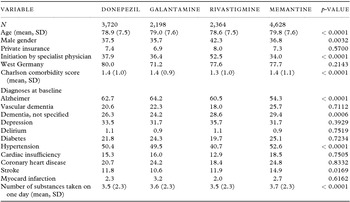
A total of 12,910 patients met study inclusion criteria and were included in the analyses. Their mean age was 79.2 years (SD: 7.6). 62.2% were female. 61.1% of patients were treated by GPs and 38.9% were treated by NPs. NPs diagnosed Alzheimer's Disease more often than GPs (75.3% vs. 49.5%). On the other hand, NPs less frequently diagnosed vascular dementia (18.3% vs. 24.7%) and unspecified dementia diagnoses (16.4% vs. 34.6%). These differences were statistically significant (see Table 1).
Basis characteristics of the sample

Note. All values represent percentages unless otherwise indicated.
The clinical characteristics stratified by initial antidementia drug are shown in Table 1. After stratification by index medication, 28.8% of patients were treated with donepezil (n = 3,720); 17% with galantamine (n = 2,198); 18.3% with rivastigmine (n = 2,364), and 35.9% with memantine (n = 4,628). Patients who received memantine as the index medication were older (79.8 SD 7.6). Age differences were small but statistically significant (Table 1). As compared to patients who received other index medications, subjects on memantine were more often treated by GPs, the proportion of patients with a history of stroke was higher and the number of substances taken on each day was higher.
Patients who received rivastigmine as initial antidementia treatment were significantly more often male (42.3%) and were substantially more often treated by SPs (52.5%). On the other hand, these patients were less often treated for vascular dementia. The proportion of patients with hypertension was lower in this group than in patients with other index antidementia prescriptions. There were no significant differences with regard to other codiagnoses.
Relative to a five year time-period, the average of continuous treatment in days was different between the four medication types. Mean continuous treatment was shortest for rivastigmine (313 days, SD = 438) whereas continuous treatment was similar for donepezil (358 days, SD = 498), galantamine (362 days, SD = 516), and memantine (369 days, SD = 504). Changes between classes of drugs were observed in 12.6% of patients receiving donepezil, in 12.3% of patients receiving galantamine, in 11.3% of patients receiving rivastigmine, and in 7.2% of patients receiving memantine (Table 1).
Kaplan–meier analyses
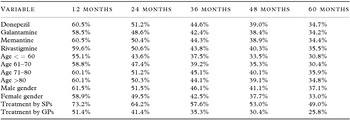
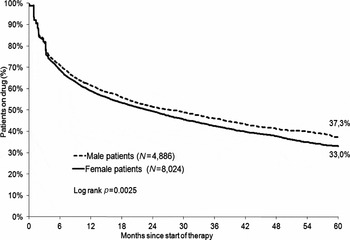
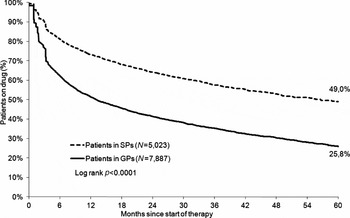
After one year of follow-up, nearly 60% continued drug treatment. Only 38.5% of male and 41.1% of female patients had discontinued their treatment (refill gap of 90 days) (Table 2). Moreover, the proportion of patients that did not receive continuous therapy depended on age; it was 30.8% in the those ≤ 60 years of age, 30.4% in patients aged 61–70 years, 35.9% in patients aged 71–80 years, and 34.8% in patients aged over 80 years (Table 2). At the five-year follow-up, discontinuation rates had increased to 62.7% for men and 67.0% for women (p = 0.0025) (Figure 1). More than 30% continued drug therapy. Within five years of follow-up, 65.3% of donezepil, 65.8% of galantamine, 65.6% of memantine, and 64.5% of rivastigmine patients had discontinued their treatment (p = 0.0991). We further investigated if discontinuation was dependent on the physician specialty and found a significant difference in the discontinuation rate up to five years between patients treated by NPs (51.0%) and patients treated by GPs (74.2%) (p < 0.0001; Figure 2).
Proportion of patients continued on therapy after 12, 24, 36, 48, and 60 months

Kaplan–Meier–Curves for continuation over five years in patients with dementia treated with donepezil, galantamine, memantine, or rivastigmine as a function of gender.

Kaplan–Meier–Curves for continuation over five years in patients with dementia treated with donepezil, galantamine, memantine, or rivastigmine as a function of treating physician specialty. Note: GP denotes general practitioners’ office, SP denotes specialist physicians’ office.

Predictors of therapy continuation
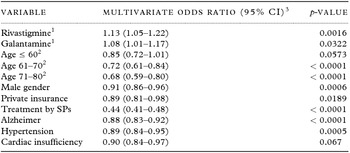
The results of the multivariate regression analyses are shown in Table 3. Donezepil (HR: 0.88; 95% CI: 0.82–0.95) and memantine (HR: 0.85; CI: 0.79–0.91) patients were more likely to receive on their initial treatment continuously as compared to rivastigmine users. Patients were less likely to be discontinued on their Index drug if they were treated by NPs (HR: 0.44; CI: 0.41–0.48). Lower age was another independent predictor of continuous treatment, as patients in age groups ≤ 60, 61–70 and 71–80 had a lower rate of therapy discontinuation compared to the age group > 80. Male patients and patients who had private health insurance had a lower discontinuation risk. Regarding comorbidity, patients were more likely to be continuously treated with the index substance if a diagnosis of heart failure or hypertension had been diagnosed at baseline. Treatment continuation was also significantly higher in patients with Alzheimer's disease than in patients with other forms of dementia. There were no significant associations between treatment continuation and geographical region, Charlson comorbidity score, number of cotreatment substances and further defined codiagnoses (data not shown).
Odds ratios for discontinuation of dementia therapy

Note. 1 Reference group is Donepezil.
2Reference group is age >80.
3Adjusted for all variables from the Table 1 and additionally for number of dementia patients in the practice. Analyses over five years, Cox regression, stepwise selection.
Discussion
The present study examined a large patient population (N > 12,000) during an observational period of 11 years with respect to antidementia treatment continuation and established continuation rates for up to five years. Antidementia treatment continuation-rate decreased over the time period of five years, starting with 60% in the first year and dropping to 34% in the fifth year. In line with our hypotheses, patients with the following characteristics were more prone to discontinuation of the index treatment: higher age, female gender, treatment initiation with rivastigmine, unspecified diagnosis of dementia (dementia n.o.s.), patients treated by GPs, and patients enrolled in public health insurance. No association with treatment adherence was shown for the following factors: geographic region, Charlson comorbidity score, other comorbidities: diabetes, myocardial infarction, CAD, stroke, delirium, depression, type and dose of comedication.
Rates of the treatment discontinuation
In our cohort, almost 39% of patients discontinued treatment within one year. These findings are consistent with other studies of treatment continuation with AD drugs (Singh et al., Reference Singh, Thomas, Arcona, Lingala and Mithal2005; Suh et al., Reference Suh, Thomas, Valiyeva, Arcona and Vo2005; Abugosh and Kogut, Reference Abughosh and Kogut2008; Mucha et al., Reference Mucha, Shaohung Wang, Cuffel, McRae, Mark and del Valle2008; Vidal et al., Reference Vidal2008; Herrmann et al., 2009; Amuah et al., Reference Amuah2010; Pariente et al., Reference Pariente, Pinet, Moride, Merlière, Moore and Fourrier-Reglat2010; van den Bussche et al., Reference Van den Bussche2011; Brewer et al., Reference Brewer, Bennett, McGreevy and Williams2013; Haider et al., Reference Haider, Schmidt, Schweiger, Forstner, Labek and Lampl2014; Maxwell et al., Reference Maxwell, Stock, Seitz and Herrmann2014) which describe discontinuation rates of 41–67%. However, a Finish longitudinal study (Taipale et al., Reference Taipalea, Tanskanene, Koponen, Tolppanen, Tiihonen and Hartikainen2014) reported a surprising low non-persistence rate of about 16% for the one-year period, potentially related to characteristics of the Finish healthcare system. Even in the long-time-period of more than three years after switching the antidementia drugs, the discontinuation rate was lower than 10% while in our cohort, the long-term discontinuation rate is 66%.
Factors associated with treatment continuation
Consistent with our findings, basic factors promoting discontinuation found in the literature are older age (Suh et al., Reference Suh, Thomas, Valiyeva, Arcona and Vo2005; Amuah et al., Reference Amuah2010; Parente et al., Reference Pariente, Pinet, Moride, Merlière, Moore and Fourrier-Reglat2010; Brewer et al., Reference Brewer, Bennett, McGreevy and Williams2013; Maxwell et al., Reference Maxwell, Stock, Seitz and Herrmann2014; Taipale et al., Reference Taipalea, Tanskanene, Koponen, Tolppanen, Tiihonen and Hartikainen2014) and female sex (Amuah et al., Reference Amuah2010; Brewer et al., Reference Brewer, Bennett, McGreevy and Williams2013; Maxwell et al., Reference Maxwell, Stock, Seitz and Herrmann2014; Taipale et al., Reference Taipalea, Tanskanene, Koponen, Tolppanen, Tiihonen and Hartikainen2014). Older Patients may be at higher risk of early discontinuation because of rapid cognitive decline, lower MMSE Score (Amuah et al., Reference Amuah2010) or adverse effects of the drugs (Gill and Dubois, Reference Gill2009). Female patients with dementia may be less likely than males to have a primary caregiver to assist with medication use (Small and Dubois, Reference Small and Dubois2007).
In our study, the rate of discontinuation of the initially prescribed antidementia treatment was different between AChEI drugs and memantine. In line with our results, several studies have reported higher rates of discontinuation for rivastigmine (Abugosh and Kogut, Reference Abughosh and Kogut2008; Mucha et al., Reference Mucha, Shaohung Wang, Cuffel, McRae, Mark and del Valle2008; Brewer et al., Reference Brewer, Bennett, McGreevy and Williams2013; Haider et al., Reference Haider, Schmidt, Schweiger, Forstner, Labek and Lampl2014; Taipale et al., Reference Taipalea, Tanskanene, Koponen, Tolppanen, Tiihonen and Hartikainen2014). When compared with donepezil and galantamine, the lower persistence for rivastigmine may be due to different formulations of these drugs. Patients are probably more compliant with once-daily formulations, which are available for donepezil and galantamine. In the present cohort, the patch formulation of rivastigmine was not investigated differentially, but it was used in 44% of rivastigmine prescriptions. In addition, donepezil provides clinically meaningful effects even at a low dose (5 mg/day) where adverse effects are minimal (Birks, Reference Birks2006). In line with our findings, a low rate of discontinuation has also been reported for memantine (Haider et al., Reference Haider, Schmidt, Schweiger, Forstner, Labek and Lampl2014).
Effects of comorbidity and comedication were investigated by Amuah et al., (Reference Amuah2010) and Pariente et al., (Reference Pariente, Pinet, Moride, Merlière, Moore and Fourrier-Reglat2010). The assumption that multimedication and multimorbidity would lead to a lower treatment continuation was not confirmed in the present analysis which is consistent in this respect with findings from Amuah et al., (Reference Amuah2010). One possible explanation is that physicians may be more involved und have more frequent contacts with multimorbid patients (Suh et al., Reference Suh, Thomas, Valiyeva, Arcona and Vo2005; Herrmann et al., Reference Herrmann2007). Furthermore, especially patients with chronic diseases like hypertension or cardiac insufficiency showed a reduced risk of therapy discontinuation with antidementia medications. We can only speculate about this finding; one possible explanation is closer monitoring and more frequent contacts in patients with cardiovascular diseases, which could have increased adherence and treatment continuity (compare Turchin et al., Reference Turchin, Goldberg, Shabina, Einbinder and Conlin2010).
Effects of healthcare systems on treatment continuation also need to be taken into consideration. The possible roles of physicians’ adherence to medical guidelines during initial diagnosis, referral to specialists, and schemes of financing have rarely been investigated (van den Bussche et al., Reference Van den Bussche2011; Amuah et al., Reference Amuah2012; Fink Reference Fink and Doblhammer2014). The outstandingly positive results reported from Finland (Taipale et al., Reference Taipalea, Tanskanene, Koponen, Tolppanen, Tiihonen and Hartikainen2014) may be explained by characteristics of the Finish healthcare system. It includes strict application and adherence to guidelines as well as initial diagnosis and treatment supervision performed by specialists. Our findings support these results, in that we could demonstrate an association between treatment continuation and involvement of SP. Recent results of the German Center for Neurodegenerative Disease also suggest that a better integration of specialists in diagnostic and therapeutic procedures (Fink, Reference Fink and Doblhammer2014) and establishing a GP-based support system led by Dementia Care Managers (Eichler et al., Reference Eichler2014) may help to improve treatment outcomes.
Study limitations and strengths
Several limitations of the present study need to be mentioned. First, no valid information on dementia stage (mild/moderate/severe) or dementia duration was available in the documentation system. Also, assessment of comorbidity relied on ICD codes provided by primary care physicians only. Data on socioeconomic status, lifestyle, or caregiver risk factors which likely impact on treatment continuation also could not be obtained. Due to the set-up and design of the data base, patients could only be followed up with regard to continuous prescriptions within the physicians’ practice where the treatment had been initiated. Therefore, treatment continuation by another physician was not captured. Furthermore, the database only provided the prescriptions that were dispensed and there is no information whether drugs had actually been taken or not. One final limitation of our study is that the reasons for discontinuation (for example: lack of response, disease progression, or occurrence of adverse events, use of non-pharmacological treatments as an alternative) were not recorded.
Conclusion
Our results demonstrate that there is room for improvement in optimizing the prescription practice of antidementia medications in Germany. Higher age and female sex are risk factors for discontinuation. In line with other studies, our report shows that donepezil and memantine are associated with a lower risk of discontinuation than rivastigmine and galantamine. Our results imply that a higher rate of specialist involvement in the complex process of prescribing antidementia drugs can provide meaningful benefits to patients, in terms of more disease-specific and continuous treatment.
Conflict of interest
JB has research support and speaking honoraria by Willmar Schwabe, Inc. KK is employed by IMS Health, Inc. MAR reports having received speaker honoraria by Merz Pharmaceuticals, Willmar Schwabe, Inc, and GlaxoSmith Kline, Inc.
Description of authors’ roles
JB formulated the research question, designed the study together with KK, ascertained data collection, and wrote main parts of the paper: introduction, results and discussion. SW provided a literature review and assisted in preparing a first draft. MAR reviewed draft version and participated in preparing final manuscript. KK was responsible for the statistical design of the study and carrying out the statistical analysis, and wrote main parts of the article: methods and results.