Introduction
There is growing consensus that working memory (WM), our active information processing system with limited capacity (Baddeley, Reference Baddeley2003), can be improved by training (Jaeggi, Buschkuehl, Jonides, & Perrig, Reference Jaeggi, Buschkuehl, Jonides and Perrig2008; Klingberg, Forssberg, & Westerberg, Reference Klingberg, Forssberg and Westerberg2002; Melbylervåg & Hulme, Reference Melbylervåg and Hulme2013; von Bastian & Oberauer, Reference von Bastian and Oberauer2014). Since WM (as a basic processing) is implicated in a variety of advanced cognitive functions, training specifically targeted on it can lead to extensive and profound transfer effects, such as increased reading comprehension, mathematical reasoning, and fluid intelligence (Au et al., Reference Au, Sheehan, Tsai, Duncan, Buschkuehl and Jaeggi2015; Melbylervåg & Hulme, Reference Melbylervåg and Hulme2013). Another striking finding is that the effects of working memory training (WM-T) can be extended to the emotional domain.
There is already evidence to show that general WM-T can improve self-regulation when viewing negative materials (Xiu, Wu, Chang, & Zhou, Reference Xiu, Wu, Chang and Zhou2018; Xiu, Zhou, & Jiang, Reference Xiu, Zhou and Jiang2016), or even improve overall emotional states (Takeuchi et al., Reference Takeuchi, Taki, Rui, Hashizume, Sekiguchi, Kotozaki and Kawashima2013). However, another line of thought holds that emotional benefits are only achievable from the WM-T specifically with the affective component. The work of Schweizer, Hampshire, & Dalgleish (Reference Schweizer, Hampshire and Dalgleish2011), Schweizer, Grahn, Hampshire, Mobbs, and Dalgleish, (Reference Schweizer, Grahn, Hampshire, Mobbs and Dalgleish2013) is of particular relevance here. They show that WM-T involving negative faces and words as updating stimuli rather than training that used more general information can improve the affective control ability of participants. These somewhat contrary results suggest that the benefits of two types of WM-T (general and emotional) may point to different forms of emotional control/regulation.
A referential theoretical framework proposed by Etkin, Büchel, and Gross (Reference Etkin, Büchel and Gross2015) suggested that emotional regulation can be divided into two categories: model-based and model-free. Specifically, model-based emotion regulation uses explicit strategies such as reappraisal (a cognitive-linguistic strategy that modulates emotional response by reconstructing thoughts and beliefs about the meaning of a stimulus or situation) (Amstadter, Reference Amstadter2008; Gross, Reference Gross and Gross2014), which is considered to depend heavily on WM capacity and executive function (Etkin et al., Reference Etkin, Büchel and Gross2015; Gan, Yang, Chen, Zhang, & Yang, Reference Gan, Yang, Chen, Zhang and Yang2017). Empirically, studies in which individuals with higher WM capacity have been found to be more successful in reducing negative emotional responses through reappraisal have indicated that reappraisal may critically rely on WM (Pe, Raes, & Kuppens, Reference Pe, Raes and Kuppens2013; Schmeichel, Volokhov, & Dernaree, Reference Schmeichel, Volokhov and Dernaree2008). The finding that high WM load impairs the effect of cognitive reappraisal using a dual-task paradigm also supports this contention (Gan et al., Reference Gan, Yang, Chen, Zhang and Yang2017). Indeed, the re-evaluation of the experience of a stressful situation requires the flexible recruitment of WM in two modes. That is, one must restrain the existing negative evaluation while at the same time drawing feasible interpretation from experience to update the original representation (Pe et al., Reference Pe, Raes and Kuppens2013). At the neural level, WM and model-based emotional regulation represented by reappraisal have a large number of overlapping brain activation, which recruits dorsolateral frontal lobe brain regions primarily (Etkin et al., Reference Etkin, Büchel and Gross2015). According to this, general WM-T may be more likely to lead to the transfer of explicit (model-based) emotional regulation improvements, which was consistent with the previous finding of Xiu et al. (Reference Xiu, Wu, Chang and Zhou2018).
Model-free emotion regulation, on the other hand, is a type of implicit emotional control which is related to unconscious assessment for affective value. This regulation is slightly far from voluntary cognitive control but more dependent on automatic conflict monitoring (Etkin et al., Reference Etkin, Büchel and Gross2015). Emotional conflict tasks (e.g. emotion Stroop Task) are thought to reflect this affective processing and considered to be implicated in the medial frontal cortex (Etkin, Prater, Hoeft, Menon, & Schatzberg, Reference Etkin, Prater, Hoeft, Menon and Schatzberg2010; Gyurak, Gross, & Etkin, Reference Gyurak, Gross and Etkin2011). This function can be associated with the executive components of WM, such as inhibition (Zhang et al., Reference Zhang, Ding, Chen, Wei, Zhao, Zhang and Li2016; Zhang & Lu, Reference Zhang and Lu2012). But more importantly, it requires the repeated exposure to emotional stimuli, which allows individuals to automatically learn and complete the emotional adaptation. The specific benefits of emotional WM-T discovered by Schweizer et al. (Reference Schweizer, Hampshire and Dalgleish2011, Reference Schweizer, Grahn, Hampshire, Mobbs and Dalgleish2013) were concentrated in such implicit regulation tasks, which suggests that emotional stimuli involvement in WM-T should be indispensable if implicit affective control facilitation is expected. Nevertheless, since general and EMW-T have never been directly compared using both explicit (model-based) and implicit (model-free) emotional regulation/control tasks, the interpretation that general training aimed at explicit regulation while emotional one further targeted on implicit control to emotion, has not been empirically proven.
Anxious individuals can be potential beneficiaries of such training, given both explicit and implicit emotion regulation impairments confer vulnerability for anxiety disorders (Cisler & Olatunji, Reference Cisler and Olatunji2012). A large number of studies have shown that the ability to explicitly regulate emotion, especially in the form of cognitive reappraisal, is deficient in anxious individuals (Hofmann, Heering, Sawyer, & Asnaani, Reference Hofmann, Heering, Sawyer and Asnaani2009; Pan, Wang, & Li, Reference Pan, Wang and Li2019). Habitual reappraisal as the adaptive strategies for coping with stressful events can generate long-term positive effects (Goldin, Mcrae, Ramel, & Gross, Reference Goldin, Mcrae, Ramel and Gross2008) and is a critical protective factor from anxiety symptom (Hofmann et al., Reference Hofmann, Heering, Sawyer and Asnaani2009). In addition, anxious individuals have long been reported to have poor implicit affective control as reflected by negative attention bias (Bar-Haim, Lamy, Pergamin, Bakermans-Kranenburg, & van IJzendoorn, Reference Bar-Haim, Lamy, Pergamin, Bakermans-Kranenburg and van IJzendoorn2007; Comte et al., Reference Comte, Cancel, Coull, Schon, Reynaud, Boukezzi and Fakra2015; de Ruiter & Brosschot, Reference de Ruiter and Brosschot1994). This maladaptation can manifest as an enhanced engagement with threat and difficulty to disengage attention away from threat (Bar-Haim et al., Reference Bar-Haim, Lamy, Pergamin, Bakermans-Kranenburg and van IJzendoorn2007), leading to the failure of spontaneous regulation of emotional processing (Etkin et al., Reference Etkin, Prater, Hoeft, Menon and Schatzberg2010). Within the framework of a cognitive theory of anxiety, this excessive negative attention bias plays a vital role in the generation, maintenance and development of anxiety disorders (Eysenck & Derakshan, Reference Eysenck and Derakshan2011).
Studies have shown that general WM-T can improve attention control in individuals with high trait anxiety (Sari, Koster, Pourtois, & Derakshan, Reference Sari, Koster, Pourtois and Derakshan2016) and that EWM-T can improve symptoms among individuals with post-traumatic stress disorder (Schweizer et al., Reference Schweizer, Samimi, Hasani, Moradi, Mirdoraghi and Khaleghi2017). However, although some evidence exists about the impact of training on healthy individuals, it is not yet clear as to whether training for anxious individuals improves explicit emotional regulation or implicit affective control.
The main objective of this study was to investigate the transfer effects of WM-T and EWM-T on explicit emotional regulation and implicit emotional control in anxious individuals. To do this, we developed a new type of dual n-back task mobile application that included both WM-T and EWM-T. Individuals with high trait anxiety, who, suffer from emotional distress and to a large extent, possess a susceptibility to anxiety disorders (Watson & Clark, Reference Watson and Clark1994) were randomly divided into three groups (control, WM-T and EWM-T) and were given 21 days of training or equivalent placebo procedures. We assessed transfer effects through pre- and post-test administration of self-reported questionnaires and behavioral tasks while we acquired event-related potential (ERP) data.
For the explicit emotional regulation task, we focused on cognitive reappraisal, but the distraction was compared as a filler strategy that did not require any WM capacity. In addition to using participants' subjective rating, we focus on the late positive potential (LPP) which served as the classic neural response of emotion regulation. Substantial evidence has shown that posterior LPP is associated with emotional arousal (Bamford et al., Reference Bamford, Broyd, Benikos, Ward, Wiersema and Sonuga-Barke2015; Brown, van Steenbergen, Band, de Rover, & Nieuwenhuis, Reference Brown, van Steenbergen, Band, de Rover and Nieuwenhuis2012), and that reductions in LPP amplitudes can be observed when explicit regulation strategies like reappraisal and distraction are applied (Hajcak & Nieuwenhuis, Reference Hajcak and Nieuwenhuis2006; Moser, Hajcak, Bukay, & Simons, Reference Moser, Hajcak, Bukay and Simons2006; Thiruchselvam, Blechert, Sheppes, Rydstrom, & Gross, Reference Thiruchselvam, Blechert, Sheppes, Rydstrom and Gross2011; Xiu et al., Reference Xiu, Wu, Chang and Zhou2018).
In order to examine implicit affective control, we selected a facial emotion Stroop task. This type of task can provide valid behavioral indicators of attention bias in the shape of delayed responses to negative stimuli compared to neutral stimuli (Williams, Mathews, & MacLeod, Reference Williams, Mathews and MacLeod1996). Besides, we concentrated on P3, which has been established as a relatively stable neural indicator for automatic attention engagement (Gootjes, Coppens, Zwaan, Franken, & Van Strien, Reference Gootjes, Coppens, Zwaan, Franken and Van Strien2011; Metzger, Orr, Lasko, McNally, & Pitman, Reference Metzger, Orr, Lasko, McNally and Pitman1997; Pishyar, Harris, & Menzies, Reference Pishyar, Harris and Menzies2004; Thomas, Johnstone, & Gonsalvez, Reference Thomas, Johnstone and Gonsalvez2007). Evidence has demonstrated that higher amplitudes of P3 (to negative attributions) are associated with the allocation of more attention resources in response to task-irrelevant distraction, while lower P3 amplitudes represent a diminished biased input to negative stimuli (Metzger et al., Reference Metzger, Orr, Lasko, McNally and Pitman1997; Pan, Wang, Lei, Wang, & Li, Reference Pan, Wang, Lei, Wang and Li2020).
In summary, by exposing individuals with high trait anxiety to two kinds of training (WM-T with or without emotional distraction) we aim to answer two questions. First, can WM-T bring benefits to anxious individuals? Based on previous research on healthy people, we hypothesized a positive effect of training on emotion-related outcomes. Second, do different benefit paths exist between WM-T and EWM-T? According to previous findings (Schweizer et al., Reference Schweizer, Hampshire and Dalgleish2011; Xiu et al., Reference Xiu, Zhou and Jiang2016) and the emotion regulation framework of Etkin et al. (Reference Etkin, Büchel and Gross2015), we hypothesized that the WM requirements inherent in both types of training can improve the ability of explicit emotional regulation (i.e. improvement of reappraisal). In addition, we predict that EWM-T has the additional property of improving affective control as reflected by a decreased negative attention bias to negative stimuli. Further, we expect that the assumed emotional benefits brought about by training can transfer to mood states, thus demonstrating a promising intervention for the alleviation of anxiety symptoms.
Materials and methods
Participants
Participants were screened from a database of 983 university students in Beijing China with trait anxiety scores in the top 20% (cut off score is 50) according to the Chinese version of the Spielberg Trait Anxiety Inventory (STAI-T; Spielberger, Reference Spielberger1983; Shek, Reference Shek1993). A total of 120 participants were initially recruited and randomly (by computer drawing lots) divided into three equal groups. During the research process, participants who drop out midway would not be invited to the post-test. In the end, 98 participants (WM-T: n = 33; EWM-T: n = 35; Control: n = 30) who had participated in the full experimental procedure and had contributed a full dataset were included in the final analysis. There were no significant differences among the three groups in terms of age, gender ratio, years of education and scores of trait anxiety. See Table 1 for demographic information of participants included in the final analysis.
Demographic information of Participants [Mean (S.D.)]

WM-T, Working Memory Training group; E- WMT, Emotion Working Memory Training group; STAI-T, Spielberg Trait Anxiety Inventory.
Training tasks
A new type of dual dimension n-back training application was designed for smartphone use. The training task required participants to remember the color and position of a colored block and then judge whether the color and position of the current block was the same as the forward nth character. Typical WM-T and EWM-T were embedded in one application but assigned to two groups of participants. The special feature of EWM-T was that the memory materials did not consist of pure color blocks, but instead included a face with a negative emotion transposed onto the color of the block. In the EWM-T version, though the colored faces were used as memory materials, the rules and operations were completely consistent with the WM-T. See supplementary information (SI, including online Supplementary Fig. S1) for more training details.
Self-report scales
Depression Anxiety Stress Scales (DASS) was used as a tool to measure general mood (subscales: depression, anxiety, tension stress); Cognitive Emotion Regulation Questionnaire (CERQ) was used as the evaluation tool for the subjective explicit emotion regulation (adaptive strategies: acceptance, positive refocusing, refocus on planning, positive reappraisal and putting into perspective; maladaptive strategies: self-blame, other-blame, focus on thought and catastrophizing). The reliability and scoring rules of the scales were available in SI.
Independent assessment task
The spatial 2-back task was used to measure the near transfer benefits of the training. In the spatial 2-back task, target stimuli (‘o’) were occurring 500 ms at 40 (8 for X-axis, 5 for Y-axis) randomly selected locations. Participants were required to judge whether or not the spatial location of the current stimulus matched the location of that on forwarding the second stimulus. See SI for task details.
Emotion control tasks with EEG recording
Explicit emotion regulation task
Emotional regulation task with four viewing blocks was used in the current study. In the Negative Watch block, participants were asked to view the negative images passively. In the Reappraise block, participants should adopt a neutral attitude toward the image content and reconstruct the meaning of what they were viewing, for example, imagining that the violent scene was played by an actor. In the distract condition, participants were asked to focus on the non-emotional background instead of core image content. Once each image left the screen, participants needed to complete the 9-point score rating of emotional valence and arousal ranging from 1 to 9. See SI for task details.
Facial Stroop tasks
Emotional attention bias processing was assessed using a modified emotional face-color Stroop task accompanied by EEG. Participants were asked to ignore the expression of the faces (disgust, fear and neutral) and instead identify the color that they were tinted with by pressing a corresponding key as quickly as possible on a keyboard. Trial details were available in SI.
EEG recoding and analyses
We recorded EEG data during the performance of the emotional regulation task and facial Stroop task during both pre- and post-training assessment. Signals were preprocessed (see for SI) and averaged across trials and time-locked to the onset of the compound stimuli for each condition of the emotion regulation task (averaged window: −500 ms to 3000 ms, negative-watching, reappraisal and distraction); and to the conditions of the facial Stroop task (averaged window: −200 ms to 800 ms, disgust, fear and neutral). According to the grand averaging waveform and distribution of topographic map of all subjects participated in the current study, as well as the previous literature involving LPP as an indicator of emotion regulation (e.g. Hajcak and Nieuwenhuis, Reference Hajcak and Nieuwenhuis2006; Pan et al., Reference Pan, Wang and Li2019; Thiruchselvam et al., Reference Thiruchselvam, Blechert, Sheppes, Rydstrom and Gross2011; Xiu et al., Reference Xiu, Wu, Chang and Zhou2018), a time window of 350–800 ms (typically early LPP) was selected for LPP analyses, and electrode points of ‘P5’ ‘P3’ ‘P1’ ‘PZ’ ‘P2’ ‘P4’ ‘P6’ ‘P8’ ‘PO5’ ‘PO3’ ‘POZ’ ‘PO4’ ‘PO6’ which can reflect the prominent LPP were averaged for further analysis. According to the current waveform/topographic map and previous studies referring to the typical P3 in similar tasks (e.g. Pan et al., Reference Pan, Wang, Lei, Wang and Li2020; Pishyar et al., Reference Pishyar, Harris and Menzies2004; Thomas et al., Reference Thomas, Johnstone and Gonsalvez2007), a time window of 250–450 ms was selected for P3 analyses in the emotional facial Stroop task, electrodes of ‘CP3’ ‘CPZ’ ‘CP4’ ‘P3’ ‘PZ’ ‘P4’, which can reflect the prominent P3, were averaged for further analysis.
Procedure
All participants were required to complete pre- and post-testing in the laboratory. Participants in the two training groups were required to complete 3 weeks of supervised training using the mobile app, while participants in the control group were required to interact with the experimenters at the same frequency.
During pre-test assessment, participants would first fill in the informed consent form, then self-assessment questionnaires and the spatial 2-back task were required. After a short break, both the facial Stroop task and the emotion regulation task were performed while EEG was recorded.
After that, participants were randomly divided into three groups. Participants in the two training groups were given the training application and a corresponding training password for the specific training group (WM-T and EWM-T). Participants were required to complete 21 days of training within the following next 4 weeks and send screenshots of training summary reports (generated by the app) of each day through WeChat. Participants were compensated by the experimenter at the end of each week.
For the control group, participants did not receive app training but were instead recommended several WeChat Subscriptions related to psychological knowledge. They also maintained a similar frequency of online communication with experimenters regarding questions related to psychology and were provided training app after the current study was all complete.
After 1 month (28–30 days), all participants returned to the laboratory for post-test. The items and sequence of post-test protocol were consistent with that of the pre-test.
Statistical analysis
In order to examine how training modulated any changes in testing indicators, two-way ANOVA (Time: pre-test/post-test × Group: Control/WM-T/EWM-T) were conducted for self-reported questionnaires and three-way ANOVA (Time: pre-test/post-test × Condition × Group: Control/WM-T/EWM-T) were conducted for behavior and ERP indicators since the tasks involved different within-subject conditions. Bonferroni method was applied for multiple comparisons testing of main effects. Partial eta-squared was reported as an indicator of the effect size. When the interaction effect related to the group was significant or trending toward significance, the direction of variance was explored using paired t tests for each group (for the inferences for ‘significant’, the typical 0.05 alpha value was Bonferroni corrected). In order to understand the association between the hypothesized training benefits, correlation analysis of the variables that had been revealed to be modulated by training would be further performed.
Results
Training progress
For participants in the two training groups, we recorded their optimal level of daily training and analyzed it as the key indicator of training progress. In general, participants in both WM-T and EWM-T groups made similar starts and achieved similar improvements. See SI online Supplementary Fig. S2a for the progress curves of 21 days and other progress related analysis. For Spatial 2-back task, we found a significant interactive effect of time by group [F (1,95) = 26.93, p = 0.001, ηp 2 = 0.131]. Individuals in the WM-T and EWM-T groups demonstrated a significant accuracy improvement in the 2-back task (WM-T: p = 0.002; EWM-T: p < 0.001), while no improvement was observed in the Control group (p = 0.930), online Supplementary Fig. S2b.
Questionnaire
Depression anxiety stress scales
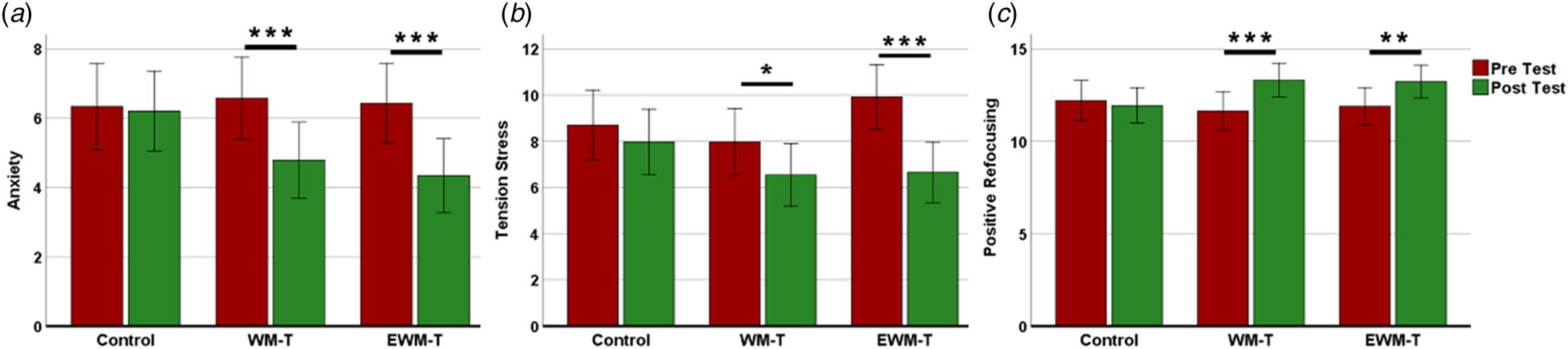
For the DASS-depression subscale, the main effect of time was significant [F (1,95) = 10.47, p = 0.002, ηp 2 = 0.099]. Depression scores among all three groups were significantly lower at post-test than at the pre-test. For the DASS-anxiety subscale and DASS-tension stress subscale, significant interactions between group and time were revealed [DASS-anxiety: F (2,95) = 4.08, p = 0.020, ηp 2 = 0.079; DASS-tension stress: F (2,95) = 3.59, p = 0.032, ηp 2 = 0.070]. Paired sample t tests (pre-test v. post-test) for each group showed that only individuals in two training groups demonstrated a significant reduction in anxiety (WM-T: p < 0.001; EWM-T: p < 0.001) and in stress (WM-T: p = 0.015; EWM-T: p < 0.001), see Fig. 1a and b.
Changes of self-reported assessments for three groups including Depression Anxiety Stress Scales (DASS) and Cognitive Emotion Regulation Questionnaire (CERQ). (a) DASS-anxiety, two training groups but not the control showed the anxiety reduction; (b) DASS-tension stress, two training groups but not the control showed the street reduction; (c) CERQ-positive refocusing, two training groups but not the control showed the increasing positive-refocusing. *p < 0.05; **p < 0.01; ***p < 0.001.

Cognitive emotion regulation questionnaire
The main effect of time for self-blame [F (1,95) = 6.57, p = 0.012, ηp 2 = 0.065], focusing on thought [F (1,95) = 19.40, p < 0.001, ηp 2 = 0.170], catastrophizing [F (1,95) = 14.12, p < 0.001, ηp 2 = 0.129], and refocusing on planning [F (1,63) = 8.90, p = 0.004, ηp 2 = 0.086] were revealed. Scores were favorably affected for each group with scores being significantly reduced for self-blame, focus on thought, catastrophizing and significantly increased for refocusing on planning.
Particularly, a significant interaction between time and group for positive refocusing was revealed [F (1,95) = 4.92, p = 0.009, ηp 2 = 0.094]. The positive refocusing was significantly increased in the WM-T group (p < 0.001) and EWM-T group (p = 0.004), but no changes in the Control (Fig. 1c).
Emotional regulation task
Behavior ratings
For valence rating, the main effect of time is significant, [F (1,190) = 13.56, p < 0.001, ηp 2 = 0.125]. The valence rating at post-test was higher than pre-test. The main effect of condition was significant [F (2,190) = 325.96, p < 0.001, ηp 2 = 0.774]. The valence rating for passively viewing was significantly lower than reappraisal, and the rating for reappraisal was significantly lower than a distraction, p s < 0.001; For ratings of arousal, the main effect of condition was significant [F (2,190) = 169.89, p < 0.001, ηp 2 = 0.641]. The arousal rating of viewing was significantly higher than reappraisal, and the arousal rating for reappraisal was significantly higher than a distraction, p s < 0.001.
LPP
The main effect of condition is significant [F (2,190) = 7.11, p = 0.01, ηp 2 = 0.101]. LPP amplitude of passively viewing was significantly higher than reappraisal (p = 0.050) and distraction (p < 0.001); the amplitude of reappraisal was larger than distraction (p = 0.054).
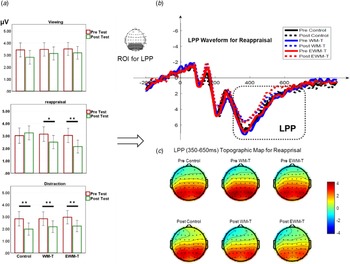
The main effect of time was significant, F (1, 190) = 9.30, p = 0.03, ηp 2 = 0.129, but a significant triple interaction of conditions, time and group [F (4,190) = 3.17, p = 0.015, ηp 2 = 0.063] was revealed. Only the LPP reduction (pre-test minus post-test) in the reappraisal condition was modulated by the group. Specifically, the LPP amplitude for reappraisal at the post-test was significantly lower than at pre-test for WM-T group (p = 0.015) and EWM-T group (p = 0.009), which was not observed in the Control group (p = 0.345), see Fig. 2. For distraction and passively reviewing, all groups showed smaller LPP amplitude relative to the baseline test (p s < 0.05), see online Supplementary Fig. S3 in SI.
LPP (late positive potential) change from the emotional regulation task before and after training for three groups. (a) Histogram of average LPP amplitude (of selected electrodes) measured at pre- and post-test for three conditions in three groups. Only the LPP changes for reappraisal (the middle bar chart) was modulated by the group. Error bars represent the 95% confidence interval. (b) Three groups of LPP waveforms under reappraisal at two test points (solid line for pre-test and the dotted line for post-test). as well as regions of interest (ROI) of electrode points. (c) LPP topographic maps (350-650 ms) of 6 situations (2 Time: Pre/Post × 3 Group: WM-T/EWM-T/Control). The waveforms and topographic maps of the viewing and distraction condition were available in online Supplementary Fig. S3.

Facial stroop task
Behavior results
For levels of accuracy, a significant main effect of time was revealed [F (1,95) = 6.61, p = 0.012, ηp 2 = 0.065], whereby accuracy at post-test was higher than at pre-test.
For reaction times (RT), main effect of condition was significant [F (2,190) = 6.15, p = 0.003, ηp 2 = 0.061], RT of the fear faces and the disgust faces was significantly longer than the neutral faces, p s < 0.01, indicating the existence of a negative attention bias. In addition, the triple interaction of time × condition × group is marginally significant F (4,190) = 2.16, p = 0.080, ηp 2 = 0.06.
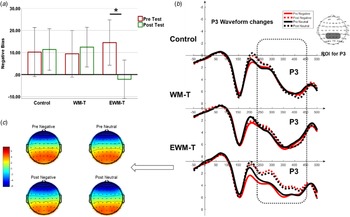
To better decompose and visualize the marginal triple interactions, we calculated a behavior indicator of attention bias, i.e. the difference between RTs for responses to negative faces (including disgust and fear) and RTs for responses to neutral faces. Two-way ANOVA (Time: pre-test/post-test × Group: Control/WM-T/EWM-T) was performed, which indicated a significant time by group interaction [F (2,95) = 3.00, p = 0.050, ηp 2 = 0.054]. Only individuals in the EWM-T group showed a significant reduction in attention bias, p = 0.023, but not in the Control, p = 0.856 or the WM-T group, p = 0.584 (Fig. 3a).
Diagram of behavior attention bias and P3 changes evoked by the emotional Stroop task for three groups. (a) Changes in behavior negative attentional bias (RTs of negative faces combined with disgust and fear minus RTs of neutral faces) at pre- and post-test in the three groups. Error bars represent the 95% confidence interval; (b) Three groups of P3 waveforms for facial stimuli (red for Negative faces, merged disgust faces and fear faces, black for Neutral faces) at two test points (solid line for pre-test and the dotted line for post-test), as well as regions of interest of electrode points; (c) P3 topographic maps (250-450 ms) for EWM-T in four conditions.

P3
A significant interaction of time by group was revealed, F (2,95) = 3.38, p = 0.038, ηp 2 = 0.067. A paired sample t test by grouping showed that P3 at post-test was only significantly smaller than that at pre-test in the EWM-T group. This difference was particularly apparent for responses to negative faces (disgust: p < 0.001; fear: p < 0.001), but was also present for responses to neutral faces (p = 0.010). P3 changes for facial stimuli in the other groups were not significant (Fig. 3b and c).
Correlation analysis
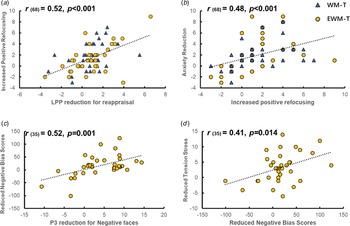
For participants in two training groups, the decreases in LPP amplitude during the reappraisal were positively correlated with self-reported positive refocusing promotion [WM-T: r(33) = 0.440, p = 0.010, EWM-T: r(35) = 5.91, p = 0.001], and increases in positive refocusing were significantly associated with decreases in anxiety [WM-T: r (33) = 0.406, p = 0.019; EWM-T: r(35) = 0.448, p = 0.07], suggesting a close relationship between adaptive emotion regulation and anxiety alleviation, Fig. 4a and b. However, only in the EWM-T group, P3 decreases in response to negative faces were positively correlated with a decrease in negative bias scores [r (35) = 0.52, p = 0.001], and the negative bias reduction was further correlated with tension stress reduction [r (35) = 0.41, p = 0.014], indicating negative bias decreases can serve as a potential pathway to the alleviation of tension, Fig. 4c and d.
Scatter plots of changes in neural indicators and changes in subjective emotional regulation and anxiety/tension stress scores. Graphs (a & b) include participants in both WM-T and EWM-T and the graph (c & d) includes only EWM-T group participants.

Detailed statistical reports on all indicators are available in SI.
Discussion
The purpose of this study was to investigate the emotional benefits of WM-T and similar training with emotional add-in (EWM-T) on individuals with trait anxiety. We observed remarkable emotion-related benefits as a result of general WMT (i.e. the changes observed in two training groups) in anxious individuals. These benefits comprised decreases in DASS-anxiety/tension stress scores improved self-reported positive refocusing and decreased LPP when reappraisal. Besides, we also observed that participants specifically from the EWM-T group demonstrated decreases in both attention bias and the P3 response to negative faces during the emotional Stroop task. These results support our hypothesis that general WM-T can improve the explicit emotional regulation ability of anxious individuals, while emotional WM-T can further facilitate their implicit affective attention control.
According to the framework postulated by Etkin et al. (Reference Etkin, Büchel and Gross2015), model-based emotion regulation represented by cognitive reappraisal requires intact WM capacity in order to construct and/or make use of internal models. By providing a novel longitudinal perspective, the results of the current study add support to the notion of a causal association between WM and cognitive reappraisal. Specifically, we found that individuals who conducted WMT showed significant reductions in LPP during the process of cognitive reappraisal. Even if the lack of reflection on subjective ratings, the modulated neurological indicator (which might exclude the demand characteristics and be more sensitive, Pan et al., Reference Pan, Wang and Li2019) implied the improvements in reappraisal ability among WMT trainees. Indeed, the increased self-reported positive refocusing in two WMT groups also provided consistent evidence. The process of positive refocusing involves refocusing on the positive side of a negative event and may share the similar mental process to reappraisal. It is worth noting, however, despite comparable, EWM-T generated slightly more significant effects than general WM-T during laboratory reappraisal. This may be related to the additional cognitive demands of EWM-T, such as inhibition. That is, participants had to suppress the interference of facial distracter while concentrating on updating task information. Indeed, reappraisal requires the suppression of previous negative evaluations of emotional stimuli, in order to accomplish successful re-processing (Drabant, Mcrae, Manuck, Hariri, & Gross, Reference Drabant, Mcrae, Manuck, Hariri and Gross2009). Compared to common training, the increased inhibition requirements of EWM-T may expand this type of emotional regulation benefit.
We also examined distraction as another explicit emotion regulation manner but found no difference for its LPP reduction between the training groups and the control group. In fact, compared with reappraisal, distraction was considered to involve less cognitively demanding and top-down control (Schönfelder, Kanske, Heissler, & Wessa, Reference Schönfelder, Kanske, Heissler and Wessa2014) and was also found to be less impaired in anxious individuals (Pan et al., Reference Pan, Wang and Li2019). Therefore, it is difficult to be influenced by cognitive training. Besides, the implement of distraction in the current study required little WM capacity but may involve early allocation of attention, which could not be well characterized by LPP in explicit emotion regulation task.
However, in the emotional Stroop task, where the implicit/early attention control of emotion was materially required and well represented, the specific effect of EWM-T was significantly pronounced. EWM-T reduced behavior attention bias and the P3 amplitude associated with negative faces, suggesting its assist in reducing the attention bias of anxious individuals. Indeed, EWM-T required individuals to focus on the non-emotional aspects of the material, i.e. colors and positions, while ignoring or suppressing the influence of emotional attributes. The repeated exposure of negative but irrelevant attribution was designed to re-balance attention weighting and may improve resistance to emotional distraction in the ongoing task, which then spontaneously transfer to emotion Stroop tasks. This type of implicit attention allocation does not require conscious voluntary regulation, but rather an automatic evaluation and resource distribution (Pollmann, Reference Pollmann2012). It is not dependent on explicit monitoring and is considered to be a type of model-free regulation (Etkin et al., Reference Etkin, Büchel and Gross2015). At the neural level, it may be less dependent on frontal-parietal networks that are directly associated with WM function, and may rely more on the control of medial prefrontal cortex and regions related to emotional response (e.g. amygdala). Thus, WM-T alone does not yield benefits related to attentional bias, while training with emotional interference is more likely to obtain this implicit additional effect.
Some studies failed to find direct emotional benefits from WM-T (Onraedt & Koster, Reference Onraedt and Koster2014; Voogd, Wiers, Zwitser, & Salemink, Reference Voogd, Wiers, Zwitser and Salemink2016; Wanmaker, Geraerts, & Franken, Reference Wanmaker, Geraerts and Franken2015). The lack of objective indicators may explain this absence. The current study used neural indicators to provide reliability and sensitivity for the measurement of emotion processing. Intriguingly, both neural indicators were associated with their corresponding subjective/behavior indexes, which was closely related to the reduced anxiety symptoms. This confirms a broad consensus that good emotional regulation, as well as reduced attention bias, do contribute to the relief of anxiety symptoms (Amstadter, Reference Amstadter2008; MacLeod, Mathews, & Tata, Reference MacLeod, Mathews and Tata1986). Besides, these results identified different pathways between WM-T and EWM-T to produce emotional benefits for an individual with anxiety. Despite the general promotion of explicit emotion regulation ability through WM-T (e.g. improved reappraisal), subtle modifications (e.g. emotional add-in) in the internal settings of WM-T might lead to additional effects (e.g. negative bias reduction).
Though cognitive behavioral therapy (CBT) and attentional bias modification (ABM) have been studied extensively as intervention programs targeted at explicit emotional regulation and implicit attention bias respectively, both programs have faced various challenges in terms of cost and reliability of efficacy (Bar-Haim, Reference Bar-Haim2010; Hakamata et al., Reference Hakamata, Lissek, Bar-Haim, Britton, Fox, Leibenluft and Pine2010; Reinholt & Krogh, Reference Reinholt and Krogh2014). The emotional benefits upheld by (E)WM-T (especially the app-based version) may open new avenues for the low-cost treatment of anxiety disorders.
Some caution needs to be expressed, such as our female-domination sample may influence the generalization of conclusions and the effect of identical training on diagnosed patients with anxiety (rather than trait anxiety individuals) remains to be verified. Another limitation is that the mechanism of the emotional benefits of (E)WM-T has not be well clarified in the current study. Though we observed the EWM-T can reduce negative attention bias, it was not clear whether the effective ingredient came from emotion attentional training or simply from exposure paradigm to emotional stimuli. Adding a control condition with only negative exposure mightwell clarify the source of this additional effect of EWM-T. In addition, we failed to observe a significant association between the progress of WM capacity during training and the emotional benefits (see in SI), which requires us to think more deeply about how the emotion improvements brought by WM-T are finally achieved (i.e. the benefits path). Perhaps independently of memory capacity, other variables that can be affected by training, such as attention control might underlie these positive findings. On all accounts, further exploration on the functional mechanism of (E)WM-T would be quite instructive.
Conclusion
WM-T can improve the explicit reappraisal ability of anxious individuals while adding emotional distraction to traditional WM-T can further balance implicit attention allocation and reduce negative attention bias. Improvements in emotion regulation adaptation and attention bias reduction can relieve anxiety. EWM-T was designed to address both processes and thus provides higher clinical application value.
Supplementary material
The supplementary material for this article can be found at https://doi.org/10.1017/S0033291720002275.
Acknowledgements
This research was supported by National Nature Science Foundation of China (31671136, 31530031), Key Laboratory of Mental Health, Institute of Psychology, Chinese Academy of Sciences. Thanks to Xiao-jing Qin and Zhi-ling Qiao for their assistance in EEG data collection, Thanks to Dao-Tuan Wang for APP technical support and Ruo-lei Gu for language modification.
Author contributions
Xuebing Li and Dong-ni designed the study. Dong-ni Pan conducted the experiments, analyzed the data, and wrote up the first draft of the paper. Delhii Hoid, Xiao-bo Wang, and Zhuo-Jia administered the participants screening and contributed to the EEG recording procedure. All authors contribute to and have approved the final text.
Conflict of interest
None.