Introduction
The global population is growing together with the increased demand for protein sources. Although alternatives for livestock are often discussed (Henchion et al., Reference Henchion, Hayes, Mullen, Fenelon and Tiwari2017), it is expected that the world demand for animal-derived protein in the next 30 years (2050) will be doubled (FAO, 2019).
In 2018, Brazil was the world’s largest beef exporter, representing almost 20% of the total global beef exports, and has the second-largest cattle herd in the world (USDA, 2019). The majority of the Brazilian herd is composed of Zebu cattle (Bos indicus), mainly the Nellore breed, which is characterized by a higher capacity in adapting to a tropical climate and are more resistant to parasites than taurine breeds (Costa et al., Reference Costa, Camargo, Diaz, Irano, Dias, Carbalheiro, Boligon, Baldi, Oliveira, Tonhati and Albuquerque2015). Although cows from the Nellore breed are very prolific, their calving interval is usually long (Abreu et al., Reference Abreu, Ribeiro, Gouveia, Cardoso and Toral2018). To overcome this, reproductive technologies such as in vitro fertilization and embryo transfer are usually applied (Baruselli et al., Reference Baruselli, Reis, Marques, Nasser and Bo2004; Souza et al., Reference Souza, Lienou, Rodrigues, Alexandrino, Cavalcante, Santos, Figueiredo and Dias2018a,Reference Souza, Oliveira, Lienou, Cavalcante, Alexandrino, Santos, Rodrigues, Campelo, Figueiredo and Diasb), resulting in an efficient enhance in meat production, but also increasing twins pregnancies (Reichenbach et al., Reference Reichenbach, Liebrich, Berg and Brem1992).
The main problem of twin pregnancies consists of the risks of freemartinism in the case of dizygotic twins (Qiu et al., Reference Qiu, Shao, He, Muhammad, Cao and Su2018). Production of monozygotic twin embryos consists of an alternative to avoid freemartinism (Hashiyada, Reference Hashiyada2017). However, in daily practice, cows are usually recipients of two embryos per transfer. Besides freemartinism, twin pregnancies may lead to problems during delivery and immediately after the birth of the calves. Therefore, we hypothesize that management may minimize the risks of losses.
Based on this, in the present study we followed two farms applying in vitro fertilization and embryo transfer in Nellore cattle, but following different management systems. Special attention was given to the twin pregnancies. For this, rates of pregnancies, number, and sex of fetuses, and cases of freemartinism were determined.
Materials and Methods
Study site and selected animals
We conducted our study in two different farms, denominated farm A and farm B in Brazil, region Legal Amazonia, Araguaína, Brazil (7°11′28′′S; 48°12′26′′W). The climate is humid tropical, with an average annual temperature of 28°C. Selected cyclic recipient Nellore cows weighing c. 400 kg and age of 4 to 6 years old, presented a good body score, between 3.0 and 3.5 from a scale of 1 to 5. After evaluation of health status, which included gynaecologic examination and confirmation of the absence of infectious diseases, 50 animals from farm A and 98 from farm B were used in the present study. The nutrition of recipients was exclusive Brachiaria brizantha pasture and mineral salt ad libitum in both farms.
Estrous synchronization, oocyte collection, and in vitro embryo production
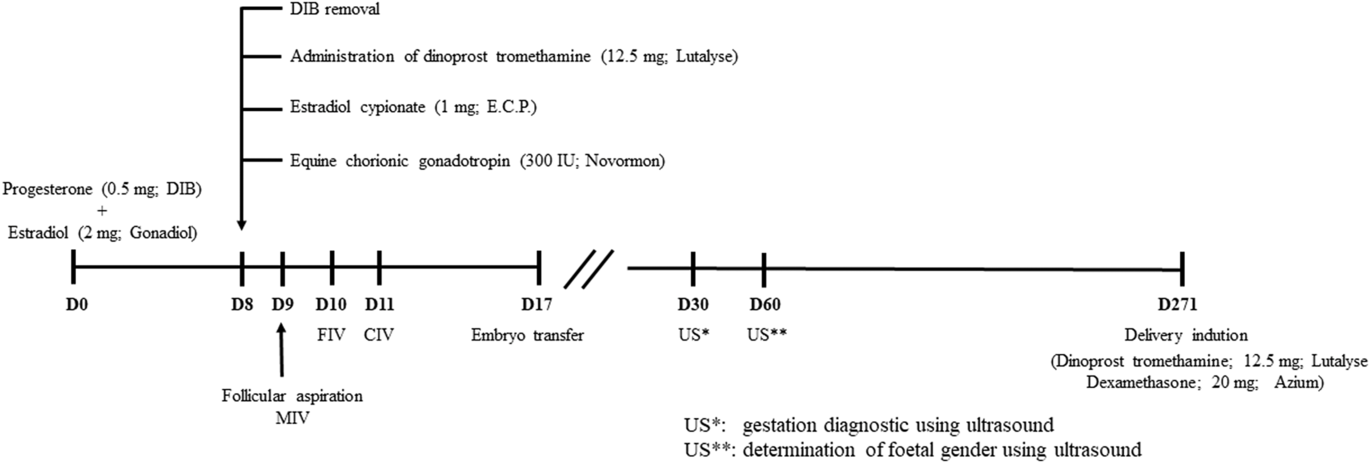
The experimental design is summarized in Fig. 1. In both farms, the same protocol for oestrous synchronization was applied. At day 0, a progesterone intravaginal releasing device (DIB 0.5, Zoetis, Brazil) was inserted, together with the administration of estradiol benzoate (2 mg, IM; Gonadial®, Zoetis, Brazil). At day 8, luteolysis was stimulated by the administration of dinoprost tromethamine (12.5 mg, IM; Lutalyse®, Zoetis, Brazil), the progesterone releasing device was removed, and the cows received estradiol cypionate (1 mg; E.C.P.®, Zoetis, Brazil) and 300 IU of equine chorionic gonadotropin (Novormon®, Zoetis, Brazil).
Experimental design of hormonal treatment, embryo transfer, gestation and delivery monitoring.

To produce the embryos, viable oocytes were collected from Nellore cows after slaughter. For this, ovaries were collected at a local slaughterhouse and transported to the laboratory at 36°C in saline solution. At the laboratory, oocyte aspiration was performed, and the viable ones were selected for in vitro maturation, in vitro fertilization and in vitro culture of the embryos, applying a protocol previously described (Souza et al., Reference Souza, Lienou, Rodrigues, Alexandrino, Cavalcante, Santos, Figueiredo and Dias2018a). In vitro fertilization was performed with the use of semen from a Senepol steer.
Embryo transfer, gestation and delivery
The produced embryos were transferred to plastic straws (0.25 ml) and transported to farm A or B. Before transfer, the recipients were assessed for their health status and, of course, the presence of the corpus luteum in one of the ovary was detected by ultrasound (ALOKA SSD 500 with a 5.0 MHz probe). Each recipient received two embryos. The first gestation diagnostic was performed 30 days after embryo transfer to determine the presence of one or two developing embryos. On day 60 of gestation, the sex of the fetuses was determined. All these procedures were performed with the help of ultrasound.
To prevent problems, e.g. prolonged gestation, stillborn and too large fetuses, delivery was induced at day 271 of gestation in all cows, via administration of a prostaglandin analogue dinoprost tromethamine (12.5 mg, IM; Lutalyse®, Zoetis, Brazil), and dexamethasone at a dosage of 20 mg, IM; Azium® Solução, MSD®, Brazil).
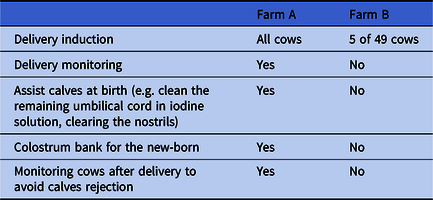
Differences between farms A and B were related to management. In farm A, all the cows presenting twin pregnancies were induced, while at farm B this procedure was performed only in five pregnant cows. Furthermore, farm A had constant supervision of a veterinarian and after delivery of twins the less vital calf received extra care and its access to colostrum was guaranteed. This procedure was not performed at farm B. Monitoring steps followed in farm A are summarized in Table 1.
Management performed in farms A and B

Results and Discussion
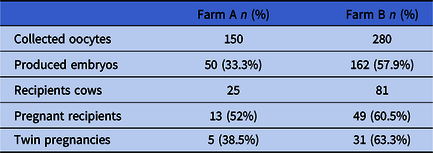
At farm A, 25 recipient cows received 50 in vitro-produced embryos (two embryos per Nellore cow) via transcervical embryo transfer, resulting in 13 (52%) pregnant cows, from which five (38.5%) twin pregnancies. At farm B, it was possible to perform transcervical embryo transfer to 81 cows, each one also receiving two in vitro-produced embryos. From these recipient cows, 49 were pregnant (60.5%), from which 31 (63.3%) presented twin pregnancies (Table 2).
Collected oocytes, produced and transferred embryos, gestation rates and types, and fetal sex obtained in farms A and B

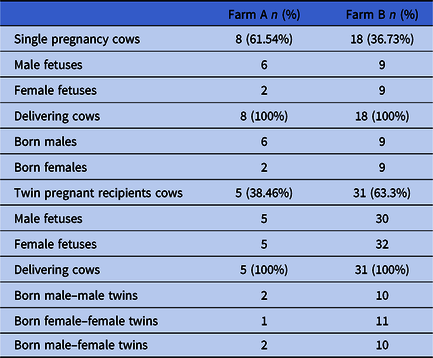
Sex of fetuses was also determined, as shown in Table 3. In Holstein cows a frequency of 87–92% freemartinism was reported in bovine dizygotic twins in a mixed-sex pregnancy (Qiu et al., Reference Qiu, Shao, He, Muhammad, Cao and Su2018). In the present study, this was observed in 100% of the cases. This means that born females will contain the XX/XY chimaera and will be often infertile, and subsequently sold for meat production resulting in genetic and economic loss (Hirayama et al., Reference Hirayama, Katagiri, Kageyama, Minamihashi, Moriyasu, Sawai, Onoe and Takahashi2007). With the rising rates of twin pregnancies in the last years (Szczerbal et al., Reference Szczerbal, Kociucka, Nowackawoszuk, Lach, Jaskowski and Switonski2014), it is expected that these losses will also increase.
Number and percentages of male and female fetuses obtained from single and twin pregnancies at farms A and B

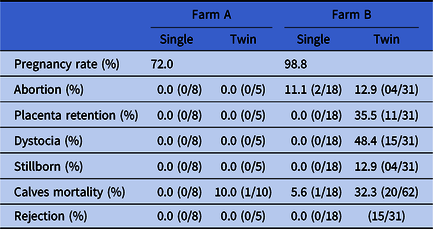
Pregnancy rates were calculated based on the number of produced fetuses, which was high in both farms (Table 4). The mean pregnancy rate via artificial insemination of cows Brazil ranged from 40 to 60% (Meneghetti et al., Reference Meneghetti, Sá Filho, Peres, Lamb and Vasconcelos2009; Sá Filho et al., Reference Sá Filho, Meneghetti, Peres, Lamb and Vasconcelos2009). Other researchers reported that gestation rates after embryo transfer ranged from 30 to 40% (McMillan, Reference McMillan1998; Hansen and Block, Reference Hansen and Block2004). We obtained much higher gestation rates after embryo transfer, i.e. 72% in farm A and 98.9% in farm B, showing the efficiency of our procedure. It was shown that embryo transfer is more advantageous than artificial insemination because it allows a higher genetic gain in a short-term due to the production of two calves per gestation (Pontes et al., Reference Pontes, Melo Sterza, Basso, Ferreira, Sanches, Rubin and Seneda2011). However, twin pregnancy in bovine brings the risk of dystocia, placenta retention, freemartinism, and even abortion (Baruselli et al., Reference Baruselli, Reis, Marques, Nasser and Bo2004). Therefore, proper gestation and delivery monitoring will minimize risks and economic losses, as observed in the present study.
Effect of gestation (single or twin) in farms A and B, and rates of pregnancy, abortion, placenta retention, dystocia, stillborn and mortality of new-borns

We also evaluated the effect of twin pregnancies on the incidence of dystocia during delivery and mortality rate of new-born calves. At farm A, no dystocia was observed, while at farm B 48% of the twin pregnancies ended up in dystocia. Dystocia is observed in c. 42% of twin pregnancies (Gregory et al., Reference Gregory, Echternkamp and Cundiff1996), requiring the presence of a veterinarian during delivery. This can be shown in the present study by the difference in more than 22% in the mortality rate of new-born calves when comparing farms A (10%) and B (32.3%). None of the farms presented dystocia when cows had a single pregnancy. These results differed from those earlier reported by other research groups, who showed a rate of 22% dystocia (Echternkamp and Gregory, Reference Echternkamp and Gregory2002). This is a result of veterinarian care at farm A. At farm A, all the cows had pharmacologically induced delivery, while at farm B not. This explains the high mortality rates at farm B (Table 3). Importantly, a shortening in the gestation period may result in an incomplete placenta maturation and subsequent retention (Echternkamp and Gregory, Reference Echternkamp and Gregory2002). However, this effect was not observed in the cows from farm A, which were induced at day 271 of gestation. Other authors indicated that placenta retention will occur anyway in 62% of cows with twin pregnancy (Penny et al., Reference Penny, Lowman, Scott, Scott, Voelkel and Davies1995). In farm B, this phenomenon was observed in 35.5% of the cows (Table 3). Furthermore, cows with twins calves could reject one of the calves (Gregory et al., Reference Gregory, Echternkamp, Dickerson, Cundiff, Koch and Van Vleck1990). In the present study, this rejection was observed only in farm B.
In conclusion, it is possible to increase the pregnancy rate by stimulation of twin gestations in Nellore. Although the occurrence of freemartinism increases, the main destination of the obtained calves was beef production and were not used in reproduction programmes. However, pregnancy and delivery must be supervised to avoid animal losses. For instance, delivery induction and monitoring, as well as initial care with born twin calves will increase production efficiency. This is a case study indicating the importance of following more farms with twin pregnancies to obtain more robust data.
Financial support
This work was funded by FINEP and IELNR-TO (number 19.847).
Conflict of interest
All the authors have no conflict of interest.
Ethical standards
Not applicable.