Agenesis of the corpus callosum (AgCC) is a congenital anomaly involving complete or partial absence of the band of white matter fibers connecting brain hemispheres (Jinkins, Whittemore, & Bradley, Reference Jinkins, Whittemore and Bradley1989). AgCC is associated with various mild to moderate cognitive deficits, including deficits in executive functioning (e.g., Brown, Anderson, Symington, & Paul, Reference Brown, Anderson, Symington and Paul2012; Brown & Paul, Reference Brown and Paul2000, Reference Brown and Paul2019; Marco et al., Reference Marco, Harrell, Brown, Hill, Jeremy, Kramer and Paul2012). Self-monitoring is an aspect of executive functioning that has not been studied in AgCC, but evidence from self-report personality measures suggests this is an area of weakness (Brown & Paul, Reference Brown and Paul2000; Kaplan, Brown, Adolphs & Paul, Reference Kaplan, Brown, Adolphs and Paul2012; Longino, Reference Longino2011).
The aim of this investigation was to study everyday executive functioning in individuals with AgCC, and the accuracy of their self-perception regarding this area of functioning. This was achieved by examining self- and informant-ratings of daily executive functioning using the Behavioral Rating Inventory of Executive Function–Adult version (BRIEF-A; Roth, Isquith, & Gioia, Reference Roth, Isquith and Gioia2005).
Agenesis of the Corpus Callosum
AgCC occurs in an estimated 1 of every 4000 live births (Glass, Shaw, Ma, & Sherr, Reference Glass, Shaw, Ma and Sherr2008), and involves complete or partial absence of the corpus callosum. While the etiology of AgCC is not fully understood, it is thought to arise from a combination of both genetic and environmental factors (Paul et al., Reference Paul, Brown, Adolphs, Tyszka, Richards, Mukherjee and Sherr2007). Individuals with AgCC may develop and retain commissures other than the corpus callosum (such as the anterior commissure), and some degree of interhemispheric transfer may occur through these alternative commissures (Barr & Corballis, Reference Barr and Corballis2002; Brown, Jeeves, Dietrich, & Burnison, Reference Brown, Jeeves, Dietrich and Burnison1999; Brown, Thrasher, & Paul, Reference Brown, Thrasher and Paul2001; Fischer, Ryan, & Dobyns, Reference Fischer, Ryan and Dobyns1992). The functioning of individuals with complete AgCC is therefore not the same as that of individuals with a commissurotomy (“split-brain”; Sperry, Reference Sperry, Schmitt and Worden1974). Nonetheless, interhemispheric transfer of information is less efficient in non-callosal pathways when compared to transfer through the corpus callosum (Brown et al., Reference Brown, Jeeves, Dietrich and Burnison1999; Brown et al., Reference Brown, Thrasher and Paul2001).
There is a significant sub-population of individuals with AgCC who are without other brain abnormalities and possess a full-scale intelligence quotient within the normal range (i.e., FSIQ ≥ 80; Chiarello, Reference Chiarello1980; Paul et al., Reference Paul, Brown, Adolphs, Tyszka, Richards, Mukherjee and Sherr2007; Sauerwein & Lassonde, Reference Sauerwein and Lassonde1994). This clinical presentation, called primary AgCC (Brown & Paul, Reference Brown and Paul2019), provides opportunities for the focused study of the neuropsychological impact of complete or partial absence of the corpus callosum.
Cognitive Profile of AgCC
A growing body of research outlines the typical pattern of mild to moderate cognitive and psychosocial deficits in Primary AgCC (reviewed by Brown & Paul, Reference Brown and Paul2019; Siffredi, Anderson, Leventer & Spencer-Smith, Reference Siffredi, Anderson, Leventer and Spencer-Smith2013). Brown and Paul (Reference Brown and Paul2019) have argued that the core deficiencies in individuals with Primary AgCC involve (a) interhemispheric transfer of complex sensory information and learning (Brown et al., Reference Brown, Jeeves, Dietrich and Burnison1999; Imamura, Yamadori, Shiga, Sahara, & Abiko, Reference Imamura, Yamadori, Shiga, Sahara and Abiko1994; Jeeves, Reference Jeeves, Steele Russell, van Hof and Berluchhi1979; Karnath, Schumacher, & Wallesch, Reference Karnath, Schumacher and Wallesch1991; Sauerwein & Lassonde, Reference Sauerwein and Lassonde1983), (b) cognitive processing speed (Erickson, Young, Paul, & Brown, Reference Erickson, Young, Paul and Brown2013; Marco et al., Reference Marco, Harrell, Brown, Hill, Jeremy, Kramer and Paul2012), and (c) complex novel problem-solving (e.g., Brown et al., Reference Brown, Anderson, Symington and Paul2012; Schieffer, Paul, & Brown, Reference Schieffer, Paul and Brown2000; Fischer et al., Reference Fischer, Ryan and Dobyns1992; Gott & Saul, Reference Gott and Saul1978; Sauerwein & Lassonde, Reference Sauerwein and Lassonde1994; Smith & Rourke, Reference Smith, Rourke and Rourke1995; Solursh, Margulies, Ashem, & Stasiak, Reference Solursh, Margulies, Ashem and Stasiak1965).
More specifically, across many studies, individuals with AgCC exhibit deficits in a variety of cognitive and psychosocial domains, including: learning and recall of verbal and visual information (Erickson, Paul, & Brown, Reference Erickson, Paul and Brown2014; Paul, Erickson, Hartman, & Brown, Reference Paul, Erickson, Hartman and Brown2016), comprehension of second-order meanings of language and proverbs (Brown, Paul, Symington, & Dietrich, Reference Brown, Paul, Symington and Dietrich2005; Brown, Symington, VanLancker-Sidtis, Dietrich, & Paul, Reference Brown, Symington, VanLancker-Sidtis, Dietrich and Paul2005; Paul, VanLancker-Sidtis, Schieffer, & Brown, Reference Paul, VanLancker-Sidtis, Schieffer and Brown2003; Rehmel, Brown, & Paul, Reference Rehmel, Brown and Paul2016), recognition of cues to emotion in faces (Bridgman et al., Reference Bridgman, Brown, Spezio, Leonard, Adolphs and Paul2014), interpreting sarcasm and understanding subtle aspects of social interactions (Symington, Paul, Symington, Ono, & Brown, Reference Symington, Paul, Symington, Ono and Brown2010), and imagining and inferring the mental, emotional, and social functioning of others (Renteria-Vazquez et al., Reference Renteria-Vazquez, Brown, Kang, Graves, Castelli and Paulin press; Turk, Brown, Symington, & Paul, Reference Turk, Brown, Symington and Paul2010; Young et al., Reference Young, Folsom, Paul, Su, Mangum and Brown2019). While general intelligence is not deficient among individuals with Primary AgCC, they appear to struggle with tasks demanding fluid intelligence compared to those involving crystallized or static intelligence (Brown & Paul, Reference Brown and Paul2000, Reference Brown and Paul2019).
AgCC and Executive Functions
Studies of AgCC using clinical assessment tools have found mild executive function deficits, particularly manifest in response inhibition and switching (Marco et al, Reference Marco, Harrell, Brown, Hill, Jeremy, Kramer and Paul2012), sustained attention and vigilance (Brown, Panos & Paul, Reference Brown, Panos and Paul2020), encoding in list-learning (Erickson et al., Reference Erickson, Paul and Brown2014; Paul et al., Reference Paul, Erickson, Hartman and Brown2016), and strategic understanding and use of interpersonal emotions (Anderson, Paul, & Brown, Reference Anderson, Paul and Brown2017). As described by Brown and Paul (Reference Brown and Paul2019), more pronounced executive function deficiencies are evident in problem-solving. Evidence of difficulty with complex, novel problems can be found in several domains, including decision-making and social functioning. Impairments in decision-making have been demonstrated on categorization tasks (Schieffer, Reference Schieffer1999) and the Iowa Gambling Task (Bechara, Damásio, Damásio, & Anderson, Reference Bechara, Damásio, Damásio and Anderson1994; Brown et al., Reference Brown, Anderson, Symington and Paul2012). Results from the Iowa Gambling Task suggest that in AgCC, decision-making is specifically hindered by difficulty establishing a beneficial strategy (Brown et al., Reference Brown, Anderson, Symington and Paul2012). In the social domain, individuals with AgCC had difficulty inferring the mental states of the people (i.e., theory of mind) shown in videos depicting complex social interactions (Symington et al., Reference Symington, Paul, Symington, Ono and Brown2010) or inferring social intention from the interpersonal-like interactions suggested by animated triangles (Renteria-Vazquez et al., Reference Renteria-Vazquez, Brown, Kang, Graves, Castelli and Paulin press). Individuals with complete AgCC also demonstrated impairments in awareness of the consequences of action choices (Young et al., Reference Young, Folsom, Paul, Su, Mangum and Brown2019), as well as in logical storytelling, social insight, and appreciation of common story content when responding to stimuli from the Thematic Apperception Test (TAT; Paul, Schieffer, & Brown, Reference Paul, Schieffer and Brown2004; Turk et al., Reference Turk, Brown, Symington and Paul2010).
Finally, AgCC appears to interfere with higher order language skills, such as understanding the second-order meanings of non-literal language expressions found in proverbs (Rehmel et al., Reference Rehmel, Brown and Paul2016), idioms (Paul et al., Reference Paul, VanLancker-Sidtis, Schieffer and Brown2003), and humor (Brown, Paul, et al., Reference Brown, Paul, Symington and Dietrich2005). Recognition of second-order meanings requires a shift in the semantic field of interpretation. As Rehmel and colleagues (Reference Rehmel, Brown and Paul2016) pointed out, difficulties with understanding second-order meanings and complex linguistic forms (such as proverbs) may account for the broader social deficiencies that individuals with AgCC experience in daily life. Similar problems are also evident in diminished ability to imagine the consequences of alternative behavioral decisions (Young et al., Reference Young, Folsom, Paul, Su, Mangum and Brown2019).
Poor executive functioning may impact multiple domains of everyday life. By early childhood, parents have reported marked behavioral problems in their children with AgCC in the areas of attention, socialization, and thought processes (Badaruddin et al., Reference Badaruddin, Andrews, Bölte, Schilmoeller, Schilmoeller, Paul and Brown2007). Although some adults with Primary AgCC may function relatively well in highly routinized social interactions, in less familiar or more complicated situations they may exhibit symptoms consistent with autism spectrum disorder (Paul, Corsello, Kennedy, & Adolphs, Reference Paul, Corsello, Kennedy and Adolphs2014). This suggests that it is the highly complex and novel domains of problem-solving that pose the greatest problems for individuals with AgCC. Brown and Paul (Reference Brown and Paul2000, Reference Brown and Paul2019) hypothesized that AgCC leads to diminished ability for higher cognitive information processing, but that the manifestation of this diminished ability may not show up in simpler, over-learned, or rote tasks.
Awareness of Deficits in AgCC
On self-report measures, adults with AgCC reveal a pattern of naïve self-understanding and inaccurate perceptions regarding their cognitive and social challenges that suggest limited self-awareness. For example in adults with AgCC, profiles generated from a self-report personality inventory (Minnesota Multiphasic Personality Inventory-Second Edition, MMPI-2 and MMPI-2-RF, Butcher et al., Reference Butcher, Graham, Ben Porath, Tellegen, Dahlstrom and Kaemmer2001) were characterized by a lack of self-awareness, significant psychological naïveté, unsophisticated defenses, and deficient self-understanding (Brown & Paul, Reference Brown and Paul2000; Kaplan et al., Reference Kaplan, Brown, Adolphs and Paul2012; Longino, Reference Longino2011). In these studies, elevations were found on the L-scale which were attributed to deficient social insight and poor personal awareness. Longino (Reference Longino2011) further highlighted the parallels between MMPI-2 profiles among the AgCC and autism spectrum disorder populations, both of which manifest “limited insight and a lack of awareness of how one’s behaviors might affect others” (p. 19).
Limited self-awareness in AgCC was also evident in a screening measure for cognitive and behavioral traits of autism. On this measure, adults with AgCC reported lower incidence of autism traits on self-ratings (Lau et al., Reference Lau, Hinkley, Bukshpun, Strominger, Wakahiro, Baron-Cohen and Marco2013) than were reported by their parents, who were presumed to provide more objective and accurate ratings. Taken together, these studies suggest a pattern of poor self-awareness in AgCC, specifically with regard to social and interpersonal skills, but little is known about their self-awareness regarding other areas of potential weakness such as executive functioning in daily activities.
Rationale and Hypotheses
While results from neuropsychological assessment instruments have indicated that individuals with AgCC have executive function difficulties, effective treatment planning requires insight about how these deficits manifest themselves in everyday behaviors and how these problems in everyday behavior are understood by individuals with AgCC. Thus, this study used the Behavior Rating Inventory of Executive Function-Adult Version (BRIEF-A) to ascertain and compare self- and informant-ratings of daily executive functioning in adults with AgCC. To identify perceived difficulty in everyday behavior, standardized BRIEF-A scores from each rater were statistically compared to the mean of a normal distribution.
Additionally, participant accuracy of self-perception (i.e., self-awareness) was examined using the discrepancy between self- and informant-ratings for each participant, with the presumption that informant-ratings provide a more objective index of functioning. This approach is consistent with studies of individuals with autism spectrum disorder (Verhoeven et al., Reference Verhoeven, Marijnissen, Berger, Oudshoorn, Sijde and Teunisse2012) and traumatic brain injury (Bivona et al., Reference Bivona, Ciurli, Barba, Onder, Azcnuda, Silvestro and Formisano2008) which reported impaired self-awareness based on discrepancies between parent-reports and self-reports. Furthermore, a study of self-awareness in individuals with traumatic brain injury found greater parent/self-report discrepancies on BRIEF ratings of metacognition than behavioral regulation (Wilson Donders, & Nguyen, Reference Wilson, Donders and Nguyen2011), suggesting that the BRIEF Metacognition Index (MI) may be a particularly sensitive index of brain-based impairment in deficit awareness.
We hypothesized that deficiencies would be evident particularly on the MI since the behaviors measured by this index involve complex cognitive abilities, such as problem-solving, planning, and organizing (Roth et al., Reference Roth, Isquith and Gioia2005; Strauss, Sherman, & Spreen, Reference Strauss, Sherman and Spreen2006). In addition, we hypothesized that participants with AgCC would endorse less difficulty with executive function than their informants, indicating mild deficiencies in self-awareness.
METHOD
Participants
Thirty-six participants with AgCC (18 females, 18 males) between the ages of 18 and 72 years (M = 33.72, SD =13.79), with Full-Scale Intelligence Quotient (FSIQ) in the normal range (M = 100.14, SD = 12.41, range 78–129) completed questionnaires measuring executive behaviors. The sample was predominately Caucasian (80%). Regarding education, 22% graduated high school, 39% completed some college, 31% completed college, and 8% completed an advanced degree. Criteria for inclusion in this study were: complete or partial AgCC confirmed by neuroimaging, at least 18 years of age, normal-range FSIQ (i.e., >75), and at least a seventh-grade reading level. From this sample, AgCC diagnosis was confirmed in 22 participants through MRI review (16 complete, 6 partial; 13 isolated, 9 AgCC plus other mild brain dysmorphology). For 14 participants, inclusion in the AgCC group was based on clinical diagnosis via MRI, with details from the MRI report provided by the informant (6 with complete, 4 with partial, 2 with dysgenesis, and 2 unknown; 9 isolated, 3 AgCC plus other neuropathology, and 2 unknown). Ten participants were also included in the Marco et al. (Reference Marco, Harrell, Brown, Hill, Jeremy, Kramer and Paul2012) study. Participants with AgCC were recruited through announcements distributed by the National Organization for Disorders of the Corpus Callosum and participant-initiated contact with the authors.
Each participant had one informant who also completed the BRIEF-A. Informants were selected by AgCC participants and were adults close enough to the participant to have observed their daily behavior in a variety of settings and over a sufficient amount of time. Informants included parents (78%), siblings (14%), and spouse or partner (8%). Participants rated by siblings or partners were evenly distributed by gender (4 males, 4 females).
Procedure
Participants with AgCC completed the BRIEF-A and identified an individual familiar with their daily behavior who completed the BRIEF-A informant version. Informants were also asked to provide background history (e.g., medical, developmental, and educational) on behalf of the AgCC participant. Before taking the BRIEF-A, participants with AgCC had to successfully complete the Wechsler Individual Achievement Test, Second Edition (WIAT-II; Wechsler, Reference Wechsler2005) Reading Comprehension item that demarcates seventh-grade reading level (as required for the BRIEF-A, Roth et al., Reference Roth, Isquith and Gioia2005). In 14 participants, FSIQ was acquired previously in the ongoing AgCC study at Travis Research Institute using Wechsler Adult Intelligence Scale, Third Edition (WAIS-III; Wechsler, Reference Wechsler1997, n = 13) or the Wechsler Intelligence Scale for Children, Fourth Edition (Wechsler, Reference Wechsler2003, n = 1, at age 15). FSIQ was estimated in the remaining 22 participants by administration of the Wechsler Test of Adult Reading (WTAR; Wechsler, Reference Wechsler2001), which correlates strongly with WAIS-III FSIQ in the age-range of our sample (.70-.80, Wechsler, Reference Wechsler2001).
Self- and informant-reports were collected using a secure online questionnaire in Qualtrics. The reading comprehension screen (i.e., WIAT-II subtest) was integrated into the online questionnaire and administered prior to the BRIEF-A. Licensing keys were obtained for all test and questionnaire items. All individuals with AgCC and their informants provided consent for participation via online consent forms. The Institutional Review Board of the Travis Research Institute at Fuller Graduate School of Psychology approved all procedures for this study.
MEASURES
Behavior Rating Inventory of Executive Function–Adult Version (BRIEF-A)
The BRIEF-A (Roth et al., Reference Roth, Isquith and Gioia2005) is a standardized questionnaire used to assess performance of self-regulatory behaviors in everyday life in adults aged 18–90. Both the self- and informant-forms of the BRIEF-A contain 75 statements on which respondents rate the level of functioning with a 3-point Likert scale of Never, Sometimes, or Often. Responses are summed into 9 clinical scales and 3 composite indices that are norm-referenced by age and converted to T scores (M = 50, SD = 10), with elevations indicating greater impairment. T score norms for the BRIEF-A are based on data collected from 1,136 self-reports and 1,200 informant-reports as detailed in the test manual (Roth et al., Reference Roth, Isquith and Gioia2005, pp. 52–53).
The two composite indices, Behavioral Regulation Index (BRI) and Metacognition Index (MI) are comprised of subscales as follows: BRI—Inhibit, Shift, Emotional Control, and Self-Monitor; MI—Initiate, Working Memory, Plan/Organize, Task Monitor, and Organization of Materials. The BRI represents the ability to maintain appropriate regulatory control over behavior and emotional responses, while the MI represents the ability to systematically solve problems via planning and organizing while sustaining processes in working memory systems. The Global Executive Composite (GEC), comprised of both BRI and MI, provides an overall summary rating of an individual’s executive functioning. The BRIEF-A also incorporates 3 validity scales: the Negativity Scale sums items that are unusually negative, the Infrequency Scale sums atypical responses, and the Inconsistency Scale sums the number of times similar questions are answered in opposite directions. For both forms, internal consistency coefficients from the normative group, r = .73–.96, and test–retest reliability correlations for a subset of healthy adults, r = .82–.96, are adequate for all scales and subscales (Roth et al., Reference Roth, Isquith and Gioia2005, p. 61).
Data Analysis
Statistical analyses were conducted in SPSS. Self- and informant-reports were analyzed separately using one-sample t tests to compare T scores with the normative mean (50) for each composite index. Significant findings were followed by post-hoc one-sample t tests of subscales. Adjustment for multiple-comparisons was addressed with a modified Bonferroni correction of significance for comparison of the 2 composite indices, and Bonferroni corrections for exploratory analyses (for 4 BRI subtests and for 5 MI subtests). The number of participants with composite index scores at or above the threshold considered borderline clinically significant (i.e., one standard deviation above the normative mean; T score ≥ 60) was compared to the number expected in a normal distribution, and significant findings (corrected for multiple comparisons) were followed by post-hoc examination of subtest scores. Fisher’s Exact Test indicates that 13 of 36 individuals with T scores greater or equal to 60 would constitute a statistically significant proportion (X 2 = 4.74, p = .029) for a single measure, and 14 of 36 would be significant for two measures using Bonferroni correction (X 2 = 5.79, p = .016).
To directly compare composite scale ratings of the same individual completed by two raters (self and informant), we calculated a discrepancy score for each participant (self- minus informant-rating). Using a Chi-square test (Campbell, Reference Campbell2007; Richardson, Reference Richardson2011; Altman, Machin, Bryant, & Gardner, Reference Altman, Machin, Bryant and Gardner2000), we compared the proportion of participants with discrepancy scores over 1 standard deviation (in each direction) to the proportion of participants in the mixed clinical/healthy normative sample with discrepancy scores in that range (Roth et al., Reference Roth, Isquith and Gioia2005, p.65).
Effects of informant characteristics (informant-participant relationship, parent or other, and informant gender) and participant characteristics (age, gender, and FSIQ) on the primary dependent measures of the study (BRI and MI) were probed via stepwise regression with self-versus-informant discrepancy scores. Although use of age-adjusted T scores controls for normal age-related variation, additional analysis of age effects was conducted because it is possible that age may have a greater impact in a clinical group, resulting in more typical age-adjusted scores at some ages and more atypical age-adjusted scores at other ages.
RESULTS
Validity Scales
No subjects were excluded due to validity scale scores. On the Negativity scale, informant-ratings were significantly higher than self-ratings, F (1, 35) = 16.59, p < .001, ηp 2 = .322. Only one informant-rating approached significant elevation (raw score = 6), but all index and subscale ratings for this participant fell within the distribution of the entire sample.
There was a trend toward significantly lower Infrequency scores from informants, F (1, 34) = 4.10, p = .051, ηp 2 = .108. Infrequency was elevated for two informant-ratings and one self-rating (raw score = 3), but these protocols were retained in our sample since all of their scores were quite low (T score range = 32–47) and they would only reduce the possibility of finding elevations.
Informant- and self-ratings did not differ on Inconsistency scores, F (1, 35) = 1.94, p = .173, ηp 2 = .053. Inconsistency was elevated for one informant (raw score = 8) and 2 participants (raw scores of 8 and 9). None of the index and subscale ratings for these participants were outliers relative to the total sample, so all were retained in the analyses.
BRIEF-A Scores
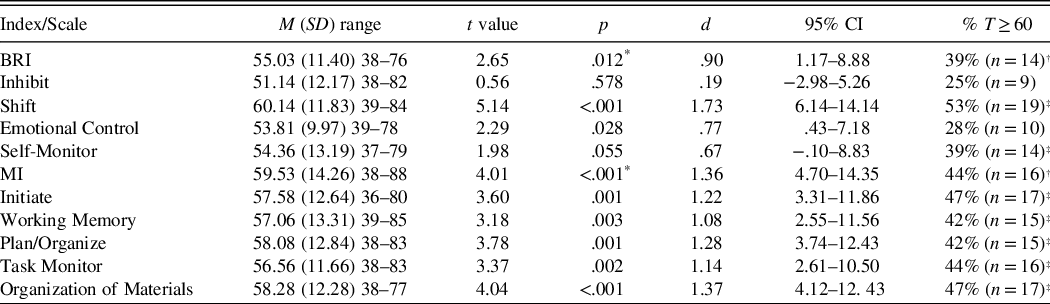
Detailed descriptive and t test statistics are listed in Tables 1 and 2. Self-ratings of executive functioning were significantly elevated compared to test norms on both the BRI, d = .94, and MI, d = .99 (with Bonferroni correction). Post-hoc analyses revealed significant elevations on six subscales (Shift, Emotional Control, Initiate, Working Memory, Plan/Organize, and Task Monitor) with moderate to large effect sizes (BRI subscales d > 1.00, MI subscales d > .74). A significant percentage of participants scored at or above the borderline-clinical threshold for MI, but not for BRI (with Bonferroni correction). Post-hoc comparisons of MI subscales revealed a significant percentage of participants with elevations on Initiate, Working Memory, Plan/Organize, and Task Monitor (see Table 1). In exploratory analysis of BRI subtests, 15 of 36 would be significant using Bonferroni correction, X 2 = 6.92, p = .009, and only Shift met that threshold (n = 21).
Descriptive and t test statistics for self-reported BRIEF-A index and subscale T scores compared to a normal T distribution

Note. BRI = Behavioral Regulation Index; MI = Metacognition Index; M = 50 and SD = 10 in a normal T distribution.
* Significant at Bonferroni adjusted α of p < .025.
† At or above 14 of 36; X 2 = 5.79, p = .016.
‡ At or above 15 of 36; X 2 = 6.92, p = .009.
§ At or above 13 of 36; X 2 = 4.74, p = .029.
Descriptive and t test statistics for informant-reported BRIEF-A index and subscale T scores compared to a normal T distribution

Note. BRI = Behavioral Regulation Index; MI = Metacognition Index; M = 50 and SD = 10 in a normal T distribution.
* Significant at Bonferroni adjusted α of p < .025.
† At or above 14 of 36; X 2 = 5.79, p = .016.
‡ At or above 13 of 36; X 2 = 4.74, p = .029.
Informant-ratings were also significantly elevated compared to test norms on both BRI, d = .90, and MI, d = 1.36. Informants endorsed elevations on the same subscales as the self-ratings (with the addition of Organization of Materials) and effect sizes were also moderate to large (BRI subscales d > .77, MI subscales d > 1.08). Additionally, there was a trend toward significant elevation on the Self-Monitor subscale with a moderate effect size, d = .67. A significant percentage of participants had informant-ratings at or above the borderline-clinical threshold for both MI and BRI (with Bonferroni correction), as well as on all MI subscales and on Shift and Self-Monitor subtests of BRI (see Table 2).
Self- Versus Informant-Ratings
The T score discrepancy between self- and informant-ratings was calculated for both index scores and all subscales. Table 3 presents the frequency of discrepancy scores of 1 standard deviation or greater in each direction. The proportion of AgCC participants whose self-ratings indicated less impairment than informant-ratings (discrepancy ≥1 SD) was greater than in the normative sample for the metacognition index, X 2 = 10.05, p = .0015 (Bonferroni corrected for 2 index scores), as well as the initiate, X 2 = 5.47, p = .0193, planning, X 2 = 6.95, p = .0084, and organization of materials, X 2 = 6.98, p = .0082, subscales. In contrast, frequency of 1 SD or greater discrepancies on the behavioral regulation index was similar in the AgCC and normative samples. However, in exploratory analyses, the proportion of AgCC participants whose self-ratings indicated less impairment than informant-ratings was greater than in the normative sample for the shift, X 2 = 10.78, p = .001, and self-monitor, X 2 = 8.27, p = .004, subscales (Bonferroni corrected for 4 subscales).
Frequency of self-informant discrepancy of 1 standard deviation or greater

Note. BRI = Behavioral Regulation Index; MI = Metacognition Index; Inhib = Inhibition; Emo = Emotional Control; Monit = Self-Monitor; Init = Initiate; WM = Working Memory; Plan = Plan/Organize; Task = Task Monitor; Org = Organization of Materials; Inf = Informant.
* Significant at Bonferroni adjusted α of p < .025.
** p < .05.
*** Significant at Bonferroni adjusted α of p < .0125.
Exploration of Moderating Effects of Informant and Participant Characteristics
Informant characteristics (relationship with participant, informant gender) and participant characteristics (FSIQ, age, gender) were entered into a stepwise regression with self-versus-informant discrepancy scores on BRI and MI. For BRI discrepancy scores, the regression model accounted for only 11% of the variance, R 2 =.142, F (1, 34) = 5.63, p = 0.023 and participant age was the only significant predictor, β = .296, t = 2.37, p = 0.023, 95% CI .042, .549. Younger participants were more likely to endorse greater behavioral regulation impairment than their informants, while older participants were more likely to endorse less impairment than their informants. Post-hoc correlations suggest that age primarily influenced self-reported BRI scores, r = −.303, p = .073, and had minimal impact on informant reports, r = .045, p = .794.
For MI discrepancy scores, the regression model accounted for only 10% of the variance, R 2 =.128, F (1, 34) =5.01, p = 0.32 and participant gender was the only factor that predicted MI discrepancy, β = −10.111, t = 2.24, p = 0.032, 95% CI .931, 19.291. On average, informant-reported metacognition deficits were more discrepant from self-reports in males than females (males M = 7.94, SD = 16.06; females M = -2.17, SD = 10.46; t (34) = −2.24, p = .032, d = .75). Self-reported MI did not differ in male and female participants, but informants reported greater metacognition deficits in males with AgCC than in females (males M = 64.28, SD = 13.56; females M = 54.78, SD = 13.68; t (34) = −2.09, p = .044, d = .70). In fact for males, compared to a normal distribution informant-ratings indicated significant metacognition impairment overall, t (17) = 4.469, p < .001, d = 1.05, and on all subscales (d range .72 to 1.06), with a significant percentage of male participants at or above the borderline-clinical threshold, X 2 = 6.41, p = .011. In contrast, the only indication of impaired metacognition in females was on self-rating of working memory, t (17) = 3.035, p = .007, d = 1.47 (with Bonferroni correction for 5 subscales).
DISCUSSION
This study investigated difficulties in everyday executive function among adults with AgCC and characterized the accuracy of their self-perception regarding these abilities. Both self- and informant-reports confirmed that on average, adults with AgCC have difficulties with daily executive functioning, and a significant percentage of these individuals have borderline to clinically elevated scores in metacognition and set-shifting. In comparison to norms, informants reported larger deficits in metacognition and set-shifting than participants reported.
The proportion of AgCC participants whose self-ratings indicated less impairment than informant-ratings (discrepancy ≥ 1 SD) was greater than in the normative sample for the metacognition index, as well as the initiate, plan, and organization of materials subscales. Although the frequency of large BRI discrepancy scores in AgCC did not differ from norms, the proportion of participants with ≥1 SD discrepancy between self and informant-ratings was greater than the normative sample for shift and self-monitor subscales.
Exploratory analyses suggest that discrepancies between self- and informant-ratings of behavioral regulation are associated with changes in self-awareness across the age range, while discrepancies in metacognition ratings are influenced by greater informant-ratings of deficits in males.
BRIEF-A Ratings
Individuals with AgCC endorsed deficits in both behavioral regulation and metacognition. Elevated subscale scores and large effect sizes suggest they see themselves as having problems with being flexible and making transitions, modulating and controlling emotions, and holding information in mind (i.e., poor working memory—that is, often losing track of what they are doing and being easily distracted). They also endorsed difficulty initiating, planning, and monitoring their own activities. However, they believe they can organize their materials adequately, and can inhibit behaviors when necessary.
Informants affirmed the self-reported deficits in behavioral regulation and metacognition, with specific deficits in flexibility, emotional control, and working memory. Informants also reported marked weaknesses in initiating, planning, and self-monitoring. Self- and informant-ratings diverged on only one subscale; informants rated organization of materials as one of the most extreme deficits, but participants did not identify this as an area of weakness.
Self- Versus Informant-Ratings
The second motivation for this study was to examine self-awareness in AgCC as represented in the relationship between self and informant BRIEF-A ratings. As predicted, individuals with AgCC were more likely than the normative sample to report less severe deficits than their informants on the metacognition index, but did not exhibit this effect for behavioral regulation ratings. While this pattern of difference from the normative sample was evident on subscales from both domains (metacognition: initiative, planning, organization of material; behavioral regulation: shifting, and self-monitoring), the general pattern of greater discrepancy on metacognition is consistent with results in traumatic brain injury (Wilson Donders, & Nguyen, Reference Wilson, Donders and Nguyen2011). This finding in AgCC supports the suggestion from Wilson et al. (Reference Wilson, Donders and Nguyen2011) that the BRIEF MI is particularly sensitive to brain-based deficits in self-awareness, and raises the possibility that MI is specifically sensitive to disruptions in brain connectivity.
Effects of Participant Characteristics
Younger participants tended to report greater deficits in behavior regulation than did older participants, but informant-ratings did not vary with participant age. The same pattern was seen in raw scores from the normative sample (Roth et al., Reference Roth, Isquith and Gioia2005, p. 53), resulting in creation of the age-stratified norms used for standardizing our data. However, use of age-stratified norms did not fully account for age-effects on self-reports in AgCC. If we presume, as we have been, that informant-ratings provide a more accurate description than self-ratings, then our findings indicate that deficits in behavioral regulation are not age-dependent in AgCC (i.e., informant ratings did not correlate with age) and age does not consistently impact our index of self-awareness (i.e., discrepancy between informant- and self-report), but age does impact self-perception of these deficits (i.e., endorsement of impairment declined with age). Relative to informant-reports, younger adults appeared to over-report and older adults under-report deficits in behavior regulation. It is possible that as a result of close contact with parents during early adulthood, younger adults are likely to be receiving stronger and more direct corrective feedback than older adults (who are no longer being “parented”), thus their elevated ratings may reflect awareness of negative feedback more so than self-awareness.
In contrast, participant gender influenced informant- but not self-ratings of metacognition, with informants reporting greater deficits in males than females. This was not the pattern in the normative sample and the norms were not gender-stratified (Roth et al., Reference Roth, Isquith and Gioia2005, p. 53). Once again, if we presume that that informant-ratings provide a more accurate description than self-ratings, our findings indicate that while males with AgCC exhibit impairments in all aspects of metacognition in daily activities, metacognition is not impaired in females. However, we cannot rule-out the possibility that informants rated males more harshly than females and should examine this in future studies.
Limitations of the Current Study
Generalizability of the study may be limited by small group size. The study may also be limited by the use of normative data from paper-and-pencil administration, which may differ from online administration in an as yet unknown manner. Online administration also limited experimental control over the testing environment and the ability to monitor compliance with instructions (e.g. to complete the testing independently). Exploration of moderating effects may have been impacted by the use of estimated FSIQ for some participants, and was limited by lack of information about potentially relevant informant characteristics (demographic, social, and psychological). Finally, because this study does not account for objectively measured variations in executive functioning, we are unable to characterize the relationship between specific skills and reports of daily functioning.
Interpretation
Complex reasoning and problem-solving weakness has been proposed as a core feature of the cognitive profile in AgCC (Brown & Paul, Reference Brown and Paul2019) and is consistent with executive function deficits in daily life described here. Previously described neuropsychological deficits in this population may inform our understanding of the underlying causes of these daily difficulties. For example, elevated MI ratings are consistent with neuropsychological studies of problem-solving (Brown et al., Reference Brown, Anderson, Symington and Paul2012; Ha, Paul, & Brown, Reference Ha, Paul and Brown2016; Mangum, Paul, & Brown, Reference Mangum, Paul and Brown2014; Schieffer, Reference Schieffer1999), flexibility and cognitive shifting (Marco et al., Reference Marco, Harrell, Brown, Hill, Jeremy, Kramer and Paul2012), and interpretation of second-order meanings in language (Brown, Paul et al., Reference Brown, Paul, Symington and Dietrich2005; Paul et al., Reference Paul, VanLancker-Sidtis, Schieffer and Brown2003; Rehmel et al., Reference Rehmel, Brown and Paul2016). Poor in-lab performance on set-shifting and flexibility tasks in AgCC was largely (but not entirely) explained by diminished processing speed, as well as poor abstract reasoning, both of which should be considered in future studies of set-shifting deficits in everyday life.
Similarly, BRIEF-A ratings indicating poor emotional control in daily life are consistent with previous findings that individuals with AgCC have diminished ability to describe and talk about their emotions and feelings (Brown & Paul, Reference Brown and Paul2000; Paul et al., Reference Paul, Lautzenhiser, Brown, Hart, Neumann, Spezio and Adolphs2006; Paul, Pazienza, & Brown, Reference Renteria-Vazquez, Brown, Kang, Graves, Castelli and Paulin press), diminished capacity for reasoning abstractly about complicated socio-emotional situations (Anderson et al, Reference Anderson, Paul and Brown2017; Young et al., Reference Young, Folsom, Paul, Su, Mangum and Brown2019) and making social inferences that involve attribution of mental and emotional states (Renteria-Vazquez et al., Reference Renteria-Vazquez, Brown, Kang, Graves, Castelli and Paulin press; Paul et al., Reference Paul, Schieffer and Brown2004; Symington et al., Reference Symington, Paul, Symington, Ono and Brown2010; Turk et al., Reference Turk, Brown, Symington and Paul2010). According to psychological constructionist theories (e.g., Lindquist, MacCormack, & Shablack, Reference Lindquist, MacCormack and Shablack2015), this weak coupling of language and emotional experiences (with reference to themselves and others) may contribute to poor emotional control.
Finally, discrepant findings on BRIEF-A self- and informant-reports is consistent with previous research reporting naïve self-understanding on personality testing (Brown & Paul, Reference Brown and Paul2000; Kaplan et al., Reference Kaplan, Brown, Adolphs and Paul2012; Longino, Reference Longino2011) and with a more recent finding of discordant self- and informant-ratings on a measure of everyday adaptive abilities (Miller, Panos, Brown, & Paul, Reference Miller, Panos, Brown and Paul2016). Taken together, self-versus-informant discrepancies in ratings on the BRIEF-A contribute important support for the conclusion that individuals with AgCC perceive their daily executive and adaptive abilities more favorably than their close relatives, which may reflect poor self-awareness.
Adults with ASD also endorse deficits in everyday executive functioning, and like the adults with AgCC, individuals with ASD tend to rate these deficits as less severe than informants rate them (Johnston et al., Reference Johnston, Murray, Spain, Walker and Russell2019). In ASD, these self- or informant-ratings of everyday executive deficits were not associated with cognitive assessment of executive functioning or with ASD symptoms, suggesting that other factors may be negatively impacting these skills in daily life. In contrast with our findings in AgCC, the opposite gender-effect has been reported in adolescents with autism: parents reported greater deficits in females than males who had similar IQ, ASD symptoms, and social/communication skills (White et al., Reference White, Wallace, Bascom, Armour, Register-Brown, Popal and Kenworthy2017). Future studies comparing daily functioning of adults with AgCC with and without a diagnosis of ASD, as well as adults with ASD without AgCC may help clarify the underlying challenges shared by and specific to these conditions.
Summary
Mild to moderate deficiencies in everyday executive functioning were endorsed by individuals with AgCC themselves, as well as by informants. The deficits are most marked in domains of executive function that involve aspects of behavioral and cognitive flexibility (i.e., shifting and emotional control) and metacognition (i.e., planning, initiating, organizing, working memory). Individuals with AgCC tend to appraise their own executive functioning problems as less severe than informants, especially with respect to their metacognitive functioning. Informants describe greater metacognitive deficits in males with AgCC than in females. Finally, younger individuals with AgCC tend to rate their deficits more similarly to informants, suggesting that older adults may be less aware of their executive functioning weaknesses.
Brown and Paul (Reference Brown and Paul2019) have argued that the core syndrome of AgCC involves reduced cognitive processing speed and deficits in complex reasoning and problem-solving (both aspects of executive functioning). The outcomes of the various subscales of the BRIEF-A provide important support for this understanding of AgCC by demonstrating deficiencies in executive functioning in daily life.
ACKNOWLEDGEMENTS
Data included in this paper was also utilized in the doctoral dissertations of RM & JM, at the Fuller Graduate School of Psychology.
FINANCIAL SUPPORT
This research was not supported by extramural funding.
CONFLICTS OF INTEREST
The authors have no conflicts of interest.