Introduction
Historical narratives on the causes of the Spanish Civil War (1936–39) root the causes of the war in the escalation of conflict and violence that marked the Second Republic (1931–36). One of the motivations of the land reform law of 1932 was mitigating the potential revolutionary threat of landless laborers. In European history, rural unrest or open peasant rebellion have been linked to revolution and civil war, especially when peasant mobilization revolves around the issue of landownership (Acemoglu and Robinson Reference Acemoglu and Robinson2005; Moore Reference Moore1967; Skocpol Reference Skocpol1979: 112). Hegemonic accounts of political transitions have considered democratic and popular threats to landowning elites as the main cause of authoritarian reaction and democratic breakdown in interwar Europe (Gerschenkron Reference Gerschenkron1966).
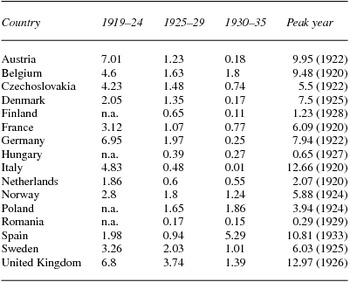
During the Second Republic, Spain witnessed one of the fastest processes of peasant mobilization in interwar Europe. In 1931–32, peasants represented between a third and a half of the booming membership of the anarcho-syndicalist National Confederation of Labor (CNT) and the Socialist Workers’ General Union (UGT) from near-zero membership levels in the late 1920s. In addition, striker rates in 1933 peaked to one of the highest levels in interwar Europe, with rural workers representing about a third of strikers (see table 1). The whole period is infamous by the unprecedented levels of violence, with anarchist rural riots in 1931, 1932, or 1933; episodes of land seizures in 1933 and 1936; and tragic clashes between rebels and the police. As the most prominent historian of agrarian conflict in 1930s Spain pithily put it, there was “latent and spontaneous Civil War in the countryside” during the Second Republic (Malefakis Reference Malefakis1970: 306).
Striker rates in interwar Europe (strikers per 100 gainfully occupied)

Sources: Mitchell Reference Mitchell2007; Nicolau Reference Nicolau, Carreras and Tafunell2005: 149.
Mainstream narratives of the causes of rural conflict in 1930s Spain have focused especially on the South of Spain, where inequality, landlessness, and poverty were endemic. There, it is argued, conflict was particularly acrimonious given the privileged position of the landowning elites pitted against a mass of desperately poor and illiterate landless laborers. Classic accounts of rural unrest in interwar Europe depict unequal power relations and exploitation by the owners of land as the preconditions for rural polarization and conflict. An exogenous shock like World War I or the Great Depression brought such an unstable system to conflict and collapse (e.g., Snowden Reference Snowden1986: 33–34; Reference Snowden1989: 150–57). In the case of Spain, employers’ boycott practices, poor wheat harvests, and a reduction in agricultural output caused unemployment and falling living standards, resulting in conflict and polarization.
However, narratives emphasizing exploitation and falling living standards in 1930s Spain do not square with the existing evidence: inequality fell quickly in the period (Prados de la Escosura Reference Prados de la Escosura2008), poor wheat harvests in 1931 and 1933 alternated with exceptionally good harvests in 1932 and 1934, olive-growing areas also experienced high levels of conflict and did not experience similar levels of output volatility, seasonal unemployment was not a new phenomenon in rural labor markets in dry-farming areas of Spain, and real wages in agricultural labor markets held up pretty well in the 1930s (Domenech Reference Domenech2013). This paper aims at evaluating mainstream narratives of rural conflict during the Second Republic by analyzing in detail the pattern of conflicts in Andalusia, concentrating on the very active provinces of Córdoba, Jaén, and Seville.
I approach the problem of rural conflict in Spain from a regional perspective because official, aggregate data on conflict are incomplete and biased for the period. The paucity of evidence has led several historians to try to reconstruct detailed local or microregional histories of protest (among other examples, del Rey Reference del Rey2008; Mintz Reference Mintz1994). However, this strategy, while providing a privileged microscopic view of the deployment of local collective action, is prone to large selection biases. In general, towns are selected because conflict was more intense there than in other towns or because the town was special for other reasons.
In order to avoid selection biases, this paper takes the middle way of a detailed macroregional perspective, allowing me to go beyond the special cases while keeping the necessary details about conflicts and their context. It is important to note that despite the fact that the provinces chosen here had several distinctive features (landownership concentration, more landlessness, specialization in cereals and olives), there is enough variation in the dependent conflict variables and independent explanatory variables to identify the main causal effects.
Using a new panel dataset of local rural conflict in three provinces of the South of Spain, I exploit the local distribution of conflict and its timing to identify the factors driving rural conflict during the Second Republic. My explanation stresses the “political opportunities” window (Goodwin Reference Goodwin2001; Goodwin and Jasper Reference Goodwin and Jasper2012; McAdam, Tarrow, and Tilly Reference McAdam, Tarrow and Tilly2001; Tilly Reference Tilly1964, Reference Tilly1986) in which the focus is in the interplay between different interest groups and social movements, the state and local and national political institutions. The main conclusion of the paper is that the pattern of conflict analyzed here is consistent with “polity process” explanations and not with “grievance-based” explanations: in 1930s Spain, peasant conflict was obviously affected by inequality and poverty, but did not closely correlate with these variables. Results found here would be consistent with narratives of conflict escalation linked to drastic political and institutional changes, the wane of repression, and the promotion of collective bargaining as a way to organize comprehensively the rural proletariat. The intensity of collective misery did not explain explosive rural conflict in 1930s Spain.
Almost 40 years ago, in an ambitious comparative research project on democratic breakdown in the twentieth century, Juan Linz and Alfred Stepan stressed the preeminence of political factors and processes over structural and economic factors to explain polarization and ultimate breakdown of democratic regimes in interwar Europe and in Latin America (Linz Reference Linz1978, Reference Linz, Linz and Stepan1994; see, as well, Payne Reference Payne1972). Linz's superb and still unsurpassed analysis of political elites’ strategic decisions during the Second Republic left, however, one open question: To what extent and through what mechanisms do elites’ decisions translate into nonelite mobilization and polarization (Linz Reference Linz, Linz and Stepan1994)? This paper is a modest attempt to open a new research agenda on the determinants of bottom-up participation in collective action in 1930s Spain and how these interact with top-down political and institutional changes. This paper plays down structural factors like inequality or harvest volatility in understanding conflict, and rather is more consistent with an account of interwar instability focused on thorough class mobilization and comprehensive labor market organization (urban and rural) in many nonliberal societies of interwar Europe, including Germany, Italy, or Spain (Luebbert Reference Luebbert1991: 9). The link between political change, policy changes, and endogenous rural mobilization and conflict is still poorly understood (some exceptions are Alston, Libecap, and Mueller Reference Alston, Libecap and Mueller2000; Bates Reference Bates1989: 11–45; Ginsborg Reference Ginsborg1984).
Literature Review
The economics of conflict and violence hypothesize a bottom-up, spontaneous response to conflict, paying little attention to the collective organization of conflict. Thus Paul Collier argues that the motivation of individuals to participate in conflict depends on the opportunity cost of violence, which in turn is determined by incomes coming from peaceful, private activities (Collier Reference Collier2009: 133). When incomes are low, or falling, or unemployment is on the rise, the motivation to engage in protest or violence increases (Do and Iyer Reference Do and Iyer2010: 735).
More recently, in the relatively recent turn to find plausible sources of exogenous variation in income, volatile rainfall and harvests have been linked to rural conflict. Thus, for example, Hidalgo et al. (Reference Hidalgo, Naidu, Nichter and Richardson2010) argue poor harvests caused by rainfall shocks increased the likelihood of land invasions in Brazil. In the case of Africa, Miguel et al. claim that droughts increased the likelihood of civil war by depressing rural incomes (Miguel, Satyanath, and Sergenti Reference Miguel, Satyanath and Sergenti2004). In countries like Rwanda, Malthusian pressures and increasing competition for land led to social crisis and violence (André and Platteau Reference André and Platteau1998). In many violent places of the developing world, the existence of a large pool of unemployed workers has been considered a typical trigger of conflict (a critical view in Berman et al. Reference Berman, Callen, Felter and Shapiro2011).
Mainstream narratives of the evolution of rural conflict in the Second Republic in Spain have emphasized the persistence of poverty, unemployment, and inequality as one of the main drivers of mobilization and conflict in the Second Republic. Thus, for example, Paul Preston argued “agrarian violence was a constant feature of the Republic” and that “based on the crippling poverty of rural laborers, it was kept at boiling point by the CNT” (Preston Reference Preston2006: 55). In his view, “throughout 1932, the FNTT [Federación Nacional de Trabajadores de la Tierra, National Federation of Agricultural Workers] worked hard to contain the growing desperation of the rank and file” (Preston Reference Preston2006: 57). Helen Graham considered “the thwarting of popular aspirations for social change produced disillusion. . . among the landless poor and unemployed of the rural south exasperated by the durability of the old relations of power” (Graham Reference Graham2005: 14). Similarly, Stanley Payne argued that in the spring of 1934, “the most active role in labor affairs was taken by the UGT's farmworker federation, the FNTT, centered in Extremadura and Andalusia.” FNTT strength was explained by the fact that “whereas conditions for urban workers had deteriorated only slightly, there was a growing sense of desperation among rural laborers, who had suffered an increase in more than 50 per cent in unemployment during the past two years” (Payne Reference Payne2006: 60–61).
Some have argued that mechanization and the intensification of production methods were the main cause of unemployment in the South of Spain, but James Simpson's calculations showed labor supply did not outstrip labor demand in Andalusia in the period from 1886 to 1935, especially because agricultural land increased faster than population in the period and mechanization was slow (Simpson Reference Simpson1992: 16). Carmona and Simpson focused on changes in the demand for different types of workers with agrarian development in the early twentieth century, with (slow) mechanization and output expansion favoring workers with permanent contracts, tenants, and gangs of temporary migrants at the expense of the local pool of casual laborers (Carmona and Simpson Reference Carmona and Simpson2003: 112–13). In addition, short run changes in labor demand were perhaps more important. The casual proletariat did not have ways of diversifying away the risk of poor harvests and struggled with seasonal income variation (Brenan Reference Brenan2008: 120). If the harvest was poor, labor demand fell and greater underemployment or unemployment followed. Unemployed laborers did not have access to financial services to smooth income shocks and there were more restrictions to temporary migrations in the 1930s (Domenech Reference Domenech2013).
Another set of explanations for conflict single out the role of diffuse property rights. Typically in the New Institutional Economics vein, diffuse property rights cause the rise of conflict, which happens when property rights to land and land reform clash, typically when different groups have competing claims to the land (Alston, Harris, and Mueller Reference Alston, Harris and Mueller2012; André and Platteau Reference André and Platteau1998). In other cases, disputes over usage of common land can lead to violence (Villarreal Reference Villarreal2004). In this view, conflict is more typical of isolated and rugged areas in which the state is weak because it is more difficult to enforce the rule of law and contracts (Fearon and Laitin Reference Fearon and Laitin2003; Herreros and Criado Reference Herreros and Criado2009).
In the case of Spain, it is natural to think that the land reform law of 1932, the most ambitious legislative piece of the period, must have led to the spread of conflict in areas with large estates. For example, 42 percent of all the area of the province of Seville and a third of the province of Córdoba was earmarked for confiscation (López Ontiveros and Mata Olmo Reference López Ontiveros and Olmo1993: 35; Pascual Cevallos Reference Pascual Cevallos1983: 33). Julián Casanova (Reference Casanova2010: 49) writes “the owners’ resistance to Republican legislation intensified conflict. This hostility could be seen to be particularly acrimonious in areas with large estates.”
In contrast, sociologists and political scientists have argued that frustration-aggression theories of conflict lack predictive power (Béteille Reference Béteille1974: 188). Inequality, unemployment and underemployment, crises, and exploitation are the norm, not the exception, in most developing countries and in historical societies, yet conflict only erupts in very special historical circumstances. Several theorists have stressed the role of expectations and contagion in large social processes, given the obvious nonlinearity of most social processes (Biggs Reference Biggs2002, Reference Biggs2005; Freeman Reference Freeman, Bordo, Goldin and White1998). In this framework, small changes in material conditions or in political opportunities can lead to large changes in collective participation.
Because collective action is prone to free-rider problems and mobilization is rare, authors like Eric Wolf or Theda Skocpol have stressed the importance of organizations and their capacity for autonomous collective action (Wolf Reference Wolf1999: 115). In some cases, autonomy appears out of historical accident, as it is for example the case when there are institutions that govern common resources (Skocpol Reference Skocpol1979: 116). The more solid the networks of solidarity among the peasants, the easier it is to organize collective action. Although landowners traditionally controlled the administration of most of the towns in the areas studied here before the 1930s (Tusell Reference Tusell1976: 330–31), there is indeed some vibrancy in the history of collective action in some areas of Andalusia (Carrión Reference Carrión1975: 57–59). In his classic book, Juan Díaz del Moral studied the spread of anarchism in the last quarter of the nineteenth century and the upheavals of the early 1870s, early 1890s, and the early 1900s that preceded the so-called Bolshevik triennium of 1918–20 (Díaz del Moral Reference Díaz del Moral1973). Carmona and Simpson (Reference Carmona and Simpson2003: 110–11) stressed the impact of Andalusian laborers’ militancy on the management of large estates since the early twentieth century.
The role of changing expectations and the role of local leaders in organizing collective action appears vividly in detailed microaccounts of town life like Collier (Reference Collier1987) and Fraser (Reference Fraser2010), in regional studies like Montañés (Reference Montañés1997) on Cádiz and by del Rey (Reference del Rey2008) or by Lisón Tolosana (Reference Lisón Tolosana1966) outside Andalusia. The story is not one of exploitation and resistance, but of empowerment, changing expectations, and large changes in the social organization of labor and land markets, especially in towns controlled by the Spanish Socialist Party and the UGT (Collier Reference Collier1987: 15). These historical contributions focus on the drastic political changes associated with democratization and its effects on the mobilization and polarization of opposing interest groups (Shubert Reference Shubert1990: 101; Tébar Hurtado Reference Tébar Hurtado2006: 22). Detailed studies by Cobo Romero (Reference Cobo Romero1992, Reference Cobo Romero1999) and Grupo de Estudios Agrarios (1995) stress the radical overturn in relations of power, especially where Socialist mayors were elected (Macarro Vera Reference Macarro Vera2000: 62). Although overactive mayors could be suspended of their duties by prefects, in April 1933 there was a Socialist mayor in 18 percent of towns in Seville, 32 percent of towns in Córdoba, and 35 percent of towns in Jaén (PSOE, AH-24-6, August 29, 1934: 8). According to this hypothesis, mobilization and conflict were highest where Socialist militants led peasants to confrontation, the mobilization of landowners, and polarization. Rather than stressing rank-and-file mobilization, in this view, institutional change and democratization sparked conflict top-down from the political parties and unions to the peasants.
However, a study by Enrique Montañés (Reference Montañés1997) on the province of Cádiz, where Socialists were weak and anarchism strong, also describes a similar overturn in power relations and stresses collective bargaining and conflicts associated with it. In the main agricultural towns of the province of Seville and Córdoba, anarcho-syndicalism was the norm and remained active until 1934 despite the intensification of selective repression since the summer of 1931. Socialists were particularly powerful in Jaén and in the sierra towns of Córdoba, whereas the CNT controlled most of the large agro-towns of the Guadalquivir plain. Several historians have stressed that selective government repression aimed at anarcho-syndicalist unions radicalized the rural proletariat in areas dominated by the CNT (most prominently, Casanova Reference Casanova2010: 144–45)
But perhaps ideological differences have been overstretched, especially because unions and their leaders have produced the main historical sources. Moreover, the actions of the Iberian Anarchist Federation (FAI), a fringe but very visible Anarchist group that orchestrated several insurrectionary movements in 1932 and 1933, have perhaps led us to believe that peasant preference for revolution was stronger than it actually was. As Montañés (Reference Montañés1997) has shown, despite the revolutionary roots of anarcho-syndicalism, day-to-day collective action in towns controlled by the CNT was closer to bread-and-butter unionism focusing on wages and hours, the preference of local workers over temporary migrants, the abrogation of piece rates, and the enforcement of collective contracts. CNT-led strikes in towns of Córdoba revolved around the length of harvest contracts, restrictions to the hiring of temporary migrants, and piece rates (Pérez Yruela, Reference Pérez Yruela1979: 126–27). Contemporary observers like journalist Manuel Chaves Nogales noted the blurred ideological preferences of rural laborers in the province of Seville, stressing their combination of anarchist, radical republican, and communist ideas (Chaves Nogales Reference Chaves Nogales2012: 35–37). In the view adopted here, Socialist and anarcho-syndicalist unions did not differ markedly in terms of aims and strategies.
Data
This paper follows Bernal in attempting to provide the most complete to-date mapping of rural conflict in Andalusia at the municipal level (Bernal Reference Bernal1974: 139–88). Although rural conflict did not only intensify in Andalusia, the poor quality of official strike data in the 1930s forces me to concentrate on one region to assemble the necessary evidence from miscellaneous sources. I focus on Andalusia because it is in this area where the effect of latifundia on conflict and polarization has been singled out as the most intense. Jaén, Córdoba, and Seville ranked 4th, 3rd, and 7th of 50 provinces by absolute number of strikers in 1933 (Boletín, VI, 60, 1935: 46–67).
Moreover, restricting my analysis to these three provinces allows me to gather information on local patterns of landownership. Because the government started the cadastre in provinces with large estates, quantitative evidence on landownership distribution in 1930s Spain only exists for some provinces, including the provinces studied here (Carrión Reference Carrión1975: 77; Pro Ruiz Reference Pro Ruiz1992: 308–16). Additionally, the three provinces shared some characteristics: they were specialized in wheat and olives, their workers faced accordingly a very seasonal demand for labor, large estates were dominant in some areas, and seasonal labor demand changes had traditionally led to intra- and interprovincial temporary migrations. Provided there is sufficient variation in rural conflict within the region, a regional approach allows me to keep several characteristics constant and be more selective on the factors that can have true explanatory power.
Because official data on strikes and conflict are poor or do not exist for the period, I rely, similar to Bernal (Reference Bernal1974) and Malefakis (Reference Malefakis1970), on nonofficial evidence, especially newspapers, and the historical literature. National newspapers devoted full sections to very detailed accounts of strikes and other conflicts in the provinces, as well as crimes and accidents of variegated nature. Moreover, this paper relies on decades of historical research in provincial archives and local newspapers. In addition, several national and provincial newspapers from the period are available online. Accordingly, I have performed Boolean searches that have been used to identify episodes of conflict in the period and region studied.
Newspapers and miscellaneous qualitative evidence from the historiography have well-known biases and problems. When official data are poor, as in the case of 1930s Spain, several important contributions to the study of social movements have relied on newspapers and qualitative information to illuminate various aspects of collective action (Earl et al. Reference Earl, Martin, McCarthy and Soule2004: 66; Franzosi Reference Franzosi1987). Newspaper research has been instrumental in several pathbreaking studies of protest and social movements (McAdam Reference McAdam1982; Tarrow Reference Tarrow1989; Tilly Reference Tilly, Zald and McCarthy1979, Reference Tilly1995).
However, in the case of newspapers, selection and description biases need to be taken seriously: censorship and government control is always an issue in countries with a short tradition of independent journalism. Moreover, newspapers selectively report events depending on their intrinsic interest to readers and probably ideological biases, which can distort the information given on the event (Earl et al. Reference Earl, Martin, McCarthy and Soule2004: 67).
In this paper, I have tried to identify the conflict episodes at the municipality level in more than one source (not always possible). Moreover, I have used the evidence in ways that minimize description biases: I focus on the strict counting of events rather than on using information on outcomes or participation in the event, which could be subject to important inaccuracies. Strict event counts follow the strategy of Hobsbawm and Rudé (Reference Hobsbawm and Rudé1973), Markoff (Reference Markoff1985, Reference Markoff1986, Reference Markoff1996), Alston, Libecap, and Mueller (Reference Alston, Libecap and Mueller2000), and, to a great extent, Hidalgo et al. (Reference Hidalgo, Naidu, Nichter and Richardson2010).
However, one can argue that the number of events and the intensity of conflict are not necessarily correlated. In fact several authors stress that the intensity of conflict could be proxied by the proportion of participants in the conflict episode in the relevant population (e.g., the number of strikers in the overall labor force of a firm or a sector or the proportion of the local population involved in land invasions) or the duration of the conflict (among others, Korpi and Shalev Reference Korpi and Shalev1980).
Using participation has problems in itself, however. First, one worries about measurement error, a serious problem in the kind of evidence used here. Second, participation could be endogenous to the success of the conflict event. Participation is generally measured at peak participation, but peak participation is endogenous to the prior probability of success (e.g., people participate more when the probability of repression is low or when success looks possible).
An oft-used second proxy for intensity is the duration of the conflict event. But duration is also poorly measured in the types of conflicts described here. Moreover, in most regression exercises with strike data, duration is negatively related to the probability of strikers’ success (Card and Olson Reference Card and Olson1995: 49–50). Both measurement error and endogeneity problems recommend not using duration and participation in the measurement of the intensity of conflict.
Finally, I do not take into account the outcome of the “conflict event.” In some cases, it is difficult to conclude that a certain episode ended in a victory or defeat of peasant and government officials might have reasons to alter the distribution of strike outcomes. The available evidence suggests that in 1931–32 workers’ victories dominated losses, although things turned sourer in 1933 and 1934 (AE 1932–33: 650; FNTT 2000: 205–6). This is not surprising: during the Second Republic, only 7 percent of all prefects were military officers, whereas almost 60 percent were schoolteachers, university professors, doctors, and journalists in most cases associated with one of the Republican parties (Serrallonga Reference Serrallonga2007). Evidence from prefects shows that with the exception of the odd military prefect, prefects were generally sympathetic to the grievances of workers (Aparicio Albiñana Reference Aparicio Albiñana1936: 25–30; Martín Villodres Reference Martín Villodres1932: 44; Pascual Cevallos Reference Pascual Cevallos1983: 75, 89). The general strike of the summer of 1934 met, however, with intense repression, hundreds of arrests, and the closing of union offices. Moreover, the anarcho-syndicalists of the CNT, with links with revolutionary anarchism and refusing to participate in state-sponsored collective bargaining institutions, faced selective repression since the summer of 1931.
The conflict dataset was culled from various sources. First, I used the very detailed historical studies of Manuel Pérez Yruela (Reference Pérez Yruela1979) on the province of Córdoba, the books of Francisco Cobo Romero (Reference Cobo Romero1992, Reference Cobo Romero2003, Reference Cobo Romero2007) on the province of Jaén, and the study by Fernando Pascual Cevallos (Reference Pascual Cevallos1983) on the province of Seville. All of these studies give very detailed accounts of rural conflict in the provinces studied here. Additionally, I read the section on conflicts in every single issue of El Sol from April 1, 1931 to July 31, 1934. Edward Malefakis considered El Sol to be the national newspaper that supplied the best information on local conflict (Malefakis Reference Malefakis1970: 304). Moreover, I undertook Boolean searches for the concepts “huelga” and “campesinos,” “huelga de campesinos,” “invasión,” “campesinos invaden,” “invasión de fincas rústicas,” and several variations of these in the online archives of newspapers El Sol, ABC national edition, and ABC Seville edition. But because national newspapers did not comprehensively cover all the conflicts (Sevilla Guzmán Reference Sevilla Guzmán1979: 100–1), I also performed the same Boolean searches in the digital newspaper library of the Spanish Ministry of Education, Culture, and Sport, which includes local newspapers from several provinces.Footnote 1
I focus on the two instances of conflict that were the most common in the period. First, I look at local strikes of peasants or farmers organized by peasant unions. For obvious reasons, focusing on reported local peasant strikes is not akin to counting the total number of peasant strikes, because several minor conflicts most probably did not appear in newspapers. Strict counting, however, needs to incorporate some restrictions. Republican laws governing strikes asked local unions to officially announce the strike to the authorities at least a week before the onset of the strike (“oficio de huelga”). Relying on “oficios de huelga” can lead to an overestimate of the number of Socialist strikes and serious underestimate of the number of anarcho-syndicalist strikes. Moreover, official announcement of a strike did not guarantee the strike took off as some local unions cancelled the strike in the last minute or the strike flopped, as it often happened in several cases 1933 and 1934. Newspaper data allow some extra information on the local strike, which can correct the overestimation of FNTT-led strikes and the underestimation of strikes in towns with anarcho-syndicalist unions.
Second, I focus on threats to property rights related to recorded instances of local land invasions and trespassing. The contemporary press did not doubt to refer to these episodes as “land invasions” or “invasions of estates” (“invasión de fincas rústicas”). However, despite the trespassing, the occasional violence, or episodes of machinery destruction and arson, I find the “land invasions” studied here qualitatively different from genuine land seizures (when peasants squat in and work land that they do not own). Because land invasions in the region studied here had more to do with picket lines and conflicts around the issue of who was hired and for how long, I decided to refer to these idiosyncratic land invasions “collective trespassing,” generally referring to episodes in which, against the will of the owner, a group of people clearly identified as peasants entered a estate to work, glean, or damage the harvest or machinery. Arson and machinery destruction of reapers and threshers look almost negligible in the towns studied here (despite the contemporary hyperbole in mainstream newspapers): the very detailed study on the province of Seville by Pascual Cevallos (Reference Pascual Cevallos1983) could only locate 15 episodes of machinery destruction, giving a total of 27 mechanical reapers smashed or damaged from 1931 to 1936, or 1 percent of the stock of mechanical reapers in the province (Ministerio de Agricultura 1933: 320; Pascual Cevallos Reference Pascual Cevallos1983: 137–38). Similarly, always according to Cevallos (Reference Pascual Cevallos1983), arson only surfaced in 11 towns in Seville from 1931 to 1936. Arson in Córdoba and Jaén was less important.
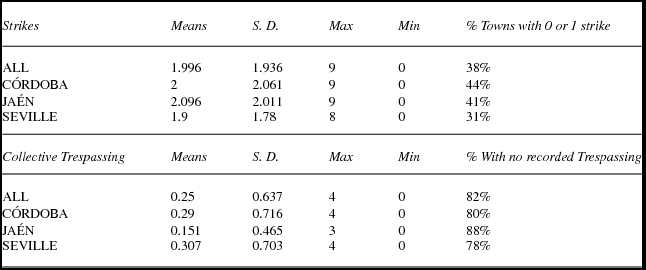
I organize the database as a monthly panel of 252 municipalities followed for 39 months from April 1931 to June 1934 (both months included) leading to 9,828 usable observations. The dependent variable takes value 1 if there was at least a strike or collective trespassing event starting in village or town i in month t and takes value 0 if there was none. Conflict was very unevenly distributed. In the case of rural strikes, between 30 to 40 percent of towns only experienced one conflict episode between April 1931 and July 1934. Clustering is more extreme when I consider collective “trespassing.” Table 2 shows the averages for the manifestations of conflict considered here: a sizable fraction of municipalities experienced zero or just one strike over three years and a substantial proportion of towns did not record acts of collective trespassing.
Strikes and land invasions in Córdoba, Jaén, and Seville, April 1931 to July 1934

Source: Own calculations using Andalusian conflict database.
Research Design
I estimate panel probit models in which the probability of observing a conflict event in municipality i a month t depends on a series of time, cross-sectional, and time-series–cross-sectional interacted variables. The dependent variable in a first set of models is a dichotomous variable taking value 1 if at least one peasant strike was started in the town in a given month between April 1931 and June 1934 and 0 otherwise (I will use the unit “town” or “municipality” interchangeably). The dependent variable in the second set of models uses a dichotomous variable taking value 1 if there was a documented event of collective trespassing in the town in town i in month t. This yields a panel dataset of 39 monthly observations for 252 municipalities and 9,828 observations (capital cities of Córdoba, Jaén, and Seville and cities with more than 30,000 souls are excluded from the sample of municipalities).
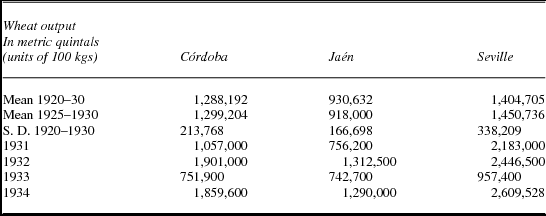
I use as regressors a set of independent variables related to the economics and historical literature. I use the deviations from the 1920–30 mean of wheat output at the provincial level to test the effect of bad harvests on conflict. Wheat and olive harvests were notoriously volatile in the South of Spain. From 1890 to 1935, the standard deviation of the output per hectare sown of wheat and olives was 23 percent and 50 percent of the mean, respectively. Table 3 provides the means and standard deviations of yearly wheat output in each province for the period 1920–30, as well as yearly wheat output in each province in years from 1931 to 1934. Compared with mean provincial wheat output for years in 1920–30, wheat output in Seville was more than two standard deviations above the 1920–30 mean in 1931, 1932, and 1934 and 1.3 standard deviations below mean in 1933. In the provinces of Córdoba or Jaén, wheat output was one standard deviation below mean in 1931, more than two standard deviations below mean in 1933, and more and more than two standard deviations above the 1920–30 mean in 1932 and 1934 (output data from De Torres Reference De Torres1944: 275–85).
Wheat harvests in Andalusian provinces, 1920–1934

Sources: AE, various years; De Torres Reference De Torres1944; El Progreso Agrario y Pecuario, July 7 1934: 402; Ministerio de Agricultura 1934 .
I can test if poor harvests caused greater levels of conflict by exploiting year-province variation in wheat output (measured as percentage deviations from the provincial 1920–30 mean). Wheat was harvested in June, but the qualitative evidence shows that, weeks before the harvest, the size of the harvest could be anticipated with some accuracy (El Progreso Agrícola y Pecuario, August 15, 1931; El Sol, May 26, 1931; El Sol, June 5, 1931; El Sol, June 6, 1934). Because it is impossible to know when exactly the value of the future harvest was apparent to laborers and employers, I have constructed three different agricultural years—from June to June, from May to May, from April to April. Results presented in the following text are robust to the use of the three different agricultural years (in the regressions presented I use an agricultural year measured from May to May).
Because crop specialization has been considered a traditional regressor in studies of rural conflict (e.g., Markoff Reference Markoff1986), I have constructed dummy variables capturing the type of local agricultural (a mix of irrigated and dry farming, cereals, cereals and olives, olives). The classification of crop specialization is based on the coding of a detailed map of agricultural land uses in 1956 (this is before large investments in irrigation were made in the 1960s).Footnote 2 However, because wheat and olives dominated production in the provinces studied here (Simpson Reference Simpson1992: 5), these dummy variables failed to show any correlation with conflict.
In order to capture the cohesiveness of the rural proletariat as well as its vulnerability to harvest failure, I use the log of the proportion of landless laborers in the whole of the poor peasant population (this is the total population of landless laborers, small tenants, and small owners). This uses the work of Espinoza et al. (Reference Espinoza, Robledo, Brel, Villar, Robledo and López2007) that tabulates information from the 1933 Census of Peasants at the judicial district level (an administrative unit encompassing several towns). There are 51 judicial districts and 252 towns in the dataset, so on average each judicial district contains 4.9 towns, although there are wide discrepancies in the number of towns in each district (e.g., one district contained just one town, whereas the district with more towns had ten). I expect this variable to have a positive effect on conflict.
One final caveat: to use landlessness measured in 1933 as an independent variable to explain conflicts in 1931 and 1932 is problematic. Using landlessness measured in 1933 is only valid as long as there was not much land redistribution in 1931 and 1932. Despite the Agrarian Reform of 1932, the evidence gathered by Edward Malefakis on the implementation of land reform suggests the pace of change in the structure of landownership was still glacial in the early 1930s. By December 1933, there had been only 140 and 250 settlers in Seville and Córdoba, respectively, while Jaén had seen 2,500 settlers taking only 905 hectares (Malefakis Reference Malefakis1970: 281). This suggests landlessness measured in 1933 can be used to approximate landlessness in 1931 and 1932.
The effect of insecure property rights is captured by the concentration of landownership. I approximate variation in land tenure inequality by using the log of the percentage of agricultural land in each municipality taken up by estates more than 250 hectares (from Carrión Reference Carrión1975). Moreover, land tenure inequality also approximates the degree of employers’ ability to act collectively, with resistance to Republican laws perhaps more easily coordinated where there were few employers. The cadastre of land holdings was the basis of landownership concentration calculated by Pascual Carrión. But because the cadastre was still being completed, Carrión did not provide estimates of landownership concentration in about 22 percent of the towns in the three provinces studied here. Because there is evidence that municipalities with missing landownership data were smaller; were characterized by small and medium plots; and recorded fewer conflicts, selection biases are going to be an issue. Therefore, in order to correct for this bias, I have logged the existing landownership data and have given an arbitrary 0 value to all the towns with missing information. After doing this, I have coded a variable taking value 1 when the landownership information was missing and 0 otherwise.Footnote 3
Several extra time-invariant variables are included as independent variables. In order to capture the effect of land scarcity, I use population density measured in 1930 as inhabitants per hectare and population growth between 1920 and 1930 (using Censo de Población 1920, 1930 and area from Carrión Reference Carrión1975). It would be far-fetched to compare the competition over scarce land with falling living standards and a Malthusian struggle for survival. In fact, mortality rates fell continuously from 1920 to 1935. Most probably, it would be more sensible to consider those variables as proxies for the competition over rents coming from valuable land, as population would endogenously locate in the most fertile parts of the province.
I add extra time-invariant variables capturing several other dimensions related to the main hypotheses in the literature. Access to information and markets are proxied by the linear distance between the municipality and the capital of the province, the town's elevation above the sea, a dummy variable taking value 1 if the town had a train station, and a dummy variable taking value 1 if the town was the main town in the judicial district.Footnote 4 Finally, the impact of the previous history of collective action is captured by a dummy variable taking one if the town had a registered peasant union in 1916 (IRS 1916).
The regressions use several time-dummies capturing the changes in bargaining power over the agricultural year. Bargaining power fluctuated throughout the year, being at its highest in May through June and November through December, when collective contracts for the wheat and olive harvest were negotiated. With the wheat or olives ripe for collection and with employers risking losing the harvests in storms or to frost, laborers bargaining power was highest. To proxy unobserved bargaining power, I use a set of 11 monthly dummies (from February to December).
In the case of time-series, cross-sectional data, heteroscedasticity, serial autocorrelation, and the structure of lags are typical problems. Some authors have recommended lagging the dependent variable and using unit and time dummies and clustered standard errors (Beck Reference Beck2001; Beck and Katz Reference Beck and Katz1995, 1998). The use of unit and time dummies has been challenged on several grounds, especially with respect to the absorption of interesting time-series and cross-sectional variance. The same applies to the practice of using time trends and, especially, lags of the dependent variable as regressors, as these can absorb interesting time series variation (Plümper, Troeger, and Manow Reference Plümper, Troeger and Manow2005: 330). In the analysis presented here, I have performed regressions with a time trend and with a time trend and a lagged dependent variable. The use of time trends is perhaps justified if there are exogenous, time-dependent forces affecting conflict: organizing collective action takes time, contagion dynamics or changes in expectations unfold over time, and exogenous forces can shape state policy and its changes. I also consider the possibility of state dependence: for example, a strike could be more likely if there had been a strike in the past. In some cases, it is possible that the buildup of collective organization depended on strikes or other conflict episodes being organized in the town, making further events more likely. Perhaps group solidarity solidified after strikes or other collective action took place.
In order to account for potential dependence on previous events, I used alternative specifications containing one of several variations of a lagged dependent variable. In particular, I tried a cumulative count of conflict events since April 1931 and dummy variables with lags of one, three, or six months of the dependent variable (the dummy variable took value 1 if there had been a strike in the last month or in the last three months or in the last six months and 0 otherwise). The lags of one, three, or six months performed poorly in the regressions, failing in all cases to be statistically significant. Minimizing the Akaike Information Criterion, I have decided to drop specifications using the one-month, three-months, or the six-months lag of the dependent variable and report only the specification with all the variables, the time trend, and the cumulative count of conflicts as a regressor. But there is a risk here that the cumulative count simply absorbs the time-trend drift and time-series variation brought about by time-varying covariates. As shown in regressions in the following text, coefficients on the harvest variable are robust to the inclusion of the cumulative count, but the cumulative count absorbs part of the effect of the time trend.
In a third set of regressions, I analyze the impact of “Socialist mayors” on the levels of rural conflict, understood by the literature as a polarizing force. There are two potential hypotheses to be considered, which are not altogether compatible: the first is that Socialist mayors pushed ahead with ambitious Republican legislation and faced fierce resistance of employers and landowners, leading to greater levels of conflict. A second hypothesis is that Socialist-dominated town councils started to feel the repression after November 1933 when the Centre-Left lost the general election. Socialist mayors were increasingly suspended after November 1933 (when the government was taken by the Rightist Republicans), with growing intensity in 1934 until the peasant general strike of June (Carmona Obrero Reference Carmona Obrero2002: 151–57; Payne Reference Payne2006: 62; Salazar Alonso Reference Salazar Alonso1935: 75–77). The intensification of state repression on Socialist local leaders after November 1933 could have sparked retaliatory conflict in Socialist strongholds from November 1933 to June 1934.
Because data on results in the April and May municipal elections are hard to come by, I use a subsample of 109 towns in Seville and Córdoba for which I have information on the composition of elected representatives at the town hall (Seville: Gómez Salvago Reference Gómez Salvago1986: 133–34; Córdoba: ABC, April 14, 1931: 31–32; La Voz, April 14, 1931, April 15, 1931, June 1, 1931, June 2, 1931, June 4, 1931). It is important to note here that I only use the May and not the April municipal elections: many April elections were repeated and the more difficult to come by May elections need to be found (e.g., electoral data on the April 12, 1931 elections for Jaén are available in Hernández Armenteros [Reference Hernández Armenteros1988: 104–9] but elections were rescheduled for the April 31 for at least 42 towns).
I coded towns with a Socialist electoral majority more than 50 percent with a 1 and gave a 0 to the other observations. I approach the polarizing effect of the electoral victory of the Centre-Right in November 1933 using the interaction of Socialist electoral majority dummy with a dummy taking value 1 in months after November 1933 and 0 in all the previous months. If the hypothesis of post-November 1933 polarization holds, this variable should have a positive coefficient. Admittedly, having a Socialist electoral majority in municipal elections is not exactly the same as having a Socialist mayor. But in most cases, Socialist electoral majorities must have led to Socialist mayors and, if that were not the case, the mayor would have been more sympathetic to labor interests.
Testing for the impact of municipal socialism is, however, difficult, as local Socialist power was obviously correlated with local workers’ militancy and would lead to overestimating the impact of Socialist mayors on conflict. Therefore, I also present results of a matched sample of elections in which Socialists won or lost by a small margin. Because there were few elections around the 50 percent discontinuity, I was forced to use a wider definition of closely contested elections (taking into account towns in which there was a share of elected representatives from the Spanish Socialist party between 30 and 70 percent). Widening the definition of “closely contested election” leads to a subsample of only 29 municipalities with closely contested elections. Of the original 109 towns with electoral data: 67 percent had a proportion of Socialist vote below 30 percent, 27 percent were closely contested (leading to 14 Socialist majorities above 50 percent of elected town council members), and only 6 percent displayed Socialist majorities above 70 percent.
I estimate the following panel probit models for the probability of observing a strike or invasion episode in town i in month t for all municipalities in the provinces of Córdoba, Jaén, and Seville from April 1931 to July 1934 (252 towns followed over 39 months).
-
[1] prob (rural strike = 1)it = ß0 + ß1’ ·Xi + ß2’ ·Xij + ß3’ ·Xikt T + ß4’ ·Xt + ß5’ ·Xit + μit
-
[2] prob (rural strike = 1)it = ß6 + ß7’ ·Xi + ß8’ ·Xij + ß9’ ·Xikt T + ß10’ ·Xt + ß11’ ·Xit + ∂i + μit
-
[3] prob (collective trespassing = 1)it = ß12 + ß13’ ·Xi + ß14’ ·Xij + ß15’ ·Xikt T + ß16’ ·Xt + ß17’ ·Xit + μit
-
[4] prob (collective trespassing = 1)it = ß18 + ß19’ ·Xi + ß20’ ·Xij + ß21’ ·Xikt T + ß22’ ·Xt + ß23’ ·Xit +∂i + μit
where Xi is a set of time-invariant town characteristics: the log of landownership inequality, a dummy variable taking value 1 if the cadastre had not been done in the town (the log of landownership inequality takes value 0 if the cadastre was not performed in the town), population in 1930, population density, population growth 1920–30, distance to the main urban center in the province, elevation above sea level and dummy variables taking value 1 if the town had a recorded peasant union in 1916, a train station or when the town was the capital of the judicial district, dummies controlling for agricultural specialization (cereals, olives, mixed cereals and olives), and a dummy variable taking value 1 if more than 50 percent of town councilmen in the town were members of the Spanish Socialist Party.
Xij refers to one time-invariant characteristic of the judicial district j corresponding to municipality i: the proportion of landless peasants among the poor peasantry (includes landless laborers, tenants and sharecroppers, and owners of small family farms).
XiktTi is the province-year harvest observation corresponding to town i in province k, month t in year T with respect to the 1920–30 mean.
Xt is a set of monthly dummy variables capturing the evolution of bargaining power in the year (11 dummies from February to December).
Xit includes the lagged realizations of the dependent variable in the form of cumulative count of previous strikes or invasions since April 1931. In addition, in the regressions using the subsample with electoral data, I include a variable taking value 1 when there was a Socialist electoral majority, which I interact with a dummy variable taking value 0 before November 1933 and 1 thereafter.
µit is the disturbance term and ∂i is the random effect.
Results
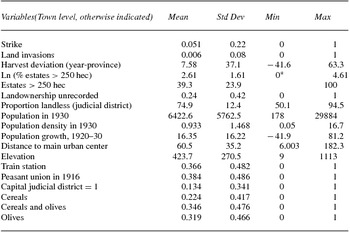
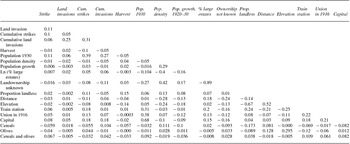
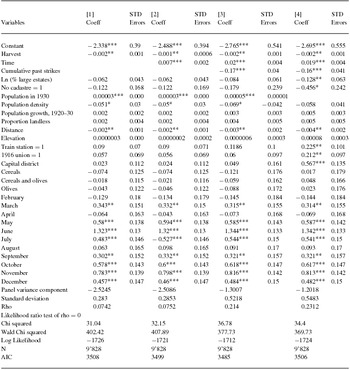
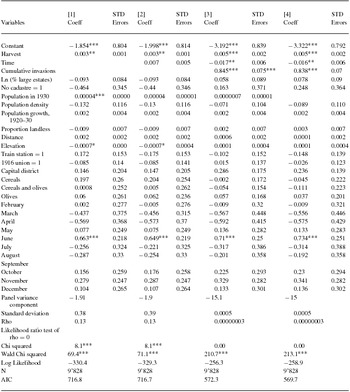
Tables 4 and 5 give the mean and the standard deviations of town and judicial district characteristics and the correlation matrix of the variables included in the analysis. Table 6 displays the coefficients of the random-effects probit regressions with strike occurrence as the dependent variable and table 7 displays the coefficients of random-effects regressions with land invasions as dependent variable. In tables 6 and 7, specification [1] includes all variables except the time trend and the cumulative count. Specification [2] adds a time trend. Specification [3] includes the time trend and the cumulative count. Taking into account that population is highly correlated with several other independent variables, specification [4] excludes “population” as a regressor, while maintaining the time trend and the cumulative count.
Descriptive statistics

Note: * arbitrary number for towns in which landownership is not recorded.
Correlation matrix

Random-effects probit regressions with strikes as dependent variable

* p < .1. ** p < .05. *** p < .01.
Random-effects regressions with invasions as dependent variable

* p < .1. ** p < .05. *** p < .01.
Using the coefficients from the random-effects probit regressions, I can analyze the various effects of harvests on collective protest calculating baseline probabilities and marginal effects. I have used the transformation of the estimated random-effects probit coefficients to calculate baseline probabilities (as indicated in Arulampalam Reference Arulampalam1999). It is noteworthy that the different specifications are well behaved, according to Wald tests of joint significance. Although most coefficients are very similar in the pooled and in the random-effects regressions, likelihood-ratio tests suggest unobserved heterogeneity needs to be taken into account as it contributes to a substantial fraction of total variance.
In the models with strike occurrence as the dependent variable, several variables display relatively consistent coefficients in all specifications. Harvest deviations have a robust negative, statistically significant impact on strikes, and a positive, statistically significant on land invasions. The time trend is positive and statistically significant in all specifications in the case of strikes, positive in the case of land invasions, and statistically significant only in the case of population-averaged probit models. The cumulative count is always statistically significant, although it commands a negative coefficient in the strike regressions and a positive coefficient in the case of invasions. The count and the time trend are very collinear, affecting the stability of the coefficient on the time trend: including the cumulative count multiplies by three the coefficient on the time trend and flips the sign of the time trend in the strikes with land invasions. Most of the other coefficients, however, are robust to the inclusion of the cumulative count.
Landownership concentration has a negative coefficient but it is not significant in the random-effects regressions. In the case of strikes, population in 1930 has a positive, significant coefficient and population density a negative statistically significant coefficient, with size and sign of the coefficients robust across specifications. Population has an effect on trespassing but not population density. The coefficients of regressor “population growth” never reach statistical significance.
In specification [4], which removes population as a regressor, other variables that are strongly correlated with population now display significant coefficients. This is the case of the dummy variable taking value 1 if there was a peasant union in 1916, the dummy variable taking value 1 if the town has a train station, and the dummy variable taking value 1 if the town was the judicial center of the district. In all cases, the coefficients are statistically significant, positive, and quite large.
“Distance” commands a negative, statistically significant coefficient in all the strike regressions, but its coefficient is insignificant in the case of regressions with land invasions. Elevation from sea level does not have a significant coefficient in all regressions. Coefficients on the agricultural specialization dummies (with mixed dry-irrigated agriculture as an omitted category) fail to be significant at standard levels.
In addition, several monthly dummies display significant, positive coefficients (meaning these months were significantly more strike prone than January): March, May, June, July, September, October, November, and December. In the case of land invasions, the coefficient on the June dummy had a positive, statistically significant coefficient while the coefficient on the September dummy was negative, large, and statistically different from zero. Other months did not display statistically significant coefficients.
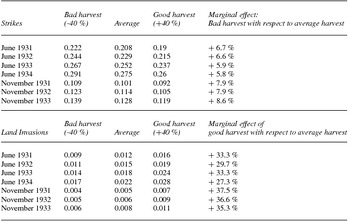
What about the size of effects of the statistically significant coefficients? In order to evaluate those, I calculate the baseline probabilities in several hypothetical scenarios, using the coefficients from the random-effects regressions with the time trend but not the cumulative count (specification [2]).
From a theoretical point of view, the harvest deviations from the 1920–30 mean is perhaps the most interesting. Table 8 gives the baseline probabilities of striking in June or in November under different harvest scenarios—extremely bad, average, and extremely good (both the good and bad scenarios are extreme events, more than two standard deviations away from the 1920–30 mean of provincial wheat output). The probabilities are calculated for a hypothetical “average Andalusian town” (putting the continuous variables at their means) with a union in 1916 and a train station using coefficients from column [2] in tables 6 and 7.

Looking at the size of the marginal effects, the effect of harvests does not support the main tenets of grievance-based explanations of conflict. As it is evident from the marginal effects, extremely bad harvests had a small effect on the propensity to strike. Events that were more than two standard deviations from the mean only increased the probability of striking by 6 percent in June and 8 percent in November (note that the size of the coefficient on “harvest deviations” is also robust to the inclusion/exclusion of the time trend and the cumulative number of previous events). The very small positive effect of bad harvests is countered by the impact of good harvests on land invasions, with two standard deviation events pushing the probability of invasions by a third (although the baseline probability is still small). These results suggest that good harvests could lead more often to potentially violent situations: the qualitative evidence shows most events of collective trespassing occurred when laborers on strike entered the fields to deter strikebreakers and perhaps deterrence was more necessary in years of good harvests. In the event of bad harvests, temporary immigrants, who used to break strikes, generally abstained from looking for work (El Sol, June 6, 1934). Poor harvests, however, had a very limited impact on the propensity to strike.
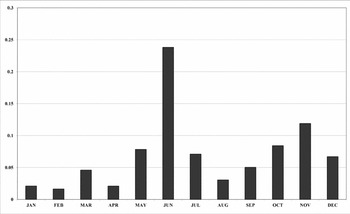
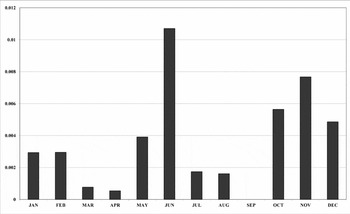
In addition, coefficients on the month dummies also do not support grievance-based theories of conflict. It is noteworthy how conflict clustered in the harvesting months, especially June and to some extent November, not during the months of seasonal unemployment. Figures 1 and 2 give the baseline probabilities of striking and trespassing from January to December calculated for a hypothetical average town with a train station (all continuous variables at their means) in 1932 (baseline probabilities calculated using the coefficients of specification [2]).
Baseline probabilities of striking, hypothetical average town in 1932

Baseline probabilities of “collective trespassing,” hypothetical average town in 1932

Figure 1 shows the much higher propensity to strike in June and in November. These were the harvesting months of wheat (June) and olives (November). At the beginning of those months, it was customary to negotiate the collective contract; strikes were the main weapon workers had to alter the working conditions in their favor: the riper the crop, the more effective. May, July, October, and December, months around the harvesting period, also displayed higher propensities to strike in comparison to other months.
In the case of collective trespassing or land invasion June also displays a higher propensity (as shown in figure 2), although the baseline probabilities are now much lower compared to strikes. Moreover, October, November, and December in this case show higher relative propensities. A typical conflict at the end of the olive harvest was related to the picking of fallen olives (“rebusca”), which might explain the prevalence of conflicts in November and December.
Considering other time-dependent effects, the time trend is positive and statistically significant in the case of strikes but not in the case of invasions. In the case of regressions with strikes, the time trend drift would increase the probability of striking for the average town in June from 0.201 to 0.268, an increase of 33 percent in the baseline probability (these probabilities are calculated for a hypothetical “average” municipality with all the continuous variables at their means and adding a train station and a recorded peasant union in 1916). In the case of November strikes, the time trend alone explains a 44 percent increase in the baseline probability of striking for the average town. Finally, specifications [3] and [4] include the cumulative count of strikes or invasions, which in all cases was statistically significant, but because adding the cumulative count alters the coefficient of the time trend, the combined effect of the cumulative count plus the time trend is very similar to the effect of the time trend alone in specification [2].
Moving to time-invariant local characteristics, coefficients on the proxy for the concentration of landownership were not significant in the random-effects regressions. Population density displayed a significant, negative impact on strikes. A one standard deviation increase in population density reduces the probability of striking in June for the hypothetical “average” town by 10 percent. More importantly, population has a robust, positive impact on the probability of both types of conflict. These impacts are also large. In the case of strikes, doubling the mean population brings about an increase in the probability of striking in June 1932 of 28 percent and of 37 percent in November 1932. For land invasions, the effect is even bigger: a doubling of population size brings about a 66 percent increase in the baseline probability of reporting an invasion of an estate in the hypothetical “average” municipality (the effect measured for June 1932). The large population effect on invasions could reflect important reporting biases, but also would be consistent with the largest rural labor markets being located in the largest towns: large markets attract temporary migrants and greater migration caused more conflicts between strikers and strikebreakers.
The large effect of population on conflict is not easy to square with mainstream theories of conflict. It could be argued that the effect of population reflects reporting biases in the main sources used here; however, the main motivation of using newspapers and related sources to count conflict events in this period was precisely reducing reporting biases in the official data. Population in the provinces studied here is also correlated with union presence in 1916, having a train station, or being the judicial capital of the district, which also had independent positive impacts on the probability of striking (but not on invasions) (I explain these effects below). Larger town sizes reflect perhaps unobserved positional advantages and higher rents from agricultural land. Larger towns in the sample were also more egalitarian (there is a negative correlation between the size of town and landownership concentration). Perhaps, larger towns were also special in that they were less homogeneous and facilitated exchanges of ideas and information. For example, in their classic book on the Captain Swing revolts in early-nineteenth-century England Eric Hobsbawm and George Rudé wrote:
On the whole, a larger village was more likely to riot than the smaller. What this means is by no means so clear. A large village is also normally a place with higher than average proportion of non-farm labourers, of craftsmen, shopkeepers, etc., and this rather than mere demographic size is what may be important. . .. At the same time it is likely to be a more important centre of trade and communications, and therefore news, discussion and action, and as such setting the tone for surrounding smaller settlements. (Hobsbawm and Rudé Reference Hobsbawm and Rudé1973: 148)
But one should not overstretch the impact of spillovers from other sectors. Gerald Brenan and others noted the lack of alternative sources of employment outside the harvest months in the large Andalusian agro-towns (Brenan Reference Brenan2008: 118, 120). Although the population census does not give a breakdown of employment into certain occupations or sectors at the local level, some historians have used 1920s municipal or 1930s electoral censuses to piece together the occupational structure of some towns, which show a widespread predominance of agricultural workers. One case, for example, is Lebrija, one of the large agro-towns in the province of Seville with a population in 1930 of 13,243. According to its 1934 electoral census, about 80 percent of its gainfully occupied males received their income from agriculture: there were 3,539 gainfully occupied males older than 22, of which 2,662 were either laborers or small farmers (75 percent) and 166 were landowners or ran large estates (4.7 percent). In contrast, there were only 159 builders (4.5 percent), 85 shopkeepers (2.4 percent), 23 employed in bakeries (0.7 percent), 25 barbers (0.7 percent), or 83 shoemakers (2.4 percent) (Pulido Matos Reference Pulido Matos1997: 265).Footnote 5
Despite the overall predominance of agricultural employment, these larger towns were still more fertile grounds for the diffusion of ideas and collective action than isolated villages. Perhaps no one like the late political scientist Juan J. Linz has captured what was going on in the large agro-towns of the plains (Campiña) of Córdoba in comparison to the smaller, isolated villages of the uplands (Sierra):
In fact, the Sierra of Córdoba with large properties, a backward agriculture, and a considerable number of farm laborers living in primitive conditions, was not the area of unrest. It was rather the Campiña where since the beginning of the century, agriculture had progressed considerably, where in many villages large properties coexisted with medium and small farms, cultivated by their owners or tenants, and where absentee owners were infrequent and considerable mobility of ownership was going on. The difference in the political responsiveness to the anarchist—and, in a few places—the Socialist propaganda between the Sierra and the Campiña seems to be accounted for in part by the communication factor. . .. In the Campiña. . . there are large villages located fairly close together, where the day laborers live and to which they return every night, and to which even the laborers living on the farms often come. In such agricultural towns, with 10,000 to 20,000 and even more inhabitants, communications are easy, news of the world is commented upon avidly, and the anarchist newspapers sometimes reach a high circulation of several hundred, whose reading is shared by many, given the high illiteracy rate. (Linz Reference Linz1976: 415)
Moreover, perhaps the effect of population can be decomposed using other potential explanatory variables that are very closely correlated with population. When population is included as a regressor, previous union organization, the existence of a train station, and being the judicial center of the district all have insignificant impacts on both the probability of strikes and the probability of invasions. Excluding population as a regressor, specification [4] displays large, significant coefficients associated with the dummy variables “union presence in 1916,” “train station,” and “capital of judicial district” in the case of regressions with strike occurrence as dependent variable. With all the variables at their means, being the judicial center of the district increases the probability of striking by 50 percent, having a union in 1916 by 17 percent, and having a train station by 16 percent.
Related to this last point, distance also had an important impact on strikes, although not so on invasions. In the regressions using strike occurrence as the dependent variable, distance commands a negative, statistically significant coefficient. Halving the distance to the main urban center in the province increased the baseline probability of striking in June 1932 for the hypothetical average town by 9 percent. Because the correlation between distance and population in 1930 is close to zero, there is something specific about being close to large urban centers that has a positive impact on conflict.
What could be behind this effect of distance? As in the case of population, distance perhaps reflects unobserved locational advantages that would be shared with the largest urban center of the province and, thus, higher unobserved agricultural rents might be partly to blame for higher conflict (in turn, this would contradict grievance-based theories of conflict). In addition, municipalities that lie closer to large urban centers receive a more intense inflow of ideas and information, especially from organized trade unions and other working-class organizations. Towns that lie close to large urban centers also tend to be more integrated into markets and generally tend to have higher productivity (generally there is a negative gradient between productivity and distance from large urban centers [Wolf and Kopsidis Reference Wolf and Kopsidis2012: 635]). Through negative coefficients on the distance variable, a combination of market integration, information, contagion and externalities, and higher agricultural rents was positively correlated with the number of strikes.
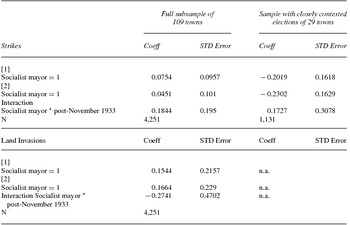
Finally, in order to assess the impact of local political power, I perform pooled and random-effects panel probit regressions on a subsample of towns in Seville and Córdoba for which information on municipal elections could be gathered (N = 109). Using the random-effects regressions, table 9 shows the coefficients of the variables of interest: Socialist electoral majority interacted with a dummy variable taking value 0 until November 1933 and 1 thereafter. Regressions were performed on the full subsample of 109 towns and on the subsample with 29 towns with closely contested elections.
Coefficients on Socialist electoral majorities
[1] Random-effects probit model with same regressors as in tables 6–7 plus a dummy variable taking value 1 when municipal elections of April and May 1931 give a Socialist electoral majority and 0 otherwise.
[2] Random-effects probit model with same regressors as in tables 6–7 plus a dummy variable taking value 1 when municipal elections threw a Socialist electoral majority and 0 otherwise and a another variable interacting the dummy of Socialist majorities with a dummy variable taking value 1 after November 1933 and 0 before November 1933.

When I use the full subsample, the coefficient on Socialist mayors is positive as expected, but not statistically significant in the case of strikes and negative and, nonsignificant in the case of collective trespassing. The interacted variable capturing the effect of the loss of local power after November 1933 on conflict has a positive coefficient in both cases, as expected according to the historical literature, but it is not statistically significant. In addition, the sample of closely contested elections suggests using the sample that uses the full subsample overestimates the impact of municipal socialism on strikes as I get a negative and now statistically significant coefficient in the case of strikes. All in all, I cannot reject the null hypothesis that local Socialist political power had no impact on local levels of conflict.
Summing up: the time-series, cross-sectional probit models of strikes and land invasions give very limited support to grievance-based theories of conflict. Poor harvests had only a very small impact on the probability of strikes, while good harvests generally increased conflict levels, maybe by expanding employment opportunities and causing conflicts between local strikers and temporary migrants. There was a positive time trend in conflict until the peasant general strike June 1934. Conflict, moreover, clustered very clearly in the harvest period, showing landless peasants struck when bargaining power was at its highest in May through June and in November. Heavy temporal clustering perhaps also explains the small impact of bad harvests on strikes. Although by no means saying inequality was irrelevant to understand conflict in 1930s Spain, I do not find in this dataset that variation in landownership patterns explains conflict, nor did the extent of landlessness or competition over scarce land (proxied by population density or population growth). My regressions, especially in the case of strikes, suggest there was substantial clustering of conflict in large towns and in towns not too distant from large urban centers, irrespective of the level of inequality. Access to information, the integration into markets, a long history of collective action, higher agricultural incomes, or a large and thick labor market for laborers explain better the spatial variation in conflict than purely structural variables such as inequality or the proportion of landless laborers. Spatial variation in inequality and harvest shocks to living standards cannot account for the rich spatial and time-series variation of collective action in the South of Spain.
Conclusions
In development economics, opportunity cost and grievance theories have become the predominant explanation of conflict in developing, agrarian societies. Does bad harvest, inequality, unemployment, or deteriorating living standards explain conflict everywhere? This paper studies one of the most intense and destabilizing processes of peasant mobilization and conflict in interwar Europe and argues that structural factors like inequality or exogenous changes in living standards can only explain a small fraction of conflict in the period. In the case studied here, “ecological” correlations between conflict and land concentration, vulnerability to bad harvests, or poverty weaken considerably once I exploit local and time-series variation in these dimensions.
Rather than emphasizing poverty and inequality, I show conflict clustered in the largest towns, which were close to large urban centers and were perhaps more likely to be integrated into national agricultural markets. To be sure, inequality and exploitation were no doubt brutal in Andalusia, but neither factor did correlate closely with the spatial and temporal distribution of conflict. Seasonal unemployment was a characteristic of rural labor markets in dry-farming areas of Spain, not a new phenomenon in the 1930s. Poverty and living standards were dismal in the 1930s, exploitation was the norm, but conflict was not particularly responsive to bad harvests or employers’ power. Quite the contrary, violent conflict was more typical of good harvest years, when it was more difficult for peasant unions to control local labor markets.
Although there is not enough space here to analyze in detail the causal mechanisms of transmission, the spatial clustering of conflict and the irrelevance of harvests and inequality would be consistent with sweeping changes in expectations and bargaining power caused by political and institutional changes. State support to collective bargaining led to a wave of strikes, which was not correlated with any possible proxy of living standards, specialization, or variations in income. The paper also explores if local political power by Socialists intensified conflict, but results, while still preliminary, do not lend support to the view that local political power drove conflict. In light of my results, I adopt the view that workers in some towns protested more possibly because they had a longer experience of strategic interaction with authorities and worked and lived in areas more tuned to the big political debates of the time. Although Andalusian protest met occasionally with fierce repression, in large towns in which various social groups competed for rents from agricultural development displayed a sometimes tragic, but continuous history of strategic interaction with employers and the state. In the early 1930s, with large changes in the organization of local labor markets and with party and union competition to win the allegiance of the rural proletariat, it was simpler for unions and peasants in large, more developed towns to organize collective action.
The results found here are perhaps another step to eradicate several myths about rural conflict and collective action in early-twentieth-century Spain (e.g., in line with Acosta Ramírez, Cruz Artacho, and González de Molina Reference Acosta Ramírez, Artacho and González de Molina2009). Although crippling poverty and exploitation were the norm, state formation, state intervention, and political competition meant that the plight of Andalusian laborers was central to the political battles of early-twentieth-century Spain. To a great extent, the results from this paper suggest a large part of the historical variation in rural conflict in the South of Spain is still unexplained, as it is generally the case in very intense, nonlinear processes of mobilization and organization of collective action. The mechanisms through which top-down processes of political and institutional change translate into bottom-up mobilization are still poorly understood. However, results presented here are also consistent with narratives of interwar instability and democratic collapse that stress political variables and dynamic processes over structural or economic variables linked to inequality and living standards. In this sense, mass politics led to attempts to fully mobilize voters. In this context, both the anarcho-syndicalist union (CNT) and the Socialists (UGT) competed to organize the urban and the rural proletariat. Irrelevance of bad harvests, poverty, and inequality in 1930s Andalusia is consistent with a view that puts Andalusian landless laborers at the forefront of some of the crucial democratic battles of interwar Europe.