INTRODUCTION
To impose liability in negligence, a plaintiff is required to preponderantly prove three basic elements: the existence of harm, the defendant's unreasonable behavior,Footnote 1 and the existence of a causal link between the defendant's unreasonable behavior and the plaintiff's harm.Footnote 2 The latter requirement is the focus of this article. In particular, this article examines a distinct situation in which the plaintiff cannot meet this requirement due to a unique legal pattern referred to here as “causal underdetermination.” In this pattern, the causal inquiry leads to an impossible conclusion, according to which the negligent defendant is, and is not, the cause of the plaintiff's harm at the same time. As an example of the pattern of causal underdetermination, consider the following scenario:
The physician. A physician performs an abdominal surgery to remove a tumor (“procedure A”). The physician chooses to reach the tumor by making a large incision in the abdominal wall, a clearly negligent choice. Subsequently, the patient dies. There are two alternative procedures the physician could have performed: reaching the tumor by laparoscopy from a right approach (“procedure  $A1$”), or reaching it by laparoscopy from a left approach (“procedure
 $A2$”); both alternative procedures are considered much safer (and less costly) than the procedure that was actually performed by the physician.
Exposing the patient to unreasonable risk by performing procedure A instead of either procedure A1 or A2, the physician in the above example is clearly negligent. However, according to prevailing tort law, the physician will be held liable for her negligence only if it can be established that it is her negligence that caused the patient's death. Consider now the following facts added to the above example:
An autopsy can prove that had the physician in the example chosen to perform the surgery by procedure A1, the patient would likely have died anyway, whereas had the physician chosen to perform the surgery by procedure A2, the patient would likely have fully recovered.
The key to inferring whether A was the cause of the patient's death thus depends on whether one applies the counterfactual inquiry through A1 or A2. How should the law address such a situation?
The physician scenario constitutes an example of causal underdetermination. This article discusses the pattern of causal underdetermination, the difficulties that it raises, and thereafter possible solutions to resolve them through a particular counterfactual theory of causation, which expresses a contrastive view of causal relations. According to this view, causal relation is expressed by the quaternary query of what if some relevant alternative event A* (the contrastive cause) rather than A, caused B* (the plausible effect of A*) rather than B?Footnote 3 In these terms, the conclusion as to whether there is causal relation depends on the existence of a difference between B and B* (i.e., on whether B − B* >0), whereas the expression B − B* manifests the difference that A actually made.Footnote 4
The main difficulty of the theory of contrastive causation is that there are countless ways to posit a contrastive cause A* to the actual cause A. Different A*s may lead to different B*s, and the factual inference regarding the causal link between A and its outcome may change accordingly. This difficulty is discussed and illustrated at length in the article. To demonstrate the pattern of causal underdetermination in the physician example through the lens of the theory of contrastive causation it suffices to acknowledge that the key to inferring whether A was indeed the cause of the patient's death depends on the definition of the contrastive cause A*.
The example tells us that denoting the contrastive cause by A1 would lead to the result that the defendant's negligence was not the cause of the patient's death since it made no difference for the patient: had the physician acted reasonably (by performing A1) instead of negligently (by performing A), it is more likely than not that the patient would have died anyway. By contrast, denoting the contrastive cause by A2 would lead us to infer that the physician's negligence is the cause of the patient's death, as the evidence shows that had the physician acted reasonably (by performing A2), it is more likely than not that the patient would have survived. This conclusion of two coexisting conflicting but-for results is metaphysically impossible. The physician cannot be and not be the cause of the patient's death at the same time. So, what should courts do in the face of causal underdetermination?
The article identifies the cases in which this difficulty may arise in negligence law as Multiple Reasonable Behaviors cases, or MRB cases. These cases are characterized by the following pattern: there is not one but rather several reasonable behaviors the defendant could have followed to meet her duty of care toward the plaintiff; the defendant followed neither of these reasonable behaviors (and is thus considered negligent); subsequently the plaintiff is injured. Causal underdetermination occurs in MRB cases when (at least) two of the reasonable behaviors not taken by the defendant lead to opposite conclusions as to whether the defendant's negligence is the cause of injury, as in the physician example.
This article demonstrates that when facing this quandary, courts usually apply what is here termed a “no-causal-link solution.” According to this solution, it is enough that only one of the reasonable behaviors (e.g., either A1 or A2 in the physician example) supports the conclusion of lack of a causal link between the defendant's negligence and the plaintiff's injury to infer that the requirement of causation was not established by the plaintiff. Consequently, in cases of causal underdetermination, negligent defendants are regularly exempted from tort liability for lack of causation. The article discusses possible explanations for the no-causal-link solution and demonstrates how it may lead to erroneous decisions, absolving defendants of tort liability even when it is more likely than not that their negligence was in fact the cause of the injury. It further explains that this mistake may have undesirable effects on defendants’ behavior, such as underdeterrence.
Having exposed the pattern of causal underdetermination in negligence cases, and the difficulties it raises, the article proposes various solutions, reviewing first the suggestions made in the literature on the theory of contrastive causation regarding the criterion for defining a relevant contrastive cause, A*, to any cause, A, in the legal context. It then explains why these suggestions fall short of resolving causal underdetermination in negligence cases.
The solutions developed in the article are based first and foremost on the understanding that the problem of causal underdetermination in negligence law derives from a normative—rather than a factual—situation, in which the law fails to direct the factfinder to the specific relevant behavior that the defendant should have followed (instead of her actual negligent behavior). In light of this realization the article applies economic theory, which defines what is appropriate in terms of efficiency. Under these terms, in negligence cases, the contrastive event, A*, represents a behavior that minimizes the total costs of both the injuries and their prevention.Footnote 5 The article shows that the implementation of this economic reasoning enables the singling out of a specific reasonable behavior in some cases of causal underdetermination. For the cases in which it does not, the article offers solutions of a different type, based on aggregation mechanisms and statistical evidence, and illustrates possible ways to implement them.
The article proceeds as follows. Section I sets out the theoretical and doctrinal framework of causal underdetermination and articulates its difficulties by using a contrastive approach to causation. To sharpen the unique features of causal underdetermination, it further distinguishes its pattern from the more familiar phenomenon of causal overdetermination. Lastly, it discusses the no-causal-link practice currently used to contend with causal underdetermination and demonstrates its problematic results. Section II discusses and illustrates possible solutions to causal underdetermination by distinguishing among three types of cases. The first are cases in which the factfinder is capable of making a normative assessment and deciding which of the alternative reasonable behaviors that leads to different causal inference can be singled out as the optimal behavior in the circumstances. In the two other cases, the factfinder is incapable of prioritizing the alternative reasonable behaviors that lead to causal underdetermination either because she lacks the information to do so or because the normative assessment leads her to conclude that these alternative behaviors are equally desirable. For the latter types of cases, the article develops solutions based on aggregation mechanisms and statistical evidence, instead of normative analysis. The Conclusion summarizes the discussion.
I. THE PROBLEM OF CAUSAL UNDERDETERMINATION
A. The Pattern of Causal Underdetermination
Under prevailing tort law, the existence of a causal link between a defendant's negligence and a plaintiff's injury is determined by a counterfactual inquiry known as “the but-for test.”Footnote 6 Generally speaking, a counterfactual approach to causation explains the idea of causal relation between events in terms of conditionals of the form “If A had not occurred, B would not have occurred.” This simple formulation has been the source of a profusion of different approaches to counterfactual analysis.Footnote 7 The causal analysis in this article is based on a particular counterfactual approach to causation, which examines causal relation between events through a contrastive formulation. According to this approach, a causal link is not a binary relation between A (cause) and B (effect). Rather, it expresses the counterfactual query of what if A* (the contrastive cause) rather than A caused B* (the probable result of A*) rather than B?Footnote 8 In contrastive causation terms, the conclusion that there is a causal link between two separate events depends on the existence of a difference between B and B* (i.e., if B − B* >0 there is such a causal link).Footnote 9
The choice to articulate the arguments in the article through the contrastive approach to causation is not coincidental. The structure of this approach corresponds with the reasoning of negligence cases, which only considers a behavior as a cause if it is proven to deviate from what counts as a reasonable behavior. Accordingly, the causal inquiry in tort law examines the existence of causation according to the following counterfactual question: What would have been the outcome for the plaintiff had the defendant acted lawfully rather than negligently? A causal relation exists if and only if the evidence shows that in that case the plaintiff's injury would have likely been prevented.Footnote 10 By contrast, to negate the existence of a causal relation, a court must conclude that the plaintiff's injury would have likely occurred even if the defendant had acted reasonably, and therefore, it is not the defendant's negligence that caused it.Footnote 11 As the article later reveals, the similarity between the causal structure of the contrastive approach and the underling reasoning of the causal inquiry in negligence cases not only helps to illuminate and articulate the legal problem at the center of this article, but also provides tools for understanding its source.Footnote 12
To exemplify the quaternary formulation of the contrastive approach to causation, consider the following simple illustration: I promised to water a plant; I did not water it; the plant dried out. In order to prove the existence of a causal link between the drying out of a plant and the fact that I forgot to water it, according to the contrastive approach to causation, it should be shown that if instead of not watering the plant (A), I had watered it (A*), it is likely that the plant would have survived (B*) instead of drying out (B). A positive difference between B and B* indicates that there is a causal link between the fact that I did not water the plant and the fact that the plant dried out. In particular, there is a causal link between A and B − B*, as the latter term defines the exact difference that my omission to water the plant actually caused to its vitality.
This illustration both demonstrates the relative nature of the contrastive causal inquiryFootnote 13 and reveals the unique difficulty in inferring causal results through it. The conclusion that some action, A, made a difference, and can thus be considered a cause, can only be drawn in comparison to a contrastive cause, A*, and its probable effect, B*.Footnote 14 The problem is that there are countless ways to posit a contrastive cause. For instance, in the plant example, A* could denote the alternate behaviors of having watered the plant once a day, every day and a half, once a week, and so forth.Footnote 15 Since different A*s may lead to different B*s, the factual inference regarding the causal link between my omission to water the plant and its drying out may also change.Footnote 16 Thus, it may be the case that whereas defining the contrastive cause as my having watered the plant once a week (A1) leads to the contrastive result that the plant would have completely dried out (B1), defining it as my having watered the plant once a day (A2) leads to the contrastive result that the plant would have survived (B2).Footnote 17 While the former counterfactual (A1, B1) leads to the conclusion that my omission is not the cause of the plant's drying out, since the plant would have dried out even if I had watered it,Footnote 18 the latter counterfactual (A2, B2) leads to the opposite conclusion, i.e., that my omission to water the plant is the cause of its drying out.Footnote 19 Which one is it then?
The prominent suggestions made by scholarship in the field of contrastive causation to answer this question shall be discussed in Section II. For the purpose of introducing the phenomenon of causal underdetermination, to which I turn next, it suffices to acknowledge that the difficulty presented by the above question is not essentially different from the one presented by the physician example that opens the article. For convenience, the example is reiterated below:
The physician. A physician performs abdominal surgery to remove a tumor. She chooses to reach the tumor by making a large incision in the abdominal wall (“procedure A”), a clearly negligent decision. Subsequently, the patient dies. There are two procedures the physician could have performed instead of A, both considered much safer and less costly than procedure A: reaching the tumor by laparoscopy from a right approach (“procedure  $A1$”) or reaching it by laparoscopy from a left approach (“procedure
 $A2$”).
As in the plant example, here too the question of whether the negligent physician is the cause of the patient's death could be answered with both yes and no. The physician example presents a situation in which there is more than one reasonable behavior a negligent defendant could have followed to meet her duty of care toward a plaintiff. I refer to such situations as Multiple Reasonable Behaviors or MRB cases. In the example, the physician could have performed either A1 or A2. Had she done so, she would not have been considered negligent in the first place. Having performed neither, the factfinder is now facing not one but two possible counterfactuals with which to apply the but-for test. In this situation, three possible but-for conclusions can be inferred: first, it may be the case that the two alternate procedures, A1 and A2, lead to the result that the patient's death would have occurred anyway (regardless of the physician's negligence). Second, the conclusion may be that had the defendant followed any of the alternate procedures, either A1 or A2, the patient's death would not have occurred. In either of these two combinations, the but-for test does not lead to opposite conclusions. A pattern of causal underdetermination occurs if and only if the but-for inquiry leads at the same time to different inferences, as in the physician example, where the evidence shows that on the one hand, had the physician performed procedure A1 the patient would have died anyway, whereas on the other hand, had she performed A2 the patient would have likely survived (or vice versa).
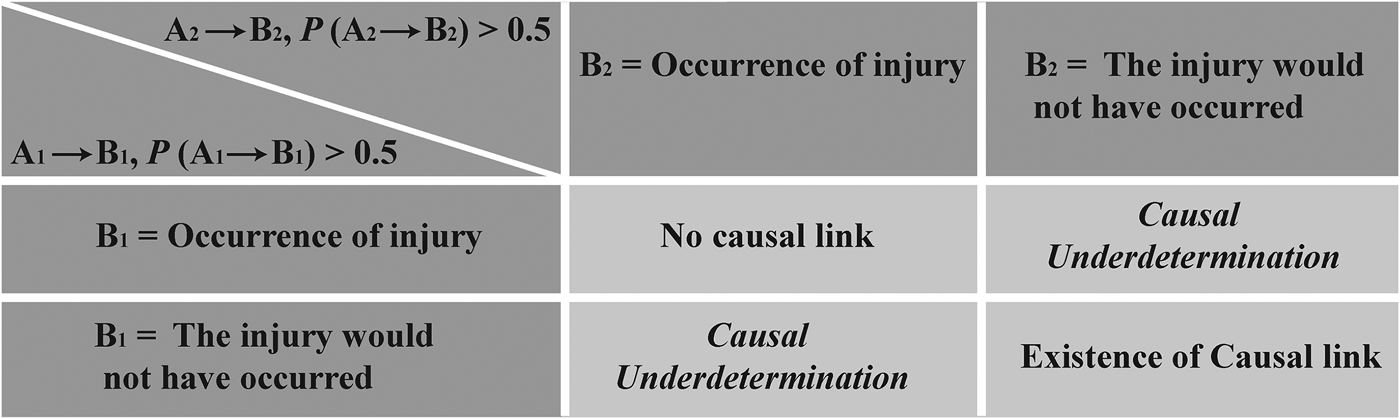
Lastly, to infer causal underdetermination in tort law an additional condition must be met. This condition refers to the burden of proof in civil litigation, according to which the plaintiff's claim is subject to the preponderance-of-the-evidence standard,Footnote 20 also known as the P > 0.5 rule.Footnote 21 This means that the evidence presented to support the claim of causation must convince the court that it is more likely than not that the defendant's negligence caused the alleged injury. In light of this rule, causal underdetermination occurs in the physician example if and only if the evidence shows that the chances of the patient's death, had the physician administered the surgery by procedure A1, would be lower than 0.5, but on the other hand would exceed 0.5 had she chosen to administer it by procedure A2.
Figure 1 above summarizes the conditions required for the occurrence of causal underdetermination in negligence cases, where P denotes the magnitude of probability that each of the reasonable behaviors not followed by a negligent defendant (A1, A2,.. Ai)Footnote 22 would have led to its result (respectively denoted by B1, B2,.. Bi).Footnote 23
The Pattern of Causal Underdetermination

B. Causal Underdetermination versus Causal Overdetermination
The previous subsection identified and defined the pattern of causal underdetermination in tort law, and particularly in negligence cases. A deeper understanding of this pattern and the problems that it entails requires us first to acknowledge the reasons for its almost complete absence from the vibrant, extensive debate on causation in the law.Footnote 24 This absence is especially noteworthy considering the scholarship's massive engagement in exploring the seemingly mirror image of causal underdetermination in the law, namely causal overdetermination.
Overdetermination is widely discussed in the literature on causation in the law to describe factual settings in which the but-for test fails.Footnote 25 The familiar profile of causal overdetermination in negligence cases consists of the following scenario: there are two or more defendants, each of whom has behaved wrongfully,Footnote 26 and each of whose actions (or omissions)Footnote 27 would have been sufficient on their own to produce the plaintiff's injury.Footnote 28 Under these circumstances, none of the defendants can be identified as the cause of the injury. To illustrate, imagine a scene in which a person is shot by two defendants who (independently) negligently fire in his direction;Footnote 29 consider that each of these shots is sufficient to cause the plaintiff's injury. This illustration exemplifies circumstances in which the but-for test fails, since each of the defendants can claim that the plaintiff's injury would have occurred but for his shot (for had his shot not hit the plaintiff, she would still have suffered the same outcome as a result of the other shooter's bullet). Therefore, in such a case, the but-for test leads to the anomalous conclusion that neither of the shooters caused the plaintiff's injury.Footnote 30 Causal overdetermination is a mirror image to causal underdetermination, in which the but-for test leads to the impossible conclusion that a defendant could either be or not be the cause of the plaintiff's injury at the same time.
In both causal overdetermination and causal underdetermination the defendant's negligence is indisputable, and therefore the only question left to determine her liability in tort is that of causation. The difference between causal overdetermination and causal underdetermination, however, is essential. As the shooters illustration exemplifies, causal overdetermination may occur in factual conditions that consist of multiple causes (i.e., whereby A denotes more than one causal factor). By contrast, causal underdetermination concerns a normative condition of multiple contrastive causes (i.e., whereby A* denotes more than one reasonable behavior). In other words, the problem of causal underdetermination is a product of a unique situation of normative overdetermination, whereby a negligent defendant could have met her duty toward a plaintiff in more than one way. It may thus occur only in MRB cases.
The shift of focus to MRB cases is therefore crucial to revealing the unique quandary of causal underdetermination. However, excluding some recent causal theorists whose works are discussed below,Footnote 31 the phenomenon of MRB cases and its potential to produce causal underdetermination in tort law are hardly present in debates on causation in the law, and accordingly, its appearance in court decisions in negligence cases is relatively rare.
A conceivable explanation for the absence of causal underdetermination from the causal debate may be that it simply escapes the radar of factfinders. The question is why. A possible answer can be inferred from an observation made by Wex Malone over sixty years ago.Footnote 32 Malone found that although both scholarship and courts embraced a contrastive implementation of the but-for test, in practice, factfinders sometimes utterly ignored the but-for test's contrastive dimension (A*, B*); in other words, they disregarded the contrastive question of what would have occurred had the defendant acted reasonably instead of being negligent. Reviewing courts' decisions in the matter of factual causation, it becomes apparent that Malone's observation is still extant. This conclusion is evident from some courts’ statements, according to which, to establish causation “[a] plaintiff need not show a better result would have been obtained absent the [defendant's] alleged negligence.”Footnote 33 Since MRB cases, by definition, are concerned with the alternative courses of reasonable behavior not followed by the defendant, they can be exposed only in light of the two-dimensional counterfactual analysis of causation that consists of both the actual and the contrastive inquiries. MRB cases would therefore remain hidden from the eyes of factfinders who are not instructed to administer a contrastive analysis of causation.
The second reason for the tendency to leave MRB cases out of the causal debate concerns the nature of the contrastive cause, A*. Though located within the counterfactual inquiry of the but-for test, conventionally perceived as a pure factual test, A* expresses a normative standard rather than a factual event. Specifically, it denotes behavior a defendant should have followed to meet her duty of care toward a plaintiff.Footnote 34 For that reason, A* is usually considered and discussed as part of the question of the defendant's wrongfulness, i.e., as part of the inquiry of whether the defendant deviated from the standard of care and should therefore be considered negligent.Footnote 35 To sharpen the difference between the latter question and the question at the center of this article, courts often focus their interrogation on whether A (the actual behavior of the defendant) is in line with either A1 or A2 (where A1 and A2 are both considered reasonable forms of behavior in given circumstances). By contrast, in MRB cases it is established that the defendant's behavior, A, was not in line with either A1 or A2 and that the defendant is therefore negligent. Subsequently, the remaining question concerns the provable results of A*, first when it denotes A1 and second when it denotes A2. It is when these results lead to opposite conclusions on whether the negligent defendant caused the plaintiff's injury that causal underdetermination occurs.
This article does not contend against the normative nature of contrastive cause A*.Footnote 36 Rather, by focusing on its being located within the counterfactual inquiry of the but-for test, it suggests also accounting for its possible implications for the factual inference of causation in the law, and in particular for causal underdetermination. As long as factual causation is a preliminary requirement for imposing legal liability, courts must both recognize the pattern of causal underdetermination and contend with it. The next subsection demonstrates how courts currently contend with causal underdetermination on the occasions that they do realize that they are facing it.
C. Causal Underdetermination as Lack of Causation
Courts often perceive causal underdetermination as lack of causation. According to this practice, it is enough if only one of the several reasonable behaviors supports the conclusion of lack of a causal link between the defendant's negligence and the plaintiff's injury to infer that the requirement of causation is not met. Consequently, negligent defendants are being absolved of tort liability in such cases. This practice, here referred to as “the no-causal-link solution,” was the reason behind the court's decision in Castro v. San Diego Gas & Elec.Footnote 37
Castro worked in the farm operating business. As part of his work he needed to cover roofs with plastic sheets, placing aluminum rods on top of them. One morning an accident occurred. Castro grabbed a rod that contacted a high-voltage power line and was severely injured. Subsequently, Castro sued the electric company that owned the power line. Seeking compensatory damages, he alleged that the electric company operated its high-voltage line negligently, breaching its duty of care in four different ways, each of which might have prevented the resulting injury: it could have complied with the relevant regulations regarding the power lines’ height, or removed the power line that was known as a hazard prior to Castro's accident, or properly trained inspectors to meet the necessary requirements to prevent potential hazards, or prepared a plan aiming to detect dangerous sites of power lines so that owners of property located under such lines would be aware of the potential danger.Footnote 38 As the defendant followed none of these reasonable alternatives,Footnote 39 the jury at the trial found that the defendant was negligent. However, since the plaintiff failed to prove that it was the negligence that caused the plaintiff's injury, the defendant company was excused from liability. Confirming this decision, the California Court of Appeal stated that “Castro cannot prevail on his substantial evidence challenge if there is substantial evidence to support the lack of causation on any one of his theories.”Footnote 40 Furthermore, the Court of Appeal explicitly held that this conclusion would not have changed even if Castro had been able to successfully prove that one or more of the other reasonable behaviors mentioned would have led to an opposite but-for result (i.e., that the negligent company was the likely cause of the injury).Footnote 41 As a result, the company was absolved of tort liability on grounds of lack of causation.Footnote 42
Applying this practice to the physician example that opens the article, the negligent physician who chose to perform the surgery by procedure A, which is clearly riskier than either procedure A1 or A2, should be excused from tort liability, since, based on the autopsy results, had the physician performed the surgery reasonably, by procedure A1, the patient would likely have died anyway. Adopting the California Court of Appeal's reasoning, this conclusion should not change even if the autopsy can prove that the other reasonable procedure not chosen by the physician, A2, would likely have led to the patient's full recovery.
A possible explanation for this result could be based on evidential grounds and, specifically, on the preponderance-of-the-evidence standard. A factfinder in the physician example may conclude that if there is one reasonable alternative that negates causation and another that affirms it, then the plaintiff was not successful in proving that it is more likely than not that the patient would not have died but for the physician's negligence. Consequently, the physician should not be held liable in tort for her negligence. This conclusion reflects an approach that separates the results of each of the counterfactual inquiries (the one held with respect to the reasonable procedure A1, and the other held with respect to the reasonable procedure A2), thus perceiving each of them as either absolutely approving or absolutely negating the causal link between the physician's negligence and the plaintiff's injury. However, this analysis of the causal inquiry ignores the degree to which the evidence supports the causal inference that the physician's negligence led to the plaintiff's injury in both of the counterfactual inquiries.Footnote 43 The following numerical illustration demonstrates how the no-causal-link solution can lead to an erroneous decision excusing a defendant from tort liability even when the aggregated weight of the evidence shows that the probability that the defendant's negligence is the cause of the alleged injury is higher than 0.5.
Consider that in the physician example the following probabilities were established by the autopsy evidence: 1) there is a 0.6 probability that the patient would have died had the physician performed the surgery by A1; 2) there is only a 0.2 probability that the patient would have died had the physician performed the surgery by A2. For simplicity, assume that the “normative weight” of both procedures is similar (i.e., that they are equally appropriate).Footnote 44 Aggregating the probabilities that the negligent physician is the cause of the patient's death, the conclusion is that there is an overall 0.6 probabilityFootnote 45 that she is the cause of the unfortunate result.Footnote 46 In this simple illustration, the preponderance requirement is met (0.6 > 0.5), and therefore the negligent physician should be held liable in tort. Absolving her of liability only because one of the alternate procedures would have led to the patient's unfortunate death anyway is therefore a mistake.
Moreover, by allowing negligent defendants to be absolved of tort liability when the evidence shows that they are the likely cause of the plaintiff's injury, the no-causal-link solution may create a problem of underdeterrence.Footnote 47 Aware of the no-causal-link practice, physicians in similar circumstances may expect to be absolved of tort liability regardless of their negligence. Consequently, they may adopt a suboptimal level of care. Consider, for example, that the surgical procedure actually administered by the physician (procedure A) exposed the patient to a risk of 200K (probability of 0.2 for harm of 1M), whereby administering either procedure A1 or A2 would have exposed the patient to a risk of 100K (probability of 0.1 for harm of 1M). In these circumstances, absolving the negligent physician of liability may cause physicians in similar cases to underestimate the risk that they impose on patients when they choose to undertake the riskier surgery, A. They will thus keep exposing their patients to an excessive risk of 100K in the future.Footnote 48
Furthermore, the no-causal-link solution that redeems negligent defendants from tort liability in any case of causal underdetermination may generate strategic behavior among defendants, motivated to increase their chances of escaping tort liability in retrospect. In particular, it may incentivize negligent defendants to search for as many non-taken reasonable precautions as possible. Under a rule that perceives causal underdetermination in and of itself as an indication of the absence of causation, defendants can realize that the greater the number of reasonable precautions they find, the greater their chance of avoiding tort liability. According to the no-causal-link solution, they need to find only one precaution that, if taken, would likely have led to the same result that actually occurred, to negate the requirement of causation and be excused from liability for their negligence.
II. CONTENDING WITH CAUSAL UNDERDETERMINATION
Having introduced the pattern of causal underdetermination and the problems that it entails, this section moves to discuss possible solutions. For this purpose, consider again the physician example, as well as the assumption that an autopsy can prove that had the physician performed the surgery by A1, the patient would likely have died anyway, whereas had she chosen to perform the surgery by procedure A2, the patient would likely have fully recovered. The autopsy results lead to the impossible inference that the negligent physician both is the cause of the patient's death and is not. As aforementioned, this result, derived from a specific legal pattern referred to here as causal underdetermination, is not essentially different from the difficulty demonstrated by the above plant example. The latter example presented numerous alternatives that could be used as a baseline to evaluate whether my omission to water the plant, A, was the cause of its drying out, B (i.e., A* could denote either A1 = “watering the plant once a day”; A2 = “watering it every other day”; A3 = “watering the plant once a week”; and so forth). Where each of these alternatives leads to a different result, the key to inferring whether my omission was indeed the causal factor of the plant's drying out is to define A* with a single value. This conclusion is true mutatis mutandis in regard to resolving the physician example. It all comes down to defining A* with a single behavior. The question is, how?
To begin answering this question, one should first consider the suggestions made in the literature on the theory of contrastive causation, concerning the requirements for defining the contrastive cause, A*, in the legal context. It should be noted that what follows is not a comprehensive survey of the context-sensitive analysis of causation outside the legal arena, or of counterfactual approaches to causation other than the contrastive view.Footnote 49 As this article focuses on the problem of causal underdetermination resulting from the contrastive structure of the causal examination in negligence law (with the hope that its examination will also contribute to the enhanced study on the context sensitivity of causal statement in general), the overview will sketch the principal proposals made in the legal literature on the definition of contrastive cause, starting with Jonathan Schaffer's proposal that in the legal arena, the contrastive cause should denote whatever is codified in the law.Footnote 50
Schaffer explains that this observation complies with Jane Stapleton's view, according to which in order to test whether a defendant's breach of duty was involved by a connection of necessity to the plaintiff's injury, we should ask what would have been the outcome in the hypothetical comparator world in which the defendant had acted just enough to comply with her duty as mandated by the law.Footnote 51 Adjusting Stapleton's reasoning to the contrastive approach to causation, so Schaffer explains, the factfinder would use the idea of reasonability as a filter device providing by the law to define the specific contrastive cause A*. However, Schaffer's proposal is inadequate to resolve the problem of causal underdetermination. As this problem occurs in MRB cases, in which by definition the law allows factfinders to define A* by more than one behavior, his observation leaves the problem intact.
A different proposal for defining the contrastive cause, A*, in the law is Alex Broadbent's suggestion that A* should denote an “appropriate foil” in which the defendant meets her “mere duty of care,” but not “in some particular way beyond what the duty itself requires.”Footnote 52 Broadbent's suggestion takes us a step forward toward the understanding that the contrastive cause is the element through which the causal inquiry becomes normatively sensitive to the context within which it is being held. The analysis suggested in the next section draws on this understanding, observing and demonstrating the way in which the contrastive cause requires factfinders to embed a (legal) normative analysis within the (philosophical) causal analysis. For the purpose of this section, however, it suffices to admit the failure of Broadbent's proposal of defining the contrastive cause to resolve the pattern of causal underdetermination in tort law. Similarly to Schaffer's definition of the contrastive cause in the legal context, Broadbent's proposal does not contend with the core feature of MRB cases, which is the multiplicity of particular ways that a defendant could have complied with her duty of care toward a plaintiff.Footnote 53 It therefore also leaves open the question of how to determine which of these alternate reasonable ways should be the one to define A*. To resolve the quandary of causal underdetermination, either by defining A* with a single behavior or by any other means, other solutions must be considered.
Prior to discussing such solutions, however, three cases of causal underdetermination should be distinguished: the first consists of circumstances that enable factfinders to resolve causal underdetermination by making a normative evaluation and accordingly to prioritize reasonable behaviors that the negligent defendant did not follow. These cases of causal underdetermination consist of what is here termed “normative certainty.” The other two types of causal underdetermination involve circumstances in which a factfinder is unable to decide which of the reasonable behaviors not followed by the negligent defendant is more desirable. These cases of causal underdetermination consist of what is here termed either “normative equivalency” or “normative uncertainty.” In the former, factfinders are capable of normatively evaluating the reasonable behaviors that lead to opposite causal inferences, but nevertheless, cannot prioritize among them, as they find them equally appropriate. By contrast, in the latter cases, factfinders cannot distinguish which of the reasonable behaviors not followed by the negligent defendant is normatively superior to the others because they lack the information to do so. The solutions discussed and demonstrated in this section are tailored to contend with each of these cases of causal underdetermination.
It should be noted that although the normative evaluation below is based on terms of efficiency, the observation regarding the distinction between the three cases of causal underdetermination is relevant, mutatis mutandis, to other legal theories as well.Footnote 54
A. Cases of Normative Certainty: The Most Appropriate Behavior Solution
This subsection focuses on situations in which causal underdetermination can be avoided by the factfinder's normative judgment regarding the desirability of the lawful behaviors the defendant could have followed to meet her duty toward the plaintiff. Such a normative evaluation enables a factfinder to prioritize in retrospect the alternate behaviors the negligent defendant could have followed ex ante in the specific MRB case that she (the factfinder) faces. When such a normative prioritization can be made, it is suggested that A* should denote the most appropriate behavior, i.e., the alternate behavior that, in the specific circumstances, is in best compliance with the factfinder's normative view. This definition of A*, also termed here “the normative solution,” can be adjusted to any normative view. In this article appropriateness is evaluated in light of efficiency considerations. In terms of efficiency, in negligence cases, A* should define an alternate behavior that meets two conditions: first, its costs should be less than the expected cost of the injury. This condition is articulated by the Learned Hand formula applied by courts to determine whether a defendant was negligent, B < PL, where B stands for the burden of precaution, P for the probability of injury, and L for the loss.Footnote 55 Second, there is no other procedure that would entail a smaller sum of total costs accrued by both the injury and its prevention. In keeping with these conditions, A* would represent the behavior that minimizes the total costs of both the injuries and their prevention.Footnote 56
A factfinder may define A* in accordance with the normative solution hereby illustrated in terms of efficiency, on two conditions: first, she must have the necessary information regarding the risks and costs of any of the different alternate behaviors of the specific MRB case. Such information is required in order to make a normative assessment regarding the alternate behavior's desirability given the circumstances. Second, the factfinder must be capable of prioritizing the alternate behaviors based on her normative analysis, i.e., she must be able to single out a specific behavior that is most appropriate given the circumstances. MRB cases that meet these two conditions are consistent with what is here termed “normative certainty.”
To illustrate such a case, suppose that in the physician example, the evidence shows both that procedures A1 and A2 are safer and less costly than procedure A performed by the physician and that procedure A1 entails lower total costs (i.e., of both expected risk and costs of operation) compared to procedure A2. In these circumstances, the efficient procedure is A1. Accordingly, A1 should be the procedure that defines A*.
Denoting A* with a single behavior allows the but-for test to express only one counterfactual. In the physician example, this counterfactual is articulated by the following question: What would have been the outcome for the plaintiff had the physician chosen to administer procedure A1 instead of A? Thus, assuming that an autopsy can prove with a probability greater than 0.5 that operating with A1 would likely have resulted in the patient's death anyway, the causal result should be that the negligent physician is not the cause of the patient's death. The negligent physician should therefore be absolved of tort liability for lack of causation. By focusing on a single counterfactual, the normative solution enables the factfinder in the physician example to avoid the quandary of causal underdetermination.
The normative solution could have been a useful tool in the famous case of Haft v. Lone Palm Hotel.Footnote 57 In that case, a father and son drowned to death in a hotel swimming pool. The California Health and Safety Code explicitly enabled pool operators, such as the defendant hotel, to choose one of two alternatives: they could either provide lifeguard services or post a warning sign alerting swimmers to the fact that there was no lifeguard at the pool. Having been stipulated in the Safety Code, the lifeguard and the warning sign alternatives were both considered reasonable safety precautions. By choosing either one of them, the hotel would not have been considered negligent in the first place. Having followed neither, the hotel was indisputably negligent, and the question that remained was whether it is more likely than not that this negligence was the cause of the decedents' deaths by drowning.
Haft illustrates an MRB case that may lead to causal underdetermination. The parties in Haft were well aware of such a possibility: the plaintiffs realized that the failure to post a warning that there was no lifeguard was not a likely cause of the deaths, because the decedents may have been aware of the absence of a lifeguard and nonetheless entered the pool. Therefore, they argued that the causal inquiry should be administered in light of the statutory alternative of providing lifeguard services.Footnote 58 For the same reason, the defendant argued that the counterfactual analysis should be administered from the point of view of the absence of a warning sign, rather than the absence of a lifeguard.Footnote 59 The counterarguments of the parties in Haft suggested the existence of opposite but-for inferences, namely, a causal underdetermination.
So, what should have been the but-for result had each of the reasonable behaviors stipulated in the Safety Code (either a lifeguard or a warning sign) led to an opposite factual inference? Interestingly, both the California Court of Appeal and the California Supreme Court were successful in avoiding this question. The Court of Appeal held that the plaintiffs had not succeeded in proving that neither a warning sign nor a lifeguard would have changed the unfortunate result. Since the plaintiff did not meet the requirement of causation, the Court of Appeal found that the negligent hotel should not be held liable for the father's and son's deaths by drowning.Footnote 60 This decision was reversed by the California Supreme Court based on evidentiary grounds. Writing the unanimous decision of the court, Justice Tobriner held that the absence of a lifeguard denied the victims not only a safety measure, but also a witness to the accident. It was therefore decided that the burden of proof would shift to the defendants, who failed to discharge this burden.
Ariel Porat and Alex Stein suggest that the shift of burden in Haft can be justified based on the doctrine of evidential damage.Footnote 61 This doctrine enables the imposition of liability on defendants whose negligence aggravated factual uncertainty in a way that undermined the plaintiff's ability to establish the requirement of causation. The doctrine of evidential damage, designed to contend with evidentiary hurdles detrimental to the plaintiff's ability to prove causation, however, should not be mistaken for a tool to resolve the potential quandary of causal underdetermination raised by the parties' counterarguments in Haft. This quandary is the result of the unique normative features of MRB cases. True, had the defendant not been negligent in the first place, this quandary would not have arisen at all. However, the defendant's negligence is not the source of causal underdetermination.Footnote 62 The normative solution suggested above is more appropriate for resolving causal underdetermination than is the evidential-damage doctrine, since it addresses the source of its difficulty, which is normative, rather than its factual symptoms.
Following the normative solution suggested here, the courts in Haft could have avoided the quandary of causal underdetermination by defining A* as the reasonable behavior that minimizes the total costs of both the drowning injuries and their prevention.Footnote 63 This goal is achieved when each pool operator seeks to minimize the total costs of her expected injury and the costs of its prevention.Footnote 64 In Haft, the law permitted replacing a lifeguard with a warning sign. Clearly, the latter alternative would reduce the costs of precautions to the minimum. However, to induce future pool operators to at least follow this least expensive alternative, a factfinder should define A* as “providing a lifeguard.” This conclusion is based on the assumption that applying the but-for test with the lifeguard alternative is more likely to lead to the but-for result that a pool operator's omission to provide a safety measure is the cause of a drowning event.Footnote 65 Accordingly, pool operators will likely be held liable in tort for any injury that occurs following their negligence. Aware of this result, pool operators will be induced to at least post a warning sign in the absence of a lifeguard.
Defining A* as the single reasonable behavior of providing a lifeguard is only the first stage of the MRB causal inquiry. A factfinder still needs to infer whether, in the specific case that she faces, providing such services would likely have prevented the decedents' deaths by drowning. Only a positive answer to that question confirms that the pool operator's negligence was indeed the cause of the deaths. Having reached a single but-for result, it is apparent that the normative solution is a useful key to avoiding causal underdetermination in cases where the law stipulates several reasonable alternatives to meet a specific duty.
However, as aforementioned, the normative solution can only be applied if a factfinder has both enough information to normatively evaluate the different alternate behaviors of the MRB case that she faces and the ability to effectively prioritize these behaviors based on such evaluation (i.e., to single out the most appropriate behavior). The next subsection illustrates cases of causal underdetermination in which at least one of these conditions is not met.
B. Normative Equivalency and Normative Uncertainty
To illustrate a possible setting of causal underdetermination that consists of what is here defined as “normative equivalency,” consider again the physician example, with a minor change:
The Physician Example. Version 2. The physician still makes the negligent choice of performing the surgery by procedure A, instead of by the less risky and less costly treatments A1 or A2. However, this time procedures A1 and A2 incur similar costs and are equally safe. As in the former version, the autopsy result can prove that had the physician performed the surgery by A1, the patient would likely have died anyway, whereas had she chosen to perform the surgery by procedure A2, the patient would likely have fully recovered.
Here too a factfinder faces a case of causal underdetermination. Furthermore, this version of the physician example also demonstrates circumstances in which a factfinder can make a normative assessment regarding the desirability of the reasonable behaviors that the negligent defendant could have followed to meet her duty toward the plaintiff under the circumstances. She has the information needed to evaluate the risks and costs of each of the reasonable procedures not administered by the physician. However, contrary to the former version of the example, in this version, based on her assessment, the factfinder perceives the procedures not followed by the physician as equally desirable; neither A1 nor A2 stands out as “the most appropriate behavior” in the circumstances. In efficiency terms, the second version of the physician example demonstrates a case in which there is not one, but two optimal levels of care. In these circumstances, a normative evaluation is not a sufficient means to define A* with a single value. Both A1 and A2 may denote A*. As the autopsy results show that either of these alternatives would have led to a different outcome for the patient, the problem of causal underdetermination persists. The same conclusion appears in the following, slightly different, version of the physician example:
The Physician Example. Version 3. The circumstances are similar to the two earlier versions of the example, with a minor change: it is impossible to know which of the alternate procedures, A1 or A2, entails smaller risks or lower costs under the circumstances. Here too, the autopsy results prove that had the physician chosen to perform the surgery by procedure A1, it is likely that the patient would have died anyway, whereas had she chosen to perform the surgery by procedure A2, the patient would likely have fully recovered.
This version of the physician example illustrates a possible setting of causal underdetermination that consists of what is here defined as “normative uncertainty,” whereby a factfinder lacks the information to conclude which one of (at least) two reasonable behaviors not followed by a negligent defendant is normatively preferable under the circumstances.
The normative uncertainty demonstrated in the latter version of the physician example may arise, for instance, with respect to new or experimental medical methods that have not yet produced the necessary evidence to infer the potential costs and risks associated with their implementation. It may also result from an unresolved controversy over the expected risks associated with two or more familiar medical methods (when both are considered reasonable, but it is impossible to determine which of them would minimize the costs of the expected harm and its prevention).
The difference between the third and the second versions of the physician example is the reason the factfinder is not able to prioritize the desirability of the alternate procedures, A1 and A2, i.e., to retrospectively decide upon a single optimum level of care, in these circumstances. Whereas in the third version, which demonstrates a case of normative uncertainty, a factfinder cannot infer which of these procedures should be considered the efficient treatment for factual reasons, in the second version, which describes normative equivalency, the factfinder is incapable of singling out the efficient treatment for normative reasons (she perceives them both as equally appropriate). Be that as it may, if the number of reasonable treatments that lead to two opposite but-for inferences cannot be reduced to one, the problem of causal underdetermination persists. The factfinder in both versions may conclude both that the negligent physician is the likely cause of the patient's death and that she is not.
The next subsection proposes that in cases of both normative equivalency and normative uncertainty, where causal underdetermination cannot be avoided by normative means, factfinders should turn instead to different solutions based on either an aggregation mechanism or statistical evidence.
C. Aggregation Mechanism and Statistical Evidence Based Solutions
Where (at least) two of the reasonable behaviors a negligent defendant did not follow lead to opposite conclusions, in the absence of normative certainty that enables a factfinder to single out the most appropriate behavior in the circumstances, the problem of causal underdetermination persists. This subsection introduces two possible solutions for causal underdetermination in such cases. The first solution is based on an aggregation mechanism,Footnote 66 previously demonstrated in Section I.Footnote 67 This solution resolves causal underdetermination by allowing the but-for inquiry to take into account the degree of proof (roughly estimated in probabilistic terms) that the outcome would have been different had the defendant acted reasonably instead of negligently, with respect to each “reasonable theory of negligence”Footnote 68 of the MRB case. In the physician example, this solution takes into account the aggregation of both the probability that the outcome would have been different had the physician administered procedure A1 and the probability that the outcome would have been different had she administered procedure A2, based on the autopsy results. The second solution is termed here the “dominant behavior solution.”Footnote 69 According to this solution, A* should denote the alternate behavior that statistics can prove is the dominant practiceFootnote 70 out of the several MRB options.
To demonstrate these solutions, consider again the physician example. Assume that statistics can show that in similar cases 60 percent of all physicians perform the surgery by A1 and, respectively, only 40 percent perform it by A2. The analogy in such a case is tossing a biased coin, with expected results of falling on A1 in 60 out of 100 flips and falling on A2 in 40 out of 100 flips. Assume further that the autopsy results can show that there is a 0.6 probability that the patient would have died had the physician performed the surgery by A1, and only a 0.2 probability that the patient would have died had the physician performed the surgery by A2. Lastly, consider that the court estimates the patient's loss of life at 1 million dollars.
Given this information, the resulting difference between the actual unfortunate result (the patient's death) and the aggregated probabilities that this result would have occurred regardless of the physician's negligence is: 1 − (0.6 × 0.6 + 0.4 × 0.2) = 0.56. Accordingly, the factfinder can conclude that there is a 0.56 probability that the physician's negligence is the cause of the patient's loss of life.
It should be noted that this result does not imply that causation in itself is a matter of probability.Footnote 71 Rather, it means that the plaintiff could prove her causal claim up to a certain degree—0.56 probability in this case. Accordingly, we could say that the plaintiff has successfully met the preponderance-of-the-evidence standard required to establish her claim for the existence of a causal link between the defendant's negligence and the patient's death.Footnote 72
Having preponderantly established the requirement of causation, a court can impose liability on a negligent physician, holding her legally responsible for the proven results of her negligence. There are two different ways to impose liability in these circumstances: either according to the preponderance-of-the-evidence standard or according to a proportional liability reasoning.Footnote 73 To demonstrate both alternatives, consider again the 0.56 probability that the physician's negligence is the cause of the patient's loss of life. As this level of proof complies with the preponderance-of-the-evidence standard (0.56 >0.5), one option is to conclude that the physician should be held 100 percent liable for the patient's loss of life and that the sum of compensation should be therefore set at 1M.Footnote 74 Alternatively, the physician's liability could be limited in accordance with the probability that her negligence caused the patient's loss of life. In that case, the required compensation would be set at 560K out of 1M.
Another possible implementation of the aggregation solution is to attribute to both reasonable procedures, A1 and A2, equal weight, regardless of any statistical evidence that may prove any other probabilistic division between them. This probabilistic equivalency may express either a state of normative equivalency or a policy akin to the idea of tossing a fair coin.Footnote 75 Whatever the reason, attributing equal weight to the alternate procedures in the physician example will lead to the conclusion that it is more likely than not that the negligence is the cause of the patient's death, in light of the following aggregation:
1 − (0.6 + 0.2)0.5 = 0.6. According to this result, there is a 0.6 probability that the negligent physician is the cause of the patient's loss of life. Accordingly, the court may decide to either base its decision on the preponderance standard and hold the negligent physician 100 percent liable for the patient's loss of life, and thus set the sum of compensation at 1M, or limit her liability in accordance with the probability that her negligence caused the patient's loss of life and set the compensation at 600K.
A second solution for causal underdetermination in the absence of normative certainty is to have A* denote the “dominant behavior” based on the statistical evidence. In light of this solution, given the aforementioned statistics in the physician example, A* should denote A1 since there is a greater chance that a reasonable physician in the defendant's shoes would have chosen to perform the surgery with it than with A2. According to the above numerical example, in this case, the probability that the physician's negligence caused the patient's death is lower than 0.5.Footnote 76 Consequently, the physician in our example would be absolved of tort liability. Alternatively, allowing an option of proportional liability, in lieu of the preponderance rule, the physician's liability can be restricted according to the probability that her negligence caused the patient's loss of life.Footnote 77 In this case, she will be required to compensate the plaintiff in the amount of 400K (out of the 1M estimation of the patient's loss of life).Footnote 78
It should be noted that although both the aggregation solution and the dominant behavior solution enable resolving causal underdetermination in cases of normative equivalency and normative uncertainty, the former may be perceived as preferable from an economic perspective. This is mainly because the aggregation solution enables the imposition of liability on defendants in proportion to the damage that they were proved to have inflicted on others. A similar numerical result can be achieved through the familiar proportional liability rule, which aims to ensure that defendants will internalize exactly the expected losses that they create.Footnote 79 However, the aggregation solution is preferable to the proportional liability rule from a causal perspective: the traditional rule of proportional liability is known for its ability to establish a necessary inference when factual uncertainty prevents a plaintiff from establishing the requirement of causation under the preponderance rule.Footnote 80 Therefore, it allows a plaintiff to recover for risks the defendant inflicted upon her without proving that the defendant actually caused the resulting injury. By contrast, the aggregation solution proposed here provides doctrinal and theoretical grounds for a proportional liability result, while keeping with the framework of the but-for test, namely, without waiving the preliminary requirement of preponderantly establishing a causal link between the defendant's negligence and the resulting injury.
CONCLUSION
This article explored a legal pattern in negligence law termed causal underdetermination. In this pattern the but-for test leads at the same time to two opposite conclusions: according to one the defendant's negligence is the cause of the injury, while according to the other she is not. Causal underdetermination can only occur in Multiple Reasonable Behavior cases, in which there are several reasonable behaviors the defendant could have followed to meet her duty toward the defendant, she had followed none of them, thus acted negligently, and subsequently, a harm occurred. When asking whether the unfortunate outcome would have been different had the defendant acted reasonably instead of negligently, each of the reasonable behaviors might lead to a different conclusion. When this happens, the unique situation of causal underdetermination occurs.
The article discussed and demonstrated the pattern of causal underdetermination, the difficulties it raises, and its possible solutions through a particular approach to the counterfactual view of causation, namely, the contrastive theory of causation. The quaternary relation formed by this theory corresponds with the test of causation applied in the law in general, and specifically in negligence cases, which examines whether the result would have been different (B– B*>0) had the defendant acted reasonably (A*) instead of negligently (A). (where B denotes the actual harm and B* the probable harm that would have occurred had the defendant acted reasonably). Given the similarity between the structure of the causal inquiry applied in negligence cases and the causal structures of the contrastive theory of causation, the article not only used the contrastive theory as a descriptive method, but also sought to learn from the suggestions made in the literature on contrastive causation with respect to the challenge of defining the relevant contrastive event for any actual event. It then explained why these suggestions are inadequate to resolve the problem of causal underdetermination in negligence cases. Subsequently, the article suggested different solutions, based on the understanding that the source of causal underdetermination in the law is first and foremost normative. In particular, it is the result of distinct circumstances in which the law is unable to filter a certain reasonable behavior with which the causal inquiry should be held.
Following this insight, the proposed solutions in the article were based on whether a normative analysis can lead the factfinder to prioritize one reasonable behavior over the other MRB alternatives. The normative analysis was demonstrated in the article through an economic theory of negligence law, distinguishing between cases where a factfinder is capable of deciding which of the multiple reasonable behaviors reflects the optimum level of care and cases where a factfinder cannot single out the optimal behavior in the circumstances, either because the reasonable behaviors that lead to opposite conclusions are equally desirable or because the factfinder lacks the information needed to prioritize them. For the latter sorts of cases, the article offered different solutions, based on an aggregation mechanism and statistical evidence.
It is my hope that the article not only exposes the difficulties of causal underdetermination in negligence law and offers viable solutions to contend with it, but also provides a possible answer to Jonathan Schaffer's pondering as to the way in which contrasts are generated from the context, at least with respect to the legal arena.Footnote 81 The article's answer to this concern is that in the law, the contrastive cause depends on normative analysis. Therefore, the context sensitivity of the theory of contrastive causation in the law is expressed in the idea that the contrastive cause is the window through which the causal theory integrates with legal theory.