1. Introduction
It has been argued by NGOs and environmental groups that conservation and poverty alleviation might be simultaneously achieved by promoting the local use and stewardship of environmental services that sustain natural systems. This is the principle behind programs such as CAMPFIRE, which encourage indigenous communities to control exploitation of African animals in ways that earn income and promote incentives to conserve. It is also the principle behind programs that have encouraged Amazonians to extract non-timber forest products (NTFPs) like Brazil nuts in order to generate local income from activities other than deforestation. Other programs, such as the shade tree coffee program, develop and promote markets that sustain higher prices for products that are both sustainable and that maintain natural ecosystem functions. The aim with all of these programs is to promote sustainable non-destructive income sources that encourage locals to become stewards of natural ecosystems.
The attention given to the commercial extraction of NTFPs as a conservation strategy comes from two implicit assumptions: (a) harvesting of NTFPs is less destructive, in terms of biodiversity, than timber harvesting, and (b) increasing the returns from NTFPs for locals provides incentives to conserve forests. If, in addition, those who extract the resource are poor, then it is argued that an increase in the price (or the quantity demanded) of NTFPs could alleviate poverty while promoting conservation (Neumann and Hirsch, Reference Neumann and Hirsch2000; Belcher et al., Reference Belcher, Ruíz-Pérez and Achdiawan2005). This market-based conservation and development approach assumes that the link between the income of local populations and conservation is positive and that there will be no unintended negative consequences (e.g., an increase in income leading the poor to buy more cattle and thus increase deforestation for pastureland).
While there is much interest in NTFP programs and similar programs in other ecosystems, there is not a great deal of understanding of whether they work in practice, and how incentives and local management do, indeed, affect poverty and local resource use. In fact, a number of studies conclude that the effects of NTFP extraction on forest conservation and poverty reduction are ambiguous or even negative (Browder, Reference Browder1992; Wunder, Reference Wunder2001; Lybbert et al., Reference Lybbert, Barrett and Narjisse2002; Angelsen and Wunder, Reference Angelsen and Wunder2003).
In this paper, we present a theoretical model that analyzes allocation of labor to NTFP extraction under unmanaged and managed common property regimes. The emphasis is on understanding the role of NTFP extraction in poverty alleviation as well as the challenges that extraction across space implies in terms of managing the resource. The theoretical analysis is complemented by an empirical analysis of the xate palm in Mexico, a NTFP that has the potential to reduce poverty in the short run (López-Feldman et al., Reference López-Feldman, Mora and Taylor2007).
The next section presents the theoretical model and its solution under the base scenarios of unmanaged and managed common property. Section 3 describes the solution to the theoretical model under the assumption of unmanaged common property with heterogeneous and constrained labor. The implications of NTFP extraction on poverty are analyzed in section 4. Section 5 presents the case study and section 6 concludes.
2. Extraction of NTFP over space
The number of theoretical studies that analyze NTFP extraction is limited. Among existing studies, the ones most directly related to the present work are Robinson et al. (Reference Robinson, Williams and Albers2002) and Gunatileke and Chakravorty (Reference Gunatileke and Chakravorty2003). Robinson et al. (Reference Robinson, Williams and Albers2002) analyze some spatial aspects of NTFP extraction using a single-period model. In their model, all members of a village consume the resource, which is acquired either by extraction or by purchase. Access to markets is affected by transaction costs that are assumed to be homogenous at the village level. Heterogeneity in villagers' opportunity cost of labor leads to heterogeneity in extraction behavior. As a result, individuals can be classified as subsistence, net-buyers or net-sellers of the resource. The study concludes that transaction costs can have an important effect on the spatial pattern of extraction.
Heterogeneity in opportunity costs is a feature of the present analysis, as well. In contrast to Robinson et al., however, this paper focuses on a NTFP that is a source of income for extractors but not consumed domestically (i.e., not consumed by the extractor's household). The minimum consumption requirement is a sensible assumption for NTFPs such as fuelwood or perhaps construction materials, but not for resources whose main destinations are national and international markets (e.g., allspice, rubber, or xate). The latter are the types of NTFPs for which the present theoretical model is suited. Our case study is also one in which the NTFP is exported and income augments other sources of income in the household and harvesting village.
Gunatileke and Chakravorty (Reference Gunatileke and Chakravorty2003) propose a spaceless dynamic model of NTFP extraction of a resource that is sold but not consumed by extractors. In order to maximize the discounted value of income, the community decides, as a single owner, how much labor should be allocated to agricultural activities and how much to extraction. While we maintain the no-consumption assumption, our analysis differs from that of Gunatileke and Chakravorty in that it considers the spatial aspects of extraction as well as the solution to a problem based on non-cooperative individuals. The non-cooperative solution is not only a good benchmark, but it is also the status quo under many NTFP extraction regimes.
2.1. A theoretical model of NTFP extraction over space
The resource that is being modeled is a marketable NTFP whose extraction is labor intensive and with minimal capital requirements. Space is modeled in a single dimension. Extraction takes place in day trips and the only variable input that extractors control is the allocation of their time. In particular, individuals decide how much of their day they will spend traveling to the extraction site and how much time they will spend harvesting the resource. By traveling a longer distance, extractors gain access to less exploited (and thus higher productivity) sites. However, they are left with less time to harvest once at the site.
We use a Schaefer-like model to represent total NTFP harvest (i.e., harvest by all individuals during a period of time t).Footnote 1 That is, total harvest at a given point s in space is defined as Hs = qEsXs, where q is a proportional harvesting coefficient, E s is total effort applied, and X s is the stock of the resource at distance s. Total effort is defined as Es = (T − 2s)Ls, where T is the fixed number of hours that individuals allocate to NTFP work during a day; s is the number of hours walked to the place where the resource is extracted; and L s is the total number of days worked in NTFP extraction during the period (say one year) at distance s by all individuals. Therefore, total harvest at s is

We assume that, if left undisturbed, the resource will grow over time according to a logistic function. Other studies have used a logistic function to characterize the growth of harvestable populations of NTFPs (see Bhat and Huffaker, Reference Bhat and Huffaker1991; Bluffstone, Reference Bluffstone1995; and Gunatileke and Chakravorty, Reference Gunatileke and Chakravorty2003). Therefore, the NTFP growth function under harvesting is represented by
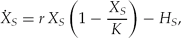
where r is the intrinsic growth rate of the NTFP and K is the carrying capacity. We do not allow r and K to vary over space. In this way the spatial heterogeneity that the model predicts is due to differences in labor allocation and not growth rates or carrying capacities over space. The resource equilibrium biomass (i.e., the stock at which  S = 0) implies that the sustainable harvest at distance s (with L s given) is equal to

2.2. Unmanaged common property
The present analysis focuses on NTFPs that are common-pool resources; that is (a) there is rivalry in appropriation, and (b) exclusion of potential appropriators or limitation of appropriation by existing users is nontrivial though not necessarily impossible (Ostrom et al., Reference Ostrom, Gardner and Walker1993). These resources can be held under different property rights regimes, the four basic categories being open access, private property, common property, and state property (Feeny et al., Reference Feeny, Berkes, McCay and Acheson1990). In this paper, we concentrate on common property NTFPs, and we also contrast with the coordinated and spatially optimized solutions.
When the resource is held under common property, all members of the community have access to it. We assume that although no individual has exclusive property rights to the resource, the community is able to exclude outsiders from appropriation.Footnote 2 We assume that this is enforced, and only the local rights-holders harvest the resource. In addition, the members of the community might establish agreed-upon rules and strategies to manage the resource. The absence of such rules is classified as unmanaged common property. The case in which the community members agree to follow a set of rules that lead to achieving a commonly set objective is classified as managed common property.
Following Gordon's (Reference Gordon1954) seminal paper, under an unmanaged regime effort flows into each patch at distance s until the rents are dissipated. This implies that labor will be allocated to extraction at point s until total revenue (pH s) is equal to total cost (wL s). By making pH s = wL s, where H s is defined by equation (3), p represents the price of the resource, and w is the opportunity cost of one day of labor. This behavior leads, in equilibrium, to the following amount of labor being allocated to extraction at each point in distance

Implicit in this solution is the assumption that there is enough labor locally to drive the system into a bioeconomic equilibrium in which rents are dissipated at each point in space. Section 3.1 explores the implications of local labor constraints that prevent this from happening.
The maximum distance that individuals travel to extract NTFP is given by
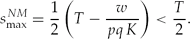
This is the extensive margin for the system, and at any distance greater than sNM max the returns from a day of work in the forest are smaller than the opportunity cost of going to the forest. If the price of the NTFP is too low (i.e., if p < w/TqK), no extraction takes place.
The equilibrium stock of the resource in the scenario of unmanaged common property is an increasing function of distance over the relevant range within the area delineated by the extensive margin. At distances greater than sNM max no extraction takes place and the stock reaches its unexploited natural equilibrium, or the carrying capacity.
By combining the sustainable harvest level in (3) with the equilibrium distribution of labor over space in (4), we can determine that the unmanaged common property levels of total harvest, revenues per day, and harvest per hour are given by



Equation (8) shows that individuals who walk shorter distances extract less per-hour than those who travel farther. Nevertheless, those walking more have less time to expend extracting (T − 2s). In the end, in equilibrium, the productivity of a day of work in NTFP extraction is constant over distance (equation (7)). That is to say, in a dynamic/spatial open access equilibrium, all extractors obtain the same amount of product in a given day, irrespective of the place where they extract. This is the way it must be, of course, because effort would be reallocated over space if it were not.
2.3. Managed common property
What are the possible gains that can be obtained by setting rules on the management of the resource? To answer this we assume that the community agrees to manage the resource in a manner that maximizes sustained net revenues. Even though it has been shown that the maximization of sustained net revenues overlooks the dynamics of both economic and biological processes (see Clark, Reference Clark1990), it provides us with a starting point and a simple set of results to compare with the unmanaged case.
As Sanchirico and Wilen (Reference Sanchirico and Wilen1999) have shown, with no spatial externalities between the productivity of different patches in space, maximizing net revenues over space is equivalent to maximizing net revenue at each point. Therefore, the community seeks the allocation of labor that solves the following problem:  at each distance s, where H s is defined as in equation (3). The solution to this problem is

This shows that if the resource is managed to maximize sustainable economic rent, the amount of labor allocated at each point is half of what is allocated under a situation of no management (equation (4)). This result shows that when effort is being optimally allocated over space, the rules that need to be established to manage the resource go beyond setting a maximum harvest rate or a maximum amount of effort. To maximize system-level returns, the community needs to allocate effort over space in a way that avoids over-exploiting areas near the village and under-exploiting more distant areas.
Differences in labor allocated over space impact not only harvest and revenues, but also the equilibrium stock of NTFP. The equilibrium biomass is always higher for the managed resource than for the unmanaged one. In fact, under management, the stock of the resource is always higher than the stock that achieves the maximum sustainable yield (i.e., K/2).
Equations (10), (11), and (12) show community harvest, revenue per unit of labor, and harvest per hour at each point, when the resource is managed to maximize net revenues



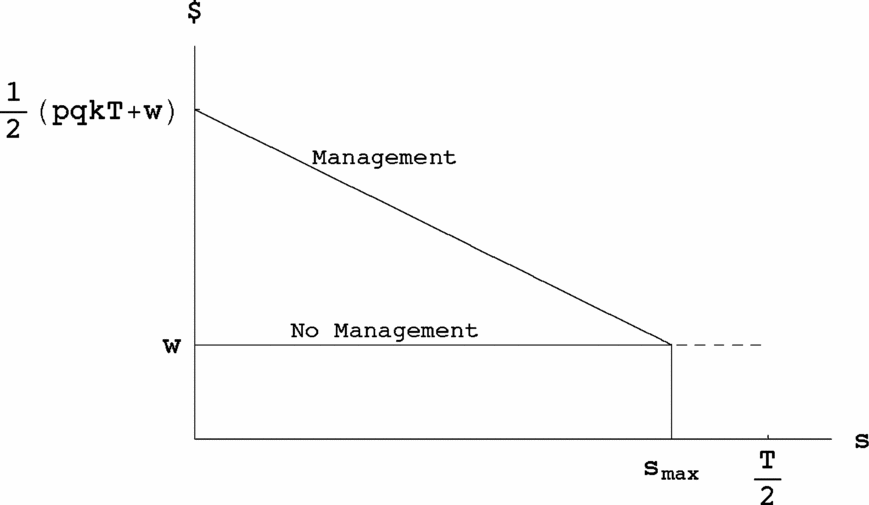
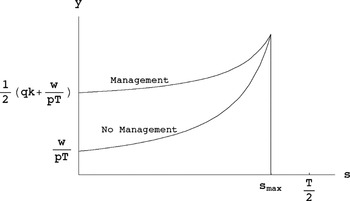
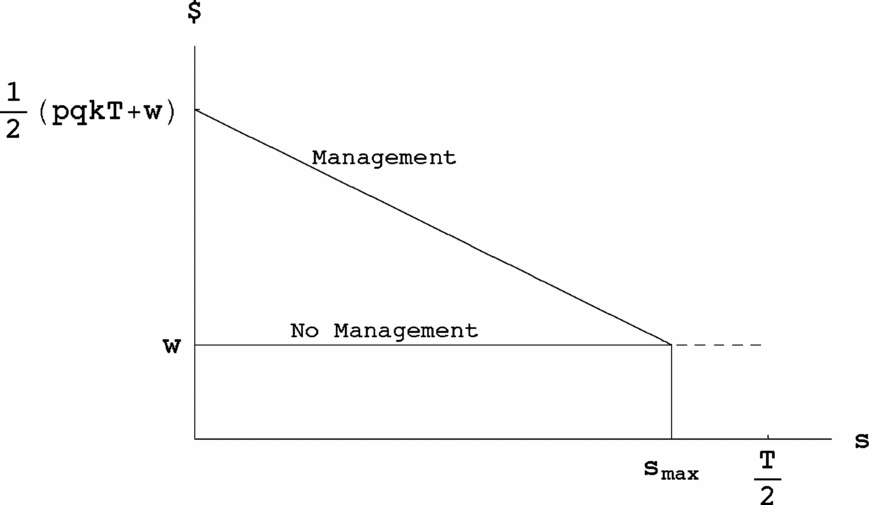
Figures 1 and 2 illustrate the latter two measures under the scenarios of unmanaged and managed common property. Arguably, the most important distinction between the two is that, under management, the value of an average day of work in NTFP extraction is always higher than the opportunity cost of time, although it is decreasing over space. That is, under optimal management each unit of labor receives, on average, more than its opportunity cost of time, which clearly would be an unstable situation without management of total effort and its allocation over space.
Revenue per day of labor over space
Harvest per hour of extraction over space

3. Unmanaged common property with labor constraints and heterogeneous labor
3.1. Labor constraints
Section 2 shows that when there is enough labor available, an unmanaged open access resource will be driven to an equilibrium in which rents are dissipated. In most settings of pure open access the natural assumption to make is that there are no labor constraints. However, this is not necessarily the case with all common property, particularly in cases where isolated villages with fixed labor utilize local common resources. To illustrate this, we add the assumption of relative shortage of local or community labor to the assumption that outsiders are excluded from extracting the common-pool resource.Footnote 3 To clarify what is meant by a relative shortage of labor consider a case where, given the values of all parameters in the optimization problem, the amount of labor that leads to rent dissipation is greater than the labor available from the right-holders of the resource. That is, there is a relative shortage of labor if  , where LNMs is defined as in equation (4) and L is total labor available.
How will this relatively limited amount of labor be distributed over space in open access equilibrium? From the solution to the case of unmanaged common property without labor constraints we know that in equilibrium individuals must be indifferent across spatial allocations. The same principle holds here with the exception that, in the presence of a labor constraint, the returns from a day of work are higher than the opportunity cost of time. This value of the average product of labor under labor constraints (θ) has to be determined. Using equation (4), we know that when there is a labor shortage the open access allocation of labor at any distance s will be given by

We also know that
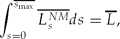
where L sNM and s max represent the allocation of labor and the extensive margin under labor shortage. Integrating the left-hand side of equation (14), we get equation (15), and from the endpoint condition that defines the extensive margin, we have equation (16). Using these two equations we can solve for the two unknowns (θ and s max.


We know that for the relevant range of distance (i.e. for  ), the function expressed in (15) is continuous and concave, while (16) is positive and with a negative slope. Both equations intersect at the point where (15) is maximized and that is the only solution for s max and θ over the relevant range of distance. Solving (15) and (16) leads to the following two equations that implicitly define the unique solution for s max and θ


Substituting the solution of θ in equation (13) defines the labor allocation over space when labor is constrained, while the solution to s max determines the extensive margin. As the labor constraint is relaxed (i.e., as L increases) θ decreases and s max increases.Footnote 4 In fact, the system of implicit equations nests the case where the labor constraint is not binding  . In that case the solution to the system will be given by θ = w and
 .Footnote 5
3.2. Labor heterogeneity
Up until now we have assumed that labor is homogenous in the sense that all individuals have the same opportunity cost of time and the same productivity in extracting the natural resource. This need not be the case. Individuals can have access to different labor alternatives and therefore have different opportunity costs of time, depending on their individual and household characteristics. Those characteristics might also affect productivity in the extractive activity. In this section, the assumption of homogeneous productivity in the extractive activity is maintained but heterogeneity in the opportunity cost of time is considered.
Assume that there are two types of individuals with opportunity costs w 1 and w 2 where w 1 < w 2. Type-1 individuals, the low opportunity cost type, will allocate labor to extraction until the value of an additional day of work is equal to the opportunity cost of time. That is, until

Under these conditions and considering that w 1 < w 2, type-2 individuals will not find it profitable to participate in NTFP extraction. Therefore, if the resource is not managed and labor is heterogeneous, only those with a low opportunity cost of time participate in NTFP extraction, and they receive w 1 as payment for every time-unit of work
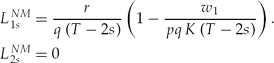
Nevertheless, this is not the case when there is a relative shortage of type-1 labor  . Under these circumstances even though all type-1 labor is allocated to resource extraction, revenues for a unit of labor (θ) are higher than w 1. If in fact the value of the marginal product of a unit of labor is higher than w 2, then type-2 individuals will participate in NTFP extraction, as well. This requirement is captured by the following participation condition

If the condition holds, then type-2 individuals allocate labor over space to extract the NTFP until

assuming that that there is no labor shortage of type-2 individuals. Although the generalization of this problem to include more than two types of individuals as well as labor constraints in more than one type of individuals is straightforward, it is arithmetically tedious and would add little by way of insight. Therefore, throughout this analysis we concentrate on the case in which there are two types of labor, only one of which is labor constrained.
The first step to find the solution is to solve for θ using the procedure outlined in section 3.1. If the participation condition (equation (21)) holds, type-2 labor will be allocated according to the following rule

where L 1sNM is obtained by substituting w 2 for θ in equation (13). And the extensive margin is given by  .
4. NTFP extraction and poverty
4.1. Price changes, spatial distribution of extraction and NTFP supply
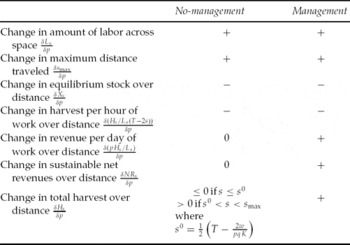
As discussed in the introduction, one policy that some conservationists are promoting is market development for products that are considered compatible with preservation of natural resources. This raises the question: what impacts might a successful ‘green marketing’ campaign have on users of a NTFP? A logical first step towards doing this is to analyze the comparative statics of the interior equilibrium solutions to the extraction problem with respect to NTFP price. Table 1 summarizes these for both unmanaged and managed common property regimes (under the assumption of homogeneous and unconstrained labor).Footnote 6
Responses to price changes

Note: The signs of the derivatives with respect to wage are the opposite of those with respect to price with the exception of the derivative of revenue per day with respect to wage. The derivative is equal to 1 for the unmanaged case and to ½ for the managed one.
Under both regimes, price increases are reflected in increases in the amount of labor allocated at each point in space. Furthermore, the total area subject to extraction increases as the price pushes the extensive margin out. The result of price increases is a lower equilibrium stock of the NTFP over space. Similarly, the amount of NTFP that can be harvested in an hour of work decreases as price increases under both regimes.
The impact that a change in price has on total harvest over distance can be decomposed into two effects. On the one hand, a price increase results in an increase in labor allocated to a point in space, and this has a positive effect on total harvest. On the other hand, the decrease in the stock of NTFP available resulting from the price increase may have a negative effect on total harvest. Under the communally managed regime, the combination of these two effects always leads to an increase in extraction at each point in space. In contrast, when there is no management, total harvest can decrease at some distances. When prices are relatively low, the positive effect that an increase in price has on labor allocated dominates the negative effect of a decrease in the stock of the NTFP. However, the opposite happens when prices are relatively high. In particular, a price increase can have a negative effect on total harvest when p > 2w/qKT, and, then, the effect is negative only at some distances.
Total supply (i.e., harvest by all individuals aggregated over all extraction points) can be computed in order to gain a better understanding of the implications of price increases. To do so HNMs and HMs are integrated over distance to obtain the total supply of the common property NTFP. The results are as follow


We know from table 1 that the derivative of harvest with respect to price is positive for all distances when institutions exist that enable the maximization of net revenues obtained from NTFP extraction. Therefore, it should also be the case that the supply of NTFP is a positive function of price in this case. In other words, under a managed common property regime the supply of NTFP is a regular supply function.
When the resource is not managed (equation (24)) and the price is high (p > 2w/qKT), the derivative of harvest with respect to price is positive over some distance ranges and negative over others. At relatively high prices, the supply can be backward bending, or a decreasing function of price.Footnote 7 If one is interested in the conservation of the stock of the NTFP, this backward-bending NTFP supply is not good news, inasmuch as it derives from an overexploitation of the resource. Even though the promotion of the commercial extraction of NTFP is based on the premise that its extraction is less damaging to the forest than alternative activities, a reduction in its stock or an increase in the area under exploitation (both caused by price increases as summarized in table 1) might still be a cause of concern.Footnote 8 In these circumstances (depending among other things on the characteristics of the NTFP and forests in question) conservation-oriented NGOs might not choose to promote green marketing policies that generate price premia.
From the extractor's welfare point of view, the most important impact is the effect of the price change on revenue per day of work. When the resource is managed by the community to maximize sustainable net revenues, a price increase has an unambiguous positive impact on revenues per day. In contrast, when the resource is not managed, rent is dissipated at all distances, implying that the revenue per day of work is equal to the opportunity cost. This means that price increases have no impact on the revenue that individual extractors receive from a day of extraction.
Under these circumstances, a successful green marketing campaign that raises NTFP prices may not improve the per capita welfare of NTFP extractors. A policy whose main objective is to alleviate poverty via higher product prices will, without community management, result in an increase in the number of days allocated to extraction and in distance traveled. Nevertheless, extractors receive the same net revenue as before (i.e., w) for a day of work. If w is the wage earned in an alternative employment activity, then the only effect of the NTFP premium will be a reallocation of more labor from the alternative activity to resource extraction. Notice too that although the price increase could ultimately result in a decrease in the quantity of NTFP supplied, the effect of a price increase is always neutral in terms of revenue per day of extraction.
In spite of these pessimistic results, under some circumstances it is possible for a price increase in an unmanaged common property resource to contribute towards poverty alleviation. This possibility is analyzed in the next section, which considers price changes when the resource is not managed and there is a binding labor constraint. In this case, price changes do not have an effect on extraction, but they do affect revenues. If, in addition, labor is heterogeneous, price increases will result in revenue increases for low-opportunity-cost individuals as long as the high-opportunity-cost individuals do not participate in extraction.
4.2. Extraction and poverty with labor constraints and heterogeneity
The results of section 2 show that, when there is no management of the common pool resource, revenue from a day of work in extraction is equal to the opportunity cost of time. Rent dissipation in the unmanaged regime is a consequence of the assumption of the relative abundance of labor. In section 3.1, this assumption was relaxed and we showed that if a relatively small group owns the resource, they can earn from extraction more than their opportunity cost of time, even if they do not have any internal rules to manage it.
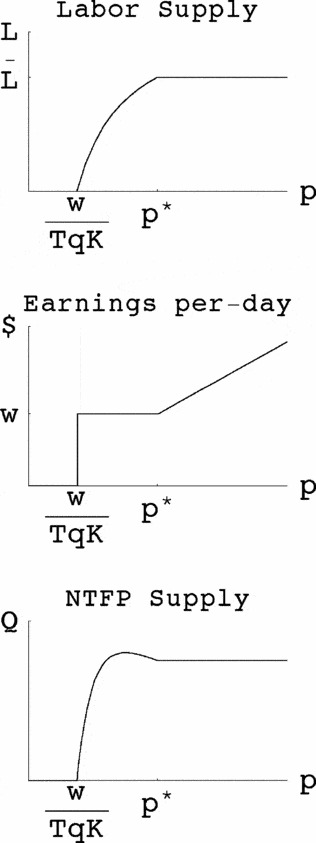
The labor constraint could be binding depending on the specific values of the parameters of the problem. Consider the case where all parameters except price are fixed. Then there is a price that makes the amount of total labor allocated to extraction equal to the labor available from the rights-holders of the resource. That is, there is a price p* at which  , where LNMs is defined as in equation (4) and L is total labor available in the community. If outside labor is effectively excluded from extracting the resource, a price increase above p* will not change the supply of the NTFP or the allocation of labor, but it will increase the income received by individuals above and beyond their opportunity cost of time.
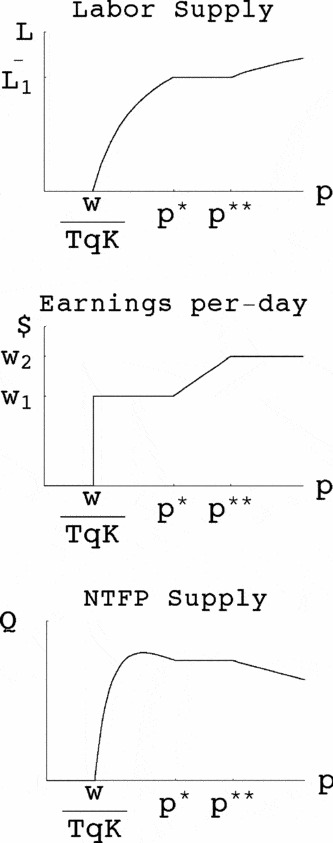
Figure 3 illustrates these results. For w/TqK < p < p*, the supply of labor is increasing as price increases, while earnings per day remain constant at w. On the other hand, when p > p*, earnings per day become an increasing function of price. As soon as p = p*, all available labor is allocated to extraction; therefore, NTFP supply is constant for all p > p*.Footnote 9 Under this institutional setting a policy that introduces an NTFP price premium can in fact have a positive impact on the income received by extractors, even without the need to coordinate behavior.
Solutions under relative scarcity of labor

Another possible setting is the one analyzed in section 3.2 with labor being not only constrained, but also heterogeneous. The relative scarcity of low opportunity cost labor (i.e., L1 < L 1NM) implies that type-1 individuals receive a return for their participation in NTFP extraction that is higher than their opportunity cost of time. In this situation, price increases can reduce poverty, although earnings per day of work do not increase continuously with respect to price as they do when labor is scarce but homogeneous (and p > p*).
Figure 4 illustrates this when there are two types of individuals. Along the price range  the supply of labor from type-1 individuals increases as price increases, and all receive w 1 for a day of work. Beyond p*, all type-1 labor is allocated to extraction. Although type-2 individuals could reallocate labor from other activities to extraction, they do not do so until the price is right, that is until price is such that earnings per day are equal to w 2. The price at which this happens in figure 4 is p**. Therefore, in the price range [p*, p**], the supply of labor and NTFP remain constant, while earnings per day increase with price. When the price surpasses p**, type-2 individuals enter into extraction, and earnings per day are constant at w 2;Footnote 10 that is, type-1 individuals do not experience any further gains from price increases once type-2 individuals begin to supply labor.
Solutions under relative scarcity of heterogeneous labor

Although the level that revenue per day of extraction can reach is bounded by w 2, a price premium can have a positive impact on the income received by extractors as long as the original price is below p** (and the new price is above p*). Furthermore, NTFP extractors can indirectly benefit from an increase in w 2 when that implies a reduction in the amount of labor that type-2 individuals allocate to NTFP extraction.
5. Case study: the xate palm in the Lacandona rainforest
We use an original data set to illustrate some of the results derived in the previous sections. Due to data limitations, we concentrate on testing the negative relationship between the opportunity cost of time and participation in extraction as well as in illustrating two predictions of the theoretical model in terms of productivity over space.
The data come from the two household surveys carried out in Frontera Corozal, a village in the Lacandona Rainforest (Selva Lacandona) in the Mexican state of Chiapas, during the years 2001 and 2004. In the first survey, 100 randomly selected households were interviewed; 86 of these households responded to the survey again during the summer of 2004 (from the 86 households interviewed both years we have an unbalanced panel of 667 individual observations).
The analysis focuses on the xate palm (Chamaedorea spp.), a marketable NTFP. Xate extraction in the rainforest is a physically demanding and risky activity that involves walking long distances (a one-way trip takes an average three hours). Other than labor, the only input used in xate extraction in Frontera Corozal is a knife. Xate palm leaves are exported to the US, Canada, and Europe where there are used by the floral industry as a backdrop for flowers in wedding and funeral displays. They are also in demand during Easter season, particularly on Palm Sunday. Xate has gained the attention of national and international organizations as a possible source for promoting development and forest conservation.Footnote 11
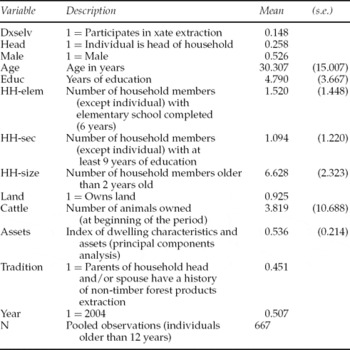
The surveys provide socio-demographic information and data on labor allocated to NTFP extraction for all household members. Table 2 presents some descriptive statistics estimated from the survey data. In addition to these variables, the 2004 round of the survey gathered information on the time traveled by each individual to the places where they extracted the resource in day trips.
Descriptive statistics

In Frontera Corozal, community members have exclusive rights to extract natural resources from the contiguous rainforest. Nevertheless, there are no community rules on how these resources, including xate, should be managed (Sánchez-Carrillo and Valtierra-Pacheco, Reference Sánchez-Carrillo and Valtierra-Pacheco2003; Tejeda, Reference Tejeda Cruz2004). Xate can therefore be considered as an unmanaged club good.
5.1. Xate extraction over space
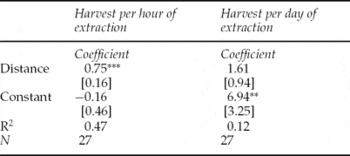
The returns from an hour of work at a given extraction site can be calculated for the 2004 sub-sample. Using this information we can illustrate (first column of table 3) how, as predicted by the theoretical model (equation (8)), the amount of resource extracted in an hour of work is an increasing function of the distance walked. The second column of table 3, on the other hand, shows how extraction per day of work is not affected by distance; that is, as expected from equation (7), the returns of a day of work are equalized across extractors, irrespective of distance traveled to the extraction point.
Xate harvest

Notes: Cluster robust standard errors in brackets. *** significant at 1%
5.2. Xate extraction and opportunity cost of time
In section 3.2 we showed that, when there is heterogeneity in the opportunity cost of time, those with a relatively low opportunity cost are the ones who extract the unmanaged common property resource. This section presents the results of an econometric test of this hypothesis. Specifically, it uses the Frontera Corozal data set to estimate the effect that the opportunity cost of time has on the decision to participate in xate extraction, controlling for other possible determinants of extraction.
Following Jacoby (Reference Jacoby1993) and Skoufias (Reference Skoufias1994), the opportunity cost of time is derived from the estimation of a Cobb–Douglas production function. The value of household's production in all the non-xate activities is the measure of production used (for more details see López-Feldman, Reference López-Feldman2006). According to this estimation, the average opportunity cost of a day of work is 37 pesos for xate extractors and 46 pesos for non-extractors (the difference in means is statistically significant at the 5 per cent level).
A probit model is used to estimate the effect that the opportunity cost of time has on the probability that a given individual will participate in xate extraction. Because the estimated opportunity cost of time is endogenous, an instrumental variables approach is employed. The instruments used to identify the model are land, cattle, and an index of households' durable assets and dwelling characteristics. The logic is that these variables affect the income generating capacities of the individual in non-xate activities (i.e., the opportunity cost), but not xate labor allocation once one controls for the opportunity cost.
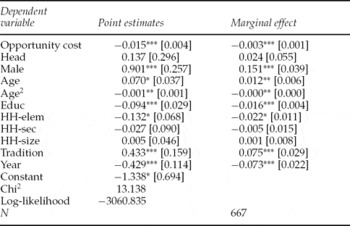
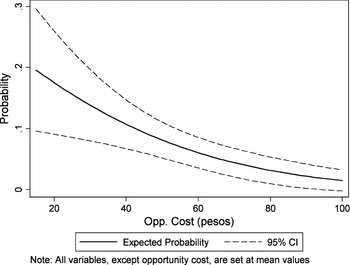
The results in table 4 show that there is in fact a negative relationship between the opportunity cost of time and the probability of participation in xate extraction. The marginal effect, evaluated at the mean of all the variables, implies that an exogenous increase of 10 pesos in the opportunity cost of time decreases the probability of participation in xate extraction by 3 per cent. An alternative way of showing the impact of changes in the opportunity cost of a day of work is to look at the predicted probabilities. Figure 5 shows a nonlinear relationship between predicted probabilities of participation in xate extraction and the opportunity cost of time. Marginal changes in the opportunity cost have a relatively higher impact on the probability of participation when the opportunity cost is low than when it is high. At high opportunity costs (in particular above 80 pesos per day), the probability of participation is close to zero, and small changes in the opportunity cost do not change that.
Participation in xate extraction (instrumental variables probit)

Notes: *significant at 10%; **significant at 5%; ***significant at 1%.
Cluster robust standard errors in brackets.
Instruments in the first stage: land, cattle and assets index.
Opportunity cost and probability of xate participation

Results for the other variables included in the estimation show that males are more likely to participate in extraction and age has an inverted u-shaped relationship with participation. In addition, even though the opportunity cost captures the effect that education (own and of other household members) has on the income generating capabilities of the individual, two of the education variables turn out to be negative and statistically significant. This finding suggests that more educated individuals (and individuals from more educated households) have distaste for participating in xate extraction. The year dummy included in the estimation has a negative and significant coefficient. Unfortunately, it does not allow us to disentangle the effects of changes in prices from changes in stock or other variables that are constant across individuals but may change over time (e.g., weather). Finally, the variable tradition has a strong and positive effect on participation in extraction.
6. Conclusions
This paper shows that because of the spatial nature of extractive activities, the solution to the problem of optimal management of common property resources goes beyond limiting the amount of total effort (total extraction). The solution to this problem requires extractors to coordinate the allocation of labor optimally across space. The analysis illustrates an important distinction in the productivity of a day of work in NTFP under managed and unmanaged regimes. Under management, the productivity of a day of work in NTFP extraction is decreasing over distance but always higher than the opportunity cost of time. In contrast, when there is no management, productivity is always equal to the opportunity cost of time; that is, each unit of labor receives more than its opportunity cost of time when management of the common-pool resource is instrumented to maximize sustainable economic rent.
The findings from this analysis have important implications for policies with the dual goal of alleviating poverty and promoting conservation. A key objective of recent conservation initiatives has been to increase the price paid to NTFP extractors. However, under an unmanaged common property regime, an increase in the price of the natural resource, say due to a ‘green product’ price premium, does not necessarily help alleviate poverty. Irrespective of how much the price increases, the revenue per day of work is always equal to an individual's opportunity cost of time, if labor is abundant and responsive with open access behavior. On the other hand, if there are constraints on the availability of local labor, price increases can in fact raise extraction income above the opportunity cost of time and help alleviate poverty even under local open access. That is to say, if a relatively small group utilizes the resource, its members can earn from extraction more than their opportunity cost of time even if they do not have any internal rules to manage it, provided that they can exclude outsiders from extracting.
These results underline the importance of local management practices, both in terms of exclusion and coordination (across time and space). Green-marketing programs might be more successful in alleviating poverty if, instead of concentrating only on price mechanisms, they linked price premiums to improved local management practices.
 and
 .