Introduction
The name ’pigeonpea’ was first reported in Barbados, a Caribbean country, where its seeds were used as feed to pigeons (Plukenet, Reference Plukenet1692). Pigeonpea (Cajanus cajan (L.) Millsp.) is a versatile food legume crop that is widely adapted to diverse climates (Nene and Sheila, Reference Nene, Sheila, Nene, Hall and Sheila1990) and cultivated in tropical and subtropical regions. Pigeonpea originated in India and spread to Africa, which is the secondary centre of diversity (van der Maesen, Reference van der Maesen1986). During the slave trade, it then moved from Africa to the Americas (van der Maesen, Reference van der Maesen1980). It was estimated that pigeonpea was grown over an area of 5.3 million ha worldwide (FAO, 2012). Caribbean region, which is located to the southeast of the North American continent, to the north of the South American continent and to the east of Central America, pigeonpea is a minor crop that is often grown either as an intercrop or around the boundaries of the plots. Dominican Republic has the largest acreage (0.03 million ha), followed by Panama (4000 ha), Venezuela (1825 ha), Trinidad and Tobago (1300 ha), Jamaica (796 ha), Grenada (580 ha), Puerto Rico (350 ha), and Saint Vincent and the Grenadines (25 ha) (FAO, 2012). In most of these countries, pigeonpea is grown as a vegetable crop near houses and farm bunds as hedges (Faris et al., Reference Faris, Saxena, Mazumdar and Singh1987; Remanandan and Singh, Reference Remanandan, Singh, Fuccillo, Sears and Stapleton1997; Upadhyaya et al., Reference Upadhyaya, Reddy, Gowda and Sube2010).
Besides its use in traditional medicine, pigeonpea is used as a source of food, feed, fuel, fencing, roofing material, basket-making material, soil enricher and soil binder (Remanandan, Reference Remanandan, Nene, Hall and Sheila1990; Morris, Reference Morris and Janick1999; van der Maesen, Reference van der Maesen, Brink and Belay2006). It is an excellent source of protein (up to 31% in the world collection) in the vegetarian diet, and mostly used as dried peas, green vegetable peas or flour (Faris et al., Reference Faris, Saxena, Mazumdar and Singh1987; van der Maesen, Reference van der Maesen, Brink and Belay2006). It is also used in Trinidad's famous palau and soups, and as dhal. In Trinidad, pigeonpea is traditionally grown in time to be harvested for Christmas.
The genebank at the International Crops Research Institute for the Semi-Arid Tropics (ICRISAT), Patancheru, India holds 13,771 pigeonpea germplasm accessions, of which 542 are from the Caribbean and Central American (CCA) regions. In view of the typical environment in these regions, poor representation of pigeonpea collection from the CCA regions conserved at the ICRISAT genebank, and fast erosion of crop diversity due to the factors such as the replacement of landraces by modern varieties, natural catastrophes (droughts, floods and fire hazards), urbanization, industrialization and habitat loss due to irrigation projects, overgrazing, mining and climate change (United Nation Environment Programme, 2008; Upadhyaya and Gowda, Reference Upadhyaya and Gowda2009), there is a need for a critical assessment of the existing collection of pigeonpea from these regions. The aim of the present study was to assess the status, geographical distribution and diversity in the existing collection from the CCA regions for planning future explorations and conservation, and for enhancing the utilization of germplasm to improve the breeding of pigeonpea varieties.
Materials and methods
Passport and characterization data of the world collection of pigeonpea germplasm from the CCA regions conserved at the ICRISAT genebank were used. The collection includes 542 accessions that originated from 16 countries of the Caribbean region and five countries of the Central American region. Passport data for geographic coordinates were updated using Microsoft Encarta®, an electronic atlas (MS Encarta® Interactive World Atlas, 2000). To verify the accuracy of the coordinates, the landraces were plotted on a country-level map and checked for their presence in the appropriate province, district, village and precise location of the sampling site. A set of 228 landraces from Barbados (19), Dominican Republic (57), Puerto Rico (43), Saint Lucia (17), Saint Vincent and the Grenadines (21), and Trinidad and Tobago (71) having geo-reference data were considered to determine the geographical distribution of the collections from these countries.
Owing to the paucity of seeds for evaluation, only 424 accessions collected from 14 countries were evaluated in different years starting from 1974 to 2012, in vertisols during the rainy season at Patancheru, India. An augmented design with one of the four control cultivars repeated after 20 test entries was used for evaluation. The accessions were grown in three rows of 4 m length each, with a spacing of 50 cm between the plants and 75 cm between the rows. The crop was fertilized with a basal dose of 20 kg N/ha and 40 kg P2O5/ha, and managed by recommended cultural and plant protection measures, including supplementary irrigation. Results are presented as the mean of three representative plants from the middle row. The accessions were evaluated for eight qualitative traits (growth habit, plant pigmentation, flowering pattern, flower colour, pod colour, primary seed colour, secondary seed colour and seed shape) and 17 quantitative traits [leaflet size, plant height, primary branches per plant, secondary branches per plant, tertiary branches per plant, days to 50% flowering, days to 75% maturity, racemes per plant, pod-bearing length, pod length, pods per plant, seeds per pod, 100-seed weight, shelling percentage, seed yield per plant, harvest index (%) and seed protein content (%)] (IBPGR and ICRISAT, 1993). The percentage of seed protein in mature whole seed was calculated by a rapid Technicon AutoAnalyser procedure at the ICRISAT biochemistry unit (IBPGR and ICRISAT, 1993).
The mean observations for each trait were standardized by subtracting the mean value of the characteristic from each observation and subsequently dividing by its respective standard deviation (SD). This resulted in standardized values for each trait with a mean of 0 and a SD of 1. The standardized values were used to perform the principal component analysis (PCA) by using GenStat 13.1 (VSN International, 2010). Cluster analysis following Ward's (Reference Ward1963) method was performed using the scores of the first nine principal components (PCs), in addition to the estimation of the range, mean and variances for all quantitative traits under study. Mean values were compared by the Newman–Keuls test (Newman, Reference Newman1939; Keuls, Reference Keuls1952), while variances were examined by Levene's (Reference Levene and Olkin1960) test. The Shannon–Weaver diversity index (H′) was calculated to assess phenotypic diversity (Shannon and Weaver, Reference Shannon and Weaver1949). Phenotypic correlation coefficients were estimated to identify useful associations among the characteristics (Snedecor and Cochran, Reference Snedecor and Cochran1980).
Results
Germplasm status
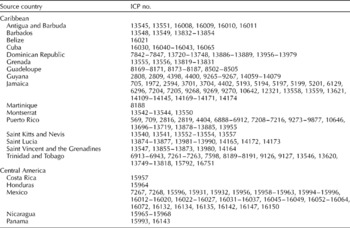
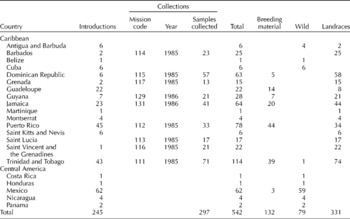
The ICRISAT assembled pigeonpea germplasm by introducing the germplasm collected previously from various organizations located in different countries, and then by launching systematic collection missions in the CCA countries in partnership with national and international institutes, National Agricultural Research Systems, universities and non-governmental organizations. The passport data of pigeonpea germplasm assembled at the ICRISAT genebank indicated that a total of 542 accessions originated from 16 countries of the Caribbean region and five countries of the Central American region (Tables 1 and 2).
Country-wise pigeonpea germplasm from the Caribbean and Central American regions assembled at the ICRISAT genebank, India

Summary of pigeonpea germplasm from the Caribbean and Central American regions assembled at the ICRISAT genebank, India

Diversity in the collection
A total of 424 accessions were evaluated for different morpho-agronomic traits. Pigeonpea is an often cross-pollinating crop with an outcrossing rate up to 24% (Githiri et al., Reference Githiri, Kimani and Saxena1991). Therefore, a high level of heterogeneity and heterozygosity was observed in the samples collected from the farmer's fields. These samples were maintained for their heterogeneity, which resulted in more than one class of individual traits within the accessions.
Qualitative traits
Growth habit
Three growth habits, namely compact, spreading and semi-spreading, were observed in the collection. More than 89% of the accessions from all the countries, except Puerto Rico, showed a semi-spreading growth habit. Of the accessions from Puerto Rico, 62 and 32% exhibited a semi-spreading and a compact growth habit, respectively.
Plant pigmentation
Three solitary colours (green, purple and red) and two colour combinations (green+red and red+green) of plants were found in the accessions from all the CCA countries. Among these accessions, 92.5% had green stems followed by 5.2% showing red stems, 1.4% purple stems and 0.7% green+red stems and 0.20% red+green stems.
Flowering pattern
Three flowering patterns, namely determinate, indeterminate and semi-determinate, were found in the collection. Of these accessions, 87.5% showed an indeterminate flowering pattern, followed by 9.9% with a determinate flowering pattern and 2.6% a semi-determinate flowering pattern. A maximum of 27.6% of the accessions from Puerto Rico, 16.8% from Trinidad and Tobago, and 13.3% from Grenada showed a determinate flowering pattern.
Flower colour
Three flower colours, namely light yellow, orange yellow and yellow flowers, were observed in the collection. More than 95% of the accessions from all the CCA countries, except Saint Kitts and Nevis, produced yellow flowers. Among the accessions from Saint Kitts and Nevis, a maximum of 16.7% produced light-yellow flowers.
Pod colour
Four solitary pod colours (dark purple, green, mixed (green and purple) and purple) and eight colour combinations (dark purple+green, dark purple+mixed, green+mixed, green+purple, mixed+green, mixed+purple, purple+green and purple+mixed) were observed in the collection. The accessions having mixed (green and purple) colour pods were predominant (44.3%) followed by those producing green pods (26.7%) and purple pods (18.4%). Other pod colours were in negligible proportions ( < 3%). The maximum percentage of the accessions producing purple pods (45.5%) was from Saint Vincent and the Grenadines followed by those from Puerto Rico (34.2%) and Trinidad and Tobago (21.1%).
Primary seed colour
A total of 17 seed colours including nine solitary (cream, dark brown, dark purple, light brown, light grey, orange, purple, reddish brown and white) and eight mixed colours (cream+brown, cream+light brown, cream+orange, cream+purple, dark brown+cream, light brown+cream, orange+cream and reddish brown+orange) were found in the collection, with 60% of the accessions having cream-coloured seeds, 12.5% light brown-coloured seeds, and 9% orange-coloured seeds. All other seed colours were in negligible proportions ( < 2%). The majority of the accessions from Grenada (93.3%) and Trinidad and Tobago (88.4%) produced cream-coloured seeds.
Secondary seed colour
Six secondary seed colours (brown, cream, orange, reddish brown, white and plain) and three colour combinations (plain+brown, white+brown and white+plain) were found in the collection. Among the accessions, 59% had white as the secondary seed colour, while 38% had no secondary seed colour (i.e. plain).
Seed shape
Four seed shapes (oval, globular, square and oval+square) were found in the collection. Of these accessions, 95% had oval-shaped seeds, and all the other seed shapes were in negligible proportions ( < 5%).
Quantitative traits
Cluster analysis
The PCA was performed using the data of the 17 quantitative traits. A hierarchical cluster analysis (Ward, Reference Ward1963) conducted using the scores of the first nine PCs, capturing 85.8% of the total variation, resulted in four clusters. Cluster 1 consisted of 79 accessions from six countries, cluster 2 consisted of 18 accessions from seven countries, cluster 3 consisted of 180 accessions from 12 countries, and cluster 4 consisted of 147 accessions from 12 countries. The accessions from Puerto Rico were predominant in cluster 1, while those from Barbados, Grenada, Guyana, Saint Kitts and Nevis, Saint Vincent and the Grenadines, and Trinidad and Tobago were predominant in cluster 3, and those from Dominican Republic, Jamaica, Saint Lucia, and Saint Vincent and the Grenadines were predominant in cluster 4.
Range of variation
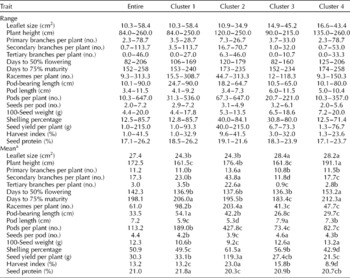
A wide variation was observed for all the traits in the collection under study. These include days to 50% flowering ranging from 82 to 206, plant height from 84.0 to 260.0 cm, racemes per plant from 9.3 to 313.3, pods per plant from 10.3 to 647.0, pod length from 3.4 to 11.5 cm, seeds per pod from 2.0 to 7.2, 100-seed weight from 4.4 to 20.0 g, seed yield per plant from 1.0 to 215.0 g (Table 3). Cluster 1 had a wide variation in the following traits: leaflet size; plant height; secondary branches per plant; days to 75% maturity; seeds per pod; 100-seed weight; shelling percentage; harvest index; seed protein content. Cluster 2 showed a wide variation in the following traits: tertiary branches per plant; pods per plant; seed yield per plant; harvest index. Cluster 3 had a wide variation in the following traits: days to 50% flowering; pod length. Cluster 4 showed a wide variation in the following traits: primary branches per plant; pod-bearing length. The range of variation indicated that the accessions of cluster 1 were important sources of variation for the traits large leaflets, more secondary branches, high pod-bearing length, more seeds per pod and high seed protein content, while those of cluster 2 were good sources of variation for more tertiary branches, racemes per plant, pods per plant, high seed yield and harvest index per plant; those of cluster 3 were a good source of variation for long pods; and those of cluster 4 were good sources of variation for high plant height, more primary branches and larger seeds (Table 3). Among the accessions, ICP 13620 was the earliest to flower (82 d) and ICP 13739 flowered very late (206 d). ICP 7212 was found to be promising for primary branches per plant (78.7), ICP 7209 for secondary branches per plant (113.7), ICP 13734 for pod length (11.5cm), ICP 9266 for racemes per plant (313.3), ICP 9275 for pod-bearing length (90.0cm), ICP 9273 for pods per plant (647.0), ICP 8504 for seeds per pod (7.2), ICP 14136 for 100-seed weight (20.0g), ICP 6943 for shelling percentage (85.7%), ICP 569 for seed yield per plant (215.0g) and harvest index (41.5%), and ICP 7209 for seed protein content (26.2%). The present study revealed that ICP 6926, ICP 8504 and ICP 13973 producing more seeds per pod (6–7), ICP 13555, ICP 13734, ICP 13828 and ICP 13831 producing longer pods (about 11cm), and ICP 5201, ICP 7208 and ICP 7209 with high seed protein content (>25%) were identified to be the promising sources for use in the breeding of vegetable-type cultivars.
Range and mean values of the different traits in the various clusters of pigeonpea germplasm from the Caribbean and Central American regions, evaluated at ICRISAT, India

Mean values followed by unlike letters were significantly different (P= 0.05).
a Mean values were tested by the Newman–Keuls test.
Means
The Newman–Keuls test of significance for mean values showed significant differences between the clusters with respect to secondary branches per plant, pod length, shelling percentage and harvest index (Table 3). Cluster 1 differed significantly from the other clusters in relation to pod-bearing length and seed protein content. Cluster 2 produced more primary, secondary and tertiary branches, racemes per plant, pods per plant, high seed yield per plant, shelling percentage and harvest index. Cluster 3 produced long pods with more seeds per pod, while cluster 4 flowered late, grew tall and produced larger seeds. Clusters 3 and 4 produced significantly larger seeds than clusters 1 and 2. The accessions of cluster 1 had a significantly higher mean seed protein content than those of the other clusters (Table 3). Compared with the accessions from the other regions, all the accessions from the CCA regions belonged to the late-maturity group (ICRISAT, 1978).
Variances
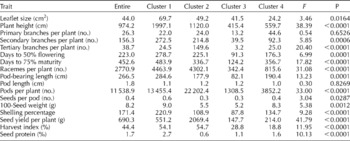
Variances were heterogeneous (P< 0.0001) for all the traits under study, except primary branches per plant and pod length (Table 4). Variances were minimum for seeds per pod and maximum for pods per plant in the entire collection as well as in the different clusters.

Phenotypic diversity
The Shannon–Weaver diversity index (H′) was calculated for the entire collection and different clusters for each trait to compare the phenotypic diversity of the 17 quantitative traits (Table S1, available online). A low H′ value indicated the lack of diversity, while a high H′ value indicated high diversity in the collection. In the entire collection, diversity was maximum (H′ = 0.630+0.026) for plant height and minimum for tertiary branches per plant (H′ = 0.259+0.026). Over all the traits, cluster 3 was found to be highly diverse, while cluster 2 had the lowest diversity. Across the clusters, the collection showed the highest diversity (H′ = 0.603+0.012) for seed protein content, while the lowest diversity was observed for tertiary branches (H′ = 0.360+0.055). Cluster 1 was highly diverse for harvest index, cluster 2 for racemes per plant, cluster 3 for seeds per pod and cluster 4 for shelling percentage.
Characteristic associations
A total of 81 trait combinations showed highly significant (P <0.01) and 17 trait combinations showed significant (P <0.05) correlations (Table S2, available online). Significant positive correlations were observed for leaflet size with pod length and seeds per pod; plant height with secondary and tertiary branches per plant, days to 50% flowering, days to 75% maturity, racemes per plant, pods per plant, 100-seed weight and seed yield per plant; primary branches per plant with secondary and tertiary branches per plant, racemes per plant, pods per plant, seed yield per plant; secondary and tertiary branches per plant with days to 75% maturity, racemes per plant, pod-bearing length, pods per plant, seed yield per plant and harvest index; days to 50% flowering with days to 75% maturity and 100-seed weight; days to 75% maturity with pod-bearing length and seed protein content; racemes per plant with pod-bearing length, pods per plant, shelling percentage, seed yield per plant and harvest index; pod-bearing length with pods per plant, seed yield per plant and seed protein content; pod length with seeds per plant and 100-seed weight; pods per plant with shelling percentage, seed yield per plant and harvest index; seeds per pod with 100-seed weight; shelling percentage with seed yield per plant and harvest index. The highest magnitude of correlations was observed between racemes per plant and pods per plant (r= 0.914) followed by between days to 50% flowering and days to 75% maturity (r= 0.749), between pods per plant and seed yield per plant (r= 0.744), and between shelling percentage and harvest index (r= 0.703).
Discussion
The success in crop improvement depends largely on the availability of highly adaptable and diverse parental lines. The genebank at ICRISAT, India conserves diverse pigeonpea accessions from different countries including those of the CCA countries. However, the relative representation of the world collection of pigeonpea from the CCA countries was found to be very low. Of the 542 accessions under study, only 228 had the geo-reference data. Accessions with geo-reference data from Barbados, Dominican Republic, Puerto Rico, Saint Lucia, Saint Vincent and the Grenadines, and Trinidad and Tobago represented only 48 geographical sites, and indicated low intensity of collection in these countries. The collections from the CCA regions included 331 landraces, 132 breeding materials and 79 wild accessions. None of the landraces was from the Central American region (Table 2). Launching of collection missions in the CCA regions has been suggested for better representation of the world collection and for filling geographical, diversity and taxonomical gaps to augment the collection for increased variability (Upadhyaya et al., Reference Upadhyaya, Pundir, Gowda, Reddy and Sube2005). It has also been suggested to gather complete passport information including that of latitude and longitude of collecting sites while collecting the germplasm for better understanding of the performance of landraces for their enhanced utilization in the improvement of pigeonpea varieties.
Identification of useful germplasm for breeding programmes is the basic requirement, and this could be achieved by identifying the regions or countries with high diversity and promising sources of desired traits. The highest frequency of accessions from Puerto Rico (27.6%), Trinidad and Tobago (16.8%), and Grenada (13.3%) showing a determinate flowering pattern could be good sources for pigeonpea breeding. Uniformity in plant height, maturity and determinate flowering pattern facilitates the application of insecticides and mechanical harvesting. More than 80% of the accessions originating from Grenada and Trinidad and Tobago produced cream-coloured seeds, which could be useful in developing pigeonpea varieties with light-coloured seeds for agro-ecologies where there is a peculiar preference for such types (Manyasa et al., Reference Manyasa, Silim, Githiri and Christiansen2008). The clustering pattern revealed specific accessions with predominant characteristics. For example, accessions of cluster 1 were specific with more secondary branches, high pod-bearing length, more seeds per pod and high seed protein content; those of cluster 2 for more pods per plant, high seed yield per plant and harvest index; those of cluster 3 for long pods; and those of cluster 4 for large seeds. These accessions with discrete characteristics may be exploited for better parental material for use in the improvement of pigeonpea breeding. The accessions of cluster 2 exhibited more primary, secondary and tertiary branches per plant, high number of racemes per plant, more pods and higher seed yield per plant, high shelling percentage and harvest index, which could be promising sources for use in the improvement of pigeonpea germplasm. Upadhyaya et al. (Reference Upadhyaya, Pundir, Gowda, Reddy and Sube2005) reported the highest number of primary branches in accessions from Americas and the lowest number of secondary branches in those from the Caribbean countries. The results for phenotypic diversity suggest the exploitation of cluster 1 for high harvest index, cluster 2 for more number of racemes per plant, cluster 3 for more seeds per pod and cluster 4 for high shelling percentage, for diverse accessions. The correlations among the traits under study indicated the possibilities for the simultaneous selection of various agronomic traits. Selection for early flowering will result in the selection of early-maturing germplasm. Similarly, selection for more number of racemes per plant will result in more pods per plant and high seed yield per plant, and selection for higher shelling percentage will result in high harvest index.
Pigeonpea landraces are generally known for their wider adaptability, and can be grown as a vegetable crop in backyards or on field bunds to support the economy of farmers. According to the standard maturity classification developed and followed at ICRISAT, almost all the accessions from the CCA countries belonged to the late-maturity group (ICRISAT, 1978). Because of late maturity and the perennial nature of the pigeonpea crop coupled with an indeterminate flowering pattern of the accessions, it is possible to extend the harvest of immature pods to sell in local markets for a longer period of time. Upadhyaya et al. (Reference Upadhyaya, Reddy, Gowda and Sube2010) reported pigeonpea germplasm from the Caribbean region as the best source of vegetable pigeonpea. Generally, soluble sugar content of the seeds will be about 5% in most of the pigeonpea varieties (Faris et al., Reference Faris, Saxena, Mazumdar and Singh1987). As most of the accessions under study are grown for vegetable purposes, continuous selection for taste might have resulted in higher seed soluble sugar and protein content (17–26%) in accessions from the CCA countries. The seed protein content in the world collection varied from 13 to 30.8% (pigeonpea germplasm characterization database at ICRISAT).
The multi-location evaluation of the collection under study for agronomic traits at potential locations in the CCA countries, and the systematic evaluation of nutritional traits and resistance to biotic and abiotic stress could result in the identification of useful genotypes, particularly vegetable types, for use in breeding programmes as well as for release as varieties in these regions. Remanandan and Singh (Reference Remanandan, Singh, Fuccillo, Sears and Stapleton1997) reported the possibilities for the successful introduction of pigeonpea in the semi-arid parts of Venezuela and other South American countries, thus reducing the expensive imports of soybean for poultry and animal feed. Limited quantities of seeds of almost all the accessions originating from the CCA regions that are conserved at ICRISAT are available under the Standard Material Transfer Agreement (SMTA) of the International Treaty on Plant Genetic Resources for Food and Agriculture, for research and training purposes.
Supplementary material
To view supplementary material for this article, please visit http://dx.doi.org/10.1017/S1479262114000987
Acknowledgements
The authors sincerely acknowledge the contribution of all the former and present staff of the genebank at ICRISAT, Patancheru, India to the assembly and conservation of the genetic resources of pigeonpea. The authors highly appreciate B. Ravi and Judson Babu, Research Technicians, for recording and documentation of the observations.