Introduction
Calcium (Ca) is an indispensable component in the bird’s growth and reproduction periods and takes part in the formation of the skeleton and the composition of the eggshell (Reynolds and Perrins, Reference Reynolds, Perrins and Thompson2010). Almost all of the total Ca in the body (98–99 g/100g) is found in the bones, and the rest is involved in cell metabolism (Reynolds and Perrins, Reference Reynolds, Perrins and Thompson2010). Since this mineral is more prevalent and makes up between 35 and 38 g/100g of the eggshell, it is also crucial for the eggshell’s quality (Barreto et al., Reference Barreto, Pereira, Umigi, Rocha, Araujo, Silva and Torres Filho2007). While the NRC (1994) suggests a Ca requirement of 2.5 g/100g for laying Japanese quails, other organisations (INRA, 1999) and researchers (Ibarra et al., Reference Ibarra, Vílchez-Perales and Zea Mendoza2023; Oliveira et al., Reference Oliveira, Machado, Goncalves, Macedo and Assis2009; Sarmiento-García et al., Reference Sarmiento-García, Gökmen, Sevim and Olgun2022; Stanquevis et al., Reference Stanquevis, Furlan, Marcato, de Oliveira-Bruxel, Perine, Finco, Grecco, Benites and Zancanela2021) recommend a Ca requirement of 2.0 to 3.5 g/100g. These results imply that the quail’s Ca requirements are still unclear and that the birds can adapt to dietary variations in Ca. Namely, quails eliminate excess Ca and modifying their metabolism to meet egg production (EP) requirements.
One way to meet the Ca requirements of birds is to improve its availability. Organic acids are one of the additives that can be used for this purpose (Ebeid and Al-Homidan, Reference Ebeid and Al-Homidan2022). Organic acids and salts as additives prevent microorganism development in feed and increase the population of beneficial microorganisms such as lactic acid bacteria in the digestive system (Ebeid and Al-Homidan, Reference Ebeid and Al-Homidan2022). In addition, organic acids improve the solubility and digestion of ingredients and the absorption of nutrients by changing the pH of the digestive system (Rahman et al., Reference Rahman, Howlider, Mahiuddin and Rahman2008). Malic acid and its salts are among the organic acids utilised as performance enhancers in poultry diets (Birilie et al., Reference Birilie, Mekuriaw and Animut2025; Král et al., Reference Král, Angelovičová, Alfaig and Walczycka2013; Qiu et al., Reference Qiu, He, Zhang, Wang, Qi, Guo, Zhang and Wu2022; Ren et al., Reference Ren, Yang, Hu, Huang, Jiao and Huang2021). Malic acid, an organic dicarboxylic acid that occurs naturally in metabolic cycles in plant and animal cells, playing a role in the energy (adenosine triphosphate-ATP) production (Ocak et al., Reference Ocak, Erener, Altop and Kop2009). Dietary malic acid administration increases nutrient utilisation by poultry and thus their production performance (Mohamed and Bahnas, Reference Mohamed and Bahnas2009; Ocak et al., Reference Ocak, Erener, Altop and Kop2009).
Quails are widely used as a commercial egg-producing species and also as an experimental model in nutritional studies due to their ease of management, high production potential and sensitivity to dietary interventions (; Olgun et al., Reference Olgun, Kılınç and Sarmiento-García2026; Sarmiento-García et al., Reference Sarmiento-Garcia, Olgun, Kılınç, Sevim and Gökmen2023). Even when the responses of quail to different levels of dietary Ca have been adequately studied (Oliveira et al., Reference Oliveira, Machado, Goncalves, Macedo and Assis2009; Sarmiento-García et al., Reference Sarmiento-García, Gökmen, Sevim and Olgun2022; Stanquevis et al., Reference Stanquevis, Furlan, Marcato, de Oliveira-Bruxel, Perine, Finco, Grecco, Benites and Zancanela2021), there is limited research examining the effects of malic acid (Birilie et al., Reference Birilie, Mekuriaw and Animut2025; Král et al., Reference Král, Angelovičová, Alfaig and Walczycka2013; Qiu et al., Reference Qiu, He, Zhang, Wang, Qi, Guo, Zhang and Wu2022; Ren et al., Reference Ren, Yang, Hu, Huang, Jiao and Huang2021). This study is based on the hypothesis that the addition of malic acid to low-Ca diets may prevent potential negative effects on production performance and mineral metabolism. Therefore, the aim of the present study was to determine the effects of malic acid supplementation to the diet containing different levels of Ca on the performance, egg quality and bone properties of laying quails.
Materials and methods
Experimental design and animal management
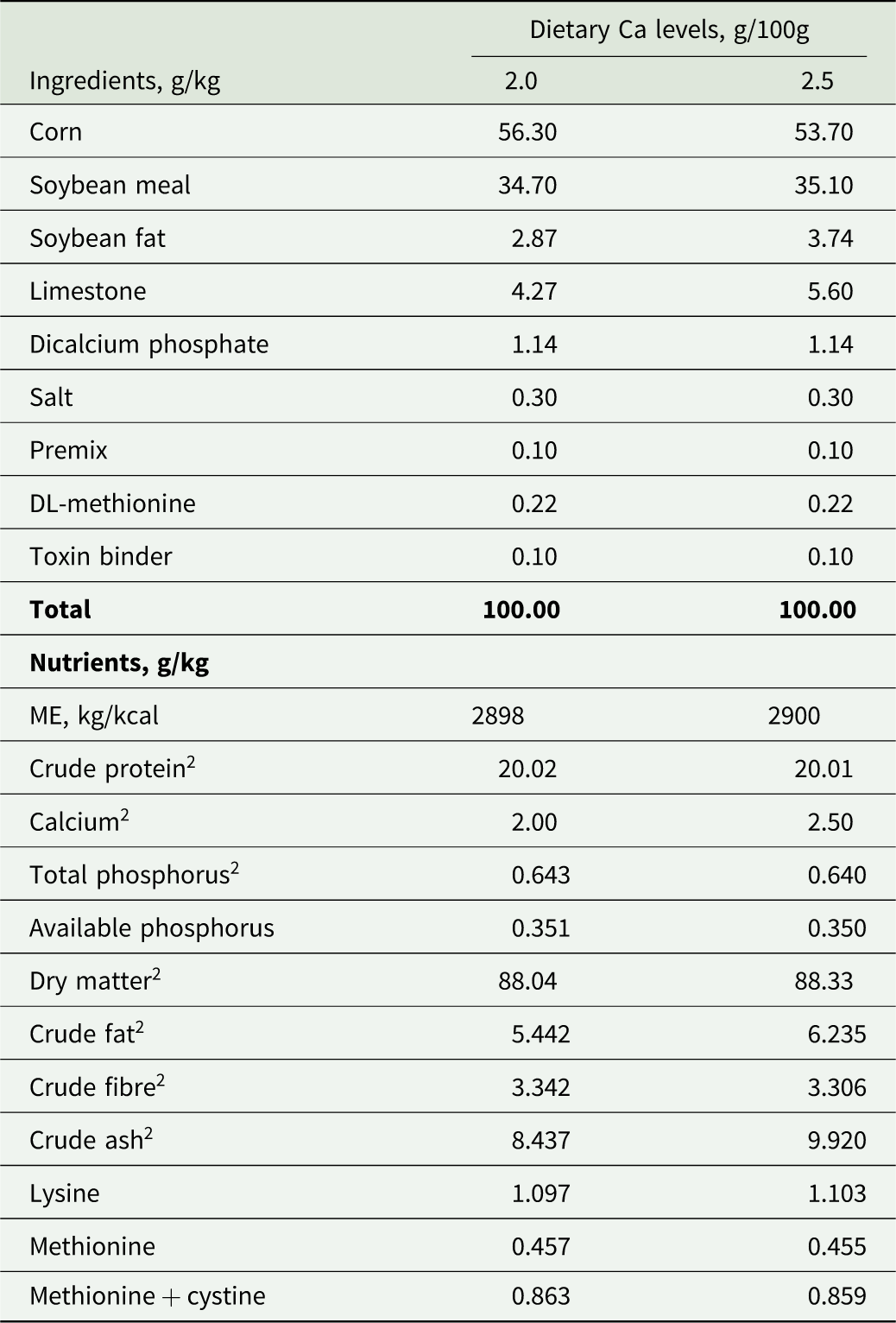
A total of 256 laying quails (267 ± 15 g), 35 weeks old, were randomly allotted into eight equal groups according to dietary treatment. The quails used in the study was obtained from the Quail Breeding Unit of the Faculty of Agriculture, Selcuk University. In each experimental group, there were eight replicates, each with four quails. Experimental diets were formulated to provide adequate levels of all nutrients according to NRC (1994), except for Ca (Table 1). Quails were housed in a layer house equipped with 64 plastic battery cages (45 × 30 × 20 cm) in an environmentally controlled room (21–25°C). In the study, the Ca level was determined using recommended of NRC (1994) (2.5 g/100g diet) and its 20% reduced level (2.0 g/100g diet), while the additional malic acid level was based on the approximate malic acid level (1 g/kg) recommended by Ocak et al. (Reference Ocak, Erener, Altop and Kop2009) and its multiples. Eight diets, arranged in a factorial design with two levels (2.0 and 2.5 g/100g diet) of Ca and four levels (0, 1, 2 and 4 g/kg) of a malic acid (Ataman Kimya A.Ş., Ataşehir, İstanbul, Türkiye) preparation were used. Lighting was provided for 16 hours/day from 06:00 to 22:00 during the experimental period. Feed and water were given ad libitum throughout the trial (35–47 weeks of age).
Treatment diets and its nutrient contents (as feed)

Table 1. Long description
A table with two columns and twelve rows, comparing dietary treatments and nutrient contents for laying quails. The columns are labeled ‘Ingredients, g/kg’ and ‘Dietary Ca levels, g/100g’. The rows list various ingredients and their quantities in grams per kilogram, as well as the dietary calcium levels in grams per 100 grams. The ingredients include corn, soybean meal, soybean fat, limestone, dicalcium phosphate, salt, premix, DL-methionine, and toxin binder. The table also includes a section for nutrients, listing their quantities in grams per kilogram. The nutrients include ME, crude protein, calcium, total phosphorus, available phosphorus, dry matter, crude fat, crude fibre, crude ash, lysine, methionine, and methionine plus cystine. The table provides detailed information on the composition of the diets used in the study.
1Premix: 13,000 IU vitamin A; 5,000 IU vitamin D3; 80 mg vitamin E; 4 mg vitamin K3; 5 mg thiamine; 9 mg riboflavin; 25 mg pantothenic acid; 5 mg pyridoxine; 0.35 mg biotin; 2.5 mg folic acid; 0.02 mg vitamin B12; 16 mg copper; 1.25 mg iodine; 20 mg iron; 120 mg manganese; 0.30 mg selenium; 120 mg zinc incorporated at 1 g per kg of feed.
2 Analysed value.
Determination of production performance of quails
Body weight change (BWC) was obtained by weighing quails at the beginning and end of the experiment (n = 256). The number of eggs per cage was recorded daily. The total number of eggs per cage and quail was divided by 84 days to calculate laying performance. Feed intake (FI) was calculated as the average for the subgroup, and egg weight (EW) was taken every four weeks. Egg mass (EM) was calculated by collecting data on EP and EW every four weeks as follows:
 $\eqalign{ {\rm{Egg\ mass}}\ ({\rm{g\,egg/quail/d}}) & = [Egg\ production(per\ egg/{\it 100}\ quails)) \cr & \quad\times Egg \ weight{\mkern 1mu} (g)]/period(g). \cr}$
Feed conversion ratio (FCR; g feed/g egg) was calculated using the formula:
 $\eqalign{ {\rm{Feed\ conversion\ ratio}}{\mkern 1mu} & = Feed\ {\it{int}}ake\ [g\,feed/quail/period(in\,g)] \cr & \quad\,\, /Egg\ mass[g\,eggs/quail/period(in\,g)]}$
Determination of egg quality
Eggs were examined to determine egg quality traits for all collected eggs during the last two days of each 4-week period of the study (n = 600). Eggshell breaking strength was measured using a cantilever system by applying increasing pressure to the wide end of the eggshell using an Egg Force Reader (Egg Force Reader, Orka Food Technology, Herzliya, Israel). The eggs were then broken, and the shells were weighed using a 0.01 g precision balance. Eggshell ratio was expressed in g per 100 g of egg. Eggshell thickness was determined at three points on the eggs using a micrometre (Mitutoyo Inc., Kawasaki, Japan).
Eggs, for which external quality characteristics were determined, were broken on a surface, its albumen and yolk heights were measured with a height gauge, and its length and width were measured with a 0.01 mm digital calliper. Internal egg quality parameters were calculated using these data with the following formulas:
 $\eqalign{ {\rm{Albumen \ index}} & = [((albumen\ {\rm{ }}height{\rm{ }}(mm)/(albumen\ width(mm) \cr & \quad+ albumen\ {\rm{ }}length(mm){\rm{ }}/{\it 2}) \times {\it 100}], \cr}$
 ${\rm{Yolk \ index}} = (yolk\ {\rm{ }}height(mm)/yolk\,diameter(mm)) \times {\it 100},\,{\rm{and}}$
 $\eqalign{{\rm{Haugh \ unit}} & = {{\it 100}} \times {{lo}}{{{g}}_{10}}(albumen\ {\rm{ }}height(mm) + {\it 7.57} - {\it 1.7} \cr & \quad\times Egg\,weight{(g)^{\it 0.37}}).}$
Determination of tibia characteristics
One quail from each subgroup was euthanised by cervical dislocation; the right and left tibias were taken, and the soft tissues were cleaned and stored at −20oC until measurement. The samples were kept for 6 hours at room temperature and in an air-controlled environment before the evaluation. The mean wall thickness (cortical bone thickness) of the left tibia was measured using digital callipers (0.001 mm) from two points on the central axis of the fractured tibia (n = 64). The tibia mechanical traits were determined by the load-deformation curve (American Society of Agricultural Engineers, 2001) generated using the Universal Testing Machine (Instron 1122) and the TestWorks 4 software package (version 4.02; MTS System Corporation, Eden Prairie, MN, USA). The crosshead speed was 5 mm/min. Shear tests on the tibia were performed using a double-shear block apparatus. Shear force was applied on a 6.35 mm section located in the centre of the diaphysis. These biomechanical traits of bone were defined by Wilson and Ruszler (Reference Wilson and Ruszler2007) and Gül et al. (Reference Gül, Olgun, Yıldız, Tüzün and Sarmiento-García2022).
To examine the ash weight, right tibia of quails (n = 64) randomly selected from each replicate have been taken and tibia separated, adhering tissue removed and dried at 100°C for 24 hours and subsequently ashed for 24 hours at 600°C. Ash ratio (g/100g) has been determined following formula:
 ${\rm{Ash ratio (g/100g)}} = (ash\,{\rm{ }}weight{\rm{ }}(g){\rm{ }}/{\rm{ }}tibia\,{\rm{ }}weight{\rm{ }}(g)) \times {{\it 100}}{\rm{.}}$
Statistical analysis
The experiment was designed as 2 Ca levels (2.0 and 2.5 g/100g diet) × 4 malic acid levels (0, 1, 2 and 4 g/kg) factorial within a randomised complete design. A GLM was used for the analysis of variance of the data in the SPSS Statistics 22’ package programme (version 22.0; IBM Corp., Armonk, NY, USA). The normal distribution and homogeneity of variances were confirmed using both the Shapiro–Wilk and Levene tests. In studies relating to performance characteristics, the cage was used as the experimental unit, while each egg was considered as a unit for egg quality analysis and each bone as a unit for bone analysis. The values presented in the tables are displayed as means with standard error means (SEM). Duncan’s multiple range tests have been applied for separate means, and statistical significance statements between means are based on the probability of P < 0.05.
Results
Performance
The effects of different Ca levels and malic acid supplementation to the diet on the performance of laying quails are shown in Table 2. Dietary Ca level statistically affected BWC and FI (P < 0.05). Reducing the dietary Ca level from 2.5 to 2.0 g/100g diet resulted in a significant increase in FI and BWC. As the main factor, dietary malic acid administration considerably affected EW (P < 0.05). The EW increased with 1 g/kg malic acid supplementation to the diet compared to 4 g/kg level. The dietary Ca level×malic acid interactions statistically affected EW (P < 0.05), EM (P < 0.01) and FI (P < 0.05). The EW of quails in the 2.0 × 2 and 2.5 × 1 interaction groups was significantly higher (10.3% and 10.6%, respectively) than the 2.5 × 4 group. Additionally, the EM of quails in the 2.0 × 2 and 2.5 × 1 groups were higher (up to 14.6%) than the other groups. The FI of the 2.0 × 2 group was considerably higher (13.6%) than that of the 2.5 × 4 group. The EP and FCR were unaffected by the treatments (P > 0.05).
Effect of malic acid supplementation to diets containing different levels of Ca on the performance of laying quails

Table 2. Long description
A table with 12 rows and 10 columns comparing the effects of different calcium (Ca) levels and malic acid supplementation on the performance of laying quails. The columns are Ca level (g/100g), Malic acid (g/kg), BWC (g), EP (per egg/100 quails), EW (g), EM (g/d/quail), FI (g/d/quail), FCR, SEM, and P-Values. Row 1: Ca level, 2.0; Malic acid, 0; BWC, 20.95; EP, 87.20; EW, 12.65; EM, 11.04; FI, 31.93; FCR, 2.913. Row 2: Ca level, 2.5; Malic acid, 0; BWC, 13.80; EP, 87.51; EW, 12.59; EM, 11.02; FI, 30.80; FCR, 2.808. Row 3: SEM, 2.078; SEM, 1.112; SEM, 0.150; SEM, 0.203; SEM, 0.387; SEM, 0.0805. Row 4: Malic acid, 0; BWC, 15.00; EP, 86.48; EW, 12.39; EM, 10.72; FI, 30.99; FCR, 2.905. Row 5: Malic acid, 1; BWC, 15.66; EP, 87.05; EW, 12.98; EM, 11.31; FI, 31.78; FCR, 2.828. Row 6: Malic acid, 2; BWC, 20.00; EP, 88.55; EW, 12.82; EM, 11.35; FI, 32.19; FCR, 2.846. Row 7: Malic acid, 4; BWC, 18.84; EP, 87.34; EW, 12.27; EM, 10.73; FI, 30.51; FCR, 2.864. Row 8: SEM, 3.069; SEM, 1.581; SEM, 0.198; SEM, 0.281; SEM, 0.541; SEM, 0.1193. Row 9: Ca level, 2.0; Malic acid, 0; BWC, 21.19; EP, 86.05; EW, 12.19; EM, 10.49; FI, 31.50; FCR, 3.018. Row 10: Ca level, 2.0; Malic acid, 1; BWC, 17.06; EP, 84.84; EW, 12.63; EM, 10.71; FI, 31.17; FCR, 2.930. Row 11: Ca level, 2.0; Malic acid, 2; BWC, 25.31; EP, 90.40; EW, 13.30; EM, 12.02; FI, 33.63; FCR, 2.803. Row 12: Ca level, 2.0; Malic acid, 4; BWC, 20.25; EP, 87.50; EW, 12.48; EM, 10.94; FI, 31.43; FCR, 2.903. The table also includes P-Values for Ca, Malic acid, and Ca x Malic acid interactions across different metrics.
Ca: Calcium, SEM: Standard error mean, BWC: Body weight change, EP: Egg production, EW: Egg weight, EM: Egg mass, FI: Feed intake, FCR: Feed conversion ratio. n = 32.
a,bMeans with different superscripts in the same within treatment were significantly different at P < 0.05.
Egg quality
The effect of malic acid addition to diets with different Ca levels on egg quality in quails is given in Table 3. As the main factor, dietary Ca level significantly affected eggshell ratio (P < 0.01). The eggshell ratio decreased significantly with reducing dietary Ca level from 2.5 to 2.0 g/100g diet (P < 0.01). The effects of the interactions of dietary Ca level and malic acid supplementation on eggshell ratio, Haugh unit and albumen index were statistically significant (P < 0.05). The eggshell ratio was significantly higher (up to 11.3%) in the 2.5 × 2 group compared to the 2.0 × 0, 2.0 × 1, 2.0 × 2 and 2.5 × 4 (P < 0.05). The Haugh unit and albumen index were higher (4.5% and 19.8%, respectively) in the 2.0 × 0 group compared to the 2.5 × 0 group (P < 0.05). Damaged eggs, eggshell breaking strength and yolk index were not affected by dietary Ca levels or interaction groups (P > 0.05). Furthermore, supplementation of the diet with malic acid had no effect on egg quality parameters (P > 0.05).
Effect of malic acid supplementation to diets containing different levels of Ca on the egg quality in laying quails

Table 3. Long description
The table presents data on the effects of malic acid and calcium levels on various egg quality parameters in quails. It has 20 rows and 10 columns. The columns are labeled as follows: Ca level, g/100g; Malic acid, g/kg; Damaged eggs, per egg/100 quails; Eggshell breaking strength, N; Eggshell ratio, g shell/100 g egg; Eggshell thickness, µm; Haugh unit; Albumen index; Yolk index; and SEM. The rows provide data for different combinations of calcium levels (2.0 and 2.5 g/100g) and malic acid concentrations (0, 1, 2, and 4 g/kg). Notable trends include the significant effect of dietary calcium level on eggshell ratio and the interaction effects on eggshell ratio, Haugh unit, and albumen index. The table also includes P-values for the effects of calcium, malic acid, and their interactions on the measured parameters.
Ca: Calcium, SEM: Standard error mean. n = 75.
a,bMeans with different superscripts in the same within treatment were significantly different at P < 0.05.
Tibia characteristics
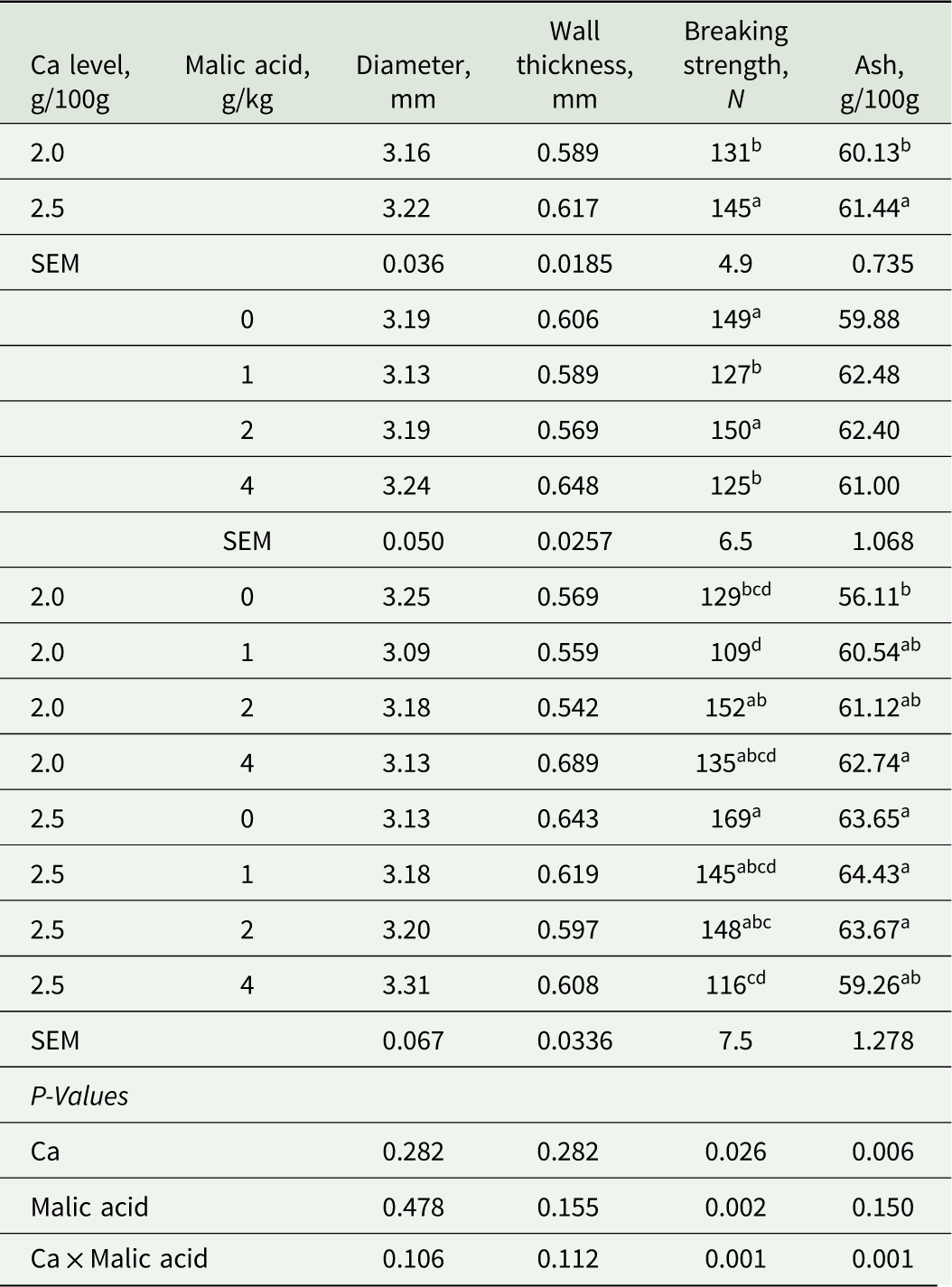
The diameter, wall thickness, tibia breaking strength and ash level are presented in Table 4. Dietary Ca levels statistically affected tibia breaking strength (P < 0.05) and tibia ash level (P < 0.01). The tibia breaking strength and ash decreased significantly with reducing dietary Ca level from 2.5 to 2.0 g/100g diet. Tibia breaking strength was affected by the addition of malic acid to the diet (P < 0.01). The tibia breaking strength of the 0 and 2 g/kg malic acid supplemented groups was considerably higher than that of the 1 and 4 g/kg malic acid added groups. The interaction groups had a significant effect on tibia breaking strength and tibia ash level P < 0.01). The tibia breaking strength in the 2.5 × 0 group was significantly higher than the 2.0 × 0, 2.0 × 1 and 2.5 × 4 groups Additionally, the tibia breaking strength in the 2.0 × 1 group was lower (up to 35.5%) than the 2.0 × 2, 2.5 × 0 and 2.5 × 2 groups. The ash level of the 2.0 × 0 group was significantly lower (up to 12.9%) than that of the 2.0 × 4, 2.5 × 0, 2.5 × 1 and 2.5 × 2 groups. The diameter and wall thickness of the tibia were not affected by the treatment groups (P > 0.05).
Effect of malic acid supplementation to diets containing different levels of Ca on the tibia parameters in laying quails

Table 4. Long description
The table presents data on the effects of malic acid supplementation and calcium levels on tibia parameters in laying quails. It has 18 rows and 6 columns. The columns are labeled as follows: Ca level, g/100g; Malic acid, g/kg; Diameter, mm; Wall thickness, mm; Breaking strength, N; Ash, g/100g. The rows present different combinations of calcium levels and malic acid supplementation, along with the measured tibia parameters. Notable trends include the significant effect of dietary calcium levels on tibia breaking strength and ash level, with higher calcium levels generally resulting in higher breaking strength and ash content. The addition of malic acid also affects tibia breaking strength, with certain levels of malic acid resulting in higher breaking strength compared to others. The interaction between calcium levels and malic acid supplementation shows significant effects on both tibia breaking strength and ash level. The diameter and wall thickness of the tibia are not significantly affected by the treatment groups.
Ca: Calcium, SEM: Standard error mean. n = 8.
a,b,c,dMeans with different superscripts in the same within treatment were significantly different at P < 0.05.
Discussion
Performance
In the present study, FI increased with reducing Ca level in the diet. Similar results were obtained in previous studies. Costa et al. (Reference Costa, Barreto, Umigi, Lima, Araujo and Medina2010) and Ibarra et al. (Reference Ibarra, Vílchez-Perales and Zea Mendoza2023) reported that increasing dietary Ca level (2.0–3.5 g/100g) decreased FI in laying quails. Similarly, Amoah et al. (Reference Amoah, Martin, Barroga, Garillo and Domingo2012) stated that increasing dietary Ca (2.5–3.0 g/100g) had a negative effect on FI in laying quails. Also, Stanquevis et al. (Reference Stanquevis, Furlan, Marcato, de Oliveira-Bruxel, Perine, Finco, Grecco, Benites and Zancanela2021) documented that FI in laying quails was affected by the increasing Ca level in the diet (1.70–3.80 g/100g) and the lowest FI was found at 2.79 g/100g Ca level. Since FI determines Ca intake, birds are often able to modify their FI to satisfy their Ca requirements. Additionally, increase in dietary Ca level results in the formation of insoluble Ca-phosphate in the digestive system (Walk et al., Reference Walk, Bedford and McElroy2012). This negatively affects metabolic functions in the digestive system, ultimately causing birds to reduce FI (Kheiri and Rahmani, Reference Kheiri and Rahmani2006). It is thought that the 2.0 g/100g dietary Ca level in the current study was insufficient to meet Ca requirements. Additionally, the digestive system’s ability to generate Ca-phosphate was also diminished, which may have increased the birds’ appetite. Therefore, the extra energy intake due to low-Ca (2.0 g/100g diet) diet did not affect EP and resulted in a significant increase in BWC of quails in this group. Studies were shown conflicting effects on dietary Ca levels on BW or BWC. Stanquevis et al. (Reference Stanquevis, Furlan, Marcato, de Oliveira-Bruxel, Perine, Finco, Grecco, Benites and Zancanela2021) stated that BW in laying quails decreased linearly with increasing dietary Ca levels (1.70–3.80 g/100g). On the contrary, Barreto et al. (Reference Barreto, Pereira, Umigi, Rocha, Araujo, Silva and Torres Filho2007) noted that increasing dietary Ca levels (1.6–3.6 g/100g) quadratically increased BWC in quails. Organic acids improve performance by lowering the pH of the feed and/or digestive tract and reducing the harmful microorganisms in the microbiota (Ghazalah et al., Reference Ghazalah, Atta, Elkloub, Moustafa and Riry2011). In the study, EW tended to improve with low (1 g/kg) malic acid supplementation to the diet, whereas it tended to deteriorate with high (4 g/kg) malic acid level. In a limited number of studies on laying hens, it was demonstrated that malic acid addition to the diet at levels of 0.5 g/kg (Mohamed and Bahnas, Reference Mohamed and Bahnas2009) and 0.2 g/kg (Sarı and Kaya, Reference Sarı and Kaya2017) did not affect EW. In a recent study, it was clarified that the addition of 8 g/kg malic acid to the diet increased EW in laying hens (Birilie et al., Reference Birilie, Mekuriaw and Animut2025). According to Aliverdi-Nasab et al. (Reference Aliverdi-Nasab, Zhandi, Yousefi, Zahedi and Rafieian-Naeini2023), the addition of a commercial acidifier (0, 1, 2 and 3 g/kg) to quail diets had a quadratic effect on EW. In another study, it was found that organic acids had an improving effect on EW in poultry (Fouladi et al., Reference Fouladi, Ebrahimnezhad, Shahryar, Maheri and Ahmadzadeh2018; Gül et al., Reference Gül, Tunç, Cengiz and Yildiz2014; Kaya et al., Reference Kaya, Kaya, Gül, Çelebi, Timurkaan and Apaydin2014; Nawrot et al., Reference Nawrot, Gumowski, Popiela, Sierżant, Asghar, Sajid, Korczyński and Konkol2025). Organic acids help maintain the optimum pH in the proventriculus, thus ensuring the correct activation and function of proteolytic enzymes to enhance protein digestion in the stomach (Lückstädt and Mellor, Reference Lückstädt and Mellor2011). Therefore, the addition of malic acid at a level of 1 g/kg may have increased the amount of dietary protein digested, which could have led to an increase in EW. Except for EW, which was statistically similar to the control, other performance parameters were not affected by malic acid supplementation. This may be because the nutrient requirements of quails were adequately met. Additionally, the effects of additives can be observed over a long period of time, and therefore, the time required for malic acid to improve the production performance of quails in this study may not have been sufficient. Interactions between Ca level and malic acid supplementation were significant for EW, EM and FI. The highest EW was observed in quails fed with 2.5 × 1 interaction diet, and the highest EM and FI were in quails fed with 2.0 × 2 added diet. The EW, EM and FI improved with the administration of 2 g/kg malic acid to a low-Ca (2.0 g/100g diet) diet, and this improvement was more pronounced in EM. However, the effect of malic acid on improving these parameters was observed at 1 g/kg level in the control diet (2.5 g/100g Ca diet). Additionally, a decrease in EW and FI was determined in the 2.5 × 4 group. High dietary Ca – depending on mineral load level and physical form – can reduce FI by altering sensory characteristics, resulting in decreased palatability. Indeed, the decrease in FI observed in the present study supports this hypothesis. Increased levels of malic acid, however, did not alter the negative effects of decreased FI on performance parameters. The fluctuating results obtained from the interactions highlight the need for further investigation of this issue in future studies.
Egg quality
Eggshell quality is an important criterion for egg marketability. It is also an indicator of the birds’ adequate Ca intake (Batres, Reference Batres2022). Eggshell ratio was negatively affected by decreasing (from 2.5 to 2.0 g/100g diet) dietary Ca level. These results are similar to those reports in previous years that the eggshell ratio increased with increasing dietary Ca level in laying quails. Barreto et al. (Reference Barreto, Pereira, Umigi, Rocha, Araujo, Silva and Torres Filho2007) stated that eggshell ratio increased with dietary Ca levels (from 1.6 to 3.6 g/100g). Similar outputs were indicated by Costa et al. (Reference Costa, Barreto, Umigi, Lima, Araujo and Medina2010); Oliveira et al. (Reference Oliveira, Machado, Goncalves, Macedo and Assis2009); Ribeiro et al. (Reference Ribeiro, Barreto, Reis, Muniz, Viana, Ribeiro, Mendonça, Ferreira and DeGroot2016); Stanquevis et al. (Reference Stanquevis, Furlan, Marcato, de Oliveira-Bruxel, Perine, Finco, Grecco, Benites and Zancanela2021); and Ibarra et al. (Reference Ibarra, Vílchez-Perales and Zea Mendoza2023) at dietary Ca levels between 1.7 and 3.8 g/100g. Calcium is the main component of eggshell, and as the Ca level in diet increases, the amount accumulated in the eggshell improves (Stanquevis et al., Reference Stanquevis, Furlan, Marcato, de Oliveira-Bruxel, Perine, Finco, Grecco, Benites and Zancanela2021). Therefore, in the current study, it is thought that with decreasing dietary Ca levels, the amount accumulated in the eggshell also reduced, and therefore the eggshell ratio decreased. Addition of malic acid to the diet had no effect on either the external or internal quality of quail eggs. These results are in agreement with the outputs found by Sarı and Kaya (Reference Sarı and Kaya2017) that the addition of 200 mg/kg malic acid to the diet had no effect on the internal and external quality of egg in laying hens. However, Birilie et al. (Reference Birilie, Mekuriaw and Animut2025) expressed that the addition of malic acid (8 g/kg) did not affect the albumen index, yolk index and Haugh unit but it was effective in improving eggshell quality. Eggshell ratio was affected by the interaction of Ca level and malic acid supplementation, and it was higher in the 2.5 × 2 group compared to the 2.0 × 0, 2.0 × 1, 2.5 × 0 and 2.5 × 4 groups. Haugh unit and albumen index were also affected by the interactions of Ca level and malic acid supplementation. These parameters reached the highest value in the 2.0 × 0 group and the lowest value in the 2.5 × 0 group, and only the difference between the two groups was significant.
Tibia characteristics
Dietary Ca level is positively correlated with bone ash percentage (Amoah et al., Reference Amoah, Martin, Barroga, Garillo and Domingo2012), and bone ash is positively correlated with bone breaking strength (Alfonso-Carrillo et al., Reference Alfonso-Carrillo, Benavides-Reyes, de los Mozos, Dominguez-Gasca, Sanchez-Rodríguez, Garcia-Ruiz and Rodriguez-Navarro2021). These bone properties are a good indicator of bone health and stability, and increasing breaking strength in poultry is important to reduce economic losses and improve animal welfare (Olgun and Aygun, Reference Olgun and Aygun2016). Additionally, it is also important as it indicates that the birds are provided with sufficient and available Ca in the diet (Olgun and Aygun, Reference Olgun and Aygun2016). In present study, the breaking strength and ash of tibia was negatively affected by reducing dietary Ca levels from 2.5 to 2.0 g/100g diet. Barreto et al. (Reference Barreto, Pereira, Umigi, Rocha, Araujo, Silva and Torres Filho2007) reported that increasing dietary Ca levels from 1.6 to 2.8 g/100g increased bone ash, but tibia ash decreased at higher Ca levels (3.2 and 3.6 g/100g). Similarly, Amoah et al. (Reference Amoah, Martin, Barroga, Garillo and Domingo2012) reported that increasing dietary Ca levels (from 2.5 to 3.5 g/100g) improved tibia ash percentage in quails. Stanquevis et al. (Reference Stanquevis, Furlan, Marcato, de Oliveira-Bruxel, Perine, Finco, Grecco, Benites and Zancanela2021) clarified that increasing dietary Ca levels (1.70–3.80 g/100g) in laying quails did not change tibia ash percentage but linearly increased Ca level and breaking strength of tibia. Ribeiro et al. (Reference Ribeiro, Barreto, Reis, Muniz, Viana, Ribeiro, Mendonça, Ferreira and DeGroot2016) found that different Ca levels (2.9 and 3.8 g/100g) in the diet did not affect bone ash, but Ca levels were quite high compared to the current study. High Ca intake concentrates blood Ca levels and increases calcitonin release from C cells of the ultimobranchial glands (Nunes et al., Reference Nunes, Pozza, Scherer, Campestrini, Rocha, Nunes and Costa2006). Consequently, bone demineralisation decreases and Ca in the blood accumulates in the bone, increasing ash and strength of bone (Nunes et al., Reference Nunes, Pozza, Scherer, Campestrini, Rocha, Nunes and Costa2006). This may be the main reason why ash percentage and breaking strength decreased in quails fed a diet containing low Ca (2.0 g/100g diet) in the present study. Inorganic substances such as Ca and phosphorus provide strength to the bone, while organic substances provide flexibility (Mutus et al., Reference Mutus, Kocabagli, Alp, Acar, Eren and Gezen2006). Organic acids increase Ca absorption by reducing the pH in the upper intestine and by stimulating the intestinal surface area, thus improving bone properties (Świątkiewicz and Arczewska-Wlosek, Reference Świątkiewicz and Arczewska-Wlosek2012). Angelim et al. (Reference Angelim, Leite, de Farias, Lourenço, Evangelista, Cordeiro, de Abreu, Freitas and Silveira2023) noted that bone characteristics in laying hens were not affected by the addition of organic acids. Similarly, Świątkiewicz and Arczewska-Wlosek (Reference Świątkiewicz and Arczewska-Wlosek2012) reported that the addition of organic acids to the diet did not affect the tibia breaking strength in broilers. As a different result, Rama Rao et al. (Reference Rama Rao, Mantena, Paul, Devanaboyina, Thota, Bhukya and Prakki2023) stated that tibia characteristics (total ash and breaking strength) in broilers were improved with organic acid (coated sodium butyrate) supplementation. However, in this study, tibia breaking strength was negatively affected by malic acid supplementation at 1 g/kg and 4 g/kg levels, but it was not affected at the 2 g/kg level. Additionally, although a numerical increase in tibia ash was achieved with the addition of malic acid, this was not reflected in the tibia breaking strength and was even negative. According to the results of this study, the effect of malic acid on the mechanical properties of the tibia is inconsistent. Therefore, investigation of the possible effect of malic acid on the macro- and micromineral concentrations and organic matrix of the tibia may provide more detailed information. The interaction between Ca levels and malic acid supplementation appeared to have a significant effect on breaking strength and ash of tibia. The breaking strength of the 2.5 × 0 group was significantly higher than the 2.0 × 1 and 2.5 × 4 groups. The ash of 2.0 × 0 group was significantly lower than the 2.0 × 4, 2.5 × 0, 2.5 × 1 and 2.5 × 2 groups. In the study, an increase in breaking strength was observed with the addition of malic acid at levels of 2 and 4 g/kg to diets containing 2.0 g/100g Ca diet, whereas a decrease in breaking strength was determined with the addition of malic acid to diets containing 2.5 g/100g diet Ca (especially at the 4 g/kg level). The increase in tibia ash percentage with the addition of malic acid to the low-Ca (2.0 g/100g diet) diet was more linear, and this increase was statistically significant at the 4 g/kg malic acid level (2.0 × 4 group). In the diet containing 2.5 g/100g diet Ca, the ash percentage of the tibia tends to decrease with the addition of 4 g/kg malic acid (2.5 × 4 group). These results suggested that the addition of malic acid to diets containing low-Ca may positively affect breaking strength and ash percentage of tibia. However, the addition of malic acid, especially at high levels, to diets containing sufficient Ca may negatively affect bone properties. In poultry, mineral and protein absorption (Abbas et al., Reference Abbas, Arshad, Saeed, Imran, Kamboh, Al-Taey, Aslam, Imran, Ashraf, Asif, Tanveer, Qureshi, Arshad, Niazi, Tariq and Abbas2022) and phytin phosphate utilisation (Kaya et al., Reference Kaya, Kaya, Gül, Çelebi, Timurkaan and Apaydin2014) are improved by the addition of organic acids to the diet. In our study, reducing the dietary Ca level from 2.50 g/100g diet to 2.0 g/100g diet may have disrupted the accumulation of Ca and other minerals in the bone. However, in low-Ca diets, malic acid may have improved the utilisation of Ca and other minerals (low pH, microbial improvement, etc.), supporting the formation of organic matrix in the bone and the accumulation of minerals, especially Ca. In a study examining the effect of organic acid addition to diets containing different Ca on bone properties, it was reported that organic acid addition to broiler diets containing low Ca did not affect tibia bone properties (Świątkiewicz and Arczewska-Wlosek, Reference Świątkiewicz and Arczewska-Wlosek2012). These differences in results may be due to variations in the animal material used in the studies and dietary components such as Ca.
Conclusion
Dietary Ca level can improve production performance, egg quality and the maintenance of bone health. This is more pronounced in cases of Ca deficiency in the diet, and the use of organic acids such as malic acid in the diet has the potential to improve to animal welfare and production economics. In the present study, administration of malic acid to Ca-deficient laying quail diets generally had a positive effect on performance and eggshell quality, while supplementation of 4 g/kg (high level) malic acid to diets containing diets with adequate Ca level had a negative effect on the productive performance of quail. Further research is needed on the effects of malic acid on bone properties.
Acknowledgements
During the preparation of this study, the authors used the ChatGPT (OpenAI) tool for spelling and grammar checking. The authors are solely responsible for the content of this publication.
Author contributions
Azra Solak and Osman Olgun contributed to the conceptualisation, methodology, investigation, writing – original draft and writing – review and editing. Osman Olgun contributed to supervision, review and editing. All authors have read and approved the final version of the manuscript.
Funding statement
This research did not receive any specific grant from funding agencies in the public, commercial or not-for-profit sectors.
Competing interests
All authors declare that they have no conflicts of interest.
Ethical standards
This study was carried out in accordance with the criteria of Selçuk University’s Research Ethics Committee for the care and use of laboratory animals and was approved by the Dean of Selçuk University’s Faculty of Agriculture.