The incidence of heart failure (HF) has continued to rise over the past few decades, leading to an ever-increasing economic burden on Western societies. In the United States (US), with a population of 308,745,538 people, the incidence of HF in 2009 increased to 670,000 new cases per year, leading to US$37.2 billion in healthcare costs (Reference Horwich and Fonarow10). On average, each developed country spends 1–2 percent of the total healthcare budget on HF-related care (Reference Berry, Murdoch and McMurray4).
Although Argentina is smaller than the United States, with a population of 40,117,096 people, a prevalent disease, such as HF, represents a heavy burden to small healthcare budgets (Reference Yao, Freemantle, Calvert, Bryan, Daubert and Cleland24). Unfortunately, data on the prevalence and incidence of HF are lacking in Argentina, thus preventing an accurate calculation of the impact of disease on the economy.
This lack of data increases the difficulty of determining the cost-effectiveness of effective treatment options, such as cardiac resynchronization therapy (CRT). CRT has been proven effective in reducing mortality in patients with advanced HF (New York Heart Association [NYHA] FC III-IV).(Reference Al-Majed, McAlister, Bakal and Ezekowitz2) Recently, randomized controlled trials (RCT) have evaluated the effects of CRT in patients with mild symptoms of HF, namely NYHA functional class (FC) I and II (Reference Abraham, Young and Leon1;Reference Linde, Abraham and Gold12;Reference Moss, Hall and Cannom18;Reference Tang, Wells and Talajic20).
One such study demonstrated that treatment of HF with a combination of optimal medical treatment (OMT), an implantable cardioverter-defibrillator (ICD), and CRT resulted in a greater reduction in hospitalization and mortality in patients with mild HF in comparison to the use of both OMT and ICD (Reference Tang, Wells and Talajic20). Likewise, studies have demonstrated a favorable effect of CRT on left ventricular remodeling in patients with mild HF, results comparable to those obtained in patients with advanced HF (Reference Al-Majed, McAlister, Bakal and Ezekowitz2). In addition to CRT's proven efficacy, several health economic evaluations have been performed in United States (US), United Kingdom (UK), and Italy to assess the cost-effectiveness of CRT in patients with advanced HF as well as mild heart failure (Reference Calvert, Freemantle and Yao6;Reference Fox, Mealing and Anderson9;Reference Linde, Mealing and Hawkins13;Reference Nichol, Kaul, Huszti and Bridges19;Reference Yao, Freemantle, Calvert, Bryan, Daubert and Cleland24). Consistently, all studies have found that CRT is cost-effective. Although a CRT randomized clinical trial has never before been performed in patients with mild HF in Latin America, thereby allowing for a population specific cost-effective analysis, the epidemiology of heart failure in low and middle income countries (LMIC) is becoming increasingly similar to that of Western Europe and North America (Reference Mendez and Cowie17). Even more, the characteristics of Argentina's HF population and the medical treatment received do not differ much from the selected studies population (Reference Zambrano, Cerezo and Ferrante25). With this knowledge, we performed an economic evaluation (EE) for Argentina, using publications of the efficacy of CRT in developed countries to assess the cost-effectiveness of combining CRT with OMT in comparison to OMT alone.
OBJECTIVES
Our primary objective is to assess the cost-effectiveness of combined OMT and CRT in Argentina in patients with mild HF (NYHA FC I-II) and a left ventricular ejection fraction (LVEF) of 40 percent or less as compared to OMT alone. A secondary objective is to compare the incremental cost-effectiveness ratio (ICER) per QALY gained with CRT in patients with mild HF (NYHA FC I-II) in Argentina versus results obtained in developed countries for patients with both mild and severe symptoms.
METHODS
Search Strategy
We searched the Central Cochrane database, Medline, and EMBASE for information through December 2010. The search strategy was: (“Heart Failure”[Mesh]) AND (“Defibrillators”[Mesh] OR “Cardiac Resynchronization Therapy”[Mesh] OR “Cardiac Resynchronization Therapy Devices”[Mesh]) filtered by “Clinical trial”. We included all RCTs that evaluated CRT implantation in patients with mild HF (NYHA FC I-II), either with or without ICD. We excluded all studies of patients with a HF classification of NYHA FC III or IV as well as patients with less than 12 months of follow-up. We found five RCTs, omitting two due to the exclusion criteria.
Target Population
The final studies included were the Randomized Trial of Cardiac Resynchronization in Mildly Symptomatic Heart Failure Patients and in Asymptomatic Patients With Left Ventricular Dysfunction and Previous Heart Failure Symptoms (REVERSE) (Reference Linde, Abraham and Gold12), Cardiac-Resynchronization Therapy for the Prevention of Heart-Failure Events (MADIT-CRT) (Reference Moss, Hall and Cannom18) and Cardiac-Resynchronization Therapy for Mild-to-Moderate Heart Failure (RAFT) (Reference Tang, Wells and Talajic20). Patients in these studies were enrolled between 2003 and 2009, representing the heart failure population of the United States, Canada, Europe, Turkey, and Australia
The general clinical characteristics were: mild HF symptoms (mostly in NYHA FC I and II), severe left ventricular dysfunction (LVEF ≤ 40 percent), normal sinus rhythm, and wide QRS (≥120 msec). Specifically for the RAFT study, we only included patients with NYHA FC II HF. All three studies enrolled only those patients receiving OMT, receiving maximum tolerated doses of angiotensin converting enzyme inhibitors or angiotensin receptor blockers, spironolactone, and beta-blockers.
Although this population represents patients with heart failure from developed countries, the characteristics of this HF population (i.e., mean age, gender distribution, incidence of hypertension, diabetes, and the prevalence of ischemic heart disease) as well as the medical treatment received do not differ much from that of Argentina's HF population (Reference Zambrano, Cerezo and Ferrante25).
Description of the Model
We based our model design on previous cost-effectiveness research (Reference McAlister, Ezekowitz and Wiebe15). Our model compares the lifetime benefits and costs of CRT in combination with OMT in comparison to OMT alone, starting at a fixed age of 65 years old, the average age of Argentina's HF population (Reference Zambrano, Cerezo and Ferrante25).
The model has two components (Supplementary Figures 1, 2, 3, which can be viewed online at www.journals.cambridge.org/thc2012059). First, the short-term component consists of a decision tree representing the changes in health status during the process of device implantation, considering the costs and complications reported within the first 30 days, that is, perioperative complications (Reference Abraham, Young and Leon1; Reference Linde, Abraham and Gold12). Patients assigned to CRT may die during the initial implantation or experience a perioperative complication, so it was important to take into account these costs. Second, the long-term component consists of a Markov model, which considers the long-term benefits offered by CRT, namely reduction in hospitalization and mortality. The model also considers complications from battery replacement and device infection (Reference Lopez Rodriguez, Rodriguez Framil, Hermida Ameijeiras and Lado Lado14). CRT did not demonstrate a clear improvement in NYHA FC in patients with mild HF symptoms, therefore, we did not use heath states based on functional class (Reference Al-Majed, McAlister, Bakal and Ezekowitz2). In the model, the complication rate during the follow-up is constant over time after implantation.
The model is based on a cohort simulation with a cycle length of 1 year and a lifetime horizon. During each cycle, patients assigned to the OMT arm could die, require HF-related hospitalization, or suffer no complications. Likewise, patients who underwent successful insertion could die, experience device infection, battery failure, require HF-related hospitalization, or suffer no complications. The model was built using the software Treeage Pro 2009 (Williamstown, MA). For the meta-analysis, we used Stata 11.1, Statacorp (College Station, TX).
Cost
The economic analysis was conducted from the third party payer perspective and includes only medical and nonmedical direct costs. Indirect costs were not included because they are not mandatory for the selected perspective (Reference Meltzer16). Direct costs come from the private and social security sector and represent the prices they pay their providers. All costs were obtained from their unpublished lists and expert opinion. We used both inpatient and ambulatory costs expressed in international dollars from 2009. Unit costs for ambulatory HF care are otherwise identical for OMT and CRT.
Quality of Life
Health-related quality of life is included in the model through the use of utilities. We used the utility estimated by the EE performed on the REVERSE trial for patients with NHYA FC I and II HF. The REVERSE trial based its estimates on a previous model of CRT using the EQ-5D and Minnesota Living with Heart Failure Questionnaire (MLWHF) (Reference Calvert, Freemantle and Yao6). We calculated quality-adjusted life- year (QALY) for each patient from his or her survival and quality of life. Uncomplicated CRT and OMT arms yield identical health-related improvement in quality of life. We incorporated the morbidity due to hospitalization into the model by assigning a different utility based on McCalister study (Reference McAlister, Ezekowitz and Wiebe15). The utility for hospitalization is identical for both therapies.
Reporting of Results
Results were reported as cost per year of life and QALY gained and expressed in international dollars (ID$) for the year 2009, the year in which costs were obtained. This allowed us to compare the cost of CRT per QALY gained between developed versus LMIC as well as NYHA FC I-II versus III-IV and, thus, improve the external validity of the analysis. For the costs comparison, we considered only those evaluations that provided enough data to update the costs to 2009.
To accomplish this, we standardized all costs, updated by the consumer price index (CPI), for the year 2009 and then expressed the values in a common currency (11). We calculated ID$ for 2009 using the corresponding conversion factor (23). This hypothetical currency is adjusted by the purchasing power parity (PPP) of each country and is mainly used for comparison between countries (21). To determine the threshold for cost-effectiveness, we used the World Health Organization's Report of the Commission on Macroeconomics and Health definition (22). The willingness to pay threshold for Argentina in 2009 was 43.680 ID$ (23). We applied a discount rate of 3 percent and performed one-way sensitivity analyses.
INPUT DATA
Survival and Hospitalization
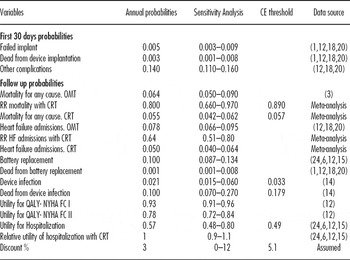
To our knowledge, Argentina does not have any available HF mortality data divided by NYHA classification, therefore, we used the annual mortality rate for patients with NYHA FC II from the OMT arm of the Amiodarone or an Implantable Cardioverter–Defibrillator for Congestive Heart Failure (SCD-HeFT trial) for our base case analysis (Reference Bardy, Lee and Mark3). This trial included a large international cohort with prolonged follow-up and patient characteristics (i.e. mean age, gender distribution, incidence of hypertension, and incidence of ischemic heart disease) similar to those of the Argentine HF population (Reference Zambrano, Cerezo and Ferrante25). To determine the annual rate of hospitalizations to use for our base case analysis for the OMT arm, we took the average from those studies used in the meta-analysis performed with a random effect model. To project the added benefits of CRT for the base case analysis, we also assumed the pooled relative risks obtained from the meta-analysis (Table 1) (Supplementary Figures 4, 5, which can be viewed online at www.journals.cambridge.org/thc2012060).
Model parameters, base-case estimates and data sources

Utilities
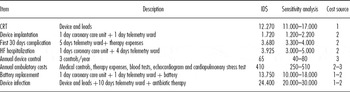
Because the majority of patients of the studies included in the meta-analysis had HF classified as NYHA FC II, we used the utility value assigned to this specific population for the base case analysis, applying it to all uncomplicated health states in both arms. The sensitivity analysis explored cost and benefits using utilities related to NYHA FC I. Table 2 lists and details all the costs included in the model with a range of values considered for the sensitivity analysis.
Medical and procedure related costs

1: Manufacturers’ list prices, unpublished data. 2: Unpublished private and social security´list prices. 3: Expert opinion.
Battery Life
On the basis of product specifications, expert opinion, and previous cost-effectiveness research, we assumed that surviving patients in the CRT group required battery replacement every 6 years (Reference McAlister, Ezekowitz and Wiebe15).
RESULTS
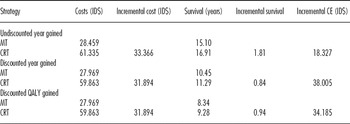
For the base case analysis, the model predicted an undiscounted average survival of 15.1 years in the OMT group versus 16.9 years for the CRT group (Table 3). In the CRT group, 30 percent of the patients were predicted to die at 6.2 years and 70 percent within12.1 years. The undiscounted average cost was 28.459 ID$/year in the OMT arm and 61.335 ID$/year in the CRT arm. After applying a 3 percent annual discount rate, the predicted average survival was 11.3 years and 10.5 years for CRT and OMT, respectively. The average cost was 27.969 ID$/year for the OMT arm and 59.863 ID$/year for the CRT arm. Incremental cost with CRT was 31.894 ID$ and the ICER was 38.005 ID$ per year of life gained. When strategies were adjusted for quality of life, the incremental survival was 0.94 QALY and the ICER was 34.185 ID$ per QALY gained. Considering the national willingness to pay threshold for the year 2009, CRT under this scenario was considered to be cost-effective for our country (23).
Cost-Effectiveness of CRT compared with OMT

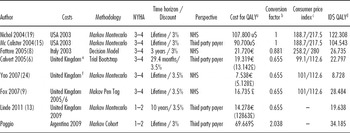
Costs comparison.

a Discounted cost per QALY in original currency.
b Conversion factor to international dollars year 2009.(23)
c Consumer price index at December of the year of publication/ Consumer price index at December 2009. (11)
d QALY in ID$ year 2009 ($QALY published / Consumer price index per year per case) x Consumer price index December 2009)/ Conversion factor year 2009)
e Costs calculated with prices from the United Kingdom. It does not indicate year of costs, it is assumed the year prior to publication
f It does not indicate year of costs, it is assumed the year prior to publication
Sensitivity Analysis
All input values and their respective range for the sensibility analysis are found in Tables 1 and 2. Within the range of probabilities analyzed, CRT was always found to increase survival compared with OMT. Additionally, the results were sensitive to the discount rate applied, relative reduction of mortality with CRT, cost of battery replacement, probability of device infection in the long term, mortality rate due to device infection, and utility value for hospitalization. According to our analysis, CRT would remain cost-effective as long as the discount rate is less than 5.1 percent, the relative risk for total mortality is less than 0.89, and the cost of the battery replacement is less than 18.646 ID$. Similarly, when the utility value for hospitalization is greater than 0.49 or the probability of device infection or its associated mortality is less than 0.033 and 0.179, CRT would be cost-effective. The remaining variables did not significantly impact the result.
For those patients with NYHA FC I HF (assuming an equal mortality rate to patients with NYHA FC II HF), the discounted median survival adjusted to quality of life was 9.9 and 10.5 years for the OMT and CRT arm, respectively. The incremental survival with CRT was 1.1 years and the ICER was 30.145 ID$ per QALY gained.
DISCUSSION
We found that long-term treatment with CRT in Argentina was cost-effective in comparison to OMT alone. CRT in this population offered similar benefits in terms of mortality and HF episode reduction as in patients with NYHA FC III-IV HF (Reference Al-Majed, McAlister, Bakal and Ezekowitz2). Although CRT was found to reduce HF episodes compared with OMT alone, we found minimal benefits in terms of quality of life. One explanation may be that CRT's reduction in hospitalizations due to HF exacerbation may be overshadowed by hospitalizations related to battery replacement and device infection following the perioperative period. The mortality rate from studies with short-term follow-up usually does not include these events.
We found that the average survival, which was originally 16.9 dropped to 11.29 years after the discount was applied. This was not surprising to us. As in any cost-effective analysis, an applied discount has an increasingly large effect the further in the future the benefits are realized. For example, in the CRT arm of the study 45 percent of the patients survive more than 10 years and 20 percent more than 15 years. Therefore, benefits from the CRT treatment that occur more than 10 years in the future, when a discount is applied, will likely result in a comparatively decreased discounted survival as we saw in our results. The results were sensitive to the discount and mortality rate.
Although for Argentina a 5 percent discount rate would have been more appropriate due to inflation to compare results, we used the same discount rate used in other cost-effectiveness analyses to compare with those studies. As mentioned in the results section, a discount rate higher than 5.1 percent would lead us to conclude that CRT is not cost-effective. Another variable that could change our conclusion is mortality reduction with CRT as a reduction of less than 11 percent (base case of 20 percent) would not be cost-effective.
Our analysis has several limitations. First, we did not include other therapies such as heart transplantation, cardiac arrhythmias, or ICD placement. Second, we did not perform a probabilistic analysis. Likewise, the selected perspective (third party payer) may limit the external validity of these results while a social perspective would provide a more realistic estimation of the true cost. Third, we assumed that the relative benefit of CRT would remain constant as the severity of heart failure increases. This may be true based on trials that included both mild and advanced heart failure populations, but remains hypothetical as it is unclear if CRT implantation affects the progression of HF in the long-term. The complication rate was likely an underestimation as we only considered battery replacement and device infection. Although many other complications may appear during the long-term follow-up period, many would be unrelated to CRT implantation and, therefore, would be balanced in both arms.
When comparing our results with other cost-effectiveness analyses, we found that the mean cost per each QALY is slightly higher to those found in Europe both in patients with mild heart failure and more severe heart failure. In studies performed with CRT in NYHA FC III-IV HF, it is observed that the mean cost per QALY gained in the United States is significantly larger than those gained in Europe. Calvert et al. (Reference Calvert, Freemantle and Yao6) performed a cost-effective analysis on the CARE-HF trial, and the result did not differ compared with the study from Fattore (Reference Fattore8) and Fox (Reference Fox, Mealing and Anderson9). Yao et al. (Reference Linde, Mealing and Hawkins13) performed the long-term projections of the benefits demonstrated in the CARE-HF trial and found an important cost reduction per QALY gained (Reference Yao, Freemantle, Calvert, Bryan, Daubert and Cleland24).
To our knowledge, there is only one other similar cost-effective analysis of CRT in patients with NYHA FC I-II HF. When comparing results, we found that the mean cost per each QALY was slightly higher; however, both proved to be cost-effective (Reference Linde, Mealing and Hawkins13). Our results revealed more of a benefit in the incremental survival when adjusted by quality of life. One explanation for this difference may be that we used different time horizons, namely a lifetime versus 10 years. We also did not analyze combined devices (CRT+ICD), as the use of ICDs for primary prevention of sudden death is unusual in Argentina. Moreover, the demonstrated benefits of CRT+ICD in comparison to OMT are clear in populations with NYHA FC III-IV HF (Reference Bristow, Saxon and Boehmer5) but not demonstrated in patients with NYHA FC I-II HF. In fact, ICD implantation in this population may result in increased heart failure episodes and may end up being futile due to improvement in LV remodeling and prognosis and even potential reduction in arrhythmia episodes as a result of CRT (Reference Cevik, Perez-Verdia and Nugent7). In our opinion, our analysis of the cost-effectiveness of CRT can be used to assist other countries with similar costs and purchasing power parity to Argentina in the process of decision making.
Finally, it is important to remark that our results should be interpreted cautiously as results apply mostly to patients in NYHA class II. Additionally, our findings may not be applicable to other LMIC. Patients without symptom limitation and patients coming from LMIC populations are underrepresented in this analysis.
In conclusion, long-term treatment with CRT in Argentina appears to be cost-effective compared with OMT alone. The results were sensitive to the discount applied and to the mortality reduction with CRT. In patients with mild symptoms, CRT would have a similar ICER per QALY gained than in patients with more advanced disease. It would be important to include a population more representative of LMIC in future studies to support and thereby strengthen our results.
SUPPLEMENTARY MATERIAL
Supplementary Figure 1, 2, 3: www.journals.cambridge.org/thc2012059
Supplementary Figure 4, 5: www.journals.cambridge.org/thc2012060
CONTACT INFORMATION
Dr. Rosana Poggio, MD MSc, Institute for Clinical Effectiveness and Health Policy (IECS); Department of Cardiology, FLENI Foundation, Buenos Aires, Argentina
Dr. Federico Augustovsky, MD MSc; Dr. Joaquín Caporale, BEc Mg; Dr. Vilma Irazola MD MSc, Institute for Clinical Effectiveness and Health Policy (IECS), Buenos Aires, Argentina
Dr. Santiago Miriuka, MD MSc, Department of Cardiology, FLENI Foundation; CONICET, Buenos Aires, Argentina
CONFLICTS OF INTEREST
All authors report they have no potential conflicts of interest.