INTRODUCTION
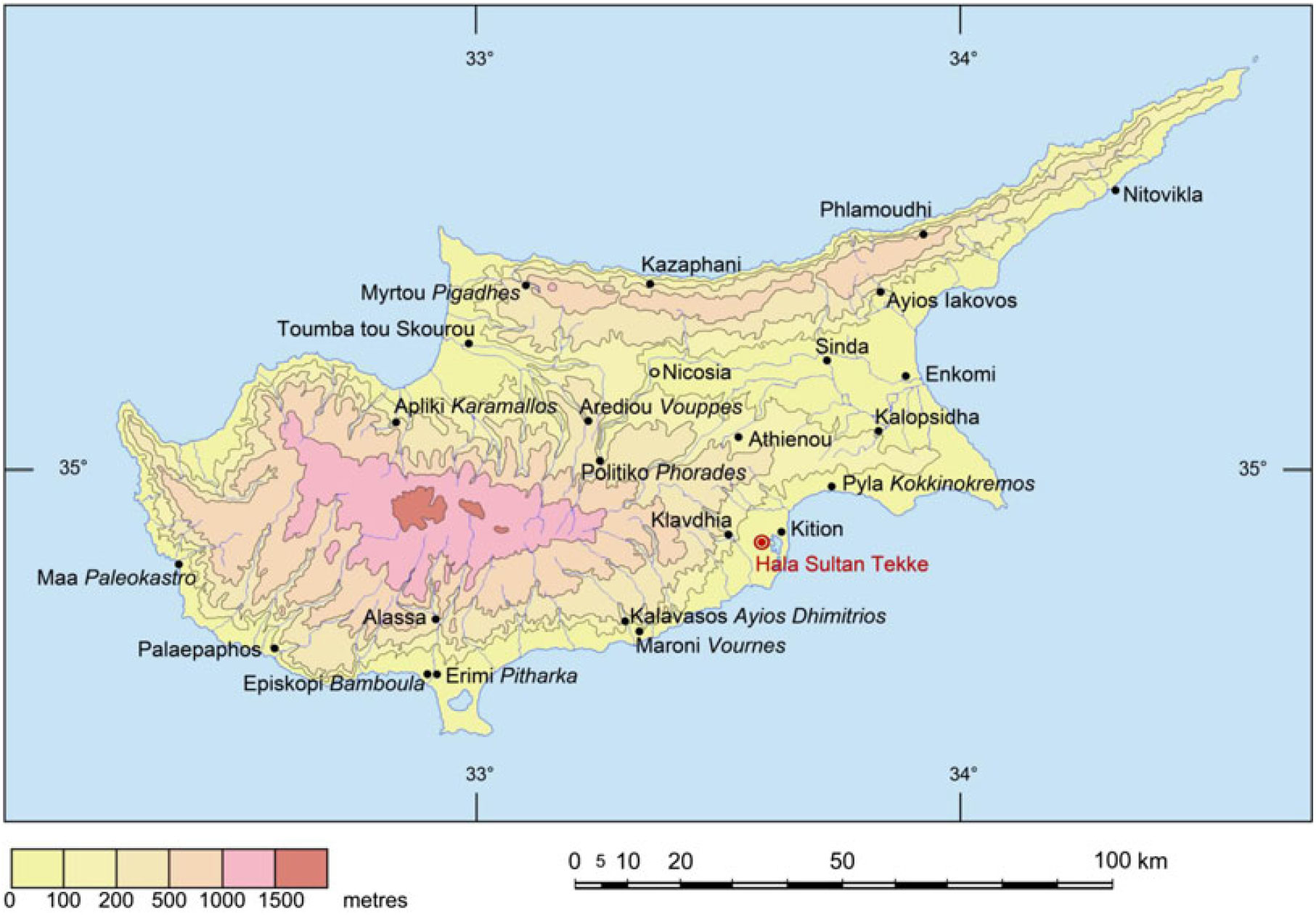
Hala Sultan Tekke is a 25–50 hectare large Bronze Age city which flourished roughly 1650–1150 BC (Fischer and Bürge Reference Fischer and Bürge2018a). Geophysical prospecting of approximately 25 hectares with georadar and magnetometers confirmed manmade structures everywhere in the surveyed area, but the city is certainly larger. This urban center is located on the southeastern littoral of Cyprus (see Figure 1) along the southwestern shore of today’s isolated Larnaca Salt Lake, which earlier was connected to the Mediterranean Sea (Fischer Reference Fischer, Fischer and Bürge2017). Owing to the best protected harbor on the island, the city became one of the most important and wealthiest trading centers at that time.
Location of Hala Sultan Tekke and other contemporaneous Late Bronze Age sites. (Map by T Bürge.)

The existence of a large ancient settlement has been known since at least the 19th century when unprofessional “archaeological” excavations and intensive illicit looting took place (Fischer Reference Fischer, Webb and Frankel2012). From the 1970s on, the exploration of the city became a Swedish project, which since 2010 has been directed by Peter M Fischer from the University of Gothenburg. Most recent excavations have exposed four new city quarters (CQ1–4) with three occupational phases (Stratum 3: oldest – Stratum 1: just below today’s surface). The dating of these phases is of the highest importance not only for defining the occupational sequence of the city itself but also because of intercultural relations with many other spheres of cultures whose relative and absolute chronologies are very much dependent on that of Hala Sultan Tekke. The find material includes imports from most of the Mediterranean area comprising Italy (fibula and pottery), the Aegean, Anatolia, the Levant (pottery, silver and lead), and Egypt (scarabs, ivory, gold and pottery). There are also confirmed connections with southern Scandinavia (Cypriot copper) and Syria/Mesopotamia (seals) (Fischer and Bürge Reference Fischer and Bürge2018a: 603–617). According to the present state of research the archaeological material from the city’s three phases of occupation should be dated to the 13th and 12th centuries BC.
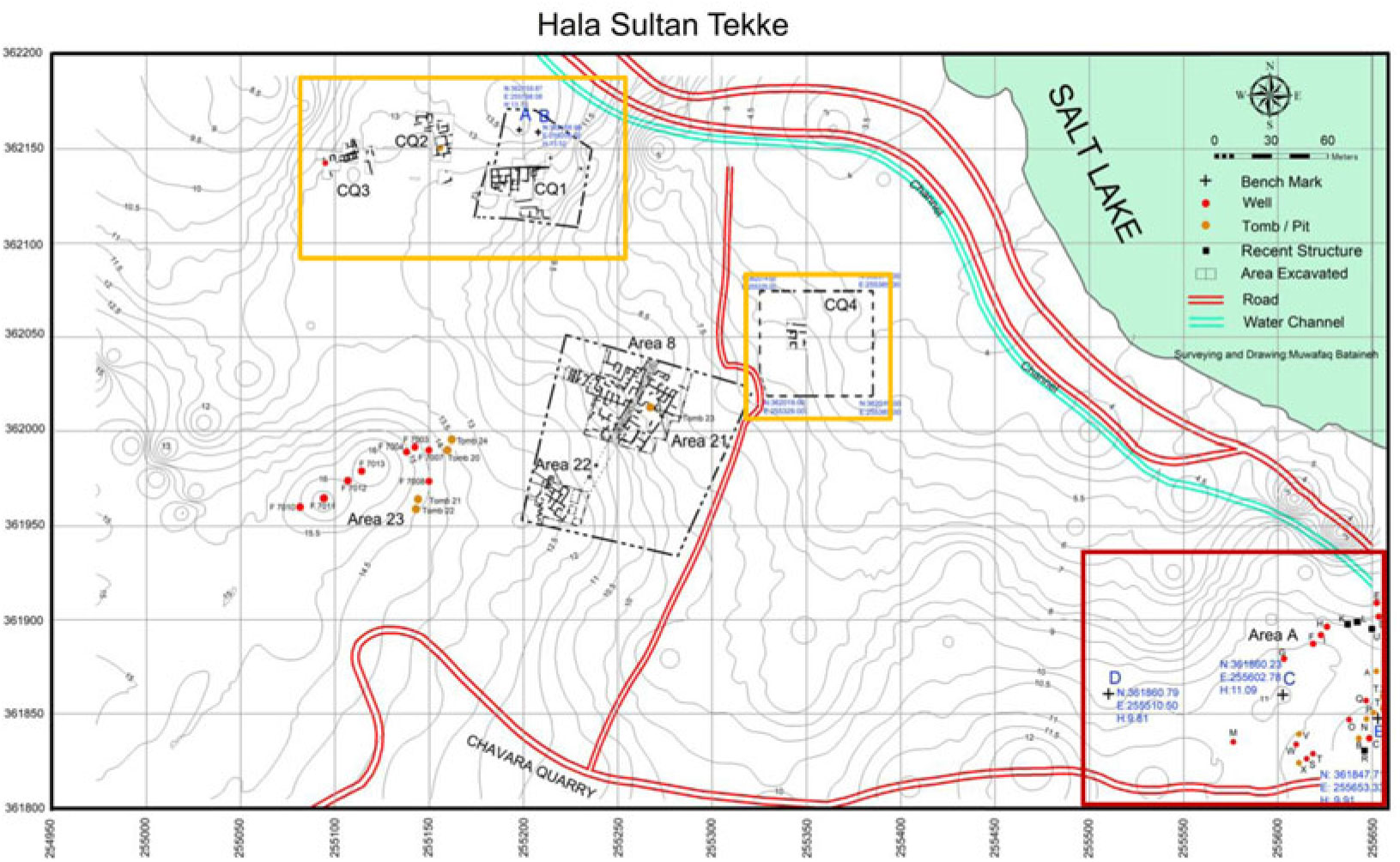
In 2014, roughly 500 m to the east of CQ1 and outside the city, one of the richest cemeteries on the island, Area A (Figure 2 red frame), was discovered by the Swedish mission (e.g. Fischer and Bürge Reference Fischer and Bürge2017c). The majority of the investigated wealthy tombs from this cemetery and associated offering pits are considerably older than the hitherto exposed remains inside the city. According to the archaeological evidence many of the tombs should be dated from the 16th to the 12th centuries BC (Fischer and Bürge Reference Fischer and Bürge2017c; see also Karageorghis Reference Karageorghis, Åström, Bailey and Karageorghis1976). This assessment is based on locally produced and imported pottery but also supported by scarabs which were imported from Egypt and which can be related to historically well-documented individual pharaohs. In addition, incised cylinder seals from the Levant back up the suggested chronology. All these older finds raise the question where the earliest city quarters are situated. Hypothetically, they may be found in the area of the recently discovered CQ4 which is closest to the cemetery in Area A. 14C data from the excavated area in 2018 are pending.
City Quarters 1–4 (yellow frames) and cemetery Area A (red frame). (From Fischer and Bürge Reference Fischer and Bürge2018a. Please see eletronic version for color figures.)

In 2016, the Swedish Research Council approved an advanced grant (no. 2015-01192, Principal Investigator Peter M Fischer) for the project “The Collapse of Bronze Age Societies in the Eastern Mediterranean: Sea Peoples in Cyprus?”. The project will run at least until 2020. In the 1970s, when research dealing with the Sea Peoples intensified (see e.g. Sandars Reference Sandars1978), these peoples were actually considered as a marauding heterogenous group of peoples who caused the collapse of many cultures in the Eastern Mediterranean around 1200 BC and even attacked the mighty superpowers at that time, Hatti (in Anatolia) and Egypt. Today, we rather speak of the “Sea Peoples Phenomenon,” a complex combination of events which became manifest in the second half of the 13th century BC and lasted roughly a century (Fischer and Bürge Reference Fischer and Bürge2017a). In the discussion of this phenomenon revolutions, migrations, climatological changes and other natural events together with pandemic diseases are included, all of which are assumed to have—in varying degrees—contributed to the decline of the high-cultures of the Late Bronze Age, the first “international” period in human history.
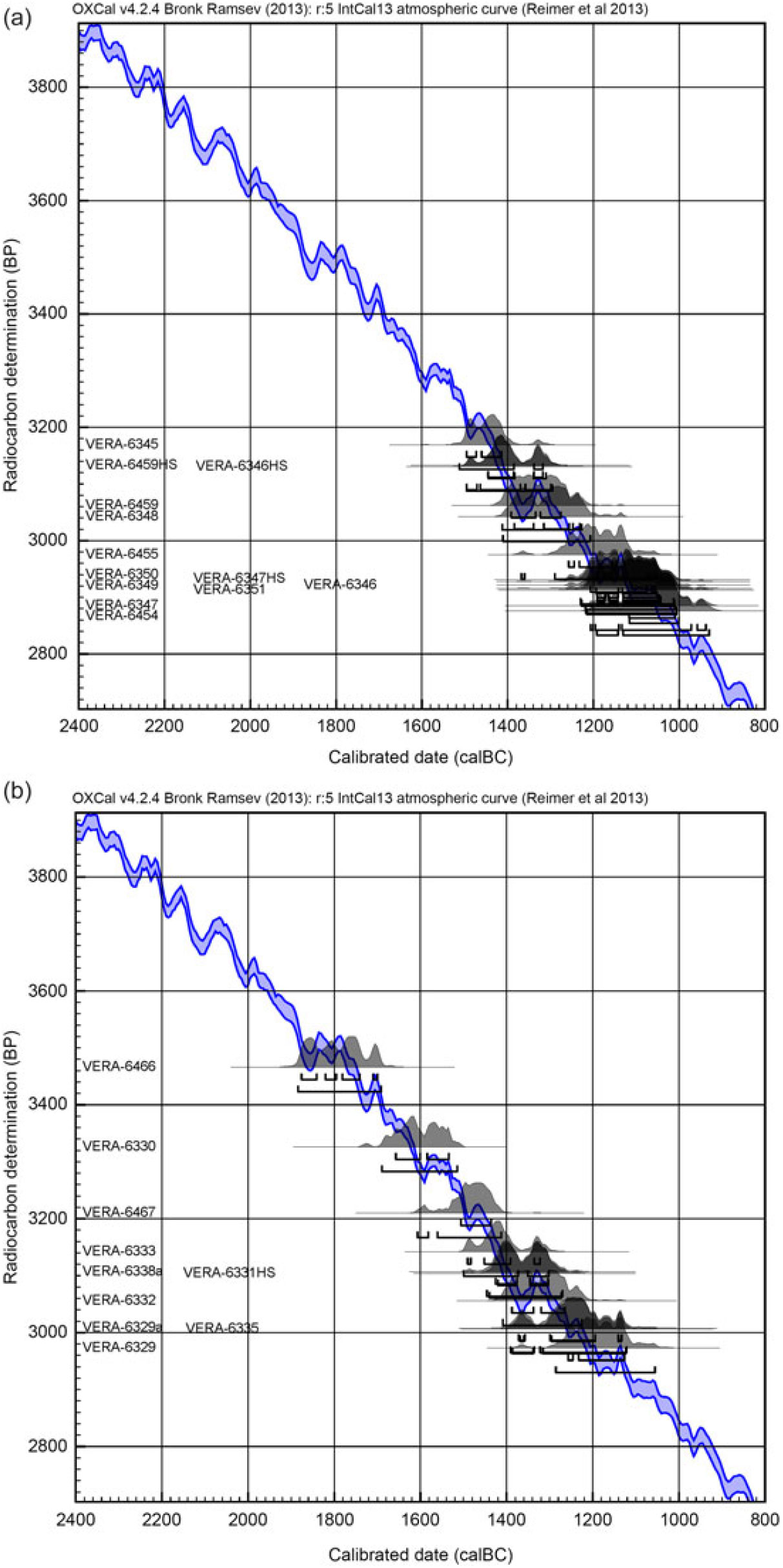
Consequently, the original objectives of the project which include the investigation of the total extent of the city and the location of the oldest city quarters will be supplemented by studies of the reasons for the sudden abandonment of this flourishing city presumably around 1150 BC (Fischer Reference Fischer, Fischer and Bürge2017). This event falls into the much-discussed period of the Sea Peoples Phenomenon and—unfortunately—also into a section of the calibration curve with a flat form and wiggles (see Figures 3a and b). A detailed description of the difficulties to calibrate 14C data from samples originating from ~1200 BC is debated, for instance, in Manning (Reference Manning2007).
a OxCal Curve plot of the new 14C data determined for samples from the city quarters. b OxCal Curve plot of the new 14C data determined for samples from the cemetery. Note that the axes in Figures 3a and b are equally scaled to better demonstrate the age differences between city quarters and cemetery.

MATERIALS AND METHODS
The recent excavations provided several radiocarbon (14C) samples from the city deriving from successive stratigraphic positions. Other 14C samples are from offering pits and tombs belonging to the cemetery in Area A to the east of the city.
Whenever possible, short-lived plant material—in most cases charred olive pits—was selected for 14C dating in order to avoid any material inherent age offsets. Bones would be an alternative when marine/riverine dietary effects are negligible. In the case of Hala Sultan Tekke a marine or riverine portion in the nutrition cannot be totally excluded for humans and omnivorous animals, because remains of freshwater and marine fish as well as shells were found at the site, but it seems that an age offset due to dietary effects is insignificant (see below). Unfortunately, although bones from humans and herbivorous animals are abundantly present at the site, their collagen was highly degraded and the attempt to date bone and tooth samples failed in several cases due to unfavourable environmental conditions, for example, the relatively high temperatures in the burial environment and probably also the high salt content of the soil (the majority of the samples came from around 10 m above sea level). From Tombs A and X of the cemetery no plant remains were available for dating, but at least four human teeth could be dated successfully. Also due to the lack of short-lived plant remains, for some other excavated features only 14C analysis of charcoal was possible. The charcoal samples were inspected by a dendrochronologist. In order to circumvent the so-called old-wood effect, pieces exhibiting a strong curvature of the tree rings and therefore most likely originating from twigs were used. However, it should be observed that an origin of these samples from the inner part of a trunk cannot be excluded but is unlikely. In addition, pieces with a minimal bending of the tree rings, which indicates that they may originate from the outer part of the trunk, were selected.
Two samples of charcoal from the area of the city should be mentioned in specific in connection with the discussion on the chronology of the city: VERA-6345 from an intramural tomb in CQ2, which should be earlier than Stratum 3 according to the associated tomb gifts; and VERA-6348 from a Stratum 2 floor in CQ1, which should provide the latest possible date for the end of Stratum 2, which was destroyed in a conflagration. Both samples were coked and no clear identification of wood species and tree rings was possible. Nevertheless, due to a lack of more suitable material these samples were also dated.
The selected charcoals and charred plant materials were processed with the standard ABA method of the VERA laboratory. For some samples it was possible to date the humic acids extracted during the alkaline step as well (see e.g. Wild et al. Reference Wild, Steier, Fischer and Höflmayer2013).
The four tooth samples were treated according to the VERA-laboratory’s standard procedure for the extraction of bone collagen (Wild et al. Reference Wild, Gauß, Forstenpointner, Lindblom, Smetana, Steier, Thanheiser and Weninger2010). The dissolution of the acid soluble part of the sample was performed at ~8°C. After the chemical pre-treatment the samples were further processed and measured following mainly routine procedures described, for instance, in Wild et al. (Reference Wild, Golser, Hille, Kutschera, Priller, Puchegger, Rom, Steier and Vycudilik1998) and Steier et al. (Reference Steier, Dellinger, Kutschera, Rom and Wild2004).
RESULTS AND DISCUSSION
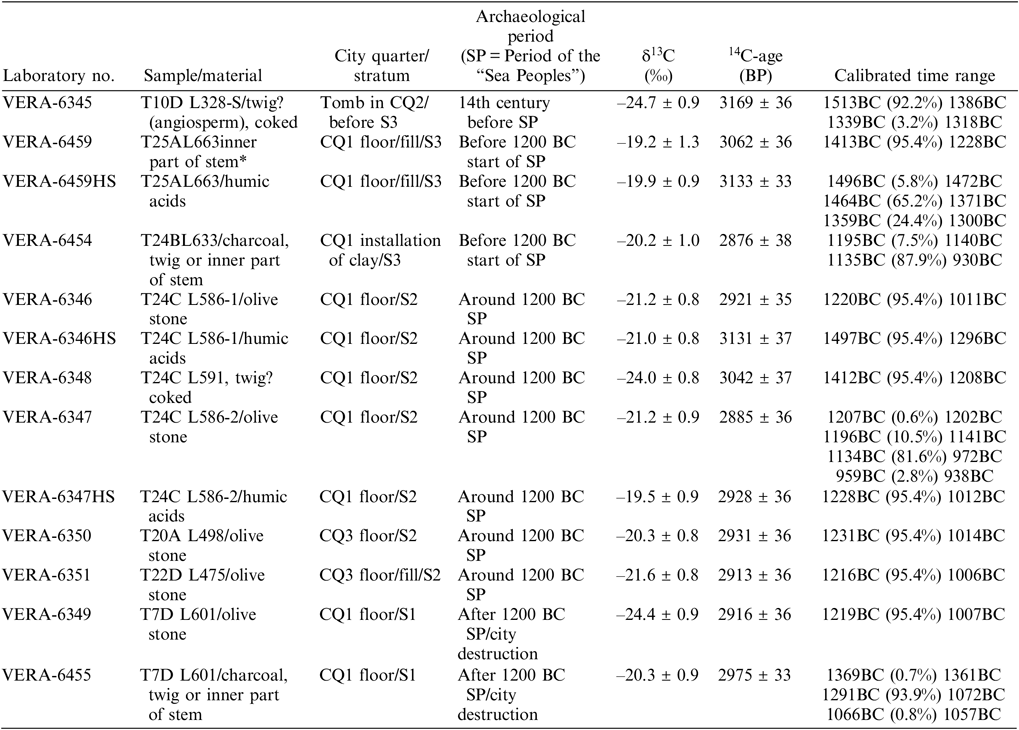
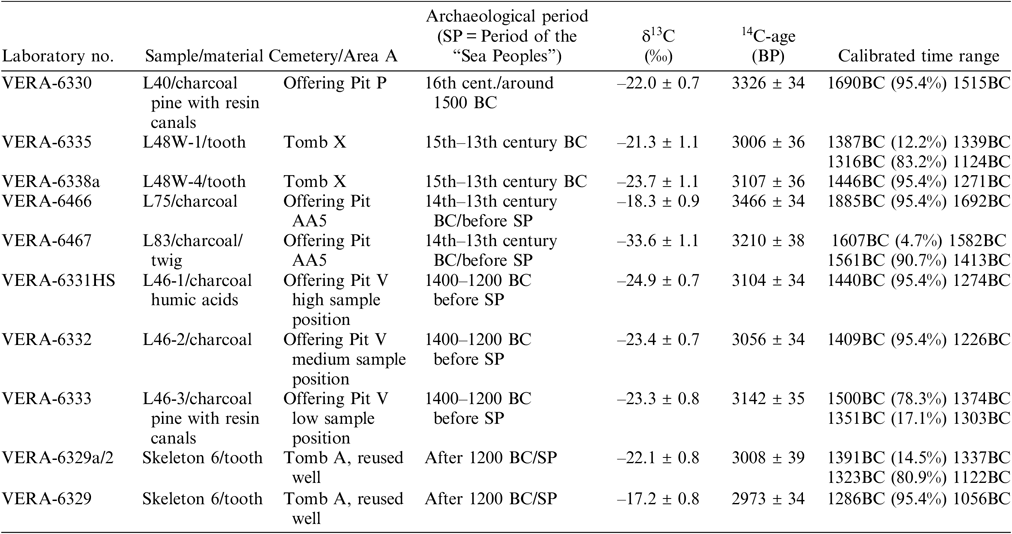
The 14C ages can be studied in Tables 1 and 2. They are chronologically arranged according to stratigraphy and other archaeological criteria, for instance, established sequences of locally and imported pottery, and display 14C dates of samples originating from the city quarters and the cemetery. In Figures 3a and b the calibrated time ranges of the 14C dates are shown in OxCal Curve plots.
Stratigraphically arranged 14C data from CQ1, CQ2 and CQ3, δ13C values were determined with the AMS system; uncertainties of the 14C and δ13C data are 1σ values; the time ranges of the calibrated ages correspond to 95.4% probability. The sample marked with * was identified to originate from the inner part of a stem, the 14C age may be affected by the “old wood” effect.

Radiocarbon data from the cemetery, δ13C values were determined with the AMS system; uncertainties of the 14C and δ13C data are 1σ values, the time ranges of the calibrated ages correspond to 95.4% probability. VERA-numbers with * indicate charcoals with wide and slightly bent tree rings.

Several data from Table 1 are already discussed in Wild et al. (Reference Wild, Steier, Fischer, Fischer and Bürge2018). The new 14C data from CQ1 as shown in Table 1 add to an earlier established set of 14C ages from Strata 1 and 2 of CQ1, which were used for Bayesian analysis (Höflmayer et al. Reference Höflmayer, Burke, Damiata, Southon, Wild, Steier, Fischer and Bürge2018), and will be incorporated into the already published sequence. A particular problem is the determination of the duration of the most recent Stratum 1 based on 14C data: this phase of occupation ended with the final destruction and the abandonment of the city. In order to estimate the end of this sequence, the Bayesian model cannot be based on the latest 14C sample anticipating that it originates from the end of Stratum 1 but should be considered as a terminus-post-quem.
Due to the unfavorable shape of the IntCal13 calibration curve in the time span covered by Strata 3–1, the calibration of the 14C dates gives only broad time intervals as demonstrated by Figures 3a and b. The most recent 14C dates displayed in Figure 3a are results of samples from Strata 2 and 1, which are associated with the occupation period just before the final destruction of the city. According to the archaeological evidence, which is based on stratigraphy and pottery types, this event should be dated to Late Cypriot IIIA2 or roughly the mid-12th century BC (Fischer and Bürge Reference Fischer and Bürge2018a). In spite of the rather broad time intervals obtained by calibration, the 14C dates (all but one, see below VERA-6454) are in concordance with the suggested archaeological dates. This time span relates to the period of the so-called “Sea Peoples” when many cities were destroyed (Fischer Reference Fischer, Fischer and Bürge2017). Years of a general crisis followed in the entire Mediterranean and the sophisticated Bronze Age, the first international (= intercultural) period in human history, came to an end. The 14C age determined for sample VERA-6454, which comes from a clay pit of Stratum 3, is younger than expected and obviously an outlier. This pit was found in 2016 but not completely excavated. The pit was open until the excavations continued in 2017. The sample seems to represent a contamination, which was deposited there during the rainy season or by animal activities.
In Table 1, also the results of 14C dating of humic acids extracted from three of the investigated samples are listed below the 14C data of the fully ABA-treated samples. For two samples the humic acids date agrees within 1 or 2 σ with the date of the ABA treated material. This finding is in concordance with our earlier work dealing with Eastern Mediterranean Bronze and Iron Age sites, where we demonstrated an agreement of the majority of humic acids dates with the respective ABA treated sample (Wild et al. Reference Wild, Steier, Fischer and Höflmayer2013). One of the three humic acids dates deviates significantly from the ABA date. The reason for the presence of older humic acids in an olive pit could not be clarified and must be left unexplained.
Table 2 and Figure 3b show the dating results of samples from the cemetery. Already highlighted above, much of the archaeological material from the cemetery is considerably older than the remains from the settlement. Some of the samples date as early as the 17th/16th centuries BC: see in specific the 14C dates of Offering Pits P and AA5.
Bones from Hala Sultan Tekke are not well preserved due to harsh environmental conditions. Consequently, 14C dating failed in most cases. However, teeth produced usable dates. In several laboratories the preservation state of the collagen in bones is used as a criterion for assessing the suitability of bones to yield reliable 14C dates. Collagen yields after sample preparation should be ≥1% of the initial sample amount. It should be mentioned that in addition some parameters like e.g. C/N ratio, δ13C- and δ15N- values are frequently used to characterize collagen extracted from bones (e.g. Van Klinken Reference Van Klinken1999). A characterization of the collagen via these parameters was not performed, although the δ-values would have been helpful for the detection of a dietary effect. Instead the reliability of the 14C results was checked by testing the reproducibility of the data and comparing the determined ages with those of coeval plant samples and ages estimated from the ceramic assemblages found together with the samples.
The collagen yields of the dated teeth were in three cases ≥0.9%. Given the fact that the initial samples also contained at least some part of the tooth enamel with an inorganic content of ≥95%, these yields seem to be high enough to meet the reliability criterion. Only for sample VERA-6335 from Burial Period 2 of Tomb X (see the three periods in Fischer and Bürge Reference Fischer and Bürge2017c: 175, Figure 9) the yield was as low as 0.3% and the age of this sample (3006 ± 36 BP) is slightly younger than the result determined for a second tooth (VERA-6338a) from the same burial period of Tomb X. Given also the uncertainty of the presence of a riverine/marine age offset the 14C dates of both samples from Tomb X have to be considered with some caution. However, the determined 14C dates agree very well with the dates suggested by the archaeological material, viz. mainly Mycenaean- and Minoan-imported pottery belonging to established pottery sequences (Fischer and Bürge Reference Fischer and Bürge2017c). In addition, there are Egyptian-produced gold-mounted scarabs one of them depicting the cartouche of pharaoh Thutmosis III in support of the 14C dates. Earlier 14C dates associated with the reign of this pharaoh support 1494–1440 BC for the length of his reign (Fischer and Bürge Reference Fischer and Bürge2017c). It must be pointed out that scarabs with his cartouche were produced long after his reign or, alternatively, were kept as heirlooms for a considerable period of time in vast areas of the Mediterranean (see e.g. the scarab with the cartouche of Thutmosis III from Tell Abu al-Kharaz in Jordan which was found in an Iron Age context dating around 1100 BC; Fischer Reference Fischer2013: 539–541).
The 14C results of two different teeth (VERA-6329, collagen yield 0.9% and VERA-6329a/2, collagen yield 1.4%) from a single human individual from Tomb A agree within 1σ uncertainty. The determined 14C ages are in concordance with conventional dating of the tomb gifts, viz. pottery which was produced in the first half of the 12th century BC, viz. the Late Cypriot IIIA period. The burials in Tomb A reflect a very special situation (Fischer and Bürge Reference Fischer and Bürge2015): There are six humans and one large dog interments in an abandoned well which was reused as a tomb. The first buried individual was covered with a layer of soil on which the next individual was buried who was covered with soil and so on, thus resulting in 3 m of compact burial deposits. The ceramic vessels—in principle the only tomb gifts of these poor burials—which were found in connection with the first (lowest) and that from the last (highest) interment are contemporaneous i.e. all individuals were buried either at one occasion or within quite a short time span. Identical pottery has been found in the last occupational phase of the city before it was abandoned, the 14C date of Stratum 1 in the city is comparable with the 14C result of the tomb and thus indicates the absence of a significant age offset caused by the consumption of riverine and marine derived food (Lernau Reference Lernau, Fischer and Bürge2018).
The archaeological age estimate of Offering Pit P is in good agreement with the lower range of the date suggested by 14C, whereas the time ranges of two samples from Offering Pit AA5 as proposed by 14C are somewhat higher for VERA-6467 and much too high for VERA-6466. The latter should be considered as an outlier, most likely as a result of the use of old wood obviously burnt in connection with offering rituals.
The 14C dates of three samples from Offering Pit V are in excellent agreement with the dates suggested by the archaeological evidence. The latter is again based on locally produced pottery and Mycenaean- and Minoan ceramic imports (see above).
CONCLUSION
We present here a status report of 14C dating in an ongoing large research project focused on the Late Bronze Age site of Hala Sultan Tekke in Cyprus and the period when the sophisticated Late Bronze Age societies came to end (13th/12th centuries BC). The site is of special interest due to close trade contacts to coexisting—mainly Mediterranean—cultures. Essential for a verification of the archaeological dating based on ceramics is an independent age determination. A limited number of 14C analyses were carried out in the course of the research project. 14C data reported in the current work are in fairly good agreement with the archaeological estimates, but there are some outliers. However, future Bayesian analyses based on additional 14C data and a sound stratigraphy may certainly lead to a higher precision of the calibrated ages.
ACKNOWLEDGMENTS
We are grateful to Otto Cichocki, Vienna Institute for Archaeological Science, University of Vienna, for inspecting the charcoals. We wish to thank Stefan Lehr for his help with the sample preparation.