INTRODUCTION
Dementia is becoming one of the major causes of death in developed countries (Hennings et al., Reference Hennings, Froggatt and Keady2010). There are currently more than 1.4 million people in Germany living with dementia. Since life expectancy increases and the risk for developing dementia rises with age, it is estimated that this figure will double by the year 2050 (Bickel, Reference Bickel2012).
Much research has been conducted about the needs of people with dementia and their families. The multiple burdens on family caregivers have especially been widely studied (Baumgarten et al., Reference Baumgarten, Battista and Infante-Rivard1992; Adler et al., Reference Adler, Kuskowski and Mortimer1995; Gräßel, Reference Gräßel1998; Brodaty et al., Reference Brodaty, Green and Koschera2003; Papastavrou et al., Reference Papastavrou, Kalokerinou and Papacostas2007; Zank et al., Reference Zank, Schacke and Leipold2007; Brodaty & Donkin, Reference Brodaty and Donkin2009). Caregivers are confronted with the cognitive and mental loss of their loved ones (Robinson et al., Reference Robinson, Hughes and Daley2005). The typical psychological and behavioral symptoms displayed can include aggression, depression, and/or restlessness. These are particularly relevant for the sense of burden experienced by caregivers (Pinquart & Sörensen, Reference Pinquart and Sörensen2003; Zank et al., Reference Zank, Schacke and Leipold2007). The comparatively long disease trajectory (between four and nine years from diagnosis to death) presents a gradual loss of the demented person to family members and can contribute to anticipatory grief (Hughes et al., Reference Hughes, Jolley and Jordan2007; Holley & Mast, Reference Holley and Mast2009). Moreover, families commonly lack knowledge and experience with the disease, which may in part be explained by poor communication with physicians (Treloar et al., Reference Treloar, Crugel and Adamis2009; Hennings et al., Reference Hennings, Froggatt and Keady2010). Compared with other caregiving groups, family members of patients with dementia experience more negative impacts on their physical and mental health as well as on their social life (Clyburn et al., Reference Clyburn, Stones and Hadjistavropoulos2000; Robinson et al., Reference Robinson, Hughes and Daley2005; Brodaty & Donkin, Reference Brodaty and Donkin2009).
In contrast to the comprehensive research about dementia care in general, the aspect of providing care at the end of a dementia patient's life has been examined far less (see Peacock, Reference Peacock2012). However, it is the care of a person with dementia near the end of life that especially involves challenges concerning health, psychosocial, and practical issues for the caregiver. There is a range of different needs family caregivers have at these times. Toward the end stage of dementia, the patient requires more extensive care than can usually be provided by informal caregivers (Shanley et al., Reference Shanley, Russell and Middleton2011; Thompson & Roger, Reference Thompson and Roger2013).
Dementia patients often suffer from chronic pain, but this is difficult to assess due to impairment of their communication abilities. As a consequence, pain and distress are frequently underdiagnosed and inadequately treated (Robinson et al., Reference Robinson, Hughes and Daley2005). Further challenges for family caregivers concern the nutrition of their loved one.
Another significant challenge family caregivers of dementia patients have to face is assuming the role of surrogate decision maker. The communication problems endemic to the end stage of dementia require decisions being made on behalf of patients. Many relatives feel overstrained with this duty, and hence the early preparation of care plans and advance care directives is recommended (Gerhard & Bollig, Reference Gerhard and Bollig2007; Thompson & Roger, Reference Thompson and Roger2013).
Despite the fact that palliative care provision is increasingly considered as a model for the care of patients with very advanced dementia, its main focus is still on end-of-life care for cancer patients (van der Steen et al., Reference van der Steen, Radbruch and Hertogh2013). End-stage dementia requires a range of care tasks that refer to palliative aspects. Difficulties arise in evaluation of the terminal phase of dementia, which possibly delays the decision to apply palliative concepts (Kunz, Reference Kunz2003; Gerhard & Bollig, Reference Gerhard and Bollig2007; Zieschang et al., Reference Zieschang, Oster and Pfisterer2012; van der Steen et al., Reference van der Steen, Radbruch and Hertogh2013). Since dementia is an increasingly prevalent terminal illness and a large number of families in Germany provide end-of-life care, research on this topic is becoming more relevant. Furthermore, it is seen as very important that caregivers themselves articulate their needs during this specific time (Shanley et al., Reference Shanley, Russell and Middleton2011). Considering the requests and experiences of family caregivers of people dying with dementia can establish optimal support services that meet their requirements and can help improve care for dementia at the end of life (Lawrence et al., Reference Lawrence, Samsi and Murray2011).
The present work makes an important contribution to the literature by expressing and analyzing family members' experiences and requests. The analysis is part of the EPACS (Establishment of Hospice and Palliative Care Services) study (carried out in Rhineland-Palatinate, Germany) to gain a representative picture of end-of-life inpatient and outpatient care (Escobar Pinzon et al., Reference Escobar Pinzon, Munster and Fischbeck2010). Utilizing qualitative methods, this article focuses on the situation of families of dementia patients. Other studies (Klindtworth et al., Reference Klindtworth, Cuno and Schneider2010; Bleidorn et al., Reference Bleidorn, Pahlow and Klindtworth2012) that analyzed relatives' and patients' experiences and expectations have shown that qualitative measures worked out advantageously for this purpose.
The aim of our study was to explore the experiences of family members while caring for a demented relative at the end of life, either in their own homes or at a care facility. More specifically, the following questions were raised:
What are the special needs of family caregivers nursing a relative dying with dementia?
How do they perceive the support of, and collaboration with, professionals?
According to close family members, what improvements are required to optimize the support system for themselves and for their loved ones?
METHODS
Data Collection and Questionnaire
The starting point for the qualitative analysis consisted of free text answers to the questionnaire employed in the EPACS study. This comprehensive cross-sectional survey was carried out in the federal state of Rhineland-Palatinate, Germany, between September 2008 and January 2009. The questionnaire was sent to randomly drawn family members of deceased citizens (for more details about the questionnaire and sampling, see Escobar Pinzon et al., Reference Escobar Pinzon, Munster and Fischbeck2010). In total, 1378 questionnaires were completed by respondents.
In line with our research question, we considered only answers related to personal support for family caregivers of persons with dementia at the end of life. The sample included 310 family members of dementia patients. Two open-ended questions from the EPACS questionnaire comprised the subject of analysis. The first item, “As far as I am concerned, I would have appreciated if the healthcare professionals . . .,” was answered by 39 participants. The other item—“Do you have suggestions on how to improve the care of terminally ill patients?”—was responded to by 46 participants. In sum, 85 respondents made suggestions for improvement or expressed expectations concerning the support and care of families of persons dying with dementia.
Analysis
In the following analytical process (based on Philipp Mayring's approach to qualitative content analysis, see Mayring (Reference Mayring2010)), all authors participated in the development of a qualitative category system. The combination of researchers' expertise in palliative medicine, interdisciplinary gerontology, psychology, and social and educational sciences provided the basis for a multidisciplinary and intersubjective understanding of the bereaved families' answers and enhanced the validity of the results.
In the first step of the analysis, original quotations were prepared for the coding procedure. Each response was divided into smaller paragraphs consisting of a single request or suggestion for improvement. Three authors then independently viewed and coded a section of these paragraphs. Subsequently, the codings were discussed and a consensus decision reached. Due to the adopted inductive approach, the codes were formulated as closely as possible with the original text. When all quotations had been coded, the authors structured the codes by sorting them thematically and by establishing main and subcategories. The main categories represented the central themes of the family members' responses, whereas the subcategories were composed of rather similar experiences or needs. Some answers did not contain explicit requests or suggestions but rather described the negative experiences of respondents. With regard to our research question, these were considered too important to be excluded from the dataset. Thus, they were coded separately as “deficiencies” and taken into account in the analysis.
Although our study followed a qualitative approach, we quantified the codes per subcategory and main category. Compared to other qualitative studies, our dataset is relatively large. Quantifying codes helped structuring it and obtaining an overview of the qualitative data. Frequency counts also allowed the researchers to identify recurrent themes (Hesse-Bieber, Reference Hesse-Bieber2010). Frequency counts do not indicate the importance or impact of respondents' answers but give insight into how general an opinion might be (Tappen, Reference Tappen2011).
RESULTS
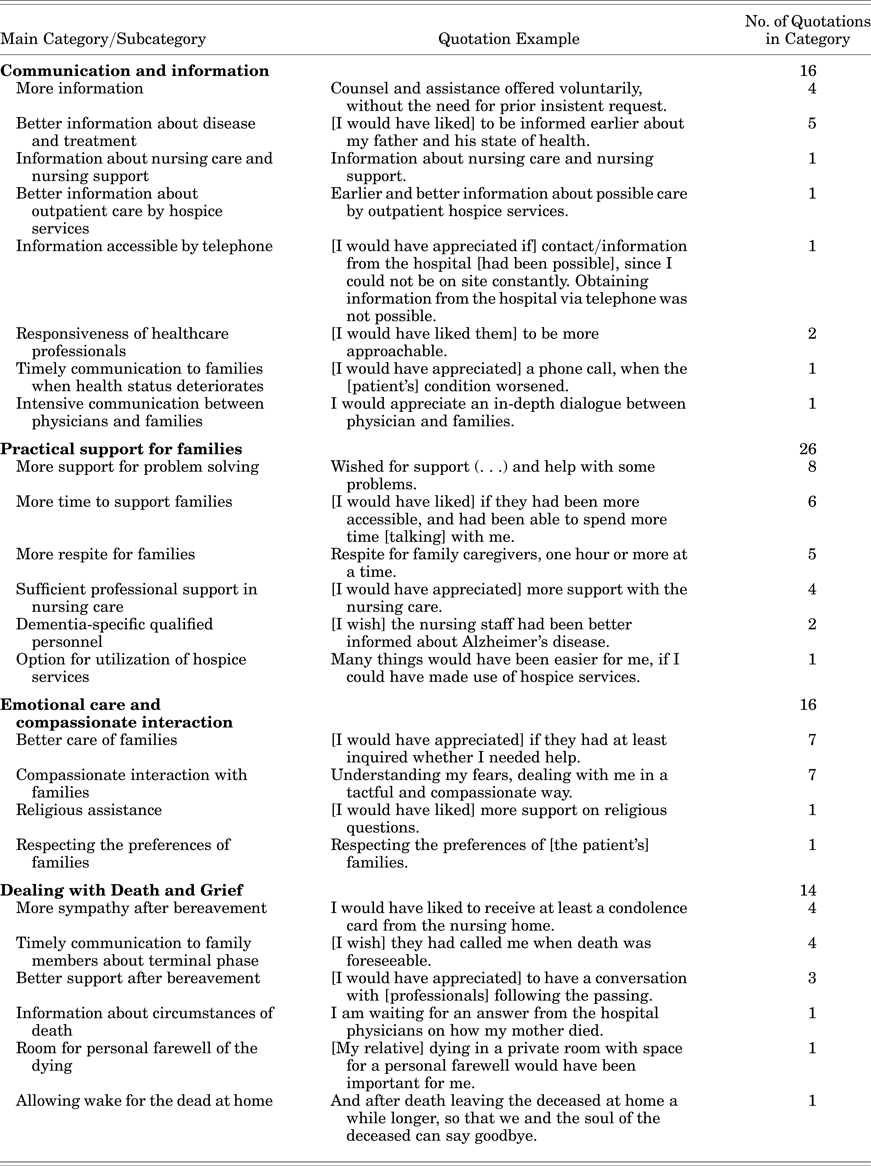
The qualitative analysis yielded four main categories. These stand for the central themes of family members' free text answers, whereas the subcategories contain similar quotations. The assignment of free text answers to categories is presented in Table 1. The category system is further explained on the basis of exemplary quotations below.
Support for families of patients dying with dementia: Suggestions for improvement

Main Category: “Communication and Information”
This category contains answers that discuss improvements in terms of communication and information structures between healthcare professionals and families. The respondents would have liked to be informed earlier and more comprehensively about general and specific issues. They would have appreciated easier contact with professionals, as well as more information about the diagnosis, about changes in the state of the health of their loved ones, and about outpatient support services:
Counsel and assistance offered voluntarily, without the need for prior insistent request. [W4908.1]
Earlier and better information about possible care by outpatient hospice services. [V1703.1]
An important concern of respondents was obtaining information about the hospital staff:
[I would have appreciated if] contact/information from the hospital [had been available], since I could not be on site constantly. Obtaining information [from the hospital] via telephone was not possible. [W4391.1]
In some cases, relatives were neither sufficiently informed about the disease pattern of dementia nor about the treatment. Consequently, the respondents requested an open and comprehensible communication with healthcare professionals:
[I would have appreciated if they would] clearly [give us] the actual diagnosis. [W4394.2]
Fundamental conversations with families about the necessity of treatments that could be spared [from] the patient. [V162.1]
There was another suggestion for improvement that concerned timely notification of families in case of a patient's worsening state of health:
[I would have appreciated] a phone call when the [patient's] condition worsened. [W3831.2]
The next quotations describe what relatives considered good communication with physicians:
I would appreciate an in-depth dialogue between physician and relatives. [V3831]
[I would have liked them] to be more approachable. [W326]
Main Category: “Practical Support for Families”
With 26 quotations, this main category comprises the majority of free text answers from families. The dominant theme is the need for professional, practical support for family caregivers, who are often overtaxed by providing care for a person with dementia. Some respondents requested more time spent by professionals for better and adequate support:
[I would have liked] if they had been more accessible, and had been able to spend more time [talking] with me. [W4394.1]
Some respondents described their caregiving tasks as very strenuous and complex. Faced with many problems, they often felt neglected by time-pressured personnel, particularly by staff at outpatient nursing services:
The time of nursing service personnel is too limited. Families are overwhelmed with too many problems—for example, constipation, decubitus, edema, shortness of breath, depression, fear, and incontinence. [VD498.1]
Without private nurses and domestic services, home-based care would not be possible. [VD3282.2]
Many family caregivers require better availability of different practical support services. In their experience, professional assistance for the care of persons suffering from dementia needs to be expanded:
More assistance, or hospital admission in cases of dementia. [V3858.1]
There should be more options for professional care at home. [V1317.2]
For some respondents, it would have helped tremendously to have access to outpatient hospice services:
Many things would have been easier for me if I could have made use of hospice services. [V4908.1]
Many family caregivers reported a great investment of time associated with providing care for a person with dementia. Therefore, they would have liked to have seen improvements in the institutional care or in the support of patients' families in general:
Better supervision and care for people with dementia, both during meals and in the meantime. My wife had to go to the nursing home three times a day to assist during meals as long as the deceased was still able to eat [cutting up and serving food, helping with drinking, wiping spilled food, etc.]. [V242]
Respite for family caregivers, one hour or more at a time. [V2642]
Finally, the respondents requested that professional personnel caring for people with dementia receive better training:
[I wish] the nursing staff had been better informed about Alzheimer's disease. [W956.1]
In the hospital: to be set up for caring for patients with dementia. [W3073.1]
Main Category: “Emotional Care and Compassionate Interaction”
For this main category, quotations have been assigned that consider, in a broad sense, psychological or spiritual care and support for families. Other quotations contain requests for more humane care from personnel. Many answers relate to improvements of emotional support for caregiving family members by professionals:
[I wish] that they had reached out and listened to the families. [W3876.1]
[I would have appreciated] if they had at least inquired whether I needed help. [W1997]
For one respondent, religious support was relevant:
[I would have liked] more support on religious questions. [W178.2]
Many respondents saw potential for improvement in the behavior of professionals. They required respect, recognition, and sensitivity from physicians and nursing staff:
Understanding my fears, dealing with me in a tactful and sympathetic way. [W3831.1]
[I wish] they had reacted to my questions about my mother's condition with more understanding and particularly with more compassion. [W4163.2]
Respecting the preferences of [the patient's] families. [W3073.2]
Main Category: “Dealing with Death and Grief”
The main category “Dealing with Death and Grief” relates primarily to family members' needs during the entire dying process. These included the need for general information about the dying process. Timely notification of relatives when death is foreseeable was given high priority to enable a final farewell:
[I wish I had] been informed in time to say goodbye. [W1269.1]
[I wish] they had called me when death was foreseeable. [W3200]
A personal farewell is an important aspect, which was also expressed in wishes for more privacy during and after death:
[My relative] dying in a private room with space for a personal farewell would have been important for me. [V1456.3]
And after death, leaving the deceased at home a while longer, so that we and the soul of the deceased can say goodbye. [V2943]
Care and sympathy after their loved one's death was another important concern for respondents. After bereavement, they mainly wished for talks or just a sign of sympathy from professionals:
[I would have appreciated] to have a conversation with [the professionals] following the passing. [W4053]
Follow-up care for families after death. [V3073.3]
I would have liked to receive at least a condolence card from the nursing home. [W2787.2]
Pausing for a moment right after death to give families time to deal with the situation was essential for some of the bereaved:
Not immediately going back to business as usual. [W3639.1]
The wish for care after bereavement also found expression in a request for specific offers of support for mourning people:
Informing me about grief support services. [W3634]
Finally, some respondents had to sort out bureaucratic matters after the death of their loved one before the grieving process could proceed:
I am waiting for an answer from the hospital physicians on how my mother died. [W3330.2]
DISCUSSION
To the best of our knowledge, this is the first qualitative study that focuses on the situation of family caregivers for persons with end-stage dementia in Germany. Our work makes an important contribution to the literature by giving insight into family caregivers' experiences and considering their suggestions for improvement.
The suggestions for improvement and requests of respondents relate to different aspects of caregiving. They also reflect the multiple burdens that impact the physical and psychological health of family caregivers. The two most prominent subjects that evolved in our analysis were practical and psychological support for caregivers as well as information from professionals. These subjects are, as this work has shown, important during the overall course of the disease. However, they seem to gain increasing importance for caregivers as the end of a relative's life approaches. This is due to the drastic deterioration in the mental and physical state of the patient, which leads to total dependence and, subsequently, to a need for around-the-clock supervision. Hence, family caregivers are often overtaxed by the complex duties this entails. They would like to receive more support for principal tasks such as daily care and supervision as well as in managing acute medical problems and symptoms (e.g., infections, pain, incontinence, loss of appetite) that are typical for end-stage dementia (Robinson et al., Reference Robinson, Hughes and Daley2005). Consequently, respondents in our study demanded dementia-specific qualified personnel in nursing homes or from nursing services. In addition, some family members would have liked to have made use of outpatient hospice services to assist them but were faced with too many administrative obstacles.
Receiving support from competent and sympathetic professionals was essential for families when it became necessary for them to entrust their loved ones to formal caregivers (nursing services or care facilities).
As our results demonstrate, practical support for family caregivers of dementia patients should be complemented by psychological care of the former (see also Shanley et al., Reference Shanley, Russell and Middleton2011). Families would like to have their own needs and problems considered and cared for, too. Empathic assistance, particularly during the terminal phase, and follow-up care after the death of their loved one are also requested.
The second main concern of family caregivers in this study concerned information about a multitude of matters. First, they would liked to have learned more about the disease trajectory and about the different stages of the disease, especially about the dying phase. Timely notification about the approach of death was of particular importance to family members so they would have time to say goodbye. Aside from specific information about the illness and the condition of their demented relative, respondents would liked to have been informed about the different options for psychosocial support, such as caregiver support groups. For the family caregivers in our study, obtaining information was dependent on the cooperation of physicians and other professionals. Consequently, poor communication from healthcare professionals seemed to add to the burden and helplessness they experienced.
LIMITATIONS
There were some limitations to our study. All selected participants had relatives suffering from dementia in the last four weeks prior to death. This information about the patient's condition was given by the participants after the family member's death. Therefore, it is uncertain whether the deceased patients had a formally tested diagnosis or if they suffered from other diseases commonly associated with aging that display dementia-like symptoms. Another limitation can be associated with the bereaved relatives' answers concerning their suggestions for improvement and their needs. Although we analyzed all answers that matched the inclusion criteria (explicit reference to the personal support of family caregivers of persons dying with dementia), the answers might also relate to general issues of end-of-life care in hospitals, care homes, or at home.
IMPLICATIONS
The results from our analysis provide important conclusions for clinical practice. Dementia has to be recognized as a terminal illness, by both healthcare professionals and families. As a consequence, patients and their families require dementia-specific palliative care. This would include comprehensive support for family caregivers to ease their burden.
The aim of palliative care is to improve the quality of life of terminally ill patients and their families (World Health Organization, 2013). To this day, it has mainly focused on cancer patients. Therefore, the traditional model of palliative care is oriented on a linearly progressive disease trajectory. This approach is problematic for dementia patients and their families, as they would benefit from palliative care involvement at earlier stages of dementia (Thompson & Roger, Reference Thompson and Roger2013). Thus, dementia-specific palliative care strategies are necessary. A first definition of palliative care in dementia and guidelines for clinical practice have only recently been compiled by the European Association for Palliative Care (van der Steen et al., Reference van der Steen, Radbruch and Hertogh2013). Experts recommend, among other things, to apply a person-centered approach to dementia care and to address families' and patients' needs throughout the disease trajectory. Advance care planning is of great importance and should begin as soon as possible to elicit the patient's preferences. Furthermore, the significance of education and support for families through the various stages and following the death of their loved one is also emphasized.
The provision of guidelines for palliative care in dementia constitutes a cornerstone for clinical practice as well as for research. These recommendations still need to be implemented. In the future, it would be useful to reevaluate the experiences of patients and their families to analyze the first results of implementation and to refine the recommendations.
ACKNOWLEDGMENTS
M. Weber was involved in the design of the study and data acquisition. P. Muders, C.A. Zahrt-Omar, S. Bussmann, J. Haberstroh, and M. Weber analyzed and interpreted the data and drafted the manuscript. The authors would like to thank Mrs. Brigitte Sztab for her support and her comments on the translation.
FUNDING
This work was supported by Fresenius Kabi Germany GmbH and the German Pharmaceutical Industry Association (BPI). Fresenius Kabi Germany GmbH and the German Pharmaceutical Industry Association (BPI) had no role in the study design, collection, analysis, interpretation, or presentation of the information. The authors declare that there is no conflict of interest.