




No CrossRef data available.
Perverse Accountability: A Formal Model of Machine Politics with Evidence from Argentina
Published online by Cambridge University Press: 02 September 2005
Abstract
Political machines (or clientelist parties) mobilize electoral support by trading particularistic benefits to voters in exchange for their votes. But if the secret ballot hides voters' actions from the machine, voters are able to renege, accepting benefits and then voting as they choose. To explain how machine politics works, I observe that machines use their deep insertion into voters' social networks to try to circumvent the secret ballot and infer individuals' votes. When parties influence how people vote by threatening to punish them for voting for another party, I call this accountability. I analyze the strategic interaction between machines and voters as an iterated prisoners' dilemma game with one-sided uncertainty. The game generates hypotheses about the impact of the machine's capacity to monitor voters, and of voters' incomes and ideological stances, on the effectiveness of machine politics. I test these hypotheses with data from Argentina.
Information
- Type
- ARTICLES
- Information
- Copyright
- © 2005 by the American Political Science Association
Thirty-five years ago, James Scott (1969) observed that political life of contemporary new nations bore a strong resemblance to the machine politics of the United States in earlier eras. The patronage, particularism, and graft endemic to the Philippines or Malaysia in the postwar decades recalled, for Scott, the Tweed machine in nineteenth-century New York or the Dawson machine in twentieth-century Chicago. Much has happened in the third of a century since Scott outlined “the contours and dynamics of the ‘machine model’ in comparative perspective” (1143). Many of the new nations that occupied his analysis have undergone transitions to electoral democracy; yet politics in these systems often remains particularistic, clientelistic, and corrupt. We therefore have a larger sample of countries, and a richer experience on which to draw, to understand the contours and dynamics of the machine. The historiography of the U.S. political machine has also grown, as have historical studies of patronage and vote buying in the history of today's advanced European democracies (see, e.g., Piattoni 2001). Finally, a formal literature on redistributive politics has developed, one in which the political machine plays a central role.
Yet the formal literature on the political machine leaves some crucial questions unanswered. Chief among them: How does the machine keep voters from reneging on the implicit deal whereby the machine distributes goods and the recipient votes for the machine? If voters can renege, then machines should not waste scarce resources on them and clientelist politics breaks down. The question is the more pressing, given that many of the societies in which we find active political machines also have the secret ballot. Political machines did not disappear in the United States after the introduction of the Australian ballot in most U.S. states at the end of the nineteenth century.1
The Australian ballot is one in that is produced by governments or neutral election authorities (rather than by political parties), distributed through guarded channels on or close to election day, and that lists all parties or candidates for an office in a single format.
Assuming that machines can overcome the problem of their clients' reneging, what kinds of voters will they target? Scattered through the qualitative literature is evidence that poor voters are the targets of machines (see, e.g., Chubb 1982; Wilson and Banfield 1963). Formal treatments agree, citing diminishing marginal utility of income as the reason why particularlistic benefits generate more votes among the poor than the rich (Calvo and Murillo 2004; Dixit and Londregan 1996).
Yet in the societies where clientelistic parties or machines are active, not all poor voters receive benefits. Limited resources force political machines to choose among poor voters. Machine operatives everywhere face a version of the dilemma that an Argentine Peronist explains. About 40 voters live in her neighborhood, and her responsibility is to get them to the polls and get them to vote for her party. But the party gives her only 10 bags of food to distribute, “ten little bags,” she laments, “nothing more.”2
Interview conducted by Valeria Brusco, Susan Stokes, and Gloria Trocello, in Villa Mercedes, Argentina, July 2003; my translation. This and all subsequent translations from the Spanish are by the author.
The formal literature answers this question by saying that machines target core constituents. But if these constituents are ideologically committed to the machine, is it not wasting resources if it distributes rewards to them? Would it not do better by distributing rewards to the uncommitted or even to those who, on ideological grounds, oppose the party? The selection method of our Argentine operative is to help “the people who complain the most, the ones who say, ‘What are you going to give me?’ I pick them up [to take them to the polls] and after I take them they say, ‘Aren't there any bags of food?’” Her words hint at a logic in which machines give private handouts not to die-hard supporters but to people whose future support is in doubt. The analysis in this article helps make sense of her explanation.
Far from being just a Latin American problem, or a problem that advanced democracies have completely overcome, vote buying, clientelism, and machine politics are blights on many democracies around the world, even today. Prosecutors in 2004 accused a candidate for a district judgeship in Eastern Kentucky of giving $50 checks to voters, implicitly in return for their support.3
The New York Times, August 29, 2004.
“Ukrainian Campaigns Gear Up for Presidential Re-Vote,” Emily Harris, December 7, 2004, www.npr.org.
These practices make a mockery of democratic accountability. Democratic accountability usually means that voters know, or can make good inferences about, what parties have done in office and reward or punish them conditional on these actions. But when parties know, or can make good inferences about, what individual voters have done in the voting booth and reward or punish them conditional on these actions, this is perverse accountability. We usually think of accountability in democratic systems as a good thing: it means that voters can keep elected officials from misbehaving and pressure governments to be more responsive to voters. But perverse accountability is bad for democracy: it reduces the pressure on governments to perform well and to provide public goods, keeps voters from using elections to express their policy preferences, and undermines voter autonomy (see Karlan 1994; Kochin and Kochin 1998; O'Donnell 1996; Stokes 2004). To overcome perverse accountability, we need first to understand how machine politics works. This article begins to build such an understanding.
STATIC MODELS OF REDISTRIBUTIVE POLITICS AND THE COMMITMENT PROBLEM
In some of our leading formal models of redistributive politics, the political machine plays a large role. Dixit and Londregan (1996) model the strategies of two parties as they attempt to mobilize groups of voters, who care both about consumption and about ideology. Parties tax some voters and redistribute to others. When both parties are equally able to deliver resources to every group, the parties deploy tactical rewards to compete for the same groups of swing voters—groups with a relatively large number of moderate voters who are ideologically indifferent between the two parties. But when one party has an especially close link to a group of voters, then the party will target this core constituency. Dixit and Londregan write that core constituents are ones
whom [the party] understands well … A party's core constituencies need not prefer its issue positions. It is the party's advantage over its competitors at swaying voters in a group with offers of particularistic benefits that makes the group core (1986, 1134)…The key to the electoral strategies of the urban political machines was their ability to provide “personal services” to their core constituents at a lower cost than could their competitors. They did this by knowing their constituents (1147).
For Cox and McCubbins (1986), the crucial feature of the machine–core constituent link is that the party is more certain about how core groups will respond to rewards than it is about other groups. The party is more certain because “core supporters … are well-known quantities. The candidate is in frequent and intensive contact with them and has relatively precise and accurate ideas about how they will react” (1986, 378–9).
The problem with both pairs of authors' models is that they don't deal adequately with commitment problems. Both assume by caveat that the party won't renege on its offer of particularistic rewards once it's won the election.5
Aware that parties in their model suffer from a commitment problem, Cox and McCubbins simply add an assumption “that candidates, once elected, carry out their promises” (1986, 373).
A DYNAMIC MODEL OF MACHINE POLITICS
Assumptions
A way to deal with these commitment problems is to place the machine–voter interaction in a dynamic context. To model the interaction between machine operatives and voters as a repeated game, we have to make certain assumptions. First, we have to assume that parties can monitor individual voters' actions and condition rewards on their inferred votes. Second, we have to assume that both sides perceive the interaction as ongoing indefinitely into the future.
The assumption that machines can hold voters accountable, that they can monitor individuals' votes (even if imperfectly) and make rewards contingent on the voter's support, departs from the implicit assumption of redistributive theorists. They assume that a member of a favored group will receive private rewards whether or not he votes for the party; individual voters are anonymous and therefore free from the party's retribution should they defect. The premise that voting is a private and anonymous act may have discouraged formal theorists from modeling these interactions as repeated games; repeated games generally rely on each player being able to observe the actions of the other in the previous round. The assumption that voting is anonymous is appropriate in most advanced democracies, but not necessarily in the historical context of political machines or in many new democracies today.6
It is not always appropriate for advanced democracies. In contemporary Spain, voters retrieve sheets containing party lists from an open table at their polling place. They can retreat into an enclosed booth to cast their ballot. But they are not required to vote in secret and many vote in the open.
There are two kinds of private information about the voter that are useful to the party: his actions—which party he votes for—and his type—his partisan predisposition in relation to the two parties.7
In the models that follow, I assume two-party competition, as do the theorists of redistributive politics discussed earlier.
Certain voting technologies allow parties to monitor individuals' votes. The recent historiography of U.S. machines deepens our appreciation of these technologies. Until the introduction of the Australian ballot in the United States, in most states in 1891, parties produced “ticket” or “coupon” ballots, ones that listed only their candidates. To monitor which party's ballot the voter was using, parties printed ballots on paper of different weights or colors. Voters deposited the ballot directly in the ballot box, under the watchful eye of party operatives, without first concealing it in an envelope (for descriptions, see Keyssar 2000; Reynolds 1988). Reynolds (1980, 193) reports that New Jersey's early automatic voting machines, introduced in 1890, made clicking noises that allowed party officials standing nearby to detect the voter's selection. And operatives from the Philadelphia Republican party in the late nineteenth and early twentieth century offered to fill out ballots on voters' behalf (McCaffery 1993).
Voting practices and technologies undermine the anonymity of the vote in contemporary developing democracies, as they did in U.S. machine cities, even where the Australian ballot is in use and where voting is, in a narrow sense, secret. In her description of contemporary India as a “patronage democracy,” Chandra (2004) notes that parties designate polling agents to observe the progress of voting. Polling agents are “usually men from the village itself, or from close by, who know the identity of each voter. While they do not witness the actual vote, they know who shows up to vote and can report on turnout figures” (139). Chandra reports that Indian parties could undermine voters' anonymity by emptying boxes and counting the returns at frequent intervals over the course of an election day. (An electoral reform in 1994 outlawed the practice.) To cite another example, in the 2003 Russian Duma elections, international observers reported “significant problems relating to the secrecy of the vote, with open voting in 30% … of polling stations … polling officials and party observers were seen to be actively encouraging persons to vote outside of polling booths” (Organization for Security and Cooperation in Europe 2003).
Certain party–organizational structures allow parties to discern individual voters' types—their predisposition for or against the machine. The typical political machine (or clientelist party) is bottom-heavy, decentralized, and relies on an army of grassroots militants. Voters in today's democracies in the developing world are frequently geographically immobile, living in neighborhoods where they grew up and where family members and close acquaintances live. Some of these familiar neighbors work as operatives for political parties. They therefore know much about an individual that shapes his partisan attachments: his job, associational membership, parents' ideological inclinations, and public statements about parties and policies. It is also hard for voters to dissemble before people they've known all their lives: as one grassroots party organizer in Argentina explained, you know if a neighbor voted against your party if he can't look you in the eye on election day.
Information about individual voters' partisan predispositions helps the machine make inferences about how individuals vote and whether they are good candidates for vote buying. For instance, the model in the next section shows that voters who are predisposed in favor of the machine on partisan or programmatic grounds cannot credibly threaten to punish their favored party if it withholds rewards. Therefore the party should not waste rewards on them. The model also shows that voters who are strongly opposed to the machine will not trade their votes for rewards. A machine can compensate, to some degree, for an effective secret ballot if it can distinguish strong opponents from people who oppose it more moderately, or strong loyalists from people who are indifferent about whom to vote for.
Argentina, the country from which I present evidence, combines a balloting system that gives parties greater control over voters than does the Australian ballot, a social structure of reduced anonymity, especially among the poor, and party organizations that help parties monitor voters. These features contribute to a widespread perception among Argentine voters and party operatives that voting is a less than fully anonymous act. As one grassroots party organizer explained, “Anyone who's militating in the streets, you know who's with you and who's not with you.”8
Interview conducted January 2003, in the city of Córdoba, by Valeria Brusco, Marcelo Nazareno, and Susan Stokes.
We used multistage cluster sampling techniques, based on census tracks, to select 500 adults each in the provinces of Buenos Aires, Córdoba, Misiones, and San Luis. The margin of error was plus or minus 4.5%.
Husband: Here it's different than in Córdoba [the nearest big city]. Here they know everyone. And they know whom everyone is going to vote for.
Author: When people come and give things out during the campaign, are they people whom you know?
Husband: Yes, they're people from here, they're neighbors. Here everyone knows each other. “Small town, big hell.” (Pueblo chico, infierno grande.)
Author: Do they know how you voted?
Husband: For many years we've seen, people will say, “So-and-so voted for so-and-so.” And he wins, and they come and say, “You voted for so-and-so.” I don't know how they do it, but they know.
Wife: We were at the unidad básica [a neighborhood Peronist locale] and they say to me, “[Your cousin] voted for Eloy” [the given name of a Radical-party candidate]. And I asked my cousin, “did you vote for Eloy?” And she said “yes”! They knew that my cousin had voted for Eloy!10
Interview conducted by Valeria Brusco, Lucas Lázaro, and Susan Stokes, July 2003.
Voting technologies in Argentina also reduce the anonymity of the vote. Argentina has the secret but not the Australian ballot.11
Scholars often fail to distinguish between the two. Argentina, Panama, and Uruguay are examples of developing democracies that don't use Australian ballots but where balloting is secret. Voting takes place in enclosed booths, and ballots are placed in opaque envelopes before being returned to election officials. But the ballots are produced by political parties and contain only a given party's list of candidates. Furthermore, I have cited two other developing democracies, India and Russia, where the Australian ballot is used but where experts claim that the secrecy of the ballot is informally violated.
The practice of handing out ballots basically serves as a method of monitoring and influencing how people vote. One Peronist organizer explained in an interview how the party used the ballots. “The most important thing is to go look for people and give them the ballot. You give them the ballot in the taxi [which the party has hired to transport them to the polls]. Then no one has time to change their ballots for them [i.e., give them a different ballot. After taking voters into the polling place] you put them on line to vote … Then they don't have a chance to change the ballot. Only if they're really sneaky and they change it inside the voting booth.”12
Interview conducted in June 2002 in the city of Córdoba, by Valeria Brusco, Marcelo Nazareno, and Susan Stokes.
In sum, my first assumption is that machines can effectively, if imperfectly, monitor the actions of their constituents.
A second assumption needed to model machine politics as a repeated game is that all players foresee the game continuing into the future. It is entirely appropriate to think of the interactions between machine operatives and their constituents as repeated over many iterations; the more artificial assumption would be that these are one-shot or short-lived interactions. Machines and clientelist parties are effective to the extent that they insert themselves into the social networks of constituents. The grassroots party operative is a long-time neighbor of the people she tries to mobilize. In Latin America, clientelist parties of renown have been long-standing organizations, deeply enmeshed in working-class communities: Peru's Partido Aprista Peruano (APRA), founded in the 1920s, Mexico's Institutional Revolutionary Party (PRI), founded in the 1930s, Argentina's Peronists, founded in the in the 1940s.
The repeated-play assumption may be most appropriate in countries where parties are old, even if the democracies in which they compete are new. The three democracies just mentioned are new: Peru and Argentina redemocratized in 1980 and 1983, respectively, and Mexico democratized for the first time in 2000. Yet clientelist parties in all of them are old. The repeated-play assumption may be less appropriate in new democracies where the major political parties are also young and hence less enmeshed in social networks.
When parties that are not enmeshed in social networks try to buy votes with private inducements, voters greet their efforts with skepticism. In connection with research I conducted in Lima, Peru, I observed the reactions of people in a working-class neighborhood to a soup kitchen that a political party established in 1985, shortly before national elections (see Stokes, 1995). Soup kitchens were familiar in the neighborhood: Catholic activists and women's organizations ran some and the local mayor's office supported them. But when residents saw an outsider party set up a soup kitchen they predicted that it would disappear after election day. They were unmoved by the sponsor-party's implicit appeal for electoral support. And they were right: the soup kitchen did disappear right after the election.
In the Argentine case, furthermore, it is appropriate to assume that parties and voters see their interaction as extending into the indefinite future; even if they could imagine hypothetical circumstances in which it might end (in the event, e.g., of a military coup), at the time of any given election since the return to democracy in that country, few would have anticipated a particular moment when it would end. The perception of an interaction with no identifiable stopping point makes it reasonable to model this as an infinitely repeated game.
To capture the repeated-play dynamic of machine politics, it is necessary to depart in a third way from received models of redistributive politics. These models assume that the machine's ability to reward voters for their support depends on its winning elections.13
In static models of clientelism in which the party only pays a reward if it wins, a voter's actions depend on his or her beliefs about the likely actions of other voters. A collective-action problem arises when voters prefer, on programmatic grounds, to vote against the machine. Then defeating the machine is a public good, but individual voters pay a cost for attempting to unseat it if the attempt fails. See Medina and Stokes 2003, and Diaz-Cayeros, Magaloni, and Weingast 2001.
To summarize, my key assumptions are that machines can monitor voters' actions and that both sides foresee their interaction extending indefinitely into the future. The latter assumption implies that machines don't lose their ability to distribute goods when they find themselves in opposition.
The Model
I begin with a one-shot game in which a person's vote is assumed to be perfectly observable by political parties. Let the ideological position of the machine in a one-dimensional policy space be represented by x1, the ideological position of the opposition by x2, and x1<x2. Let x*≡(x1+x2)/2 be the midpoint between the two parties (see Figure 1). Let the voters' preferences be given by

where vi={x1, x2} represents a vote for either the machine or the opposition, xi represents voter i's position on the ideological spectrum, and bi={0, b} represents the value to the voter of the reward offered by the machine in exchange for votes, relative to the value of voting according to the voter's preferences. Thus −(1/2)(vi−xi)2 represents the expressive value of voting for one of the two parties. If the machine does not offer a gift, then bi=0 and the voter votes for the machine if −(xi−x1)2≥−(xi−x2)2, or if xi≥x*. That is, if there is no gift the voter supports the party that falls closest to the voter on the ideological or programmatic dimension. If the machine offers a gift of b>0, the voter will vote for it if

or

or

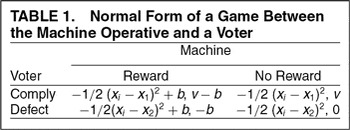
The normal form of the stage game is depicted in Table 1. In the Table, the machine is represented as expending b when it pays a reward, and gaining v when it receives a vote.

The Location on a Spatial Dimension of a Political Machine(x1), Its Opponent (x2), the Median Voter (x*), and a Hypothetical Voter (xi)

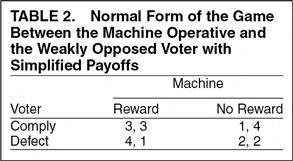
Define voters for whom x<x* as Loyal voters (see Figure 2). Loyal voters' dominant strategy is to vote for the machine. Define voters for whom x>x+b/(x2−x1) as Opposition voters. Opposition voters will oppose the machine even if offered b to change their votes. Define voters for whom x*<x<x*+b/(x2−x1) as Weakly opposed voters. Weakly opposed voters prefer to vote against the machine in the absence of a reward, but prefer to vote for the machine if doing so brings them a reward. If the value of the vote to the machine exceeds b, the machine and the Weakly opposed voter are in a prisoners' dilemma. Table 2 gives the game between a Weakly opposed voter and a machine, with simplified payoffs that make clear the prisoners'–dilemma structure of the game.

Types of Voters by Their Location on a One-Dimensional Policy Space

Next, I assume an infinite sequence of elections and model the interaction between the machine and a Weakly opposed voter as an iterated prisoners' dilemma with one-sided uncertainty.14
In a sense there is uncertainty on both sides, about whether the other will cooperate or defect in the future. This uncertainty characterizes all iterated prisoners' dilemmas—indeed, all repeated games—in which there is more than one equilibrium. I model this game as one of one-sided uncertainty because only the machine is uncertain about whether the voter has cooperated or defected. The voter, by contrast, observes perfectly whether the machine gives him a reward.
Interview conducted in January 2003 in the city of Córdoba by Valeria Brusco, Marcelo Nazareno, and Susan Stokes.
Returning to the model, if the voter votes against the machine, I now assume, the machine observes the negative vote with a probability p. Voters discount the future by a discount factor β, which falls on the interval [0, 1]. The condition for a subgame-perfect equilibrium (SPE) in which the Weakly opposed voter receives the reward and votes for the machine, supported by a grim trigger strategy should the voter be observed to renege, is

In other words, to sustain cooperation, the value to the voter in the current and all subsequent periods of voting for the machine and receiving a reward must equal or exceed the sum of the payoff from defecting in the current period plus (1) avoiding detection and returning to cooperation in the next and subsequent periods (with probability p), or (2) being caught and, in all subsequent periods, voting against the machine but foregoing rewards (with probability 1−p).
Inequality [1] simplifies to

where

Hence, the set of voters who would sell their votes in exchange for a private benefit is the set whose ideal point, xi, satisfies

Lambda falls on the [0, 1] interval. Lambda is an increasing function of the discount rate (β) and of the probability of a defector being caught (p). If p=0 (there is no possibility that the machine would observe a defection by the voter), or if β=0 (the voter cares nothing about future consumption), then inequality [2] reduces to xi=x*. In these cases the machine can buy the votes only of voters who are indifferent, on ideological grounds, between the parties.
Loyal voters do not meet the condition in [2]. As illustrated in Figure 2, for Loyal voters xL<x*. Intuitively, Loyal voters who want to extract private rewards from their preferred party would, under the grim trigger, have to threaten to vote against the party forever if the machine denied them a reward once. Such a threat would lack credibility: the party knows that the Loyal voter, even without rewards, is better off cooperating forever than defecting forever.16
The loyal voter's diehard ideological commitment to the party allows the machine, in a sense, to exploit him, garnering his vote without having to spend scarce resources on him. Loyalists would therefore have an incentive to masquerade as indifferent voters, a possibility that I do not model here. It might, however, be psychologically difficult for party enthusiasts to feign indifference. Note also that any ideological shift by the machine runs the risk of turning the loyalist into an indifferent or even an opposition voter. Machines would then have to consider the distribution of loyal voters and the additional resources that might be needed to retain their support, were it to consider a change in its ideological stance.
Weakly opposed voters (and indifferent voters, where xi=x*) are the only types whose policy ideal points make them potential vote sellers.17
Their minmax payoffs are, for the machine, 0, and, for WO, −1/2(xWO−x2)2. Hence, the feasible and individually rational payoffs they will accept in repeated play include the cooperation payoffs of (v−b,−1/2(xWO−x1)2+b).
Inequality [2] implies four comparative statics:
- As the ideological distance between the two parties (x2−x1) shrinks, the potential for vote buying grows. Intuitively, when the two parties are ideologically or programmatically close, there is less at stake for the voter in the decision of which to vote for, and the value of the private reward becomes more salient.
- As the value of the private reward (b) relative to the value of voting in accordance to one's policy or ideological preference increases, the potential for vote buying increases. The reward must be worth a lot to the voter. But its value to the machine must be less than the value of a single vote—not very much. This suggests that, given decreasing marginal utility from income, machines will target poor voters.
- The more accurately the machine can monitor voters, the greater the potential for vote buying (λ is an increasing function of p). This accuracy is a function of the technology for monitoring voters' actions and of the machine's organizational structure.
- Among its core constituents—those whom it can observe well—the machine is most effective when it targets Weakly opposed voters (for whom x*≤xi≤x*+λ(b/x2−x1)), rather than Loyal (xi<x*) or Opposition voters (xi>x*+b/(x2−x1)) voters.
MACHINE POLITICS AND VOTE BUYING IN ARGENTINA
The comparative statics from my formal model generate hypotheses about the causes of machine or clientelist politics. In this section, I test these hypotheses with evidence from one developing democracy, Argentina.18
The one comparative static from the model that I do not test is that ideological proximity between the parties encourages vote buying. The surveys did not elicit respondents' views of the ideological distance between Argentina's two major parties.
As in the 2003 survey reported on earlier, we used multistage cluster sampling techniques, based on census tracks. In this earlier survey we selected 480 adults each in the provinces of Buenos Aires, Córdoba, and Misiones, and from the area of Mar del Plata. The margin of error was plus or minus 4.5%.
Students of political clientelism and redistributive politics have typically observed the distribution of resources and their effects on voting at aggregated levels, such as the district or the county (see, e.g., Ansolabehere and Snyder, 2002, or Diaz-Cayeros, Magaloni, and Weingast, 2001). The problem of ecological inference can mar this approach. In contrast, the main problem with the survey approach used here is that people may be reluctant to acknowledge receiving handouts, in the Argentine case probably as much because of the implication that they are poor enough to sell their votes as out of concern about the illegality or immorality of their actions. It is probably evidence of this reluctance that only 7% of our sample acknowledged having received goods, whereas 44% said goods were distributed in their neighborhood, 39% could mention exactly what items were distributed, and 35% could name the party that gave them out. The effect of underreporting of clientelism is, in estimations where it is the dependent variable, to bias coefficients downward and make statistically significant associations appear insignificant.
Poverty and Vote Buying
I discuss five pieces of evidence from the survey that lend support to my theory of machine politics. The first has to do with the effect of poverty on a voter's willingness to sell his or her vote. The formal model analyzed earlier predicts that vote buying is more easily sustained, all else equal, when the voter values the private reward relatively highly but the party values it relatively little. The picture this paints is of parties giving minor benefits to voters who are poor enough to value them highly—a picture consistent with much of the qualitative literature on machine and clientelist parties. To cite just one of many examples, Wilson and Banfield (1963) explain that U.S. machines operated in a city's “river wards,” where working-class residents lived, but not in the “newspaper wards,” where middle-class residents lived.
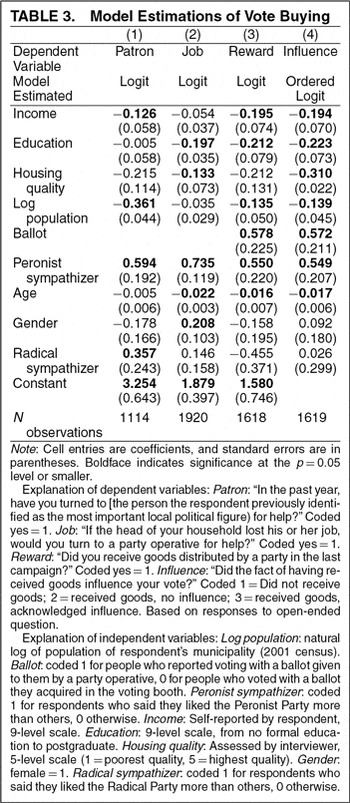
Table 3 reports regression estimates of the likelihood of a clientelistic response to the set of questions discussed earlier, including whether the respondent received a private reward from a party. The negative and significant coefficients on Income, Education, and Housing quality variables show that poverty predicts clientelism. To illustrate the effect, the simulated expected probability that a wealthy person (one with the highest income, education, and housing-quality level) would have received a reward and acknowledged that it influenced her vote is 0.2%. The probability that a poor person (one with the lowest income, education, and housing-quality level) would have received a reward and allowed his or her vote to be influenced by it is 65 times greater: 13%.21
All simulations reported in this section were executed with the Clarify program (King, Tomz, and Wittenberg, 2000, and Tomz, Wittenberg, and King, 2001). Clarify draws simulations of parameters of statistical models (in this case, ordered logit regressions) from their sampling distribution and then converts these simulated parameters into expected values, such as expected probabilities of an answer to a survey question, given hypothetical values of explanatory variables. Clarify software and documentation are available from Gary King's web site at http://gking.harvard.edu. For this simulation I assumed a female Peronist supporter whose age and municipality size were average for the sample. Confidence intervals around the 0.2% expected probability were 0.05% and 0.5%, and around the 13% probability, 7% and 22%.

In sum, political machines buy the votes of poor people in Argentina.
Monitoring Voters
Machine Organizational Structure
In the presence of the secret ballot, parties make inferences about how people vote by observing their type—where they fall on the dimension of programmatic support for the parties. A tentacle-like organizational structure is a great asset to parties in this regard. We know from a large secondary literature that the Argentine party with the organizational structure most like that of the machine is the Peronist party (see, e.g., Auyero 2000, and Levitsky 2003). And our surveys indicate that the Peronist party was by far the most active in distributing private rewards. Eight hundred thirty-nine of our respondents said that a party distributed private rewards in their neighborhoods during the campaign; of these, 423 (50%) said that the Peronists distributed them. The next most frequently mentioned party, the Radical Party, was mentioned by only 49 respondents.
Community Structure
The ease of monitoring is also influenced by the structure of communities where machines operate. We expect voters to be less anonymous, their partisan predispositions or types more a matter of public knowledge, in smaller towns and cities, where social relations are multifaceted and where, as one person we interviewed put it, “everyone knows each other.”22
Interview conducted by Valeria Brusco, Lucas Lázaro, and Susan Stokes, July 2003.
In our surveys, the smaller the population size of the respondent's municipality, the more likely she or he was to have received rewards and to be responsive to them. These two effects are revealed in Table 3 by the negative and significant coefficients relating logged population size (as measured in the 2001 census) to Patron Reward and to Influence variables.23
Note that 90% of our interviews were with people who lived in cities with more than 10 thousand inhabitants. Thus, we interviewed few people who could be said to live in rural communities, and our population variable is best interpreted as distinguishing people according to the size of the urban area in which they lived.
The Technology of Voting
The last two findings— that rewards are distributed by the party with the most machine-like structure, and that people in small towns and cities are more likely to receive, and to be responsive to, rewards—might be interpreted as simply showing that parties hand out rewards preferentially to people whom they can reach most efficiently. But I have argued that efficiency of distribution is just one side of the link between political machines and their constituents. The other side is perverse accountability: the machine's ability to hold voters accountable for their votes.
The fourth piece of evidence that I report goes directly to a party's ability to discern people's votes and to condition rewards on compliance. This evidence has to do with the technology of voting. Recall that Argentines vote with party-produced ballots, which they can acquire either directly from party operatives, as part of the process of face-to-face mobilization, or anonymously, in the voting booth. Ballot in Table 3 is a dummy variable for people who voted with ballots given to them by party operatives (15% of our sample). The positive and significant coefficient relating Ballot to Reward shows that people who vote with personally distributed ballots are more likely than others to receive rewards from parties, such as food or clothing. The positive and significant coefficient relating Ballot to Influence shows that people who receive personally distributed ballots are also more responsive to rewards.24
The confidence intervals around the 7% figure are 4% and 12%. An alternative interpretation is that parties, as a service, deliver ballots to the loyal partisans, who are more likely to vote for them anyway. In this case partisanship would “cause” both the hand delivery of the ballot and support for the party, and the apparent link between ballot delivery and support would be spurious. Yet this alternative explanation is inconsistent with the testimony of party operatives, who, like the one cited earlier, focus their ballot-delivery efforts on uncommitted or indifferent voters, ones who—they fear—might change the ballot in the voting booth.
To give a sense of the magnitude of this effect, the simulated expected probability that a poor voter would allow his or her vote to be influenced by a reward, as we have seen, is 13%. This assumes that the voter received his or her ballot from a party operative. If we assume the same hypothetical poor voter voted with a ballot he or she finds in the voting booth, the probability is cut almost in half, to 7%.
In sum, in Argentina the more able a party is to monitor its constituents, the more effective its efforts at vote buying. The party with the most decentralized and tentacle-like organizational structure, hence the one best able to monitor the actions and types of its constituents, was the party that most actively attempted to buy votes. And the more observable the vote, either because the voter lives in a small community or because he or she receives the ballot directly from a party operative, the more likely he or she is to be the target of vote buying.
Types of Voters and Vote Buying
A fifth piece of evidence speaks to the question, What types of voters do machines pursue? My theoretical prediction was that machines focus their vote-buying efforts on people in the middle of the distribution of partisan predispositions: ones who are indifferent about whether to vote for or against the machine (xM=x*), and ones with a weak predisposition against it (x*≤x≤x*+b/(x2−x1)). Machines will avoid voters who are loyalists or strong opponents.
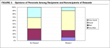
We asked respondents their opinions of the Peronist party, Argentina's preeminent political machine. We asked them to choose among “very good,” “good,” “bad,” and “very bad” as their answers. Figure 3 displays the percentages of people who received or did not receive handouts by opinions of the Peronist party.

Opinions of Peronists Among Recipients and Nonrecipients of Rewards
A striking finding, and one that conforms to the theoretical prediction, is the small proportion of those who rated the party “very good” who received rewards. Three times as many people who did not receive rewards as those who did receive them rated the Peronists “very good” (31% vs. 10%). The Peronist party turned away from its strongest loyalists when it gave out private rewards. (The difference is all the more striking given that one might anticipate some endogeneity of perceptions of the party: people who receive rewards from it might be more prone, because of the gift, to rate the party “very good.”) Another aspect of the findings that accords with my model's predictions is that many more people who rated the party “bad” received rewards than those who rated it “very bad.”
In some ways, however, the findings do not accord with the predictions. Recipients of rewards were concentrated in the “Good” category: nearly 60% of those who received handouts from the Peronists saw it as a good party. These findings are inconsistent with the theory if we think of people who called the machine “good” as falling somewhat to the left of the median ideal point (x*) in Figure 2 and hence as being weakly predisposed in the machine's favor. Recall that, in theory, even voters just mildly predisposed in the machine's favor would not be able to credibly threaten to punish the machine if it defected and therefore would not, in repeated play, be able to induce the machine to pay them rewards. And we might have expected a relatively larger proportion of voters who rated the Peronists as “bad,” and hence who were weakly opposed to it, to receive rewards. Similarly, note that the regression models in Table 3 show that, controlling for other factors, Peronist sympathizers were significantly more likely to receive rewards.
One explanation for the slippage between the theory and the evidence is that our survey did not offer people the option of indicating true indifference about the Peronists. Some people who chose the “good” option might in fact be closer to indifferent. And some people who were close to indifferent, prerewards, might have called the party “bad” but, because of the reward, been nudged into seeing it as “good.”
The finding may also suggest a dynamic that goes beyond the model. Political machines organize by neighborhood and district, and they do more than just give out tactical rewards. They also proselytize. Although their proselytizing, in a competitive setting such as Argentina's, is not perfectly successful, to the extent that it is successful at all we expect the distribution of voter types in areas of machine organizational penetration to be skewed toward machine supporters, weak and strong. In other words, we expect organizational penetration by the party to increase not only the efficiency with which it distributes rewards and its ability to monitor voters, but also its partisan support (as Cox and McCubbins 1986 assume). If organizational penetration increases partisan support, then the machine will target its supporters more than its opponents simply because it has greater access to them. Whatever the explanation for this anomaly, the evidence from Argentina does show unambiguously that, among core constituents, the machine discriminates against its most ardent supporters.
CONCLUSIONS
The dynamic model I analyze and test here by no means answers all of our questions about machine politics. For reasons of space, I haven't addressed the question, If two parties compete by offering private rewards, what determines a voter's choice? One can imagine a bidding-war dynamic, where the value of private rewards escalates rapidly. If two parties offered private rewards of the same value, one would expect the machines to compete for the same set of (ideologically) marginal voters. But competition between “dueling machines” seems, empirically, unusual. It is more common that, even in settings where politics is competitive at the macro level, parties have especially close links to particular groups of voters. And often one party specializes in machine-style politics, whereas another focuses on programmatic mobilization.
This last point raises the question, If parties that are organized as machines can use minor payoffs to sway voters, why don't all parties organize themselves this way? A tentative answer is that parties face unequal costs of monitoring voters. Monitors are most effective when they live among the voters they are observing. Given residential segregation by income, parties with a middle-class base would have to employ middle-class monitors, who would require greater compensation than do the working-class operatives. Parties with middle-class constituencies therefore are more effective when they advertise their programs, focusing resources on “air,” rather than “ground,” campaigns.
These limitations notwithstanding, we have made some headway. I have returned to Scott's insight that machine politics of old is a lot like clientelist politics of new. I have argued that the dynamics of machine or clientelist redistribution has only been half-understood in the literature, which has captured the delivery-of-services but not the monitoring-of-voters side of the story. The literature thus misses the fact that machines are able to use their social proximity to voters to monitor their actions and types and hence to enforce the implicit redistributive contract. This insight allows us to model the strategic interactions between machines and constituents as repeated games.
Casting voter–machine interactions as repeated games allows us to overcome commitment problems, over which the formal literature has stumbled, and to identify equalibria in which vote buying actually takes place. I have shown formally that when voters see parties as ideologically close to one another, vote buying is more likely to occur. I have shown, formally and empirically, that machines target poor people, for whom the payoff of even a small reward outweighs the expressive value of voting for one's preferred party. Empirical evidence also supports the theoretical finding that the more accurately the machine monitors individual voters, either through a tentacle-like party structure or through voting technologies that reduce the anonymity of the vote, the more successful are its efforts at vote buying. And evidence supports (though with some nuances) the theoretical finding that machines avoid extending largesse to diehard loyalists and focus their rewards on voters in the middle of the distribution of partisanship.
The Argentine evidence, then, on the whole supports the theoretical finding that perverse accountability—the ability of parties to monitor constituents' votes, reward them for their support and punish them for defection—is what sustains machine politics.
I thank Valeria Brusco, John Carey, Matt Cleary, Avinash Dixit, Jeff Grynaviski, John Londregan, Scott Mainwaring, Roger Myerson, Luis Fernando Medina, Mario Navarro, Marcelo Nazareno, Steve Pincus, Duncan Snidal, and three anonymous APSR reviewers for excellent comments. I am especially indebted to Michael Wallerstein. Research was supported by National Science Foundation research Grant SES-0241958 and by the John Simon Guggenheim Memorial Foundation.
References
Ansolabehere Stephen, and
James M. Snyder, Jr.
2002.
Party Control of State Government and the Distribution of Public Expenditures.
Massachusetts Institute of Technology. Typescript.Google Scholar
Auyero Javier.
2000.
Poor People's Politics: Peronist Survival Networks and the Legacy of Evita.
Durham, NC:
Duke University Press.
Calvo Ernesto, and
Maria Victoria Murillo.
2004.
“Who Delivers? Partisan Clients in the Argentine Electoral Market.”
American Journal of Political Science
(October):
742–
57.Google Scholar
Chandra Kanchan.
2004.
Why Ethnic Parties Succeed: Patronage and Ethnic Head Counts in India.
New York:
Cambridge University Press.
Chubb Judith.
1982.
Patronage, Power, and Poverty in Southern Italy.
New York:
Cambridge University Press.
Cox Gary W., and
Matthew D. McCubbins.
1986.
“Electoral Politics as a Redistributive Game.”
Journal of Politics
48
(May):
370–
89.Google Scholar
Diaz-Cayeros Alberto,
Beatriz Magaloni, and
Barry Weingast.
2001.
Democratization and the Economy in Mexico: Equilibrium (PRI) Hegemony and its Demise.
Stanford University.
Typescript.
Dixit Avinash, and
John Londregan.
1996.
“The Determinants of Success of Special Interests in Redistributive Politics.”
Journal of Politics
58
(November):
1132–
55.Google Scholar
Fox Jonathan.
1994.
“The Difficult Transition from Clientelism to Citizenship: Lessons from Mexico.”
World Politics
46
(January):
151–
84.Google Scholar
Karlan Pamela.
1994.
“Not by Virtue but by Money Won? Vote Trafficking and the Voting Rights Systems.”
Virginia Law Review
80
(October):
1455–
75.Google Scholar
Keyssar Alexander.
2000.
The Right to Vote: The Contested History of Democracy in the United States.
New York:
Basic Books.
King Gary,
Michael Tomz, and
Jason Wittenberg.
2000.
“Making the Most of Statistical Analysis: Improving Interpretation and Presentation.”
American Journal of Political Science
94:
347–
61.Google Scholar
Kitschelt Herbert,
Zdenka Mansfeldova,
Radoslaw Markowski, and
Gábor Tóka.
1999.
Post-Communist Party Systems: Competition, Representation, and Inter-Party Cooperation.
Cambridge:
Cambridge University Press.
Kochin Michael S., and
Levis A. Kochin.
1998.
“When Is Vote Buying Wrong?”
Public Choice
97:
645–
62.Google Scholar
Levitsky Steven.
2003.
Transforming Labor-Based Parties in Latin America: Argentine Peronism in Comparative Perspective.
New York:
Cambridge University Press.
McCaffery Peter.
1993.
When Bosses Ruled Philadelphia: The Emergence of the Republican Machine, 1867–1933.
University Park, PA:
Penn State Press.
Medina Luis Fernando, and
Susan C. Stokes.
2003.
Clientelism as Political Monopoly.
Chicago Center on Democracy Working Paper #25.
O'Donnell Guillermo.
1996.
Another Institutionalization: Latin America and Elsewhere.
Kellogg Institute Working Paper #222.
Notre Dame, IN:
Kellogg Institute for International Studies.
Organization for Security and Cooperation in Europe.
2003.
Russian Federation State Duma Elections, 7 December 2003: Preliminary Findings of the OSCE International Election Observation Mission.
Vienna, Austria:
OSCE.
Piattoni Simona, ed.
2001.
Clientelism, Interests, and Democratic Representation: The European Experience in Historical Perspective.
Cambridge, England:
Cambridge University Press.
Reynolds John.
1988.
Testing Democracy: Electoral Behavior and Progressive Reform in New Jersey, 1880–1920.
Chapel Hill, NC:
University of North Carolina Press.
Reynolds John.
1980.
“‘The Silent Dollar’: Vote Buying in New Jersey.”
New Jersey History
98:
191–
211.Google Scholar
Scott James C.
1969.
“Corruption, Machine Politics, and Political Change.”
American Political Science Review
63
(December):
1142–
58.Google Scholar
Stigler George J.
1975.
The Citizen and the State: Essays on Regulation.
Chicago:
University of Chicago Press.
Stokes Susan C.
1995.
Cultures in Conflict: Social Movements and the State in Peru.
Berkeley, CA:
University of California Press.
Stokes Susan C.
2004.
Is Vote Buying Undemocratic?
Paper presented annual meetings of the American Political Science Association,
Chicago.
Tam Waikeung.
2003.
Clientelist Politics in Singapore: Selective Provision of Housing Services as an Electoral Mobilization Strategy.
University of Chicago.
Typescript.
Tomz Michael,
Jason Wittenberg, and
Gary King.
2003.
Clarify: Software for Interpreting and Presenting Statistical Results. Version 2.1.
Cambridge, MA:
Harvard University,
January 5. Http://gking.harvard.edu.
Wilson James Q., and
Edward Banfield.
1963.
City Politics.
Cambridge, MA:
Harvard University Press.

The Location on a Spatial Dimension of a Political Machine(x1), Its Opponent (x2), the Median Voter (x*), and a Hypothetical Voter (xi)
Normal Form of a Game Between the Machine Operative and a Voter

Types of Voters by Their Location on a One-Dimensional Policy Space
Normal Form of the Game Between the Machine Operative and the Weakly Opposed Voter with Simplified Payoffs
Model Estimations of Vote Buying
Opinions of Peronists Among Recipients and Nonrecipients of Rewards
 You have Access
- 895
- Cited by
Comments
No Comments have been published for this article.