INTRODUCTION
Robbins et al. (Reference Robbins, Sakari, Nezami Baluchi and Clark2006) recorded a single male Chinese mitten crab (Eriocheir sinensis H. Milne Edwards, 1853) from Anzali Wetland along the Iranian coast of the Caspian Sea. A single female of E. sinensis was reported in the same year by Clark et al. (Reference Clark, Abdul-Sahib and Al-Asadi2006) from the Shatt Al-Basrah Canal in southern Iraq, northern Persian Gulf estuarine system. During the ‘Gulf I congress’ held in Al-Ain, United Arab Emirates in 2006, the occurrence of the Chinese mitten crab E. sinensis in the northern Persian Gulf was announced in an oral presentation by M. Apel and J. Bishop. Since then there have been more reports of E. sinensis from the region (Hashim, Reference Hashim2010; Naser et al., Reference Naser, Son and Yasser2011). Naser et al. (Reference Naser, Timothy, Ng, Apel, Yasser, Bishop, Ng and Clark2012), based on detailed morphological comparison and CO1 analysis, assigned Iraqi specimens to E. hepuensis, Dai, 1991. They also provided morphological discriminative characters of both Eriocheir species.
Local fishermen from the northern Persian Gulf marshlands of Iran have been reporting the occurrence of a shaggy crab in the region. During a scientific excursion to the area a small female crab was found under a stone. The purpose of this paper is to report the presence of E. hepuensis from Bahmanshir, southern Iran, which is a further recognition of this invasive species in the region.
Material examined
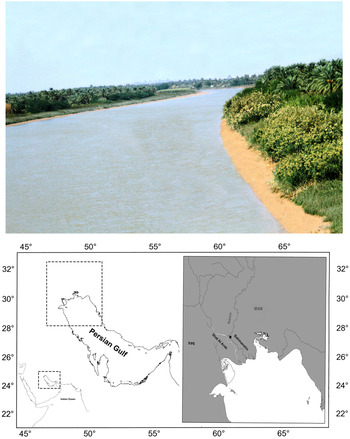
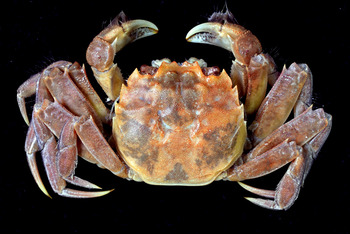
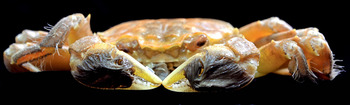
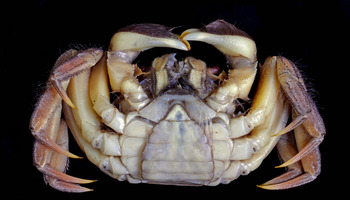
1♀, carapace length = 28.22 mm, carapace breadth = 31.00 mm, collected from under stone in muddy bank of the Bahmanshir River, Pole-Tanki Abolhassan, Abadan, Iran (see Figure 1); deposited in the Zoological Museum, University of Tehran (ZUTC 5235) (Figures 2, 3 & 4).
Map showing the position of the Persian Gulf and northern Persian Gulf estuarine system. Sampling site indicated by a black rectangular on the map. Photograph above is sampling habitat in Pole-Tanki Abolhasan, Abadan, Bahmanshir River, Southern Iran (photograph taken by R. Naderloo).

Eriocheir hepuensis (ZUTC 5235): dorsal view of the female specimen (photograph taken by R. Abdollahi).

Eriocheir hepuensis (ZUTC 5235): frontal view of the female specimen, indicating the setal patch on the cheliped manus (photograph taken by R. Abdollahi).

Eriocheir hepuensis (ZUTC 5235): ventral view of the female specimen (photograph taken by R. Abdollahi).

DISCUSSION
The majority of the human-induced effects on the ecosystem are directly or indirectly related to the developing oil-related industries in the region of the Persian Gulf. Annually, around 25,000 tankers transport oil and gas via the Strait of Hormuz from 25 main oil terminals to western and eastern countries (Haapkylai et al., Reference Haapkylai, Ramade and Salvat2007). For such a small region, this large amount of maritime traffic provides an enormous vector for the introduction of invasive species with respect to ballast water and hull fouling. Unfortunately, because of the paucity of detailed faunistic studies and regular biodiversity monitoring projects in the Persian Gulf ecosystem, there is no referable data on the exotic species in the area. Naser et al. (Reference Naser, Son and Yasser2011) listed five exotic invertebrates in the Shat Al-Arab marshes of Iraq. During the recent expedition to Bahmanshir, southern Iran, a further five crustacean species were found at the same habitat with E. hepuensis including Chiromantes boulengeri (Calman, 1910) (Decapoda), Neorhynchoplax kempi (Chopra & Das, 1930) (Decapoda), Palaemon elegans (Rathke, 1837) (Decapoda), Amphibalanus amphitrite (Darwin, 1854) (Cirripedia) and Sphaeroma ananndalei Stebbing, 1911 (Isopoda). Of these, the first two species are abundant in the northern Persian Gulf, whereas P. elegans is non-indigenous, being first recorded by Holthuis & Ali (Reference Holthuis and Ali1975). Chiromantes boulengeri Calman, 1910, is found in freshwater habitats and is common in the northern Persian Gulf estuarine system (Naderloo & Schubart, Reference Naderloo and Schubart2009).
The Hepu mitten crab was thought to be transported through ships' ballast water (Clark et al., Reference Clark, Abdul-Sahib and Al-Asadi2006; Naser et al., Reference Naser, Timothy, Ng, Apel, Yasser, Bishop, Ng and Clark2012). This species has probably become established in the Iraqi marshlands. Invasive Eriocheir species are problematic due to their burrowing activities along river banks, their ability to disperse widely over river catchments and their potential consumption of the native biota. Consequently this crab should be carefully monitored and consideration should be given to beginning an eradication programme before it becomes fully established. Eriocheir is a catadromous species living (mostly) in fresh water but migrating to marine waters to breed (Clark et al., Reference Clark, Abdul-Sahib and Al-Asadi2006; Hashim, Reference Hashim2010; Naser et al., Reference Naser, Son and Yasser2011, Reference Naser, Timothy, Ng, Apel, Yasser, Bishop, Ng and Clark2012). The present sampling from Iranian waters shows this species occurring in the upper reaches of the rivers. Furthermore, the watersheds of the three main rivers (Euphrates, Tigris and Karun) could be expected to be inhabited by this species (Clark et al., Reference Clark, Abdul-Sahib and Al-Asadi2006; Naser et al., Reference Naser, Timothy, Ng, Apel, Yasser, Bishop, Ng and Clark2012).
ACKNOWLEDGEMENTS
This report is a part of the biodiversity project funded by the Iran National Science Foundation (INSF) and the University of Tehran. I greatly appreciate my graduate students, Mina Gharavi, Saeed Ebrahimnejad and Saeedeh Julani for their kind help in the field and R. Abdollahi for taking photographs of the Hepu crab. Paul Clark, Natural History Museum, London is kindly acknowledged for improving the manuscript.