1. Introduction: What is Linguistic Purism?
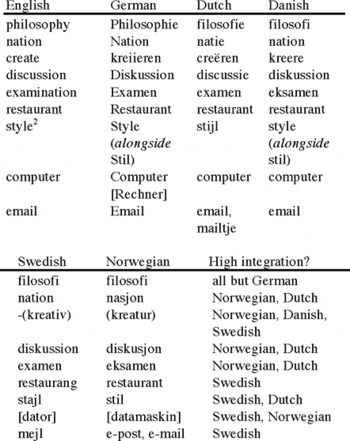
Sand⊘y (Reference Sand⊘y, Sand⊘y and Tenfjord2006:83) calls Norwegians strong “orthographic purists.” loanwords are integrated in spelling as far as possible in line with their Norwegian pronunciation. Table 1 below provides some examples of older and more recent borrowings, with comparisons to German, Dutch, Danish and Swedish. Similarities and differences across languages are immediately obvious (see last column), and they invite further comparisons:
i. How do these speech communities compare on their attitudes to uncertainties in spelling and to spelling reform?
ii. How do these speech communities compare in their attitudes to the influence of other languages, of which loanwords like those in table 1 are an obvious but not the only important instance?
I pursue these two questions in the following, and take the opportunity to reflect on the notions of linguistic nationalism and linguistic purism as applied to the Germanic languages.Footnote 1
Orthographical integration of loanwords in some Germanic languages.

My starting point is Thomas’ commonly cited working definition of linguistic purism (Reference Thomas1991:12):
Purism is the manifestation of a desire on the part of a speech community (or some section of it) to preserve a language from, or to rid it of, putative foreign elements or other elements held to be undesirable (including those originating in dialects, sociolects and styles of the same language). It may be directed at all linguistic levels, but primarily the lexicon. Above all, purism is an aspect of the codification, cultivation and planning of standard languages.
Thomas' definition privileges purism directed at foreign elements, especially in the lexicon. The xenophobic foreign word purism of seventeenth- to nineteenth-century Germany (though from the eighteenth century onwards, other, anti-elitist motivations also played a role alongside the xenophobic one) is for Thomas (Reference Thomas1991:199) the prototype for purist movements elsewhere in Europe. It is the “classic case.” In this article, however, I suggest that it is today not the only common manifestation in the Germanic languages. I argue as follows:
i. While Thomas (Reference Thomas1991:80) labels any rejection of foreign elements “xenophobic,” purism may be directed at a perceived external threat without being xenophobic (in the common pejorative sense, with its associations of chauvinism). Although the target is foreign matter, the motivation may be non-chauvinist nationalist rather than chauvinist. It is important today to distinguish the xenophobia of chauvinist nationalism from a modern nationalism which asserts the important link between nation and identity, while more or less explicitly rejecting chauvinism (explicitly for instance in Jansen Reference Jansen, Blanke and Scharnhorst2007:135, regarding Dutch).
ii. Foreign word purism is not the only expression of linguistic nationalism. At the level of policy in many Germanic-speaking countries, foreign word purism is downplayed but linguistic protectionism finds expression instead in official efforts to protect the domains in which the state's language is used. Not the linguistic system, but its range of use as a “complete” language must be protected.
iii. A prominent target of puristic efforts in the Germanic languages today is orthography. Such orthographic purism may be defensive (in the face of a perceived threat, such as the fear of foreign orthographical conventions undermining those of the language), but it may also be “unificatory,” aiming to “satisfy the solidarity criterion of standard languages” (Thomas Reference Thomas1991:76, who introduces these terms from Ŝevĉik Reference Ševčik1974–1975:56).
I conclude by drawing some comparisons of linguistic nationalism, purism, and protectionism across several Germanic languages.
2. Purism, National Identity, and a New Sort of Nationalism
At least three types of linguistic nationalism must be distinguished in the Germanic-speaking countries. Gardt (Reference Gardt1999:302; Reference Gardt and Gardt2000) makes a principled distinction between linguistic nationalism and linguistic patriotism. Linguistic patriotism is for Gardt characterized by praise of one's own language, by the hypostasization of “the” language as a unified whole with identifiable, positive attributes, and by equations of the language with other entities: the culture, the people (Volk), etc.Footnote 3 Linguistic nationalism is a later, more extreme, and unacceptable development, which goes as far as denigrating foreign languages, cultures, and political systems (Gardt Reference Gardt1999:302–303, also Gardt Reference Gardt and Gardt2000:247–250). German linguistic nationalism (in Gardt's sense of the term) came to the fore in the nineteenth century, and was discredited after the excesses of National Socialism. However, Stukenbrock (Reference Stukenbrock2005a:432–438) questions Gardt's principled distinction between nationalism and patriotism. Stukenbrock finds many continuities in German discourse about language from 1600 to 1945—in rhetorical strategies, metaphorical fields, and underlying assumptions—and so Stukenbrock prefers to apply the term “linguistic nationalism” to the full spectrum of such patriotically motivated linguistic activism. However, Stukenbrock's study stops at 1945. The idea of linguistic patriotism or nationalism has been an uncomfortable one for Germans since World War II.
And yet linguistic nationalism is not dead in Germany, merely changed. For instance, though there is not space to demonstrate it here, the discourse of the language society Verein Deutsche Sprache (VDS) exhibits eight of nine markers of linguistic nationalist discourse identified by Stukenbrock.Footnote 4 Purist reactions to the spelling reform, too, share many of the hallmarks, though again I do not have space to demonstrate this here.Footnote 5 Only Stukenbrock's ninth and final characteristic distinguishes linguistic nationalism up to 1945 from more recent expressions of German nationalism: according to Stukenbrock's so-called “automystification principle” (Stukenbrock Reference Stukenbrock2005a:438–439), a certain mystical essence in the language remains ineffable to linguistic nationalists (and may be referred to as its Eigentümlichkeit, or its unique Sprachgeist). Other entities correlated with language, such as Volksgeist, may also be portrayed as mystical. This strategy provides a compensatory justification for the fact that such invented notions as Sprachgeist or Volksgeist cannot, in fact, be satisfactorily defined. This last characteristic identified by Stukenbrock for the period up to 1945 no longer seems to be a feature of mainstream linguistic nationalism in Germany. Instead, the unchallengeable, mystical value underpinning recent nationalist purist discourse is, I would argue, democracy.
Opposing the 1996 spelling reform is equated with restoring true democracy:
Die Sprachbildung ist eine zutiefst demokratische Angelegenheit, eine Form der Willensbildung von unten, bei der es gilt, den Leuten “auf's Maul” zu schauen, statt die Sprache von oben herab zu reglementieren.Footnote 6
[Shaping the language is a profoundly democratic matter, an expression of will from below, in which one must look at the language of people on the street, instead of regulating the language from above.]
Eine ganz andere Frage ist es aber, ob man das Regelwerk der deutschen Nationalsprache (die gemeinsames Eigentum aller ist, die diese Sprache sprechen!) dem Gutdünken einer zwölfköpfigen Kommission aussetzen kann. Egal, wie kompetent diese Kommission auch besetzt sein mag—die Antwort lautet ganz einfach: nein. (Sparschuh Reference Sparschuh2005:433).
[It is quite another question whether one can leave the rules for the German national language (the common property of all who speak this language!) up to the whims of a twelve-member commission. Regardless of how competent the commission's members might be—the answer is quite simply: no.]Footnote 7
Puristic discourse against Anglicisms likewise rests on arguments founded on Western democracy, for example by appealing to the UNESCO declaration on cultural diversity of 2001; the Verein Deutsche Sprache's Sprachpolitische Leitlinien call for similar explicit protection of cultural and linguistic diversity to be included in an EU constitution. While often hostile to British and (especially) US hegemony, such purist discourse today is not chauvinistically nationalistic. Rather, the case of German is carefully set in a wider European context:
Gegen die Behauptung von der “einzigartigen” Funktionalität des Englischen behauptet der Verein Deutsche Sprache die sprachliche Identität und kulturelle Herkunft der europäischen Sprachen und Staaten. (Verein Deutsche Sprache Argumente, III).
[Against the assertion of the “unique” functionality of English, the Society for the German Language asserts the linguistic identity and cultural origins of the European languages and states.]
Purist arguments about language and identity today in Germany, then, explicitly reject Deutschtümelei. In a secular age, the higher authority relied on is neither religious (God's plan for German and Germany, in which seventeenth century patriots like J. G. Schottelius (Reference Schottelius and Hecht1663) believed) nor pseudo-religious (as in Nazi mythologizing of an Aryan destiny). Rather, it is the legal and ideological framework that underpins the democratic Western world with which Germans now identify them-selves. There is an interesting parallel with Sweden here, where Romantic, chauvinistic nationalism was likewise discredited after World War II by its associations with Nazi racial theories. It “became more or less taboo to discuss Swedishness” (Linn & Oakes Reference Linn, Leigh, Fandrych and Salverda2007:60). Swedes instead took pride in their ‘inverted’ nationalism, identifying themselves with being modern and international. Knowledge of English as the international lingua franca became itself “a distinctly Swedish trait” (Linn & Oakes Reference Linn, Leigh, Fandrych and Salverda2007:60; see Oakes Reference Oakes2001:64–69, 165, also Oakes Reference Oakes2005). Germany, too, has re-invented itself in a similar sort of inverted nationalism—less internationalist than that of Sweden, perhaps, but with a similar recognition of international—especially democratic—values. Footnote 8
This section has presented recent German foreign-word purism and spelling purism as expressions of a new type of linguistic nationalism. But the overlap of purism and nationalism in the history of the European languages, and of German in particular, should not lead us to assume that linguistic nationalism and linguistic purism necessarily overlap. I now consider some instances of non-overlap.
3. Linguistic Nationalism in Germanic Language Policies Today
Despite concerns in the population at large (see table 2 in section 4, below), there is little or no appetite at the level of policy for foreign-word purism in the Germanic-speaking countries discussed here. In Sweden, neither the 2002 language report Mål i mun (SOU 2002:27) nor the 2008 proposal for a language law with the programmatic title Värna Språken (“To defend the language,” SOU 2008:26) contain any reference to curbing the use of English loanwords in Swedish. There is no mention of English loanwords in the most recent (third edition) “blacklist” of expressions and phrases to avoid in formulating official documents and statutes, published by the Swedish government initiative Klarspråk (“Plain language”). The Danish government initiative “Best on the net” (Bedst på nettet) lists questions web designers should ask themselves about the language they use (listed Kulturministeriet 2008:92), but again the topic of English loanwords is conspicuous by its absence, at most implicit in the test “Are ‘common’ words used?” (Er der brugt “almene” ord?)
Indeed, in the most recent Danish government report on language, Sprog til tiden (Kulturministeriet 2008), discussion of loanwords from English is presented in the most anti-inflammatory context possible. A text-box on the recent influence of English (Kulturministeriet 2008:12) is preceded by other text-boxes about the medieval influence of Low German on Danish and about other, even earlier language contacts, while the format of the text-box itself—that is, separated from the main discursive text—presents the topic merely as an interesting feature, rather than as a core issue. The text states that Danish is no different from the majority of other European languages in having undergone massive and rapid influence from English; the fact that in some domains English is preferred to the mother tongue is likewise described as “characteristic” of a pan-European development. The downplaying of English lexical influence is so strong as to be disingenuous.
In the Netherlands, the frequency of English words in advertising and youth culture in particular attracts comment in the media, and individual high profile instances of English in Dutch have been criticized (such as the punning slogan for Amsterdam, I AMsterdam). Although the Dutch Language Union (Nederlandse Taalunie, funded jointly by the Netherlands and Flanders to formulate and promote language policy) selected English influence as the topic for its inaugural annual public debate on November 12, 2007 in response to public interest (De opmars van het Engels in het Nederlandse taalgebied: uitdaging, fait accompli, of blessing? “the rise of English in the Dutch language area: challenge, fait accompli or blessing”), its own recent policy documents nowhere profess concern about loan-words from English (Taalunie Reference Taalunie2007, Reference Taalunie2008).
In sum, the absence of foreign word purism in official spheres is so noticeable in Denmark, Sweden and the Netherlands at least, that one might speak of anti-purism at an official level (on anti-purism, see Thomas Reference Thomas1991:81)—even if this may well be at odds with popular feeling, as noted at the start of this section.
The absence of foreign-word purism at the level of policy does not mean, however, an absence of linguistic nationalism. On the contrary, recent policy from the governments of these non-German Germanic languages all explicitly address the danger of domain loss to English, especially in the area of higher education, where increasing numbers of degree courses are taught wholly or partly in English (see Linn & Oakes Reference Linn, Leigh, Fandrych and Salverda2007). Swedish, Danish, Norwegian, and Dutch policy documents all assert explicitly that their language is a “complete” language—that is, “a language that can be used in all domains and social situations” (die zich laat gebruiken in alle domeinen en alle sociale situaties, Taalunie Reference Taalunie2007:17; similarly Danish Kulturministeriet 2008:8; Swedish SOU 2008:16, 20; Norwegian Språkrådet 2005:12). An example of the impact of this concern for a “complete” language is the establishment in April 2007 of a Centre for Dutch-language technical terminology (Steunpunt Nederlandstalige Terminologie; see Taalunie Reference Taalunie2008:15), which aims to ensure consistency across terminology developers, users, and translators, to ensure the language is in practice complete across specialist fields (and which has a model in the French commissions de terminologie, in existence since the early 1970s; see Schmitt Reference Schmitt and Andreas2000:711).
The similarities between language policies of the Nordic countries are scarcely surprising—they share a Nordic Language Council—but it is interesting that Dutch language policy is heading in the same direction. The new challenge at an official level, at least, is linguistic protectionism expressed not through campaigns against foreign borrowings in the lexicon, but through language domain protection: lexical enrichment (adding to the language) instead of purifying campaigns (attempts to “subtract” from the language). Domain protection promotes the creation and use of “native” technical terms that make it possible to argue that foreign words are superfluous in those domains, at least.
4. Spelling and Linguistic Purism in Germanic Speaking Countries
As suggested above, the massed resistance to spelling reform in Germany can be viewed as an instance of linguistic purism (Langer Reference Langer2001), non-chauvinistic but nationalistic. How do attitudes to spelling reforms in some of the other Germanic-speaking countries compare? Dutch underwent a very unpopular spelling reform in 2005; in Denmark, reform proposals are under discussion, to be presented in 2009; in Sweden the thirteenth update of the Swedish Academy Wordlist appeared in 2006. How do reactions in public discourse in these countries compare with that in Germany?
4.1. The Dutch Spelling Reform and Reactions.Footnote 9
Spelling has a special place in the hearts of the Dutch—the Groot Nederlands Dictee is an annual dictation competition (since 1990), broadcast live from the Lower house of Den Haag. But when in 2005 a new Groene Boekje (the definitive “Little Green Book”) was published (Taalunie Reference Taalunie2005), aiming to spell out rules in greater detail than had the 1995 Groene Boekje (published as the first update since 1954, with the intention that updates would henceforth appear every ten years), it was not well received.Footnote 10 A partial media boycott resulted, and the language society Genootschap Onze Taal (founded in 1931 by a group of language purists, but now describing itself as a society for language lovers, taalliefhebbers) published a competing Witte Boekje (“Little White Book” = Genootschap Onze Taal 2006), which simplified explanations of rules, but in some cases disregarded them. As in the German debate (see Stenschke Reference Stenschke2005), certain words took on iconic status in the media discussion of the spelling reform: paardenbloem ‘dandelion’ came to represent the insertion of an -n- in compounds of certain types, while ideeëloos ('clueless', replacing ideeënloos) was a word which lent itself to critical headlines (see Sanders Reference Sanders2005). Superficially, then, the resistance to the spelling reform seems akin to reactions in Germany. In fact, objections were chiefly practical rather than nationalistically purist. Proponents of the reform emphasized the increased unity in the system, while critics opposed it because of perceived lack of uniformity (in part where genuine errors were spotted) or because the complicated presentation obscured the uniformity. The Taalunie website rejects the Witte Boekje preference for alternative variant spellings as inherently undesirable—for instance, when searching documents or websites electronically, one might have to search for two alternatives. In the Netherlands, then, we find purism directed at the orthography, as in the German case, but the motivation behind the discussion appears to be narrower: it is the “standardization ideology” aiming at minimal variation and maximum uniformity (Milroy & Milroy 1991:22). A strong standardization ideology is perhaps not surprising in a speech community that has worked hard in recent decades to create and promote a standard language spread across two (and since 2004, with Suriname, three) states.
The same standardization ideology lies behind other expressions of Dutch orthographical purism, too. An entire website is devoted to spacing errors (SOS Signalering Onjuist Spatiegebruik; it is not clear by whom the site is maintained). Many of the errors reported on this website are occasioned by failure to apply Dutch spelling conventions for compounding to borrowed words—the “winner” for 2007 was naakt modellen tekenen ('draw models while naked'; the intended meaning was ‘draw naked models'). Indeed, borrowings are the source of many of the technicalities in spelling. One iconic case in 2005 was the word apparently now to be spelt would-beschrijver ('would-be writer', open to misreading as ‘would-describer'; the Taalunie clarified that a hyphen is always permissible for readability, hence would-be-schrijver). Yet although so many difficulties in Dutch spelling do in fact concern non-native words, it is their spelling, not their presence in Dutch, that is the focus of purism. Several of the most frequently consulted (Top-25 [sic!]) online advice notes provided by the language society Genootschap Onze Taal concern the correct orthographical integration of English borrowings in Dutch. We learn that fte (meaning ‘full time equivalent', a bureaucratic term) has the plural fte's and the diminutive fte'tje [!]; the spelling of the past participle of ‘to fax’ is gefaxt, because -t rather than -d follows voiceless consonants. Other problem cases—such as the conjugation of leasen, skaten, etc.—are similarly resolved by reference to spelling rules, and with no suggestion of avoiding the word (though there is a suggestion to avoid the awkward past participle ge-e-maild by rephrasing).
4.2. Reactions to Spelling Changes in Sweden
The most recent, 2006 edition of the Swedish Academy's Wordlist (Svenska Akademiens ordlista or SAOL 13, the thirteenth edition since 1894, replacing the twelfth edition of 1998) for the first time recognized w as a separate letter. (Spellings with w had previously been listed in dictionaries under v, though spelt with w). Although the change is peripheral in that it affects only borrowed words, it is nevertheless very salient to language users and amounts to a concession to the influence on Swedish of foreign phonologies and orthographies. However, reactions appear to have been entirely pragmatic. A headline in the Svenska Dagbladet (April 20, 2006) declares the dramatic news, “The alphabet no longer has 28 letters, but 29” (Alfabetet består inte längre av 28 bokstäver, utan 29), but the opening sentence makes clear the change is welcome: “finally, for that's international practice” (Äntligen—för det är internationell praxis, Boldmann Reference Boldmann2006). More significant in the mind of Bo Löfvendahl, writing in the same paper on April 22, 2006, is the treatment in SAOL 13 of some English loanwords, which are for the first time accompanied by the advice: “rather use …” and a Swedish alternative—a first hint of officially sanctioned foreign-word purism, then.
Swedish tolerance towards variation in spelling is also evident in the case of the word just ‘fair', which is found spelt variously as sjyst, schyst, schysst, and just. In his regular language column for the Svenska Dagbladet on March 29, 2008, Siv Strömqvist observed that his students prefer schysst, although sjyst and schyst are the two alternatives permitted by the SAOL. In 2004 Catharina Grünbaum, in her own language column for Dagens Nyheter, had already commented on this variation, but had rejected schysst because of a rule against a double -ss- before -t, except when the -t is added as a grammatical suffix (for example, visst, kysst ‘certainly, kissed', where the -t is a marker of an adverb and of a past participle). However, Grünbaum's concern with consistency appears to run counter to public opinion. In a Dagbladet on-line vote running since March 29, 2008, it is the non-authorized, non-listed spelling of schysst which in June 2008 had a clear majority of the votes (57% of the 3427 people who participated). The wry headline to Strömqvist's article Både sjyst och schyst är schysst att skriva (perhaps best translated “Both spellings of right are wright”), sums up an open attitude to orthographical variation that is hard to imagine in the German context.
Some Swedes themselves are aware of a different attitude to spelling compared to Germans. The author of a 2004 article about the German spelling reform (Tralau Reference Tralau2004) begins: “Recently one of Germany's most bitter conflicts has escalated. For a Swede it might seem strange: the conflict concerns spelling” [Nyligen trappades en av Tysklands bittraste strider upp. För en svensk kan det förfalla besynnerligt: konflikten handlar om rättstavning]. The author must explain to his readers that “people in Germany are often conservative where the development of the language is concerned.”
Although space constraints prohibit discussion of Norwegian here, it is useful to note that Norwegians are accustomed to considerable variation in both spelling and inflection because of the existence of two standard written forms of the language (Bokmål and Nynorsk), and so have a weak expectation of homogeneity and uniformity in the written language in any case. Perhaps Sweden is influenced by its neighbour in this regard.
4.3. Spelling Reform in Denmark
In Denmark, the most recent spelling reform was that of 1948, in which capitals for nouns (as still used in German) were abandoned. Thanks to rapid changes to pronunciation in the direction of the Copenhagen prestige variety over the last century or so, Danish, like English, now exhibits a considerable discrepancy between its spelling and pronunciation. The Danish language council has undertaken to present a proposal for a spelling reform in the new edition of the Spelling Dictionary (Retskrivningsordbogen) planned for 2009. Suggestions for reform range from very radical changes like those of the linguist Frans Gregersen, who proposed sweeping changes such as doing away with of the silent h- in words beginning with hv- and hj- (Thorsen Reference Thorsen2005), to much milder proposals, limited to getting rid of permitted doublets (where two spellings are possible, causing confusion, such as cykelen and cyklen ‘the bicycle') and clarifying where words should be written as a compound or separately.
Arguments in favour of reform presented in mainstream Danish newspapers since 2005 are familiar to anyone who followed the progress of the reform in Germany: children's poor performance in reading and spelling compared to other countries; the democratic project of making spelling accessible to all, not just to an elite concerned to protect its privilege; uncertainty over whether words should be written as one or two words and over existing doublets. Yet a leader by the editor of the chief Danish newspaper Politik, Klaus Ulrik Keel (Keel Reference Keel2005) was highly critical of the language council's desire for change. Keel used many of the same arguments that characterized opposition to the German spelling reform: querying the value of the contribution of learned linguists remote from everyday users (the democratic argument); uncritical reliance on majority usage (even if incorrect) as a criterion for change; cost of changing existing reference works and textbooks; fear of alienation from the cultural inheritance (epitomized by Hans Christian Andersen); and “aesthetic shock.” But one further, specifically Danish argument against dramatic reform must carry considerable weight. As a small language community, Denmark benefits from membership of the Nordic language group, including the much larger languages Norwegian and Swedish. Some changes to bring spelling closer to Danish pronunciation would simultaneously increase the distance from these other languages and reduce their mutual comprehensibility (in reading, at least). Yet promoting this facility in communicating with neighbouring languages remains a priority in the most recent policy document in Denmark (Kulturministeriet 2008:115), which recommends that examinations in Danish should also include texts in neighbouring languages. Not surprisingly, therefore, the report concludes cautiously that in the short term, reform should be limited to adjusting the spelling of individual words and phrases (Kulturministeriet 2008:26).
5. Conclusion
Surveying some manifestations of linguistic purism and linguistic nationalism in a number of Germanic-speaking countries, I have suggested that linguistic purism and linguistic nationalism today are separate phenomena that may overlap (as in the German case, in the guise of a new nationalism), but that do not necessarily do so. Purism is neither just one manifestation of linguistic nationalism, nor is linguistic nationalism one variant of purism. Rather, figure 1 captures better the reality. Non-nationalistic but standardization-ideology oriented orthographical purism is found in the reactions to uncertainties caused by the 2005 spelling reform in the Netherlands, for instance; Swedish tolerates variation, but exhibits a (modern) nationalist purism in the strong orthographical integration of loanwords.
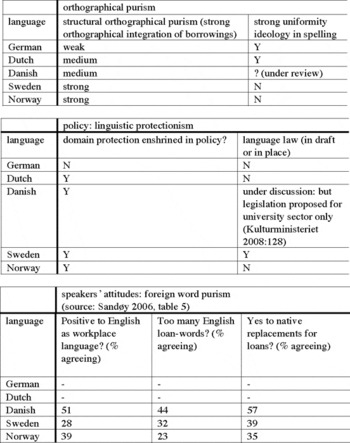
As for linguistic nationalism within the Germanic languages, Germany on the one hand, and Norway and Sweden at the other, lie at opposite ends of the scale (see table 2). By all measures, Sweden and Norway lead the way—both in the established principles of orthographic purism, and in current policy. Sweden is the first of the Germanic countries to have a language law. Speaker attitudes appear to match this protectionism: Norway and Sweden also score higher than Danish (and all the other Nordic languages: see Sand⊘y Reference Sand⊘y, Sand⊘y and Tenfjord2006:table 5) for foreign word purism, and lowest on readiness to accept English as the language of the workplace. Denmark is more moderate on all these measures, though both it and the Netherlands are now following the Swedish and Norwegian lead in domain protection. (Iceland—not discussed here—has pursued such a policy for some decades; see Árnason Reference Árnason, Deumert and Vandenbussche2003:274.) Meanwhile, Norway and Sweden appear least committed to the “minimum variation and maximal uniformity” standard language ideology, something which is reflected prominently in both German and Dutch spelling debates. It will be interesting to see where Denmark falls when its proposals are presented in 2009.
Conceptualizing linguistic nationalism, linguistic purism, standardization ideology, and attitudes to spelling.

Some indicators of linguistic purism and linguistic nationalism in a selection of Germanic speaking countries.