INTRODUCTION
People with HIV (PWH) are twice as likely to engage in heavy alcohol use and two to three times more likely to meet the criteria for an alcohol use disorder (AUD) in their lifetime than the general population (Galvan et al., Reference Galvan, Bing, Fleishman, London, Caetano, Burnam and Shapiro2002; Justice, Reference Justice2010). Heavy alcohol use not only promotes the transmission of HIV through sexual risk-taking behavior and nonadherence to antiretroviral therapy (ART; Cook & Clark, Reference Cook and Clark2005; Paolillo, Gongvatana, Umlauf, Letendre, & Moore, Reference Paolillo, Gongvatana, Umlauf, Letendre and Moore2017; Wen, Balluz, & Town, Reference Wen, Balluz and Town2012), but also directly exacerbates HIV disease burden by compromising the efficacy of ART and increasing systemic inflammation (Bryant, Reference Bryant2006; Miguez, Shor-Posner, Morales, Rodriguez, & Burbano, Reference Miguez, Shor-Posner, Morales, Rodriguez and Burbano2003; Shuper et al., Reference Shuper, Neuman, Kanteres, Baliunas, Joharchi and Rehm2010; So-Armah et al., Reference So-Armah, Cheng, Freiberg, Gnatienko, Patts, Ma and Samet2019). In addition to increased risk for physical illness (e.g., liver disease and cardiovascular risk; Molina, Simon, Amedee, Welsh, & Ferguson, Reference Molina, Simon, Amedee, Welsh and Ferguson2018; Price & Thio, Reference Price and Thio2010), there is substantial evidence indicating that comorbid HIV and heavy alcohol use is more detrimental to brain structure and results in higher rates of neurocognitive impairment than either condition alone (Rosenbloom, Sullivan, & Pfefferbaum, Reference Rosenbloom, Sullivan and Pfefferbaum2010; Rothlind et al., Reference Rothlind, Greenfield, Bruce, Meyerhoff, Flenniken, Lindgren and Weiner2005; Sullivan & Pfefferbaum, Reference Sullivan and Pfefferbaum2019).
The impact of comorbid HIV and heavy alcohol use on the central nervous system (CNS) is especially important to consider in the context of aging. The population of older adults with HIV is rapidly growing; approximately 48% of PWH in the USA are aged 50 and older and the prevalence of PWH over the age of 65 increased by 56% from 2012 to 2016 (Centers for Disease Control and Prevention, 2018). Trajectories of neurocognitive and brain aging appear to be steeper in PWH (Cohen, Seider, & Navia, Reference Cohen, Seider and Navia2015), possibly due to chronic inflammation and immune dysfunction, long-term use of ART, frailty, and cardiometabolic comorbidities (Pathai, Bajillan, Landay, & High, Reference Pathai, Bajillan, Landay and High2014). In addition to HIV, rates of alcohol use and misuse are also rising in older adults (Breslow, Castle, Chen, & Graubard, Reference Breslow, Castle, Chen and Graubard2017; Han, Moore, Sherman, Keyes, & Palamar, Reference Han, Moore, Sherman, Keyes and Palamar2017). The neurocognitive and physical consequences of heavy alcohol use are more severe among older than younger adults, and several studies also report accelerated neurocognitive and brain aging in adults with AUD (Pfefferbaum et al., Reference Pfefferbaum, Zahr, Sassoon, Kwon, Pohl and Sullivan2018; Sullivan & Pfefferbaum, Reference Sullivan and Pfefferbaum2019). While mechanisms underlying these effects are poorly understood, older adults may be more vulnerable to alcohol-related neurotoxicity due to a reduced capacity to metabolize alcohol, lower total fluid volume, and diminished physiologic reserve to withstand biological stressors (Meier & Seitz, Reference Meier and Seitz2008; Strandberg, Trygg, Pitkälä, & Strandberg, Reference Strandberg, Trygg, Pitkälä and Strandberg2018).
Altogether, these studies support a hypothesis that PWH may be particularly susceptible to the combined deleterious effects of aging and heavy alcohol use. For example, in a recent longitudinal report, Pfefferbaum et al. (Reference Pfefferbaum, Zahr, Sassoon, Kwon, Pohl and Sullivan2018) reported that PWH (aged 25–75) with comorbid alcohol dependence exhibited faster declines in brain volumes in the midposterior cingulate and pallidum above and beyond either condition alone. There is considerable heterogeneity, however, in profiles of neurocognitive functioning across individuals with HIV and AUD (Devlin & Giovannetti, Reference Devlin and Giovannetti2017; Sullivan & Pfefferbaum, Reference Sullivan and Pfefferbaum2019). Patterns of alcohol consumption rarely remain static throughout the course of an AUD, but rather are often characterized by discrete periods of heavy use. This episodic pattern of heavy consumption may similarly impact the stability of HIV disease (Cook et al., Reference Cook, Zhou, Kelso-Chichetto, Janelle, Morano, Somboonwit and Bryant2017), which may in part explain why some PWH with AUD exhibit substantial neurocognitive deficits while others remain neurocognitively intact. Self-report estimates of alcohol use, however, often fail to predict neurocognitive performance (Durvasula, Miller, Myers, & Wyatt, Reference Durvasula, Miller, Myers and Wyatt2001; Fama, Rosenbloom, Nichols, Pfefferbaum, & Sullivan, Reference Fama, Rosenbloom, Nichols, Pfefferbaum and Sullivan2009; Rothlind et al., Reference Rothlind, Greenfield, Bruce, Meyerhoff, Flenniken, Lindgren and Weiner2005). Methods for quantifying heavy drinking are also inconsistent across studies. For example, some studies classify individuals based on DSM criteria for AUD, whereas others define heavy drinking based on “high-risk” patterns of weekly consumption (e.g., >7 drinks/week for women, >14 drinks/week for men). These methods characterize the chronicity of drinking and psychosocial aspects of alcohol misuse, but they are suboptimal for quantifying discrete periods of heavy exposure and high-level intoxication that may confer a higher risk for neurocognitive dysfunction. Binge drinking, defined by the National Institute on Alcohol Abuse and Alcoholism (NIAAA) as four or more drinks for women and five or more drinks for men within approximately 2 h, may more precisely capture discrete episodes of heavy exposure. The relationship between binge drinking and neurocognitive functioning remains poorly understood across the lifespan and particularly in the context of HIV.
Thus, the current study examined two primary aims to better understand the impacts of HIV, binge drinking, and age on neurocognitive functioning. The first study aimed to examine the independent and interactive effects of HIV and binge drinking on global and domain-specific neurocognitive functioning. We hypothesized that: (1) neurocognitive performance would be poorer with each additional risk factor such that the HIV−/Binge− group would exhibit the best neurocognition, followed by the single-risk groups (HIV+/Binge− and HIV−/Binge+), and finally the dual-risk (HIV+/Binge+) group and (2) these group differences would be explained by a detrimental synergistic (i.e., not just additive) effect of HIV and binge drinking on neurocognition. The second study aimed to examine whether the strength of the association between age and neurocognition differed by HIV/Binge group. We hypothesized that: (1) older age would relate to poorer neurocognition and (2) that this negative relationship would be strongest in the HIV+/Binge+ group.
METHODS
Participants
Participants included 85 PWH and 61 HIV− adults who reported drinking alcohol (i.e., at least 1 drink) in the 30-day period prior to their study visit. Participants were further stratified based on their recent binge drinking status, resulting in the following four groups: HIV+/Binge+ (n = 30), HIV−/Binge+ (n = 23), HIV+/Binge− (n = 55), HIV−/Binge− (n = 38). All participants were enrolled in NIH-funded research studies at the University of California, San Diego’s (UCSD) HIV Neurobehavioral Research Program, and gave written informed consent as approved by the UCSD Institutional Review Board. The current cross-sectional study is a secondary analysis of data from each participant’s baseline visit at the HIV Neurobehavioral Research Program from 2003 to 2019. Exclusion criteria for the current analysis were: (1) current diagnosis of non-alcohol substance use disorders (SUDs; i.e., cannabis, cocaine, hallucinogen, inhalant, opioid, sedative, and methamphetamine); (2) diagnosis of psychotic or mood disorder with psychotic features; (3) presence of a neurological or medical condition that may negatively affect cognitive functioning, such as traumatic brain injury, stroke, or epilepsy; (4) positive urine toxicology for illicit drugs (excluding cannabis) or positive breathalyzer test for alcohol on the day of study visit; (5) report of no “recent” alcohol consumption (in the last 30 days).
Measures
Alcohol use, substance use, and psychiatric assessment
A modified timeline follow-back interview was used to assess drinking behavior in the last 30 days (e.g., total number of drinking days, total number of drinks). Binge drinking was assessed as per NIAAA criteria for binge drinking (i.e., ≥ 4 drinks for women and ≥5 drinks for men within approximately 2 h). Binge drinking behavior was dichotomized such that participants who had any binge drinking episode in the last 30 days were classified as binge drinkers (Binge+). Lifetime history of alcohol exposure, including quantity and frequency, was assessed via a semi-structured timeline follow-back interview that evaluates drinking patterns across different periods in an individual’s life.
Current depressive symptoms were assessed using the Beck Depression Inventory-II, a self-report measure (Beck, Steer, & Brown, Reference Beck, Steer and Brown1996). The Composite International Diagnostic Interview (CIDI, v2.1) was administered to evaluate current and lifetime (occurring >12 months prior) mood and SUDs (World Health Organization, 1998). Notably, the parent grants from which baseline data were drawn were funded prior to the publication of the DSM 5. Therefore, diagnoses were made in accordance with DSM-IV criteria, where alcohol/substance abuse is met when participants report recurring problems (e.g., interpersonal, work-related, legal) as a result of continued alcohol/substance use; and alcohol/substance dependence is met when participants experience symptoms of tolerance, withdrawal, and/or compromised control over their alcohol/substance use (American Psychiatric Association, 2000). In order to remain consistent with the current DSM 5 criteria and nomenclature, alcohol/substance abuse and dependence criteria were combined to capture AUD and SUD.
Neuromedical assessment
Participants were tested for HIV by enzyme-linked immunosorbent assay (ELISA) with Western Blot confirmation. All participants completed a comprehensive medical evaluation including self-report measures, structured neurological and medical evaluations, and blood samples to assess the presence of medical comorbidities (i.e., hepatitis C) and HIV disease characteristics. HIV viral load in plasma was measured using reverse transcriptase polymerase chain reaction (RT-PCR; Amplicor, Roche Diagnostics, Indianapolis, IN, USA), where the viral load was deemed undetectable below 50 copies/ml.
Neurocognitive assessment
Participants were administered a comprehensive battery of neurocognitive assessments for measuring global and domain-specific neurocognitive performance: global function, verbal fluency, executive function, processing speed, learning, delayed recall, working memory, and motor skills (Heaton et al., Reference Heaton, Clifford, Franklin, Woods, Ake, Vaida and Group2010). Raw scores from each neuropsychological test were converted into demographically-corrected (i.e., age, education, sex, and race/ethnicity) T scores (M = 50, SD = 10). Global and domain-specific continuous T scores were derived from averaging the demographically-corrected T scores across all tests and within each neurocognitive domain, respectively (Antinori et al., Reference Antinori, Arendt, Becker, Brew, Byrd, Cherner and Wojna2007; Heaton, Miller, Taylor, & Grant, Reference Heaton, Miller, Taylor and Grant2004; Heaton, Taylor, & Manly, Reference Heaton, Taylor and Manly2003). These global and domain-specific T scores were used as primary outcomes for comparisons of neurocognition between HIV/Binge groups.
Statistical Analyses
Demographic, psychiatric, medical, alcohol and substance use, and HIV disease characteristics were compared between the four HIV/Binge groups using analysis of variance (ANOVA) or chi-square tests, as appropriate. Pairwise comparisons were conducted to follow-up on significant omnibus results using Tukey’s Honest Significant Difference (HSD) tests for continuous outcomes or Bonferroni adjustments (α = .05/4 = .0125) for categorical outcomes. Nonparametric Wilcoxon tests were used for continuous variables with skewed distributions.
To examine the first study aim, one-way ANOVA and Tukey’s HSD tests were used to compare mean global and domain neurocognitive T scores between the four HIV/binge drinking groups. For any significant one-way ANOVA result, a 2 × 2 factorial ANCOVA was used to model independent and interactive effects of HIV and binge drinking status, covarying for total drinks consumed in the last 30 days (to better separate the independent effects of binge drinking from total alcohol consumption) and any demographic or non-alcohol-related clinical characteristics that differed between groups at p < .05 (i.e., age, sex, and lifetime history of non-alcohol SUDs). These demographic covariates were included to increase confidence that any observed difference in neurocognition between HIV/Binge groups would not be attributable to confounding effects of age and sex that may exist above and beyond the T scores’ demographic corrections. To further support any findings indicating additive main effects, Jonckheere–Terpstra tests for ordered alternatives examined whether there was a statistically significant negative relationship between the number of risk factors (i.e., 0 risks = HIV−/Binge−; 1 risk = HIV−/Binge+ or HIV+/Binge−; 2 risks = HIV+/Binge+) and neurocognitive performance (e.g., Iudicello et al., Reference Iudicello, Woods, Deutsch and Grant2012). Finally, to examine the second study aim, multiple linear regressions modeled the interaction between age and HIV/Binge status group on global and domain-specific T scores, also covarying for total drinks consumed in the last 30 days, sex, and lifetime history of non-alcohol. Our examination of age as a predictor of demographically-corrected T scores will allow the understanding of how the effect of age in certain vulnerable groups (e.g., PWH who binge drink) may go above and beyond that of normal controls on which demographic corrections were based. Parametric statistics were used because the outcome variables (i.e., global and domain-specific neurocognitive T scores) were continuous and had normal distributions in each HIV/Binge group. All analyses were performed using R, version 3.5.0.
RESULTS
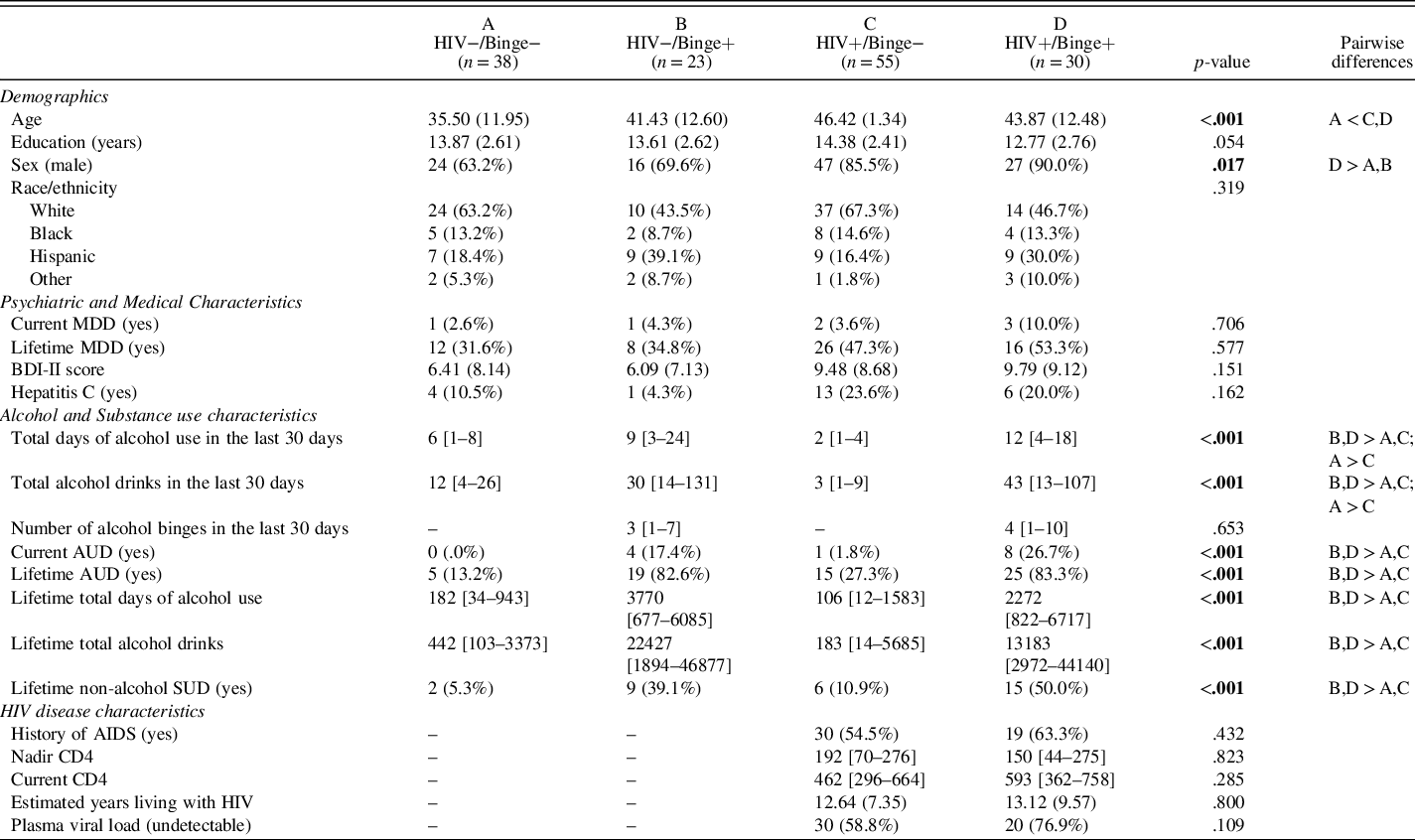
Demographic and clinical factors by HIV/Binge group are displayed in Table 1. The HIV−/Binge− group was younger than both HIV+ groups (p < .001), and the HIV+/Binge+ group had a higher proportion of men compared to the two HIV− groups (p = .017). Regarding alcohol and substance use characteristics, the two Binge+ groups had significantly higher quantity and frequency of alcohol use in the last 30 days, higher proportions of current and lifetime AUD, higher lifetime quantity and frequency of alcohol use, and a higher proportion of lifetime non-alcohol SUDs compared to those of both Binge− groups (p’s < .001). Alcohol use characteristics, including frequency of alcohol binges in the last 30 days, did not differ between the HIV−/Binge+ and HIV+/Binge+ groups (p > .05). All psychiatric, medical, and HIV disease characteristics were comparable across groups.
Demographic and clinical characteristics by HIV/Binge groups

Values are mean (SD), n (%), or median [IQR]. Bold p-values are significant at p < 0.05. MDD = major depressive disorder; BDI-II = Beck Depression Inventory – Second Edition; AUD = alcohol use disorder; SUD = substance use disorder (including cannabis, cocaine, methamphetamine, opioids, sedatives, hallucinogens, and inhalants).
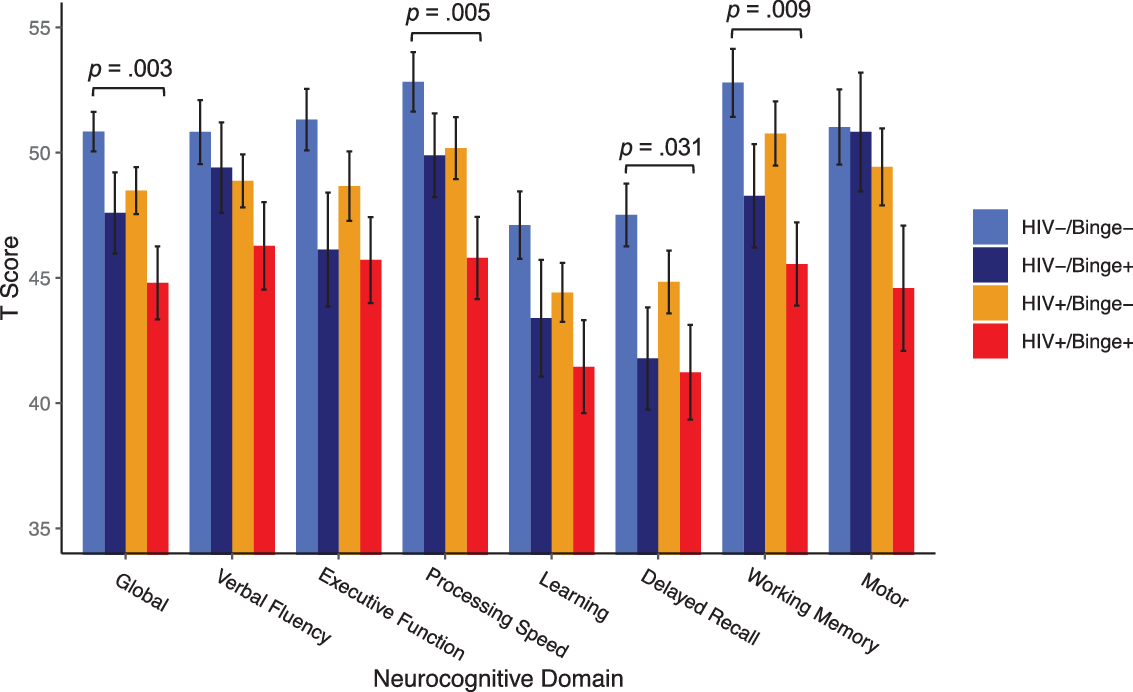
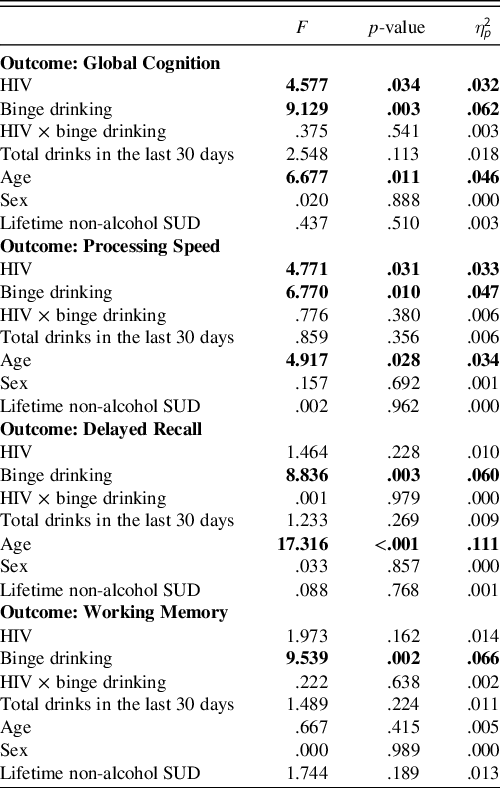
ANOVA results revealed a significant omnibus difference across HIV/Binge groups in mean global neurocognitive function (F(3,142) = 4.39, p = .006), which was driven by domain-specific differences in processing speed (F(3,142) = 3.86, p = .011), delayed recall (F(3,142) = 3.27, p = .023), and working memory (F(3,142) = 3.851, p = .011). For each of those neurocognitive outcomes with a significant omnibus result, follow-up pairwise comparisons showed significant differences between only the HIV−/Binge− and the HIV+/Binge+ groups, with HIV+/Binge+ participants exhibiting poorer performance (Figure 1). Results of the 2 × 2 factorial ANCOVAs are shown in Table 2. Additive main effects of HIV status and binge drinking status were detected on global function and processing speed, however, none of the interactions between HIV and binge drinking status on neurocognitive outcomes reached statistical significance. Additive main effects of HIV and binge drinking were further supported by results from Jonckheere–Terpstra tests indicating significantly lower global (JT = 2303.5; p < .001) and processing speed (JT = 2414.0; p = .001) performance by each increase in risk factor count (i.e., 0 risks = HIV−/Binge−; 1 risk = HIV−/Binge+ or HIV+/Binge−; 2 risks = HIV+/Binge+). Binge drinking was also a significant predictor of delayed recall and working memory. Of note, the effects of binge drinking on neurocognition were not attenuated by accounting for total drinks in the last 30 days, which did not significantly relate to any neurocognitive outcome (p’s > .05; Table 2).
Mean differences in global and domain-specific neurocognitive T scores across HIV/Binge groups. P-values were derived from post hoc Tukey’s HSD pairwise comparisons between the HIV−/Binge− and HIV+/Binge+ groups.

Effect sizes and results of 2 × 2 factorial ANCOVA examining independent and interactive effects of HIV status and binge drinking status on neurocognitive T score outcomes that showed significant HIV/Binge group differences

Bold values are significant at p < 0.05.
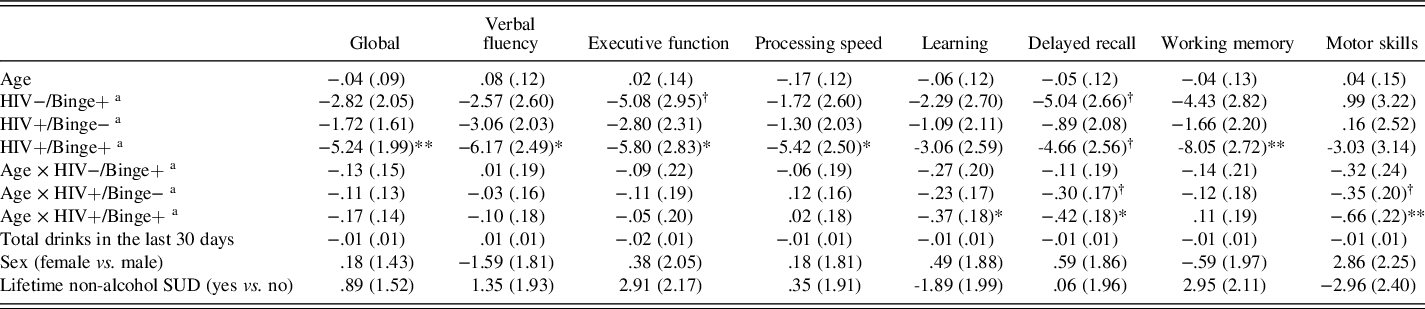
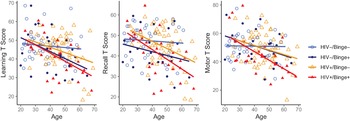
Multiple linear regression revealed significant interactions between age and HIV/Binge group on neurocognitive outcomes of learning (b = −.37, p = .044), delayed recall (b = −.42, p = .021), and motor skills (b = −.66, p = .003) (Table 3). Specifically, the association between age and each of those three neurocognitive outcomes was significantly more negative in the HIV+/Binge+ group (Learning: b = −.43, p = .001; delayed recall: b = −.47, p < .001; motor skills: b = −.63; p < .001) compared to that of the HIV−/Binge− group (Learning: b = −.06; p = .647; Recall: b = −.05, p = .690; Motor: b = .04; p = .811) (Figure 2). This interaction was not significant for any other neurocognitive outcome (i.e., global cognition, verbal fluency, executive function, processing speed, and working memory). Additional analyses comparing age slopes between all groups revealed that the difference in age slopes between the HIV+/Binge− and HIV−/Binge− groups approached significance for delayed recall (p = .072) and motor skills (p = .082), such that the HIV+/Binge− group had a stronger relationship between age and those neurocognitive domains. Total drinks in the last 30 days, sex, and lifetime non-alcohol SUD were not significant predictors of any neurocognitive outcomes. In addition, all results remained the same when also covarying for current and lifetime AUD. Notably, when the age range of the entire sample is restricted to a maximum of 60 years old (i.e., so that all groups have the same upper age limit and comparable mean ages; HIV−/Binge−: Mage = 35.5, SD = 11.9; HIV+/Binge−: Mage = 41.2, SD = 8.2; HIV−/Binge+: Mage = 40.4, SD = 11.8; HIV+/Binge+: Mage = 41.6, SD = 10.9; F[3,124] = 2.6, p = .06), the interaction between age and HIV/Binge group (i.e., HIV+/Binge+ vs. HIV−/Binge−) remains significant for neurocognitive outcomes of delayed recall (b = −.46, p = .02) and motor skills (b = −.64, p = .01) while it becomes marginally significant for learning (b = −.32, p = .09).
Multiple linear regression results examining independent and interactive effects of age and HIV/Binge group on global and domain-specific neurocognitive T score outcomes

Values are regression estimate (SE).
a Compared to HIV−/Binge−.
† p < .10; * p < .05; ** p < .01.
Differential associations between age and neurocognitive outcomes (i.e., learning, delayed recall, and motor skills) by HIV/Binge group.

CONCLUSIONS
Given the rapidly growing population of older adults with and without HIV along with the increased rates of binge drinking among them, studying the combined effects of HIV and binge drinking across the lifespan is timely and important. Partially consistent with our first hypothesis, the HIV+/Binge+ group demonstrated the worst global neurocognitive functioning (driven by domain-specific findings in processing speed, delayed recall, and working memory); however, the combined effects of HIV and binge drinking on global neurocognitive functioning exhibited an additive, rather than synergistic, pattern (as indicated by significant main effects of both HIV status and binge drinking status without a significant interaction effect). Consistent with our second hypothesis, we found a novel interaction between age and HIV/Binge drinking group such that the HIV+/Binge+ group displayed a stronger negative relationship between age and three domain-specific neurocognitive outcomes (i.e., learning, delayed recall, and motor skills) compared to the HIV−/Binge− group. Importantly, the alcohol-related detriments to neurocognition appeared to be specific to binge drinking, as a total of 30-day alcohol consumption was not a significant independent predictor of any neurocognitive outcome in our statistical models. These findings suggest that recent, discrete episodes of heavy alcohol exposure relate to poorer brain function and highlight the need for interventions to reduce binge drinking behavior among PWH, especially older PWH, in order to promote cognitive health.
The findings showing additive main effects of HIV and binge drinking are consistent with several other studies demonstrating additive, but not synergistic, effects of HIV and heavy alcohol use on neurocognitive functioning (Rosenbloom et al., Reference Rosenbloom, Sullivan and Pfefferbaum2010). In fact, there is only one study to our knowledge that has shown an interactive effect of HIV and heavy alcohol on neurocognition, specifically in the domains of motor and visuomotor speed (Rothlind et al., Reference Rothlind, Greenfield, Bruce, Meyerhoff, Flenniken, Lindgren and Weiner2005). Our finding of HIV/Binge group differences in neurocognitive domains of processing speed, delayed recall, and working memory is also consistent with the frontostriatal and frontolimbic neural damage that has been observed in studies of adults with HIV and heavy alcohol use (Pfefferbaum et al., Reference Pfefferbaum, Rosenbloom, Sassoon, Kemper, Deresinski, Rohlfing and Sullivan2012; Rosenbloom et al., Reference Rosenbloom, Sullivan and Pfefferbaum2010; Sullivan & Pfefferbaum, Reference Sullivan and Pfefferbaum2019). As briefly discussed, there are a number of possible mechanisms underlying the relationship between heavy alcohol use and adverse neurocognitive outcomes in HIV, including those related to ART nonadherence (Paolillo et al., Reference Paolillo, Gongvatana, Umlauf, Letendre and Moore2017) and possible ART pharmacokinetic interactions with alcohol (Simon et al., Reference Simon, Siggins, Winsauer, Brashear, Ferguson, Mercante and Molina2018). Recent research, however, has revealed neuroinflammatory and neuroimmunological effects as major pathways underlying the relationship between heavy alcohol use and neurobiological damage (Crews et al., Reference Crews, Sarkar, Qin, Zou, Boyadjieva and Vetreno2015), with several of these neuroimmune pathways overlapping with effects from HIV (Monnig, Reference Monnig2017). Although these immunobiological underpinnings are still poorly understood in the context of comorbid HIV and heavy drinking, this represents an important line of research that is needed to develop potential targeted interventions for reducing the incidence and/or severity of neurocognitive impairment in this population.
The current study also uniquely found that the negative relationship between age and neurocognitive functioning was steepest among the PWH who reported binge drinking in the last 30 days, particularly in the domains of learning, delayed recall, and motor skills. Our findings are consistent with what is known about the greater vulnerability to brain atrophy and neurocognitive deficits in older PWH (Clifford et al., Reference Clifford, Samboju, Cobigo, Milanini, Marx, Hellmuth and Valcour2017; Greene et al., Reference Greene, Covinsky, Valcour, Miao, Madamba, Lampiris and Deeks2015; Valcour et al., Reference Valcour, Shikuma, Shiramizu, Watters, Poff, Selnes and Sacktor2004) and older adults who drink heavily (Sullivan & Pfefferbaum, Reference Sullivan and Pfefferbaum2019; Woods et al., Reference Woods, Porges, Bryant, Seider, Gongvatana, Kahler and Cohen2016; Zahr, Reference Zahr2018). Furthermore, this result showing an age by HIV/Binge group interaction is also similar to findings from a previous study in which age was found to be a significant predictor of demographically-corrected episodic memory scores only among individuals with comorbid HIV and AUD (Fama, Sullivan, Sassoon, Pfefferbaum, & Zahr, Reference Fama, Sullivan, Sassoon, Pfefferbaum and Zahr2016). Speculation about accelerated aging or neurocognitive decline cannot be made from our data, as they are cross-sectional; however, this result does suggest that older adults are the most susceptible to adverse neuropsychological outcomes in the context of HIV and binge drinking. Notably, this result also held when restricting the maximum age range to 60 years old for all groups, indicating that HIV/Binge group differences in delayed recall and motor skills emerge even in the earlier stages of older adulthood.
Notably, findings from this report appear to be driven specifically by our binge drinking variable, as a total of 30-day alcohol consumption did not significantly predict any neurocognitive outcome above and beyond binge drinking. Although there is a dearth of studies examining the specific impact of binge drinking on neuropsychological outcomes compared to that of chronic drinking over a longer span of time, some evidence suggests that the repeated periods of high level of intoxication and withdrawal from binge drinking exacerbates the detrimental neurobiological effects of alcohol (e.g., oxidative stress, proinflammatory and neuroimmune response, and excitotoxicity leading to neuronal damage in frontal and hippocampal regions) (Campanella et al., Reference Campanella, Peigneux, Petit, Lallemand, Saeremans, Noel and Verbanck2013; Crews et al., Reference Crews, Sarkar, Qin, Zou, Boyadjieva and Vetreno2015; Maurage et al., Reference Maurage, Joassin, Speth, Modave, Philippot and Campanella2012; Meyerhoff et al., Reference Meyerhoff, Blumenfeld, Truran, Lindgren, Flenniken, Cardenas and Weiner2004; Petit, Maurage, Kornreich, Verbanck, & Campanella, Reference Petit, Maurage, Kornreich, Verbanck and Campanella2014; Waszkiewicz et al., Reference Waszkiewicz, Galinska-Skok, Nestsiarovich, Kulak-Bejda, Wilczynska, Simonienko and Konarzewska2018). Future research is needed to examine the chronicity of binge drinking (independent of chronic non-binge consumption) and whether there may be a specific threshold (i.e., number of binges) associated with the greatest level of CNS risk. Still, given evidence that binge drinking may be at least as detrimental to the CNS as alcohol dependence, public safety measures that aim to reduce binge drinking behavior (including in social settings) may have widespread benefits, especially among older PWH.
While this study has strengths in novelty, use of a comprehensive neuropsychological battery, and clinical relevance, it also has several limitations. First, the HIV/Binge group-specific sample sizes were relatively small, particularly in Binge+ groups. Although this limited our ability to examine a full factorial three-way interaction between age, HIV status, and binge drinking status, we were still able to examine the novel age by HIV/Binge group interaction with adequate statistical power. Next, our assessment of binge drinking is based solely on self-report and may be subject to error by recall bias, memory difficulties, and/or social desirability bias; however, the majority of alcohol and substance use research relies on self-report of use. In addition, while binge drinking data specifically pertained to use within the last 30 days, we do not know exact amounts of time between participants’ last binge episode and their participation in the study, limiting our ability to comment on how recency relates to cognitive performance. Future research may benefit from the use of more objective measures of alcohol use in daily life to more accurately characterize alcohol use patterns (e.g., a portable breathalyzer or wearable alcohol sensor). Finally, our exclusion of participants with current non-alcohol SUDs limits generalizability to others with binge drinking behavior and/or AUD among whom polysubstance use is common.
In summary, the current study demonstrated detrimental additive (not synergistic) effects of HIV and binge drinking on neurocognitive functioning, and that older adults appear to be most vulnerable to these adverse effects particularly in the neurocognitive domains of learning, delayed recall, and motor skills. Our findings support the need for clinical screening for binge drinking behavior given that many adults who engage in binge drinking behavior do not meet the criteria for an AUD, as well as psychoeducation and psychosocial interventions targeting the reduction of binge drinking among older PWH. Additionally, given evidence that improvements in neurocognitive functioning may be possible after sustained sobriety following AUD recovery among HIV− populations (Stavro, Pelletier, & Potvin, Reference Stavro, Pelletier and Potvin2013), future work is needed to understand whether this may also be true among PWH who reduce or cease binge drinking behavior.
Acknowledgments
The San Diego HIV Neurobehavioral Research Center [HNRC] group is affiliated with the University of California, San Diego, the Naval Hospital, San Diego, and the Veterans Affairs San Diego Healthcare System, and includes: Director: Robert K. Heaton, Ph.D., Co-Director: Igor Grant, M.D.; Associate Directors: J. Hampton Atkinson, M.D., Ronald J. Ellis, M.D., Ph.D., and Scott Letendre, M.D.; Center Manager: Thomas D. Marcotte, Ph.D.; Jennifer Marquie-Beck, M.P.H.; Melanie Sherman; Neuromedical Component: Ronald J. Ellis, M.D., Ph.D. (P.I.), Scott Letendre, M.D., J. Allen McCutchan, M.D., Brookie Best, Pharm.D., Rachel Schrier, Ph.D., Debra Rosario, M.P.H.; Neurobehavioral Component: Robert K. Heaton, Ph.D. (P.I.), J. Hampton Atkinson, M.D., Thomas D. Marcotte, Ph.D., Mariana Cherner, Ph.D., David J. Moore, Ph.D., Matthew Dawson; Neuroimaging Component: Christine Fennema-Notestine, Ph.D. (P.I.), Gregory Brown, Ph.D.; Neurobiology Component: Cristian Achim, M.D., Ph.D.; Neurovirology Component: David M. Smith, M.D. (P.I.), Douglas Richman, M.D.; International Component: J. Allen McCutchan, M.D., (P.I.), Mariana Cherner, Ph.D.; Developmental Component: Cristian Achim, M.D., Ph.D.; (P.I.), Scott Letendre, M.D., Ph.D.; Participant Accrual and Retention Unit: J. Hampton Atkinson, M.D. (P.I.), Jennifer Marquie-Beck, M.P.H.; Data Management and Information Systems Unit: Anthony C. Gamst, Ph.D. (P.I.), Clint Cushman; Statistics Unit: Ian Abramson, Ph.D. (P.I.), Florin Vaida, Ph.D. (Co-PI), Bin Tang, Ph.D., Anya Umlauf, M.S.
The views expressed in this article are those of the authors and do not reflect the official policy or position of the Department of the Navy, Department of Defense, nor the United States Government.
FINANCIAL SUPPORT
Data for this study was collected as part of four larger studies: (1) the HIV Neurobehavioral Research Center (HNRC; NIMH award P30MH062512); (2) the California NeuroAIDS Tissue Network (CNTN; NIMH awards U01MH083506 and R24MH59745); (3) NIDA award P01DA012065; and (4) the Translational Methamphetamine AIDS Research Center (TMARC; NIDA award P50DA026306). Stipend support to EWP is funded by NIAAA award F31AA027198. Stipend support to RS is funded by NIA award F31AG064989. Stipend support to MK is funded by NIAAA award T32AA013525. Stipend support to CW-MW is funded by NIDA award T32DA031098.
CONFLICT OF INTEREST
RCM is a co-founder of KeyWise AI, Inc. and a consultant for NeuroUX. No other authors declare conflicts of interest.
ETHICAL STANDARDS
All participants gave written informed consent as approved by the UCSD Institutional Review Board. This research was completed in accordance with the Helsinki Declaration.