In November 2005, Ellen Johnson-Sirleaf became the first female elected head of state in sub-Saharan Africa. On the face of it, the fact that this important breakthrough occurred in Liberia may seem paradoxical given that Liberia recently came out of years of conflict and is one of the poorest countries in the world. Generally, the advancement of women politically has been associated with the economic advancement of a country (Inglehart and Norris Reference Inglehart and Norris2003). However, Johnson-Sirleaf's victory is consistent with new trends on the continent regarding women's political leadership. Ten years ago, African women held just 10.7% of the seats in their legislatures, falling below the global average at the time of 12.2%.Footnote 1 Today, women in Africa hold 17% of legislative seats, matching the global average. In several countries, women have made far greater progress: They hold nearly 50% of legislative seats in Rwanda (48.8%) and over 30% of seats in Mozambique, South Africa, Burundi, and Tanzania.
While scholars have highlighted women's growing representation in legislatures in Africa (Bauer and Britton Reference Bauer and Britton2006; Goetz and Hassim Reference Goetz and Hassim2003; Tripp, Konaté, and Lowe-Morna Reference Tripp, Konaté, Lowe-Morna and Dahlerup2006), relatively less attention has been devoted to women's gains in the executive branch. And while the international media heralded Johnson-Sirleaf as the first elected female head of state in Africa, few commentators recognized the extent to which it reflected women's growing presence in the executive branch across the continent and the developments that made her victory possible. This essay begins by placing her victory in this broader context, demonstrating that while she is the first woman in Africa to win the presidency, many women are seeking and obtaining leadership positions in the executive branch. Global, regional, and national women's movements have played an important role in this development, pushing for higher levels of women's political representation through 50-50 campaigns that promote gender parity, gender quotas that set a minimum threshold of seats that must be held by women, and subregional and regional initiatives to enhance gender equality (e.g., the Southern African Development Community's (SADC) Gender and Development Declaration and the African Union's (AU) commitment to gender parity in the AU Commission). After examining these continental trends, the essay then takes a more careful look at the Liberian context, arguing that opportunities provided by the postconflict environment and the role played by a strong women's movement that mobilized in support of Johnson-Sirleaf contributed to her victory.
African Women's Participation in the Executive Branch
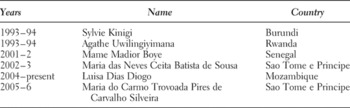
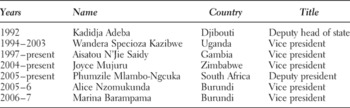
Since the mid-1990s, women have made substantial gains in all areas of the executive branch in Africa. There are increasing numbers of women holding ministerial posts, serving as prime ministers and vice presidents, and running for the presidency. Women hold an average of just over 4 ministerial posts in African governments. Women's representation in cabinets ranges from one in Comoros, Kenya, Somalia, and Sudan to a high of 12 in South Africa. Since 1993, six women have served as prime ministers in five different states (Burundi, Rwanda, Senegal, São Tomé e Príncipe, and Mozambique; See Table 1). Since 1992, seven women have held the position of vice president or deputy president in six countries (Djibouti, Uganda, Gambia, Zimbabwe, South Africa, and Burundi; See Table 2). In 1996, Ruth Perry became the first woman head of state in Africa when she was appointed the head of the Council of State in Liberia. Her appointment was an important victory for women peace activists in Liberia.
Women prime ministers in Africa

Source: Worldwide Guide to Women in Leadership, “Woman Prime Ministers,” http://www.guide2womenleaders.com/Premier_Ministers.htm (February 12, 2008).
Women vice presidents and deputy presidents in Africa

Source: Worldwide Guide to Women in Leadership, “Female Vice-Presidents and Deputy Heads of State,” http://www.guide2womenleaders.com/Vice-Presidents.htm (February 12, 2008).
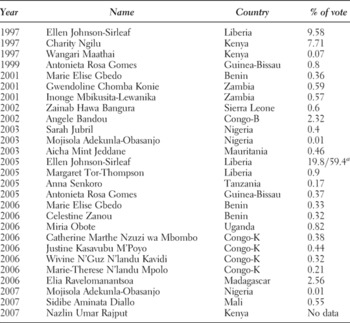
In addition, women are seeking the most powerful political office in most African states—the presidency. The presidency is different from other executive offices—including prime minister—in that it often requires candidates to win votes in direct, national elections. Despite these obstacles, women are increasingly seeking the presidency in Africa. In the past eleven years (1997–2007), 23 different women ran in 19 different contests in 14 different states in Africa (See Table 3). Several women ran in more than one election; thus, there have been a total of 27 women aspirants in 19 elections during the 11-year time frame. Out of these 14 states, five have experienced widespread conflict in the past two decades (Liberia, Guinea-Bissau, Sierra Leone, Uganda, and Congo-Kinshasa), lending support to broader findings that women tend to win executive offices in countries that are politically unstable and lack political institutionalization (Jalalzai Reference Jalalzai2008). One way that women presidential aspirants in Africa differ from their counterparts in Asia and Latin America is that few are related to powerful men. This difference may be a result of an historical tradition of women leaders in Africa.
African women presidential candidates

Source: Data collected from the African Elections Database, http://africanelections.tripod.com/index.html (February 12, 2008). Table includes only candidates who won their party's nomination. Johnson-Sirleaf received 19.8% of the vote in the first round in which 22 candidates competed. She polled 59.4% in the second round.
The majority of the women candidates polled less than 1% of the vote (22 out of 27, or 81.5%); nonetheless, it seems that most Africans are open to having women political leaders. About 74% of Africans polled in a recent Afrobarometer survey agreed or strongly agreed with the notion that women should have the same chance of being elected to political office as men. Overall, women were slightly more likely to agree with this statement than men (79.3% vs. 68.8%), though the gender gap varied across countries. Strong incumbents, weak party systems, and the high number of candidates in these races partially explain women candidates' low numbers. In the 19 presidential races, there were 14.42 candidates on average, ranging from a high of 33 in the Democratic Republic of Congo in 2006 to a low of five in Uganda in 2006. In the 19 elections, the first-place candidate polled an average of 54.91% of the vote in the first round of elections, ranging from 89.41% in the 2002 election in Congo-Brazzaville to 28.3% in the 2005 election in Liberia. On average, the margin of victory (i.e., difference between the first- and second-place candidates) was 32.28%, ranging from 2% or less (Zambia in 2001 and Kenya 2007) to 86.65% in Congo-Brazzaville in 2002.
In her first campaign for the presidency, Johnson-Sirleaf received just 9.8% of the vote. Charles Taylor, the winner of the 1997 presidential election, won over 75% of the vote, largely due to 1) fears that a Taylor loss would lead to a renewal of violence and 2) Taylor's control over key resources, including the only radio station that broadcast outside of the capital city, Monrovia. Even when Johnson-Sirleaf won the presidency in 2005, she received only 19.8% of the vote in the first round, placing second among the 22 candidates. In the second round, due largely to the support of women, she pulled ahead of the first-round winner, George Weah, winning 59.4% of the vote. In sum, although Johnson-Sirleaf was the first woman to win a national presidential election in Africa, many other women are running for the presidency.
Factors Contributing to Women's Growing Presence in Politics
So what has changed? Why are more women entering politics, and what specific factors made Johnson-Sirleaf's victory possible? What does it tell us about the changing nature of African politics? At least two developments have contributed to Johnson-Sirleaf's election: the opportunities created by Liberia's postconflict situation and the ability of an active women's movement to take advantage of these openings.
Postconflict Situations
In Africa, postconflict societies have seen the largest gains in terms of women's representation. Aili Tripp, Dior Konaté, and Colleen Lowe-Morna (2006, 119) found, for example: “Of the 12 African countries with the highest rates of female representation in parliament, eight (Angola, Mozambique, South Africa, Uganda, Rwanda, Eritrea, Burundi, and Namibia) have undergone liberation wars or civil conflict in recent years.” Conflicts contribute to women's increased presence in politics in a variety of ways. In conflict situations, women take on new roles: They become heads of households and take on new economic responsibilities; enter into armies, rebel forces, and liberation movements; and lead civil-societal organizations. Women draw on these experiences in postconflict environments, using the organizational and leadership skills developed during the conflict to shape the laws and institutions of postconflict states. Conflict also breaks down the social fabric of society. While this destruction undeniably has many negative effects, one potential consequence is that it can also break down aspects of patriarchal structures. In postconflict environments, transitional governments frequently establish new constitutions and political institutions. Effective women's movements can take advantage of these openings to push for the inclusion of gender-equity provisions within these laws and bodies.
In addition, in postconflict environments, the reconstitution of the political order provides openings for new participants, including women, to enter politics. When incumbents are out of the way, women—like all new contenders—have a chance to win elections. Describing the 2005 election in Liberia, David Harris (Reference Harris2006, 393) notes:
This was, to all intents and purposes, an election amongst civilians on a playing field, if not level, at least not dramatically tilted. … The Liberian polls resembled few other African elections in peace or after war, in that there was no incumbent party with vastly superior resources at its disposal.
The lack of an incumbent and of warlords among the 2005 presidential candidates created an opening for Johnson-Sirleaf. She seized this opening, capitalizing on perceptions that women in Liberia have been peacemakers rather than those responsible for sparking the conflict. She also took a strong stance against corruption, building on the widespread view that women are less corrupt than men. This perception is not groundless; a 1999 World Bank study, for example, found that higher levels of women's participation in politics correspond with lower levels of corruption (Dollar, Fisman, and Gatti Reference Dollar, Fisman and Gatti1999). The mobilization of women in support of Johnson-Sirleaf in the second round of the election, when she was the sole woman contender, propelled her to victory.
Women's Movements
Across Africa, the demise of one-party states and the spread of democratic transitions (even partial transitions) in the 1990s provided openings for the emergence of new civil-societal actors. In many countries, women's organizations quickly became one of the strongest and most active elements of civil society (Tripp Reference Tripp2001). These new women's organizations differed from their predecessors in that they had greater autonomy from ruling parties and the state and took on a broader range of issues, going beyond development to advocacy for women's political representation, women's human rights, and peace.
While Liberia did not undergo a democratic transition in the 1990s, a number of autonomous women's organizations emerged during this decade with a focus on peace. Women's organizations and networks, such as the Liberian Women's Initiative (LWI), Women in Peace Building Network (WIPNET), the Association of Female Lawyers in Liberia (AFELL), and the Mano River Union Women Peace Network (MARWOPNET) played important roles during the civil conflict (African Women and Peace Support Group 2004). They raised awareness about the conflict and its effects on civilians, pressured ruling factions to participate in peace talks, advocated for the inclusion of women in peace negotiations, and provided support to those displaced by the conflict. Comparing women's activism in Mozambique and Liberia, Mary Moran and M. Anne Pitcher (Reference Moran and Pitcher2004, 504) found that “there was far more peace-oriented activity by explicitly women's organizations going on in Liberia; furthermore, these organizations existed at all levels from the most powerful urban elites to illiterate villagers.” The movement played a critical role in ending violence in Liberia, successfully lobbying for the appointment of Ruth Perry as the Head of Liberia's Council of State, pressuring faction leaders to participate in peace talks, and advocating for the inclusion of women in formal peace negotiations, including several MARWOPNET observers at the 2003 Accra peace talks.
After the civil war, activists drew on skills and networks acquired through their peace activism to take on issues like women's political representation. This focus grew out of the recognition that women needed to be in decision-making positions to influence policies. Just as women's rights activists pushed for the inclusion of women in peace negotiations during the conflict, they also pressed for women's inclusion in the postconflict government. Activists lobbied the transitional government for the adoption of gender quotas. While their attempt to include a gender quota in the election reform bill adopted by the transitional government in December 2004 failed, activists were able to lobby successfully for the inclusion of a gender quota in the electoral guidelines adopted by the National Elections Commission (NEC) in January 2005. The guidelines called on parties to include at least 30% women on electoral lists. The NEC, however, did not enforce this provision. In the 2005 elections, 108 women ran for seats in the Senate and House of Representatives, accounting for just 14% of those running for legislative office (IRIN 2005). Those women candidates who were nominated by their parties did relatively well, winning 5 out of the 30 seats in the Senate (17%) and 8 out of the 64 seats in the House (12.5%).
In contrast to activists' failure to secure an effective legislative quota for the 2005 election, they played a critical role in contributing to Johnson-Sirleaf's electoral victory. In the lead up to the October 2005 election, the Ministry of Gender and Development, under the leadership of Vabah Gayflor, undertook a voter registration drive. Seeing that women comprised less than 30% of registered voters early in the voter registration period, the ministry launched a campaign to increase women's registration. Describing these registration efforts, a United Nations Development Fund for Women (UNIFEM 2006) report noted:
Awareness campaigns saw women going from village to village, door to door, telling their sisters, mothers, daughters, and grandmothers to register to vote. When it was discovered that large numbers of women living in urban areas and working in the local markets simply could not afford to lose a day's wages to make the journey to faraway registration centers, women were organized, en masse, to take over market stalls for the day so their owners could register without losing a penny of sales.
The campaign was successful; women's proportion of registered voters went from under 30% to over 50% in less than a month (NEC 2005).
After Johnson-Sirleaf placed second in the first round of elections, which qualified her for the November runoff, activists undertook a national campaign to elect her. Describing the ministry's and women's movements' activities, Gayflor notes:
We women had come to recognize our strengths in numbers, and what we could achieve if we stuck together. Suddenly we realized that Liberia could have a female president, and a credible one at that. … We rolled up our mattresses and went by bus or car to as many areas as we could; sometimes we ate and slept in the cars. We painted the picture for women that showed how, for the first time, our daughters could have a future we could only dream about. … We reminded them that we all had a stake in the peace process, and if we didn't seize the opportunity now with Ellen Johnson-Sirleaf, then we would only have ourselves to blame. (UNIFEM 2006)
A number of women's organizations, including the LWI, endorsed Johnson-Sirleaf. This support from Liberian women, which crossed ethnic and class lines, played an important role in her victory.
Conclusions
Many observers were surprised that a woman was elected president in Liberia. Given the dramatic changes in women's political representation in Africa since the 1990s—and especially given the changes in postconflict countries—it was perhaps not so surprising. Across the continent, women are seeking high executive offices. This increase in women's political representation is occurring in contexts that have experienced civil conflicts or liberation movements and have strong women's movements. To date, when women have contested for the presidency, their electoral successes have not been overwhelming. The conditions underlying Johnson-Sirleaf's victory, though, give some clues about the contexts within which African women their presidential candidates are most likely to succeed.
It is not coincidental that breakthroughs in women's political leadership are occurring in postconflict states. Liberia has had Africa's only two women heads of state—Ruth Perry and Ellen Johnson-Sirleaf. Rwanda tops the world in women's representation in the legislature. Uganda had the first African woman vice president, and Rwanda, Burundi, and Mozambique have all had women prime ministers. Women are often perceived as outsiders to politics: They tend to be viewed as less corrupt than male politicians, and citizens generally do not see them as bearing responsibility for their countries' conflicts. Regardless of whether these perceptions are right or wrong, they provide an important advantage to women candidates in postconflict environments.
The existence of African women's movements with a focus on women's political representation has been critical to women's electoral successes across the continent. African women's movements have initiated more 50-50 campaigns than any other world region (Tripp et al. forthcoming), have pressured states to adopt gender quotas, and have lobbied regional institutions like SADC and the AU to adopt gender equity measures. These efforts have paid off, contributing to women's growing presence in politics.
The victory of Johnson-Sirleaf fits into some but not all global patterns. Like many women executives, she came to power in a politically unstable context. In contrast to many women leaders, however, Johnson-Sirleaf is not related to a politically powerful man and enjoys substantial powers as Liberia's president. The Liberian case suggests that just as there are fast-track and slower-track routes to legislative representation, there are multiple paths to executive power for women. In South Asia and Latin America, familial ties have traditionally provided a path for women leaders. In Africa, though, postconflict changes and pressure by women's movements have been the critical variables that have created openings for women leaders.