Introduction
With increasing rates of food insecurity and food waste in the developing and developed world, the need to “fix” the food system has become all the more urgent. In this context, food banks have been cast as a solution that could speak to both problems. On the one hand, they could regenerate downsized local economies; on the other hand, they can make existing global actors and routes of circulation more sustainable.Footnote 1 Critics, however, suggest that not only do these “in the meantime” solutions exacerbate and prolong the chronic problems generating food insecurity and food waste in the first place, but by shifting the focus to private donors and non-governmental aid organizations, they can facilitate deeper cuts in public spending for welfare services for the needy.Footnote 2
While examining the success of food banks is surely vital, studies so far have primarily done so by measuring their effectiveness in addressing food insecurity.Footnote 3 The literature has done less to place food banks within the waste regimes or assess their impacts in eliminating or reducing food waste.Footnote 4 I began my research with hopes of contributing to the literature precisely on these gaps. I intended to map out the supply chains of food/waste that feed the food banks and to ethnographically uncover the conceptual entanglements of food and waste (when does food become waste and waste become food again—and for whom?). During preliminary fieldwork, however, I found that the supply chains and the conceptual entanglements that materialize through them are shaped by, and in turn shape how actors within the supply chains perceive the supply chain itself and their role within it. As such, I shifted my focus to trace these perceptions, the connections they support, and the practices through which they are expressed.
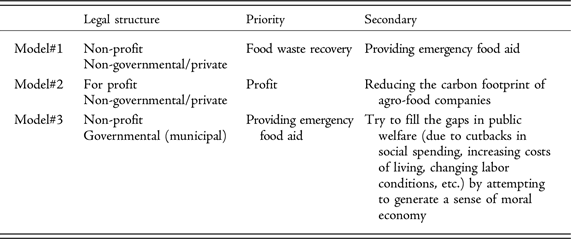
In this paper I will put the spotlight predominantly on how the food bank operators and volunteers (hereafter, “the staff”) perceive and engage with food waste and those who (they think) generate the food waste. I will orient this discussion around three points of conceptual unclarity in the literature. The first is definitional: are food banks agents of food waste recovery or emergency food aid providers to the needy? Second, exactly what (food waste vs. food loss vs. food surplus) is recovered and redistributed in the food banks? In conjunction, third, are these recovery and redistribution operations sustainable solutions or do they perpetuate chronic inequalities and systemic problems? Emphasizing that these are not merely scholarly disagreements, next I explore how these three points are represented in the organizational structures and operating principles in the three different models of food banks in İstanbul: non-profit non-governmental organization model (Model#1); for-profit private initiative model (Model#2); and the municipality-run social markets (Model#3).
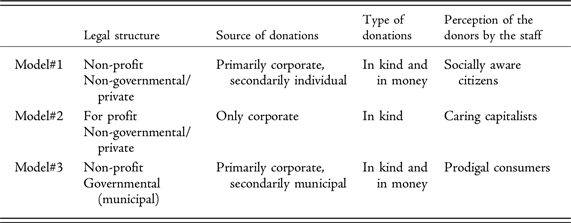
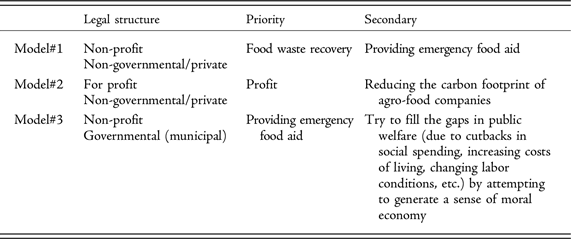
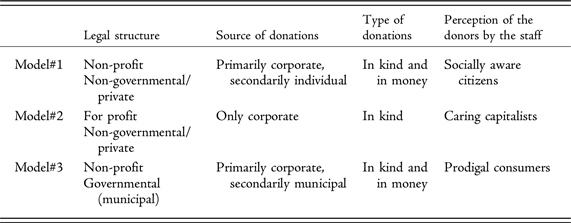
After an in-depth discussion of the differences between these models (see Table 1), I then explain what role the staff attribute to the food banks in dealing with food waste and how the staff perceive and construct the donors—or, those who generate the food waste (see Table 2). For the staff of Model#1, for example, the donors are “socially aware citizens” who contribute to the common good by helping to feed the hungry, whereas the staff of Model#2 perceive their donors as smart and environmentally conscious entrepreneurs doing their best to reduce their carbon footprint and eliminate food waste while effectively managing the costs of their waste disposal (“caring capitalists”). For the staff of Model#3, in contrast, the donors are “prodigal consumers” who cannot make correct resource allocation decisions and waste food as a result. What is interesting here is that in the imaginaries of the staff of all the models, the donors are predominantly individuals, families, or households. In practice, however, the donors are mostly corporations—agro-food processors (not farmers) and distributors.
Models of food banks in İstanbul
Priorities of food banks
This key finding is also the crux of my argument: while each imagery is important in that it reflects to a degree each model’s worldview, the misperception—that is, imagining, thinking, and talking about the donors as if they were individual consumers and not the corporate food producers (not farmers) and distributers that they are—in itself is much more significant. It shifts the conversation on waste generation on two different axes. First, rather than identifying why waste is generated in the food system (overproduction? Mismanagement? Inadequate infrastructure?), we end up talking about various forms of ethical consumerism to “fix” the “waste problem.” Second, we laud the agro-food waste-generators as pioneers in waste management and for their social and ecological responsibility while we attempt to discipline (a la Foucault) individuals and/or households who are marked as the source of waste (consume better! Repurpose the excess! Do good while making money!). As I will discuss in the conclusion, what these shifts do is to direct the conversation toward certain topics (who generates food waste?) and away from others (food injustice). As a result, we not only get a crooked view of waste politics, but also, equally consequentially, of food politics.
Methodology
The data for this paper come from six months of fieldwork conducted in İstanbul between June and December 2018 (with preliminary fieldwork going back to the summer of 2015). This involved, first and foremost, figuring out how many food banks there are.Footnote 5 I searched for specific associations and foundations which use the term “food bank” (gıda bankası) or “social market” (sosyal market) in their title or in the description of their activities. Among them, I contacted those that seemed operational (that is, they are receiving aid and distributing donations every day or every week) and asked the staff if they would consent to semi-structured interviews and allow for participant observation. In total, I interviewed representatives of seven institutions (municipal, NGO, and for profit); in two of them I was allowed to do participant observation. I also talked to fifteen staff (including those who previously worked or volunteered in the food banks but for a variety of reasons had quit their jobs). This makes up my first dataset.
In addition, I talked to representatives of municipalities and district governorates. In Turkey, the residents (which also includes resident aliens and refugees) need to receive an “income verification document”Footnote 6 that shows that the per capita income in their household is equal to or less than one-third of the minimum wage to qualify to use the food banks; and the municipal and district representatives are tasked with providing this document. Talking to them has provided major insights into the application process for receiving social aid. This constitutes my second dataset.
Unfortunately, the recipients and the donors were the least forthcoming parties. Language and the formal structure of the interviews were the primary barriers for the recipients. With the donors, there seemed to be two forces pulling them in opposite directions. On the one hand, almost all the donors—particularly the corporate donors—wanted to make public the work they do with food banks. On the other hand, because of the partisan politics involved in food banking, they did not want to make public which food banks they work with. As a result, when I communicated with various corporate donors to interview them, they did not consent. Some sent vary vague answers to my questions and only agreed to speak on the phone and off the record. The information I thus gathered from the recipients and the donors constitutes my third dataset.
None of my informants consented to their names and the name of the food bank they work in/with being made public. As such, all the names I provide here are pseudonyms.
Food waste and food banks
The scholarship on food banks is unclear about what the primary task of food banks is and/or should be. When defining what a food bank is or does, scholars tend to emphasize feeding the needy. Only secondarily do they mention waste reduction or elimination of surplus food. Tarasuk et al., for example, describe food banks as “organizations established by community groups to coordinate the collection and redistribution of donated foods to those ‘in need,’ typically on an ad hoc, voluntary basis.”Footnote 7 Similarly, Lambie-Mumford defines them as non-governmental initiatives that provide short-term, emergency food aid to people in crisis while they await other services.Footnote 8 Alternatively, Lindenbaum conceptualizes food banks as “re-gifting depots” that “distribute donated and gleaned products, purchased food items, and federal government food packages to individual clients, school programs, and partner agencies such as soup kitchens and food pantries.”Footnote 9 The food waste reduction role of food banks, when mentioned, is still situated within this framework, as an addition to feeding the needy. Thus, Gonzalez-Torre and Coque, for example, paraphrasing Starkey et al. (1998, 1999), describe food banks as “non-profit organizations based on volunteering, whose purpose is to recover food excesses in our society and redistribute them among needy persons, avoiding any food waste or misuse.”Footnote 10
One reason why the waste reduction aspect is underemphasized is the confusion with respect to what constitutes waste. Fehr et al., for example, differentiate between scraps, loss and waste:
Scraps refer to customary remains after consumption: the parts that are not eatable. An example is a banana peel. Loss refers to entire food items that do not serve their purpose: they are thrown away without being considered for consumption, for whatever reasons there might be. An example is an entire banana found in the garbage. The words waste or biodegradables are used to address the sum of scraps and losses.Footnote 11
Comparably, Garrone et al. suggest that:
Food losses’ usually refers to edible food, lost at any stage of the supply chain, such as meats, bread, discarded or unserved restaurant-prepared food, or products that are unmarketable for aesthetic reasons, but otherwise edible and safe (Kantor et al., 1997), and excludes only the inedible part that cannot be used for human consumption (Tarasuk and Eakin, 2005). “Food waste” is often defined as food lost at any stage of the supply chain, including crops damaged during harvesting, food damaged during transport or food discarded and mixed with other wastes (Griffin et al., 2009), i.e. edible food losses mixed with garbage or leftovers that are not necessarily edible. In addition, a distinction should be made between the different types of waste generated in a production process. For example, Darlington and Rahimifard (2006) distinguish between the wastage of finished products and the waste from production, including process waste, overproduction waste and bulk organic waste.Footnote 12
According to these definitions, food banks are targeting the recovery and redistribution of foods that would otherwise become loss—not waste. Without getting into the nuts and bolts of these distinctions, however, Santini and Cavicchi and Wells and Caraher, for example, mention food waste reduction as a task of food banks.Footnote 13 Moreover, given that boundaries between waste and loss can easily be blurred in practice, some scholars prefer to talk about “food surplus” rather than “food waste” vis-à-vis food banks. Tarasuk and Eakin, for example, remark that “‘surplus’ food [is] that cannot be retailed [which] can include processed foods deemed unfit for the retail market because of manufacturing errors or damage during shipping, handling, and storage, new food products that failed when introduced into the marketplace, and unprofitable agricultural crops.”Footnote 14 Hinging on this conceptual gray zone, Lohnes and Wilson similarly describe food banks as “a charitable strategy to distribute surplus food to the working poor, unemployed, aged, disabled, homeless, and other food insecure people in Canada and the United States in the 1970s.”Footnote 15 In other words, it remains unclear what constitutes waste (and loss), as also whether food banks are supplied by food waste and/or food surplus.
Relatedly, there are disagreements on where in the food supply chain salvageable waste occurs, how that waste is (or should be) salvaged for redistribution, and whether the salvaged waste is nutritious enough as food. These disagreements are not only about technologies, practices, and regulations of waste recovery and measurements of diet and nutrition. To some extent, they speak to the core principles of sustainability discourses. For example, if salvaged food waste helps feed the poor, is making the food supply chain more efficient (i.e. more waste-proof) a necessarily good public policy outcome? Similarly, what node of the food system should primarily be targeted to make the system more sustainable? That is, should the focus be on more effective retail and consumption mechanisms and practices (longer-lasting packing, better transportation techniques, etc.) so that less waste occurs at the tail end of the supply chain, or should the producers be coaxed into improving their production practices so that waste is prevented even before the problem makes its way to the consumers? These are not easily settled questions. No matter how they are answered, they put the burden of improving the entire food system on some agents, industries, or sectors rather than all. More importantly, they implicitly suggest that food injustice and food waste are matters of food system inefficiency that could be fixed with more technology and deeper integration with the global markets. They are not framed as symptoms of the crisis-generating tendencies of capitalism—the laisses mourir that necessarily follows the laissez faire,Footnote 16 the consequences of overproduction, for example, the linking of one of the major requirements of life (i.e. food) to the violent fluctuations of price, the destructive inconsistencies of providing subsidies to large corporations and propagating free trade, and (in)advertently supporting the oligopolization in the processing, transportation, and retailing of foods as they make their way from producers to consumers.Footnote 17
These conceptual inconsistencies, disagreements, and ambiguities are not scholarly oversights. Food banks are a particular solution to a particular framing of a diverse set of socio-economic problems. As such, inconsistencies, disagreements, and ambiguities are manifestations of shifts in the framings of these problems. While such ambiguity can be unsettling for those craving more comprehensive solutions to food injustice and food waste, for others who want to address the crisis by reforming the existing system, the particularity of the framing of the problem is indeed comforting. As one of my informants put it:
We think about whether we are helping the urban poor, or we are just perpetuating more food justice. This is a regular topic of conversation. We also question our donors—their ethics of operation. Would we accept their donations if they were known criminals, for example? Honestly, we try to maintain our distance from everyone—both the recipients and the donors. But it is not easy. We are aware that by not taking a side, we are in fact taking a side and perpetuating the already existing inequalities. At the same time, we cannot solve all the problems of the food system. [This food bank] is a good organization; it does good deeds; it helps those who need it. And for now, that’s enough. (Melek, staff member at Model#1 food bank)
In short, larger discussions ensue among the food bank staff—as they do within the scholarly literature. Moreover, neither these conversations nor the soul searching they stimulate are paralyzing for the staff. The tension they generate, in fact, is “what keeps the job interesting” as it provides “the feeling that what [they] do matters, that [food banks as] institutions, organizations, networks are worthwhile” (Ismet, staff member at Model#1 food bank).
İstanbul’s food banks
These inconsistencies, disagreements, and ambiguities are also manifest in the organizational structures and operating principles of the food banks in İstanbul. As I mentioned above, there are three types of food banks in İstanbul. What I call Model#1 is similar to the food bank/food pantry set-up in the Global North; that is, they act as warehouses where donations are collected and then distributed to more localized agencies which dispense them to the needy. These food banks are primarily non-governmental organizations, though they may work with public food pantries as well as private charities. Model#3 food banks, also called “social markets” (sosyal market in Turkish), are municipal organizations. Not only do they collect and distribute donations (both cash and in kind)—thus combining the food bank/food pantry set-up—they also purchase food through municipal tax funds to supplement their supply chain. Model#2 food banks, in contrast, are private for-profit companies that bring in technologized solutions to donation collection and distribution logistics. Their customers are almost always private sector food processors, retailers, and wholesalers, and the donations they manage are always in kind—never in money.
The source and the type of donations these food banks receive also differ: Model#1 relies on a combination of corporate and individual donors and receives them either in kind or money; Model#2 exclusively gets corporate donations in kind; and Model#3 receives both corporate and individual cash and in-kind donations in addition to the funds from the municipal budget. Whereas the in-kind donations Model#1 and Model#2 receive are food that would otherwise become waste, Model#3 also purchases food destined for retail from wholesalers. This generates a strong tension within the food bank scene. The proponents and the staff of Model#1 and Model#2 frequently criticize Model#3 for contributing to the urban food supply chain problems, including generation of food waste and increasing carbon footprint.
As I will discuss below, the primary difference between the models is their priority: by recovering food that would otherwise become or remain waste, Model#1 and Model#2 food banks emphasize food waste reduction; whereas the priority for Model#3 food banks is to provide emergency food aid. Other differences in the operation (for profit vs. non-profit, public vs. private, charity vs. electoral quid pro quo vs. entrepreneurship) are almost always tied in with this primary difference in their priorities.
Without putting too much emphasis on it, the electoral undertones of Model#3 need to be recognized. Though municipal elections have always been heavily contested in Turkey, in the post-1980 period (the period of concern here), when neoliberal globalization was taking İstanbul by storm, they became local arenas in which divergent readings of the zeitgeist were offered and different visions of the future were displayed.Footnote 18 Besides, the Turkish state has a strong tendency toward centralization.Footnote 19 In this context, municipal politics and municipal elections remain (for now) one of the few areas in which citizens could more directly participate in governance and make their voices heard at the local level. For many who think that their views and interests are not sufficiently represented in the general elections in particular, municipal elections are vital. Not only are they potent instances of resistance, but municipal politics themselves are potential venues for realizing and maintaining alternative lifeworlds. For the municipal food banks, however, these imply a deeper entanglement in the intensifying socio-political polarization. The recipients, for example, see the Model#3 food banks as the materialization of promises made by the party elites in return for votesFootnote 20 during the municipal elections. Similarly, the staff treat them as integral constituents of the governing party’s outreach efforts. Given these increasing expectations and demands from Model#3 food banks, it is understandable that they expand their food supply chains from food waste recovery to purchasing food intended for retail.
The monetary donations Model#1 food banks receive also generates dilemmas for the staff. My informants told me that they came up with ways to use these donations without having to forgo food waste recovery, however. Instead of spending the donations on purchasing food destined for retail, the donations—with the approval of the donors—are used to cover transportation costs and maintenance and repair of the facilities, and to provide essential non-food commodities (diapers, for example) for the needy (Ismet, staff member at Model#1 food bank). If the donors do not consent to their donations being used as such, Model#1 food banks do let them buy food from retailers and wholesalers and donate those to the food bank instead. In such cases, the donors are told specifically what they should buy; and that is dependent on what the staff have identified as most needed by the recipients.
Model#2 food banks are the only ones free of such contentions. The donors they work with record what they estimate they will not sell to the various online platforms these food banks manage. These records are then viewed by the local food pantries, which pick and choose among the donations depending on what their recipients need and what they can distribute. The primary constraint enforced on the donors is that their donations must comply with the legal food safety and hygiene standards and that they should guarantee that the donations will be transported to the food pantries in accordance with the same health and safety regulations.Footnote 21 In return, the food pantries must guarantee that they will keep and distribute the donations to the appropriate recipients before the donations expire and become inedible. More importantly, food pantries need to ensure that the donors’ identities will not be revealed unless the donors consent to disclosure.Footnote 22 Finally, both parties must be local—though definitions for what constitutes “local” varies. Still, one of the primary goals of Model#2 food banks is to energize regional economies by intensifying local circulation of goods and to offer decentralized and regionally adoptable solutions to global challenges like hunger and climate change (Halit, staff member at Model#2 food bank).
While the Model#2 food banks are the most efficient in terms of food waste recovery from the donors and supplying the local food pantries, their for-profit approach is a major source of tension within İstanbul’s food bank scene. The staff of Model#1 food banks fiercely oppose such monetization of aid efforts. They claim that the for-profit approach “takes away the charity aspect of food banks”; “people do not volunteer; they participate either to make money or to cut costs.” More importantly, introducing for-profit agents into the aid sector may “further deter the state from taking action” (Deniz, staff member at Model#1 food bank):
As I mentioned before, we wonder whether what we are doing is actually good in the long term. But at least we are not making money off of this. If we do what [one of the Model#2 food banks] does, then we would be actively taking away incentives from the state to fix these problems—the poverty, hunger, unemployment, etc. The state should be the one to help these people; but it doesn’t, so we do. But if we were to make money off of this, the state would look at us and say: somebody is making money, so why should I intervene? And we don’t want that. (Melek, staff member at Model#1 food bank)
For the staff of Model#2, these criticisms “miss the point about what they are really trying to do, [which is] to reduce carbon footprint and recover food waste” (Mustafa, staff member at Model#2 food bank):
We are not interested in social policy. We are a for-profit company; we are also social entrepreneurs. We have gotten into the food bank sector because we think we can recover food waste and help feed the hungry at the same time. But our priority is decreasing the carbon footprint and energizing local economies. We are not here to complain about how the state is not doing its job. Whatever the problems, we know we can do something about it. The private sector can handle it. (Nihat and Mustafa, staff member at Model#2 food bank)
Similarly, externally set targets like the UN Millennium Development Goals or the Slow Food Terra Madre are aspirations to work towards. These are not mere references to legitimize what they are doing, however. Rather, they are signs that affirm their specific socio-economic vision: a new order in which “‘society’ takes care of its own without having to rely on the state” (Mustafa, staff member at Model#2 food bank) or “the [economic] externalities are melted down, smoothened out in the society, for the society, by the society” (Halit, staff member at Model#2 food bank). They frequently compare the local food bank scene with those of the EU and the US and comment on potential areas of growth for their businesses and utilize the language of “global connections” to articulate their position within the larger fields of the waste recovery and aid sectors.
Because Model#2 food banks orient the donor–recipient relationship and the food/waste supply chain through digital platforms of various kinds,Footnote 23 their donors are almost always other corporations. For retailers and wholesalers in particular, these donations are great public relations projects. They help paint the companies in “a positive, socially responsible light” (Halit, staff member at Model#2 food bank). Plus, they enable them to reduce their waste-related costs.Footnote 24 Still, food banks are not the only option for the donors to cut disposal costs. Retailers and wholesalers can return the unsold food products and/or items to processors or producers—in some cases free of charge, and in others at discounted prices. As such, for the for-profit food bank model to work, these potential donors need to be convinced to donate their surplus destined to be waste rather than returning or disposing of it. To do so, the staff of Model#2 food banks “offer professional consulting on inventory management and waste reduction and an outlet to do solid good for the society.” For the food pantries, they provide logistical and transportation support and at times, financial guidance (Halit, staff member at Model#2 food bank). While surely “doing good” is itself an incentive for some, the various forms of support these food banks provide (which the donors and the recipients would otherwise have to purchase) should not be overlooked as reasons for working with the Model#2 food banks either.
Tensions may run high (and arguments sometimes can get personal) between the staff of different models of food banks. Nonetheless, cooperation does happen, and is in fact relatively common. For example, mindful of the public backlash they may get due to overspending a portion of the municipal budget on food aid, Model#3 food banks may prefer to work with the private sector (Model#2) and non-profit civic (Model#1) actors. Cooperation also enables municipal food banks to find additional donors when donations are not enough or there are not enough donors to work with—which usually happens outside of İstanbul. In İstanbul, it is more common for donors to pull away from working with the municipal food banks over political disagreements or to switch to a different food bank if the political party they support loses the elections (Işık, staff member at Model#1 food bank). Thus, municipal food banks commonly look for cooperation with the other food banks to ensure a relatively smoothly functioning supply chain. It is less common for Model#1 and Model#2 food banks to work together, however. There are simply too many disagreements between the staff about what food banks are, what they should prioritize, and how they should operate.
In emphasizing these disagreements, my intention is not to suggest that the staff are confused or that they don’t know what they are doing. Rather, the inconsistencies I observed on what constitutes food waste, ambiguities vis-à-vis who generates food waste and disagreements with regard to what to do with food waste represent diverging views about what is identified as the “problem” and consequently, what “solution” should be advanced. To put it differently, these disagreements, inconsistencies, and ambiguities are not symptoms of a malfunctioning system; they are manifestations of people identifying different constellations of agents, nodes, and dynamics from a diverse set of socio-economic problems as problem generating: change the frame, and you get a different constellation of agents, nodes, and dynamics to work with; and unsurprisingly, you would advocate for different directions and methods of interventions—or, simply, different solutions.
Food banks and their donors
If food banks are indeed a particular solution to a particular framing of a diverse set of socio-economic problems, and how this framing is constructed significantly differs in emphasizing certain problems (food waste over food insecurity, for example) and solutions over others (reducing food waste and carbon footprint over subsidizing urban agriculture, for example), then conceptualizations of what food waste is, who generates food waste, and what they do to reduce food waste will also differ. In other words, depending on the framing, different agents and the nodes of the urban food supply chain will be identified as problem generating and different interventions will be suggested to “fix” the system.
For the food banks, however, this poses an interesting contradiction: given that food waste is a problem, the staff should consider the donors as problem generating and direct solution-oriented interventions at them. Similarly, the donations—which are theoretically food waste or food surplus—should be treated as manifestations of the problem that needs to be fixed. Because food banks repurpose food waste as (emergency) food aid, however, the dynamics I observed in the field were the exact opposite. Regardless of the model of the food bank they worked in, the staff always cast the donors in a positive light and described them as helpful (yardımcı), generous (cömert), and compassionate (şefkatli). They never indicated that they thought the donors needed any intervention aside from “a little goading” or “pushing and prodding to increase their donations” (Nihat and Mustafa, staff member at Model#2 food bank). For example, the staff did not speak of overproduction, mismanagement of the stocks, misreading customer preferences, or convoluted labels (best buy vs. sell by vs. expires, etc.), as potentially imprudent practices the donors engaged in which led to food waste or food surplus. Instead, they flagged the recipients as needing intervention and carefully divided them into those deserving of aid and those who were reaching for more than what they deserved.Footnote 25
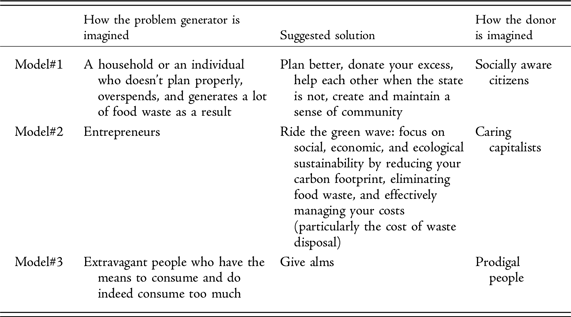
Even though the donors were cast in a positive light and praised loudly across different models of food banks, how the staff viewed them—more precisely, who the staff thought the donors were and what kinds of practices they thought the donors engaged in—varied depending on the model of the food bank (see Table 3). For the staff of Model#1, for example, the donors are first and foremost citizens who know that contributing to the common good is “a duty” (Deniz, staff member at Model#1 food bank). They help feed those in need because “they understand that we are in this together” (Işık, staff member at Model#1 food bank) and “being patriotic also involves looking after each other.” Moreover, “being wealthy or poor is matter of luck; [and as such] they might befall anyone.” By helping each other out, the citizens can create a milieu in which the consequences of such randomness are mitigated socially “without having to rely on the stricter, more overtly political requirements of the state” (Melek, staff member at Model#1 food bank).
How the staff perceives the problem generators
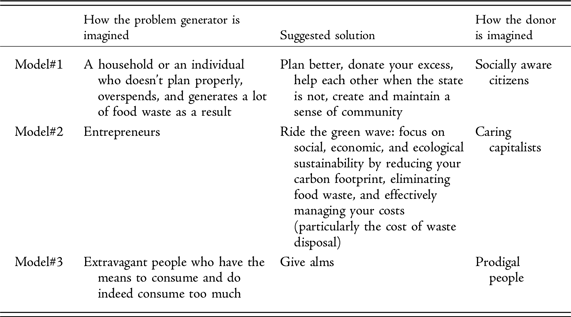
Note: The “problem” is food waste, which becomes donations to the food banks. The donors, as such, are the problem generators.
Perhaps inadvertently, this imaginary calls on an older symbolism of the neighborhood where a close community of neighbors, transgressing the strict public–private divisions that are usually observed among strangers, would help each other with anything from day-to-day tasks (looking after kids, sharing meals, prepping various processed household food items like orzo in common) to all sorts of exceptions and emergencies (births, deaths, marriages, debts, incarceration).Footnote 26 In this imagery, the state is a force external to the neighborhood community but omnipresent, capable of solving all sorts of problems but either unwilling to do so or creating more problems as it does so. The “average citizen,” thus, can make his/her life easier by relying on the neighborhood community rather than the state. The staff of Model#1 situates the food banks within this framework and construct what their donors—as well as themselves and what they are doing—as one of the newer manifestations of this old symbolism.
While the discourses on citizenship, patriotism, and duty are important, the staff predominantly conceptualize the donor as an individual. Complementarily, the waste the donors generate—which becomes the donations—are imagined as the outputs of individual practices of consumption:
Perhaps they buy too much, or they do not assess their needs right. And we all work. Sometimes we can’t pay enough attention to what is in the fridge. And things go bad, like the lettuce gets wilted for example, and the apples turn brown. But if we know our consumption habits and we are aware, then we can redirect those excess purchases to donation. We can consume better, and we can help someone else. That’s what the food banks do. (Deniz, staff member at Model#1 food bank)
The donors are, then, socially aware citizens who know their consumption patterns. They buy as much as they need to—not more even if they can afford to—and they use the rest of their budget to make donations so that their imagined community (pun intended) of neighbors and/or citizens is looked after.
The staff of Model#3, similarly, construct the donors as individuals or neighbors; however, differing from the Model#1, they imagine the donors as extravagant people who have the means to consume and do indeed consume too much. Rather than pushing them to make better resource allocation decisions, however, the staff prefer to remind these “prodigal consumers” of their duty to give alms as good Muslims:
Our donors are those who share some of their food with their neighbors who are in need. Not only is this what a good neighbor does, but also this is what Allah asks of us as good Muslims. We are told to give as much as 1/40th of our wealth as zakat. Our food bank is sort of an intermediary in this sense. We help distribute zakat; we make sure zakat goes to those who are truly in need. And trust me, that is a very heavy burden on our conscience. We have to be fair. (Deniz, staff member at Model#1 food bank)
In other words, although overspending is identified as a problem, consuming less is not suggested as the solution. When I pointed out this contradiction, the responses coalesced around two points. First, cutting spending could hurt the economy which was not something the municipal food banks would want in any shape or form. Second, the staff were not in a position to “dictate how people should spend their money” (Deniz, staff member at Model#1 food bank); the donors themselves decided—and should decide—what was excess. The staff could then help them (re)direct this excess toward a good cause.
In addition to the questionable macroeconomic soundness of the approach, the switch from giving alms (zakat) to giving what you—as the individual, prodigal consumer—deem excess is interesting here. Not only does it project the structural problems of the food system onto individual practices, it also shifts the grounds for the solution from a religiously formulated (dictated and legitimized) socio-economic practice to a self-determined and individualy driven moral economy approach.Footnote 27 As a result, overspending (which is the source of waste) stops being—or stops being considered as—a problem. What burdens the conscience, instead, is whether the (re)distribution of excess—in the form of zakat—is done fairly, that is, if it goes to the deserving poor or not.
The staff of Model#2 food banks consider their donors to be neither prodigal consumers nor socially aware citizens. Rather, the donors are posited as entrepreneurs who follow closely the most recent trends in consumption patterns and consumer preferences, and as such are aware of the recent rise in interest in social, economic, and ecological sustainability. Riding on this wave, these smart, environmentally conscious entrepreneurs are doing their best to reduce their carbon footprint and eliminate food waste. At the same time, they are effectively managing their costs, particularly that of their waste disposal. In other words, the donors are caring capitalists who juxtapose capitalism, sustainability, and socio-economic causes and conceive win–win scenarios in their business strategies:
We are a social enterprise and we work with other social entrepreneurs. Our partners care about climate change and as such, they want to reduce their carbon footprint. We help them do precisely that. We take their food waste and give it to our other partners who use it for a good cause—whether that be distributing that to those in need or turning it into bioenergy or supplying animal shelters. We take UNDP’s sustainable development goals very seriously; and we think that the best way to achieve them is through private sector participation. That’s why our partners are so important. They know that sustainability is key—both for a better world and it is now the peak concern for their customers. So if they take actions to better manage their waste, for example, they can also reduce their carbon footprint, improve local economies, land their support to various social causes. (Nihat and Mustafa, staff member at Model#2 food bank)
Like the staff of Model#1 and Model#3 food banks, the staff of Model#2 food banks construct their donors primarily as individuals—even though their “partners” are predominantly for-profit companies. This is not, however, “really a contradiction because individuals or companies, it is all the same in the private sector” (Mustafa, staff member at Model#2 food bank) and “it is the intention and the action [that] counts—the ‘what’ not the ‘who’.” Model#2 food banks, moreover, are not interested in telling their donors “what to do with their time, money, services or goods” (Nihat, staff member at Model#2 food bank) unless, of course, the donors themselves ask for the consultancy services from the staff. It is, rather, “the intellectual challenge for [the staff] to figure out how to best mobilize the partners and to utilize their donations in the most efficient way possible” (Mustafa, staff member at Model#2 food bank).
While coming up with a variety of techniques and technologies to solve such “intellectual puzzles” may be worthwhile for some, it—like in other models—shifts the focus away from the problem-generating practices of the donors. Indeed, during the interviewees my informants frequently talked about “data,” new technologies (cloud, blockchain, radio-frequency identification) and “engineering more efficient connections” between their partners. They cast themselves as “solution oriented” without necessarily clarifying what problems they were talking about. When I pushed them to identify the problems, they mentioned macro-level issues related to the “underdevelopment of the country” (Mustafa, staff member at Model#2 food bank). They were reluctant to highlight specific production and/or supply chain issues or to attribute what they talked about to the business practices of their donors. Finally, when I directly asked them about their donors’ contribution to the problems of the food system, they chose to acquit them of any responsibly whatsoever:
Look, [supply chain] issues are going to be there anyway. Go to the most developed country, or work with [one of the world’s biggest food companies] and you’ll still have them. Surely, they are important, but we know we can’t solve those issues. What we care about is whether we can do something with what our donors are willing to work with. Because [our donors] are already saying they want to give back, to contribute to the society. They are not saying they don’t care. By working with us, they are showing that they care. In comparison, there are so many others who just dump their waste and forget about it. They don’t care about carbon footprint or the environment or sustaining rural communities. (Nihat and Mustafa, staff members at Model#2 food bank)
The relatively smooth transition between identifying the donors as companies and casting them as individual caring capitalists is also important here. Although both constructs reference the motive for profit to some extent, the latter suggests a possible harmony between profit (and profit-targeting practices) and ecological, economic, and social sustainability, whereas the former rests on an imaginary in which ruthless capitalism and its profit motive trumps all other concerns. Furthermore, discursive transitions between the two constructs—“because individuals or companies, it is all the same in the private sector” (Mustafa, staff member at Model#2 food bank)—enable the staff to at best ignore, and at worst make the responsibility of problem-generating practices disappear. What remains and takes center stage is technology, which is imagined as a panacea regardless of the problem, or for that matter the actors.
Conclusion
Whether as “socially aware citizens,” “prodigal consumers,” or “caring capitalists,” the donors are thought to be individuals even though for-profit companies predominantly supply the food banks. Surely this discrepancy can be dismissed as a misperception or false information. However, what it does as a misperception is crucial. By switching the focus from companies to individuals, first, it shifts the conversation on waste generation. Rather than overproduction, for example, it is the individual and/or household consumption practices that are identified as problematic. Companies, in contrast, are hailed as trailblazers of better practices in waste management and forerunners of social responsibility. In conjunction, second, individuals and/or households identified as problem generating are constructed as subjects who waste in specific ways and are then disciplined (a la Foucault): socially aware citizens are pushed to consume better and support their communities, prodigal consumers are reminded to show their religious commitment by repurposing their excess, and caring capitalists are told they can make money while doing good. Again, whether these constructs are accurate or not is beside the point. Their significance lies in their making obvious how the dominant discourses on waste generation and waste management imagine waste being created and, by the same token, being repurposed: in the imaginaries of the staff (regardless of the model of food bank they work in), waste is a problem produced by certain practices of specific types of individuals; and food banks offer opportunities for converting these problem-generating practices into doing-good practices and rehabilitating these specific types of individuals (from mere citizens to socially aware citizens, for example).
Yet, if, as I mentioned before, food banks are a particular solution to a particular framing of a problem, what is included in the framing is as important as what is left out. When the conversation shifts from poverty to food insecurity, for example, we begin to treat food insecurity as a standalone problem—one among many perhaps, but standalone nonetheless. To put it differently, we divorce food insecurity from a constellation of mechanisms, processes, and forces that shape it – i.e. poverty. As a result, the solutions we offer remain limited in their scope, at best providing temporary improvements (such as emergency food aid) to chronic failures. The same could be said for food waste: when the conversation focuses on food waste supposedly generated by specific demographics, food injustice experienced by certain populations is ignored. In other words, we end up talking about the “haves,” rather than the causes of inequality between “haves” and “have nots.” This is also why the misperceptions with regard to the donors are so crucial: imagining them as individuals and/or households, but more importantly as consumers, we fail to see the structural problems that arise due to the bottleneck shape of the contemporary food system.Footnote 28 Shifting the conversation away from individuals and/or households—and in any case, from consumers—would enable us to tackle these entrenched problems more directly and put the responsibility for the failures of the contemporary food system (whether of food injustice, ecological unsustainability, or poverty) on those who generate, maintain, and profit from them. The framing of the problem is, thus, vital.
These being said, there is one more possible explanation for the misperceptions. Presuming that changing consumer behavior is more doable than tackling the profit-oriented practices of the food industry, the staff (of all the three models of food banks) may be deliberately casting the individual and/or household consumers as problem generating (waste producing) and food banks as mechanisms, networks, and/or agents that can mediate that problem. To put it differently, what seems like misperceptions may be a tactical choice of discourse in order to get done (reduce food waste and feed the hungry) what is possible within systemic constraints (e.g. the bottleneck shape of the contemporary food system). Unfortunately, my fieldwork provided no indicators that this is the case. Still, I do not want to forgo this reading. Whatever the contradictions inherent in them (and there are many), fair trade, slow food, and the organic movements from around the world have shown us that consumers voting with their wallets can indeed be an effective method to direct the conversation and to emphasize certain practices and mentalities over others. The battles, however, are still raging. And though the profit motive seems to have engulfed even the relative power of consumer action, the unease with which consumers relate to the food system—the force fueling consumer action—is alive and well. Perhaps consumer resistance will not be so futile after all.