

1. Introduction
Uncertainty and institutions are both central concepts in entrepreneurship. Yet the focus on general equilibrium constructs has resulted in economic research ignoring uncertainty thus diminishing the role of the entrepreneur. While the role of the entrepreneur continues to be marginalized in economic research, entrepreneurship as an independent discipline is flourishing and at the centennial of Frank H. Knight's landmark book Risk, Uncertainty and Profit (1921), which highlighted uncertainty as inherently different from risk, the concept is regaining traction (Alvarez and Barney, Reference Alvarez and Barney2005, Reference Alvarez and Barney2007; Foss and Klein, Reference Foss and Klein2015; Packard et al., Reference Packard, Clark and Klein2017). A recent research stream has further contemporized the concept of judgment, which Knight introduced as the tool to overcome uncertainty (Foss and Klein, Reference Foss and Klein2015; Knight, Reference Knight1921; McMullen, Reference McMullen2015). The importance of uncertainty for the entrepreneurial function has been noted by several of the most influential scholars in the field (e.g. Cantillon, [1755] Reference Cantillon2010; Kirzner, Reference Kirzner and Kirzner1982; Knight, Reference Knight1921). A recent contribution further reminds us that Knight did not only discuss uncertainty as it relates to individual actors, but also tackled the broader question of how uncertainty affects the social organization of economic activity (Emmett, Reference Emmett2021). Similarly, the role of institutions in fostering entrepreneurial action and economic growth has received a lot of scholarly attention (Bruton et al., Reference Bruton, Ahlstrom and Li2010; Seligson and McCants, Reference Seligson and McCants2021). We know that entrepreneurial action takes place within an institutional framework that provides structure to human interaction (Baumol, Reference Baumol1990). Research has shown that entrepreneurial activity is the driver of economic growth (Carree and Thurik, Reference Carree, Thurik, Acs and Audretsch2010; Hall and Sobel, Reference Hall and Sobel2008; Kreft and Sobel, Reference Kreft and Sobel2005; Mises, [1949] Reference Mises1998). Institutions relate to entrepreneurial activity in a variety of ways (Stenholm et al., Reference Stenholm, Acs and Wuebker2013). For example, government intervention has been linked to a reduction in the amount of entrepreneurial action (Djankov et al., Reference Djankov, La Porta, Lopez-de-Silanes and Shleifer2002; Malone et al., Reference Malone, Koumpias and Bylund2019), regulatory burden has been shown to lead entrepreneurs to more negative evaluations of opportunities (Wood et al., Reference Wood, Bylund and Bradley2016), and sound money is positively correlated with entrepreneurial activity (Bjørnskov and Foss, Reference Bjørnskov and Foss2016). The concepts of uncertainty and institutions are not only important to entrepreneurship individually but are closely related. Indeed, institutions mainly exist to remove friction and reduce uncertainty (Knight, Reference Knight1921; North, Reference North1990).
Recent research has made strides in integrating uncertainty and institutions within the context of entrepreneurship (Bylund and McCaffrey, Reference Bylund and McCaffrey2017). However, the negative effects of institutions within this context have generally been overlooked or shadowed by the positives. A reason for this might be a lack of understanding of the processes involved. There is a lot of value in understanding how institutions can negatively affect entrepreneurs through the introduction of uncertainty and recent publications have invited scholars to study this (McCaffrey, Reference McCaffrey, Javadian, Gupta, Dutta, Guo, Osorio and Ozkazanc-Pan2018). Sometimes the harm can outweigh the benefits, but this may be overlooked without a proper understanding of the processes involved. The merits of institutions can be evaluated in a more balanced and realistic way by recognizing detrimental effects and including them in the analysis.
The purpose of the present paper is to start down that path by offering a coherent description of the way in which institutions affect the uncertainty that the entrepreneur faces, what this means for the entrepreneurial process, and what economic consequences that may have. The main contribution lies in the development of a conceptual model describing the judgment process of entrepreneurs as it relates to institutional uncertainty. This will provide a framework for analyzing the negative ways in which uncertainty introduced by institutions may affect the entrepreneurial process. As such, the present paper will apply the theories of uncertainty to an institutional context and relate this to theories of entrepreneurial judgment, to shed light on negative aspects of institutions. In other words, contributions are made to the research streams on entrepreneurial judgment, uncertainty, and institutions.
The remainder of this paper proceeds by describing the role of Knightian uncertainty in the entrepreneurial process and how this uncertainty can be overcome through superior judgment and how institutions can aid this judgment process and enable entrepreneurial action. Next, the paper will introduce the opposite effect of institutions, namely the introduction of institutional uncertainty, and describe how this distorts the judgment process. Finally, the economic consequences of these institutional effects on the judgment process will be discussed, before summarizing the key findings in the conclusion.
2. Entrepreneurial uncertainty, judgment, and the role of institutions
A major contribution of Frank H. Knight was his distinction between risk and uncertainty (Knight, Reference Knight1921). Recognizing that not all choices have options that can be estimated mathematically or statistically, Knight argued that uncertainty should be distinguished based on whether probabilities can be estimated. This resulted in his dichotomy between probabilistic risk and immeasurable uncertainty, which is often referred to as Knightian uncertainty and is the focus of the present paper. Recent research has expanded upon the Knightian dichotomy by presenting a typology of uncertainty based on whether the option set of available means and the outcome set of possible ends are open (i.e. infinite) or closed (i.e. finite) (Packard et al., Reference Packard, Clark and Klein2017). Under absolute uncertainty, when both the sets of means and ends are open, entrepreneurs seek to reduce this uncertainty by closing either of the sets. Environmental uncertainty, when the set of means have been limited to a finite number, and creative uncertainty, a finite amount of ends, are easier for the entrepreneur to navigate. If both the sets of means and ends are closed, the uncertainty is reduced to probabilistic risk or ambiguity.
Uncertainty is central to the entrepreneurial process (Bylund and Manish, Reference Bylund and Manish2016; Knight, Reference Knight1921; Packard et al., Reference Packard, Clark and Klein2017). Knight himself focused on how uncertainty explains the existence of profit and loss, and thus the entrepreneur (Knight, Reference Knight1921). It is uncertainty that leads to the existence of imperfect market structures that entrepreneurs in their equilibrating role react to in the search for profits. In essence, the entrepreneur bears uncertainty in the present with the belief that consumers will value the outcome of the process in the future. Indeed, the existence of uncertainty is the basis for any human action (Mises, [1949] Reference Mises1998). The presence of uncertainty means that the entrepreneur makes decisions based on judgment, consisting of intuition, understanding, and gut feeling (Knight, Reference Knight1921).
The concept of judgment has been promoted to the front of entrepreneurship research over the last decade (Foss and Klein, Reference Foss and Klein2012; Knight, Reference Knight1921; McMullen, Reference McMullen2015; McMullen and Shepherd, Reference McMullen and Shepherd2006; Sarasvathy and Dew, Reference Sarasvathy and Dew2013). In short, this stream of research conceptualizes entrepreneurship as judgmental decision-making taking place in a market setting under uncertainty. Entrepreneurial action is operationalized through the ‘Beliefs-Actions-Results’ framework (Foss and Klein, Reference Foss and Klein2020). In this view, the entrepreneurial process begins with the entrepreneur's subjective belief about the present state of affairs, the outcome set of identified possible futures, and confidence in the ability to bring about those possible futures through the identified option set (Klein, Reference Klein, Audretsch and Lehmann2016). These beliefs are then the basis for a judgmental decision-making process leading to entrepreneurs either taking action or deciding not to devote resources to this new venture. The judgmental decision-making process refers to the absence of formal models of decision-making and entails that individuals will reach different conclusions, as their intuition and understanding differ (Foss and Klein, Reference Foss and Klein2020). With a basis in subjectivism, this framework follows the traditions of Knight (Reference Knight1921). Subjectivity is a key concept as the entrepreneur is not assumed to express the neoclassical perfect economic rationality, but rather a bounded rationality, acting to the best of their judgment, based on individual differences in preferences, knowledge, and expectations and subjective interpretations of the context (Foss et al., Reference Foss, Klein, Kor and Mahoney2008; Kor et al., Reference Kor, Mahoney and Michael2007).
In order to reduce the complexity of absolute, Knightian uncertainty, the decision-maker must populate both the option and the outcome sets (Packard et al., Reference Packard, Clark and Klein2017). It is only after having employed judgment that the entrepreneur takes action by acquiring and committing resources to production. Judgment is thus the link between beliefs and action. Taking action does not necessarily lead to a successful result, as the nature of uncertainty leaves room for errors of judgment and the anticipated state of affairs might not be realized. To Knight, this presence of uncertainty, and thus, the room for errors of judgment, is what distinguishes the entrepreneur from the manager (Knight, Reference Knight1921). Whereas the manager mechanically optimizes, the entrepreneur bears uncertainty and exercises judgment. This, according to Knight, changes the primary problem from one of execution to one of decision. It follows that the quality of the judgment is directly linked to the results of the entrepreneurial action. In case the underlying beliefs are correct, profits arise. On the contrary, errors of judgment lead to losses. The Beliefs-Actions-Results process is continuous as feedback resulting from the chosen course of action provides new insight, adding to the beliefs of the entrepreneur and providing the basis for further action or a revision of the original decision (Foss and Klein, Reference Foss and Klein2020).
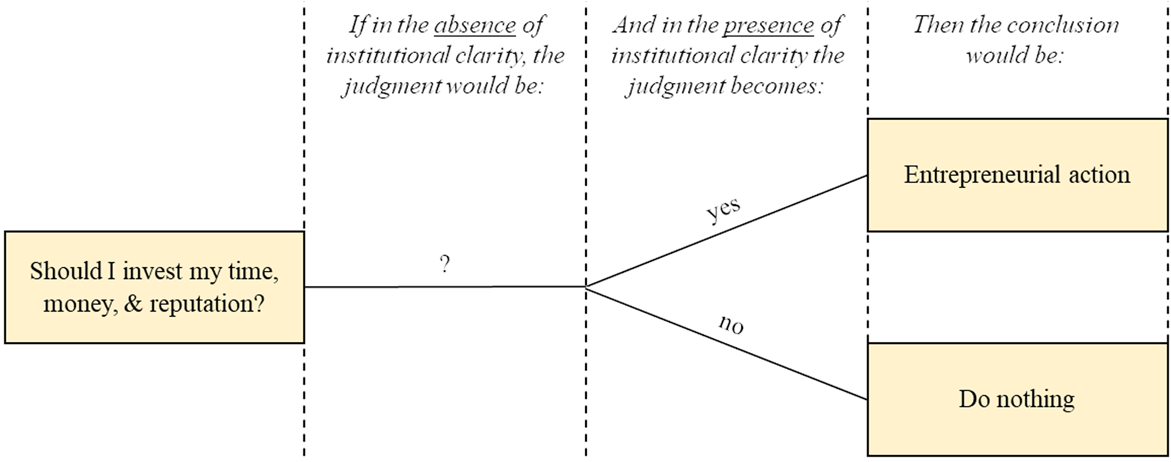
Similarly, the beliefs of the entrepreneur can be altered by new information originating from exogenous factors, which change the environment for the decision and may alter the option or outcome sets (Packard et al., Reference Packard, Clark and Klein2017). The institutional context is one such factor. The subjective interpretation of the institutional context may affect the judgment process and any changes to this perception may result in the dynamic revision of the original judgment. Both formal and informal institutions provide structure to human interaction and facilitate the economizing behavior of rationally applying given means to achieve given ends (Asmussen et al., Reference Asmussen, Foss, Foss and Klein2021; Knight, Reference Knight1921; North, Reference North1990). Formal institutions such as laws and regulations define legal actions, while informal institutions such as culture may shape expectations and pressure the decision-maker toward specific options (Bylund and McCaffrey, Reference Bylund and McCaffrey2017). This limits the possible sets of means and ends, thus contributing to closing the option and outcome sets and the reduction of uncertainty (Endres and Harper, Reference Endres and Harper2013). The reduction of uncertainty and the reduced friction it entails is arguably one of the main reasons for the existence of institutions. As explained by North (Reference North1990), ‘The major role of institutions in a society is to reduce uncertainty by establishing a stable (but not necessarily efficient) structure to human interaction’. By closing the option and outcome sets, institutions can aid the judgment process of the entrepreneur by introducing institutional clarity, the uncertainty-reducing characteristic of institutions. From a situation of absolute, Knightian uncertainty, where the entrepreneur is not yet in a position to make a judgment, the introduction of institutional clarity allows the entrepreneur to choose whether to take action or not. In such cases, the institution plays a critical role in enabling the judgment process and thus entrepreneurial action. This is illustrated in Figure 1, which, along with the rest of the figures in the current paper, has evolved from the work of McMullen (Reference McMullen2015). Without the introduction of institutional clarity, the entrepreneur would not be in a position to make a judgment and would revert to the status quo of doing nothing or spend time and resources attempting to reduce the uncertainty in other ways. This is not to be understood as a temporal process, but rather to depict two alternative realities, one with and one without the presence of institutional clarity, and highlight the difference.
The role of institutional clarity in the judgment process.

Institutional clarity can originate from various types of institutions. A recent contribution established a framework for research on the relations between entrepreneurship and institutions (Bylund and McCaffrey, Reference Bylund and McCaffrey2017). The authors relate the hierarchical model of institutions introduced by Williamson (Reference Williamson1985) to the entrepreneurial context. According to this framework, the highest level of institutions is informal institutions such as traditions, norms, and culture that are not subject to economizing but impose constraints on the lower levels. The second-highest level consists of the formal institutions and the rules, laws, and regulations they impose. Below are the governance structures, which include the market's longer-term attempts to reduce uncertainty through firms and contracts. Finally, the lowest level in the institutional hierarchy is the market exchange, where the price mechanism helps structure the allocation of resources in the economy. It follows that each of these levels can introduce institutional clarity, whether it is the traditions or laws limiting the number of socially accepted means or the structure of the market providing insight into consumer preferences and capital structures, institutions can help limit the possible means and ends and thus close the option and outcome sets. As such, the present paper fully recognizes the positive and central role that institutions can play in reducing uncertainty and enabling judgment and entrepreneurial action.
3. Institutional uncertainty and the judgment process
While institutions play a positive role through characteristics that help reduce uncertainty, there is also a darker side of institutions. Researchers have examined and discussed the concept of institutional uncertainty from a variety of perspectives. The present paper is an attempt at offering a coherent view of how institutional uncertainty disturbs or undermines the judgment process and thwarts entrepreneurial action.
Institutional uncertainty is the result of perceived contradictions or incongruences between institutional levels, also referred to as institutional misalignment (Bylund and McCaffrey, Reference Bylund and McCaffrey2017; Nabisaalu and Bylund, Reference Nabisaalu and Bylund2021). This introduces uncertainty for the entrepreneur who is unsure of how to interpret the institutional environment. As Mises (Reference Mises1944) puts it, the entrepreneur is at the whim of the sovereign consumer, with success depending on providing what the consumer demands. Thus, in an uncertain context, the entrepreneur attempts to identify the most urgent customer demand and allocate resources appropriately (Foss et al., Reference Foss, Klein and McCaffrey2019).
An example of an important institution that helps reduce uncertainty about consumer preferences and thus facilitate judgment about resource allocation is the price system. By providing information about the subjective valuation of various goods, price signals are crucial to the entrepreneur (Hayek, Reference Hayek1945; Mises, [1949] Reference Mises1998). Yet other institutions can distort the signaling effect of prices. For instance, inflation originating from institutions on a higher level of the institutional hierarchy muddles the information and thus introduces further uncertainty (Bjørnskov and Foss, Reference Bjørnskov and Foss2013; Friedman, Reference Friedman1977).
There can be myriad sources of institutional misalignment. Given the varying tempo with which institutions on the different levels change, these contradictions can be seen as inevitable by-products (Seo and Creed, Reference Seo and Creed2002). A common example of this is technological progress that suddenly changes the available means, but might be at odds with the existing institutional framework in terms of laws, regulations, and socially acceptable behavior (Elert et al., Reference Elert, Henrekson and Lundblad2016). Another cause of institutional misalignment might be situations where informal social norms and values might conflict with formal laws and regulations (Webb et al., Reference Webb, Tihanyi, Ireland and Sirmon2009). Adding further uncertainty is the fact that geographically separate institutions across cities, states, or countries may have different rules or norms (Elert and Henrekson, Reference Elert and Henrekson2015). These contradictions drive institutional change and are thus the source of institutional uncertainty (Seo and Creed, Reference Seo and Creed2002).
There are generally four ways the entrepreneur can react to institutional uncertainty. The entrepreneur can abide by the institution, completely evade it, attempt to alter it, or if none of those options seem feasible to the entrepreneur, give up entrepreneurial action (Bylund and McCaffrey, Reference Bylund and McCaffrey2017; Henrekson and Sanandaji, Reference Henrekson and Sanandaji2011). This results in a bidirectional relation, as entrepreneurs affect the institutions through their chosen response. Abiding by the institution provides legitimacy to the status quo. Evasive action undermines the institution and can help provoke change. Finally, institutional entrepreneurship aimed at altering the institution and directly changing the rules of the game is the most obvious example of this interdependence (Douhan and Henrekson, Reference Douhan and Henrekson2010).
In addition to the various ways institutions can introduce uncertainty, there can also be a general lack of trust in the institutions themselves leading to a subtype of institutional uncertainty. Political uncertainty regards the lack of trust in the stability of the institutions. Perceived governmental instability and unpredictability regarding policies and regulation can introduce uncertainty (Laine and Galkina, Reference Laine and Galkina2017). This also includes uncertainty regarding the implementation and enforcement of rules and policy changes (Bjørnskov and Foss, Reference Bjørnskov and Foss2013; Brunetti and Weder, Reference Brunetti and Weder1998). Further, the formation and adjustments of institutions are unlikely to satisfy the divergent interests of all parties affected or involved. This may lead to an unstable political struggle where the policies change regularly (Seo and Creed, Reference Seo and Creed2002). A related concept is regime uncertainty, which entails a mistrust of the people in charge of the institutions (Higgs, Reference Higgs1997). Changes in the government may result in a perception that new policies will be more or less business-friendly than those of the previous government. In addition, many institutional arrangements are open to interpretation and the amount of attention given to nomination processes for the United States Supreme Court indicates that even though the underlying laws are unchanged, different personnel may result in different consequences. Perceived regime uncertainty might be self-reinforcing, as it casts doubt on the credibility of the policymakers in the future (Coyne and Boettke, Reference Coyne and Boettke2009). These types of institutional uncertainty are critical to entrepreneurs since the element of time is central to the Austrian view of the entrepreneurial function. As such, perceived instability adding further uncertainty regarding future institutional arrangements is a huge challenge to the entrepreneur (McCaffrey, Reference McCaffrey2015; Schumpeter, Reference Schumpeter1939).
Common for all types of institutional uncertainty is that it has an effect on the judgment process and subsequent entrepreneurial action. Entrepreneurial action begins with subjective beliefs about the current situation, an option set of perceived means, and an outcome set of identified future states (Klein, Reference Klein, Audretsch and Lehmann2016). Institutional uncertainty muddles this process. Inconsistencies and contradictions make the current state of affairs difficult to define. Separate regulations placing contradictory limitations on the same action cast doubt on the available set of means, and perceived instability makes it difficult to delimit the set of imagined future states of affairs. Thus, institutional uncertainty generally opens the option set, the outcome set, or both. As such, the judgment process can be amended with the introduction of institutional uncertainty.
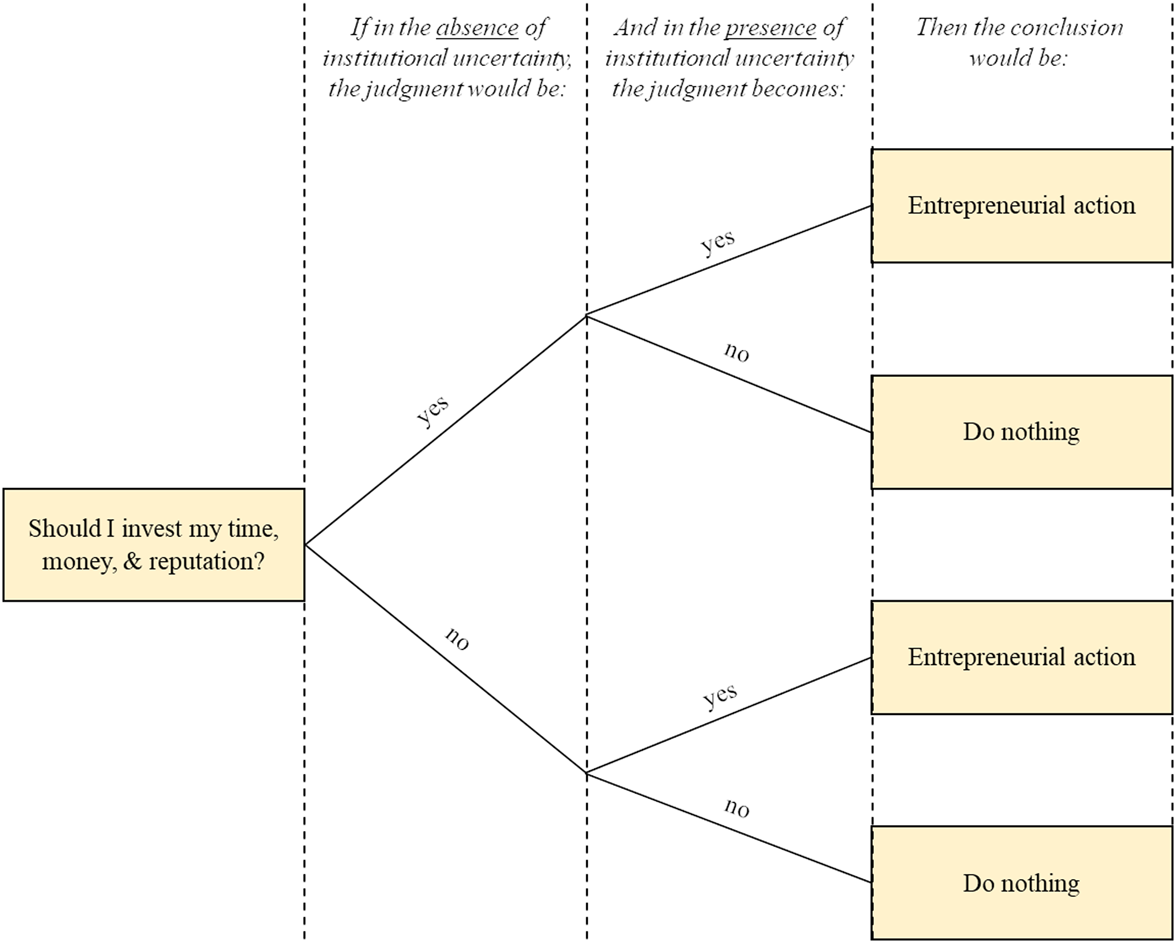
Figure 2 illustrates a situation where the entrepreneur is facing the decision of whether or not to act. Depending on the nature of the decision, the entrepreneur may have managed to reduce uncertainty to the degree that a judgment can be made or may simply revert to the status quo of doing nothing. However, the introduction of institutional uncertainty may affect the judgment or cause the entrepreneur to restart the process given the changes in the option and outcome sets. If without institutional uncertainty, the entrepreneur had managed to close both the option and outcome sets and decided to take action, the introduction of institutional uncertainty may make no difference, or the new aspects playing into the decision may result in the opposite conclusion. Similarly, if without institutional uncertainty, the entrepreneur had judged that it was best not to take action, the introduction of institutional uncertainty may make no difference, or the newly introduced options or outcomes may make the entrepreneur judge differently and concluding to take action.
The role of institutional uncertainty in the judgment process.

4. The effects of institutional uncertainty on entrepreneurial outcomes
Following entrepreneurial action comes the consequence or outcome. Thus, a judgment process resulting in the lack of entrepreneurial action then results in the absence of said outcome. As it has been established that the introduction of institutional clarity or institutional uncertainty can affect the judgment process, it follows that the institutional environment is related to the outcome of entrepreneurial action.
Distinguishing between productive and unproductive entrepreneurship has been the foundation for a prominent strand of entrepreneurial research and is based on the notion that not all entrepreneurship creates wealth and increases in living standards (Baumol, Reference Baumol1990; Boettke and Piano, Reference Boettke and Piano2016). Engaging in unproductive entrepreneurship is not necessarily a conscious choice. Rather, the institutional environment affects the distribution between productive and unproductive entrepreneurship by distorting the judgment process of entrepreneurs (McCaffrey, Reference McCaffrey, Javadian, Gupta, Dutta, Guo, Osorio and Ozkazanc-Pan2018). This can happen in multiple ways. The institutional environment determines the payoffs or incentive structures facing the entrepreneurs, leading some potential outcomes to seem more or less profitable to the entrepreneur (Boettke and Coyne, Reference Boettke and Coyne2009). Further, the introduction of institutional clarity or institutional uncertainty also interferes with the judgment process preceding entrepreneurial action, thus affecting the distribution between productive and unproductive entrepreneurship.
In line with the notion that not all entrepreneurship is productive is the concept of malinvestments, which plays a central role within the Austrian School. These are investments that are ‘uneconomic in relation to genuine consumers’ demand’ (Rothbard, [1962] Reference Rothbard2004) and ‘a squandering of the means available’ (Mises, [1949] Reference Mises1998). There is no way of knowing ex ante whether any entrepreneurial action will turn out to be profitable or not. Only when the market provides feedback do the entrepreneur discover whether their judgment was correct. Under the shroud of uncertainty, it is difficult for the entrepreneur to identify the most productive use of scarce resources, which may lead to decisions that turn out to be unproductive. This Austrian lens has been identified as an appropriate way to apply Baumol's typology to evaluate entrepreneurial judgment (McCaffrey, Reference McCaffrey, Javadian, Gupta, Dutta, Guo, Osorio and Ozkazanc-Pan2018). The concept of malinvestment thus embodies unproductive entrepreneurship as the waste of resources stemming from inferior judgment.
In addition to the productive or unproductive outcomes of entrepreneurial action, it is also appropriate to examine the consequences of the absence of action. As shown, uncertainty may distort the judgment process and result in the entrepreneur not taking action. While some situations undoubtedly warrant this, it is easy to imagine other situations in which the entrepreneur would have been better off by taking action and had done so, had it not been for the uncertain context. In such cases, the introduction of uncertainty prevents productive entrepreneurship. Extending the famous distinction between ‘That which is seen’ and ‘That which is not seen’ (Bastiat, Reference Bastiat1873), a recent contribution introduces ‘The unrealized’ (Bylund, Reference Bylund2016). In the absence of distortions in the economy, some of the unrealized would be realized. Unrealized productive entrepreneurship constitutes a loss for society, which would have been better off had entrepreneurial action been taken. As such, the concept of unrealized value is an appropriate illustration of what could have been without uncertainty distorting the judgment process and affecting entrepreneurial action.
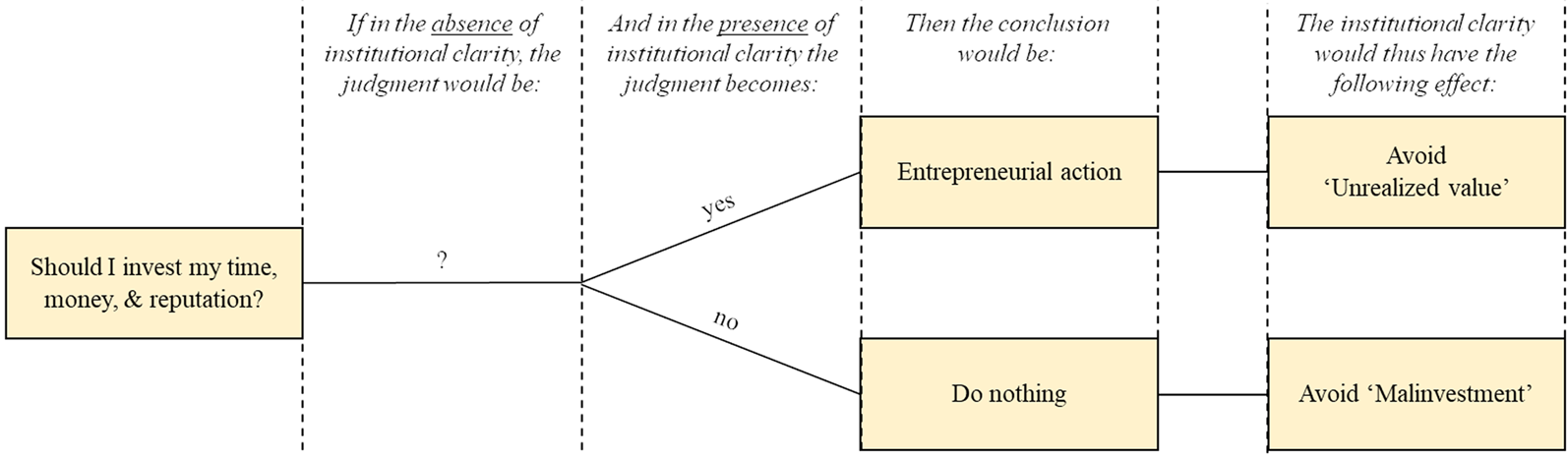
Given these considerations, the model introduced earlier can be amended to include all three steps; judgment, action, and outcomes. While it is impossible to ascertain the objectively correct decision in practice, for illustrative and theoretical purposes, Figure 3 assumes that the introduction of institutional clarity leads the entrepreneur to superior judgment and thus includes the appropriate outcomes. Specifically, when the introduction of institutional clarity leads to entrepreneurial action that the entrepreneur may otherwise not have taken, it results in the avoidance of unrealized value. Similarly, if the introduction of institutional clarity provides new information that convinces the entrepreneur not to act, it results in the avoidance of malinvestment. With the opposite assumption, that is, that institutional clarity leads the entrepreneur to the objectively wrong decision, entrepreneurial action would lead to malinvestment and no action would result in unrealized value.
The relation between institutional clarity and entrepreneurial outcomes.

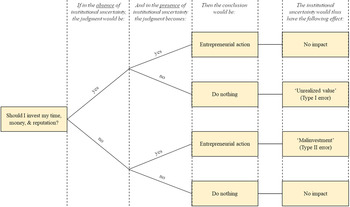
The same logic underlies the process illustrated in Figure 4. The introduction of institutional clarity can either result in no changes to the decision or it can lead the entrepreneur to the opposite judgment of the one made before institutional uncertainty was introduced. Had the original decision been to take entrepreneurial action, with the theoretical assumption that this is the objectively correct judgment, and had the entrepreneur reached the opposite conclusion after the introduction of institutional uncertainty, it would be the source of unrealized value. This can be equated to a type I error, as the new information leads the entrepreneur to conclude that entrepreneurial action would not be profitable, when in fact it would. Similarly, a type II error would result from the introduction of institutional uncertainty leading to action that the entrepreneur should objectively not have taken and would have judged against taking before the introduction of institutional uncertainty. This leads to malinvestment, but the new information convinces the entrepreneur that taking action was the right decision.
The relation between institutional uncertainty and entrepreneurial outcomes.

As in the case of institutional clarity, this model allows the opposite assumption as well. With the underlying assumption that the introduction of institutional uncertainty leads the entrepreneur to the objectively correct decision, there would be no type I or type II errors. Instead, if the entrepreneur discards action that would otherwise be taken, based on the new information, malinvestment would be avoided. Similarly, if the introduction of institutional uncertainty leads to entrepreneurial action that would otherwise be discarded, unrealized value would be avoided.
5. Concluding remarks
The purpose of the present paper was to provide a coherent description of how institutions affect the judgment process preceding entrepreneurial action through the concept of uncertainty. The main contribution lies in the introduction of a conceptual model showing these processes. Institutions are intended to remove friction and uncertainty by providing structure and introducing institutional clarity. This aids the judgment process by enabling the entrepreneur to close the option or outcome sets and decide whether to take action or not. With the assumption that the introduction of institutional clarity leads the entrepreneur to superior judgment, it helps avoid either malinvestment or unrealized value. Yet there is also a dark side to institutions as they can introduce institutional uncertainty and thus distort the judgment process. When the entrepreneur faces institutional uncertainty, it might result in inferior judgment and lead to either malinvestment or unrealized value.
A better understanding of the processes involved facilitates a heightened focus on these aspects of institutions. This in turn opens the door for more valid and relevant evaluations of institutions and their effects on the economy. In addition, the conceptual model facilitates analyses of potential mitigation strategies to minimize the impact of institutional uncertainty, by providing a framework of the processes involved. The present paper further adds to our understanding of the origins of the uncertainty surrounding entrepreneurs and how adverse effects emerge as a result. We often treat uncertainty as an exogenous contextual factor, a law of nature of sorts, standing in the way of human action. The present paper has shown that some uncertainty is rather an endogenous result of human action and is thus avoidable.
Future research can add to this framework through a deeper analysis of the bidirectional aspect introduced earlier. This area would benefit from increased scholarly attention and the conceptual model introduced in the present paper has implications for that research. While the conceptual model implicitly treats entrepreneurial action in spite of institutional uncertainty as abiding by the institutions, it might rather lead to evasive or even altering entrepreneurial action. This distinction is outside of the scope of the current paper, but it is a tangible effect of the presence of institutional uncertainty. The attention to institutions implied in evasive or altering action can be seen as a type of malinvestment in itself, as it entails a different course of action than without the presence of institutional uncertainty.